A Processing–Microstructure Correlation in ZrB
2
–SiC
Composites Hot-pressed under a Load of 10 MPa
Mehdi Shahedi Asl
*, Mahdi Ghassemi Kakroudi
Department of Materials Science and Engineering, Faculty of Mechanical Engineering, University of Tabriz, Iran
Copyright © 2015 Horizon Research Publishing All rights reserved.
Abstract
Monolithic ZrB2 ceramic and its composites, with 5 to 30 vol. % SiC, has been prepared by hot pressing at temperatures of 1700, 1850 and 2000 °C, for 30 minutes under relatively low pressure of 10 MPa. Densification behavior of ZrB2-based composites is improved by the addition of SiC particulates. The fracture surface of monolithic ZrB2 ceramics shows a grained structure, with faceted ZrB2 grains, as the fracture appears to spread prevalently along an intergranular path. The ZrB2/ZrB2 boundary interface is seemingly free of any secondary phases. The microstructure of ZrB2–30 vol. % SiC composite, hot-pressed at 1700 °C, is consistent with measured porosity for the sample that has ~8% open pores, nearly without closed pores. It seems that mechanical interlocking between ZrB2 and SiC is an important mechanism for densification. In the microstructure of specimens consolidated at 1850 °C, neck formation between ZrB2 particles is visible. In contrast, relatively fully dense samples are obtained by hot-pressing at 2000 °C. Intergranular SiC particles inside ZrB2 grains show the occurrence of mass transfer among ZrB2 particles, which in effect brings the elimination of pores to a fortunate ending. Efficient mixing of starting powders is very critical in order to achieve a fine-grained homogenous microstructure.Keywords
Hot Pressing, Zirconium Diboride, Silicon Carbide; Microstructure, Grain Growth, Powder Mixing1. Introduction
Zirconium diboride is striking for its ultra-high melting temperature as well as its hardness, elastic modulus, low electrical resistivity, and resistance to chemical attack. As a result, this material has been proposed for a variety of structural applications at room and elevated temperature, including armor, cutting tools, molten metal containment, steel processing, and electrodes. Zirconium diboride is also considered to be an ultra-high-temperature ceramic and is a candidate to be used as leading edges and propulsion components in hypersonic aerospace vehicles and advanced reusable atmospheric reentry vehicles [1-3].
varied from 2.2 to 4.7 μm and 1.2 to 2.7, respectively [11]. The effect of SiC particle size, ranging from 0.45 to 10 μm, on the microstructure of ZrB2-based composites, containing 30 vol. % SiC, was studied. Investigations showed that smaller starting SiC particles led to improved densification and finer microstructure [12]. A ZrB2-based composite containing 20 vol. % nano-sized β-SiC particles (30 nm) was hot pressed at 1900 °C for 30 min under 30 MPa. It was shown that the grain growth of ZrB2 matrix was effectively suppressed by SiC particles [13]. Recently, the dominant densification mechanisms for hot pressing of ZrB2–20 vol. % SiC composite, at different sintering temperatures and pressures, was identified. For hot pressing at 1700 °C, it was found to be only mechanically driven particle fragmentation and rearrangement, whereas at 1850 °C a plastic flow mechanism started to happen. At 2000 °C, the dominant mechanism changed from plastic flow to grain boundary diffusion [14].
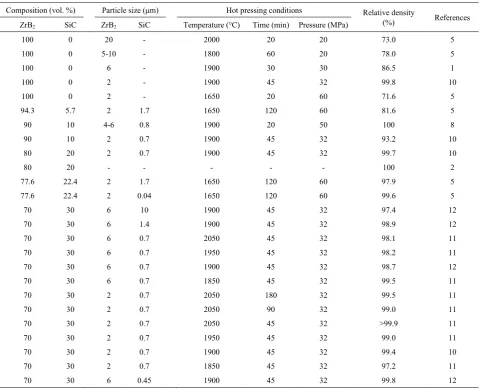
Although in recent years, ZrB2-based composites have been densified by other techniques such as pressureless sintering [6, 15-17], reactive hot pressing [4, 9, 18-24], and spark plasma sintering [25-28], but hot pressing is still the dominant method in research on consolidation. Table 1 lists the compositions, starting particle sizes, sintering conditions, and relative densities of the composites investigated by researchers, employing hot pressing as the sintering method.
[image:2.595.66.547.318.707.2]The purpose of this paper is to describe the microstructural conduct of ZrB2–SiC composites, hot pressed under relatively low-pressure using mono-sized starting powders. X-ray diffraction analysis, optical microscopy and scanning electron microscopy micrographs are used to study the evolution of microstructure as a function of sintering temperature and SiC content. In addition, the densities and porosities of composites consolidated at 1700, 1850 and 2000 °C will be compared to deduce the effect of processing temperature.
Table 1. Hot pressing conditions and relative densities of ZrB2–SiC composites.
Composition (vol. %) Particle size (μm) Hot pressing conditions Relative density
(%) References ZrB2 SiC ZrB2 SiC Temperature (°C) Time (min) Pressure (MPa)
100 0 20 - 2000 20 20 73.0 5
100 0 5-10 - 1800 60 20 78.0 5
100 0 6 - 1900 30 30 86.5 1
100 0 2 - 1900 45 32 99.8 10
100 0 2 - 1650 20 60 71.6 5
94.3 5.7 2 1.7 1650 120 60 81.6 5
90 10 4-6 0.8 1900 20 50 100 8
90 10 2 0.7 1900 45 32 93.2 10
80 20 2 0.7 1900 45 32 99.7 10
80 20 - - - 100 2
77.6 22.4 2 1.7 1650 120 60 97.9 5
77.6 22.4 2 0.04 1650 120 60 99.6 5
70 30 6 10 1900 45 32 97.4 12
70 30 6 1.4 1900 45 32 98.9 12
70 30 6 0.7 2050 45 32 98.1 11
70 30 6 0.7 1950 45 32 98.2 11
70 30 6 0.7 1900 45 32 98.7 12
70 30 6 0.7 1850 45 32 99.5 11
70 30 2 0.7 2050 180 32 99.5 11
70 30 2 0.7 2050 90 32 99.0 11
70 30 2 0.7 2050 45 32 >99.9 11
70 30 2 0.7 1950 45 32 99.0 11
70 30 2 0.7 1900 45 32 99.4 10
70 30 2 0.7 1850 45 32 97.2 11
2. Experimental Procedure
2.1. Processing
ZrB2 (particle size ~2 μm, purity ~99.9%, Leung Hi-tech Co., China) and α-SiC (particle size ~2 μm, purity >99%, Carborundum Universal Limited, India) powders were the starting materials. Powder samples of ZrB2 with 0, 5, 10, 15, 20, 25 and 30 vol. % SiC were mixed at 120 rpm for 1 hour in a zirconia cup with balls. To investigate the effect of mixing on final microstructure of the composites, some samples were prepared without efficient mixing. Then, samples were loaded into a graphite die and boron nitride spray was applied to all graphite surfaces. Hot pressing was completed in a graphite resistance-heated vacuum hot press furnace (made by Shenyang Weitai Science & Technology Development Co., Ltd., China). In each hot pressing experiment, 10 MPa pressure was applied as soon as the final isothermal temperature cycle started. Samples were initially heated at a rate of 12 °C/min up to 1000 °C, given a dwell isotherm at 1000 °C for 30 min in order to remove volatile species from the powder batch, then heated again at a rate of 10 °C/min up to the designated temperatures. Above 1000 °C, the temperature of the graphite die was monitored using an infrared temperature sensor (Model IT-6). Hot pressing was carried out at different temperatures (1700, 1850 and 2000 °C), given a dwell isotherm for 30 min. Finally, the hot press furnace was cooled down naturally. One billet, with a diameter of 25 mm and thickness of 5 mm, was prepared for each experiment.
2.2. Characterization
X-ray diffraction (XRD) analysis (Cu lamp, λ = 1.54 Å, 40
kV, 30 mA, Siemens D5000 model) was carried out on the samples. Bulk density of samples was measured using the Archimedes’ technique with distilled water as the immersing medium, and the relative density was calculated with respect to theoretical density. The theoretical density was estimated using rule of mixtures, based on starting compositions of the samples and pure component densities ZrB2: 6.1 g/cm3 and SiC: 3.2 g/cm3. Microstructure characterization was carried out by an optical microscopy (Nikon, Eclipse MA100, Japan), beside a scanning electron microscopy (Mira3 Tescan, Czech Republic). Chemical analysis was performed simultaneously with SEM, using energy dispersive spectroscopy (EDS). Samples were prepared for microscopy by a four-step mechanical polishing to 0.25 μm, using diamond abrasive. Some of the polished sections were thermally etched at 1600 °C for 30 min. The grain size was determined from optical microscopy images, using image analysis software (ImageJ 1.44p, Wayne Rasband, National Institute of Health, USA), after thermal etching in vacuum (5×10⁻² Pa) at 1600 °C for 30 min.
3. Results and Discussion
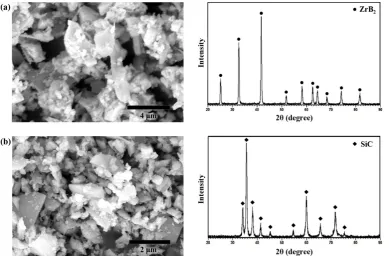
[image:3.595.108.498.489.745.2]Fig. 1 presents the SEM images of morphologies and the XRD of starting materials. As it seems, the only crystalline phases detected were ZrB2 and SiC. As shown in Fig. 2, the densities decreased with increasing SiC content, due to lower density of SiC than ZrB2 and/or decreasing hot pressing temperature and consequent incomplete densification. Based on this figure, it seems that by densification at 2000 °C, the theoretical and experimental values are meeting each other in the ZrB2–30 vol. % SiC composite.
Figure 2. Density of hot pressed ZrB2–SiC composites at different
temperatures for 30 min under 10 MPa load.
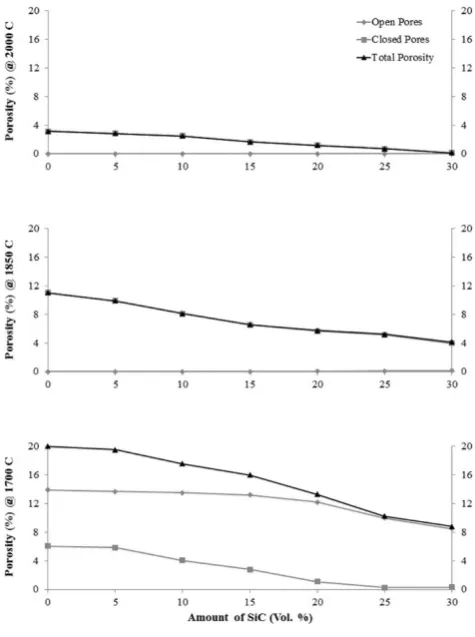
[image:4.595.313.535.383.675.2]Fig. 3 shows that the amount of porosity decreases as the sintering temperature or amount of SiC increases. Open pore is the dominant type of porosity in ZrB2–SiC composites, hot pressed at 1700 °C. But the type of pore changes completely to closed one at higher sintering temperatures. Since the progress of sintering process begins with elimination of open channels between starting powders, the nature of porosity changes gradually from open to closed form at final stages. Hence, no open pores exist at 1850 °C and higher temperatures.
Figure 3. Amount and type of porosities in hot pressed ZrB2–SiC
composites at different temperatures.
Densification behavior of ZrB2-based composites were improved by adding SiC particulate. The monolithic ZrB2 ceramic and the composites which have been reinforced using inadequate SiC particulates, demonstrated a sinterability lower than that of appropriate composite samples. Contamination of ZrB2 powder by oxygen supports evaporation-condensation and grain coarsening mechanisms during hot pressing, which exacerbates the maximum reachable density. Achieving a denser composite with increasing additive content, manifestly confirmed the advantageous role of SiC in restricting such harmful mechanisms for densification. It seems that the cleaning of ZrB2 powder surface from oxygen, through chemical interactions with SiC, is a key step to acquire fully dense materials.
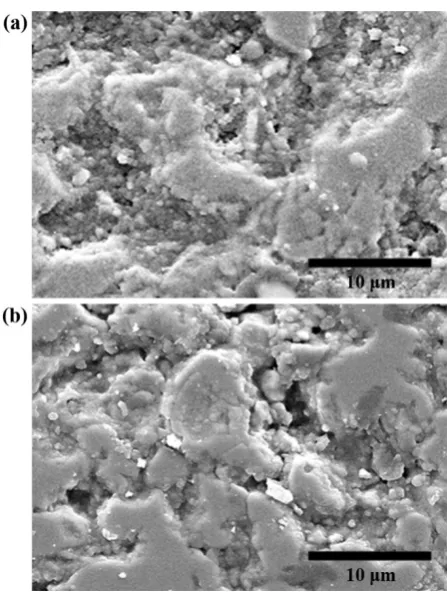
The fracture surface of monolithic ZrB2 ceramics, densified at 1850 and 2000 °C, were examined by SEM (Fig. 4). A grained structure with faceted ZrB2 grains has been shown, as the fracture appeared to spread prevalently along an intergranular path. The ZrB2/ZrB2 boundary interfaces were seemingly free of secondary phases. Some pores were visible in the SEM micrographs of monolithic ZrB2 ceramic, sintered at 1850 °C (Fig. 4-a), that had a relative density of ~89 %. On the other hand, since the relative density had been measured to be about 97 %, no discernible porosity was found in the hot pressed sample at 2000 °C (Fig. 4-b).
Figure 4. SEM micrographs of fracture surfaces of monolithic ZrB2
ceramics, hot pressed at different temperatures; (a) 1850 °C, and (b) 2000 °C.
[image:4.595.58.296.411.730.2]measured porosity value for the sample that has more than 8 percent open pores nearly without closed pores. It seems that mechanical interlocking between ZrB2 and SiC is an important mechanism for densification at 1700 °C.
Figure 5 . Micrographs of the ZrB2–30 vol. % SiC, hot pressed at 1700 °C;
(a) SEM image on a polished surface and elemental maps showing the distribution of (b) O, (c) Zr, and (d) Si.
In the microstructure of monolithic ZrB2 and ZrB2–30 vol. % SiC composite, after hot pressing at 1850 °C (Fig. 6), neck formation between ZrB2 particles in both samples was observed. There were more obvious grain boundaries between ZrB2 and SiC in the composite sample. It seems that the density of ZrB2–30 vol. % SiC composite is higher than that of monolithic ceramic, hot pressed in the same condition. This is in agreement with the result of porosity curve versus SiC addition (Fig. 3), because the amount of porosity in the composite sample is three times less than the other one. However, by the formation of necks, the density increased after hot pressing at 1850 °C in all compositions in comparison with samples processed at 1700 °C (as shown in Fig. 2). A highly dense network of dislocations in ZrB2 grain was found by Patel et al. [14] in TEM images of a sample hot pressed at 1850 °C under 25 MPa. Limited grain growth and a network of dislocations in the sample suggested that the dominant densification mechanism might be plastic deformation of ZrB2 grains.
Figure 6. SEM micrographs of the samples hot pressed at 1850 °C; (a) monolithic ZrB2 ceramic, and (b) ZrB2–30 vol. % SiC composite.
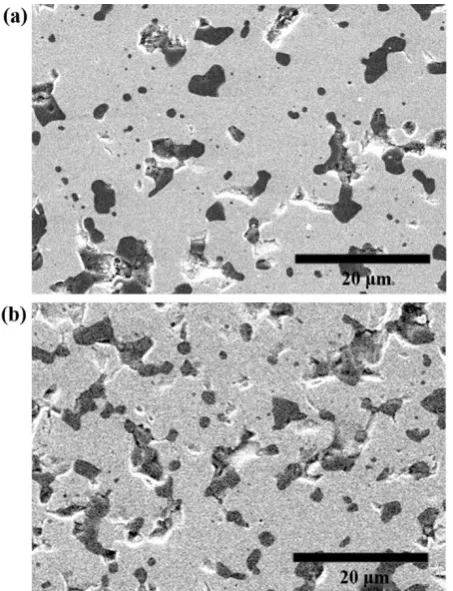
In contrast, relatively fully dense samples were obtained by hot pressing at 2000 °C. SEM observations of the polished sections (Fig. 7) confirmed that residual porosity is not substantial.
[image:5.595.56.284.123.728.2] [image:5.595.312.536.305.602.2]atoms through grain boundaries [14]. Intergranular SiC particles inside ZrB2 grains (Fig. 8 and Fig. 10) prove a meaningful mass transfer among the ZrB2 particles, which in effect brought the elimination of the pores to a fortunate ending.
Average ZrB2 grain sizes in the samples (consolidated at 2000 °C) were measured from the polished and thermally etched surfaces (Fig. 8). As the results are shown in Fig. 9, largest grain sizes belonged to monolithic ZrB2 ceramic (~15.4 μm). For the composite samples, average ZrB2 grain size reached ~3.5 μm, when 30 vol. % SiC was added to the ZrB2 powder under the same conditions. Hence, the effect of SiC as a ZrB2 grain growth controller is demonstrated clearly.
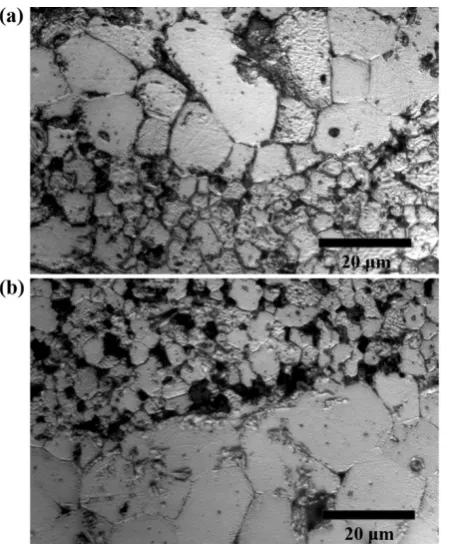
[image:6.595.313.537.74.370.2]The influence of inefficient mixing of the starting powders on the final microstructure of the composites has been revealed in Fig. 10. In the optical microscope images of the polished and thermally etched surfaces of nearly fully dense (but without proper mixing) ZrB2-based composites, there is a clear boundary that has divided the microstructure into two regions. In the region with relatively good distribution of SiC phase, the ZrB2 grains seem to have normal size (based on Fig. 9), but on the other side, ZrB2 grains grow dramatically due to lack of SiC phases, reaching a microstructure like monolithic ZrB2 ceramic. Therefore, efficient mixing of the starting powders is very critical in order to achieve a fine-grained homogenous microstructure.
Figure 7. SEM micrographs of the composites hot pressed at 2000 °C; (a) ZrB2–20 vol. % SiC, and (b) ZrB2–30 vol. % SiC. Light grains are ZrB2 and
[image:6.595.313.538.422.597.2]dark grains are SiC.
Figure 8. Optical microscope images of polished and thermally etched surfaces of ZrB2-based composites hot pressed at 2000 °C; (a) ZrB2–15 vol. %
SiC, and (b) ZrB2–25 vol. % SiC (Light grains are ZrB2 and dark grains are
[image:6.595.58.285.424.720.2]SiC).
Figure 9. Average ZrB2 grain size in the ZrB2–SiC composites
microstructure as a function of amount of SiC additive (hot pressed at 2000 °C for 30 min under 10 MPa load).
4. Conclusions
The microstructure of composites is consistent with measured values for porosity. Mechanical interlocking between ZrB2 and SiC, neck formation between ZrB2 particles alongside with more obvious grain boundaries between ZrB2 and SiC, and Intergranular SiC particles inside ZrB2 grains was observed in the microstructures of composites densified at 1700, 1850, and 2000 °C, respectively. Achieving a finely grained homogenous microstructure was strongly depended on an efficient mixing of the starting powders.
Figure 10. Optical microscope images of polished and thermally etched surfaces of ZrB2-based composites, hot pressed at 2000 °C; (a) ZrB2–20 vol. %
SiC, and (b) ZrB2–30 vol. % SiC (Light grains are ZrB2 and dark grains are
SiC).
Acknowledgements
This work was supported by the Advanced Ceramic Research Group, University of Tabriz, Iran.
REFERENCES
[1] W. G. Fahrenholtz, G. E. Hilmas, I. G. Talmy, J. A. Zaykoski, Refractory Diborides of Zirconium and Hafnium, Journal of the American Ceramic Society, 2007, 90, 5, 1347-1364. [2] S. R. Levine, E. J. Opila, M. C. Halbig, J. D. Kiser, M. Singh,
J. A. Salem, Evaluation of ultra-high temperature ceramics for aeropropulsion use, Journal of the European Ceramic Society, 2002, 22, 2757-2767.
[3] J. Marschall, D. C. Erlich, H. Manning, W. Duppler, D. Ellerby, M. Gasch, Microhardness and High-Velocity Impact
Resistance of HfB2/SiC and ZrB2/SiC Composites, Journal of
Materials Science, 2004, 39, 5959-5968.
[4] A. L. Chamberlain, W. G. Fahrenholtz, G. E. Hilmas, Low-Temperature Densification of Zirconium Diboride Ceramics by Reactive Hot Pressing, Journal of the American Ceramic Society, 2006, 89, 12, 3638-3645.
[5] S. Q. Guo, Densification of ZrB2–Based Composites and
Their Mechanical and Physical Properties: A Review, Journal of the European Ceramic Society, 2009, 29, 995-1011. [6] M. Mallik, S. Roy, K. K. Ray, R. Mitra, Effect of SiC content,
additives and process parameters on densification and structure–property relations of pressureless sintered ZrB2–
SiC composites, Ceramics International, 2013, 39, 2915-2932.
[7] J. Zou, G. J. Zhang, H. Zhang, Z. R. Huang, J. Vleugels, O. V. D. Biest, Improving high temperature properties of hot pressed ZrB2–20 vol% SiC ceramic using high purity
powders, Ceramics International, 2013, 39, 1, 871-876. [8] F. Monteverde, Beneficial effects of an ultra-fine á-SiC
incorporation on the sinterability and mechanical properties of ZrB2, Applied Physics A- Materials Science & Processing,
2006, 82, 329-337.
[9] J. W. Zimmermann, G. E. Hilmas, W. G. Fahrenholtz, F. Monteverde, A. Bellosi, Fabrication and properties of reactively hot pressed ZrB2–SiC ceramics, Journal of the
European Ceramic Society, 2007, 27, 2729-2736.
[10] A. L. Chamberlain, W. G. Fahrenholtz, G. E. Hilmas, D. T. Ellerby, High-Strength Zirconium Diboride-Based Ceramics, Journal of the American Ceramic Society, 2004, 87, 6, 1170-1172.
[11] A. Rezaie, W. G. Fahrenholtz, G. E. Hilmas, Effect of Hot Pressing Time and Temperature on the Microstructure and Mechanical Properties of ZrB2–SiC, Journal of Materials
Science, 2007, 42, 2735-2744.
[12] S. Zhu, W. G. Fahrenholtz, G. E. Hilmas, Influence of silicon carbide particle size on the microstructure and mechanical properties of zirconium diboride-silicon carbide ceramics, Journal of the European Ceramic Society, 2007, 27, 2077-2083.
[13] Q. Liu, W. Han, X. Zhang, S. Wang, J. Han, Microstructure and mechanical properties of ZrB2–SiC composites, Materials
Letters, 2009, 63, 1323-1325.
[14] M. Patel, V. Singh, J. J. Reddy, V. V. Bhanu Prasad, V. Jayaram, Densification mechanisms during hot pressing of ZrB2–20 vol.% SiC composite, Scripta Materialia, 2003, 69,
370-373.
[15] S. Zhu, W. G. Fahrenholtz, G. E. Hilmas, S. C. Zhang, Pressureless sintering of carbon-coated zirconium diboride powders, Materials Science and Engineering A , 2007, 459, 167-171.
[16] J. Zou, G. J. Zhang, Y. M. Kan, Formation of tough interlocking microstructure in ZrB2–SiC-based
ultrahigh-temperature ceramics by pressureless sintering, Journal of Materials Research, 2009, 24, 7, 2428-2434. [17] A. L. Chamberlain, W. G. Fahrenholtz, G. E. Hilmas,
[18] M. Shahedi Asl, M. Ghassemi Kakroudi, B. Nayebi, A fractographical approach to the sintering process in porous ZrB2–B4C binary composites, Ceramics International, 2015,
41, 379–387.
[19] M. Shahedi Asl, M. Ghassemi Kakroudi, B. Nayebi ,H. Nasiri, Taguchi analysis on the effect of hot pressing parameters on density and hardness of zirconium diboride, International Journal of Refractory Metals and Hard Materials, doi:10.1016/j.ijrmhm.2014.09.006.
[20] W. W. Wu, G. J. Zhang, Y. M. Kan, Y. Sakka, Synthesis, microstructure and mechanical properties of reactively sintered ZrB2–SiC–ZrN composites, Ceramics International,
2013, 39, 7273-7277.
[21] M. Shahedi Asl, M. Ghassemi Kakroudi, Fractographical Assessment of Densification Mechanisms in Hot Pressed ZrB2–SiC Composites, Ceramics International, 2014, 40,
15273–15281.
[22] L. Rangaraj, C. Divakar, V. Jayaram, Fabrication and mechanisms of densification of ZrB2-based ultra high
temperature ceramics by reactive hot pressing, Journal of the European Ceramic Society, 2010, 30, 129-138.
[23] M. Shahedi Asl, M. Ghassemi Kakroudi, S. Noori, Hardness and toughness of hot pressed ZrB2–SiC composites
consolidated under relatively low pressure, Journal of Alloys and Compounds, 2015, 619, 481–487.
[24] M. Shahedi Asl, M. Ghassemi Kakroudi, Characterization of hot-pressed graphene reinforced ZrB2–SiC composite,
Materials Science and Engineering A, doi:10.1016/j.msea.2014.12.028.
[25] E. Zapata-Solvas, D. D. Jayaseelan, H. T. Lin, P. Brownc, W. E. Lee, Mechanical properties of ZrB2- and HfB2-based
ultra-high temperature ceramics fabricated by spark plasma sintering, Journal of the European Ceramic Society, 2013, 33, 7, 1373-1386.
[26] A. Snyder, Z. Bo, S. Hodson, T. Fisher, L. Stanciu, The effect of heating rate and composition on the properties of spark plasma sintered zirconium diboride based composites, Materials Science and Engineering A, 2012, 538, 98-102. [27] V. Zamora, A. L. Ortiz, F. Guiberteau, M. Nygren,
Spark-plasma sintering of ZrB2 ultra-high-temperature
ceramics at lower temperature via nanoscale crystal refinement, Journal of the European Ceramic Society, 2012, 32, 2529-2536.
[28] V. Zamora, A. L. Ortiz, F. Guiberteau, M. Nygren, Crystal-size dependence of the spark-plasma-sintering kinetics of ZrB2 ultra-high-temperature ceramics, Journal of