Application of Superheated Steam in Sample Preparation
(Chicken Sausage) for Determination of Total Fat,
Fatty Acid and Lipid Oxidation
Asmaa A. Abdulhameed
1,2, Wahidu Zzaman
1, Tajul A. Yang
1,*1Food Technology Division, School of Industrial Technology, Universiti Sains Malaysia, Minden 11800 Pulau Pinang Malaysia
2Al-Adel Health Center, Al-Karkh Health Directorate, Ministry of Health, Bab Al-Mudam Area, Baghdad, Iraq
*Corresponding Author: [email protected]
Copyright © 2014 Horizon Research Publishing All rights reserved.
Abstract
In this study, the variations in fat, fatty acid composition, and lipid oxidation of chicken sausage during superheated steam and conventional drying oven (hot air oven) were investigated. Different superheated steam drying temperature (140-170°C) was applied at various time domains (22-40) min. The hot air oven temperature was 105°C, and the drying time was between 16-18 h. Statistical analysis was performed to precisely identify the efficacy in the fat , fatty acid, and lipid oxidation. The results revealed that at a temperature below 170° C, there was no significant difference in fat content when superheated steam was applied in drying. Applying the hot air drying was producing the highest amount of SFA as compared to their values in the superheated steam. While, the proportion of PUFA and MUFA values were maximized in superheated steam drying especially at temperatures between (160-170℃). Conventional drying oven significantly had higher value of lipid oxidation as indicated by peroxide value, p- anisidine value and Totox value than superheated steam oven. The results indicated superheated steam drying oven has efficiently improved the quality of the analysis as well as it decreased the drying time.Keywords
Fat, Fatty Acid, Superheated Steam Drying, AOAC Drying, Chicken Sausage1. Introduction
Meatand meat products are considered vital sources of B vitamins and trace ingredient, which considerably contributes to the daily intakes of numerous nutrients that are essential for optimal development and growth. Chicken meat and its products have experienced increasing popularity and become widely spread all over the world. Chicken sausage is considered as one of the popular foodstuffs among these products. It was found to be a good source of
polyunsaturated fatty acid (PUFA) compared to pork and beef sausage. This is because of chicken meat has great nutritional value and high level of PUFA compared to red meat, which has a remarkable effect on health [1,2].
To quantify the amount of fat, the drying of meat/meat product is essential. Removing water from food can prevent or inhibit the growth of microorganisms [3]. Drying can contribute to a formation of porous structure, shrinkage and crack formation. The effect of a drying method on the physical properties and structure of food products has been reported by [4]. In addition, the quality of a dried food and its cost are greatly influenced by the drying technique. Currently, a wide range of drying techniques and equipment are available for use. Depending on the process and product needs, the selection ranges from contact and convection
dryers, fluidized beds, spray dryers, freeze or vacuum dryers,
to microwaves and radio-frequency dryers, in which most of the industrial dryers use hot air as a drying medium.
Normally, AOAC method considered one of the most common methods for drying food and determining moisture content, in which the hot air oven is applied as a drying medium. However, it has a significant limitation of uneconomical energy consumption and long drying time (need around 16-18 hours) resulting in product quality degradation [5, 6]. This technique employs a flow of heated air stream to supply heat to the food and remove its moisture, as well as, the moist air must be replaced by fresh air. During drying, the food contacts with oxygen in the air oven and may be exposed to high temperature for a long time. Such exposure to heat decreases the content of some valuable components which readily undergo oxidation at elevated temperature [7].
at the given pressure. However, a drop in temperature (when superheated steam is applied) will not happen in condensation of the steam as long as the temperature is still higher than the saturation temperature at the processing pressure [8, 9].In one hand, this technique might also improve the product quality such as, low shrinkage, high porosity and high vitamin C retention. On the other hand, it decreases the energy consumption and process emissions, eliminates the possibility of fire and explosion hazards due to
the absence of oxygen and nitrogen. The lack of oxygen can also eliminate oxidative reactions (lipid oxidation) from occurring within the product [7, 10-13].
Bórquez and co-workers stated that the dried mackerel press-cake using superheated steam resulted in a product with very low losses of the valuable omega-3 fatty acids in comparison with hot air oven [7]It has been studied the effect of superheated steam dryer on the stability of n-3 fatty acid for fish particles, in which the lower losses in n-3 fatty acid during drying in superheated steam were found [10]. Additionally, the effect of superheated steam drying on the fat content of beef was extensively investigated by Speckhahn et al.,(2010). They observed that the fat extraction efficiency of superheated steam is much faster than that for the hot air oven [14].
As such, to decrease drying time and increase the accuracy of fat and fatty acid analysis, the novel approach attained in this study was the implementation of superheated steam drying during the chemical analysis of chicken sausage. Therefore, the aim of this study was investigate the effect of superheated steam and conventional drying oven on total fat, fatty acid composition, and lipid oxidation for chicken sausage.
2. Material and Method
2.1. Sample Preparation
Ready-to-cook commercial chicken cocktail sausage supplied from a local hypermarket was used in this study. The chicken cocktail sausage was held under frozen conditions (-18 to -20℃) in a freezer prior processing. Then the chicken sausage was thawed for 2 h, then cut in longitudinal section to the size of (2 * 2 * 0.5) cm and put in aluminium tray for drying steps.
2.2. Hot Air Drying Oven
Chicken sausage was placed in the hot air drying oven and dried at 105℃for overnight until reached the constant weight in according to the method of AOAC [15].
2.3. Superheated Steam Drying Oven
Superheated steam drying was carried out by placing the tray containing chicken sausage samples in the processing chamber of superheated steam processing system and
exposed to different temperatures ( 140,150,160, and 170 ℃ for ( 40,30,25, and 22) min respectively until reach the constant weight. Sharp AX-1500 was used as superheated steam equipment with a steam generation capacity of 16 cm3/min, oven capacity of 31 L, and team engine heater of 900 W. The steam was supplied by the boiler at the beginning of the drying process (at a pressure of approximately 1 bar) and it was heated up by the electric heater until it reached the superheated state.
2.4. Determination of Fat Content
Fat content in dried chicken sausage was determined in according to the method of AOAC [16]using soxhlet extraction with petroleum ether as a solvent.
2.5. Determination of Fatty Acid Composition
Fatty acid methyl ester (FAME) was prepared according to the method of Mondello et al.,(2006). 0.2 ml of crude oil was extracted from chicken sausage samples and trans-esterified in a Pyrex tube by using 2 ml of borontrifluoride-methanol (20% BF3) reagent then heated for 30 min at100°C. After cooling down, 2 ml of n-hexane and 8 ml of distilled water were added to the mixture, which was then mixed manually for 1 min and centrifuged for 2 min [17]. Approximately 1 ml of the upper n-hexane layer was transferred to a 1.5 ml glass insert for 2 ml vials after diluting the extracted hexane to obtain a suitable chromatographic response. Fatty acids were identified by comparing the retention times of FAME mixture with the standard Myristic acid palmitic acid, stearic acid, oleic acid, linoleic acid, eicosapentaenoic acid (EPA), docosahexaenoic acid (DHA). The results of fatty acid composition were expressed in GC as area percentage. The fatty acid composition of chicken sausage was directly analyzed using Gas Chromatography (GC) after methylesterification. One µL of each fatty acid methyl ester (FAME) sample was injected (split ratio 15:1) into a GC 17 A-SHIMADZU Gas Chromatography (GC-MS,Shimadzu Scientific Inc., USA) with flame ionization detector. A BPX 70 (SGE, Australia) column consisting of a 30 m x 0.32 mm fused silica capillary coated with 70 % cyanopropylpolysilphenylene-siloxane of 0.25 µm film thickness was used, with Hydrogen as the carrier gas at a constant linear velocity (28 cm/s). The injector temperature was 250°C and the detector temperature 280°C.The oven was programmed as follows: 80°C for 2 min, 5°C/min to 200°C for 10 min and 10°C/min to 230°C for a further 10 min. Fatty acid were grouped as follows : saturated(SFA) , mono (MUNA) and poly (PUFA) fatty acids.
2.6. Determination of Lipid Oxidation
(30:20 v/v).Then 0.5 ml of saturated potassium iodide (KI) solution was added into the mixture and shaken for 1 minute. 30 ml of distilled water (H2O) was added into the mixture. Slowly titrate with 0.01M of sodium thiosulfate (Na2S2O3) until the yellow color disappeared. 0.5 ml of 1% starch solution was added to the mixture. Continue titrating, shaking the flask vigorously until the blue color disappeared. All samples were measured in triplicate. Peroxide value was calculated as equation below:
Peroxide value (miliequivalent peroxide/kg of oil) = (S * M * 1000)/ weight of sample in grams(1)
S = ml of sodium thiosulfate (Na2S2O3)used M = molarity of sodium thiosulfate (Na2S2O3) used P-anisidine value (PAV) was determined by using spectrophotometric method of IUPAC (1989) [19].2 gram of fat was weighed and dissolved with 25 ml of iso- octane. Then, absorbance of the solution was measured at 350 nm.5 ml of this mixture solution was then mixed with 1 ml of 0.25% p-anisidine reagent and stored in dark condition for 10 minutes at room temperature. Then, absorbance of this mixture was read at 350 nm using UV-160A spectrophotometer (Shimadzu Corp.). All samples were measured in triplicate. p-anisidine value all samples were calculated using equation below;
p-anisidine value = (25 * ( 1.2 As – Ab)) / (weight of sample)(2)
As = Absorbance of fat solution after reaction with the p-anisidine reagent
Ab= Absorbance of fat solution before reaction with the p-anisidine reagent
While the Totox value (Total oxidation) was determined as twice of peroxide value plusp-anisidine value.
2.7. Statistical Analysis
Statistical analysis was performed using analysis of variance (ANOVA). The Duncan’s new multiple range test was used to determine the differences among means at a 5% significance level.
3. Result and Discussion
3.1. Fat Content
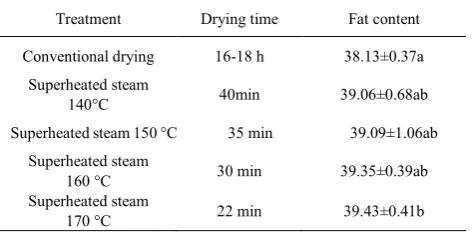
To investigate the behavior of superheated steam at various treatments, the fat content was plotted against the temperature and shown in Fig. 1.There was a slight increase in fat content with temperature. As seen from the figure, the increase in fat at temperatures between (140-150) °C is only 0.07%, while it shows an increase of 0.66% between (150-160) °C. However, the statistical analysis exhibited no significant difference (p > 0.05) in fat content within superheated steam treatments.
[image:3.595.324.538.146.302.2]The fat content of chicken sausage that dried using superheated steam and air oven were listed in Table 1. At superheated steam drying temperature below 170°C, there was no significant difference (p > 0.05) in fat content as compared to the hot air dryer.
Figure 1. Effect of superheated steam drying temperature on
fat (g/100 g) content for chicken sausage
Table 1. Fat content (g/100 g) in hot air and superheated steam – dried chicken sausage at different times and temperatures
Treatment Drying time Fat content
Conventional drying 16-18 h 38.13±0.37a
Superheated steam
140°C 40min 39.06±0.68ab
Superheated steam 150 °C 35 min 39.09±1.06ab
Superheated steam
160 °C 30 min 39.35±0.39ab
Superheated steam
170 °C 22 min 39.43±0.41b
Results are expressed as means ± standard deviations.
a–bAverage with different letters in the same column indicate significant
differences (p < 0.05). (n=3)
For the purpose of illustration, the increase in fat content when superheated steam was applied was evaluated using Eq. 1
% 𝐹𝐹𝑐𝑐ℎ𝑎𝑎𝑎𝑎𝑎𝑎𝑎𝑎 = �𝐹𝐹𝑆𝑆𝑆𝑆𝑆𝑆𝐹𝐹− 𝐹𝐹𝑆𝑆𝐻𝐻
𝑆𝑆𝑆𝑆𝑆𝑆 � ∗ 100 (1) where, Fchange represents the percentage change in the fat, FSHS and FHA represent the amount of fat for superheated steam and hot air dryer, respectively. Fig. 2 explained the increase in fat percent when superheated steam was compared to the hot air dryer. The highest percent (p< 0.05) was obtained at a temperature of 170 °C and 22min of resident time.
[image:3.595.313.550.363.479.2]grass carp fillets during drying with hot air oven were higher than microwave drying oven, due to of the higher retention of fat in a microwave oven than hot air drying [5]. This result is in contrast with other researchers that acquired the fat losses due to lipid oxidation and lipolysis [20]. However, it has found in another research that the fat content of beef samples dried using SHS drying is less than that of air dryer at similar drying conditions (temperature and time) [14].
3.2. Changes in fatty acid composition during drying
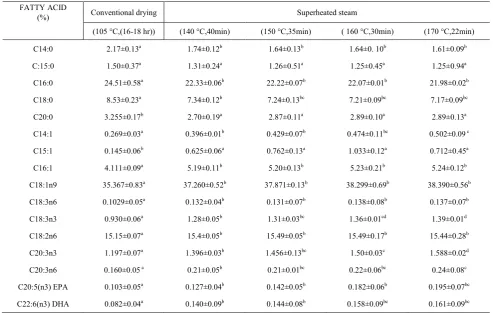
Fatty acid composition of chicken sausage that was dried in both hot air and superheated steam drying oven are shown in Table 2. The MUFA which represent in higher amounts and were dominated by oleic acid (C18: 1) and palmitoleic acid (C16: 1). The PUFA was dominated by linoleic acid (C18: 2n-6) as the most abundant omega -6 fatty acid and α- linoleic acid (C18: 3n-3) as the most abundant omega-3 fatty acid .The SFA was dominated by palmitic acid (C16: 0) and stearic acid (C18: 0).
For better illustration of the result, the SFA, PUFA, MUFA, PUFA/SFA, and n-6/n-3 were presented in Fig 3. At
[image:4.595.320.544.152.316.2]various temperatures and different drying time, the fatty acid analysis of superheated steam showed a slight difference. As such, the SFA proportion at all temperatures was approximately constant. While, for PUFA and MUFA fatty acid the behaviors of them were approximately identical at the examined conditions.
Figure 2. Increase of fat percent when superheated steam was applied at different drying temperatures
Table 2. Fatty acid composition (% of total fatty acids) of hot air- dried and superheated steam -dried chicken sausage FATTY ACID
(%) Conventional drying Superheated steam
(105 °C,(16-18 hr)) (140 °C,40min) (150 °C,35min) ( 160 °C,30min) (170 °C,22min)
C14:0 2.17±0.13a 1.74±0.12b 1.64±0.13b 1.64±0. 10b 1.61±0.09b
C:15:0 1.50±0.37a 1.31±0.24a 1.26±0.51a 1.25±0.45a 1.25±0.94a
C16:0 24.51±0.58a 22.33±0.06b 22.22±0.07b 22.07±0.01b 21.98±0.02b
C18:0 8.53±0.23a 7.34±0.12b 7.24±0.13bc 7.21±0.09bc 7.17±0.09bc
C20:0 3.255±0.17b 2.70±0.19a 2.87±0.11a 2.89±0.10a 2.89±0.13a
C14:1 0.269±0.03a 0.396±0.01b 0.429±0.07b 0.474±0.11bc 0.502±0.09 c
C15:1 0.145±0.06b 0.625±0.06a 0.762±0.13a 1.033±0.12a 0.712±0.45a
C16:1 4.111±0.09a 5.19±0.11b 5.20±0.13b 5.23±0.21b 5.24±0.12b
C18:1n9 35.367±0.83a 37.260±0.52b 37.871±0.13b 38.299±0.69b 38.390±0.56b
C18:3n6 0.1029±0.05a 0.132±0.04b 0.131±0.07b 0.138±0.08b 0.137±0.07b
C18:3n3 0.930±0.06a 1.28±0.05b 1.31±0.03bc 1.36±0.01cd 1.39±0.01d
C18:2n6 15.15±0.07a 15.4±0.05b 15.49±0.05b 15.49±0.17b 15.44±0.28b
C20:3n3 1.197±0.07a 1.396±0.03b 1.456±0.13bc 1.50±0.03c 1.588±0.02d
C20:3n6 0.160±0.05 a 0.21±0.05b 0.21±0.01bc 0.22±0.06bc 0.24±0.08c
C20:5(n3) EPA 0.103±0.05a 0.127±0.04b 0.142±0.05b 0.182±0.06b 0.195±0.07bc
C22:6(n3) DHA 0.082±0.04a 0.140±0.09b 0.144±0.08b 0.158±0.09bc 0.161±0.09bc
Results are expressed as mean ± standard deviation.
[image:4.595.58.552.361.674.2]As indicated in Fig. 3, the amount of SFA for chicken sausage dried using the hot air oven is higher than that of the superheated steam. However, the values of MUFA and PUFA were found to decrease in hot air oven. It is generally accepted that the unsaturated fatty acid was found to decrease in hot air dryer as shown in pioneering study reported by Phatanayindee et al. (2012). In which, they found that the unsaturated fatty acid decreased significantly in hot air drying oven due to lipid oxidation that initiated by the presence of oxygen in hot air oven, which attacked the double bond of unsaturated fatty acid [21]. Similar finding was observed in the study of Wu and Mao ( 2008), in which they observed that microwave oven dried grass carp fillet, had the lower value of SFA, and higher PUFA and MUFA than that of hot air drying oven (Wu and Mao, 2008[5]. Additionally, Sampels et al. (2004) and Cosgrove et al., (1987) were ascribed the increase in SFA and the decrease in PUFA fractions to the oxidation process [22, 23].
Figure 3. Fatty acid composition for hot air and superheated dryers at different times and temperatures
The results revealed that the ratio PUFA/SFA in hot air oven is lower than that of the superheated steam dryer. While, the reverse behavior were observe for the ratio of n-6/n-3 fatty acid. The decreasing in the content of PUFA after drying and at a lower ratio of PUFA/SFA, are also an indications of an oxidation process. This is because of the unsaturated fatty acid undergo oxidation more easily than SFA [22]. The highest losses in PUFA were also observed during drying kaffir lime leaves using hot air drying oven [6]. One of the possible ways to decrease the fatty acid oxidation is by working in oxygen-free medium. As the superheated steam is normally working in the absence of oxygen, in which this condition could prevent or reduce the oxidation of unsaturated fatty acid (Huang et al., 2004). Furthermore, other researchers believed that the short resident time during superheated steam drying could reduce the losses in the unsaturated fatty acid. They found that the superheated steam reduces the losses of the valuable omega-3 fatty acids in comparison with hot air oven due to short resident drying time [7, 10].
The improvement in the analysis of fatty acid (when
superheated steam was applied rather than the hot air dryer) might be evaluated using Eq.2
% 𝐹𝐹𝐻𝐻𝑐𝑐ℎ𝑎𝑎𝑎𝑎𝑎𝑎𝑎𝑎 = �𝐹𝐹𝐻𝐻𝑆𝑆𝑆𝑆𝑆𝑆𝐹𝐹𝐻𝐻𝑆𝑆𝑆𝑆𝑆𝑆− 𝐹𝐹𝐻𝐻𝑆𝑆𝐻𝐻� ∗ 100 (2)
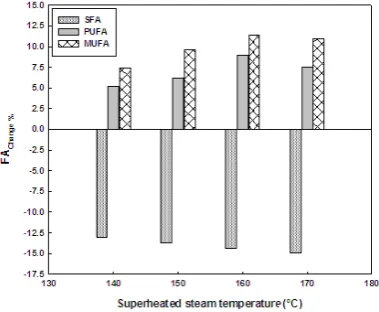
where, FAchange represents the percentage change in the fatty acid, FASHS and FAHA represent the amount of fatty acid for superheated steam and hot air dryer, respectively. Using equation 1, the variations of SFA, PUFA, and MUFA were represented in Fig. 4. In which, the positive values for this equation refer to the increasing in the FA content, while the negative values indicate the decreasing of their FA. In this figure, the x-axis refers to the superheated steam temperatures, and the y-axis indicates the change in the fatty acid percentage. It might conclude from the figure that there was a decreasing in SFA with temperature. Their values reached the maximum values at 170 °C (14.94 %). At drying temperatures between (140-160 °C), the PUFA and MUFA were found to increase when superheated steam was applied. However, their values (relative to that of 160 °C) were shown to decrease slightly at a drying temperature of 170 °C.
Figure 4. Changes in the fatty acid at different drying temperatures (the time is varies from 22-40 min and increase with decreasing in drying temperature, i.e. 140 °C (40 min); 150°C (35min); 160 °C (30min), 170 °C (22 min)
Based on the results presented in this section, there was an enhancement in the fatty acid amount that obtained using superheated steam in drying of chicken sausage samples. The analysis of the data proved that the improvement in the fatty acid is mainly due to the short residence time (as compared with hot air oven). The short drying residence time (between 22-30 min), and at a temperature between 160-170 °C, the values of PUFA and MUFA showed the highest values.
3.3. Determination of Lipid Oxidation
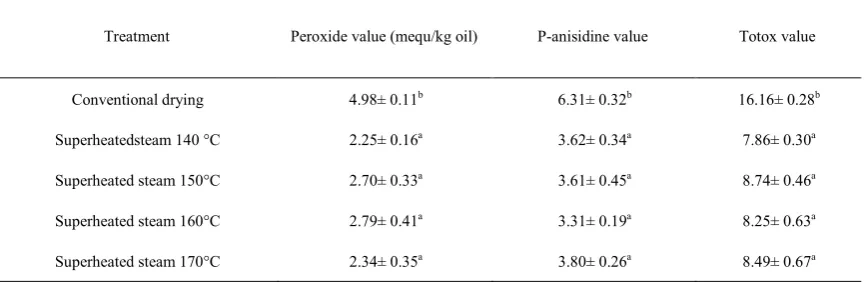
[image:5.595.338.528.335.491.2]Table 3. The effect of conventional drying oven and superheated steam drying oven on peroxide value, p-anisidine value, and Totox value
Treatment Peroxide value (mequ/kg oil) P-anisidine value Totox value
Conventional drying 4.98± 0.11b 6.31± 0.32b 16.16± 0.28b
Superheatedsteam 140 °C 2.25± 0.16a 3.62± 0.34a 7.86± 0.30a
Superheated steam 150°C 2.70± 0.33a 3.61± 0.45a 8.74± 0.46a
Superheated steam 160°C 2.79± 0.41a 3.31± 0.19a 8.25± 0.63a
Superheated steam 170°C 2.34± 0.35a 3.80± 0.26a 8.49± 0.67a
Results are expressed as mean ± standard deviation.
a–bAverage with different letters in the same column indicate significant differences (p < 0.05). (n=3) Lipid peroxidation is a free radical chain reaction that may
be described in the terms of initiation, propagation, and termination processes. Oxygen species and activated catalysts seem to be the key factor of polyunsaturated fatty acid oxidation through three different pathways: hydrogen abstraction, free radical attack on double bonds, and singlet oxygen “ene reaction” ” [24]. In the present study, the peroxide value in all samples ranged between (4.92- 2.25meq/kg), were below 25 meq of active O2/kg, which is considered as limit of acceptability in fatty food[25]. Peroxide value for hot air oven was significantly (p<0.05) higher than superheated steam oven. This is may be due to the presence of oxygen with long drying time in hot air oven could accelerate the lipid oxidation. Ahn et al., (1992)also reported that oxygen contact with meat was the most important factor in the development of lipid oxidation [26]. However, there is no significant difference (p<0.05) in peroxide value during drying with superheated steam oven. This may explain by the absence of oxygen inside superheated steam which minimizes or prevent the lipid oxidation reaction in dried samples. Huang et al., (2004)found that the superheated steam fried Zousoon had superior lipid stability to that prepared by the conventional pan-frying method [24]. While, Speckhahn et al.,(2010) noted that the curve of peroxide value during drying in superheated steam were almost constant and it lower than hot air drying ,this due to the absence of oxygen in superheated steam consequently hardly any peroxides develop in the meat during exposure to superheated steam [14].p-anisidine value was analyzed to determined secondary product of lipid oxidation. P-anisidine value is mainly a measure of 2-alkenals and 2,4-dienals in animal fat and vegetable oil. The result of this study showed that the p-anisidine value in hot air oven significantly (p< 0.05) higher than in superheated steam oven and it ranged between (6.31-3.80). This is may be attributed to the presence of oxygen in hot air oven and the long resident drying time which resulted in a greater degree of lipid oxidation. However the p-anisidine value of the sampled dried with superheated steam had constant line due to exclusion of molecular oxygen in
superheated steam and the short drying time. Total oxidation value, the so-called Totox value, calculated from twice the peroxide value plus the p-anisidine value, is another useful indicator of measuring the onset of progressive deterioration in oil and provides information regarding progression of the formation of primary and secondary oxidation products[27]. As indicated in Table 3,the Totox value was ranged between (16.16-7.86) .Similarly to changes in peroxide and p-anisidine, the sample dried in hat air oven had higher Totox values than in superheated steam oven. While, the Totox value showed constant level during drying in superheated steam at different temperature and drying times. The stability in peroxide value, p-anisidine value, and Totox
value during superheated steam drying confirm the
advantages of utilization the superheated steam as a drying medium to reduce the degree of oxidation, and thus reduction in another undesirable quality changes affecting aroma and
flavor of the meat.
4. Conclusions
sausage resulted in a remarkable enhancement in the quality of the analysis. Also, the time required in this method is much lower than that used in the conventional drying technique.
REFERENCES
[1] R. M. Khaksa, M. Moslemy , H. Hosseini, A. Taslimi, Z.
Ramezani,A. Amiri, A. Sabzevari. Comparison of lipid changes in chicken frankfurters made by soybean and canola oils during storage, Iranian Journal of Veterinary Research, Vol.11, No2, 2010.
[2] N. Gerber, M.R.L. Scheeder, C. Wenk. The influence of
cooking and fat trimming on the actual nutrient intake from meat, Meat Science, Vol.81, No.1,148-154, 2010.
[3] S.Selmi, N. Bouriga, M. Cherif, M.Toujani, M. Trabelsi.
Effects of drying process on biochemical and microbiological quality of silverside (fish) Atherinalagunae, International Journal of Food Science & Technology,Vol.45, No.6, 1161-1168, 2010.
[4] M. KashaniNejad, L. Tabil, A. Mortazavi,A.SafeKordi.
Effect of drying methods on quality of pistachio nuts. Drying Technology, 2003. Vol. 21 No. 5, 821-838, 2003
[5] T. Wu,L. Mao. Influences of hot air drying and microwave
drying on nutritional and odorous properties of grass carp (Ctenopharyngodonidellus) fillets, Food Chemistry, Vol. 110, No. 3, 647-653, 2008..
[6] P. Raksakantong, S. Siriamornpun, N. Meeso. Effect of
drying methods on volatile compounds, fatty acids and antioxidant property of Thai kaffir lime (Citrus hystrix DC). International Journal of Food Science & Technology, No.47, Vol. 3, 603-612,2012..
[7] R. M. Bórquez, E. Canales,H.Quezada. Drying of Fish
Press-Cake with Superheated Steam in a Pilot Plant Impingement System, Drying Technology, Vol, 26,No,3, 290-298 2008.
[8] S.Cenkowski, C. Pronyk, D. Zmidzinska, W.E. Muir.
Decontamination of food products with superheated steam, Journal of Food Engineering, Vol. 83, No.1,68-75, 2007.
[9] W. Zzaman, T.A. Yang. Effect of Superheated Steam and
Convection Roasting on Changes in Physical Properties of Cocoa Bean (Theobroma cacao), food science and technology research, Vol. 19, No. 2, 181-186, 2013.
[10] R.Bórquez. Stability of n-3 fatty acids in fish particles during
processing by impingement jet, Journal of Food Engineering, Vol. 56, No. 2–3,245-24, 2003.
[11] P.Sa-adchom, T. Swasdisevi, A. Nathakaranakule, S.
Soponronnarit. Drying kinetics using superheated steam and quality attributes of dried pork slices for different thickness, seasoning and fibers distribution, Journal of Food Engineering, Vol. 104, No.1, 105-113, 2011.
[12] T. Somjai, S. Achariyaviriya, A. Achariyaviriya,K. J.
Namsanguan. Strategy for longan drying in two-stage superheated steam and hot air. Journal of Food Engineering, Vol 95, No 2, 313-321, 2009.
[13] T.C. Wang, B.Y Chen, Y. P. Shen, J. J. Wong, C. C. Yang, T.
C. Lin. Influences of superheated steaming and roasting on the quality and antioxidant activity of cooked sweet potatoes. International Journal of Food Science & Technology, Vol 47, No 8, 1720-1727, 2012.
[14] A.Speckhahn, G. Srzednicki, D.K. Desai. Drying of beef in
superheated steam. Drying Technology,Vol. 28, No.9, 1072-1082, 2010.
[15] William Horwitz. Official Methods of Analysis of AOAC.
Association of Official Analytical Chemists, Gaithersburg,
Method 950.46, 2000.
[16] W. Zzaman, T.A. Yang. Effect of Superheated Steam and
Convection Roasting on Changes in Physical Properties of Cocoa Bean (Theobroma cacao), food science and technology research, Vol. 19, No. 6, 949-956, 2013.
[17] L. Mondello, P. Q. Tranchida, P. Dugo, M. Dugo. Rapid,
micro-scale preparation and very fast gas chromatographic separation of cod liver oil fatty acid methyl esters. Journal of Pharmaceutical and Biomedical Analysis, Vol. 41, No. 5, 1566-1570, 2006.
[18] William Horwitz. Official Methods of Analysis of AOAC.
Association of Official Analytical Chemists, Gaithersburg.,
Method 965.33, Vol. 2, 2000.
[19] A. Dieffenbacher, W.D. Pocklington.(IUPAC) Standard
Methods for the Analysis of Oils, Fats and Derivatives, Blackwell Scientific Pub. Ltd,Oxford , 1987.
[20] G. Jin, J. Zhang, X. Yu, Y. Zhang, Y. Lei, J.Wang. Lipolysis
and lipid oxidation in bacon during curing and drying–ripening, Food Chemistry, Vol. 123, No. 2, 465-471, 2010.
[21] S. Phatanayindee, C. Borompichaichartkul, G. Srzednicki, J.
Craske, M. Wootton. Changes of Chemical and Physical Quality Attributes of Macadamia Nuts during Hybrid Drying and Processing, Drying Technology, Vol. 30, No.16, 1870-1880, 2012.
[22] S. Sampels, J. Pickova, E. Wiklund. Fatty acids, antioxidants
and oxidation stability of processed reindeer meat, Meat Science,No. 67, Vol. 3, 523-532, 2004.
[23] J. Cosgrove, D. Church, and W. Pryor. The kinetics of the
autoxidation of polyunsaturated fatty acids. Lipids, vol. 22, No. 5, 299-304, 1989.
[24] TZOU-CHI. Huang,H. O. CHI-TANG, D HUI-YIN FU.
Inhibition of lipid oxidation in pork bundles processing by superheated steam frying, Journal of Agricultural and Food Chemistry, Vol. 52, No. 10, 2924-2928, 2004.
[25] K. I. Sallam, M. Ishioroshi, K. Samejima. Antioxidant and
antimicrobial effects of garlic in chicken sausage, LWT-Food Science and Technology, Vol. 37, No. 8, 849-855, 2004.
[26] D. Ahn,F. Wolfe,J. Sim, D. I. Kim. Packaging cooked turkey
meat patties while hot reduces lipid oxidation, Journal of Food Science, Vol. 57, No. 5, 1075-1115, 1992.
[27] H. Abramovic, V. Abram. Physico-chemical properties,