Adomian’s Decomposition Method to Squeezing Flow and
Heat Transfer between two Parallel Disks with Velocity
Slip and Temperature Jump
Muhammad Usman, Aqsa Nazir, Zertaisha Naheed, Syed Tauseef Mohyud-Din
*Department of Mathematics, HITEC University, Taxila Cantt Pakistan *Corresponding Author: [email protected]
Copyright © 2013 Horizon Research Publishing All rights reserved.
Abstract
In this paper, we are apply Adomian’sDecomposition Method to find appropriate solutions of to squeezing flow and heat transfer between two parallel disks with velocity slip, temperature jump which are of utmost importance in applied and engineering sciences. A concrete relation between the basic ideas of the proposed technique and the existing literature is also presented. Numerical results coupled with graphical representation explicitly reveal the complete reliability of the proposed algorithm.
Keywords
MHD Squeezing Flow, Newtonian Fluid,Velocity Slip, Temperature Jump, Adomian’s Decomposition Method, Adomian’s Polynomials, Numerical Solution
1. Introduction
In recent years, squeezing flow of Newtonian and non-Newtonian fluids has attracted considerable attention of many researchers because of its widespread applications in different engineering disciplines. Such flows are induced by two approaching parallel surfaces in relative motion. Stefan [1] was the first to initiate pioneering work on the squeezing flow by invoking lubrication approach. Kuzma [2] studied the effects of fluid inertia in squeeze films between two circular glass plates. Magneto hydrodynamic squeeze film was considered by Hamza [3]. Recently, Domairry and Aziz [4] employed He’s homotopy perturbation method to consider the suction and injection effects on the flow of electrically conducting viscous fluid squeezed between two parallel disks. Hayat et al. [5, 6] extended the work presented in [4] to analyze the squeezing flow of non-Newtonian fluids by taking second grade and micropolar models. While Qayyum et al. [7] investigated the unsteady squeezing flow of viscoelastic Jeffery fluid between parallel disks and discussed the porosity and squeezing effects on the velocity profile. Besides, some authors studied the heat transfer
an asymmetric channel [17], viscous flow due to a stretching sheet with surface slip and suction [18], boundary layer stagnation-point flow and heat transfer towards a shrinking sheet [19], MHD liquid flow and heat transfer over non-linear permeable stretching surface with chemical reaction [20], Three dimensional rotating flow and heat transfer between two porous wall [21], and MHD flow and heat transfer over a porous shrinking surface [22]. The study reported here extends the work of Domairry and Aziz [4] by considering the velocity slip and temperature jump at the surfaces of lower and upper disks. Our principle goal is to study the effects of slip parameters on the velocity and temperature profiles and on the related physical quantities like skin friction coefficient and the Nusselt number. Adomian’s decomposition method [23-27] is used to obtain the numerical solution of the nonlinear flow problem. Numerical solution is also computed and comparison is made between the two sets of results.
2. Basic Equations and Mathematical
Formulation
Consider the axisymmetric flow of an incompressible electrically conducting viscous fluid squeezed between two parallel disks separated by a variable distance ℎ(𝑡𝑡) =
𝐻𝐻√1− 𝛼𝛼𝑡𝑡. Where 𝛼𝛼 is a characteristic parameter having dimensions that of time inverse. The upper disk at 𝑧𝑧=ℎ(𝑡𝑡) is approaching the lower stationary disk at 𝑧𝑧= 0 with a velocity 𝑣𝑣(𝑡𝑡) =𝑑𝑑ℎ𝑑𝑑𝑡𝑡. We consider the velocity profile in the form (𝑢𝑢, 0,𝑤𝑤), where 𝑢𝑢 and 𝑤𝑤 are radial and axial velocities along 𝑟𝑟 and 𝑧𝑧 axes, respectively. A uniform magnetic field proportional to 𝐵𝐵0
√1−𝛼𝛼𝑡𝑡 is applied along the axial component and electric field is taken zero. Under the stated conditions the continuity, momentum and energy equations can be written as:
𝜕𝜕𝑢𝑢 𝜕𝜕𝑟𝑟+
𝑢𝑢 𝑟𝑟+
𝜕𝜕𝑤𝑤
𝜕𝜕𝑧𝑧 = 0, (1)
𝜌𝜌 �𝜕𝜕𝑢𝑢𝜕𝜕𝑡𝑡+𝑢𝑢𝜕𝜕𝑢𝑢𝜕𝜕𝑟𝑟+𝑤𝑤𝜕𝜕𝑢𝑢𝜕𝜕𝑧𝑧�=−𝜕𝜕𝑟𝑟𝜕𝜕𝜕𝜕+𝜇𝜇 �𝜕𝜕𝜕𝜕𝑟𝑟2𝑢𝑢2+1𝑟𝑟𝜕𝜕𝑢𝑢𝜕𝜕𝑟𝑟+𝜕𝜕 2𝑢𝑢
𝜕𝜕𝑧𝑧2−𝑟𝑟𝑢𝑢2� − 𝜎𝜎𝐵𝐵0 2
1−𝛼𝛼𝑡𝑡𝑢𝑢, (2)
𝜌𝜌 �𝜕𝜕𝑤𝑤𝜕𝜕𝑡𝑡 +𝑢𝑢𝜕𝜕𝑤𝑤𝜕𝜕𝑟𝑟 +𝑤𝑤𝜕𝜕𝑤𝑤𝜕𝜕𝑧𝑧�=−𝜕𝜕𝑧𝑧𝜕𝜕𝜕𝜕+𝜇𝜇 �𝜕𝜕𝜕𝜕𝑟𝑟2𝑤𝑤2+1𝑟𝑟𝜕𝜕𝑤𝑤𝜕𝜕𝑟𝑟 +𝜕𝜕 2𝑤𝑤
𝜕𝜕𝑧𝑧2�, (3)
𝜌𝜌𝐶𝐶𝜕𝜕�𝜕𝜕𝜕𝜕𝜕𝜕𝑡𝑡+𝑢𝑢𝜕𝜕𝜕𝜕𝜕𝜕𝑟𝑟+𝑤𝑤𝜕𝜕𝜕𝜕𝜕𝜕𝑧𝑧�=𝑘𝑘 �𝜕𝜕 2𝜕𝜕
𝜕𝜕𝑟𝑟2+ 1
𝑟𝑟 𝜕𝜕𝜕𝜕 𝜕𝜕𝑟𝑟+
𝜕𝜕2𝜕𝜕
𝜕𝜕𝑧𝑧2�
+2𝜇𝜇 ��𝜕𝜕𝑢𝑢𝜕𝜕𝑟𝑟�2+�𝑢𝑢𝑟𝑟�2+�𝜕𝜕𝑤𝑤𝜕𝜕𝑧𝑧�2+ 12�𝜕𝜕𝑢𝑢𝜕𝜕𝑧𝑧+𝜕𝜕𝑤𝑤𝜕𝜕𝑟𝑟�2�, (4) subject to the boundary conditions
𝑢𝑢=𝛽𝛽1𝜕𝜕𝑢𝑢𝜕𝜕𝑧𝑧,𝑤𝑤= 0, 𝜕𝜕=𝛾𝛾1𝜕𝜕𝜕𝜕𝜕𝜕𝑧𝑧+𝜕𝜕0, at 𝑧𝑧= 0, (5a)
𝑢𝑢=−𝛽𝛽1𝜕𝜕𝑢𝑢𝜕𝜕𝑧𝑧, 𝑤𝑤=𝑑𝑑ℎ𝑑𝑑𝑡𝑡(𝑡𝑡), 𝜕𝜕=−𝛾𝛾1𝜕𝜕𝜕𝜕𝜕𝜕𝑧𝑧+𝜕𝜕1, at 𝑧𝑧=ℎ(𝑡𝑡), (5b) where 𝜌𝜌 is fluid density, 𝜇𝜇 is dynamic viscosity, p is the pressure, 𝜎𝜎 is electrical conductivity, 𝐶𝐶𝜕𝜕 is the specific heat at constant pressure,
k
is the thermal conductivity, 𝛽𝛽1 and 𝛾𝛾1 are the slip parameters with respect to velocity and temperature. Note that 𝜕𝜕,𝜕𝜕0 andT
1 (T
1>
T
0) are the temperature of the fluid, constant temperatures of the lower and upper disks, respectively.Introducing the dimensionless quantities:
𝑢𝑢=2(1𝛼𝛼𝑟𝑟− 𝛼𝛼𝑡𝑡)𝑓𝑓′(𝜂𝜂),𝑤𝑤=− 𝛼𝛼𝐻𝐻
√1− 𝛼𝛼𝑡𝑡𝑓𝑓(𝜂𝜂)
,𝜕𝜕=𝜕𝜕0+ (𝜕𝜕1− 𝜕𝜕0)𝜃𝜃(𝜂𝜂),𝜂𝜂=𝐻𝐻√1−𝛼𝛼𝑡𝑡𝑧𝑧 . (6) Substituting 𝑢𝑢 and 𝑤𝑤 into Eqs. (2-3) and eliminating the pressure gradient, we obtain the following dimensionless differential equation:
𝑓𝑓′′′′(𝜂𝜂)− 𝑆𝑆�𝜂𝜂𝑓𝑓′′′(𝜂𝜂) + 3𝑓𝑓′′(𝜂𝜂)−2𝑓𝑓(𝜂𝜂)𝑓𝑓′′′(𝜂𝜂)�
−𝑀𝑀2𝑓𝑓′′(𝜂𝜂) = 0. (7) By virtue of (6), the energy equation (4) and the boundary conditions (5) take the following form
𝜃𝜃′′(𝜂𝜂) + Pr𝑆𝑆(2𝑓𝑓(𝜂𝜂)𝜃𝜃′(𝜂𝜂)− 𝜂𝜂𝜃𝜃′(𝜂𝜂)) + Pr𝐸𝐸𝐸𝐸 (𝑓𝑓′′(𝜂𝜂)2+ 12𝛿𝛿2𝑓𝑓′(𝜂𝜂)2) = 0. (8)
𝑓𝑓(0) = 0,𝑓𝑓′(0)− 𝛽𝛽𝑓𝑓′′(0) = 0, 𝜃𝜃(0)− 𝛾𝛾𝜃𝜃′(0) = 0, (9a)
where the respective values of squeeze number 𝑆𝑆, the Hartman number 𝑀𝑀 the Prandtl number Pr the Eckert number 𝐸𝐸𝐸𝐸, the dimensionless slip parameters 𝛽𝛽 and 𝛾𝛾 with respect to velocity and temperature, and the dimensionless number 𝛿𝛿 are
𝑆𝑆=𝛼𝛼𝐻𝐻2𝜈𝜈2,𝑀𝑀2=𝜎𝜎𝐻𝐻2𝐵𝐵02
𝜇𝜇 , Pr = 𝜇𝜇𝐶𝐶𝜕𝜕
𝑘𝑘 ,𝐸𝐸𝐸𝐸=
1
𝐶𝐶𝜕𝜕(𝜕𝜕1− 𝜕𝜕0)�
𝛼𝛼𝑟𝑟
2(1− 𝛼𝛼𝑡𝑡)�,
𝛽𝛽= 𝛽𝛽1
𝐻𝐻√1− 𝛼𝛼𝑡𝑡,𝛾𝛾= 𝛾𝛾1
𝐻𝐻√1− 𝛼𝛼𝑡𝑡,𝛿𝛿=
𝐻𝐻√1− 𝛼𝛼𝑡𝑡 𝑟𝑟 .
The dimensionless physical quantities like skin friction coefficient and local Nusselt number can be calculated from the following:
𝐶𝐶𝑓𝑓𝑟𝑟 =
𝜇𝜇 𝜕𝜕𝑢𝑢𝜕𝜕𝑧𝑧�
𝑧𝑧=ℎ(𝑡𝑡)
𝜌𝜌[𝑣𝑣(𝑡𝑡)]2 , 𝑁𝑁𝑢𝑢=−
𝐻𝐻𝑘𝑘 𝜕𝜕𝜕𝜕𝜕𝜕𝑧𝑧�
𝑧𝑧=ℎ(𝑡𝑡)
𝑘𝑘(𝜕𝜕1− 𝜕𝜕0) , which by virtue of (6) reduces to
√1− 𝛼𝛼𝑡𝑡𝐻𝐻𝑟𝑟22𝑅𝑅𝑒𝑒𝑟𝑟𝐶𝐶𝑓𝑓𝑟𝑟 =𝑓𝑓′′(1),√1− 𝛼𝛼𝑡𝑡𝑁𝑁𝑢𝑢=−𝜃𝜃′(1), (10) where 𝑅𝑅𝑒𝑒𝑟𝑟 =𝛼𝛼𝐻𝐻𝑟𝑟2𝜈𝜈 is the local squeeze Reynolds number.
3. Analysis of Method
Consider the following nonlinear differential equation
𝐿𝐿𝑢𝑢+𝑅𝑅𝑢𝑢+𝑁𝑁𝑢𝑢=𝑔𝑔, (11) where L is, mostly the lower order derivative which is assumed to be invertible, R is other linear differential operator, non linear term and g is a source term. We next apply the inverse operator 𝐿𝐿−1 to both sides of equation (11) and using the given condition to obtain,
𝑢𝑢=𝑓𝑓 − 𝐿𝐿−1(𝑅𝑅𝑢𝑢+𝑁𝑁𝑢𝑢), (12) where the function f represents the terms arising from integrating the source term g and from using the given conditions that are assumed to be prescribed. As indicated before, Adomian’s method defines the solution u by an infinite series of components given by,
𝑢𝑢(𝑥𝑥,𝑦𝑦) =∑∞ 𝑢𝑢𝑛𝑛(𝑥𝑥,𝑦𝑦)
𝑛𝑛=𝑥𝑥0 , (13) where the components 𝑢𝑢0,𝑢𝑢1,𝑢𝑢2…are usually recurrently determined. Substituting (13) into both sides of (12) leads to,
∑∞𝑛𝑛=0𝑢𝑢𝑛𝑛 =𝑓𝑓 − 𝐿𝐿−1(𝑅𝑅(∑𝑛𝑛=0∞ 𝑢𝑢𝑛𝑛) +𝑁𝑁(∑∞𝑛𝑛=0𝑢𝑢𝑛𝑛)), (14) accordingly, the formal recursive relation is defined by,
𝑢𝑢0=𝑓𝑓,
𝑢𝑢𝑘𝑘+1=− 𝐿𝐿−1(𝑅𝑅𝑢𝑢𝑘𝑘+𝑁𝑁𝑢𝑢𝑘𝑘).
4. Solution of Problem
Applying ADM the equation (7) and (8) in operator form will be given as 𝐿𝐿1𝑓𝑓=𝑆𝑆(𝜂𝜂𝑓𝑓′′′ + 3𝑓𝑓′′ −2𝑓𝑓𝑓𝑓′′′) +𝑀𝑀2𝑓𝑓′′,
𝐿𝐿2𝜃𝜃=−𝑃𝑃𝑟𝑟𝑆𝑆(2𝑓𝑓𝜃𝜃′− 𝜂𝜂𝜃𝜃′)− 𝑃𝑃𝑟𝑟𝐸𝐸𝐸𝐸 (𝑓𝑓′′2+ 12𝛿𝛿2𝑓𝑓′2), where 𝐿𝐿1= 𝑑𝑑
4
𝑑𝑑𝜂𝜂4 , and 𝐿𝐿2= 𝑑𝑑 2
𝑑𝑑𝜂𝜂2 .
Applying 𝐿𝐿−11 and 𝐿𝐿−12 on both sides of above equations, we get,
𝑓𝑓(𝜂𝜂) =𝑓𝑓(0) +𝜂𝜂𝑓𝑓′(0) +𝜂𝜂 2 2
𝑓𝑓′′(0) +𝜂𝜂3
3!𝑓𝑓′′′(0) +𝐿𝐿−11 {𝑆𝑆(𝜂𝜂𝑓𝑓′′′ + 3𝑓𝑓′′ −2𝑓𝑓𝑓𝑓′′′) + 𝑀𝑀2𝑓𝑓′′},
𝜃𝜃(𝜂𝜂) =𝜃𝜃(0) +𝜂𝜂𝜃𝜃′(0) +𝐿𝐿 2
−1{−𝑃𝑃𝑟𝑟𝑆𝑆(2𝑓𝑓𝜃𝜃′− 𝜂𝜂𝜃𝜃′)− 𝑃𝑃𝑟𝑟𝐸𝐸𝐸𝐸 (𝑓𝑓′′2+ 12𝛿𝛿2𝑓𝑓′2)},
let 𝑓𝑓(0) =𝐴𝐴,𝑓𝑓′(0) =𝐵𝐵,𝑓𝑓′′(0) =𝐶𝐶,𝑓𝑓′′′(0) =𝐷𝐷,𝜃𝜃(0) =𝐸𝐸,𝜃𝜃′(0) =𝐹𝐹 we get,
𝑓𝑓(𝜂𝜂) =𝐴𝐴+𝜂𝜂𝐵𝐵+𝜂𝜂22𝐶𝐶+𝜂𝜂3!3𝐷𝐷+𝐿𝐿−11 {𝑆𝑆(𝜂𝜂𝑓𝑓′′′ + 3𝑓𝑓′′ −2𝑓𝑓𝑓𝑓′′′) + 𝑀𝑀2𝑓𝑓′′},
𝜃𝜃(𝜂𝜂) =𝐸𝐸+𝜂𝜂𝐹𝐹+𝐿𝐿−12 {−𝑃𝑃𝑟𝑟𝑆𝑆(2𝑓𝑓𝜃𝜃′− 𝜂𝜂𝜃𝜃′)− 𝑃𝑃𝑟𝑟𝐸𝐸𝐸𝐸 (𝑓𝑓′′2+ 12𝛿𝛿2𝑓𝑓′2)}, According to ADM, we have recurrence relation as
𝑓𝑓0(𝜂𝜂) =𝐴𝐴+𝜂𝜂𝐵𝐵+𝜂𝜂22𝐶𝐶+𝜂𝜂
3
3!𝐷𝐷,
𝑓𝑓𝑘𝑘+1(𝜂𝜂) =𝐿𝐿−11 {𝑆𝑆(𝜂𝜂𝑓𝑓𝑘𝑘′′′ + 3𝑓𝑓𝑘𝑘′′ −2𝐴𝐴𝑘𝑘) + 𝑀𝑀2𝑓𝑓𝑘𝑘′′}, 𝑘𝑘 ≥0 ,
𝜃𝜃0(𝜂𝜂) =𝐸𝐸+𝜂𝜂𝐹𝐹,
𝜃𝜃𝑘𝑘+1(𝜂𝜂) =𝐿𝐿−12 {−𝑃𝑃𝑟𝑟𝑆𝑆(2𝐵𝐵𝑘𝑘− 𝜂𝜂𝜃𝜃𝑘𝑘′)− 𝑃𝑃𝑟𝑟𝐸𝐸𝐸𝐸 (𝐶𝐶𝑘𝑘+ 12𝛿𝛿2𝐷𝐷𝑘𝑘)}, 𝑘𝑘 ≥0, where 𝐴𝐴𝑘𝑘, 𝐵𝐵𝑘𝑘,𝐶𝐶𝑘𝑘and 𝐷𝐷𝑘𝑘 are Adomian’s polynomials
𝑓𝑓1(𝜂𝜂) =𝐿𝐿1−1{𝑆𝑆(𝜂𝜂𝑓𝑓0′′′ + 3𝑓𝑓0′′ −2𝐴𝐴0) + 𝑀𝑀2𝑓𝑓0′′},
𝜃𝜃1(𝜂𝜂) =𝐿𝐿−12 {−𝑃𝑃𝑟𝑟𝑆𝑆(2𝐵𝐵0− 𝜂𝜂𝜃𝜃0′ )− 𝑃𝑃𝑟𝑟𝐸𝐸𝐸𝐸 (𝐶𝐶0+ 12𝛿𝛿2𝐷𝐷0)}
𝑓𝑓2(𝜂𝜂) =𝐿𝐿1−1{𝑆𝑆(𝜂𝜂𝑓𝑓1′′′ + 3𝑓𝑓1′′ −2𝐴𝐴1) + 𝑀𝑀2𝑓𝑓1′′},
𝜃𝜃2(𝜂𝜂) =𝐿𝐿−12 {−𝑃𝑃𝑟𝑟𝑆𝑆(2𝐵𝐵1− 𝜂𝜂𝜃𝜃1′)− 𝑃𝑃𝑟𝑟𝐸𝐸𝐸𝐸 (𝐶𝐶1+ 12𝛿𝛿2𝐷𝐷1)}
𝑓𝑓3(𝜂𝜂) =𝐿𝐿−11 {𝑆𝑆(𝜂𝜂𝑓𝑓2′′′ + 3𝑓𝑓2′′ −2𝐴𝐴2) + 𝑀𝑀2𝑓𝑓2′′},
𝜃𝜃3(𝜂𝜂) =𝐿𝐿−12 {−𝑃𝑃𝑟𝑟𝑆𝑆(2𝐵𝐵2− 𝜂𝜂𝜃𝜃2′)− 𝑃𝑃𝑟𝑟𝐸𝐸𝐸𝐸 (𝐶𝐶2+ 12𝛿𝛿2𝐷𝐷2)} where 𝐴𝐴0=𝑓𝑓0𝑓𝑓0′′′,
𝐴𝐴2=𝑓𝑓1𝑓𝑓0′′′ +𝑓𝑓0𝑓𝑓1′′′ , , 𝑎𝑎𝑛𝑛𝑑𝑑 ,
𝐴𝐴1=𝑓𝑓2𝑓𝑓0′′′ +𝑓𝑓1𝑓𝑓1′′′ +𝑓𝑓0𝑓𝑓2′′′, .
. .. 𝐵𝐵0=𝑓𝑓0𝜃𝜃0′,
𝐵𝐵1=𝑓𝑓1𝜃𝜃0′ +𝑓𝑓0𝜃𝜃1′
𝐵𝐵2=𝑓𝑓2𝜃𝜃0′+𝑓𝑓1𝜃𝜃1′ +𝑓𝑓0𝜃𝜃2′, .
. .. 𝐶𝐶0= (𝑓𝑓0′′)2,
𝐶𝐶1= 2𝑓𝑓0′′𝑓𝑓1′′,
𝐶𝐶2= (𝑓𝑓1′′)
2
+ 2𝑓𝑓0′′𝑓𝑓2′′, .
. .. 𝐷𝐷0= (𝑓𝑓0′)2,
𝐷𝐷1= 2𝑓𝑓0′𝑓𝑓1′,
𝐷𝐷2= (𝑓𝑓1′)2+ 2𝑓𝑓0′𝑓𝑓2′ , .
The series solution is obtained as,
𝑓𝑓(𝜂𝜂) =𝑓𝑓0(𝜂𝜂) +𝑓𝑓1(𝜂𝜂) +𝑓𝑓2(𝜂𝜂) +𝑓𝑓3(𝜂𝜂) …,
𝑓𝑓(𝜂𝜂) = 𝐴𝐴+𝜂𝜂𝐵𝐵+𝜂𝜂22𝐶𝐶+𝜂𝜂3!3𝐷𝐷 −25201 𝑆𝑆𝐷𝐷2𝜂𝜂7− 1
360𝑆𝑆𝐶𝐶𝐷𝐷𝜂𝜂6+ 1
30𝑆𝑆𝐷𝐷𝜂𝜂5+⋯,
𝜃𝜃(𝜂𝜂) =𝜃𝜃0(𝜂𝜂) +𝜃𝜃1(𝜂𝜂) +𝜃𝜃2(𝜂𝜂) +𝜃𝜃3(𝜂𝜂) +⋯,
𝜃𝜃(𝜂𝜂) =𝐸𝐸+𝜂𝜂𝐹𝐹 −101 𝛿𝛿2𝑃𝑃𝑟𝑟𝐸𝐸𝐸𝐸𝐷𝐷2𝜂𝜂6− 1
60 𝜂𝜂5𝑃𝑃𝑟𝑟𝑆𝑆𝐷𝐷𝐹𝐹 − 3
5 𝜂𝜂5𝑃𝑃𝑟𝑟𝐸𝐸𝐸𝐸𝐶𝐶𝐷𝐷𝛿𝛿2+⋯.
5. Results and Discussion
[image:5.595.183.433.187.458.2]Graph of 𝜃𝜃(𝜂𝜂) for 𝑀𝑀= 1.0 =𝑆𝑆=𝐸𝐸𝐸𝐸,𝛽𝛽=𝛾𝛾=𝛿𝛿= 0.1
Figure 1. Effect of Prandtl number Pr on temperature profile
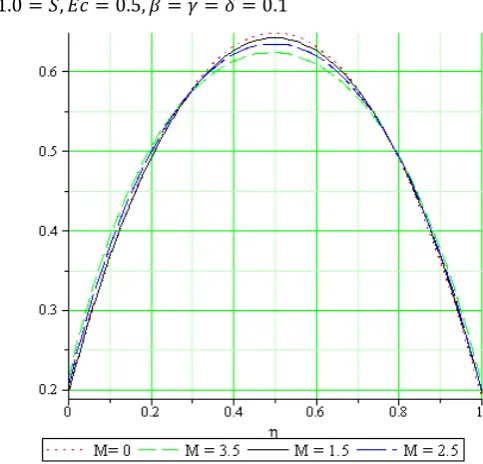
Graph of 𝑓𝑓′(𝜂𝜂) for 𝑃𝑃𝑟𝑟= 1.0 =𝑆𝑆,𝐸𝐸𝐸𝐸= 0.5,𝛽𝛽=𝛾𝛾=𝛿𝛿= 0.1
[image:5.595.178.420.493.725.2]Graph of 𝜃𝜃(𝜂𝜂) for 𝑆𝑆= 1.0 =𝑀𝑀=𝑃𝑃𝑟𝑟,𝐸𝐸𝐸𝐸= 0,𝛽𝛽=𝛿𝛿= 0.1
Figure 3. Effect of temperature slip parameter 𝛾𝛾 on temperature profile
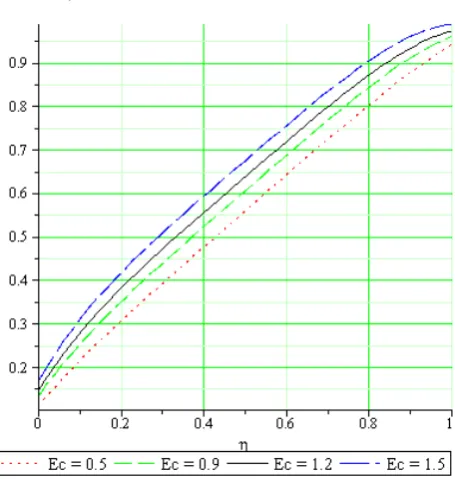
Graph of 𝜃𝜃(𝜂𝜂) for 𝑆𝑆= 1.0 =𝑀𝑀=𝑃𝑃𝑟𝑟,𝛽𝛽=𝛿𝛿=𝛾𝛾= 0.1
Figure 4. Effect of Eckert number Ec on temperature Profile
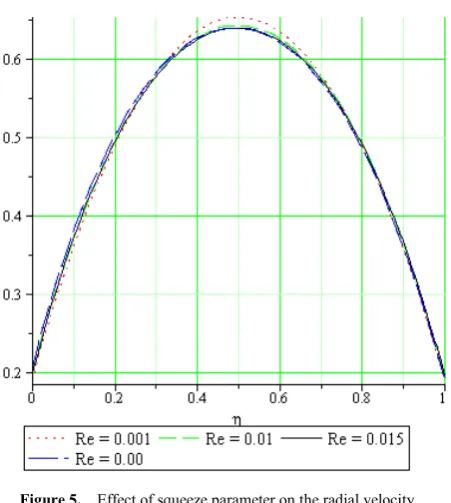
[image:6.595.193.421.373.613.2]Figure 5. Effect of squeeze parameter on the radial velocity
Table 1 (a). Comparison of Numerical and different order ADM solutions for 𝑓𝑓(𝜂𝜂) when 𝑆𝑆=𝑀𝑀=𝑃𝑃𝑟𝑟=𝐸𝐸𝐸𝐸= 1.0,𝛽𝛽=𝛾𝛾=𝛽𝛽= 0.1.
𝜂𝜂 0𝑡𝑡ℎ order 1𝑠𝑠𝑡𝑡 order 2𝑛𝑛𝑑𝑑 order 3𝑟𝑟𝑑𝑑 order 4𝑡𝑡ℎ order 5𝑡𝑡ℎ order 6𝑡𝑡ℎ order (NM)
0.0 0.00000 0.00000 0.00000 0.00000 0.00000 0.00000 0.00000 0.00000 0.1 0.02679 0.02682 0.02839 0.02839 0.02838 0.02838 0.02837 0.02837 0.2 0.06745 0.06788 0.07157 0.07157 0.07156 0.07154 0.07153 0.07153 0.3 0.11748 0.11955 0.12537 0.12537 0.12536 0.12532 0.12532 0.12532 0.4 0.17238 0.17852 0.18604 0.18604 0.18603 0.18598 0.18597 0.18597 0.5 0.22767 0.24167 0.25007 0.25008 0.25007 0.25001 0.25000 0.25000 0.6 0.27885 0.30587 0.31406 0.31411 0.31410 0.31403 0.31402 0.31402 0.7 0.32143 0.36778 0.37460 0.37476 0.37475 0.37469 0.37468 0.37468 0.8 0.35091 0.42372 0.42809 0.42853 0.42852 0.42847 0.42846 0.42846 0.9 0.36279 0.46946 0.47059 0.47165 0.47165 0.47163 0.47163 0.47163 1.0 0.35259 0.50000 0.49758 0.50000 0.50000 0.50000 0.50000 0.50000
Table 1 (b). Comparison of Numerical and different order ADM solutions for 𝜃𝜃(𝜂𝜂) when 𝑆𝑆=𝑀𝑀=𝑃𝑃𝑟𝑟=𝐸𝐸𝐸𝐸= 1.0,𝛽𝛽=𝛾𝛾=𝛽𝛽= 0.1.
η 0𝑡𝑡ℎ order 1𝑠𝑠𝑡𝑡 order 2𝑛𝑛𝑑𝑑 order 3𝑟𝑟𝑑𝑑 order 4𝑡𝑡ℎ order 5𝑡𝑡ℎ order 6𝑡𝑡ℎ order (NM)
[image:7.595.133.478.359.548.2] [image:7.595.122.480.572.738.2]6. Conclusions
Analytic and numerical techniques are used to analyze the influence of temperature and wall slip conditions on the unsteady MHD squeezing flow and heat transfer in a viscous fluid between two parallel disks. Analytical and numerical results are compared and an excellent agreement is found between them. In addition, Convergence of the series solution is demonstrated and it is found that fifth-order approximations are enough for a series solution. The results are plotted and following conclusions are drawn
Increase in the value of velocity slip parameter 𝛽𝛽 results in increasing the radial velocity near the disks surfaces regions while opposite trend is observed near the central region.
Skin friction coefficient is an increasing function of velocity slip parameter.
Local Nusselt number increases with increasing value of temperature slip parameter.
REFERENCES
[1] M. J. Stefan, Versuch Uber die scheinbare adhesion, Akademie der Wissenschaften in Wien. Mathematisch-Naturwissenschaftliche, 69 (1874), 713.
[2] D. C. Kuzma, Fluid inertia effects in squeeze films, App. Sci. Res. 18 (1968), 15–20.
[3] E.A. Hamza, The magnetohydrodynamic squeeze film, J. Tribology, 110 (1988), 375–377.
[4] G. Domairry and A. Aziz, Approximate analysis of MHD Squeeze flow between two parallel disks with suction or injection by homotopy perturbation method, Math. Prob. Eng. (2009), DOI: 10.1155/2009/603916.
[5] T. Hayat, A. Yousaf, M. Mustaf and S. Obaidat, MHD squeezing flow of second-grade fluid between two parallel disks, Int. J. Numer. Meth. Fluid, (2011), DOI: 10.1002/fld.2565.
[6] T. Hayat, M. Nawaz, A. A. Hendi and S. Asghar, MHD Squeezing Flow of a Micropolar Fluid Between Parallel Disks, J. Fluids Eng. 133 (2011), 111206.
[7] A. Qayyum, M. Awais, A. Alsaedi and T. Hayat, Unsteady squeezing flow of Jeffery fluid between two parallel disks, Chin. Phys. Lett. 29 (2012), 034701.
[8] A. R. A. Khaled and K. Vafai, Hydromagnetic squeezed flow and heat transfer over a sensor surface, Int. J. Eng. Sci. 42 (2004), 509–519.
[9] M. Mahmood, S. Asghar, M. A. Hossain, Squeezed flow and heat transfer over a porous surface for viscous fluid, Heat Mass Transf. 44 (2007), 165–173.
[10] H. M. Duwairi, B. Tashtoush, R. A. Damseh, On heat transfer effects in a viscous fluid squeezed and extruded between two parallel plates, Heat Mass Transf. 41(2004), 112–117. [11] M. Mustafa, T. Hayat, S. Obaidat, On heat and mass transfer
in the unsteady squeezing flow between parallel plates, Meccanica (2012), DOI: 10.1007/s11012-012-9536-3. [12] B. Tashtoush, M. Tahat, S. D. Probert, Heat transfer and
radial flows via a viscous fluid squeezed between two parallel disks, Appl. Energy, 68 (2001), 275-288.
[13] A. R. Bahadir, T. Abbasov, A numerical approach to hydromagnetic squeezed flow and heat transfer between two parallel disks, Ind. Lub. Trib., 63 (2011), 63–71.
[14] C. Neto, D. R. Evans, E. Bonaccurso, H.J. Butt, V.S.J. Craig, Boundary slip in Newtonian liquids: a review of experimental studies, Rep. Prog. Phys. 68 (2005), 2859–2897.
[15] C. L. M. H. Navier, The effect of slip condition on unsteady MHD oscillatory flow of a viscous fluid in a planer channel, Mem. Acad. Sci. Inst. France, 1 (1823), 414–416.
[16] C. S. Kumar, Microfluidic devices in nanotechnology: Fundamental concepts, John Wiley & Son, New Jersey, 2009. [17] A. Ebaid, Effects of magnetic field and wall slip conditions on the peristaltic transport of a Newtonian fluid in an asymmetric channel, Phys. Lett. A, 372 (2008), 4493–4499.
[18] C. Y. Wang, Analysis of viscous flow due to a stretching sheet with surface slip and suction, Nonlinear Anal. Real World Appl., 10 (2009), 375–380.
[19] K. Bhattacharyya, S. Mukhopadhyay, G. C. Layek, Slip effects on boundary layer stagnation-point flow and heat transfer towards a shrinking sheet, Int. J. Heat Mass Transf., 54 (2011), 308–313.
[20] M. H. Yazdi, S. Abdullah, I. Hashim, K. Sopian, Slip MHD liquid flow and heat transfer over non-linear permeable stretching surface with chemical reaction, Int. J. Heat Mass Transf., 54 (2011), 3214–3225.
[21] T. Hayat, M. Awais, A. A. Hendi, Three-dimensional rotating flow between two porous walls with slip and heat transfer, Int. Commun. Heat Mass Transf., 39 (2012), 551–555.
[22] L. Zheng, J. Niua, X. Zhang, Y. Gao, MHD flow and heat transfer over a porous shrinking surface with velocity slip and temperature jump, Math. Comput. Model., (2012), doi:10.1016/j.mcm.2011.11.080
[23] Y. Cherruault and G. Adomian, Decomposition methods: a new proof of convergence, Math. Comput. Model., 18(12) (1993), 103–106.
[24] A.M. Wazwaz, A reliable modification of Adomian’s decomposition method, Appl. Math. Comput., 92(1) (1998), 1–7.
[25] A. M. Wazwaz, Partial Differential Equations: Methods and Applications, Balkema Publishers, Leiden, (2002).
[26] A. M. Wazwaz, The modified decomposition method for analytic treatment of differential equations, Appl. Math. Comput., 173(1) (2006), 165–176.