Published by Canadian Center of Science and Education
A Study of the Functionality of Hydrated Lime as an Admixture
Declan O‘Looney1 & Sara Pavía1 1 Dept. of Civil Engineering, Trinity College Dublin, Ireland.
Correspondence: Sara Pavía, Dept of Civil Engineering, University of Dublin, Trinity College, Dublin 2, Ireland. Tel: 353-1608-2516. E-mail: [email protected]
Received: March 12, 2014 Accepted: March 31, 2014 Online Published: November xx, 2014 doi:10.5539/jmsr.v4n1px URL: http://dx.doi.org/10.5539/jmsr.v4n1px
Abstract
It is known that hydrated lime improves the workability and water retention of Portland cement (PC) mortars. PC-lime mixes can be reworked without increasing entrained air thus not undermining durability. In addition, lime lowers strength and stiffness making PC mortars more deformable. However, the use of hydrated lime in PC composites has largely decreased due to the use of plasticisers. These enhance workability and lower cement content reducing heat of hydration. As they are water reducers, they are expected to decrease permeability, minimise shrinkage, enhance ultimate strength and accelerate early-strength gain; leading to stronger, durable composites. Despite these advantages, plasticisers have drawbacks related to wastage and environmental protection. This paper studies the properties of PC-lime mortars and their plasticised equivalents. It concludes that lime raises mortar water demand however, this does not reduce strength but on the contrary, mortars of low lime content (lime amounting 1/4th the cement), have superior flexural and compressive strengths than their plasticised equivalents. The use of lime delivered PC mortars with excellent workability and surface finish and lack of segregation and bleeding. It is concluded that, when lime amounts 1/4th the cement, the mortars are stronger (in tension and compression, at both early and mature age) and gain strength at a faster rate than plasticised mixes. However, when lime equals the cement content, strengths are lower than those of plasticised mixes. It was also noted that lime enhanced bond strength at all ages; and that the ultimate bond strength is greater for the low lime than for the high lime content mortars.
Keywords: Portland cement-lime mortars, hydrated lime, plasticisers, masonry
1. Introduction
In the past, it was common practice to mix hydrated lime -Ca(OH)2- with PC to produce masonry mortars. Lime improved workability and allowed to rework mortars without wastage; it also lowered strength and stiffness making PC mortars more deformable. However, in the last decades, the use of hydrated lime as an admixture has largely decreased due to the indiscriminate use of chemical admixtures. According to Jackson and Dhir (1988) chemical admixtures should only be used when the required modifications cannot be made by varying the composition and proportions of the constituent materials, or when the admixture can produce the required effects more economically. However, in reality, admixtures are continuously used and sometimes mistreated materials. Plasticisers are the most common chemical admixture, accounting for almost 50% of all admixture sales in the UK (Newman and Choo, 2003). They appeared in 1932 and have been used commercially for the past 40 years (Rixom and Mailvaganam, 1999). They are extensively used by ready-mix companies to optimise their mix design; especially at low to medium slump. Current plasticisers are usually based on lignosulphonate salts (natural polymers derived from wood processing in the paper industry) (Hewlett, 1988).
Today, on view of environmental concerns (such as chemical toxicity and production of non-biodegradable waste), there is a need to evaluate the functionality of lime in PC composites. This paper investigates the function of lime in PC mortars. It studies the properties of some common plasticised PC mortars used in construction and compares them with their equivalent PC-lime mixes.
1.1 Functionality of Plasticisers
surface-active agents so, as detergents, they reduce interfacial particle tension and increase electro-kinetic potential, enhancing particle mobility and eluding flocculation/segregation; these avoid inter-particle friction improving workability (Hewlet 1988). In addition, water inside cement particle agglomerates is released further enhancing workability. Plasticisers also reduce the volume of unbounded water, hence decreasing permeability and minimising shrinkage cracking, leading to stronger, durable composites.
However, despite these advantages, the use of plasticisers has drawbacks that can result in wastage. According to Cryan (2009), 13% of the total housing construction garbage is wastage; and a high proportion of this are mixes going off prematurely. This is often caused by over mixing plasticised composites which leads to an excessive volume of entrained air. For example, the travel time for a ready-mix from batching plant to site is approximately 1.5 hours (Runova et al. 2005). During transit, the material is slowly mixed to prevent setting however, with site delays such as pumping issues and unloading, the material can over mix for up to 2 hours. Also in plasticised, site-mixed mortars, delays can lead to remixing; and adding extra water leads to wastage and poor durability (Hover, 1998).
Furthermore, the effectiveness of plasticisers depends on several variables that have been proven difficult to control on site. These include dosage (at high dosage they may cause retardation), temperature, the chemical composition of the cement and workmanship (Blackledge and Binns 2002; Higgins 1984). Plasticisers involve complex mix design as, to maintain the required strength, the water content must be adjusted in order to compensate for the addition of the admixture. This is an added calculation that can become a source for error. Rigorous site supervision is required to ensure manufacturer specifications are adhered to, including testing of site produced composites and the use of automatic admixture dispensing equipment (Usher et al. 1980). To obtain consistent results, the plasticiser should be dissolved in the mixing water (if added after initial mixing, its effect may be greater but it may not be evenly dispersed -Higgins 1984). However, on site, it is difficult to accurately control the amount of mixing water. General practice is to add enough water until the operative is happy with the workability, however, as a result, often, not all of the admixture is added - if contained in the discarded mixing water.
In addition, the interaction of plasticisers with new, more sustainable, cements that are becoming widely used is scant and unclear (Bannon 2006). New cements are treated on site in the same manner as traditional cement (CEM I) however, their composition is different. For example, CEM II contains materials such as limestone, pulverised fuel ash or blast furnace slag and typically has 10 to 20% less clinker than CEM I and this, as aforementioned, affects the effectiveness of the admixture.
Finally, admixtures can cause leaching especially in wet climates. In Europe, in order to control the risks that chemicals may pose to human health and the environment, manufacturers and importers must register all their substances in the Registration, Evaluation, Authorisation and Restriction of Chemical substances directive (REACH). Hydrated lime is a natural, non-toxic, simple chemical compound (Ca(OH)2 ) registered under the chemical abstracts as a calcined lime product (registry number 1305-62-0 and European Inventory of Existing Commercial Chemical Substance (EINECS) number 215-137-3) (Eula 2007). However, lignosulphonates in plasticisers are toxic (Park and Paper in Zhang, 2002). Jolicoeur and Simard (1998) state that lignosulphonate plasticisers are a complex mixture of chemical compounds. As a result, it is difficult to identify whether all of these compounds comply with REACH or what environmental threats they may pose.
1.2 Functionality of Hydrated Lime in PC Mortars
It is well known in the building industry that lime improves the workability and water retention of PC mortars. Masons agree that lime confers ease of mixing and spreading as well as minimal segregation. PC-lime mixes can be reworked without increasing the volume of entrained air thus not compromising durability. Therefore over mixing, caused by transit or site delays does not lead to wastage. In addition, in the hardened state, lime confers plasticity lowering stiffness so that PC mortars become more deformable on stress application, tolerating masonry movement which may be caused by settlement, subsidence, wind pressure or earthquake. The ability of PC-lime mortars to accommodate movement has been known for decades: Tate (2005) citing Boynton 1980, refers to 1:2:5 (PC:lime:sand) as a specification for mortars of tall chimneys subject to wind movement.
lime mixes had similar water retention while Schuller et al. (1999) affirm that the water retention of PC:lime:sand mortars was superior and their air content lower. Green et al. (1999) also highlight the strong water-retaining characteristics of lime. This paper relates initial flow, water retention, compressive and flexural strengths with elastic modulus and bond strength of some common lime/PC mortars used in construction, and compares them with equivalent plasticised mixes.
1.3 Background and Relevance of Mortar Properties Investigated
The properties investigated determine mortar quality and performance. Water demand (amount of mixing water) affects workability, strength and shrinkage therefore, it impacts mortar quality and durability. Water retention is essential so that the mortar remains workable and retains enough water for proper curing and bonding. A mortar with high water retention remains plastic for longer enhancing contact with masonry units and avoding wastage. In addition, an increase in water retention enhances bond strength (Borchelt et al 1996; BIA 2003; Pavía and Hanley 2010). The strength of the bond between the mortar and the building unit is important as it ensures the structural integrity of masonry (adequate resistance to compressive and tensile loading) and seals against weathering agents. The mortar water retention and the initial suction by the building unit determine bond development, as they control moisture transport at the interface influencing the formation of the hydrates that enable bond (Hedstrom et al.1991; Grandet, 1975; Lawrence and Cao 1987).
The effect of lime content in bond strength is not clear. Some authors state that lime reduces bond strength while others state that low lime contents enhance bond. Bond strength is due to the mechanical interlock of cement hydrates into the brick pores (Lawrence and Cao 1987; Groot 1993; Wright 1993). Groot (1993) states that PC mortars show greater bond strength than PC-lime mortars due to their higher hydrate content. Melander and Conway (1993) agree, stating that lime addition (0-4 parts by volume) to PC mortars reduces compressive and bond strength; and that a 1:2 (PC:lime) ratio is the maximum advisable lime content. However, other authors note that, PC-lime mortars develop greater bond strength than PC mortar (Venumadhava Rao et al. 1996; Sugo et al. 2001). According to Sugo, a 1:1:6 (PC:lime:sand) mix achieves greater bond than a 1:6 (PC:sand) mortar because it experiences less reduction in the volume of the paste due to its higher water retention and, as a result, there is a greater provision of hydrates over the mortar-unit interface which increases bond.
As aforementioned, mechanical strength and stiffness are believed to decrease with increasing lime content. Flexural (tensile) strength determines the mortar’s resistance to tensile stresses resulting from loading or expansion caused by frost action, temperature changes and salt/swelling clays; while compressive strength informs on mechanical resistance and relates to durability (stronger materials usually have longer lives). It is often used as a principle criterion for material specification and quality control; e.g. the classifications and designations of limes, cements and mortars are based on compressive strength. Flexural and compressive strengths are superior in mortars with higher cement content due to their greater hydrate content. Elastic modulus relates to mortar stiffness and the ability to deform on stress application. This is often more important than the ultimate strength (at peak load), as it is desirable for building materials to exhibit an ability to deform under stress without cracking. 2. Materials and Methods
[image:3.595.176.422.565.726.2]2.1 Materials
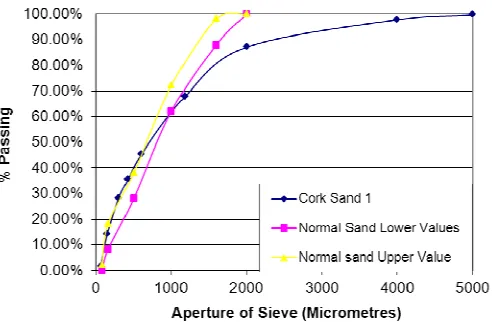
Portland cement (CEM II/ A-L), hydrated lime (CL90s), a lignosulphonate based plasticiser and frogged, machine-pressed, fired-clay bricks were used. A well graded siliceous aggregate was graded in accordance with EN 196-1:2005. The particle size distribution ranges within the standard limits with slightly more abundant coarse aggregate than the CEN reference sand. The aggregate moisture content was constantly within a 4.34-5.17% range. CEM II is Portland limestone cement including 80-94% clinker, 6-20% limestone and 5% minor constituents complying with EN 197-1:2011.
2.2 Admixture Dispersion, Mixing, Moulding and Curing
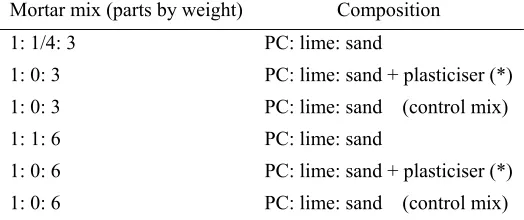
[image:4.595.167.429.249.359.2]Mortar batches were prepared according to EN 196-1 (2005) and EN 459-2 (2001). The lime, cement and water were added simultaneously. The plasticiser was gauged as per the manufacturer specification (Table 1). The specimens for determination of strength and elastic modulus were de-moulded 24 hours after casting and cured in water at 20+/-1 ºC.
Table 1. Mortar mixes and composition
Mortar mix (parts by weight) Composition
1: 1/4: 3 PC: lime: sand
1: 0: 3 PC: lime: sand + plasticiser (*)
1: 0: 3 PC: lime: sand (control mix)
1: 1: 6 PC: lime: sand
1: 0: 6 PC: lime: sand + plasticiser (*)
1: 0: 6 PC: lime: sand (control mix)
Note. (*) = 125–250 ml of plasticiser per 50 kg of cement.
2.3 Determination of Water Demand: Initial Flow
The water demand to produce a flow diameter of 185+/-3 mm was recorded (EN 459-2, 2001). A truncated cone was placed in the centre of the flow table. It was filled and the excess mortar struck off. After 10 seconds, the mould was lifted and the mortar spread by jolting the plate, 15 times, at one jolt per second. The mean value of the diameter, measured in two perpendicular directions, was reported; and the test repeated 3 times for each mix.
2.4 Determination of Water Retention
Assemblies were built with filter paper, plastic plate, nonwoven tissue, ring and mortar as specified in EN 459-2 (2001) and weighed. The values reported are arithmetic means of 3 tests. The mortar water content (W2) and the mass of water absorbed by the filter plate (W3) were measured and the relative loss of water from the mortar (W4) calculated from the equation:
100 2 3 4 = ×
W W
W (1)
The water retention (WRV) was then calculated as a percentage as follows:
4 100 W
WRV = − (2)
2.5 Determination of Flexural Strength
The specimens were removed from the curing tank 15 minutes before testing. The flexural test was carried out using the three-point loading method. The load was applied at a rate of 50 +/-10 N/s until failure. The flexural strength (Rf N/mm²) (mean of 3 tests) was calculated from the following formula:
3 5 . 1
b I F
Rf = × f × (3)
Where: b is the side of the square section of the prism, in mm; Ff is the maximum load applied, in Newton; I is the
2.6 Determination of Compressive Strength
Each specimen was compressed between two steel plates. The load was increased smoothly at a rate of 2400+/-200 N/s until failure. The compressive strength (Rc-N/mm²) was calculated from the following formula. The values reported are the arithmetic mean of 6 tests.
Rc = Fc /1600 (4)
Where: Fc is the maximum load at fracture (N); 1600 is the platen’s area (40 x 40 mm2)
2.7 Determination of Moduslus of Elasticity
The ratio of the axial stress over the axial strain was recorded during both the flexural and compression strength tests: the distance travelled by the loading point (
Δ
L
) was recorded for each load increment and graphs of load versusΔ
L
made. The slope of each graph (m) was calculated and used in the following equation to determine the elastic modulus (E). The values reported are the mean of 3 and 6 tests in flexion and compression respectively.E = X3 m / 4b d3 (5)
Where: X-distance between loading point and outer point at prism’s base (100 mm); m- slope of load versus
Δ
L
; b-breadth of prism (40 mm); d-depth of prism (40 mm).2.8 Determination of Flexural Bond Strength With the Bond Wrench Test
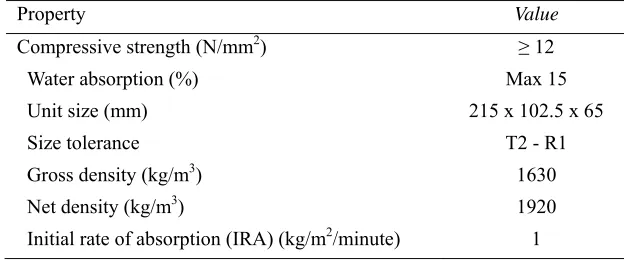
[image:5.595.139.451.347.478.2]The flexural bond strength was measured using the bond wrench test (EN 1052-5). The properties of the frogged, machine-pressed, fired-clay bricks used were determined according to EN 772-16 and EN 772-1 (Table 2).
Table 2. Brick characteristics determined according to EN 772
Property Value
Compressive strength (N/mm2) Water absorption (%) Unit size (mm) Size tolerance Gross density (kg/m3) Net density (kg/m3)
Initial rate of absorption (IRA) (kg/m2/minute)
≥ 12 Max 15 215 x 102.5 x 65
T2 - R1 1630 1920 1
Two six-unit prisms were built with each mortar, resulting in 10 joints being tested for each mortar type at both 7 and 28 days. The bricks were submerged for 3 minutes prior to assembly. A template ensured consistent joint thickness (12 mm) before tamping. Loading was applied incrementally so that failure occurred after 2-5 minutes. The weight of the top unit (W), the applied load (F1), specimen dimension and failure mode were recorded. For each failure the bond strength (fwi) was calculated to the nearest 0.01 N/mm2 using the following equation:
Z W F F d e F e F fwi ⎟ ⎠ ⎞ ⎜ ⎝ ⎛ + + − +
= 3 4
2 2 1 2 2 1 1 (6) Where
Z bd2/6; b=width of the joint-mm; d depth of the specimen-mm
e1 distance from the applied load to the tension face of the specimen in mm
e2 distance from centre of gravity of the lower and upper clamp to the tension face of the specimen-mm
F1 applied load in N; F2 weight of the bond wrench in N
3. Results
3.1 Initial Flow, Water Demand and Workability
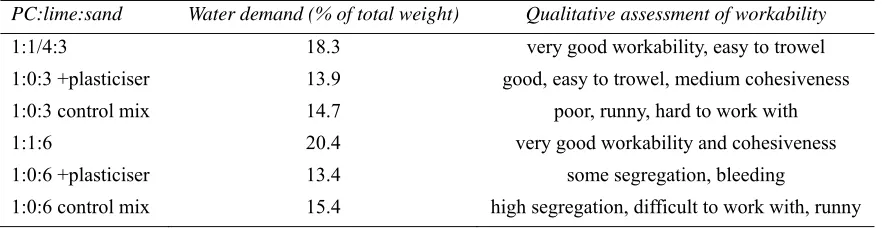
[image:6.595.79.520.259.373.2]As expected, the mortars containing lime had a greater water demand to produce the required flow; and the water demand increased with the lime content (Table 3). However, it was also noted that the plasticiser did not significantly reduce the mortar water demand- this can be evidenced when comparing the plasticised and control mixes in Table 3. As it can be seen from Table 3, workability was assessed qualitatively. The PC-lime mixes (1:1:6 and 1:1/4:3) produced no segregation or bleeding after 15 jolts of the flow table. In contrast, both the plasticised and PC only mortars (control mixes) showed segregation and surface bleeding which were less noticeable in those with a lower aggregate content. The PC-lime mortars achieved excellent consistency while the plasticised mixes were free flowing and lighter on the trowel, making prism fabrication slow. It was also noted that both the plasticised and PC (control) mortars compressed to a greater extent than the PC-lime mixes resulting in reduction of the joint thickness.
Table 3. Water demand to initially flow to 185 mm, workability, segregation and bleeding of the mortars studied
PC:lime:sand Water demand (% of total weight) Qualitative assessment of workability
1:1/4:3
1:0:3 +plasticiser 1:0:3 control mix 1:1:6
1:0:6 +plasticiser 1:0:6 control mix
18.3 13.9 14.7 20.4 13.4 15.4
very good workability, easy to trowel good, easy to trowel, medium cohesiveness
poor, runny, hard to work with very good workability and cohesiveness
some segregation, bleeding
high segregation, difficult to work with, runny
3.2 Hardened Surface Finish
[image:6.595.118.482.477.622.2]Figure 2 shows the surface finish of the mortars stripped from their steel moulds after 24 hours. As it can be seen, those containing lime (left) display a light colour and a smooth surface finish with no cavitations, while the plasticised mixes showed abundant voids and cavitations and the PC control mixes showed an acceptable surface finish with minimal cavitations.
Figure 2. Surface finish (from left to right) PC-lime; plasticised and PC mortars
3.3 Water Retention
Figure 3. Water retention of PC-lime, plasticised and PC (control) mortars
3.4 Flexual and Compressive Strength
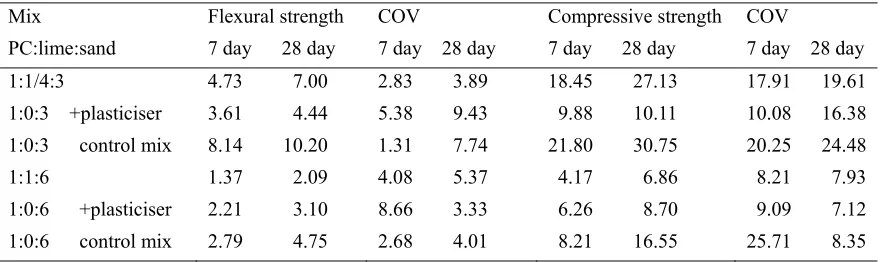
Under flexion, the low lime content mortars (1:1/4:3) showed greater, both early and ultimate flexural strength than their equivalent plasticised mixes (Table 4). However, this trend is reversed when the amount of lime equals that of cement: the 1:1:6 mortars achieved lower flexural strengths than their equivalent plasticised mixes. As expected, the mortar with the highest lime content displays the lowest flexural strength; and the strength drops with increasing aggregate content. The PC control mixes consistently showed the highest flexural strength.
Under compression, the trend is similar: the early and ultimate compressive strengths of the low lime content mortars are superior to those of their equivalent plasticised mixes and, at high lime contents, the trend is reversed, with the plasticised mortars being stronger than the lime mixes. The relatively low COVs (coefficients of variation) suggest dispersion within acceptable limits.
Table 4. Compressive and flexural strengths with their COVs Mix
PC:lime:sand
Flexural strength 7 day 28 day
COV
7 day 28 day
Compressive strength 7 day 28 day
COV
7 day 28 day
1:1/4:3 4.73 7.00 2.83 3.89 18.45 27.13 17.91 19.61
1:0:3 +plasticiser 3.61 4.44 5.38 9.43 9.88 10.11 10.08 16.38 1:0:3 control mix 8.14 10.20 1.31 7.74 21.80 30.75 20.25 24.48
1:1:6 1.37 2.09 4.08 5.37 4.17 6.86 8.21 7.93
1:0:6 +plasticiser 2.21 3.10 8.66 3.33 6.26 8.70 9.09 7.12 1:0:6 control mix 2.79 4.75 2.68 4.01 8.21 16.55 25.71 8.35
3.5 Elastic (or Young’s) Modulus
At low lime content, the PC-lime mortars are significantly stiffer than the plasticised mixes at all ages, both in flexion and compression. However, when the lime equals the cement content the trend is reversed, and the plasticised mortars are stiffer than the PC-lime mortars.
The PC mortars are stiffer than the plasticised mixes both in flexion and compression, at all ages except for the 7-day compression modulus which shows similar values.
[image:7.595.79.520.453.584.2]COV values in flexion were low (3.03-5.53%) with one exception (28.7% for a control mix) while under compression, they occasionally reached over 30% for the 7 day tests suggesting some dispersion.
Table 5. Elastic modulus (E) under flexion and compression Mix
PC:lime:sand
E (N/mm2)- flexion 7 day 28 day
E (N/mm2)- compression 7 day 28 day
1:1/4:3 996.6 1559.0 323.8 484.4
1:0:3 +plasticiser 821.3 1050.8 182.6 171.1
1:0:3 control mix 1830.6 2356.6 257.1 356.1
1:1:6 349.4 593.1 74.4 129.2
1:0:6 +plasticiser 472.5 888.5 141.0 217.3
1:0:6 control mix 727.1 1244.1 123.4 291.0
3.6 Flesural Bond Strength
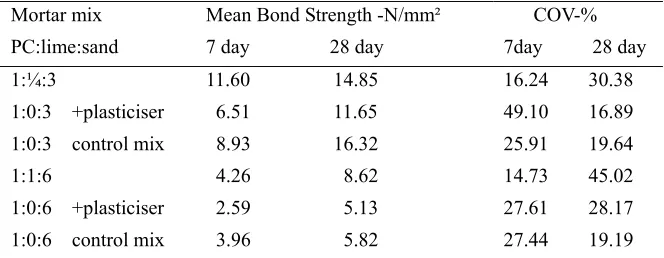
At early stages (7 days), the mortars containing lime have developed a superior bond than any of the other mortars (Table 6). After hardening (28 days) the lime mortars show superior bond strength than the plasticised mixes at both lime contents.
Table 6. Strength of the bond between brick and mortar Mortar mix
PC:lime:sand
Mean Bond Strength -N/mm² 7 day 28 day
COV-% 7day 28 day
1:¼:3 11.60 14.85 16.24 30.38
1:0:3 +plasticiser 6.51 11.65 49.10 16.89
1:0:3 control mix 8.93 16.32 25.91 19.64
1:1:6 4.26 8.62 14.73 45.02
1:0:6 +plasticiser 2.59 5.13 27.61 28.17
1:0:6 control mix 3.96 5.82 27.44 19.19
In the mortars with low lime content (1:1/4:3), the bond develops early (11.6 N/mm2 at 7 days) and increases at a slow rate during hardening (28% bond strength gain). In contrast, the bond develops significantly later in the equivalent PC and plasticised mortars, but increases at a higher rate during hardening (79 and 83% increase for the plasticised and PC mixes respectively).
The strength of the bond is significantly greater for the lower lime content mortars (11.60 and 14.85 N/mm2 at 7 and 28 days) than for the mortars of higher lime content (4.25 and 8.62 N/mm2). However, the high lime content mortar (1:1:6) shows the greatest rate of bond strength gain (at 102% between 7 and 28 days), followed by the 1:6+plasticiser mix at 98% and the 1:6 control mix at 47%.
The superior bond strength of the mortars containing hydrated lime is probably due to their enhanced workability and higher water retention (85-87% water retention vs 74-80% of their plasticised equivalents –Figure 3). This agrees with previous authors stating that an increase in water retention results in increased bond strength (Borchelt et al 1996; BIA 2003; Pavía and Hanley 2010).
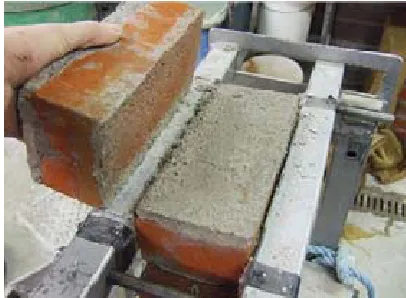
[image:8.595.132.464.364.493.2]Figure 4. Flexural bond wrench test failure at the mortar interface with the upper unit (A1 mode)
The COVs remain within acceptable limits (14-28%); similar to those reported by previous authors Hedstrom et al. (1991); Melander et al. (1993); Pavía and Hanley (2010) with two exceptions at 45 and 49% (both plasticised mortars).
4. Conclusion
Hydrated lime in PC mortar raises the mortar’s water demand however, this does not undermine strength but on the contrary, at low lime contents (1:1/4:3), despite containing more water, the PC-lime mortars achieved superior flexural and compressive strengths than the plasticised equivalents.
This research concludes that, when the amount of hydrated lime is approximately 1/4th the cement content, PC-lime mortars are stronger (in tension and compression, both at early and mature ages) and gain strength at a faster rate than their equivalent plasticised mixes. However, when the lime equals the cement content, tensile and compressive strengths are lower than those of plasticised mixes.
The paper also concludes that hydrated lime enhances bond strength, at both early and mature age. The mortars containing lime consistently showed greater bond strength than their plasticised equivalents (often greater than the PC control mortars); and the ultimate bond strength is greater for the lower lime content mortars than for the higher lime ones. In addition, at low lime contents (lime amounting 1/4th the cement), the bond develops earlier than in plasticised and PC mixes. It seems that there is an optimum amount of lime addition that optimises the properties investigated however, this needs further research.
The use of hydrated lime delivered PC mortars with superior workability and surface finish and a lack of segregation and bleeding.
Acknowledgments
The authors acknowledge the support of Dr Kevin Ryan, Chief Technician, and the technical staff in the laboratories of the Department of Civil Engineering, Trinity College Dublin.
References
Bannon, C. (2006). Concrete Progress -The Cement Industry's Response to Kyoto. Engineers Ireland. Retrieved
from http://www.irishconcrete.ie/uploadedFiles/Benefits_of_Concrete/article10.pdf
BIA. (2003). Mortars for Brick Masonry. Technical Notes on Brick Construction. Reston, VA, The Brick Industry
Association.
Blackledge, G. F., & Binns, R. A. (2002). Concrete Practice (3rd ed.) Crowthorne, UK.
Borchelt, J. G., & Tann, J. A. (1996). Bond strength and water penetration of low IRA brick and mortar. Proc. of 7th North American Masonry Conference. Masonry Society, Boulder Co.
Boynton, R. S. (1980). Chemistry and Technology of Limestone. John Wiley and Sons. USA.
BRE. (2001). Building Research Establishment, Digest 362, Spon Press, London.
BS 5628-1. (2005). Code of practice for the use of masonry: Structural use of unreinforced masonry.
Cryan, C. (2009). Waste, WT4208: Building Services II (unpublished report). Department of Materials Science &
EN 1052-5. (2005). Methods of test for masonry-Part 5: Determination of bond strength by the bond wrench method. CEN- European Committee for Standardization.
EN 196-1. (2005). Methods of Testing Cement - Part 1: Determination of strength. CEN- European Committee for
Standardization.
EN 197-1. (2011). Cement Part 1: Composition, specifications and conformity criteria for common cements.
CEN- European Committee for Standardization.
EN 459-2. (2002). Building Lime – Part 2: Test methods. CEN- European Committee for Standardization.
EN 772-1-2. (2003). Specification for masonry units – Part 1: Clay masonry units. Part 2: Determination of compressive strength. CEN- European Committee for Standardization.
EN 772-16. (2000). Methods of test for masonry-Part 16: Determination of dimensions. CEN- European
Committee for Standardization.
EN 998-2. (2003). Specification of mortar for masonry. Masonry mortar. European Committee for Standardization.
CEN- European Committee for Standardization.
Environmental Protection Agency. (2009). REACH. Retrieved fromhttp://www.epa.ie/whatwedo/monitoring/reach/
European Lime Association (2007) Lime Process. Retrieved from http://www.eula.be/EULA/pixportal01.nsf/ OpenPage?OpenAgent&DID=CHMD-5VPD3P
Grandet, B. (1975). Physico-chemical mechanisms of the bond between clay and cement. In H. Glitza, & K. Göbel (Eds), Proc.3rd Int. Brick and Block Masonry Conf. (pp. 217–221). Bonn, Germany.
Green, K. M., Carter, M. A., Hoff, W. D., & Wilson, M. A. (1999). The effects of lime and admixtures on the water-retaining properties of cement mortars. Cement and Concrete Research, 29(11), 1743-1747.
http://dx.doi.org/10.1016/S0008-8846(99)00162-3
Groot, C. (1993). Effects of water on mortar-brick bond PhD thesis. University of Delft, Delft, The Netherlands.
Hedstrom, E. G., Tarhini, K. M., & Thomas, R. D. (1991). Flexural bond strength of concrete masonry prisms using PC and hydrated lime mortars. Masonry Society Journal, 9(2), 8–23.
Hewlett, P. C. (Ed.). (1988). Cement Admixtures: Use and Application (2nd ed.). Longman, Essex.
Higgins, D. D. (1984). Admixtures for Concrete. Cement and Concrete Association, UK.
Hover, K. C. (1998). Concrete mixture proportioning with water-reducing admixtures to enhance durability: A quantitative model, Cement and Concrete Composites, 20(2-3), 113-119. http://dx.doi.org/10.1016/S0958-9
465(98)00002-X
Jackson, N., & Dhir, R. K. (Ed.) (1988). Civil Engineering Materials (4th ed.) MacMillan, London.
Jolicoeur, C., & Simard, M. (1998). Chemical admixture-cement interactions: Phenomenology and physico-chemical concepts, Cement and Concrete Composites, 20(2-3), 87-101. http://dx.doi.org/10.1016/
S0958-9465(97)00062-0
Lawrence, S. J., & Cao, H. T. (1987). An Experimental Study of the Interface Between Brick and Mortar. In M. Elgaaly (Ed), Proc. 4th North American Masonry Conference (pp. 1-48). TMS, Los Angeles, USA.
Melander, J. M., & Conway, J. T. (1993). Compressive strengths and bond strengths of Portland cement-lime mortars. In J. M. Melander, & L. R. Lauersdorf (Eds), Proc. of Design and Construction, Problems and Repair (pp. 105- 120). ASTM, Miami, 1992.
Newman, J., & Choo, B. S. (Ed.). (2003). Advanced Concrete Technology. Elsevier, GB.
O’Looney, D. (2010). Hydrated lime versus chemical admixtures in Portland cement composites. Unpublished
Master thesis, Dept. of Civil Engineering, Trinity College Dublin.
Pavía, S., & Hanley, R. (2010). Flexural bond strength of natural hydraulic lime mortar and clay brick, Materials and Structures, 43(7), 913-922. http://dx.doi.org/10.1617/s11527-009-9555-2
Rixom, R., & Mailvaganam, N. (1999). Chemical Admixtures for Concrete (3rd ed.) E & FN Spon, London.
http://dx.doi.org/10.4324/9780203017241
Runova, R. F., Kochevyh, M. O., & Rudenko, I. I. (2005). On the slump loss problem of super plasticised concrete mixes. In R.K. Dhir, P. Hewlett, M. Newlands (Eds), Admixtures - Enhancing Concrete Performance (pp.
Schuller, M., Van Der Hoeven, R., & Thomson, M. (1999). Comparative investigation of plastic properties and water permeance of cement-lime mortars and cement lime replacement mortars. In J. M. Boyd, & M. J. Scheffler (Eds), Proc. of Water Problems in Building Exterior Walls: Evaluation, Prevention and Repair (pp.
145-158). ASTM, Atlanta, Georgia, 1998.
Sugo, H. O., Page, A. W., & Lawrence, S. J. (2001). The development of mortar bond. Proc. of the 9th Canadian Masonry Symposium. New Prunswick University, Canada.
Tate, M. (2005). The most important property of cement lime mortar in masonry construction is... International Building Lime Symposium, Orlando, Florida.
Usher, P. M., Angles, J. G., Rixom, M. R., Ryle, R., & Kenny, R. (1980). Chemical admixtures for concrete: Report of a Joint Working Party, The Concrete Society, London.
Venumadhava Rao, K., Venkatarama Reddy, B. V., & Jagadish, K. S. (1996). Flexural bond strength of masonry using various blocks and mortars. Materials and Structures (RILEM), 29(186), 119-124.
http://dx.doi.org/10.1007/BF02486202
Wright, B. T.,Wilkins, R. D., & George, W. J. (1993). Variables affecting the strength of masonry mortars.
Masonry: Design and Construction, Problems and Repair. ASTM 1180, J. M. Melander & Lynn R.
Lauersdorf Eds., American Society for Testing and Materials, Philadelphia 1993.
Zhang, L., & Yin, D. (2002). Preparation of a new lignosulfonate-based thinner: introduction of ferrous ions.
Colloids and Surfaces A: Physicochemical and Engineering Aspects, 210(1), 13-21. http://dx.doi.org/
10.1016/S0927-7757(02)00211-X
Copyrights
Copyright for this article is retained by the author(s), with first publication rights granted to the journal.