MANAGEMENT IMPLEMENTATION IN
KNOWLEDGE - BASED ORGANIZATIONS
DR ROSMAINI TASMIN
KNOWLEDGE MANAGEMENT INTERNATIONAL
CONFERENCE
(KMICE 2010)
25-27 MAY 2010
Determining Factors of Knowledge Management Implementation in
Knowledge-Based Organizations
Rosmaini Tasmin1, Y a p L S2
'Faculty of Technology Management, Business and Entrepreneurship Universiti Tun Hussein Onn Malaysia (UTHM),
86400 Parit Raja, Batu Pahat, Johor, Malaysia rosmainKajuthm. edu. m y
2Faculty of Technology Management, Business and Entrepreneurship
Universiti Tun Hussein Onn Malaysia (UTHM), 86400 Parit Raja, Batu Pahat,
Johor, Malaysia erica funnv(a)msn.com.mv
ABSTRACT
Knowledge management (KM) is regarded as a potential management tool in running modern organizations. It contributes significant roles in creating long term internal strength and supporting external competitive advantage. The study seeks to gauge level of KM implementation in Multimedia Super Corridor (MSC) status organizations. MSC certified firms are acknowledged as knowledge-based organizations. This study also examines relationship between demography of respondents with KM influential factors in those organizations. Results of
121 data sets have been collected from 4 MSC-status organizations. Mean score and One Way ANOVA are applied to identify the level of KM practices. This also identifies the relation between the demography and KM factors. It is reported that KM practices in MSC status organizations are at medium level. There are significant differences in KM practices with respect to age of respondents and job designation. It is suggested that sufficient attention should be given to culture, information technology, organization structure and people to achieve success in KM implementation.
Keywords
Multimedia Super Corridor, Knowledge Intensive Firms, Knowledge Management, Malaysia
1.0 INTRODUCTION
Knowledge management's primary goal is to facilitate opportunistic application of fragmented knowledge through integration system (Tasmin, 2008). KM can be defined as a process of
transforming information and intellectual assets into enduring value. It connects people with the knowledge that they need to take action. By applying knowledge management into organization, it can integrate, identify, manage and share all of the department's information assets. According to Darroch (2005), knowledge management has emerged as a new discipline in an organization, and it plays an essential supporting function by providing a coordinating mechanism to enhance conversion of resources into capabilities.
2.0 BACKGROUND
Multimedia Super Corridor (MSC) is the Malaysian government initiative. It was designed to leapfrog Malaysia into the information and knowledge age. The MSC was initiated as a part of Malaysia's long term plan to become a knowledge-based and a fully developed country by the year 2020. This corridor houses core MSC initiatives which include high-technology projects such as e-Government, Telemedicine, Smart School, Multipurpose Smart Card System, Research and Development Cluster, e-Business and Technopreneur Development.
Companies such as the one applied at Microsoft Malaysia (KMtalk .net).
3.0 PROBLEM STATEMENT
According to Gan (2006), there is lacking of knowledge management surveys from Malaysian perspectives. Most Malaysians do not understand well about knowledge management and it functions. Furthermore, most companies do not investigate the implementation of knowledge management The knowledge transfer and knowledge sharing in an organization may be limited if they do not apply appropriate knowledge management approaches.
A survey reported that many top executives of firms view knowledge management resources as critical for a firm's success (Amlus Ibrahim et al. 2006). This implies that many firms are lacking knowledge management strategy in their firms. The success of firms is strongly related with managing knowledge.
Amlus Ibrahim et al. (2006) stated that there is no single department or function alone that can deliver corporate objectives. The shifting winds of change in today's business environment, together with the pressure of the emergence of global knowledge-based economy, have made organizations realize that the knowledge is their key asset (Chong et al, 2006). Without knowledge-based approach, company may face several problems and tougher competition in global market.
Traditional disciplinary knowledge is limited in its ability to support challenging decisions that lie ahead. This causes organizations to have urgent measure for seeking fundamental insight to help them immense potential of their knowledge asset for capability to excel at the leading edge of innovation (Syed Z. Shariq, 1997).
4.0 RESEARCH QUESTIONS
• What is the level of knowledge management practices among MSC status organizations?
• What is the relationship between demographic elements and knowledge management factors that can influence the implementation of knowledge management practices in MSC status organizations?
5.0 OBJECTIVES
• To measure the level of knowledge management practices in MSC status organizations.
• To identify the relationship between demographic elements and knowledge
management factors that can influence the implementation of knowledge management practices in those organizations.
6.0 RESEARCH SIGNIFICANCE
The purpose of this study is to provide a clear understanding of knowledge management research. Besides that, this study is to find out the current levels of knowledge management practices among Multimedia Super Corridor companies in Malaysia. It allows better understanding of knowledge management practices in these companies. Apart from that, it also allows organizations to understand all the process which is needed in knowledge management to build appropriate knowledge management strategies for competitive advantage.
7.0 RESEARCH SCOPE
This research is conducted in Pahang, more specifically in the area of Kuantan. Research are conducted at MSC status organizations in Kuantan. The samples of this research are derived from organizations which were registered under the category of MSC-certified organizations which are certified by MSC Malaysia, Cybeijaya.
8.0 LITERATURE REVIEW
Subsequent sections highlight the basis of this study such as background of KM, definitions, and theories.
8.1 Definitions of Knowledge
At the fundamental level, knowledge is defined as information possessed by individuals within the organization. We change the information into knowledge form in an individual, and then distribute and sharing the knowledge within the organization. Systems designed to support knowledge may not appear to be radically different from other forms of information systems, but will be aimed towards enabling users to assign meaning to information and to capture their knowledge (Randeree, 2006).
8.2 Types of Knowledge
There are two main types of knowledge, namely tacit knowledge and explicit knowledge. Explicit knowledge is formalized and written knowledge, expressed in the form of data, scientific formula, specifications, manuals, or textbooks. It can be articulated, explained, and may sometimes help individual articulate what they know. While tacit knowledge is action-based and unformulated, highly personal and hard to transfer.
8.3 Definitions of Knowledge Management
Knowledge management was defined as an organizational capability that allows people in organization working as a individual, or in teams, project, or other such communities of interest, to create, capture, share, and leverage their collective knowledge to improve performance (Lakshman, 2007). By appling knowledge management in organizations, it can increased globalization of competition, speed of information and knowledge aging, dynamics of both product and process innovations, and competition through buyer markets (Greiner et al., 2007).
Malhotra (2005) argued that knowledge management is a function of the generation and dissemination of information, developing a shared understanding of the information, filtering shared understandings into degrees of potential value, and storing valuable knowledge within the confines of an accessible organizational mechanism. Knowledge management systems must connect people to enable them to think together and to take time to articulate and share information and insights they know are useful to others in their community (Josephine Lang C.Y.
2001).
Rosmaini Tasmin and Woods (2007) argued that, knowledge management as a socio-technology-based system that supports the collaboration and integration among interlocking organizational function to create more innovation and value-added products and services for the market. According Amlus Ibrahim et al. (2006), knowledge management is a more detailed and 'everyday management approach than intellectual capital management; it focuses on facilitating and managing knowledge-related activities.
9.0 KM IN MALAYSIA
Knowledge management only really began to take off in the late 1990s. Malaysian government through its "Knowledge Economy Master Plan" had inspired government agencies as well as local companies to adopt knowledge management. There are limited
number of Malaysian organisations which have initiated knowledge management programs in Malaysia.
Government agencies are among the earliest organizations to initiated knowledge management approaches in Malaysia. Government Linked Companies (GLCs) are in advanced stage in term of knowledge management practices. Only few private companies have taken advanced approach in knowledge management initiatives.
According to some researchers, in order to launch knowledge management successfully, Malaysian companies need to develop strategic perspectives at viewing and sharing knowledge.
9.1 Multimedia Super Corridor
The Malaysian government set up the Multimedia Development Corporation in 1996 to oversee the development of a Multimedia "Super Corridor" (trade zone). The idea was to make Malaysia a major production and service sector for high tech and multimedia industries. By the year 2020, the MSC will be extended to the whole country, transforming Malaysia to a knowledge-based economy and society, as envisaged in Vision 2020.
The Government recognises local and international companies that undertake ICT activities in the MSC initiative by awarding them with a MSC Status. MSC-status companies enjoy a host of incentives and benefits from the Malaysian Government that is backed by the ten-point Bill of Guarantees. These MSC status companies are actually involved in software development, software design, internet-based solution and content development (MDC).
9.2 KM Practices in Malaysia
One of the earliest studies on knowledge management in Malaysia indicated that Malaysian organizations tend to be slow in uptaking of knowledge management and that levels of knowledge management are still in the infancy stage (Goh, 2006). The knowledge sharing among manufacturing firms was found that at a moderate level, electrical and electronics-based organizations revealed that there is no clear and identifiable knowledge management strategy in place (Goh, 2006).
bureaucratic and have a centralized decision-making structure with lower levels of knowledge management applications and system in place (Ramanathan Narayanan et al., 2003).
10.0 DETERMINING FACTORS
10.1 Culture
According Tasmin and Woods (2007), knowledge culture constitutes of the accumulation and combination of common expectation, tacit rules, shares experiences and social norms that shape our attitudes and behaviors. Successful organizations empower employees to want to share and contribute intellectual information, by rewarding them for such actions (Mathi, 2004).
10.2 Information Technology
According Chourides et al. (2003), Ruggles and Leug argued that knowledge building is dependent upon IT. In order to build knowledge sharing capabilities, the organization must develop a comprehensive infrastructure that facilitates the various types of knowledge and communication (Kim and Lee, 2004).
10.3 Organizational Structure
Gan (2006) stated that the structure of the organization impacts the ways in which organizations conduct their operations and in doing so, affects how knowledge is created and shared amongst employees. The hierarchical structure of an organization affects the people with whom individuals frequently interact, and to or from whom they are consequently likely to transfer knowledge (Wei et al., 2006).
10.4 People
Goh (2006) articulated that people are the heart of creating organizational knowledge as it is people who create and shared knowledge. People are said to be true agents in business where all tangible and intangible assets are result of human action and depend ultimately on people for their continued existence (Syed Omar Sarifitddin and Rowland, 2004).
11.0 METHODOLOGY
According Chua (2006), the outcome of research is determined by method and the research design. The research design is determined by the objective of the research. In this research, a quantitative research methodology will be applied. Chua (2006) stated that not all research designs can be used in all the research, but a research can use several types of research design (Chua, 2006). There are two types of research, which are experimental and
experimental. This research will apply non-experimental research design.
12.0 SAMPLING
Sampling is a process of choosing a number of subjects from a population to become research respondents (Chua, 2006). According Saunders et al. (2007), sampling technique provides a range of methods that enable research to reduce the amount of data to be collected by considering only data from a subgroup rather than all possible cases or elements. There are two types of sampling method which is probability sampling and non-probability sampling (Saunders et al., 2007). In this research, the applied sampling method is non-probability sampling. Non-probability sampling provides a range of alternative techniques to select samples based on subjective judgement (Saunders et al., 2007).
12.1 Sampling Method
The sampling method in this research is non-probability sampling. The technique will be choosing is purposive sampling. Purposive sampling is a sampling which is a group of respondents will be choose have same characteristic and enable answer research question and meet the objective.
13.0 RESEARCH INSTRUMENT
Research instrument is a tool that specially designed to collect data for the research. The method for data collection applied in this research is via survey, quantitative measurement approach.
13.1 Survey
The survey question is distributed randomly to the employees of MSC status companies in Kuantan. The survey is divided into two parts. The first part of survey is personal information of the respondents. The second part of the survey is the questionnaire of the critical KM implementation factors to be measured by a 5-point Likert scale format.
14.0 RELIABILITY TEST
Table 1: Survey data reliability Factors Cronbach's No. of No. of
Alpha (a) Items Respondent
Culture 0.779 10 121
Information 0.857 7 121
Technology Organizational Structure
0.834 6 121
People 0.852 13 121
15.0 R E S P O N S E R A T E
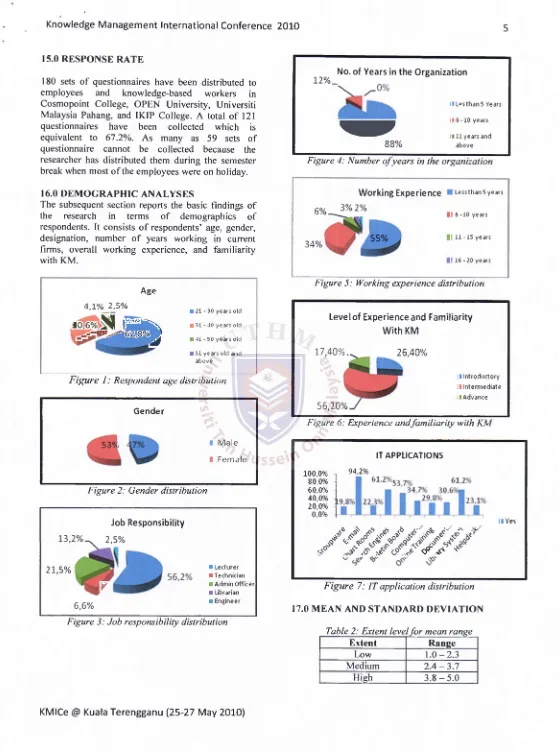
180 sets of questionnaires have been distributed to employees and knowledge-based workers in Cosmopoint College, OPEN University, Universiti Malaysia Pahang, and IKIP College. A total of 121 questionnaires have been collected which is equivalent to 67.2%. As many as 59 sets of questionnaire cannot be collected because the researcher has distributed them during the semester break when most of the employees were on holiday.
16.0 D E M O G R A P H I C A N A L Y S E S
The subsequent section reports the basic findings of the research in terms of demographics of respondents. It consists of respondents' age, gender, designation, number of years working in current firms, overall working experience, and familiarity with KM.
No. of Years in the Organization
12%_
w
88%
• L » s t h a n 5 Years
• 6 - 1 0 years
[image:6.595.29.588.15.767.2]i l l years and above
Figure 4: Number of years in the organization
Working Experience • Less t h a n 5 years
3% 2% 6%
34% 55%
I 6 -10 years
I 1 1 - 1 5 years
116 - 2 0 years
Age
4 , 1 % 2 , 5 %
• 2 1 - 3 0 years old
3 0 . 6 % N | ^ • 3 1 - 4 0 years old
" " " " 6 2 , 8 % ^
• 4 1 - 5 0 years old
• 5 1 years old and above
• 5 1 years old and above
Figure 1: Respondent age distribution
Gender
i Male
I Female
Figure 2: Gender distribution
Job Responsibility
13,2% 2,5%
21,5% • Lecturer
• Technician
• A d m i n Off icer
• Librarian
• Engineer
V
• Lecturer • Technician
• A d m i n Off icer
• Librarian
• Engineer 6,6%
• Lecturer • Technician
• A d m i n Off icer
• Librarian
• Engineer
Figure 3: Job responsibility distribution
Figure 5: Working experience distribution
Level of Experience and Familiarity With KM
17,40%.
56,20%
26,40%
l Introductory • I n t e r m e d i a t e
• Advance
Figure 6: Experience andfamiliarity with KM
IT APPLICATIONS
100,0% 80,0% -60,0% 40,0% 20,0% 0,0%
94,2%
l Yes >>
-/ W / / & / J
r-S # <r ^ ^
Figure 7: IT application distribution
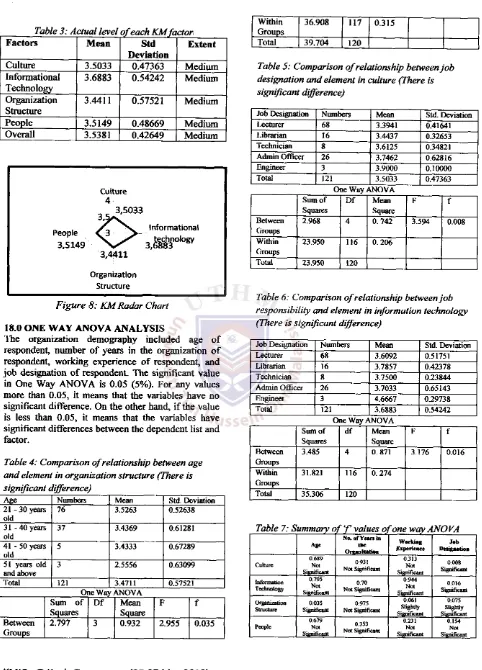
17.0 M E A N A N D S T A N D A R D D E V I A T I O N
Table 2: Extent level for mean range Extent R a n g e
Low 1 . 0 - 2 . 3
Medium 2 . 4 - 3 . 7
Table 3: Actual level of each KM factor
Factors Mean Std
Deviation
Extent
Culture 3.5033 0.47363 Medium Informational
Technology
3.6883 0.54242 Medium
Organization Structure
3.4411 0.57521 Medium
People 3.5149 0.48669 Medium Overall 3.5381 0.42649 Medium
Culture
4
, , 3,5033
People <3 > Informational
3,5149 3 , ® ° '0 e y
3,4411
Organization Structure
Figure 8: KM Radar Chart
18.0 ONE WAY ANOVA ANALYSIS
The organization demography included age of respondent, number of years in the organization of respondent, working experience of respondent, and job designation of respondent. The significant value in One Way ANOVA is 0.05 (5%). For any values more than 0.05, it means that the variables have no significant difference. On the other hand, if the value is less than 0.05, it means that the variables have significant differences between the dependent list and factor.
Table 4: Comparison of relationship between age and element in organization structure (There is significant difference)
Age Numbers Mean Std. Deviation 21 - 30 years
old
76 3.5263 0.52638
31 - 40 years old
37 3.4369 0.61281
41 - 50 years old
5 3.4333 0.67289
51 years old and above
3 2.5556 0.63099
Total 121 3.4711 0.57521
Sum o f Squares
D f Mean Square
F f
Between Groups
2.797 3 0.932 2.955 0.035
Within Groups
36.908 117 0.315
Total 39.704 120
Table 5: Comparison of relationship between job designation and element in culture (There is significant difference)
Job Designation Numbers Mean Std. Deviation
Lecturer 68 3.3941 0.41641 Librarian 16 3.4437 0.32653 Technician 8 3.6125 0.34821 Admin Officer 26 3.7462 0.62816
Engineer 3 3.9000 0.10000
Total 121 3.5033 0.47363
One Way ANOVA Sum of
Squares
Df Mean Square
F f
Between Groups
2.968 4 0.742 3.594 0.008
Within Groups
23.950 116 0.206
Total 23.950 120
Table 6: Comparison of relationship between job responsibility and element in information technology (There is significant difference)
Job Designation Numbers Mean Std. Deviation
Lecturer 68 3.6092 0.51751 Librarian 16 3.7857 0.42378 Technician 8 3.7500 0.23844 Admin Officer 26 3.7033 0.65143
Engineer 3 4.6667 0.29738
Total 121 3.6883 0.54242
One Way ANOVA
Sum of Squares
df Mean Square
F f
Between Groups
3.485 4 0.871 3.176 0.016
Within Groups
31.821 116 0.274
Total 35.306 120
Table 7: Summary of 'f values of one way ANOVA
Age
19.0 DISCUSSION
Based on the findings, it shows that the level of knowledge management in MSC status organizations in Kuantan is at a medium range. According Chong et al. (2006), there are many organizations which have just started implementing knowledge management initiatives. However, they are not aware of the whole spectrum of knowledge management implementation.
Another reason that may lead to the knowledge management level of this study to be in the medium range is because of human behavior. Lee and Fariza Hanum (2008) stated that Malaysians do not seem to practice sharing of knowledge in their working environment. Malaysians tend to keep their knowledge to themselves rather than sharing it with their colleagues. Besides that, the reason knowledge management in Malaysia is not that successful is due to the fact that most of the Malaysians are quite
self-centered, termed as "Chinese-man" culture. Most of
the people do not teach their skills to others. It is believed that once they teach their specific skills to others, they will lose their specialty or advantage.
The second objective of this study is to find out the relationship between demographic elements and knowledge management factors that can influence the implementation of knowledge management practices in MSC status organizations in Kuantan. Table 5 shows that job designation of respondents is the most important demographic factor that can influence the implementation of knowledge management practices and subsequently followed by age of respondent.
Table 7 shows that job designation has significant relationship with culture and information technology. There is a significant difference between job designation of respondents and culture. Perhaps, respondents with different job designation has different thinking pattern regarding sharing of knowledge. For example, lecturer is in the position to teach or share their knowledge with student. Thus, lecturers have higher tendency of sharing culture which is embedded into their daily work.
20.0 CONCLUSION
As a conclusion, the current knowledge management level among MSC status organization in Kuantan is in the medium range. The most important factor ranked is information technology which is in accordance to the finding of Syed Omar and Rowland (2004). It also shows that there is relationship
between some demographic elements and knowledge management factors which are represented by (1) the relationship between job designation with culture and information technology and (2) the relationship between age and organizational structure. Successful knowledge management practices in an organization depend on its wholesome integration of culture, structure, technology, and people. Although information technology plays a more significant role in knowledge sharing in an organization, the other three factors cannot be discounted. As such, information technology, culture, organizational structure and people should always be taken into critical considerations in KM implementations.
REFERENCES
Amlus Ibrahim, Hirun Azaman Ismail, Susita Hj. Asree, Mohd Radzai Said (2006). "Knowledge Management as Strategy For K-Economy: Looking At Malaysia Environment." Universiti Utara Malaysia.
Asoh, D., Belardo, S. and Neilson, R. (2002). "Knowledge Management: Issues, Challenges and Opportunities for Governments in the New Economy." Proceedings of the 35th Hawaii International Conference on System Sciences.
Bygstad, B. (2008). "Some Implementation Challenges of Knowledge Management Systems: A CRM Case Study." In Murray, E. J. "Knowledge management concepts, methodologies, tools, and applications." New York: Information Science Reference, pp.2334-2344.
Chua, Y. P. (2006). "Research Method." Malaysia: McGraw-Hill Companies.
Chong, C. W., Chong, S. C., Paul Heng, P. Y. (2006). "KM Implementation in Malaysian Telecommunication Industry." Industry Management & Data System. Vol.106 No.8. pp.1112-1132.
Chouride, P., Longbottom, D., and Murphy, W. (2003). "Excellence in knowledge management: an empirical study to identify critical factors and performance measures." Measuring Business Excellence. Vol.7. No.2. pp.29-45.
Darroch, J. (2005). "Knowledge Management,
Innovation and Firm Performance." Journal of
Gerald Goh Guan Gan (2006). "Knowledge Management Practices in Multimedia Super Corridor Status Companies In Malaysia." University Of Southern Queensland: Thesis Paper.
Greiner, M. E., BOhmann, T., Krcmar, H. (2007). "A Strategy for Knowledge Management." Journal Of Knowledge Management., Vol.11 No.6. pp.3-15.
Gupta, A. K. and Govindarajan, V. (2000). "Knowledge Management's Social Dimension: Lessons From Nucor Steel." Sloan Management Review. Vol.42 No.l. pp.71-81.
Josephine Lang C. Y. (2001). "Managerial Concerns in Knowledge Management." Journal Of Knowledge Management. Vol.5 No.l. pp.43-57.
Kim, S. H. and Lee, H. S. (2004). "Organizational Factors Affecting Knowledge Sharing Capabilities in E-Government: An Empirical Study."
Lakshman, C. (2007). "Organizational Knowledge Leadership: A Grounded Theory Approach." Leadership & Organization Development Journal. Vol.28 No.l. pp.51-75.
Lee Ai Leng and Fariza Hanum Md Nasaruddin. (2008). "Application of Knowledge Management in Malaysian Banks - A Pre-liminary Study." Faculty of Computer Science and Information
Technology, University Malaya.
Malhotra Y. (2005). "Integrating Knowledge Management Technologies in Organizational Business Processes: Getting Real Time Enterprises to Deliver Real Business Performance." Journal Of Knowledge Management. Vol. 9 No.l. pp.7-28.
Nonaka, I. and Takeuchi, H. (1995). "The Knowledge-Creating Company." Oxford: Oxford University Press.
Ramanathan Narayanan, Richardson, S. and Abdul Latif Salleh. (2003). "Knowledge Management: A Malyasian Study". Malaysian Management Review. Pp.79-87.
Randeree, E. (2006). "Knowledge Management: Securing the Future." Journal Of Knowledge Management. Vol.10 No.4. pp.145-156.
Tasmin, R. and Woods, P. C. (2007). "Relationship Between Corporate Knowledge Management and The Firm's Innovation Capability." International Journal of Technology and Management. Vol.8 No.l. pp.62-79.
Rosmaini Tasmin and Woods, P. C. (2008). "Knowledge Management Theories and Practices: An Empirical Survey." Proceedings in KM02008 Conference: Challenges of Knowledge Management, Va'asa, Finland.
Satyadas, A. and Harigopal, U. (2001). "Knowledge Management Tutorial: An Editorial Overview." IEEE Transactions on Systems, Man, and Cybernetics. Vol.31 No.4. pp.429-437.
Saunders, M., Lewis, P. and Thornhill, A. (2007), "Research Methods for Business Students", Prentice Hall.
Stukalina, Y. (2006). "New Challenges For The Educational Management in The Knowledge-based Society." Computer Modelling and New Technologies. Vol.10. No.2. pp.26-29.
Suresh, R. H. and Egbu, C. O. (2004). "Knowledge Management: Issues, Challenges And Benefits For A Sustainable Urban Enviroment."Leeds Metropolitan University.
Syed Omar Sharifuddin Syed-Ikhsan and Rowland, F. (2004). "Knowledge Management in A Public Organization: A Study On The Relationship Between Organizational Elements and The Performance of Knowledge Transfer." Journal Of Knowledge Management. Vol.8 No.2.
pp.95-111.
Syed Z. Shariq (1997). "Knowledge Management: An Emerging Discipline." The Journal Of Knowledge Management. Vol.1 No.l. pp.75-82.
Tasmin, R. (2008). "Knowledge Management and Innovation Among Manufacturing Firms in Peninsular Malaysia". Unpublished PhD Thesis. MMU Cybeijaya.
Wei, C. C., Choy, C. S. and Paul Yeow, H. P. (2006). "KM Implementation In Malaysian Telecommunication Industry." Industrial Management & Data System. Vol.106 No.8. pp.1112-1132.