
DEVELOPMENT OF EARLY WARNING METHODS FOR VOLTAGE INSTABILITY IN ELECTRIC POWER SYSTEM
TAI CHIA WUEN
A project report submitted in partial fulfillment of the requirement for the award of the
Degree of Master of Electrical Engineering
Faculty of Electrical and Electronic Engineering Universiti Tun Hussein Onn Malaysia
ABSTRACT
ABSTRAK
CONTENTS
TITLE
DECLARATION
DEDICATION
ACKNOWLEDGEMENT
ABSTRACT
CONTENTS
LIST OF TABLE
LIST OF FIGURES
LIST OF SYMBOLS
AND
ABBREVIATIONSCHAPTER
1
INTRODUCTION1.1 Project title
1.2
Introductioni
ii
iii
v
vii
CHAPTER 2 LITERATURE REVIEW
4
2.1 Definition
4
2.2 Case study for pervious work based on Phasor 4
Measurement Units (PMUs) applications
2.2.1 Wide area measurement system
(WAMS)
based 5applications
2.2.2 Application and analysis of optimum
PMU
9placement methods
2.3 Voltage stability overview I
2.3.1 Factors affecting voltage stability
2.3.2 Point of collapse
2.3.3 Conventional power flow
2.4 A Hilbert-Huang based approach for on-line
extraction of modal behavior from
PMU
data2.5 Case study on previous works that related to the
Kalman filter, extended Kalman filter and unscented
Kalman filter
2.5.1 Voltage stability margin identification using 17
local measurements and linear Kalman filter
2.5.2 Case study for pervious work on the extended 18
Kalman filter
2.5.3 Case study for pervious work on the unscented 19
CHAPTER 3 RESEARCH METHODOLOGY
22
3.1 Definition 22
3.2 Voltage instability predictor
(VIP)
223.3 Use of radial equivalent independent
(REI)
network 243.4 Application to
TNB
132 kV network 263.5 Methods of tracking Thevenin equivalent parameters 27
for online estimation
3.5.1 The Kalman filter algorithm 29
3.5.2 The extended Kalman filter algorithm
3.5.3 The unscented Kalman filter algorithm
CHAPTER 4 RESULTS
AND
DISCUSSION4.1 Definition
4.2 Results and analysis for two bus system
4.2.1 Results by using Kalman filter algorithm
4.2.2 Results by using extended Kalman filter algorithm
4.2.3 Results by using unscented Kalman filter algorithm
4.2.4 Discussion for the results in two buses system
4.3 Results and analysis for ten bus system
4.3.1 Results by using Kalman filter algorithm
4.3.2 Results by using extended Kalman filter algorithm
4.3.4 Discussion for the results in ten buses system
4.5
Overall discussionCHAPTER 5 CONCLUSIONS AND RECOMMENDATIONS
5.1 CONCLUSION
5 2
RECOMMENDATIONSLIST OF TABLE
4.
1
Changes of voltage and apparent power at specific time3 6
4 . 2 Value of the index fiom different method
41
4 . 3 Value of voltage and apparent power at time
0.16
seconds 42LIST
OFFIGURES
TNB
WAMS System ArchitectureTNB
real-time Human Machine Interface Visualization DisplayI
PMU location at Transmission Grid System
in
PeninsularMalaysia
GUI Power system oscillation and spectrum analyzer
Examples of power disturbance captured
Role of State Estimation in power system control and operation
Voltage stability phenomena and time responses
Two bus system
P-V curve for two bus system
A
continuation power-flow analysisLocal bus and the rest of the system treated
as
a Theveninequivalent
WAPS and the simplified network
General circuit for
RE1
networkDetail of
TNB
132 kV load area under investigationThe ongoing discrete Kalman Filter cycle
A
complete picture of the operation of theKalman
FilterA
complete picture of the operation of the Extended KalmanFilter
A complete picture of the operation of the Unscented
The apparent power at each bus and the RE1 network
Graph of load voltage with Thevenin voltage and load impedance
with Thevenin impedance by KF
The point of collapse traced by using KF algorithm
Graph of load voltage with Thevenin voltage and load impedance
with Thevenin impedance by EKF
The point of collapse traced by using EKF algorithm
with Thevenin impedance by
UKF
Graph of load voltage with Thevenin voltage and load impedance
The point of collapse traced by using UKF algorithm
Graph of real power profile for two buses system
1
Voltage at each bus and the
RE1
networkThe apparent power at each bus and the
RE1
networkGraph of load voltage with Thevenin voltage and load impedance
with Thevenin impedance by
KF
The point of collapse traced by using
KF
algorithmGraph of load voltage
with
Thevenin voltage and load impedancewith Thevenin impedance by
EKF
The point of collapse traced by using EKF algorithm
Graph of load voltage with Thevenin voltage and load impedance
with Thevenin impedance by UKF
The point of collapse traced by using UKF algorithm
xiv
LIST OF SYMBOLS AND ABBREVIATIONS
Active power
Admittance
Apparent impedance
Apparent power
Current
Imaginary Thevenin voltage
Kalman filter measurement vector
Kalman filter state vector
Kalman gain
Load impedance
Measurement noise covariance
Measurement noise
Process noise covariance
Process noise
Reactance
Reactive power
Real Thevenin voltage
Thevenin impedance
Thevenin reactance
Thevenin resistance
Voltage angle
CHAPTER 1
INTRODUCTION
1.1 Project title
The title of this project is "Development of Early Warning Mdlrods for Voltage Iustabitity in Ele& Power Sy&m "
1.2 Introduction
With the growing of demand in power system, voltage instability problem has become a challenge to power system operator. Load growth without a corresponding increase of transmission capacity has brought many power systems closer to their voltage stability boundaries, which leads to voltage instability problems increase.
The Malaysia power system is equipped with Phasor Measurement Units (PMUs). The implementation of the technology of PMU in real power systems is under the process currently. PMU technology is able to get a snapshot of the current system state by measuring such parameters as positive sequence voltage and current magnitude and angel and fiequency. By referring to the announcement on the increase in electricity tariff from [I], the continually increasing in load demand and fuel cost leads to an urgent needs to improve operational efficiencies utilization of transmission and distribution assets and reduction of losses. Therefore, Tenaga Nasional Berhad-Transmission (TNB-T) and TNB-Research (TNB-R) have joint collaboration in a 5-years research and development project on Wide-Area Intelligent Systems (WAIS) to enhance security and reliability of the power system network, and hence to provide system operators with real-time informatioh on proximity of the system to voltage collapse [2].
1.3 Objective and scope of study
There are three main objectives of conducting research on the methods for early warning of voltage instability in electric power system.
To investigate the countermeasures available in order to advise prevention purpose.
To develop and implement early warning methods on voltage instability. To predict the point of voltage collapse and improve the methods for prevention purpose.
The scope of the study is basically based on the analyzing data collected from
. PMUs system and few methods for voltage stability analysis. The actual data from
simulated data obtained from TNB-R are in the form of voltage and current Phasor which refer to its magnitude and angle. For the time being, TNB-R is using the latest PMUs technology that able to measure 50 samples per second. The experimental performance of simulation was conducted at TNB-R with the 132 kV load area under investigation.
CHAPTER 2
LITERATURE REVIEW
2.1 Definition
This chapter consists of the literature review and case study on the applications of PMUs and pervious researchers' methods for voltage stability study and analysis. It is directly related to the project, providing information on theories, models, materials
and techniques used in the research.
2.2 Case study for pervious work based on Phasor Measurement Units (PMUs) applications
PMUs are time-synchronized tool used by power engineers and system operators for
Wide-Area Measurement (WAMS) applications [3]. The BMUs measure time- synchronized voltage and current phasors that are time-stamped with high precision. PMUs are equipped with Global Positioning Systems (GPS) receivers that allow for the synchronization of the several readings taken at distant points. They rely on recursive algorithm for calculating symmetrical components of voltages and currents.
parametric (load) dependence to estimate the proximity of a power system to the voltage collapse. Some authors propose PMU-based algorithms to determine voltage collapse proximity. PMU-based measurements support real-time measurements of voltage and incident current phasors at observable system buses. The voltage phasors contain enough information to detect voltage-stability margin directly &om their measurements [4].
2.2.1 Wide area measurement system (WAMS) based applications
WAMS APPLICATION DATA ARCHIVER SERVER
OPERATION SERVER
PHASOR DATA CONCENfRATO
PMU SIMULATOR
PMU 5
-
-
TNB OPERATION-
pMd
N-OL
d PMU 4 [image:17.536.140.409.44.275.2]PMU 3
Figure 2. 1 TNB WAMS System Architecture [5]
The real-time monitoring system application development by TNB-R has completed the development of real-time voltages phase angle/magnitude and system frequencies visualization display, power oscillation, dynamic thermal circuit rating
and generator dynamic parameter monitoring system applications and historical analysis tools.
[image:17.536.163.408.424.616.2]Instantly, there are eight units of PMUs have been installed at TNB 275kV Main Intake substations which located at the four corners of the TNB grid system as shown in Figure 2.3. The installation basically to allow maximum observation of the TNl3 transmission power system under real operational conditions. The PMUs installation locations of are:-
[image:18.536.113.423.163.646.2]i. PLPS & JJNG [northern] ii. PAKA & KAWA [eastern] iii. ATWR & KULW [central] iv. YGPE & PMJY [southern region]
Power System Oscillation Monitoring System provides the information on dynamic characteristics of inter-area oscillation, together with information on oscillation frequency and damping coefficient. With this application, it will increase the knowledge of the operator with regards to the dynamic behavior of the grid, and for better Power System Stabilizer tuning.
Figure 2. 4 GUI Power system oscillation and spectrum analyzer [5]
Figure 2. 5 Examples of power disturbance captured [5]
2.2.2 Application and analysis of optimum PMU placement/methods
Kun, Lars, and Lennart (2009), had considered the optimum PUM placement methods with applications to state estimation accuracy. They considered geographic location of the PMUs within the power system naturally affects the value added by PMUs to one specific application in power grid control and operation. The analysis shows that there are considerable gains to be made in estimator accuracy if the PMUs are placed in accordance with this method when compared to the current placement strategy. It could be observed when the PMU monitored buses reaches a certain number in the entire network, the further introduction of phasor measurements will not be as effective in estimation accuracy improvement.
Old Estimates,
Measurements
[image:21.531.106.424.42.255.2]State Eetimaf on
Figure 2.6 Role of State Estimation in power system control and operation [7]
The study of optimum PMU placement methods with application to state estimation accuracy gives a significant gain in accuracy, especially for the angle estimates, if the PMUs are placed with priority given to estimation accuracy
improvement. However, in reality the decision of PMU placement is a compromise of many issues spanning from technology level up to enterprise vision which will be made based on comprehensive research.
2.3 Voltage stability overview
This sub-title gives a description of voltage stability and together with factors
causing voltage instability such as mechanisms for load restoration. An overview of voltage stability indices and the methods for voltage stability analysis also included. These indices are used to predict the proximity to voltage collapse. Power system voltage stability is a dynamic phenomenon involving power generation, transmission
Transient Voltage Stability Longe~Term Voltage Stability
Induchon Motor Dynamics LoadlPower Transfer lncrease
GeneratorlExatat~m Dynamics LTC Transf & D ~ s t Voltage Reg
!%me Mover control L a d D~vers~~IThe~mostat
Mech Swtched CapacitorslReactors Excitattm Llmitlng Gas Turbine Startup
Undervoltage load shedding Powerplant Operator
SVC Generahon ChangelAGC
Generator Inertla1 Dynamics Baler Dynamics L~nelTtansf Overload
DC DC Converter LTCs System Operator
Protehve Relaying Includmg Overload Protection
1 minute 10 minutes 1 hour
I I I
[image:22.526.88.431.56.314.2]I I 1 1 , 1 1 1 1 I 1 1 1 1 1 1 1 I I 1 1 1 1 1 1 1 I I 1 1 1 1 1 1 1 , 1 1 1 , 1 1 1
Figure 2. 7 Voltage stability phenomena and time responses [9]
2.3.1 Factors affecting voltage stability
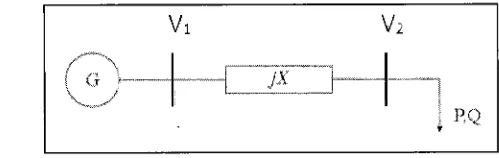
Voltage instability and collapse are dynamic and normally large disturbance phenomena, involving load, transmission and generation subsystems of large power systems. There are three key aspects of voltage stability. First is the reactive power support either through power transfer, or at loading point. The second is the load characteristics as seen fiom the bulk power network. The last is the available means for voltage control at generators and in the network [8]. In the main grid there is a strong connection between voltage magnitude, V and the reactive power, Q and similar between voltage angle, 6 and active power, P. Using the two-bus system as
Figure 2. 8 Two bus system
The generator is represented by an infinite bus supplying both reactive and active load, keeping the voltage at 1.0 p.u. The transmission line is represented by a reactance, jX and the load is constant power, both reactive power, Q and real power, P. Generally, voltages are solved using the Newton-Raphson algorithm in a load-
/
flow program, but the load voltage can be calculated analytically in this simple example. The solution of Equation (2.1) is the load voltage for the load-flow equations of the example, when the voltage angle is eliminated.
P-V curve presents load voltages as a hnction of load or sum of loads. Equation (2.1) yields two solutions of voltages to any set of load flow, represented by the upper and lower parts of the P-V curve.
Figure 2. 9 P-V curve for two bus system [8]
The description of the voltage stability phenomenon has been limited to a radial system because it presents a simple and clear picture of the problem. In practical power systems, many factors affect the progress of voltage collapse due to voltage instability. However, the major disadvantages of the power flow situation will diverge near the nose or maximum power point on the curve. Also, generation must be rescheduled as the area load is increased in reality. Hence, the curves are dynamics in real time and will not to static.
2.3.2 Point of collapse
The point of collapse method [lo] solves the conditions for the bifurcation point.
f
( x , 2) = 0f
(XI4
= 0D x f ( x , 2) = 0 OR
D,T
f (x, A) = 0 (2.2)Ilvll
+
0llwll
*
0Where, the
D,f
(x, A) is the system Jacobian and the w and v are the left and right eigenvectors. The bihrcation point is characterized by the steady-state Jacobian, denoted byD L
f
(z, A) having a single and unique zero eigenvalue, with non-zero left1
and right eigenvectors. These conditions can be summarized by Equation (2.2). This method has the advantage of producing lefi and right eigenvector information. The left eigenvector can be used to compute an optimal control strategy to avoid saddle- node bifurcations, whereas the right eigenvector can be used to detect variables (areas) in the network prone to voltage collapse.
2.3.3 Conventional power flow
Bus voltage ,,+ Predictor
A
.
--- ._ --: > - - - 4- . - - . - Corrector 2-
9.
C
--'.
E
-.
D'p:,,
G
.
F Exact solution ..1'
..* /'
/
,'
[image:26.524.113.391.54.244.2]Load
Figure 2. 10 A continuation power-flow analysip [8]
From a known initial solution (A), a tangent predictor is used to estimate the solution (B) for a specified pattern of load increase. The corrector step then determines the exact solution (C) using a conventional power-flow analysis with the system load assumed to be fured. The voltages for a hrther increase in load are then predicted based on a new tangent predictor. If the new estimate load (D) is now beyond the maximum load on the exact solution, a corrector step with fixed loads would not converge; therefore, a corrector step with a fixed voltage at the monitored bus is applied to find the exact solution (E). As the voltage stability limit is reached, the size of load increase has to be reduced gradually during the successive predictor
2.4 A Hilbert-Huang based approach for on-line extraction of modal
behavior from PMU data
Zarraga, F. L., A. L. Rios, et al. in 2009, had proposed on Hilbert Huang based approach for the on-line extraction of modal behavior from PMU data. They found that the Hilbert Huang Transform (HHT) and empirical mode decomposition (EMD) was an efficient method for analyzing the local dynamics of transient oscillations. Two novel approaches are investigated to characterize non-stationary issues.
The first method is a local implementation of the EMD technique. The second technique is an algorithm to compute the Hilbert transform using variable window filters. By combining a sliding window of finite length with tlie sifting process by blocks, a local implementation of the empirical mode decomposition is proposed. Approaches to extending Hilbert-Huang analysis to analyze the local properties of general non-stationary signals are then explored based on finite-impulse-response (FIR) designed using Kaiser Window. This approach enables the Hilbert-Huang technique to be a truly online analysis technique for measured data. The application of these techniques is tested on time-synchronized phasor measurements collected by Phasor Measurement Units [12]. In this paper an efficient method for analyzing the local dynamics of transient oscillations using a local EMD and the Hilbert transform is presented. The results at the early stage of the applications using this technique imply that the method is accurate, and capable of identifying multiple modal characteristics.
2.5 Case study on previous works that related to the Kalman filter,
extended Kalman filter and unscented Kalman filter
This section include case study for the related methods which are suitable for the application in tracking the Thevenin equivalent parameters. The Thevenin equivalent networks are connected to a bus and a load. Tracking the Thevenin equivalent is the essential of the voltage collapse detection. There are many methods to track the Thevenin parameters. The methods being used in this project are the Kalman Filter, Extended Kalman Filter and the Unscented Kalman Filter. The more detail information for these methods will be discussed in Chapter 3. An analysis of the results from these three methods will be compare and discuss in and Chapter 4.
1
2.5.1 Voltage stability margin identification using local measurements and
linear KaIman filter
2.5.2 Case study for pervious work on the extended Kalman filter
Hongwen, Rui et al. (201 1) had introduced the State-of-Charge Estimation of the Lithium-Ion Battery Using an Adaptive Extended Kalman Filter (EKF). EKF algorithm is able to obtain a better convergent and robust result that can greatly improve the dependence of the traditional filter algorithm on the battery model. The typical characteristics of the lithium-ion battery are analyzed by experiment. An improved Thevenin battery model is achieved and model parameters are identified by using the EKF algorithm. There is a comparison between the EKF algorithm and the adaptive EKF and yet the results for adaptive EKF which present that the estimation algorithm has higher accuracy compared with the EKF algorithm. Normally, the EKF
I
algorithm possesses certain stability; however, it easily causes divergence due to the error existing in the model and the noise statistics, particularly the noise statistics evaluated by the trial-and-error method [15].
Sayadi, 0. and M. B. Shamsollahi (2008) had introduced the efficient denoising and lossy compression schemes for electrocardiogram (ECG) signals based on a modified EKF structure. They have chosen the EKF for its simplicity and more numerical stability. However, the overall filtering performance is expected to be better with Extended Kalman Smoother or Unscented Kalman Filter [16].
Pera, x, et al. (2007) stated that the Kalman filter and its extensions has been widely studied and applied in positioning, in part because its low computational complexity is well suited to small mobile devices. While these filters are accurate for problems with small nonlinearities and nearly Gaussian noise statistics, they can perform very badly when these conditions do not prevail. In these paper "Robust Extended Kalman Filtering in Hybrid Positioning Applications", there are two methods to robustifj the Kalman filter are presented. Six robust EKF together with the classical EKF and the second order EKF (EKF2) are tested in numerical simulations. Based on the simulations, the proposed methods seem to outperform EKF and EKF2 in contaminated cases and do almost as well in normal cases [17].
large errors in the true posterior mean and covariance of the transformed Gaussian random variables, which may sometimes lead to divergence of the filter.
2.5.3 Case study for pervious work on the unscented Kalman filter
Wan and Van der Menve (2000) had investigated on the Unscented Kalman Filter (UKF) for Nonlinear Estimation. They points out the flaws in using the EKF, and introduces an improvement which is the UKF. A central and hndamental operation performed in the Kalman Filter is the propagation of a Gaussian random variable (GRV) through the system dynamics. The EKF state distribution is approximated by a GRV, which will propagate analytically through the frst-order linearization of the
1
nonlinear system. This can caused large errors in the true posterior mean and covariance of the transformed GRV, which may lead to sub-optimal performance and sometimes divergence of the filter. The UKF addresses this problem by using a deterministic sampling approach. The state distribution is again approximated by a GRV [IS]. In this paper, comparison has been made between the results by using the EKF and UKF. The UKF consistently achieves a better level of accuracy than the EKF at a comparable level of complexity.
Partovibakhsh, M. and L. Guangjun (2012) had published an American control conference paper which entitled "Online Estimation of Model Parameters and State-of-Charge of Lithium-Ion Battery using Unscented Kalman Filter". In this paper, based on the equivalent circuit model of the Lithium-Ion battery, the UKF algorithm has been employed for online estimation of model parameters. As many factors affect the battery performance during charge and discharge, by this method the validity of the battery model has been increased and the obtained results have shown good consistency with offline calculations [19]. Experiments have been conducted on a wheeled-mobile robot, and the results have been compared between the EKF and the UKF. The obtained results have shown that the UKF algorithm has provided improved performance in comparison with EKF.
digital map to estimate the vehicle states. They are using the road geometry information obtained fiom a digital map data base. The measurements of DGPS and INS are used to set up the dynamic and measurement equations of the nonlinear filtering. The vehicle states are first estimated by the loosely coupled DGPSIINS system and the unconstrained Unscented Kalman Filter (UUKF), and after that the UUKF estimates are projected into the state constraints to obtain the final CUKF estimates. Synthetic and real data are used to evaluate the performance of the CUKF algorithm for fising DGPS, INS and digital map [20]. The results obtained fiom the computer simulations demonstrated that the CUKF can improve the estimation accuracy of the vehicle states effectively.
Ghahremani, E. and 1. Kamwa (2011) had investigated on the online state estimation of synchronous generator by using the Unscented Kalman Filter. They proposed online state estimator in the model based category according to above classification, uses the UKF algorithm to generate the estimated states fiom the available signals obtained fiom a Phasor Measurements Units (PMU), which is assumed to be installed in the substation of a power plant [21]. The UKF algorithm allows to overcome the limitations of the linearization process required by the traditional EKF method, and also to increase the operational range of the system variables around the operating point by not using the linearization in the state estimation algorithm. The implemented UKF based scheme produced high quality results and also showed greater accuracy of the state estimates in the presence of noise, compared to the traditional EKF method.
CHAPTER 3
RESEARCH METHODOLOGY
I
3.1 Definition
This important chapter explains in detail the samples, instruments, materials,
procedures and data gathering methods used in this project research. The proposed methods of early warning for voltage instability is based on analyzing the collected data fiom PMUs at the selected load area which under investigation by TNB-R.
3.2 Voltage instability predictor (VIP)
The VIP method is based on the assumption that voltage instability is closely related
Figure 3. 1 Local bus and the rest of the system treated as a Thevenin equivalent [8]
It is noted that no assumption has been made about the characteristic of the load. The apparent impedance Z,,, is merely the ratio between the voltage pnd current phasors measured at the bus. Tracking the Thevenin equivalent is essential for the detection of voltage collapse.
There are many methods to track the Thevenin parameters. The tracking is based on Equation (3.1).
Eth =
v
+
Zth. I (3.1) Denoted that:Eth = E,.
+
jEiV = V , + j V i
1 = 1,.
+
)Ii Rewritten the above equations into a matrix form: [image:34.535.125.396.52.194.2]oscillations, a larger data window needs to be used. The estimation therefore attempts to minimize the error in a least-square sense.
3.3 Use of radial equivalent independent network
The complexity of the interconnectivity of power system network today has created a big challenge to and has received attention by power system engineers to simplify the network for efficient system analysis. In 1970s, P. Dimo introduced an equivalent network for power system called Radial Equivalent Independent (REI) network. By the use of RE1 network, the analysis can be simplified by decreasing the size of the system to few nodes. Wide Area Power System (WAPS) ard divided into three subsystems, which are internal power system, external power system, and boundary power system as shown in Figure 3.2 [2].
Internal Boundary External System Network System
[image:35.513.90.402.338.546.2]I I I I I I I I I I
Figure 3. 2 WAPS and the simplified network [2]
[I] TNB Announcement on the Increase in Electricity TMI# in Peninsular
Malaysia Due to the Revision of Natural Gas Price, Revision of Base Tarzfl&
1
Implementation of Feed-In-Tarz#(FiT) for Renewable Energy (RE). 201 1.
[2] Sarmin, M.K.N.M., W. Nakawiro, et al., Real-Time Voltage Stability
Monitoring For W B Network Proceedings of the IASTED Asian Conference
Modelling, Identification, and Control, 2012. (AsiaMIC 2012): p. 7.
[3] Karlsson, D., M. Hemrningsson, and S. Lindahl, Wide area system
monitoring and control
-
terminology, phenomena, and solutionimplementation strategies. Power and Energy Magazine, IEEE, 2004.2(5): p.
68-76.
[4] Momoh, J.A., X. Yan, and G. Boswell. Voltage stability enhancement using
Phasor Measurement Unit ( P m technology.
in
Power Symposium, 2008.NAPS '08. 40th North American. 2008.
[5] Sheikh Abdullah, S.K. and N.S.
Ni
Yusuf. Tenaga nasional berhad WideArea Measurement System based applications.
in
Power and EnergyConference, 2008. PECon 2008. IEEE 2nd International. 2008.
[6] Kun, Z., L. Nordstrom, and L. Ekstam. Application and analysis of optimum PMU placement methods with application to state estimation accuracy. in
Power & Energy Society General Meeting, 2009. PES '09. IEEE. 2009.
[7] Hongxian, W. and J. Giri. PMU Impact on State Estimation Reliability for
Improved Grid Security. in Transmission and Distribution Conference and
Exhibition, 2005/2006 IEEE PES. 2006.
[8] Warland, L. and A.T. Holen. A voltage instability predictor using local area
Taylor, C.W., Power System Voltage Stability.
.
Vol. The EPRI PowerSystem Engineering Series. 1994: McGraw-Hill, Inc.
Canizares, C.A. and F.L. Alvarado, Point of collapse and continuation
methods for large AC/DC systems. Power Systems, IEEE Transactions on,
1993.8(1): p. 1-8.
Kundur, P., Power System Stability and Control. 1994: McGraw-Hill, Inc. Zarraga, F.L., et al. A Hilbert-Huang based approach for on-line extraction
of modal behavior @om PMU data. in North American Power Symposium
(NAPS), 2009.2009.
Norden E Huang, S.S.P.S., Hilbert-Huang Transform and Its Applications.
Vol. 5.2005: World Scientific Publishing Co. Re. Ltd.
Alamrnari, R.A., Voltage Stability Margin Identzjkation Using Local
Measurements And Linear Kalman Filter. Engineering Journal of the
University of Qatar, 2002.15: p. 153- 164.
Hongwen, H., et al., State-of-Charge Estimation of the Lithium-Ion Battery
Using an Adaptive &tended Kalman Filter Based on an Improved Thevenin
Model. Vehicular Technology, IEEE Transactions on, 20 1 1. 60(4): p. 146 1
-
1469.
Sayadi, 0. and M.B. Shamsollahi, ECG Denoising and Compression Using a
Modified Extended Kalman Filter Structure. Biomedical Engineering, IEEE
Transactions on, 2008.55(9): p. 2240-2248.
Pera, et al. Robust Extended Kalman Filtering in Hybrid Positioning
Applications. in Positioning, Navigation and Communication, 2007. WPNC
'07. 4th Workshop on. 2007.
Wan, E.A. and R. Van der Merwe. The unscented Kalman filter for nonlinear
estimation. in Adaptive Systems for SignaI Processing, Communications, and
Control Symposium 2000. AS-SPCC. The IEEE 2000,2000.
Partovibakhsh, M. and
L.
Guangiun. Online estimation of model parametersand state-of-charge of Lithium-Ion battery using Unscented Kalman Filter. in
American Control Conference (ACC), 201 2.20 12.
Li, W. and H. Leung. Constrained unscented Kalman JiIter based fusion of
GPS/DLS/digital map for vehicle localization. in Intelligent Transportation
![Figure 2. 1 TNB WAMS System Architecture [5]](https://thumb-us.123doks.com/thumbv2/123dok_us/8775296.901090/17.536.163.408.424.616/figure-tnb-wams-system-architecture.webp)
![Figure 2. 3 PMU location at Transmission Grid System in Peninsular Malaysia [5]](https://thumb-us.123doks.com/thumbv2/123dok_us/8775296.901090/18.536.113.423.163.646/figure-pmu-location-transmission-grid-system-peninsular-malaysia.webp)
![Figure 2. 4 GUI Power system oscillation and spectrum analyzer [5]](https://thumb-us.123doks.com/thumbv2/123dok_us/8775296.901090/19.536.169.385.165.342/figure-gui-power-oscillation-spectrum-analyzer.webp)
![Figure 2. 5 Examples of power disturbance captured [5]](https://thumb-us.123doks.com/thumbv2/123dok_us/8775296.901090/20.536.113.432.54.198/figure-examples-power-disturbance-captured.webp)
![Figure 2.6 Role of State Estimation in power system control and operation [7]](https://thumb-us.123doks.com/thumbv2/123dok_us/8775296.901090/21.531.106.424.42.255/figure-role-state-estimation-power-control-operation.webp)
![Figure 2. 7 Voltage stability phenomena and time responses [9]](https://thumb-us.123doks.com/thumbv2/123dok_us/8775296.901090/22.526.88.431.56.314/figure-voltage-stability-phenomena-time-responses.webp)
![Figure 2. 9 P-V curve for two bus system [8]](https://thumb-us.123doks.com/thumbv2/123dok_us/8775296.901090/24.522.110.404.51.282/figure-p-v-curve-bus.webp)
![Figure 2. 10 A continuation power-flow analysip [8]](https://thumb-us.123doks.com/thumbv2/123dok_us/8775296.901090/26.524.113.391.54.244/figure-continuation-power-flow-analysip.webp)
![Figure 3. 1 Local bus and the rest of the system treated as a Thevenin equivalent [8]](https://thumb-us.123doks.com/thumbv2/123dok_us/8775296.901090/34.535.125.396.52.194/figure-local-bus-rest-treated-thevenin-equivalent.webp)
