Training a Functional Link Neural Network
Using an Artificial Bee Colony for Solving a
Classification Problems
Yana Mazwin Mohmad Hassim and Rozaida Ghazali
Abstract—Artificial Neural Networks have emerged as an important tool for classification and have been widely used to classify a non-linear separable pattern. The most popular artificial neural networks model is a Multilayer Perceptron (MLP) as is able to perform classification task with significant success. However due to the complexity of MLP structure and also problems such as local minima trapping, over fitting and weight interference have made neural network training difficult. Thus, the easy way to avoid these problems is to remove the hidden layers. This paper presents the ability of Functional Link Neural Network (FLNN) to overcome the complexity structure of MLP by using single layer architecture and propose an Artificial Bee Colony (ABC) optimization for training the FLNN. The proposed technique is expected to provide better learning scheme for a classifier in order to get more accurate classification result.
Index Terms— Neural Networks, Functional Link Neural Network, Learning, Artificial Bee Colony.
—————————— ——————————
1 I
NTRODUCTIONRTIFICIAL Neural Networks have been known to be successfully applied to a variety of real world classification tasks especially in industry, business and science [1, 2]. Artificial Neural Networks (ANNs) especially the Multilayer Perceptron (MLP) are capable of generating complex mapping between the input and the output space in performing arbitrarily complex nonlinear decision boundaries. For a classification task, ANNs needs to be “trained” for the network to be able to pro-duce the desired input-output mapping. In training phase, a set of example data are presented to the network and the connection weights of the network are adjusted by using a learning algorithm. The purpose of the weights adjustment is to enable the network to “learn” so that network would adapt to the given training data.
The most common architecture of ANNs is the multi-layer feedforward network (MLP). MLP utilize a super-vised learning technique called Backpropagation for training the network. However, due to its multi-layered structure, the training speeds are typically much slower as compared to other single layer feedforward networks [3]. Problems such as local minima trapping, overfitting and weight interference also make the network training in MLP become challenging [4]. Hence, Pao [5] has intro-duce an alternative approach named Functional Link Neural Network (FLNN) in avoiding these problems. This approach removes the hidden layer from the ANN architecture to help in reducing the neural architectural complexity and provides them with an enhancement
rep-resentation of input nodes for the network to be able to perfom a non-linear separable classification task[5, 6].
In this paper, we describe an overview of FLNN and the proposed Artificial Bee Colony (ABC) as learning al-gorithm in order to achieve better classification abilility. The rest of this paper is organized as follows: A back-ground and related work regarding to the Multilayer Per-ceptron, FLNN and Population-based optimization tech-nique are given in section 2. The proposed Population-based optimization for training the FLNN is detailed in section 3. The simulation result of the proposed learning scheme is presented in section 4. Finally, the paper is con-cluded in section 5.
2
RELATED WORK2.1 Artificial Neural Network
Artificial Neural Networks (ANNs) are information cessing model inspired by the way of human brain pro-cesses information. ANNs required knowledge through a learning process while the interneuron connection strength known as synaptic weights are used to store knowledge [7]. Therefore with these abilities, Neural Networks provides a suitable solution for pattern recog-nition or data classification problems.
One of the best known types of Neural Networks is the Multilayer Perceptron (MLP). It has one or more hidden layers in between the input and the output layer. Figure 1 illustrates the layout of MLP with single hidden layer. The function of hidden neurons is to provide the ANNs with the ability to handle non-linear input-output map-ping. By adding one more hidden layer, the network is able to extract higher order statistics, which is particularly valuable when the size of the input layer is large [7].
————————————————
• Yana Mazwin Mohmad Hassim is with the Universiti Tun Hussein Onn
Malaysia, 86400 Parit Raja, Batu Pahat, Johor, Malaysia.
• Rozaida Ghazali is with the Universiti Tun Hussein Onn Malaysia, 86400 Parit Raja, Batu Pahat, Johor, Malaysia.
A
Fig. 1. The structure of single hidden layer MLP with Backpropa-gation algorithm
The MLP networks are trained by adjusting the weight of connection between neurons in each layer. For training the network, MLP utilize a supervised learning technique called Backpropagation, in which the network is provided with examples of the inputs and desired outputs to be computed, and then the error (difference between actual and expected results) will be calculated. Figure 1, depict-ed an example of MLP with Backpropagation. With this architecture, the neurons are organized in layers and their signals are sent “forward” while the calculated errors are then propagated backwards. The idea of the backpropa-gation algorithm is to reduced error, until the networks learned the training data. The training began with ran-dom weights, and the goal is to adjust them until the min-imal error is achieved.
2.2 Higher Order Neural Network
Higher order Neural Networks (HONNs) is a different type of neural network with the presence of expanded input space in it single layer feed-forward architecture. HONNs contain summing unit and product units that multiply their inputs. These high order terms or product units can increase the information capacity for the input features and provides nonlinear decision boundaries to give a better classification capability than the linear neu-ron [8]. A major advantage of HONNs is that only one layer of trainable weight is needed to achieve nonlinear separable, unlike the typical MLP or feed-forward neural network [9].
Although most neural networks models share a com-mon goal in performing functional mapping, different network architecture may vary significantly in their abil-ity in handle different types of problems. For some tasks, higher order architecture of some of the inputs or activa-tions may be appropriate to help form good representa-tion for solving the problems. HONNs are needed be-cause ordinary feed-forward network like MLP cannot avoid the problem of slow learning, especially when in-volving highly complex nonlinear problems [10].
2.2.1 Functional Link Neural Network
Functional Link Neural Network (FLNN) is a class of Higher Order Neural Networks (HONNs) that utilize higher combination of its inputs [5, 6]. It was created by Pao [6] and has been successfully used in many applica-tions such as system identification [11-16], channel equal-ization [3], classification [17-20], pattern recognition [21, 22] and prediction [23, 24]. In this paper, we would dis-cuss on the FLNN for the classification task. FLNN is much more modest than MLP since it has a single-layer network compared to the MLP but still is able to handle a non-linear separable classification task. The FLNN archi-tecture is basically a flat network without any hidden layer which has make the learning algorithm used in the network less complicated [9]. In FLNN, the input vector is extended with a suitably enhanced representation of the input nodes, thereby artificially increasing the dimension of the input space [5, 6].
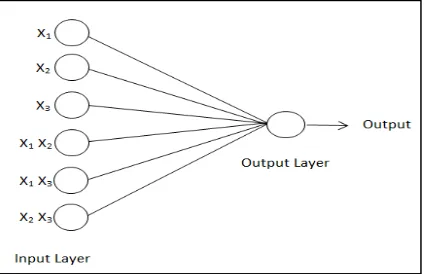
Fig. 2. The 2nd order FLNN structure with 3 inputs
Our focused on this work is on Functional link neural networks with generic basis architecture. This architec-ture uses a tensor representation. In tensor model the in-put features of x for example
x
i, can be enhance intox
ix
j,xixjxk and more with condition of i≤ j≤ k. The enhanced input features from the input layer are fed into the net-work and the output nodes, in the output layer calculates the weighted sum of inputs and passes it through activa-tion funcactiva-tion to produce network output, y. Pao [6], Patra [12], Namatamee [25] has demonstrated that this architec-ture is very effective for classification task. Figure 2 de-picts the functional link neural network structure up to second order with 3 inputs. The first order consist of the 3 inputs x1, x2 and x3, while the second order of the net-work is the extended input based on the product unit
x1x2, x1x3, and x2x3. The learning part of this architecture
on the other hand, consists of a standard Backpropagation as the training algorithm.
In most previous researches, the learning algorithm used for training the FLNN is the Backpropagation (BP) [4]. Table I below summarizes recent studies on FLNN for classification.
[image:2.612.321.533.282.419.2]TABLE 1
previous research on FLNN Training[4]
Reference Method Learning algorithm
[26] ClFLNN Pseudoinverse
[27] EFLN BP-learning
[28] ClaFLNN Genetic Algorithm
with BP-learning
[18] GFLNN Adaptive learning
[9] FLANN BP-learning
[29] ClasFLNN BP-learning
[24] FLNN BP-learning
Even though BP is the mostly used algorithm in train-ing the FLNN, the algorithm however, has several limita-tions. First, it is easily get trapped in local minima espe-cially for those non-linearly separable classification prob-lems. Second, the convergence speed of the BP learning is too slow even if the learning goal can be achieved. Third, the convergence behavior of the BP algorithm depends on the choices of initial values of the network connection weights as well as the parameters in the algorithm such as the learning rate and momentum [4]. For these reasons, a further investigation to improve a learning algorithm used in tuning the learnable weights in FLNN is desired.
2.3 Artificial Bee Colony
The Artificial Bees Algorithm is an optimization tool, which provides a population-based search procedure [30]. The ABC algorithm simulates the intelligent foraging behavior of a honey bee swarm for solving multidimen-sional and multimodal optimization problem [31]. In population-based search procedure, each individual pop-ulation called foods positions are modified by the artifi-cial bees while the bee’s aim is to discover the places of food sources with high nectar amount and finally the one with the highest nectar.
In this model, the colony of artificial bees consists of three groups: which are employed bees, onlookers and scouts [32]. For each food source there is only one artifi-cial employed bee. The number of employed bees in the colony is equal to the number of food sources around the hive. Employed bees go to their food source and come back to hive and with three information regarding the food source: 1) the direction 2) its distance from the hive and 3) the fitness and then perform waggle dance to let the colony evaluate the information. Onlookers watch the dances of employed bees and choose food sources de-pending on dances. After waggle dancing on the dance floor, the dancer goes back to the food source with fol-lower bees that were waiting inside the hive. This forag-ing process is called local search method as the method of choosing the food source is depend on the on the experi-ence of the employed bees and their nest mates [31]. The employed bee whose food source has been abandoned becomes a scout and starts to search for finding a new
food source randomly without using experience. If the nectar amount of a new source is higher than that of the previous one in their memory, they memorize the new position and forget the previous one [31]. This explora-tion managed by scout bees is called global search meth-ods.
Several studies done by [31-33] has described that the Artificial Bee Colony algorithm is very simple, flexible and robust as compared to the existing population-based optimization algorithms: Genetic Algorithm (GA) , Dif-ferential Evolution (DE) and Particle Swarm Optimization (PSO) in solving numerical optimization problem. As in classification task in data mining, ABC algorithm also provide a good performance in gathering data into classes [34]. Hence motivated by these studies, the ABC algo-rithm is utilized in this work as an optimization tool to optimize FLNN learning for solving classification prob-lem.
3
PROPOSED TRAINING SCHEMEInspired by the robustness and flexibility offered by the population-based optimization algorithm, we proposed the implementation of the ABC algorithm as the learning scheme to overcome the disadvantages caused by back-propagation in the FLNN training. The proposed flowchart is presented in figure 4. In the initial process, the FLNN architecture (weight and bias) is transformed into objective function along with the training dataset. This objective function will then be fed to the ABC algo-rithm in order to search for the optimal weight parame-ters. The weight changes are then tuned by the ABC algo-rithm based on the error calculation (difference between actual and expected results).
Fig. 4. The proposed Training scheme for FLNN-ABC
[image:3.612.345.533.466.702.2]Based on the ABC algorithm, each bee represents the so-lutions with a particular set of weight vector. The ABC algorithm [35] used for training the FLNN is summarized as follow:
1. Cycle 0:
2. Initialize a population of scout bee with random solu-tion xi , i = 1,2, .. SN
3. evaluate fitness of the population
a. initialize weight and bias for the FLNN 4. cycle 1: while Maximum cycle not reached,
repeat step 5- step 11
5. form new population vi for the employed bees using:
where k is a solution in the neighbourhood of i, Φ is a random number in the range [-1,1] and evaluate them.
a. Form new weight and bias for FLNN
6. Calculate fitness function on new population
7. Apply the greedy selection process between xij and vij 8. Calculate the probability values pifor the solutions xi
using:
9. If the onlookers are distributed a. Go to step 11
10. else
a. Repeate step 5 until step 8 for onlookers. 11. Apply the greedy selection process for onlookers, vi 12. Determine the abandoned solution for the scout, if
exists, and replace it with a new randomly produced solution xiusing:
13. Memorize the best solution
a. Update new weight and bias for the FLNN 14. cycle=cycle+1
15. Stop when cycle = Maximum cycle 16. Save updated FLNN new weight and bias.
4
SIMULATION RESULTIn order to evaluate the performance of the proposed learning scheme FLNN-ABC for classification problem, simulation experiments were carried out on a 2.30 GHz Core i5-2410M Intel CPU with 8.0 GB RAM in a 64-bit Operating System. The comparison of standard BP train-ing and ABC algorithms is discussed based on the simula-tion results implemented in Matlab 2010b. In this work we considered 4 benchmark classification problems, Breast Cancer Wisconsin, PIMA Indian Diabetes and BU-PA Liver Disorder.
During the experiment, simulations were performed on the training of MLP architecture with Backpropagation
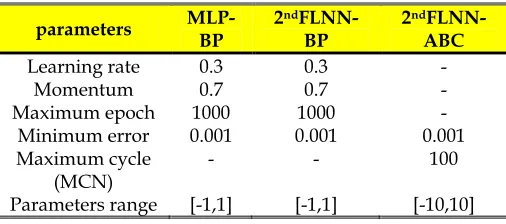
[image:4.612.305.558.277.389.2]algorithm (MLP-BP), second order FLNN architecture with Backpropagation algorithm (2ndFLNN-BP) and se-cond order FLNN architecture with ABC algorithm (2ndFLNN-ABC) as their learning scheme. The best train-ing accuracy for every benchmark problems is taken out from these simulations. The Learning rate and momen-tum used for both MLP-BP and 2ndFLNN-BP were 0.3 and 0.7 with the maximum of 1000 epoch and minimum er-ror=0.001 as for the stopping criteria. Parameters setup for the 2ndFLNN-ABC however, only involved the setting up of stopping criteria of maximum 100 cycles and mini-mum error=0.001. The activation function used for the network output for both MLP and 2ndFLNN is Tangent Hyperbolic sigmoid function. Table 2 below summarized the parameters considered in this simulation.
TABLE 2
Parameters considered MLP-BP, 2nd order FLNN-BP and 2nd order FLNN-ABC simulation
parameters
MLP-BP
2nd
FLNN-BP
2nd
FLNN-ABC
Learning rate 0.3 0.3 -
Momentum 0.7 0.7 -
Maximum epoch 1000 1000 -
Minimum error 0.001 0.001 0.001
Maximum cycle (MCN)
- - 100
Parameters range [-1,1] [-1,1] [-10,10]
The reason of conduction a simulation on MLP and FLNN architectures is to provide a comparison on neural complexity between standard Artificial Neural Network and Higher Order Neural Network. In this simulation we used a single hidden layer of MLP with the numbers of hidden nodes equal to it input features while for the FLNN architecture we used a second order input en-hancement (2ndFLNN) to provide a nonlinear input-output mapping capability. The neural complexity refers to the numbers of trainable parameters (weight and bias) needed to implement good approximation in each neural network architecture. The less numbers of parameters indicate that the network required less computational load as there are small numbers of weight and bias to be updated at every epoch or cycle and thus led to a faster convergence. Table 3 below shows the comparison of network complexity for each benchmark problems.
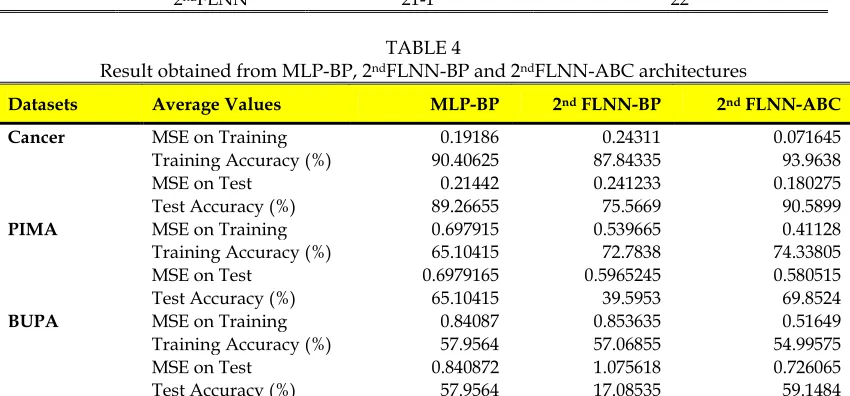
Ten trials were performed on each simulation of the MLP-BP, 2ndFLNN-BP and 2ndFLNN-ABC with the best training accuracy result is taken out from these 10 trials. In order to generate the Training and Test sets, each da-tasets were randomly divided into two equal sets (1st-Fold and 2nd-Fold). Each of these two sets was alternatively used either as a Training set or as a Test set. The average values of each datasets result were then used for compar-ison. Table 4 below, presents the simulation result of MLP-BP, 2ndFLNN-BP and 2ndFLNN-ABC architectures. It is shown that, the implementation of ABC as the training scheme for FLNN-ABC provides better accuracy on Test set compared to FLNN-BP and MLP-BP.
TABLE 3
Comparison on complexity of the architecture between MLP and FLNN for each benchmark datasets
Datasets Network type Network structure No of parameters/dimensions (D)
Cancer MLP 9-9-1 100
2ndFLNN 45-1 46
PIMA MLP 8-8-1 83
2ndFLNN 36-1 37
BUPA MLP 6-6-1 49
2ndFLNN 21-1 22 TABLE 4
Result obtained from MLP-BP, 2ndFLNN-BP and 2ndFLNN-ABC architectures
Datasets Average Values MLP-BP 2nd FLNN-BP 2nd FLNN-ABC
Cancer MSE on Training 0.19186 0.24311 0.071645 Training Accuracy (%) 90.40625 87.84335 93.9638 MSE on Test 0.21442 0.241233 0.180275 Test Accuracy (%) 89.26655 75.5669 90.5899
PIMA MSE on Training 0.697915 0.539665 0.41128 Training Accuracy (%) 65.10415 72.7838 74.33805 MSE on Test 0.6979165 0.5965245 0.580515 Test Accuracy (%) 65.10415 39.5953 69.8524
BUPA MSE on Training 0.84087 0.853635 0.51649 Training Accuracy (%) 57.9564 57.06855 54.99575 MSE on Test 0.840872 1.075618 0.726065 Test Accuracy (%) 57.9564 17.08535 59.1484
5
CONCLUSIONIn this work, we evaluated the FLNN-ABC model for the task of pattern classification of 2-class classification prob-lems. The experiment has demonstrated that FLNN-ABC performs the classification task quite well. For the case of Cancer, PIMA and BUPA the simulation result shows that the proposed ABC algorithm can successfully train the FLNN for solving classification problems with better ac-curacy rate on unseen data. The importance of this re-search work is to provide an alternative training scheme for training the Functional link Neural Network instead of standard BP learning algorithm.
R
EFERENCES[1] G. P. Zhang, "Neural networks for classification: a survey," Systems, Man, and Cybernetics, Part C: Applications and Reviews, IEEE Transactions on, vol. 30, pp. 451-462, 2000.
[2] S.-H. Liao and C.-H. Wen, "Artificial neural networks classification
and clustering of methodologies and applications – literature analysis from 1995 to 2005," Expert Systems with Applications, vol. 32, pp. 1-11, 2007.
[3] J. C. Patra and R. N. Pal, "A functional link artificial neural network for adaptive channel equalization," Signal Processing, vol. 43, pp. 181-195, 1995.
[4] S. Dehuri and S.-B. Cho, "A comprehensive survey on functional link
neural networks and an adaptive PSO–BP learning for CFLNN,"
Neural Computing & Applications vol. 19, pp. 187-205, 2010.
[5] Y. H. Pao and Y. Takefuji, "Functional-link net computing: theory, system architecture, and functionalities," Computer, vol. 25, pp. 76-79, 1992.
[6] Y. H. Pao, "Adaptive pattern recognition and neural networks," 1989.
[7] S. Haykin, "Neural Networks: A Comprehensive Foundation. ," The
Knowledge Engineering Review vol. 13, pp. 409-412, 1999.
[8] E. Sahin, "A New Higher-order Binary-input Neural Unit: Learning
and Generalizing Effectively via Using Minimal Number of Monomials " Master, Middle East Technical University of Ankara, 1994.
[9] B. B. Misra and S. Dehuri, "Functional Link Artificial Neural Network for Classification Task in Data Mining," Journal of Computer Science, vol. 3, pp. 948-955, 2007.
[10] A.-S. Chen and M. T. Leung, "Regression neural network for error correction in foreign exchange forecasting and trading," Computers & Operations Research, vol. 31, pp. 1049-1068, 2004.
[11] J. C. Patra and C. Bornand, "Nonlinear dynamic system identification using Legendre neural network," in Neural Networks (IJCNN), The 2010 International Joint Conference on, 2010, pp. 1-7. [12] J. C. Patra and A. C. Kot, "Nonlinear dynamic system identification
using Chebyshev functional link artificial neural networks," Systems, Man, and Cybernetics, Part B: Cybernetics, IEEE Transactions on, vol. 32, pp. 505-511, 2002.
[13] H. M. Abbas, "System Identification Using Optimally Designed
Functional Link Networks via a Fast Orthogonal Search Technique,"
JOURNAL OF COMPUTERS, vol. 4, FEBRUARY 2009 2009. [14] S. Emrani, et al., "Individual particle optimized functional link neural
network for real time identification of nonlinear dynamic systems," in Industrial Electronics and Applications (ICIEA), 2010 the 5th IEEE Conference on, 2010, pp. 35-40.
[15] S. J. Nanda, et al., "Improved Identification of Nonlinear MIMO
Plants using New Hybrid FLANN-AIS Model," in Advance
Computing Conference, 2009. IACC 2009. IEEE International, 2009, pp. 141-146.
[16] J. Teeter and C. Mo-Yuen, "Application of functional link neural
network to HVAC thermal dynamic system identification," Industrial
Electronics, IEEE Transactions on, vol. 45, pp. 170-176, 1998.
[17] P. P. Raghu, et al., "A combined neural network approach for texture classification," Neural Networks, vol. 8, pp. 975-987, 1995.
[18] I.-A. Abu-Mahfouz, "A comparative study of three artificial neural networks for the detection and classification of gear faults "
International Journal of General Systems vol. 34, pp. 261-277, 2005. [19] L. M. Liu, et al., "Image classification in remote sensing using
functional link neural networks," in Image Analysis and Interpretation, 1994., Proceedings of the IEEE Southwest Symposium on, 1994, pp. 54-58. [20] S. Dehuri and S.-B. Cho, "Evolutionarily optimized features in functional link neural network for classification," Expert Systems with Applications, vol. 37, pp. 4379-4391, 2010.
[21] M. Klaseen and Y. H. Pao, "The functional link net in structural
pattern recognition," in TENCON 90. 1990 IEEE Region 10 Conference
on Computer and Communication Systems, 1990, pp. 567-571 vol.2. [22] G. H. Park and Y. H. Pao, "Unconstrained word-based approach for
off-line script recognition using density-based random-vector functional-link net," Neurocomputing, vol. 31, pp. 45-65, 2000. [23] R. Majhi, et al., "Development and performance evaluation of
FLANN based model for forecasting of stock markets," Expert
Systems with Applications, vol. 36, pp. 6800-6808, 2009.
[24] R. Ghazali, et al., "Dynamic Ridge Polynomial Neural Network: Forecasting the univariate non-stationary and stationary trading signals," Expert Systems with Applications, vol. 38, pp. 3765-3776, 2011. [25] A. Namatame and N. Veda, "Pattern classification with Chebyshev
neural network," International Jounal of Neural Network, vol. 3, pp. 23– 31, 1992.
[26] S. Haring and J. Kok, "Finding functional links for neural networks by evolutionary computation," in In: Van de Merckt Tet al (eds) BENELEARN1995, proceedings of the fifth Belgian–Dutch conference on machine learning, Brussels, Belgium, 1995.
[27] S. Haring, et al., "Feature selection for neural networks through functional links found by evolutionary computation," In: ILiu X et al (eds) Adavnces in intelligent data analysis (IDA-97). LNCS 1280, pp. 199–210, 1997.
[28] A. Sierra, et al., "Evolution of functional link networks," Evolutionary Computation, IEEE Transactions on, vol. 5, pp. 54-65, 2001.
[29] S. Dehuri, et al., "Genetic Feature Selection for Optimal Functional Link Artificial Neural Network in Classification," presented at the Proceedings of the 9th International Conference on Intelligent Data Engineering and Automated Learning, Daejeon, South Korea, 2008. [30] D. Pham, et al., "The Bees Algorithm," Manufacturing Engineering
Centre, Cardiff University, UK,2005.
[31] D. Karaboga, "An Idea Based on Honey Bee Swarm for Numerical Optimization," Erciyes University, Engineering Faculty, Computer Science Department, Kayseri/Turkiye2005.
[32] D. Karaboga and B. Basturk, "On the performance of artificial bee colony (ABC) algorithm," Elsevier Applied Soft Computing, vol. 8, pp. 687-697, 2007.
[33] B. Akay and D. Karaboga, "A modified Artificial Bee Colony algorithm for real-parameter optimization," Information Sciences, vol. In Press, Corrected Proof, 2010.
[34] D. Karaboga and C. Ozturk, "A novel clustering approach: Artificial Bee Colony (ABC) algorithm," Applied Soft Computing, vol. 11, pp. 652-657, 2011.
[35] D. Karaboga, et al., "Artificial Bee Colony (ABC) Optimization Algorithm for Training Feed-Forward Neural Networks," in
Modeling Decisions for Artificial Intelligence. vol. 4617, V. Torra, et al., Eds., ed: Springer Berlin / Heidelberg, 2007, pp. 318-329.
Yana Mazwin Mohmad Hassim is a Ph.D student at Universiti Tun Hussein Onn Malaysia (UTHM). Her current research focuses on the optimization of Higher Order Neural Networks using Swarm Intelli-gence Algorithms. She received her Master’s Degree in Computer Science from University of Malaya in 2005 and Bachelor’s Degree in Information Technology from National University of Malaysia in 2001.
Rozaida Ghazali is a Deputy Dean (Research and Development) at the Faculty of Information Technology and Multimedia, Universiti Tun Hussein Onn Malaysia (UTHM). She graduated with Ph.D. degree from the School of Computing and Mathematical Sciences at Liver-pool John Moores University, United Kingdom in 2007, on the topic of Higher Order Neural Networks for Financial Time series Predic-tion. Earlier, in 2003 she completed her M.Sc. degree in Computer Science from Universiti Teknologi Malaysia (UTM). She received her B.Sc. (Hons) degree in Computer Science (Information System) from the Universiti Sains Malaysia (USM) in 1997. In 2001, Rozaida joined the academic staff in UTHM. Her research area includes neu-ral networks, data mining, financial time series prediction, data anal-ysis, physical time series forecasting, and fuzzy logic.
![TABLE 1 previous research on FLNN Training[4]](https://thumb-us.123doks.com/thumbv2/123dok_us/8777303.902177/3.612.345.533.466.702/table-previous-research-on-flnn-training.webp)