Journal of Chemical and Pharmaceutical Research, 2013, 5(8):85-90
Research Article
CODEN(USA) : JCPRC5
ISSN : 0975-7384
Development and validation of HPTLC method for estimation of efavirenz in
human plasma
Nandan V. Shinde
1, Prashant U. Tompe
1, Mrinalini C. Damle* and Ashwini R. Madgulkar
21
Department of Quality Assurance, AISSMS College of Pharmacy, Pune, India
2Department of Pharmaceutics, AISSMS College of Pharmacy, Pune, India
_____________________________________________________________________________________________
ABSTRACT
Efavirenz is an anti-HIV drug. A simple, selective, and sensitive high performance thin layer liquid chromatographic (HPTLC) method for the determination of Efavirenz in human plasma has been developed. The method utilizes Liquid liquid extraction as the sample preparation technique using methanol for final reconstitution of the samples. The HPTLC separation was achieved on the aluminum backed layer of silica gel 60F254 using (Dichloromethane:
Methanol) (5:0.3 v/v) as mobile phase. Quantification was achieved with HPTLC detection at 247 nm over the concentration range of 200 to 1400 ng/band(2µg/ml to 14µg/ml) with recovery in the range of 96.59- 96.69% for Efavirenz. Retention factor (Rf) for EFV and the internal standard were 0.69 and 0.34 respectively. The method is simple and extended for routine analysis in human plasma and can further be extended to pharmacokinetic studies. Efavirenz in plasma samples was stable when tested as per US CDER guidelines. The method showed acceptable values for accuracy, precision, recovery, sensitivity and stability.
_____________________________________________________________________________________________
INTRODUCTION
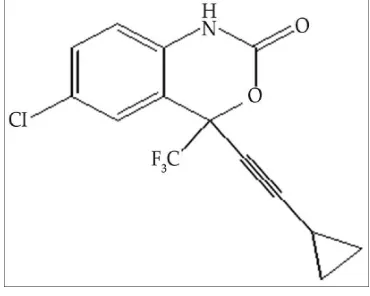
[image:1.595.215.400.571.719.2]Efavirenz is(S)-6-Chloro–4-(cyclo-propyl-ethynyl)-1,4–dihydro–4-(tri-fluoro-methyl)-2H-3,1–benzoxazin–2–one. It is a non nucleoside reverse transcriptase inhibitor drug used to treat HIV infection. It is has about 59% bioavailibility. Efavirenz (EFV)is metabolised by CYP450 2B6 and 3A4 to hydroxylated metabolites with subsequent glucuronidation. Efavirenz is an inducer and an inhibitor of the cytochrome P450 system and leads to self-induction.It gets slowly absorbed after oral administration with a peak plasma concentration reached after 2-7 days. C max for Efavirenz is 12.9 µg/ml[1-3].
______________________________________________________________________________
Literature Survey reveals that many methods[4-18] are reported to determine the Efavirenz and some other drugs [19-21] in biological fluids by using Liquid Chromatography-Tandem Mass Spectrometry, HPLC. No HPTLC method has been reported for determination of Efavirenz in human plasma.
The present method describes a simple, selective, and sensitive HPTLC method with UV detection. The method utilizes Liquid liquid extraction with Dichloromethane followed by use of Methanol for the final reconstitution of the samples. The method has been validated as per the US CDER Guidelines [22].
EXPERIMENTAL SECTION
Efavirenz (EFV) working standard and Mirtazapine was kindly provided by Matrix Laboratories, Hyderabad. The drugs were used as such without further purification. Methanol AR Grade was purchased from SD Fine Chemicals Laboratories, Mumbai. Dichloromethane AR grade was purchased from Loba Chemicals. Chromatographic separation was performed on aluminium plates pre-coated with silica gel 60 F254, purchased from E-Merck, Germany. Samples were applied on the plate as a band with 4 mm width using Camag 100 µL sample syringe (Hamilton, Switzerland) with a Linomat 5 applicator (Camag, Switzerland). Linear ascending development was carried out in a twin trough glass chamber (10 x 10 cm) at room temperature and a densitometry scanning was performed using Camag TLC scanner 3 in the range of 400-200 nm, operated by winCATS software (Version 1.4.3, Camag). Deuterium lamp was used as a radiation source.. All weighing was done on Shimadzu balance (Model AY-120).
Preparation of mobile phase and stock solutions:
AR grade Dichloromethane & Methanol was mixed in 5:0.3 v/v proportion. Stock solution was prepared by dissolving 10 mg EFV in methanol and then diluted to mark with methanol in 10 ml volumetric flask to get concentration of 1000 µg/ml. Working stock solution for EFV was prepared by diluting appropriately stock solution to get the final concentrations of 20 to 140µg/ml. Ten milligram of Mirtazapine (MZP) (IS) was dissolved in methanol and then diluted to mark with methanol in 10 ml of volumetric flask to get concentration of 1000 µg/ml. 3 ml of above solution was diluted to 10ml with methanol to get the final concentration of 300 µg/ml.
Preparation of Spiked Plasma Samples:
The reported peak plasma concentration values for Efavirenz is 12.9 mg/lit. The linearity range was chosen as 200-1400ng/band i.e. from 2 to 14µg/ml. Spiked plasma was prepared by taking 0.8ml plasma, to which 0.1ml solution of EFV and 0.1 ml stock solution of IS(300 µg/ml) were added. The contents of the tubes were vortexed for 1 min. Later 0.1 ml Phosphate buffer pH 7 & 5 ml Dichloromethane was added to it, vortex mixing was done for 5min. It was centrifuged at 3000 rpm for 10 minute. The organic layer was collected and evaporated to dryness slowly on water bath set at temperature 600C. Later reconstitution was done with 0.5 ml Methanol. 50µl volume of this solution was applied on TLC Plates.
[image:2.595.79.547.530.726.2]The detection wavelength used as 247nm. Representative UV Spectrum is shown in Figure 2.
The HPTLC analysis was performed on aluminium plates pre-coated with silica gel 60 F254, purchased from E-Merck,
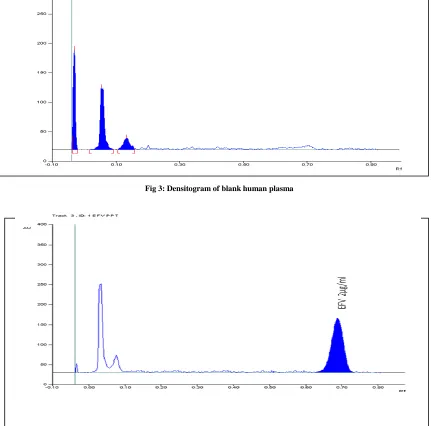
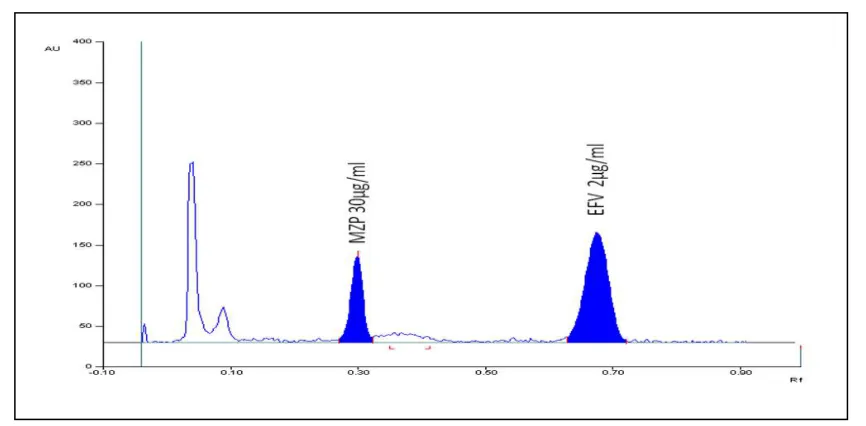
Germany. Samples were applied on the plate as a band with 4 mm width using Camag 100 µL sample syringe (Hamilton, Switzerland) with a Linomat 5 applicator (Camag, Switzerland). Linear ascending development was carried out in a twin trough glass chamber (10 x 10 cm) at room temperature and a densitometric scanning was performed using Camag TLC scanner 3 in the range of 400-200 nm, operated by winCATS software (Version 1.4.3, Camag). Deuterium lamp was used as a radiation source. Representative Densitograms of blank human plasma, human plasma spiked with Efavirenz (200ng/band) and Densitograms of human plasma spiked with Efavirenz (200ng/band) & IS (300ng/band) are shown in Figure 3, 4 and 5 respectively. The Retention Factor (Rf) Values
[image:3.595.86.520.197.420.2]observed for Efavirenz and IS were 0.69 and 0.34 respectively.
Fig 3: Densitogram of blank human plasma
[image:3.595.89.520.222.648.2]______________________________________________________________________________
Fig 5: typical Densitogram of human plasma spiked with Efavirenz (2µg/ml) and IS(30 µg/ml) Concentration EFV 200ng/band (Rf:0.69±0.03)& IS 300ng/band (Rf:0.34±0.03)
VALIDATION
The method was validated as per US CDER[22] guidelines.
Selectivity:
Selectivity is the ability of an analytical method to differentiate and quantify the analytes in the presence of other components in the sample. The selectivity of the method was evaluated by analyzing pooled plasma samples obtained from different sources spiked at LLOQ (Lower Limit of Quantification).
Calibration/standard curve:
Linearity was tested for the range of concentrations 200-1400ng/band for HPTLC . Each sample in five replicates was analyzed and peak areas were recorded. The response factor for each concentration was calculated by taking ratio of peak area of Efavirenz and IS. The response factors were then plotted against the corresponding concentrations to obtain the calibration graphs.
Accuracy, precision and lower limit of quantification:
The accuracy and precision of the method were evaluated using the Quality Control samples. Intra-day accuracy and precision was measured by consecutively analyzing Q.C. samples in one single day. The procedure was repeated for three different days to test the inter-day accuracy and precision. Accuracy was calculated as percentage accuracy, whereas precision was measured in terms of relative standard deviation (R.S.D.) of each calculated concentration. Lower limit of quantification (LLOQ) was found to be 100 ng/band for HPTLC, since the response obtained was five times the response compared to blank.
Recovery:
Recovery for Efavirenz was evaluated at three concentration levels corresponding to three routine Q.C. samples 200,800,1400 ng/band for HPTLC analyzed in triplicate. Recovery was determined by comparing the ratio of the peak area of Efavirenz obtained after the application of the processed plasma calibration samples with those achieved by working standard solution in the methanol.
Stability:
As per US CDER[22] guidelines, stability was checked under different conditions viz. Freeze- thaw stability
Short term stability long term stability Stock solution stability Post preparative stability
[image:4.595.93.526.64.277.2]state at -50C followed by a complete thaw at a room temperature. Short term stability consisted of two Q.C. samples stored for 4 hrs at room temperature and long term stability involved storage of two Q.C. samples for 14 days at 40 C. For stock solution stability, the stock solutions of the drug and IS were stored for period of 5 days in refrigerator at 40 C and then for 6 hrs at room temperature. Post preparative stability, where stability of the spiked samples for MQC of Cefalexin and IS were determined after the storage for 5 hrs at room temperature. All these Q.C. samples were then evaluated in triplicate and the results were compared with the freshly prepared samples of same concentrations.
RESULTS AND DISCUSSION
Retention Factor (Rf) for Efavirenz and IS were 0.69 and 0.34 respectively. As previously stated the representative
Densitograms of blank human plasma, human plasma spiked with Efavirenz (200ng/band) and Densitograms of human plasma spiked with Efavirenz (200ng/band) & IS (300ng/band) are shown in Figure 3, 4 and 5 respectively.
Selectivity:
The selectivity of the method was evaluated by analyzing pooled plasma samples obtained from different sources spiked at LLOQ 100ng/band for HPTLC in which no interference by endogenous components was noted. % RSD (Relative standard deviation) for 6 replicates spiked at LLOQ was found to be 0.634%
Calibration curve:
Calibration curve was constructed by plotting Response factor Vs concentration of Efavirenz solutions, and the regression equation was calculated. The calibration curve was plotted over the concentration range 200-1400ng/band. With correlation coefficient 0.9960, a mean slope of 0.0042, mean y-intercept of 0.8045.
Accuracy:
[image:5.595.138.478.409.458.2]The method showed good accuracy and precision in plasma samples. Table 1 shows the results for intra- and inter-day precision and accuracy for Efavirenz in plasma samples. Mean % accuracy of all quality control samples was found to be 99.02 ± 0.33 . LLOQ was found to be 100ng/band.
Table 1: Accuracy Of Efavirenz In Human Plasma QC Samples
Theoretical (ng/band) Observed(mean ng/band ± SD) Precision (%R.S.D.) Accuracy (%)
200 198.4 ±1.02 0.51 99.23
800 789.0 ± 7.41 0.93 98.63
1400 1388.8 ± 12.02 0.86 99.20
Average 0.76 ± 0.22 99.02 ± 0.33
Recovery:
[image:5.595.211.407.540.592.2]Table 2 shows the results of the recovery tests for the three Q.C. levels tested (200,800 and 1400 ng/band). The extraction recovery in plasma samples ranged from 96.59 to 96.69 % for Efavirenz at three concentration levels. The mean recovery for Efavirenz was found to be 96.63 %.
Table 2: Recovery Of Efavirenz In Human Plasma Q.C. Samples
QC Levels(ng/band) % R.S.D. Recovery (%)
200 0.70 96.62
800 2.69 96.69
1400 2.85 96.59
[image:5.595.172.448.619.752.2]Average 2.08 96.63
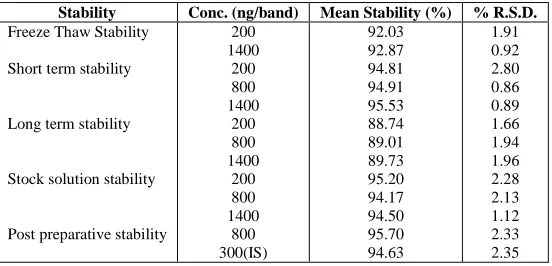
Table 3: Stability Of Efavirenz In Human Plasma Q.C. Samples
Stability Conc. (ng/band) Mean Stability (%) % R.S.D. Freeze Thaw Stability
Short term stability
Long term stability
Stock solution stability
Post preparative stability
______________________________________________________________________________
Stability Studies:
Plasma Q.C. at two concentrations (200 and 1400 ng/band ) was used for freeze-thaw, Short term and long term stability studies. Stock solution stability was performed at three concentrations (200,800,1400 ng/band).Post preparative stability was performed for the drug (800 ng/band) and IS (300ng/band). It was performed to evaluate the influence of storage conditions from the sample collection to analysis. Table 3 represents the results of stability studies. Results indicated that Efavirenz is stable in human plasma for the given stability conditions. The deviation of the mean test responses to the freshly prepared solutions was less than 15% at any of the stability conditions.
CONCLUSION
Most published methods to quantify Efavirenz in body fluids use tedious extraction, purification steps and sometimes solid phase extraction or some other procedures like protein precipitation (in which drug may remain bound to protein molucules resulting into lower recovery) have been applied to get rid of interfering proteins and other matter from the selected matrix. In this study, rapid and sensitive HPTLC method has been developed for the determination of Efavirenz in human plasma by Liquid Liquid extraction technique which is with simple and limited steps. Validation results proved that the developed method performs well with selectivity, precision, accuracy, stability and linearity for the concentration range of EFV expected to be found in human plasma after oral administration of 300-600mg dose. The validated method covers the range of linearity over 200-1400 ng/band and is therefore suitable for the determination of EFV in human plasma at different therapeutic dose levels. The mean recovery of EFV 96.63%. The resolution between EFV and endogenous substances was satisfactory. The proposed method can be used for therapeutic drug monitoring in order to optimize drug dosage on an individual basis. The developed method is able to measure concentration of Efavirenz which can be used in plasma for dose regulation and bioavailability studies.
Acknowledgements
Authors are thankful to Matrix laboratories, Hyderabad for supply of Efavirenz and Mirtazapine . Authors are also thankful to Pune Blood Bank, Pune for providing pooled human plasma and the Management, AISSMS College of Pharmacy, Pune, India for providing required facilities to carry out research work.
REFERENCES
[1] http://www.usp.org. [accessed on 2012 Sep 22]
[2]www.who.int/prequal/WHOPAR/WHOPARGUIDE/EFV_DISC_%20v0_9.doc. [accessed on 2012 Sep 22]
[3]A Deshmukh; C Kulkarni. J. Chem. Pharm. Res., 2012,4(8),3914-3919.
[4]CZ Matthews; EJ Woolf; RS Mazenko; H Haddix weiner; CM Chavez. J. Pharm Biomed Anal., 2002 Jan, 2(8),925-934.
[5]M Takahashi; M Yoshida; T Oki; N Okumura; T Suzuki; T Kaneda. Bio. Phram. Bull. ,2005 May, 28(7),1286-1290.
[6]MS Nacenta, Y López; LF Lípez-Cortés; J Mallolas; JM Gatell; X Carné. J Chromatogr B Biomed Sci Appl., 2001 Nov 5,763(1-2),53-59.
[7] I Kanfer; Mogatle; Seloi. Journal of Pharmaceutical and Biomedical Analysis., 2009, 49 (5), 1308-1312. [8]P Srivastava; GS Moorthy; R Gross; JS Barrett. PLoS One.,2013 June,8(6), e63305.
[9] P Villani; M Pregnolato; S Banfo; M Rettani; D Burroni; E Seminari; R Maserati; MB Regazzi. Ther Drug
Monit.,1999 Jun, 21(3),346-350.
[10]G Ramachandran; A. K. H Kumar, S. Swaminathan; P. Venkatesan; V Kumaraswami; D.J. Greenblatt . J
Chromatogr., 2006 , 8(35), 131-135.
[11] VA Simon; MD Thiam; LC Lipford . J Chromatogr. ,2001,9(13),445-447.
[12] K Titier; F Lagrange; F Pehourcq; LE Mcheik; MN Moore. Ther. Drug Monit.2002,2(4),417-424. [13]ER Montgomery; AL Edmanson; SC Cook . J Pharm Biomed Anal. 2001,2(5),267-284.
[14] PS Devrukhakar; R Borkar; N Shastri; VK Surendranath. ISRN Chromatography ,2012 Aug, Article ID 878295. [15] PD Hamrapurkar; PS Patil; MD Phale; N Shah; SB Pawar. Int. J. Appl. Sci. ,2010 Nov, 2,155-165.
[16] SC Dwivedi; A Kushnoor. International Journal of Pharma and Bio Sciences.,2011 Oct,4(2),220-231. [17]G Bhargavi; T Reddy; Y Mohammad; R Reddy. Journal of pharmacy research.,2012 Jan,5(12),711-714. [18] BS Rajpoot. International Research Journal of Pharmacy.,2012 June,3(7),297-300.
[19]PS Ranaware; AM Ingle; A Ladke; AR Madgulkar; MC Damle. J. Chem. Pharm. Res.,2012,4(6),3003-3009. [20]OMS Minzi; E Ngaimisi. J. Chem. Pharm. Res.,2010, 2(2),431-439.
[21]BM Ishaq; KV Prakash; CH Kumar; GU Rani; GK Mohan. . J. Chem. Pharm. Res.,2010, 2(6),324-333.