Journal of Chemical and Pharmaceutical Research, 2013, 5(9):241-247
Research Article
CODEN(USA) : JCPRC5
ISSN : 0975-7384
241
An on-line auction method for resource allocation in computational grids
1,2
Lili Ding,
1Wanglin Kang and
1Lei Wang
1
College of Economics and Management, Shandong University of Science and Technology, China 2
College of Physical and Environmental Oceanography, Ocean University of China, China
_____________________________________________________________________________________________
ABSTRACT
Auction-based resources allocation and jobs scheduling are key techniques in grid computing system. In this paper, we propose an on-line auction method to allocate grid resource, where the resource providers arrive dynamically and resource user has to make a multi-attribute decision whether to trade jobs or not before the end of current round. In this method, a trade-some-if-beneficial algorithm is designed to help resource user determine the finial winners with incomplete information. Experiments show that our approach can satisfy the resource user’s quality demand on speed, memory and deadline even in an on-line setting. The simulating results also highlight how a resource user can improve his performance using this algorithm.
Keywords: computational grids, auction, on-line algorithm, multi-attribute
_____________________________________________________________________________________________
INTRODUCTION
Grid computing is the future computing paradigm for enterprise applications in some fields especially for science and engineering. The reasons are that grid computing can provide a significant amount of computing power to solve complex problems with the flexible, secure, and coordinated resources. The key function of grid resource management is to build a protocol or mechanism under which resource providers and users can trade-off smoothly. However, the resource providers and users have different goals, objectives, strategies, and demand patterns. It is very difficult for the traditional approaches to build an optimal grid resource allocation mechanism which can meet the objectives of both resource providers and users.
In recent years, there exist two basic models in the grid resource allocation fields, i.e., commodities market models and auction models. These approaches mainly focus on efficiency in the condition where the resources have predefined use and access policy. In the commodities market model, a publicly agreed price is proposed for each resource. However, the constant price in commodities market models can’t reflect the change of supply-demand relationship in grid resource markets. In contrast, in the auction models, the auction participants would trade-off at a price that is unknown before the auction ends. Compared to other allocation schemes, auctions have many advantages, for instance, they are decentralized in nature, they require little global information and are easy to implement, etc. Thus, auction models have been widely adopted in the grid resources allocation problem.
sponsored search auction, a model called infinite horizon alternative-move was built by Asdemir [4]. The other is that there are many auctioneers and bidders, e.g., double auction and combinatorial auction. An agent-based economic model was proposed by Haque et al. based on the traditional double auction to realize the dynamic management of resources [5]. Similarly, the traditional double auction model was also extended by Izakian et al. [6], in which the new agent-oriented model could maximize the resource provider's profit. Also, Qureshi et al. considered that market-like techniques could be used in the double auction to ensure resource users to trade-off appropriately [7]. Chandak et al. surveyed heuristic based task allocation strategies and their efficiency. And the strategy was proved to optimize various performance parameters such as makespan, resource utilization, response time, workload balancing, service reliability, fairness deviation and throughput [8]. Gorbanzadeh et al. improved the efficiency in determining the winners in a double auction by declaring two types of hybrid genetic algorithms [9]. Schnizler et al. adopted a heuristic algorithm in the combinatorial auction to improve the efficiency and performance of resource management [10].
The previous studies on auction-based resource allocation protocols have focused on the complete information where auctioneers make their decisions only when all the bidders have arrived and provided their bids , and then choose the best or second best bid. In fact, in the network environment, all participants, i.e., resource providers and resource users, could not be willing to wait for a long time for the final decisions. For example, the CPU time or cache space allocation, each request (bids) may need an immediate answer. Thus, an on-line auction model for gird resource allocation problem is motivated by competitive analysis of on-line algorithms. A systematic study of on-line algorithms was given, where suggested comparing an on-line algorithm with an optimal off-line algorithm [11]. An on-line algorithm is said to be r-competitive (r1) if, given any instance of the problem, the return of the solution given by the optimal off-line algorithm is no more than r multiplied by that of an on-line algorithm, i.e.,
( ) ( )
on line off line
Return I r Return I for any problem instance I. In this case, we say that on-line algorithm attains a competitive ratio r. An on-line algorithm is said to be best-possible if there does not exist another on-line algorithm with a strictly smaller competitive ratio. On-line algorithms have been used to analyze paging in computer memory systems, distributed data management, navigation problems in robotics, multiprocessor scheduling, and so on [12]. For the on-line auction problems, Hajiaghayi et al. considered an on-line truth telling mechanism based on the off-line Vickrey model [13]. Buchbinder et al. designed a (1-1/e)-competitive (optimal) algorithm for the on-line ad-auction based on a clean primal-dual approach, which was useful for analyzing the other on-line problems such as ski rental and TCP acknowledgement problem [14]. For the limited supply goods, Ding et al. studied a multi-attribute on-line auction problem and designed a deterministic on-line algorithm to help auctioneer find the final winners [15].
This paper extends the traditional auction-based models and protocols for computational grids allocation problem. An on-line auction method is provided to help resource providers and resource users make decisions, which is a favorable way to give provable performance guarantees in the presence of total uncertainty. Furthermore, we consider that price-only negotiations in grid resource auction models are not suitable. In fact, the resource providers and users often make decisions based on grid resource’s multiple attributes, e.g., resource speed and memory size. Thus, a trade-some-if-beneficial algorithm is presented, in which we design a satisfaction degree function for the resource users, helping them achieve satisfaction level maximization based on multi-attribute bids in an on-line setting. Finally, we provide the simulation and results about our on-line auction model and protocol.
ON-LINE AUCTION-BASED GRID ALLOCATION MODEL
The main participants in the multi-attribute on-line auction model are Grid Resource Provider (GRP), Grid Resource Broker (GRB) and Local Markets for Auction (LMA). Here, we use Grid Resource Providers that work on behalf of resource providers, Grid Resource Broker that works on behalf of the users and Local Markets for Auction that works on behalf of service platforms. They interact with each other in the form of on-line auction for obtaining objectives.
We assume that there are n rounds with the expired time T0. Different from the current literature, we consider an on-line setting where different GRPs arrive at different times in LMA, and GRB is required to make decisions about each multi-attribute bid as it is received. In round i fori1, 2, ,n, the ith GRP presents his bid characterized by three-tuple Bi( , , )b v si i i , where bi stands for the price for providing a service and is expressed in form of
grid units per MIPS (G$ /MIPS), vi is the computational speed of resource and is expressed in terms of millions of
instructions that the resource can process in one second (MIPS), and
s
i is the memory size of resource. In this paper, we allow GRPs to declare untruthful types. GRB has K jobs or tasks. Each job is denoted by a four-tuple( , , , )
i i i i i
GRB is to execute its total jobs within its corresponding deadlines and maximize the multi-attribute utility. Thus, in this paper, we use satisfaction degree to represent the user's utility. This satisfaction degree function can compare with each attribute's reservation value to achieve the total value, which is the sum of the user's levels of satisfaction level from various attributes' values. It is common that the less price, the more satisfaction. Different from the above literature, we design a satisfaction degree function to describe the user’s utility about multi-attribute bids. The satisfaction degree function ui is presented as follows.
1 2 3
i i
i i i i i
i
i i i
L T
RP b v s S
u w w w
RP T s
(1)
where 0w11,0w21 and 0w31 indicate the weights of computational speed attribute, price attribute
and memory size attribute, respectively.
Deterministic on-line algorithm. It assumes that satisfaction degree input sequence is bounded, m ui M and
that the GRB knows the bounds mand M (0 m M ). We consider the following on-line strategy, thereafter called the trade-some-if-beneficial (TSIB) algorithm. Let r be any competitive ratio that can be attained by some deterministic on-line algorithm. For a start, assume that r is known to the GRB and GRPs.
TSIB Algorithm.
(i) Only trade when the satisfaction degree input sequence reaches a new high, i.e., uiui1.
(ii) While i1, GRB converts the quantity q1 of jobs to the first winner (i.e., when the first GRP presents the
multi-attribute bid satisfying u1 r m, GRB ensures that TSIB algorithm attains a competitive ratio r). We show this result as follows.
1 1
1
u rm K
q
r u m
where u1 r m
(ii) For i1, GRB converts the quantity qi of jobs to the ith winner (i.e., whenever GRB buys grids service,
allocate just enough job to ensure that a competitive ratio r would be obtained if an adversary drops the satisfaction degree to the minimum possible rate and keeps it there throughout the game). We also show this result as follows.
1
i i
i
i
u u K q
r u m
(iv) In the end of auction, if GRB has the remaining jobs, he has to face the threat of trading with the minimum satisfaction degree.
Computing qi
.We can compute the allocated job quantity qi in each round, i.e., when a new multi-attribute bid is
given by considering the threat of the satisfaction degree down to m. If TSIB algorithm wishes to achieve a competitive ratio r, then it must ensure that
1 ( 1 )
i
i i
j j j
j j
u K
r
u q K q m
(2)Case 1. If the adversary chooses such input sequences that mu1 and u2 u3 unm, we substitute u1
into (2) and achieve that
1 1
1
u rm K
q
r u m
(3)
Case 2. If the adversary chooses such input sequences that muk, where 1 k n, i.e., uk1uk2 unm,
1 1 1 1 1 1 ( ) ( ) i i
j j j
j j
i i
j j i i j i
j j
u q K q m
u q u q K q m q m
(4)Substituting (4) into (2) and solving for qi, we give that
1 i i i i u u K q
r u m
(5)
Optimal competitive ratio. The trade-some-if-benefi-cial (TSIB) algorithm trades the minimum quantity of jobs for GRPs to achieve the optimal competitive ratio r under the threat that the adversary will drop the satisfaction degree to m and keep it for the remaining auctioning period. It is clear that TSIB algorithm can not attain an arbitrarily small r. For example, if r1, then GRB converts all his job K to the first GRP at the first multi-attribute bid. But, GRB may be failing to achieve a competitive ratio of 1, if the adversary increases the satisfaction degree after the first auctioning period. Hence, GRB can obtain the competitive ratio from (2) by TSIB algorithm. In the following, the GRB’s goal is to achieve the smallest competitive ratio.
Let u be a satisfaction degree sequence and let r1 be any real. Consider such case that uu1, ,u mk, , ,m.
For any k, GRB wants to the trading quantity of job in each auctioning period to satisfy
1
k i iq K
. Suppose for the period that k is known to all the participants, i.e., GRB and GRPs. The optimal competitive ratio of TSIB algorithm must be obtained in such case that there will be no jobs remaining after the period of k. In other words, TSIB algorithm can achieve the optimal competitive ratio as follows.1
k i iq K
(6)Solving qi from (6) by substituting (3) and (5), we obtain
1 1
2 1
k i i
i i u u u rm K K K
r u m r u m
(7)From equation (7), we have
1 1 2 1 1 1 2 1 1
1 ( 1 )
k i i
i i k i i i u u u m r
u u m
u m
u m k
u u m
(8)For the sequences, its geometrical mean is larger than its arithmetic mean. Thus, we give the competitive ratio of TSIB algorithm as follows.
1
1 1 1
1
1 ( 1) (1 ( )k )
k
u m u m
r k
u u m
(9)
In order to avoid the worst-case satisfaction degree sequences, TSIB algorithm can advise the GRB to convert the average quantity 1k of jobs in the first auctioning period. Using (3), we can derive that
1 1
1
( ) ( 1)
r m K q r m k u
K q r k r
(10)
For the relation between r and uk, we take the derivative of r uk. Clearly, r uk 0, i.e., r is increasing
with uk. Furthermore, the competitive ratio is maximized when uk m. Therefore, substituting equation (10) into (9), we have the optimal competitive ratio of TSIB algorithm as follows.
1
1
(1 ( ) )
1 k r r k
Notice that r k 0, i.e., the competitive ratio is increasing with k. Thus, the maximum-minimum of r can be obtained when kn.
ON-LINE MULTI-ATTRIBUTE REVERSE AUCTION PROTOCOL
In this paper, we consider the on-line version of grid resource allocation problem based on the TSIB algorithm. The on-line multi-attribute reverse auction (OMRA) protocol is provided as follows.
OMRA protocol. Phase I: Bidding
1.GRB provides K jobs with four tuples.
2.GRPi, i1, 2,…,n, sends multi-attribute bid Bi( , , )b v si i i to GRB in LMA.
Phase II: Completion
1. In each round i, GRB receives the bid of GRPi and does the following:
1.1 Compute the satisfaction degree ui using (1) and make it public for GRPs.
1.2 If ui ui1, then GRB sends reject messages to GRPi.
1.3 If uiui1, then GRB notices GRPi that he is the winner and computes the quantity qi of jobs to GRPi
according to TSIB algorithm as follows.
1
1
1
i i
i
i i
i
i
u rm K
q i
r u m u u K
q i
r u m
2. If GRPi is the last one or in, then GRB terminates the round.
3. Determine the trading price and quantity for the final winners GRPs*. 4. GRB sends the jobs to GRPs* and GRPs*execute them.
5. GRB sends payments toGRPs*.
RESULTS AND DISCUSSION
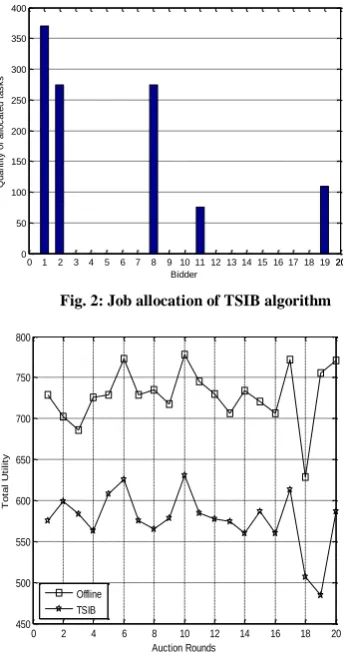
In this section, the simulating environments are given to describe the performance of TSIB algorithm and the efficiency of OMRA protocol, which are important for the resource user to make decision. In Figure 1, there are 20 auctioning periods, where 20 GRPs arrive one by one and present their multi-attribute bids. In an on-line setting, we provide a TSIB algorithm for GRB to determine the winners. I.e., winner determination is based on the following two rules. One is that the increasing satisfaction degree sequences are necessary. The other is the on-line trading strategy can achieve the competitive ratio r in any cases. In Fig. 1 and Fig. 2, we set K1000, m0.4250,
0.7346
M and M m/ . It can be seen from simulation that the winners of this auction are bidders 1,2,4,11 and 19 for OMRA protocol. I.e., there are only 5 valid bids for these 20 bidders based on TSIB algorithm. Thus, we can compute the competitive ratio according to (11) and achieve r1.347. It means that our TSIB algorithm achieves better performance. In the worst case, the benefit of TSIB algorithm also can be less than 34.7% than the off-line case.
0 1 2 3 4 5 6 7 8 9 10 11 12 13 14 15 16 17 18 19 2020
0.4 0.45 0.5 0.55 0.6 0.65 0.7 0.75
Bidder
U
ti
li
ty
winner 2
winner 1 winner 3 winner 3
winner 3 winner 4
[image:5.595.221.386.595.732.2]winner 5
The OMRA protocol considers such case that the trading order can be split for many winners. This is different from the above literature, where the jobs or tasks are not divided. In fact, in OMRA protocol, we establish an on-line multi-unit multi-attribute auction model, which can help the GRB make decisions under the assumption of incomplete information. Figure 2 shows that there 370 jobs allocated to the first winning GRP, and the next is 274, 10, 75 and 109. In the end of auction, GRB still has 162 jobs left. According to TSIB algorithm, GRB has to trade these jobs at the lowest satisfaction degree, i.e., he is in such worst case that converts the remaining jobs at the satisfaction degree of 0.4250.
0 1 2 3 4 5 6 7 8 9 10 11 12 13 14 15 16 17 18 19 2020
0 50 100 150 200 250 300 350 400
Bidder
Q
u
a
n
ti
ty
o
f
a
llo
c
a
te
d
t
a
s
k
s
0 2 4 6 8 10 12 14 16 18 20
450 500 550 600 650 700 750 800
Auction Rounds
T
o
ta
l
U
ti
li
ty
Offline TSIB
As shown, there are 2 lines in Fig. 3, which denote the user’s total utility about the winning GRPs for different requests or jobs, respectively. I.e., the satisfaction degree multiplies with trading jobs for winning GRPs are sum up. Results show that the user’s total utilities in off-line situation all exceed 600. On the contrary, the total utilities of TSIB algorithm are upper bound of 650 and lower bound of 450. We have presented the competitive ratio of TSIB algorithm, which has a better performance in on-line situation. For example, in Fig. 3, even in the worst case, the competitive ratio is r800 450 1.77 , which means that the return of TSIB algorithm is close to the off-line return. The results show that the competitive ratios are increasing with the fluctuation of .
CONCLUSION
The key function of resource management is to build a protocol or mechanism under which resource providers and users can trade-off smoothly. In this paper, an on-line multi-attribute reverse auction protocol is proposed based on the assumption of incomplete information. The resource user's satisfaction degree is introduced into the designed auction protocols to help the grid resource broker make multi-attribute decisions. The future directions are to put some artificial intelligence into the auction protocols.
Acknowledgments
[image:6.595.217.389.160.493.2]This work is supported by the National Science Foundation of China (71001057; 71371111; 71373247); SDMYSAF(No.2010BSE06034); QDSKL130422; AOCQN2013; KDYC13017; 2013GSF12203;SDUST Research Fund (No. 2011KYTD104 and No. 2011KYJQ103).
Fig. 2: Job allocation of TSIB algorithm
REFERENCES
[1] Lynar, T.M., R.D. Herbert and S.Simon,2009. WSEAS Transactions on Computers, vol.8, no. 10: 1671-1680. [2] Mirzayi, M. and M.R. Khayyambashi,2009. Information Technology Journal, vol.8, no. 8: 221-1227. [3] Prodan,R., M.Wieczorek and H.M. Fard,2011. Journal of Grid Computing, vol.9, no. 4: 531-548. [4]Asdemir, K.,2011. Information Technology and Management,vol.12: 1-16.
[5]Haque, A., S.M.Alhashmi and R.Parthiban,2011. Towards better understanding of two economic models: a grid perspective, Communications of the IBIMA: 1-11.
[6] Izakian,H., A.Abraham and B.Ladani,2010. Future generation computer systems, vol.26:228-235.
[7]Chandak,A., B.Sahoo and A.K.Turuk,2011. International Journal of Advanced Networking Applications, vol.2, no. 5: 804-810.
[8] Qureshi,K., B. Nazir and M.A. Shah,2011. Engineering e-Transaction, vol.6: 50-54.
[9]Gorbanzadeh, F. and A.A. P.Kazem,2012. International Journal of Articial Intelligence, vol.1, no. 2:54-62. [10]Schnizler,B., D. Neumann, D. Veit and C.Weinhardt,2008. European Journal of Operational Research, vol.187, no.3:43-961.
[11]Ding, L. L., X.M. Liu and W.L. Kang,2011..Journal of Software, vol.6 no.10:2009-2015.
[12]Goldberg, A., J.Hartline and A. Wright,2001.Competitive auctions and digital goods,In Proceedings of the 12th ACM-SIAM sympo-sium on discrete algorithms:735-744.
[13]Hajiaghayi,M.T., R.Kleinberg and D.C.Parkes,2004. Adaptive limited-supply online auctions, In Proceedings of the 5th ACM conference on electronic commerce, ACM Press:71-80.
[14]Buchbinder,N., K.Jain and J.S.Naor,2007. Online primal-dual algorithms for maximizing ad-auctions revenue, In Proceedings of the 15th Annual European Symposium on Algorithms:253-264.