Journal of Chemical and Pharmaceutical Research
__________________________________________________
ISSN No: 0975-7384 CODEN(USA): JCPRC5
J. Chem. Pharm. Res., 2011, 3(5):108-115
Excess Volumes and Viscosities for the Binary Systems of 2-
Propanol with alkyl acetates at 303.15 K
K. Vasudha1, D. Vijaya Kumari2, G. Yuvaraja3, A. Krishnaiah3*
1
Department of Chemistry, S.P.W. Degree and PG College, Tirupati
2
Department of Chemistry, S.V. Arts College, Tirupati
3
Biopolymers and Thermophysical Laboratories, Department of Chemistry, Sri Venkateswara University, Tirupati, Andhra Pradesh., India
______________________________________________________________________________
ABSTACT
Measurements of excess volumes and viscosities of binary mixtures of 2-propanol with methyl acetate (MA), ethyl acetate (EA), butyl acetate (BA), and iso-amyl acetate (IAA) are reported at 303.15 K over the entire range of composition. Excess volumes are measured using batch dilometer technique. The viscosity data are analysed on the basis of corresponding states approach and Grunburg-Nissan treatment. Excess volumes are positive and deviations in viscosities are negative over the entire range of composition. The experimental results are discussed in terms of possible interactions between like and unlike molecules.
Keywords: Excess volumes; Viscosities; 2-Propanol; Acetates.
______________________________________________________________________________
INTRODUCTION
The thermodynamic functions of mixtures containing 2-propanol as one of the binary mixtures
have been investigated.1-3 The thermodynamic properties of binary mixtures of 2-propanol with
______________________________________________________________________________
The study and understanding of thermodynamic and transport properties properties of pure liquids, liquid mixtures and solutions have found many applications chemical, textile, leather,
pharmaceutical, nuclear industries and in understanding solute solvent interactions as well
4-6
.The thermodynamic properties are found to be sensitive to molecular interactions. The study on thermophysical properties were going on in our lab. We reported thermophysical properties for
the system diisopropyl ether with acetates in our earlier paper 7.
EXPERIMENTAL SECTION
The component chemicals were purified by the methods described in literature8. Finally the
purity of the samples was checked by comparing the measured densities and boiling points of the
components with those reported in the literature9-12 (Table-1).
Table-1: Boiling points and densities of pure components at 303.15 K.
Component Boiling point (Tbp)/k Density p/gcm-3 Present work Literature Present work Literature 2-propanol 354.9 355.4 0.78100 0.78120* Methyl acetate 329.0 329.4 0.92721 0.92790* Ethyl acetate 350.9 350.2 0.89149 0.89455* Butyl acetate 399.1 399.2 0.87138 0.87632 Iso amyl acetate 415.7 415.1 0.86842 0.86640*
* 298.15 k.
Excess volumes were measured with the dilatometer technique described by Reddy et al.13 with
an accuracy of ±0.003 cm3 mol-1. Four dilatometers which differ in the capacities of
compartment 1 and 2 are used to cover the entire range of composition of the mixtures. The
densities were measured with bicapillary pycnometer described by Rao and Naidu14. The
viscosity of pure liquids and liquid mixtures were determined with an accuracy of ± 0.001 using
suspended ubbelohde type viscometer15.
RESULTS
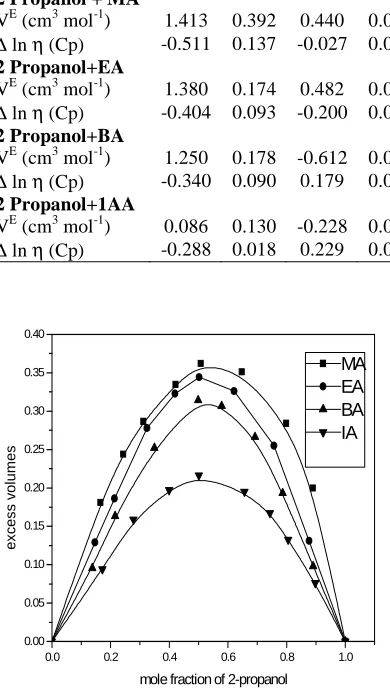
Experimental excess volume data at 303.15 K for the binary systems of 2-propanol with MA,
EA, BA, IAA are included in Table 2. The dependence of VE on mole fraction of 2-propanol is
graphically represented in Fig.1.
The excess volume VE was calculated using the relation
1 2 1 2
)
( + −
∆
= r h n n
VE π (1)
The viscosity of the mixture was calculated using the equation
t KV. ρ.
______________________________________________________________________________
where Kv is viscometer constant, ρ and t are the density and flow time respectively. The
densities of mixtures are calculated from excess volume data. Deviations in viscosity (∆ ln η) of
the mixtures were calculated using the equation
∆ ln η = ln ηmix – (x1 ln η1 + x2 ln η2) (3)
where ηmix is the viscosities of the mixture, η1 and η2 are the viscosities of 2-propanol and
acetate respectively. The viscosity data were analyzed in terms of corresponding states approach
and Grunberg and Nissan treatment Teja and Rice16, 17 proposed the following expression for the
liquid mixtures viscosity,
ln (ηmix εmix) = x1 ln (η1ε1) + x2 ln (η2ε2) (4)
where ε = (Vc)2/3 / (TcM)½ , Tc, Vc and M are critical temperature, critical volume and molecular
mass respectively. The values of these parameters were evaluated by the procedure described by
Krishnaiah and Viswanath18. The values of interaction parameter (ε12) used in this theory are
given in Table 4 along with absolute average deviation (AAD). ADD was calculated using the equation.
] [
1 )
( nexp ncal
n Cp
AAD = Σ − (5)
where ηexp and ηcal are the experimental and calculated viscosities respectively.
Grumberg and Nissan19 proposed the following equation for the viscosity of liquid mixtures at
low temperatures.
ln ηmix = x ln η1 + (1-x) ln η2 + x (1-x) d12 (6)
where η1 η2 and ηmix are viscosity of 2 propanol, acetate and mixture respectively, d12 is the
interaction parameter which is the function of chemical nature of components and temperature.
The value d12, obtained from equation 6 using experimental viscosity data at equi-mole fraction
was used to compute the viscosities over the entire range of composition. The value of d12 are
given in Table 4 along with AAD. The computed values of viscosity on the basis of the two theories are included in Table 2.
Excess molar volumes (VE), and deviations in viscosity (∆ ln η) were correlated by Red
lich-Kister polynomial equation
2 1 2 [ 0 1 ( 1 2) 2( 1 2)
A= x x a +a x −x +a x −x (7)
where x and 1 x represent the mole fraction and A is corresponding thermodynamic property. 2
______________________________________________________________________________
( )
(
)
1 2 2 exp cal
A A
A
n p
σ = Σ −
−
(8)
where n is the number of experimental data, p is the number of parameter in eq. (7) and A is the
corresponding thermodynamic property (VE, ∆ ln η).
CONCLUSION
The values of VE are positive in all the systems. These results indicate that the interaction
between like molecules are stronger compared to that between unlike molecules. The VE follows
the algebric order.
2 propanol + MA > 2 propanol + EA > 2 propanol + BA > 2 propanol + 1AA
The dilution of strong hydrogen bonded liquid 2-propanol by a non common component acetate leads to the cleavage of hydrogen bonds. This would be accompanied by adsorption heat and expansion in volume. The magnitude of volume change will be determined by the breaking and stretching of dipole-dipole interactions in acetates and also the structure breaking of alcohols by
acetates. Ranjith20 et al. reported sigmoid shape of VE for the binary mixtures of phenyl
acetonitrile +2 propanol.
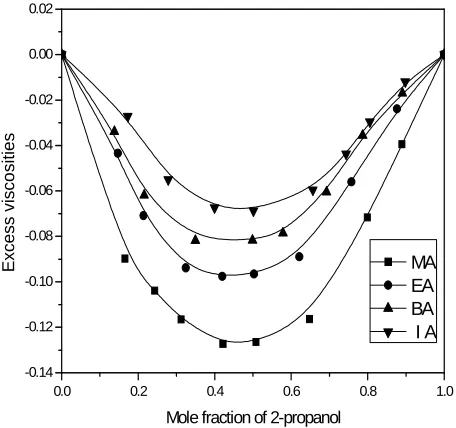
The data presented in Table 2 indicate that deviations in viscosity (∆ ln η) are negative over the
whole composition range for all the systems. In general, for system where dispersion and dipolar
interactions are operating ∆ ln η values are found to be negative whereas charge transfer and
hydrogen bonding interactions lead to positive ∆ ln η values21. The ∆ ln η values support the
contention that the interaction between like molecules is stronger. The negative deviations in viscosity for the binary systems of 2-propanol with acetate follow the order, which is exactly
opposite to the order observed with respect to VE.
2 propanol + MA > 2 propanol + EA > 2 propanol + BA > 2 propanol + 1AA
Viscosity data derived from corresponding states approach, and Grunberg-Nissan model are
reported in Table 2. The values of interaction parameters ε12 and d12 derived from above two
models are included in Table 3. The average absolute deviations (AAD) between the experimental and calculated values of viscosities are also given in Table 3.
______________________________________________________________________________
Table-2: Data on mole fraction of 2-propanol (x1) density (f) excess volume (VE) and viscosity (ηηηη) for the binary systems of 2-propanol with MA, EA, BA, IAA.
Mole fraction (x1)
VE (cm3 mol-1) Density (ρ)
(g cm-3) ηExp η (c.s.t) η (G.N) ∆ lnη
2-propanol with methyl acetate
0.0000 0.000 0.9201 0.343 - - -
0.1654 0.184 0.8951 0.411 0.408 0.420 -0.089 0.3123 0.244 0.8836 0.460 0.437 0.467 -0.104 0.3889 0.286 0.8734 0.508 0.469 0.515 -0.116 0.4215 0.334 0.8575 0.601 0.535 0.608 -0.127 0.5079 0.362 0.8449 0.692 0.607 0.698 -0.126 0.6479 0.351 0.8249 0.879 0.781 0.887 -0.116 0.7988 0.284 0.8037 1.176 1.085 1.174 -0.071 0.8892 0.199 0.7913 1.408 1.344 1.403 -0.039
1.0000 0.000 0.7769 1.755 - - -
2-propanol with ethyl acetate
0.0000 0.000 0.8883 0.424 - - -
0.1467 0.129 0.8739 0.480 0.493 0.477 -0.043 0.2138 0.186 0.8671 0.515 0.541 0.518 -0.079 0.3245 0.277 0.8553 0.592 0.633 0.598 -0.093 0.4198 0.322 0.8450 0.679 0.725 0.681 -0.097 0.5026 0.344 0.8359 0.771 0.818 0.768 -0.096 0.6213 0.326 0.8226 0.927 0.975 0.920 -0.089 0.7569 0.255 0.8069 1.161 1.199 1.147 -0.059 0.8767 0.131 0.7926 1.429 1.447 1.410 -0.023
1.0000 0.000 0.7769 1.755 - - -
2-propanol with butyl acetate
0.0000 0.000 0.8712 0.621 - - -
0.1378 0.095 0.8625 0.693 0.739 0.693 -0.033 0.2158 0.163 0.8570 0.730 0.797 0.730 -0.061 0.3494 0.252 0.8469 0.822 0.906 0.822 -0.081 0.4987 0.314 0.8342 0.961 1.048 0.961 -0.081 0.5786 0.306 0.8268 1.047 1.134 1.047 -0.078 0.6924 0.266 0.8154 1.200 1.272 1.200 -0.060 0.7865 0.193 0.8052 1.356 1.402 1.356 -0.035 0.8905 0.093 0.7924 1.540 1.565 1.540 -0.017
1.0000 0.000 0.7769 1.755 - - -
2-propanol with iso-amyl acetate
0.0000 0.000 0.8640 0.712 - - -
0.1726 0.094 0.8549 0.809 0.836 0.809 -0.027 0.2784 0.158 0.8485 0.866 0.920 0.866 -0.055 0.3996 0.197 0.8404 0.954 1.026 0.954 -0.067 0.5012 0.216 0.8327 1.044 1.125 1.044 -0.068 0.6562 0.195 0.8193 1.212 1.296 1.212 -0.059 0.7432 0.167 0.8105 1.332 1.403 1.332 -0.043 0.8056 0.132 0.8035 1.429 1.485 1.429 -0.029 0.8978 0.076 0.7919 1.581 1.613 1.581 -0.012
______________________________________________________________________________
Table-3: Values of Parameters eq. (7) and standard deviation at 303.15 k.
System a0 a1 a2 σA
2 Propanol + MA
VE (cm3 mol-1) 1.413 0.392 0.440 0.005
∆ ln η (Cp) -0.511 0.137 -0.027 0.005
2 Propanol+EA
VE (cm3 mol-1) 1.380 0.174 0.482 0.004
∆ ln η (Cp) -0.404 0.093 -0.200 0.003
2 Propanol+BA
VE (cm3 mol-1) 1.250 0.178 -0.612 0.004
∆ ln η (Cp) -0.340 0.090 0.179 0.003
2 Propanol+1AA
VE (cm3 mol-1) 0.086 0.130 -0.228 0.003
∆ ln η (Cp) -0.288 0.018 0.229 0.002
0.0 0.2 0.4 0.6 0.8 1.0
0.00 0.05 0.10 0.15 0.20 0.25 0.30 0.35 0.40
e
x
c
e
s
s
v
o
lu
m
e
s
mole fraction of 2-propanol
MA EA BA IA
[image:6.595.196.391.157.501.2]Fig. 1: Excess volume (vE) vs. mole fraction of 2-propanol (x1) for 2-propanol with MA (■) EA (●), BA (▲) and IA (▼)
Table-4: Values of interaction parameters (εεεε12, d12) and average absolute deviation (AAD) for the binary system of 2-propanol with acetates at 303.15 k.
[image:6.595.154.442.580.651.2]______________________________________________________________________________
0.0 0.2 0.4 0.6 0.8 1.0
-0.14 -0.12 -0.10 -0.08 -0.06 -0.04 -0.02 0.00 0.02
E
x
c
e
s
s
v
is
c
o
s
it
ie
s
Mole fraction of 2-propanol
MA EA BA I A
Fig. 2. Deviation in viscosity (∆ lnη) vs. mole fraction of 2-propanol, for 2-propanol with MA (■), EA (●), BA (▲) and IA (▼)
REFERENCES
[1] MMH Bhuiyan; MH Uddin. J. Mol. Liquids., 2008 138, 139-146.
[2] CA Cerdeirina; CA Tovar; J Troncoso; E Carballo; L Romani. Fluid Phase equilibria., 1999,
157, 93-102.
[3] D Venkatesulu; P Venkatesu; MV Prabhakara Rao. Fluid Phase Equilibria., 1997, 128,
241-248.
[4] R Venis; R Rajkumar. J. Chem. Pharm. Res., 2011, 3(2) .878-885.
[5] D Bal Raj; Anusharma; K C Singh. Chinese J. Che. Eng. 2008, 16(4), 599-604
[6] S Thirumaran, S Sudha J.Chem. Pharm.Res 2010, 2(1), 327-337
[7] G Sankara Reddy; A Subba Reddy; M Venkata Subbaiah; K Vasudha; A Krishnaiah. J. Ind.
Eng. Chem., 2010, 16, 941-946.
[8] AI Vogel. A text book of “Practical Organic Chemistry”, 5th Edition, John Willey and Sons,
New York 1989.
[9] JA Riddick; WB Bunger; TK Sakano. “Organic Solvents” Physical Properties and methods
of purification, 4th Edition. Wiley InterScience, New York 1986.
[10]J Timmermans. “Physico-Chemical Constants of pure organic Compounds”, Elsevier
Publication Co., Amsterdam 1950 and 1962.
[11] TRC-Thermodynamic Tables-Non Hydrocarbons, Thermodynamics Research Centre,
The Texas A & M University System, College Station, TX, 1963, a-6060 (Loose-lead data sheets, extant 1996).
[12]TE Daubert; RP; Danner. Physical and Thermodynamic Properties of Pure Chemicals, John
[image:7.595.177.405.140.354.2]______________________________________________________________________________
[13]KVR Reddy; K Rambabu; T Devarajulu; A Krishnaiah. J. Chem. Eng. Data., 1995, 40,
124-127.
[14]MVP Rao; PR Naidu. Can. J. Chem., 1974, 52, 788.
[15]A Krishnaiah; KN Surendranath. J. Chem. Eng. Data., 1996, 41, 1012-1014.
[16]AS Teja; P Rice. Chem. Eng. Sci., 1981, 36, 7-10.
[17]AS Teja; P Rice. Ind. Eng. Chem. Fundam., 1981 20, 77-81.
[18]A Krishnaiah; DS Viswanath. J. Chem. Eng. Data., 1991 36, 317-318.
[19]L Grunberg; AH Nissan. Nature., 1949, 164, 799-800.
[20]KB Ranjith; KP Murali; B Sathyanarana; JT Savitha; N Sathynarayana. Indian J. Chem.,
2008, 47, 1026.