The London School of Economics and Political
Science
To Be or To Become? An Enquiry into the Changing Nature of
Requirements in Open Source Health IT
Daniel Adrian Curto-Millet
A thesis submitted to the Department of Management of the London School of Economics and
I certify that the thesis I have presented for examination for the MPhil/PhD degree of the London School of Economics and Political Science is solely my own work other than where I have clearly indicated that it is the work of others (in which case the extent of any work carried out jointly by me and any other person is clearly identified in it).
The copyright of this thesis rests with the author. Quotation from it is permitted, provided that full acknowledgement is made. This thesis may not be reproduced without my prior written consent.
I warrant that this authorisation does not, to the best of my belief, infringe the rights of any third party.
Abstract
This thesis develops a contemporary problematisation of software requirements. It departs from traditional conceptions of requirements as simple, tamed objects with deterministic force over socio-technical actors and based on assumptions of stability. Such views can lead to a narrow, ultimately unfruitful understanding of the significance of requirements and denied wider consequences of their modes of articulation. Instead, the thesis builds on perspectives where requirements are complex and interactive actors.
The thesis uses openEHR—an open source health IT project aiming to build interoperable Electronic Health Records (EHRs)—as a case study. Studying open source practice offers a good opportunity to consider the nature of requirements because there is an ongoing debate about requirements’ role and influence on development activities and project organisation.
The analysis uses Deleuzian concepts of assemblage, multiplicity and becoming. These themes align with a larger body of work influenced by STS and process oriented theorisations, which see the world as dynamic and performative. The philosophy of Deleuze and Guattari in particular provides a counter-balance to any assumed stability in the world.
Acknowledgements
The first person I would like to thank is Almudena, my wife. She is the reason this work was completed and the reason it was completed with a smile. Without her and Leonor, our little penguin she has been coddling, there would be no reason at all.
There has been a number of persons who have been helpful beyond sanity. Tony Cornford, my supervisor, put up with my convoluted writing and provided keen insights that often led me to days of intense reflection. His capacity to think across issues amazes me.
Maha Shaikh has been a good friend to me and to this research. The debates with her have been some of the most challenging I have had. Her passion for the subject equals her passion for steaks. She has taught me to become a learned, ethical, and passionate researcher.
My parents, Nicole and Federico, have always been present. They have gone beyond themselves to be supportive. Their example of hard work is imprinted in my mind. My brother, Fabien, has been a staunch supporter for a long time. I remember with fondness when we would talk after school about what he had learnt.
UCL’s widely multi-disciplinarian approach to education and research has allowed me to pursue my interests in and beyond engineering.
Kostis Dryllerakis and Francicso García Morán, from the European Commission, have left me an unforgettable impression. Kostis took it upon himself to act as my mentor undeterred by my inexperience. His lessons on being a good professional and software engineer are invaluable. Francisco gave me his support and, despite his huge workload, he took time to listen and talk to an intern.
The CENATIC (the principal Spanish national center for the research and ap-plication of open source software), kindly invited me to work with them in their offices in Spain. We shared insightful discussions regarding the realities that had to be met by open source projects in Spain and beyond. Special thanks go to Manuel Velarde, Pop Ramsamy, Manuel Domínguez, and Jorge Martín.
The two institutions which gave me their financial support, the EPSRC for the beginning and the Fundación Ramón Areces towards the end, have allowed me to fully dedicate myself to this research.
Contents
Prologue 15
I
Stability and Change: Questioning a Paradox
21
1 Introduction 23
1.1 Inherited Assumptions . . . 25
1.2 Evolving Contexts and the Messy World . . . 27
1.3 Uprooting Assumptions and Research Questions . . . 28
1.4 Outline . . . 31
2 Literature Review 35 2.1 The Early Articulation of the ‘Requirements Problem’ . . . 38
2.1.1 Early Requirements Representations . . . 38
2.1.2 The Waterfall Simplicity . . . 41
2.2 Exploring the World to describe the Machine . . . 44
2.2.1 A Different Kind of Objectifying . . . 44
2.2.2 Requirements as Phenomena . . . 46
2.2.3 Approaching Requirements: Risks, Uncertainties, and Imbri-cations . . . 48
2.3 The Socio-Technical Gap: Requirements as Interactive Objects . . . 52
2.3.1 Soft Systems and the Interactive Requirements . . . 54
2.3.2 Requirements and its Multiple Bodies . . . 56
2.4 Requirements in Open Source . . . 59
2.4.1 Sourcing Requirements . . . 60
2.4.2 Articulating Requirements . . . 64
2.5 Conclusion . . . 67
3.4 Conclusion . . . 96
II
Entering the Case Study
101
4 Method 103 4.1 Looking for a Case . . . 1044.2 Entering the Field . . . 106
4.2.1 Interviews . . . 109
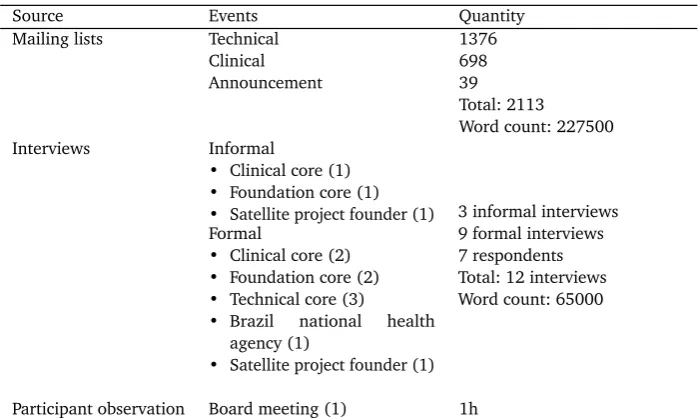
4.2.2 Mailing Lists . . . 111
4.3 Coding . . . 113
4.3.1 Practical Coding Issues . . . 113
4.3.2 Formal Open and Selective Coding . . . 117
4.3.3 Revising Coding . . . 118
4.3.4 Theme Building . . . 120
4.4 Justifying Choices . . . 122
4.4.1 Coding Decisions . . . 122
4.4.2 Theoretical Sampling and Construct Validity . . . 125
4.5 Conclusion . . . 126
5 Case Study 129 5.1 Electronic Health Records and Health IT . . . 131
5.2 The openEHR Case Study . . . 134
5.2.1 Early History . . . 135
5.2.2 Pre-Transition Governance . . . 137
5.2.3 Transitional Period . . . 138
5.3 Requirements and Processes in openEHR . . . 138
5.4 Conclusion . . . 141
III
Starting from the Middle
145
Mapping the Analysis 147 6 Identity: Being in the World 151 6.1 Building a Collective . . . 1526.2 Back to Basics . . . 160
6.4 Conclusion . . . 173
7 Exploring Contexts and Territories 175 7.1 Unseen Boundaries . . . 176
7.1.1 Timing the Territory . . . 177
7.1.2 Matters of Time . . . 182
7.1.3 A Frontierless State . . . 187
7.2 Realising Territories and Contexts . . . 191
7.2.1 Contextsin-becoming . . . 191
7.2.2 Ownership andin-becoming . . . 194
7.3 Conclusion . . . 196
8 openEHR Engages Requirements 199 8.1 Modes of Engagement . . . 200
8.1.1 Emergence is King . . . 201
8.1.2 Wary Opportunism . . . 206
8.2 This is not a Requirement . . . 210
8.2.1 Substantial Requirements . . . 211
8.2.2 Expressive Requirements . . . 216
8.3 Conclusion . . . 223
IV
Complexified Requirements
225
9 Discussion 227 9.1 Entangled Bodies . . . 2299.2 Requirementsin-becoming. . . 233
9.3 The Entangled Bodies of Virtual Requirements . . . 239
9.4 Multiplicity of Virtual Requirements . . . 243
9.5 Towards a Theory of Virtual Requirements . . . 246
9.6 Conclusion . . . 251
10 Conclusion 255 10.1 Limitations . . . 256
10.2 Contributions . . . 257
10.2.1 To Information Systems . . . 257
10.2.2 To Open Source . . . 261
10.2.3 To Software Engineering . . . 261
10.2.4 To Practitioners . . . 262
V
Bibliography and Addenda
267
References 269
Glossary 301
Appendices 305
A Pilot Protocol 305
B Code 315
List of Figures
2.1 Requirements in a formal language . . . 69
2.2 Requirements in a natural language . . . 70
2.3 Data flow diagram . . . 71
2.4 Waterfall model . . . 71
2.5 The world and the machine . . . 72
2.6 The spiral process . . . 72
2.7 A transversal cut of the spiral model . . . 73
2.8 Activities in SSM . . . 73
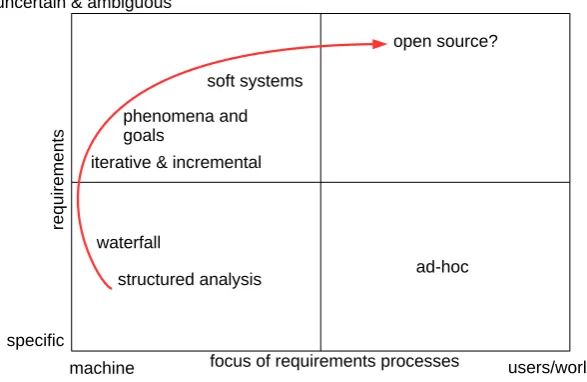
2.9 The review’s red line . . . 74
5.1 The openEHR Reference Model . . . 143
5.2 Conceptual view of requirements in openEHR’s two-tiers . . . 144
9.1 Theoretical themes from coding . . . 229
9.2 Virtuality of requirements . . . 251
9.3 Potential for becoming of traditional requirements . . . 253
List of Tables
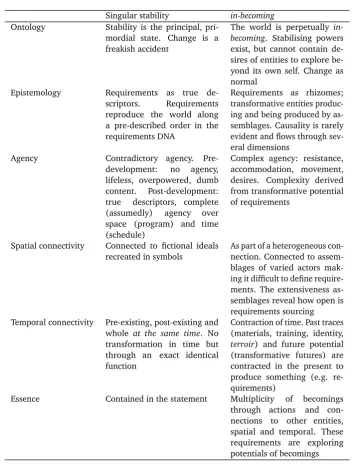
3.1 Singular stability andin-becomingrequirements . . . 99
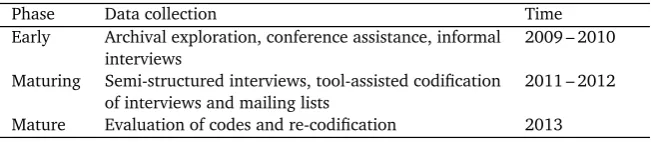
4.1 Data collection phases . . . 108
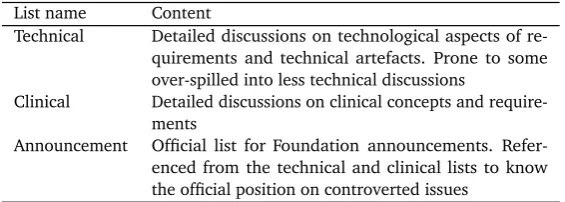
4.2 Coded mailing lists . . . 113
4.3 Data Collection . . . 114
4.4 Data Analysis . . . 115
4.5 Initial open and selective codes . . . 119
4.6 Revised open and selective codes . . . 127
4.7 Relation between themes and codes . . . 128
9.1 Deterministic andin-becomingtheories of requirements . . . 252
C.1 Selected movements in the 2009 openEHR technical list . . . 317
C.2 Selected movements in the 2010 openEHR technical list . . . 321
C.3 Selected movements in the 2009 openEHR clinical list . . . 323
Prologue
This thesis problematises the nature of requirements engineering, the part of software engineering which is responsible for the correct elicitation and modelling of a software’s requirements. The identification and definition of requirements are often considered the first steps towards the building of software. The purpose of requirements is to define the functionality of the future software; it responds to the question: ‘what should the software do?’. The activities that oversee the capture and definition of requirements have themselves become an important engineering activity inside the larger software engineering discipline, and have increasingly become guided by tools and modelling frameworks. Engineering requirements is not a simple task since requirements are often tacit to the users and complicated to communicate—thus hard to understand for engineers who are not intimate with the context. Also, the introduction of a new software is frequently perceived as a disruptive agent by the future users. In some ways, requirements engineering functions much like a Delphic oracle:
1. engineers are asked by the clients to build a new system (the context is framed);
2. engineers ask the users what they would like (identifying the requirements);
Though sketchy, the previous points represent the main tasks in requirements engineering. Requirements engineering is much of a guessing game: engineers usually know little of the users’ work. Nonetheless, they have to understand the specific needs of the users who often take their own work as natural and have difficulties to explain it. The requirements which are elicited and modelled from the users, are then coded into the software and introduced in the environment in which the software should function. Recurrently, the software does not meet the users’ needs. This problem and its frequency is termed the ‘requirements problem’ in the literature. It seems almost comical that the hardest part of building a software system is, in fact, knowing what to build.
Upon examination, the literature tends to conclude that there is a disconnect between the elicited requirements, the users’ expectations, and the reality in which the software is supposed to function. When the resulting software does not work according to how (for the users) it should work, users often resort to workarounds (which are socio-technical in nature). The root cause of this disconnect, it seems, is the messy nature of the world and the competing realities. How to capture the messy world? How to translate messy contexts into a machine which does not understand messiness? To solve this requirements problem, two main lines of investigation and practice emerged in the software engineering community.
The second took an overtly social turn. The ‘soft’, social aspect became a methodology which would take the messiness of the world and create methods out of it. It took, essentially, a constructivist perspective: it tried to understand the interaction between the requirements and the software-to-be, and their effects across multiple interests and actors. Pictures that depicted the world would be drawn, shown to the users who would in turn draw their own picture. The user, consequently, would become more implicated in the process.
Though both positions took diverging paths—one more positivist, the other more constructivist—they shared the original insight that the world needed to be considered and its logic understood. Each position has its own merit: they proposed beneficial solutions and rethought, in their own way, the contexts in which require-ments are generated and used. Nevertheless, both methods still saw requirerequire-ments as stable entities with enduring, recognisable features. To this day, there still lacks a conceptual and—perhaps of greater importance—evolving conceptualisation of requirements. A requirement was and continues to be recognised as a functional, deterministic statement describing an aspect or purpose the machine needs to satisfy. It is this deterministic aspect that this thesis questions.
The enquiry is set in open source, a good laboratory in which to study re-quirements because it is subject to two contradictory affirmations, and is therefore controversial in nature. On the one hand, some authors believe it provides nothing new to the craft of software engineering. On the other hand, some suppose it is a paradigm shift, ready to challenge closed source methodologies, along with their organisational practices. Since open source development is still an open debate, there are no accepted views on its nature. Such volatility is more welcoming to the search for alternative views of consolidated concepts such as requirements.
mundane, but essential in the functioning of organisations. Deleuze and Guattari’s concepts, on which this study bases its theory, share this appreciation of the impor-tance of perpetual movement (or the desire to). Starting from Deleuze’s concept of rhizome, an ontological perspective in which requirements are in-becoming is proposed. Such dynamic and evolving requirements, if empirically supported, would imply different management necessities.
To look for such empirical evidence, openEHR is chosen as a single case study. openEHR is an open source health IT project, which, unlike other projects in open source, puts a large emphasis on the creation of knowledge artefacts. In contrast to many open source projects, openEHR is explicitly conscious about requirements, giving careful consideration to how they should be sourced and articulated. The principal source of evidence is the project’s mailing lists, complemented with inter-views. The use of these two sources helps to contextualise issues. Grounded theory methods are used to help the analysis of such a large quantity of data. From this a model emerges that relates identity, territory, and modes of engaging requirements. The emergent model is a meeting point between Deleuze and Guattari’s concepts which are used to explain the empirical evidence.
Part I
Stability and Change:
Chapter 1
Introduction
“The image is not singular, since it is a sedimentation of
tempo-ralities”
1(Coulombe 2012)
Sitting on a bench, in a lecture room at UCL’s computer science department, I hear an improbable paradox. It is one of the first lectures of my final year as an undergraduate. I do not expect a life-altering revelation when starting my final year reading computing engineering. But I receive one anyway: a majority of software problems can be directly traced back to incorrect requirements. Noiselessness in the class.2 Apparently, such a simple question as “What should the programme do?” is really difficult to answer (Brooks 1995). The paradox is unsettling. “And we are told this in the fourth year?” I remember asking myself. Not really: in some way, that the users—that most external, irreverent, unexplainable meddler—could be problematic had been mentioned to us. Yourdon (1998), while citing Garry Weinberg, says “there are only three problems in developing software: people, people, and people.” Snobbishly, I thought, the users were to blame. Not con-sciously guilty, but rather as a way of course, as representatives of those things that were difficult to understand: the ungraspable organisation; the political motives;
1My translation
management; lack of general knowledge of computers; and all the other aspects software engineers have little control over.
The next years would serve as a continual reminder of the complexity of re-quirements. The small paradox multiplied. It went by different names: drifting, work-arounds, resistance to change, fear and domination, inscription and scripts. The dark side of computer science held many more accounts of requirements prob-lems than the clean, crisp world of methods and tools. Everywhere, requirements provoked questions and debates. Everywhere except in open source it seemed. Did open source solve the requirements problem? Or did it just ignore it in the same way that Agile methodologies are sometimes accused of avoiding engineering requirements seriously? From there, questioning what requirementsareis only a stone’s throw away. These questions informs this thesis.
This chapter introduces the principal research questions that depart from that original paradox. The question: ‘What is a requirement?’ is refined by exploring some of the assumptions placed on requirements. It is in these (increasingly) disputed assumptions that a gap is revealed, from which follow a set of research questions and the aim of this work.
This chapter is structured as follows:
Inherited assumptions. Some of the assumptions prevalent in the field are briefly introduced.
Evolving contexts and the messy world. Requirements are briefly contextualised. This account describes how the concept of requirements has evolved over time.
Uprooting assumptions and research questions. This section presents the re-search questions.
1.1. Inherited Assumptions
1.1
Inherited Assumptions
As with many aspects of computer science, requirements originated from the search for a solution to a given problem. The problem space—a term engineers use to define the space where requirements are to be found—was originally small. It included mathematical problems of ranging complexity, limited only to the architectural boundaries of computers of the time. Their resolution depended on their complexity and the time it took to go through the algorithmic solutions. Space and context mattered little, and meaning was unambiguous. However, as the uses of a computer moved beyond those of neatly defined needs such as those made for calculators—the computer’s original use—so did the problem space. The solution to any given problem increasingly became relative to other possible, uncertain solutions. Computer science and software engineering tended to see the increasing complexity as a need for better modelling tools (Bell and Thayer 1976).
As computer usage grew, the purpose associated with requirements and their engineering changed (Jackson 1978). The focus shifted to eliciting existing phe-nomena of interest, instead of choosing the stable elements that could be easily described and coded. These phenomena would be stabilised by a systematic process from which requirements and machine specifications would be derived (Jackson 1995b; Jackson and Zave 1995; Sommerville 2005). The resulting requirements would be tied back to concrete stakeholder needs which would give a picture of the interaction between the machine (software) and the world (reality). This di-chotomous arrangement of requirements—the machine on one side and the world in the other—opened the view for more elaborate models and approaches to the articulation of requirements. For example, goal oriented requirements engineering owes much of its ideas to that conception of the world (Lamsweerde 2009b). Certain aspects that had been largely disregarded took shape, for example, the means for the exploration of the problem domain where requirements would be found. Developing better ways to explore the world would lead to finding better requirements.
1.2. Evolving Contexts and the Messy World
of competing models and processes ensured that, even though the problem domain was still believed as pre-existing the engineers’ enquiry, care was needed in eliciting and articulating requirements. The wrong method could in certain contexts hinder the proper identification of the stakeholders’ needs.
Competition between models helped launch a discussion, even if implicit, on the role and meaning of context in requirements engineering. Changes to organisational boundaries and the speed of change in the life of systems helped start divergent trends in research—more critical ones—with new ontological and epistemological positions (Bencomo et al. 2010). Open source has contributed in its own way to this as it is generally positioned against traditional requirements engineering because of the informal nature of requirements. It is for this reason that open source is a good laboratory to study the nature of requirements.
To research requirements in open source, it is necessary to problematise their conceptualisation and the different meanings they may take. This implies a move away from the assumptions of mainstream requirements engineering (and open source studies). Established requirements engineering views requirements as sin-gular, stable objects that can be wholly identified from the world. For example, requirements are described as abstracted definitions (Lamsweerde 2009b). Open source, though indirectly questioning the nature of requirements, also holds as-sumptions of informal objects and processes where requirements are taken, seem-ingly, from the ether of collaboration. Even the theory of the commons, perhaps the only meta-theory that open source has, stabilises requirements by institutionalising them: they appear as objects waiting to be evaluated after a circular process of identification and validation (Benkler 2011). Requirements end up rationalised and subjected (objected) to stability.
1.2
Evolving Contexts and the Messy World
which has, as yet, seen limited research into requirements but indirectly questions their role by posing itself as an alternative to traditional requirements engineering. In open source, requirements have not been problematised yet. Not problematising them would lead to the unfortunate neglect of the opportunity to understand their constitutive nature in that particular domain.
Why are requirements in open source not such a debated topic? There are two reasons for this. First, research has deemed open source as an alternative method to traditional software engineering practices, but has, despite its attempt to distance itself, unfortunately inherited its language. Second, research has viewed requirements in open source as just another instance of requirements but placed in a specific context, without any particular attributes of their own—therefore not warranting any specific research. The first view has pushed open source into the world of Agile methodologies via its similar use of informal objects; it has thus avoided to problematise what open source—or agility—mean, and their conse-quences on requirements. The second view holds requirements to be universal objects, influenced in deterministic ways through the same mindful processes of purification. As a result, open source, as a domain for the study requirements, has drifted without gaining clarity. This thesis forms a response to this dichotomous view and proposes that requirements in open source, along with the processes that make and undo them, are constituted by and constitutive of their projects. Requirements are immersed, along with other objects, in the murky role of defining what things are.
1.3
Uprooting Assumptions and Research Questions
1.3. Uprooting Assumptions and Research Questions
the added benefit to be in a format that other software engineers, further down in the process of software production, would understand. This top-down, waterfall-like thinking was supposed to clean requirements from their messy origins and describe them through algorithmic statements. This kind of thinking, reminiscent of the natural philosophies, essentially proposed deterministic statements to translate worldly requirements into their machine-like equivalents. The messy nature of requirements was associated with the ambiguous human language and was not considered as an intrinsic property of finding what the program should do. This positivist view, although useful in the modelling of requirements for subsequent engineering phases, complicated the requirements’ problem by over-objectifying requirements and abstracting the complexity away. But in every abstraction there is an extraction (Guattari 1995), and simplifying requirements also narrowed their purpose and role. The alternative that took a more constructivist perspective was more welcoming of the world’s messiness, but maintained the similar consideration that requirements could be objects (albeit complex ones).
studying requirements. This makes them indissociable to the processes that bear them. The use of this theory can help understand the way in which requirements evolve, are apprehended in the world, and the reach they have.
The choice of theory implies the use of a certain methodology. Deleuze and Latour, among other theorists, have influenced research protocols. They provide a theoretical position which can be useful to give voice to requirements. Empirical evidence is not formatted to fit a framework; on the contrary, the use of theory attempts to emancipate those actors and assemblages involved in requirements so that they may express themselves. Their views are not upheld as universal or true; but their assemblages and their evolution are taken into account in their own terms. This can be done by looking at perturbations, moments in which actors and assemblages question their place in the world. It is their disquiet that is to be revealed. By relating to the concerns of those that make up the realities in question, this type of theory grounds itself empirically. The data is gathered using grounded theory methods and their use of coding schemes.
The case study used here is openEHR, a health IT project that specifies clinical requirements for health systems. Health, as a domain, is an interesting field to study requirements in because of the multiplicity of meanings and complexity of the field (Mol 2008). openEHR is also an open source project, although unique in many aspects. openEHR is not the typical, infrastructural project with a predominant hacker culture. In contrast, openEHR has, for some time now, been discussing and coming to various understandings on the meaning of open source and how to handle requirements. Should they protect their requirements, controlling derivative products, or encourage their decentralisation? openEHR values requirements from a perspective other than solely an engineering one and can reveal aspects of requirements engineering that may be interesting.
The search for an alternative conception of requirements can be phrased in a list of research questions. The original question that motivated this research: ‘what are requirements?’, can be refined into several:
1.4. Outline
of requirements? What are the consequences of these assumptions? Should they be questioned?
• Are requirements stable or tamed objects? Is there an alternative to the purification process engineering puts them through to make them useable? How are requirements sourced and articulated? Could (and should) there be an alternative understanding to the nature of requirements?
• What is specific—if anything—to open source requirements?
1.4
Outline
The thesis follows this structure:
this line and study requirements as performative actors, the field of open source—and how it is helpful in departing from established concepts—is presented. This chapter opens the door for the theory to contend the accepted notions of stability that define them.
Chapter 3. This chapter presents the theoretical foundations with which to con-duct the analysis and discussion. The theory used escapes mainstream under-standing of stability and shows how change has redefined what is understood by stable. Thus, the theory links with processual studies which give a larger role for change to play. The main theoretical concepts are based on Deleuze and Guattari: rhizomes open the door to an understanding of requirements in-becoming with varying potentials and involved in complex assemblages.
Chapter 4. The method chapter first describes the reasons behind the search for a case study and the theoretical implications to the methodology. The theo-retical considerations and the analysis of the literature guided the choice of openEHR as an in-depth, interpretive, exploratory case, principally because of openEHR’s explicit consideration of requirements. The data collection choices are put in the context of the researcher entering the field and the gradual contextualisation of the project. The data analysis section presents the coding methods and schemes used. Though this research uses grounded theory methods, it does not build theory from the codes. However, an emer-gent model derived from coding acts as a meeting point for the theory to make sense of requirements. This chapter also presents the issues that arose during coding and justifies the decisions the choices made.
1.4. Outline
field of health IT and EHRs, briefly exposes the project’s goals, and introduces some of the key concepts of openEHR.
Chapter 6. This is the first analysis chapter and is entangled to the other two analysis chapters (7 and 8). This chapter deals with openEHR’s identity and its concern forbeingin the world. openEHR’s identity has a direct influence on the way requirements are sourced and articulated. Three aspects of this relation between identity and requirements are explored: the type of collec-tive that openEHR attracts and builds modifies the ways its requirements are handled; how requirements can reshape even foundational assumptions about the project; and the importance of openEHR’s position in the market as a minoritarian force. This chapter shows the intimate relation requirements can have with the project’s own identity.
Chapter 7. The second analysis chapter analyses the influence requirements have on (and receive from) the territories that openEHR wants to settle into. The way territories are contextualised and brought into openEHR denotes how requirements are sourced and articulated. Time features prominently in the issues openEHR faces when settling spaces: there is no referential time-frame which would restrict the exploration of worthwhile territories to explore. The immediate consequence is that the project does not have a cleanly cut visible frontier. The contextualisation of territories is difficult because the contexts themselves evolve and disrupt openEHR’s own requirements and the way these are to be controlled. This chapter shows how openEHR maps the spaces it wants to settle and the issues it faces when tracing boundaries.
to requirements in line with its goals. This balancing exercise reveals the evolving, in-becoming nature of requirements in openEHR and how they take substance in the project and express changing needs.
Chapter 9. The discussion chapter first summarises the findings and their analy-sis into an emergent model which is given perspective through the use of Deleuze and Guattari’s concepts. The emergent model shows requirements’ reach through the assemblages they entangle to in openEHR. These assem-blages are in-becoming, alternatively opening and closing the door to various potential realities that requirements shape. The high potentiality of require-ments is termed virtuality and is the principal finding of this thesis. Virtual requirements are requirements which can shape realities in multiple ways. The shaping of these realities is observable when the requirements are being actualised and their forces enact realities. The virtuality of requirements is a consequence of their multiplicity and the competing realities that their actualisation can give rise to. Virtual requirements, if carefully managed, can be useful in accurately enacting realities in domains with high uncertainty.
Chapter 2
Literature Review
“However, many operators sensed that the relationship between
data and reality is a matter for inquiry, inherently problematic.”
(Zuboff 1989)
wa-terfall model can be problematic and straw-men unto themselves: some argue that the waterfall model is often (or should be) used in varying degrees of conformity (Kruchten 2010).
The greatest difficulty, however, is that requirements cannot be discussed com-fortably out of their context as if they were held inside a test tube, outside of time and space, and with clearly defined protocols to establish some truths about their matter. Though requirements have been, at times, bounded off and away from worldly preoccupations, requirements also represent evolving trends of various be-liefs in science and the establishment of truth encompassed within closed artefacts (Kallinikos 2005). A review of requirements itself depends on other straw-man accounts of related issues, such as the waterfall model. The beliefs themselves are not necessarily epochal in a historical understanding (Popper 2002; Savage 2014), so reflections on requirements cannot be sectioned into neat, temporal packages. Maybe the ill-fitting categories that define the requirements straw-man make a useful point: requirements are a middle that, just like translation devices not only diffuse and hold knowledge (e.g. of the organisations’ functioning), but also perform multiple realities, thereby enacting them along with their own selves (Ricœur 2006).
of (Appan and Browne 2012; Davidson 2002).
Requirements’ prominent place within the development of information systems compels an enquiry into their nature and the probable relation they have with the (seemingly recurring) software crisis (Curtis et al. 1988; Greenspan et al. 1994; Jason 1989; Lyytinen 1987). The so-called ‘requirements problem’ and its persis-tence has been empirically substantiated through a number of field studies showing that a large proportion of software defects were traceable directly to requirements (Group 1994, 2003; Juristo et al. 2002; Lubars et al. 1993; Potts and Catledge 1996). The requirements problem is the enduring causality between requirements and software defects (Lamsweerde 2000), and is an explicit acknowledgement of the requirements’ prominent role in the larger concept of the ‘software crisis’ (Pressman 1982).
2.1
The Early Articulation of the ‘Requirements Problem’
The recognition of requirements as a problematic endeavour started in the late 1970’s when the complexity of computer systems tried to follow suit with their increasing calculative power (Jackson 1983). One of the first articles to make explicit this troublesome relation reflects on the authors’ experience with the rigorous articulation of requirements (Bell and Thayer 1976). A decade later, a survey of 17 large projects over their software design processes (that included requirements activities) attributes three problems to requirements specifically: thin domain knowledge by designers; changing requirements; and conflicts in their definitions (Curtis et al. 1988).
If the requirements problem has not been solved yet (Lamsweerde 2009b), its conception from Bell and Thayer’s (1976), to Curtis’s et al. (1988), evolved alongside the parent field of software engineering to expressively take into account the organisational environment as key to successfully describe requirements. The 1980’s are marked by change in the software development paradigm because of the growing recognition that information systems, in their totality, are irreducible to a machine; the world is too large for any machine. The waterfall model shares the top-down approach of structured analysis, and because of its inflexible nature, helped further the simplification requirements, subsequently detached them from worldly concerns.
In this section, the earliest understanding of requirements is presented. Their definition and processes fit into an era marked by a widespread acceptance of the waterfall approach to software engineering (Royce 1970), and an emphasis on information flow modelling (Coad and Yourdon 1990).
2.1.1
Early Requirements Representations
2.1. The Early Articulation of the ‘Requirements Problem’
must be performed” (Bell and Thayer 1976), or “all aspects of system development prior to actual system design” (Ross and Schoman 1976). There are two points to take out from these definitions: the first point is a view of the software system as a functionally described machine which takes inputs and computes outputs, the second point evidences the nascent field of requirements engineering which should hold different concerns than the closer-to-code design phase. Bringing these two points together sums up the purpose of requirements engineering: describing all of the machine’s functions before any implementation activities.
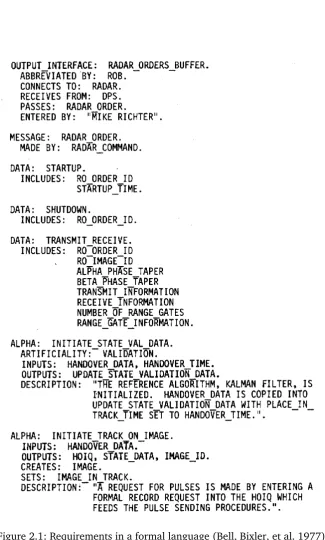
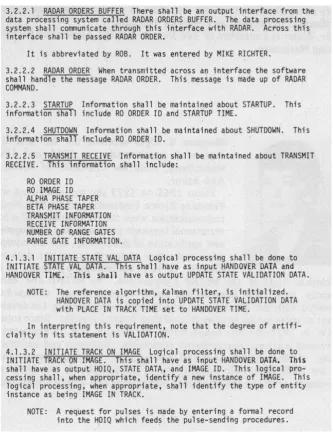
In the 1970’s, when requirements started featuring prominently in general software engineering literature, formalistic statements were the state of the art; these are highly structured statements describing requirements as functions over inputs and outputs. Increasing the rigour of a requirement’s description, it was hoped, would increase its veracity. Bell et al. (1977) proposed such a formalistic language which would rigorously provide definitions of a machine’s computa-tional steps (c.f. figure 2.1). This is in opposition to unstructured requirements and informal definitions which could be misleading (c.f. figure 2.2). The formal definitions, instead, were to provide unambiguous descriptions to automate much of the engineer’s work to help him “use his creativity,[thus]the system should be natural and flexible; it should allow him to express requirements in terms of concepts which are familiar to him” (Bell, Bixler, et al. 1977). The emphasis is on the engineer’s use of concepts “familiar to him”, not those used by the machine’s future stakeholders.
derived in from the top down: from highly abstract and conceptual views of the whole system, to lower levels representing the system-as-solution (Chang et al. 2001). The systematic, functional, top-down derivation of a requirement is called functional decomposition(Coad and Yourdon 1990). Functional decomposition does not refer to an increasingly precise understanding of what the system should do on the whole; instead, it gradually details the routines and sub-routines that the machine should execute.
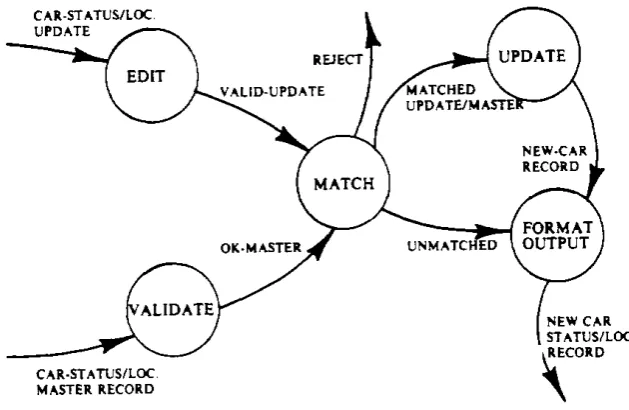
Compared to formal language requirements, structured analysis might not seem much different. For example, both Bell and Thayer (1976) and Chand and Yadav (1980) see requirements as information that is formatted in some unambiguous way. Both see in the nature of requirements a precise rendition of a machine’s working routines. The difference is a clearer relation between the functions and their effects on information through a diagrammatic representation. The drawing of various levels of the system-as-solution domain was intended to provide a hierarchical ordering of data transformation (hence a structured analysis). For example, figure 2.3 shows a data flow diagram at a certain level of abstraction (Peters 1980). Data flow diagrams, as an example of structured analysis techniques (Chapin 1978), provide “the software engineer with guidance on how to define the software given that he has a model of the data flow which will eventually occur in the system” (Peters 1980). The system, thus,isthe machine; requirements are algorithmic information describing the inter-related routines of a machine. The possibility to diagrammatically see functions in action helped to see the “forest for the trees” (Pressman 1982, p.97) and gather an overall picture.
2.1. The Early Articulation of the ‘Requirements Problem’
idea that will gain more prominence throughout the evolution of requirements and software engineering (Iivari and Iivari 2011; Jackson 2008).
Notwithstanding the progress made by structured analysis in the philosophical understanding of requirements and their role as transformative information that is not so easily plucked out of the ether of contextual reality, the ‘requirements problem’ remained. Partly to blame is the waterfall approach which reinforced the reliance on top-down, solution-oriented approach of structural analysis. The waterfall glued requirements as a well-defined activity which would output a clear and stable deliverable. The waterfall model, though part of the general software engineering work on software life-cycles, helps explain the expectations placed behind requirements in the overall engineering effort.
2.1.2
The Waterfall Simplicity
The waterfall model is a top-down approach and a contemporary of structured analysis (Raccoon 1997; Sneed 1989). The model consists of a series of activities carried out in sequence and in which backtracking is discouraged (Wolff 1989). This is not always the case, and the early promoters of the waterfall did not specifically deter from returning upwards to previous activities (Davis and Sitaram 1994). More than a theoretical imposition, the recurring problems of backtracking that the waterfall suffered from might rather be attributable to the legitimisation of the deliverables at every phase. If taken to extremes, analysts would be confronted every so often with a “go/no-go decision” (Cave and Salisburi 1978), forcing them to make decisions that might be invalidated in later phases despite the looming costs of late corrections (Boehm 1984b).
(Buss 1981), which is usually not the case (Rowen 1990). For example, Heninger (1980, p.2) recounts the difficulty of creating a complete specification of an existing aircraft prototype “in spite of the availability of a working program and experienced maintenance personnel”. She goes further: “None of the available documents were entirely accurate; no single person knew the answers to all our questions; some questions were answered differently by different people; and some questions could not be answered without experimentation with the existing system.”
The difficulty encountered by Heninger and her team to understand require-ments, let alone provide a complete specification, resides in their multiplicity: they hold different meanings to different people. The objective of the waterfall tries to lop off the ensuing uncertainty of meaning by putting a large effort in understand-ing the problem domain early. It does this by stabilisunderstand-ing requirements by freezunderstand-ing or rooting them in a document that constitutes a homogeneous representation of meaning (Cusumano and Selby 1997; Lyytinen 1987).
The problem is that this freezing ultimately drives and coordinates software engineering efforts though objectifications (Scarbrough et al. 2012), which are, however, inflexible to change. Falsely rooting requirements down and artificially removing their multiplicity consequently affects their representative capacity. Some authors consider requirements as boundary objects with interpretive flexibility (Barrett and Oborn 2010; Doolin and McLeod 2012); if this flexibility is removed, the world portrayed is at best inaccurate, and at worst difficult to alter. Some views become invisible, possibly discarded, while others can be given an unmerited prominence (Davidson 2002).
2.1. The Early Articulation of the ‘Requirements Problem’
that they evolve little, their potentiality cut early (Deleuze and Guattari 1987); the requirement might be well described, but a poor representative of needs.
The experts charged with the burden to make these decisions serve a similar role to that of the scientist-philosopher depicted by Latour. Using Plato’s cave as an allegory, the expert removes himself from the worldly pollutants that could alter his access to truth (Latour 2004). In the waterfall period, politics are such a pollutant and the objective of the expert was to remove or to limit its effects (Hirschheim and Klein 1989).1The expert analyst abstracts requirements out of the messiness of life and standardises them, attempting to produce a universal value useful along every possible user of the system (Ciborra 2002b).
Law (2002, p.150) echoes this standardisation when he speaks of the disap-pearing of the political, or “that which cannot be said, or at any rate cannot be said in the right place, removes itself from the Political becoming something quite Other.” Once the requirements document has been written, it is difficult to nudge it through small politics; requirements having come to represent the universalised big Politics. Local situations, small voices, Others, they are all equally crushed beneath the enlightening power of technical requirements that have been purified from the organisational politics by scientific processes.
This is, at the same time, the strength and weakness of formalistic and structured requirements: they assume that the software system can be strongly anchored to truthful requirements, and because they are truthful, their place in the world should be unproblematic. As Crotty (1998, p.27) says of positivism: “science ascribes no meanings at all. Instead, itdiscoversmeaning, for it is able to grasp objective meaning, that is, meaning already inherent in the objects it considers.” The requirements processes, thus, are more about measuring the world than producing it since the measurement relates objective, pre-existing, and essential truth values (Law 2004). Requirements thus also act as a social instrument of acceptable
change (Munson 1981), at the expense, under the waterfall, of the performativity of multiple becomings.
2.2
Exploring the World to describe the Machine
The top-down approaches of structured analysis and waterfall modelling gave way to more flexible paradigms such as object-oriented analysis, Boehm’s (1986) risk-oriented, spiral method, and Jackson’s (1995b) view of requirements as world and machine phenomena. This section introduces this evolution in the understanding of requirements as a more flexible object which represents reality is less clear-cut ways, requiring an explicit and repetitive exploration of the problem domain. The methods of analysis and the overall spiral methodology (indicating a departure from the waterfall’s usage of requirements), are presented through underlying similarities. First, requirements are shown to be perceived as different kinds of objects, being much closer to the problem domain than the machine-solution of top-down approaches. Second, the overall conception of the machine as a system has shifted; it is no longer considered as a clean separation between inside and outside, but as a complex transformer of inputs.
2.2.1
A Different Kind of Objectifying
2.2. Exploring the World to describe the Machine
of the problem context” (Jackson 1995a, p.169).
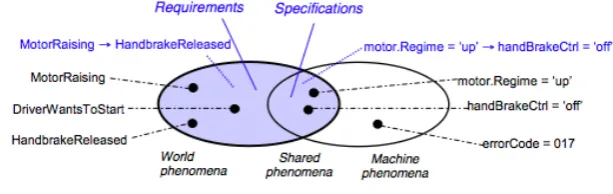
The wording is telling: requirements are describedexactlywhen they describe the requiredbehaviour between the world and the machine, and requirements reside in the world2. The world and the machine, when portrayed as intersecting Venn diagrams (see figure 2.5), show requirements as interface-beings. As an interface, requirements can (objectively) mediate the world in which they reside (they tell of objective realities that happen), and describe (or should do so) the machine which interacts with the world.
Treating requirements as interfaces casts doubt on the strong positivism behind their nature; after all, there are many possible models of requirements to accurately represent reality, yet some are better than others (Letier and Lamsweerde 2004). If there is still one reality (or world) in which one machine is a part of, it is indicative that Jackson’s understanding of requirements as models of phenomena is still positivist, only less so because their modelling admits the possibility of misrepresenting reality (of which there can be many, possibly conflicting models). The work of the engineer, then, becomes one of sorting through the possible modelling. The direct consequence is a shift from the machine-solution oriented engineering that was more common in the top-down approaches, to one focused on the problem domain and closer to the user and stakeholders.
To see requirements as interfacing puts the world back into the limelight because the world is mediated (and re-mediated) through the machine (Kallinikos 2011). As an interface, requirements are in a state of “being on the boundary. It is that moment where one significant material is understood as distinct from another significant material. In other words, an interface is not a thing, an interface is always an effect” (Galloway 2012, p.33). There is a differentiation taking place, of which requirements are in part the describers, and in part the performers (or rather, to describe is to perform). Perhaps this is the reason why the world and machine metaphor has gained such popularity to explain the place of requirements
in software engineering (Berry 2011): it provided an engineering lens to account for the rapidly evolving meaning of the requirements in the world.
This is in contrast to functional decomposition: if a requirement needs to be validated by the client, then it is more than just a programme’s function or a number of agglomerated sub-routines (even though it would be described diagrammatically through data-flows). For Jackson (1983), the function and its decomposition into lower-level sub-routines is not the main concern. Instead, he argues that the starting point for requirements should be the synthesis of the problem domain and the hypothetical interactions of the machine, without which there would be no context when requirements are specified (Jackson 1983). A requirement, thus, sits somewhat uncomfortably between the social world from where comes its context, and the machine, which offers a number of ways to implement the requirement.
The world and the machine, when portrayed as intersecting Venn diagrams (see figure 2.5), shows the difficulty of pure top-down approaches to black-box a software’s requirements as a conglomerate of machine-functions. Kallinikos (2006), building on Luhmann, has termed this aspect the ‘closure’ of a technology’s functionality. Closing off functions can be done in different ways. In structured analysis, the closing happens when functions are decomposed successively, gaining further legitimacy at every lower-level of analysis; any change will have to confront with the number of derivations that went through defining the function (in this sense, the derivations would be repetitions of the same since they would be causally related (Deleuze 2004)). In the world and the machine paradigm, it is much more difficult to isolate the functionality from the world since the machine’s influence on the world is subjected to comprehending the problem domain, and thus, the requirements.
2.2.2
Requirements as Phenomena
2.2. Exploring the World to describe the Machine
related to both the nature of requirements (what are they in the world?), and how they should be approached (how can requirements be described?). By treating requirements as transformable information, structured analysis makes the machine the sole responsible of re-ordering the world. Jackson, instead, treats requirements as world phenomena (c.f. figure 2.5) on which the machine acts upon. The ensuing system is less cleanly definable and prone to the vagaries of the social world.
Jackson (1995a, p.143) defines phenomena to be “whatappearsto exist, to be present, or to be the case, when you observe the world or some part of it in a domain”. On one hand, there are world phenomena, from where requirements are found; on the other hand, there are machine phenomena—machine-specific requirements the machine alone is responsible to see satisfied. Shared phenomena are requirements that are implemented, or should be implemented in the machine, but which also depend on world phenomena to be satisfied (such as a user pushing a button). In this sense, these shared requirements bind together the world and the machine. Although both are distinguishable analytically, the machine’s purpose and incidence on the world is made clearer and more complex.
The nature of statements is different in the world phenomena than it is in the machine phenomena. Ontologically speaking, the interesting requirements (for the engineering of the system) are those that exist in the intersection between the world and the machine, for example, whether they are describable (through translations) to machine phenomena. Analytically, though, these two worlds are separate, conforming to different rules and adapting to contexts. The world phe-nomena which have no direct incidence on the machine (but may have an indirect one) are explored and generally assumed, unless they are counted as a possible risk.
reality is still assumed, but the variety of models and alternatives open requirements engineering up to wonder about alternative problems and solutions (Duboc et al. 2013). The role and prominence of the machine has also shifted; it is ontologically inseparable from the world (Jackson and Zave 1995). The shared part of the world, the boundary, is much more malleable than pure data flows through well-defined systems.
That requirements are part of the world and act as interfaces between them-selves (e.g. as description) and reality(-ies) indicates a loss of control away from the engineer. Top-down approaches, as has been criticised, tried to deal with this prob-lem by freezing interactions and simplifying requirements as machine-functions. The loss of control directly influences the nature of requirements because they can no longer be considered ‘wholes’ or complete, as they would in the previous, more positivist accounts. Instead, requirements, as a body of functions become superseded by a number of partial concepts: viewpoints (Nuseibeh, Kramer, et al. 2003), for example, represent a stakeholder’s partial understanding of the system that need to be accommodated (Boehm 1998); or, experiential phenomena that indicate some transformative movement (Jackson 1995a); or, even, constructed narratives (Barrett and Oborn 2010; Urquhart 2001).
Though the terminologies are different and denote distinct aspects of require-ments, it is the erosion of requirements as a complete thing represented as the trio input-function-output that is of note. How should incomplete requirements be approached?
2.2.3
Approaching Requirements: Risks, Uncertainties, and
Imbrica-tions
2.2. Exploring the World to describe the Machine
agree, always believe the territory.” Boehm’s (1984a) instigations to reflect on both the validity (useful system) and veracity (correct system) of a software echo the controversial multiplicity of requirements. These are not only difficult to see implemented correctly; their interaction with world actors needs to be validated as well, making this process an uncertain one.
Boehm’s (1986) spiral model is a testament to the uncertain and risky nature of the world and is a cornerstone for the inclusion of requirements into contemporary software engineering paradigms based on iterative and incremental approaches (Lamsweerde 2009a; Mathiassen, Saarinen, et al. 2007). The spiral model admits implicitly that complete or perfect requirements are not likely to be found easily (c.f. figure 2.6 representing the multiple and repeated tasks of validation and verification). ‘Perfection’ can only be approached through multiple iterations, incrementing step by step the deliverables (requirements document and others). This approach echoes Parnas and Clement’s (1986) words on rational processes and why they should be ‘faked’. Under such a view any requirement might not bethecomplete requirement; what matters is getting as close to it as possible so that it could be considered as such. The reason is the number of iterations which give confidence to the degree of accuracy in depicting reality. In other words, requirements might be marginally imperfect, but their representation of the single, extant reality is taken to be a symbolic truth, becoming legitimised through the iterations and increments as almost perfect translators of reality. Such objects invariably hold an increasing objective force the more increments are carried out.
the possibility of deviation.
Objectifying requirements in such a way is problematic: are the repetitions (or iterations) not creating distinct requirements? Or do they serve the purpose of idealising requirements so that they lead future iterations? In other words, are the iterations repetitions (where difference is admitted and even contingent to repetitions (Deleuze 2004)), or are the same requirements reproduced? In the spiral model, this question amounts to asking whether phenomena are subordinate to their representation as documented deliverables.
Following Kallinikoss (2006) concepts, technology is necessarily about the closing of operations. Under this view, technological systems are designed to be closed around selected, unambiguous operations.3 When Kallinikos (2006, p.37) writes: “Unforeseen relations cannot be handledin situ. They could possibly be incorporated into the model by the programmer in a future periodic revision of the program. . . ”, he points to the temporal contradictions between the world and the machine. Though the machine is charged with intentional change on the world, these intentions need to be revised once the machine is deployed. This disjunct feedback loop is reminiscent of the historical division between the complex social world, and the unambiguous intentions of the machine (the Taylorist scientific management in particular (Zuboff 1989)).
To solve this contradiction, Boehm’s spiral model seems to ally well with the world and machine paradigm: both ultimately attempt to select those requirements by experiencing the world, by iterating dips into the world. The same does Jack-son (1995a, p.143) when he describes phenomena as those things which appear and disappear through the use of language, adding that “Each method supports, encourages, or enforces a particular way of seeing the world.” This is not far from Derrida’s (1967) point when he wonders why originality is given to the oral word and deprived from the written form as if the spoken word came necessarily first; as if the written form (the model) could not be eminently influential on the semantic
2.2. Exploring the World to describe the Machine
foundation of the spoken idea’s substance (the world).
That the representation of a requirement could narrow the experience of stakeholders and the understanding of the problem domain is important. Such narrowing means that it is not only the unambiguity of the computer’s binary manipulation that affects requirements, it is also the method used that is responsible in the ‘cutting’ of a reality, making apparatuses to see the truth from the false (Barad 2007). This ‘cutting’ of the world and the machine takes place at various steps. In the machine and world paradigm, the first such ‘cut’ is to separate the machine from the world, somewhat cleanly, as if one would be imbricated into the other (Leonardi et al. 2013). In the spiral model, it is separating and focusing on activities between the requirement’s side and the implementation side (Céret et al. 2013), despite the concurrency of software engineering processes (Davis and Sitaram 1994).
Behind the separation between the world and the machine hides a discussion of systems: Jackson’s and Boehm’s greatest merit is, perhaps, to have shown how much one was permeable to the other. Instead of brushing off and simplifying early the complex interactions of the social world, the paradigms proposed by both authors sought out an unity of the machine-system that was to be achieved through the differentiating possibilities it could bring onto the world.4Luhmann (2013, p.63), when defining systems, mentions particularly this paradox between the unity of the system and how it differentiates: “the important issues consists in the fact that the system draws its own boundaries by means of its own operations, that it thereby distinguishes itself from its environment, and that only then, and in this manner can it be observed as a system.” In this sense, “a system is not a unity, but rather a difference, and, as a consequence, we have to face the difficulty of conceiving the unity of the difference.”
Deleuze (2004) accords a whole book todifference as a concept onto itself, the “difference of the difference” (Zourabichvili 2012, p.103), free from the false difference that is always rooted onto an originator; a source which imposes its
own moral value system thereby, reproducing itself. The top-down approaches did precisely that very early on: they ‘froze’ requirements (both the idea of a requirement and its representation) (Sneed 1989). Consequently, requirements risked being reproduced from early conceptions. Jackson’s and Boehm’s ideas translated to an unsettled boundary, one which itself needed to be argued. Where should the machine stand? Is it inside the world and the interactions are more messy, or is it outside, with a clean interface between the two? Part of the answer resides in the distance between its representations (not being cast into machine-representations of functions), and the present’s capacity to enact and interpret both its dimensions of past and future (Hernes 2014; Zourabichvili 2012). Thus, the ‘cuts’ in themselves are not necessarily negative; they translate a necessity of translation to machine code. It is important, however, to consider how this cutting is done because it influences not ““what is being?” butwho—or how—is being?” (Zourabichvili 2012). “Who draws this distinction. . . ” between the system and its environment which “is the difference that constitutes a system” (Luhmann 2013, p.63)?
2.3
The Socio-Technical Gap: Requirements as
Interac-tive Objects
2.3. The Socio-Technical Gap: Requirements as Interactive Objects
following way: requirements are interfaces (a manifest relationship, one which mediates), but as interfaces, they depend on the level of interaction to be described (how much they mediate). It is this interaction, and its intensity, that is the purpose of discussion in this section.
This section deals with a ‘softer’ understanding of requirements, where it is admitted (at least implicitly) that requirements are irreducible and performative: the ‘construction’ of a requirement leads to the construction of the world-machine, and vice-versa. Because of the irreducibility of the social world into the technical world (Ackerman 2000)—its bridging contingent to advancements in artificial intelligence (Dreyfus 2007)—, there is some sense of futility behind constructing systems. As Checkland (1985a, p.821) says: “In Churchman’s[(1971)]language, S.S.M.[Soft System Methodology]is a “Singerian Inquirer”, one which accepts that inquiry is never ending and is intent, in “an heroic mood”, on both attacking and defending thestatus quo.” Compared to the previous sections, this one considers the possibility of defining optimal requirements as elusive: just like Zeno’s paradox, the more requirements represent, the more of reality they create, creating in turn the need to represent some more, and so on.
2.3.1
Soft Systems and the Interactive Requirements
Soft systems is more a heuristic methodology than a prescriptive method (Check-land 1985b). It contains four different kinds of activity that are not necessarily sequential, but can, in the most simple of cases, follow this pattern (c.f. figure 2.8): initial perceptions of the situation are explored; models are made that describe some actions; the models are related to the “real” situation; and, finally, an action is taken which supports desirable and feasible change (Checkland and Poulter 2006, p.13).5The perceptions behind a situation are indicative of the problematic locality which needs to be explored by the stakeholders.
At first glance, there is much to connect Checkland’s soft systems methodol-ogy to contemporary efforts in requirements engineering, and specifically, Jack-son’s world and machine paradigm, with some authors arguing for their conjunct use (Ulrich 2012; Water et al. n.d.). Just as Jackson talked about phenomena and the exploration of the problem domain, Checkland speaks of modelling rele-vant ‘happenings’. Such ‘happenings’, once modelled, form part of points of views (specifically, theWeltanschauungen, parts of the ‘root’ definitions that describe the world-views). Such aWeltanschauunggives meaning to the root definition; it puts the world itself—and its arrangement—in a problematic and possibly conflicting position which needs to be explored. For example, the perspective “the Olympic games from the perspective of the host city” organises meaning around the host city (Checkland and Poulter 2006, p.38). The world-views and root definitions could be seen to resemble problem-frames in which goals and requirements operate, a sort of “problem class” that defines the world (Nuseibeh 2010, p.346).
The difference comes when the multiplicity of theWeltanschauungis discussed: “It does not bother to ask which models are ‘correct’, since the models are not
2.3. The Socio-Technical Gap: Requirements as Interactive Objects
would-be descriptions of part of the world, they are accounts of some ways (among a multiplicity of ways) of perceiving it.” (Checkland 1985a, p.822). The represen-tation of the world and the world itself are unhinged: the models have become accounts that are deliberately removed from specifically enacting it (Mingers and White 2010). In the world and the machine paradigm, the requirements are clearly represented as interactive shared phenomena: the general goals and objectives found in the world would be directly or indirectly operationalised by the machine (Jackson and Zave 1995). This is specifically rejected by the soft systems method-ology because the world and the objectives therein are too complex to be easily delineated into clean, singular systems (Checkland 2000).
Checkland’s point about the perception of the world is important to further differentiate the third way: the singular system does not exist, except in the most simple cases (Checkland 2000). In norm, however, systems are complex systems which themselves are interpretable in a number of ways (Checkland and Poulter 2006). The interpretivity of systems means that the same system could be modelled and still be understood differently. In this sense, the systems as wholes and parts are not unique and essential as some believe (e.g. (Robinson and Wilson 2003)), they do not translatea totality, but one of many possible and feasible systems. Work in STS has given a particular emphasis on the irreducibility of concepts, however standard (Bowker and Star 2000), however technical and scientific (Mol 2012; Mol 2002), however popular (Star 1990), however engineering-like (Law 2002), however quantitative (Beunza and Stark 2012).
often overlooked aspect of soft systems: that depicting the purposeful actionof stakeholders correlates to knowing, or rather learning, this purpose. The stake-holders are purposeful actors who enact systems transiently, depending on their moving understanding, and which properties emerge in time (Checkland and Poulter 2006).
It is this closeness to the stakeholders—beyond the simplified categorisation of formality versus informality which pits ‘hard’ against ‘soft’ systems—that effectively breaks part of the concept of requirements as an interface. The closeness between expert, analyst, and stakeholder shatters a ‘fourth wall’, as it were, propelling a different narrative to explore the problem domain. The teasing out of requirements becomes an interactive matter, one in which the stakeholder is no longer queued in by the analyst (Urquhart 1999), but a knowledgeable and capable peer. Ackerman’s (2000) socio-technical gap is bridged differently, influencing the ways requirements are conceived and represented.
2.3.2
Requirements and its Multiple Bodies
The interactive multiplicity of requirements is a prickly problem: if a requirement can be represented in many ways, thenwhatis a requirement? Is the representation of a requirement equivalent to the requirement, or, instead of being a faithful photograph, is it a painting approaching the ‘fundamental’ requirement through method? The previous sections have shown an increasing uncertainty towards a clean definition. The (elusive) answers to this ‘what’ question have shown the multiplicity behind the concept of requirements and the increasing relation to a problem domain have brought it to the sphere of the socially constructed (Hacking 1999).
2.3. The Socio-Technical Gap: Requirements as Interactive Objects
are over- or undervalued.” While Preda’s work analyses the evaluation of securities through devices—a world apart from requirements engineering—the similarities are revealing. Structured analysis looks for those requirements that describe the system’s functions from the abstract to the machine code. Soft systems also believe in a fundamental value, but one which is made. Similarly, Hertzum (2004) speaks of an uneasy balancing by engineers between ‘hard’, contractual requirements, and a never-ending, open-ended exploration of the problem domain. The tying down also contributes, enables even, their search.
It is telling that some requirements need to be tied down to allow for the exploration of others to get to their own stable definition. Perhaps this stabilisation is due to the increasingly dynamic nature of work and the multi-faceted shapes of cooperation that technology can put in motion (Schmidt and Bannon 1992). In this sense, the interactive requirement can be seen as a generative ‘conversation’ between the ideal and the enactment (Cohn et al. 2009); a middle, so to speak, between a constituted reality and one which is being made. The generative ‘mid-dleness’ places requirements in a position of mediation that makes it difficult to attribute it with clear properties and transcendental values, but which considers requirements as moving and changing beings.
Though a never-ending exploration of requirements might not always be useful, either to vendors or even to stakeholders (e.g. functional creep), this elusive nature is telling. The question ‘What is a requirement?’ becomes groundless in light of its interactive potential. Contrary to the more formal engineering conceptions o