University of Huddersfield Repository
Tan, Feng, Xu, Qiang, Lu, Zhongyu and Liu, Dezheng
Practical guidance on the application of RK integration method in finite element analysis of creep
damage problem
Original Citation
Tan, Feng, Xu, Qiang, Lu, Zhongyu and Liu, Dezheng (2013) Practical guidance on the application
of RK integration method in finite element analysis of creep damage problem. In: Proceedings The
2013 World Congress in Computer Science, Computer Engineering, and Applied Computing.
CSREA Press, pp. 141145. ISBN 1601322380
This version is available at http://eprints.hud.ac.uk/id/eprint/21779/
The University Repository is a digital collection of the research output of the
University, available on Open Access. Copyright and Moral Rights for the items
on this site are retained by the individual author and/or other copyright owners.
Users may access full items free of charge; copies of full text items generally
can be reproduced, displayed or performed and given to third parties in any
format or medium for personal research or study, educational or notforprofit
purposes without prior permission or charge, provided:
•
The authors, title and full bibliographic details is credited in any copy;
•
A hyperlink and/or URL is included for the original metadata page; and
•
The content is not changed in any way.
For more information, including our policy and submission procedure, please
contact the Repository Team at: [email protected].
Abstract—A practical user guidance of Runge-Kutta (R-K)
integration method with the context of non-linear time dependent finite element analysis (FEA) was proposed in this paper. Following the literature review of different integration method within the finite element analysis framework, detailed numerical experiments were conducted to find out the right balance between computing accuracy and efficiency. It contributes to knowledge to the numerical analysis software development in general and specific to computational creep damage mechanics.
Key words—integration method, creep damage, finite element
analysis
I. INTRODUCTION
In general finite element analysis software, the complete processing progress can be divided into three stages. The first stage is pre-processing where topology of a FEA model, boundary condition, and type of problem (where the solution method need to be specified) is defined. The second stage is a numerical problem solving, for example, the stress and strain will be calculated and other field variables will be updated. The third stage is post-processing where the numerical results obtained in second stage will be presented and analysed by users, typically with interaction with graphic presentation. There is readily available commercial software for the pre- and post- processing now, such as FEMSYS or GID [1, 2].
Creep damage problem is complicated and dynamically developing, and there is not readily available analysis capability in most of the commercial analysis software. There is still a need, to certain degree, to develop and then use in-house software in research community. Tan et al. [3] reviewed the current situation of computational tools in 2012 and reported, for example, 1) DAMAGE XX [4] is an early creep damage analysis solver, for 2D problem, developed at and used by the researchers at UMIST, and DAMAGE XXX [5] is
a new advanced version for 3D problem; 2) FE-DAMAGE is another in-house code developed at University of Nottingham; 3) HTΣ is a Chinese package used for creep damage analysis which proposed by Tu [6]; 4) A Japanese in-house code was mentioned by Haigihara [7].
The nature of creep damage analysis is of time dependant and the field variables such as stress, strain, and creep damage variables need to be updated where an integration scheme needs to be implemented. Liu et al. [8] proposed some detailed algorithms to build an in-house FE package.
From literature review [6, 9], it seems that the fourth-order R-K method is a good choice due to its computing efficiency and accuracy. This paper reports an investigation about the balance between accuracy and efficiency in its use to integrate creep damage constitutive equations. It contributes to knowledge to the numerical analysis software development in general and specific to computational creep damage mechanics.
II. INTEGRATION METHOD
A. Euler’s method
The Euler method is a first-order numerical procedure for solving ordinary differential equations with a given initial value [10]. The Euler method required extremely small time steps to ensure the convergence of iterations and accuracy of calculations in creep fracture problem [11]. The method has advantages of brevity and simplicity in concept and programming. Unfortunately, this scheme is only conditionally stable and the stability condition is rather stringent. In creep fracture problem, high concentration of creep strain exists near the crack tip; the use of Euler method for creep damage simulation is quite uneconomic.
It can be found from literature that this method was adopted by an in-house code was developed by Tsing Hua University [11]. It is understood that DAMAGE XX has incorporated it as one of the integration methods while the user has to make
Practical guidance on the application of R-K
integration method in finite element analysis of
creep damage problem
Feng Tan
1, a, Qiang Xu
1, b, Zhongyu Lu
2, c, Donglai Xu
1, d, Dezheng Liu
1, e1
School of Science and Engineering, Teesside University, Middlesbrough, TS1 3BA, UK
2
School of Computing and Engineering, University of Huddersfield, Huddersfield, HD1 3DA, UK
a
decision on which one to use.
B. Runge-Kutta method
Actually, in order to improve the efficiency of Euler’s method, a new numerical method was suggested. A standard way to determine whether the Runge–Kutta values are sufficiently accurate is to re-compute the value at the end of each interval with the step size cut in half. The method is also called “step doubling” [5]. If this makes a change of negligible magnitude, the results are accepted; if not, the step is halved again until the results are satisfactory.
It is generally understood that R-K method is more accurate and efficient in comparison with forward Euler method, and thus its application has been reported. For instance, DAMAGE XX [6] incorporated fourth order R-K integration method. HT∑ is a Chinese package used for creep damage analysis. The core of this code is an advanced integration method subroutine within Runge-Kutta-Merson algorithm which developed by Ling et al. [6]. As an in-house code, the accuracy and efficiency of this programme had been proved by the solution of a thick cylinder problem.
III. THE OVERALL EQUILIBRIUM EQUATIONS IN FINITE ELEMENT METHOD
The creep deformation and damage can be calculated from creep damage constitutive equations; however, in FE area, constitutive equation cannot be used immediately [6]. It is not only a mathematical problem but also a boundary balance need to be considered in FE simulation. In order to achieve this goal, assumed total strain increment as:
∆𝜀=∆𝜀𝑒+∆𝜀𝑐 (3.1)
Where ∆𝜀, ∆𝜀𝑒, ∆𝜀𝑐 total strains, elastic strain, and creep are strain respectively; Then ensure the relation between stress increment and total strain increment:
∆𝜎=𝐷× (∆𝜀− ∆𝜀𝑐) (3.2)
Where D is elastic modulus, ∆𝜎 is stress increment; to relate to the displacement vector, equation (3.2) will be expressed:
∆𝜎=𝐷×�𝐵×∆𝜇− ∆𝜀𝑐� (3.3)
Where B is strain matrix, ∆𝜇 is displacement vector; the equilibrium equation can be addressed as:
� 𝐵𝑇×∆
𝜎×𝑑𝑉=∆𝑅
𝑣 (3.4)
Where ∆𝑅 is nodal mechanical load increment, V is element volume; Combine equations (3.3) and (3.4):
� 𝐵𝑇×𝐷×�𝐵×∆
𝜇− ∆𝜀𝑐�×𝑑𝑉=∆𝑅
𝑣 (3.5)
The integration of creep damage constitutive equations occurs on the determination of ∆𝜀𝑐. Such constitutive equations also need to be normalised because they are stiff in nature [9]. The normalisation of variables is based on the selection of an appropriate normalising stress. This is in order to remain the values of stress close to unity during the computation because the constitutive equations raise stresses to a power, which may be quite large for some materials. If absolute values of stress are used, very large or very small values are obtained; the algebraic manipulation of these
numbers leads to numerical rounding errors.
IV. SPECIFIC CONSTITUTIVE EQUATIONS
The KRH uni-axial constitutive equations [12] were used in the test:
𝜀̇=𝐴𝑠𝑖𝑛ℎ �(1𝐵𝜎− 𝜑(1)(1− 𝐻− 𝜔) )� (4.1)
𝐻̇=ℎ𝜎�1−𝐻𝐻∗� 𝜀̇ (4.2)
𝜑̇=𝐾𝑐
3(1− 𝜑)4 (4.3)
𝜔̇=𝐶𝜀̇∗ (4.4)
The KRH multi-axial constitutive equations can be expressed:
𝜀𝚤𝚥̇ =3𝑆2𝜎𝑖𝑗𝑒𝐴𝑠𝑖𝑛ℎ �(1−𝜑𝐵𝜎𝑒()(1−𝐻1−𝜔))� (4.5)
𝐻̇=𝜎ℎ 𝑒�1−
𝐻
𝐻∗� 𝜀𝑒̇ (4.6)
𝜑̇=𝐾𝑐
3(1− 𝜑)4 (4.7)
𝜔̇=𝐶𝜀̇∗�𝜎1 𝜎𝑒�
𝑣
(4.8)
Where A=2.1618×10⁻⁹MPah-1, B=0.20524MPa-1, C=1.8537, h=2.4326×10⁵MPa, H*=0.5929, Kc=9.2273×10⁻⁵MPa-3h-1, v=2.8.
V. NAG ROUTINE
D02BHF (NAG) [13] integrates a system of first-order ordinary differential equations solution using Runge-Kutta-Merson method. This subroutine can be adopted in the FEA software of creep damage analysis development, and a detailed instruction on how to use it was published by the company [13]. Basically, this routine can be written as:
SUBROUTINE D02BHF (X, XEND, N, Y, TOL, IRELAB, HMAX, FCN, G, W, IFAIL)
INTEGER N, IRELAB, IFAIL
REAL X, XEND, Y(N), TOL, HMAX, G, W(N, 7) EXTEERNAL FCN, G
D02BHF aims to solve ordinary differential equation using Runge-Kutta-Merson method, until a user-specified function of the solution is zero; therefore, it cannot be adopted completely. The variables which mentioned above should be re-identified in creep damage analysis application area.
1. X – real
The X means the start moment t1 2. XEND – real
The XEND means the finish moment t2 3. N – integer
The N means the number of constitutive equations 4. Y(N) - real array
The Y(N) means the arrays which store the data of strain, damage, hardness….. respectively
5. TOL – real
The TOL means the tolerance for controlling the time steps 6. IRELAB – integer
The IRELAB means the type of error control, in here, normally set as 1.
7. HMAX – real
The FCN means the constitutive equations statement 9. G – real function
The G was originally developed for terminate this programme when the specific function equal to zero. This function would not be used in creep damage analysis because all constitutive equations should not be expected to appear a solution equal to zero. The G was suggested to set as the default G=Y(1).
10. W(N,7) – real array 11. IFAIL – integer
IFAIL means the routine error feedback, and must be set to 0, -1 or 1.
VI. NUMERICAL EXPERIMENT
This case is uni-axial creep under stress of 40 MPa. The component is deemed failed if the damage parameter reaches 0.33 which is the criterion used here. To solve this set of constitutive equations within NAG routine, the terminated time should be predicted for prepared this numerical experiment because this routine was suggested from one specific time to another specific time.
A. Result based on Euler’s method
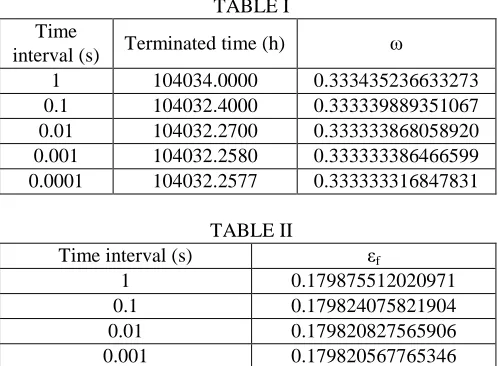
In order to make sense the most exactly lifetime, a simple Euler’s method programme had been coded. And the code was tested using different time increment such as 1, 0.1, 0.01, 0.001, 0.0001 hour respectively.
Three Tables were listed to show the detail of the results. The Table I shows the terminated time and omega depending on the size of time interval. The time interval 0.0001 is the most accurate between the five different intervals. Table II and Table III displayed the specific creep strain value, H which is the primary creep state variable (strain hardening), and φ which is the precipitate coarsening state variable.
[image:4.612.47.296.548.731.2]Even from mathematic aspect, the interval 0.0001 is the best selection; however, from the physics aspect, 0.0001 hours equal to 0.36 second, and this is a too short time interval. Therefore, the author selects the time interval 0.01 hour as the master accuracy control parameter. Following that, the lifetime value can be observed from table 1 is 104032.27 hours.
TABLE I Time
interval (s) Terminated time (h) ω
1 104034.0000 0.333435236633273 0.1 104032.4000 0.333339889351067 0.01 104032.2700 0.333333868058920 0.001 104032.2580 0.333333386466599 0.0001 104032.2577 0.333333316847831
TABLE II
Time interval (s) εf
1 0.179875512020971
0.1 0.179824075821904 0.01 0.179820827565906 0.001 0.179820567765346
0.0001 0.179820530208621
TABLE III Time
interval (s) H φ
1 0.592900000000000 0.544764812531457 0.1 0.592899999999999 0.544760827698831 0.01 0.592899999999992 0.544760468843807 0.001 0.592899999999917 0.544760434279127 0.0001 0.592899999999174 0.544760430559092
B. Result based on Runge-Kutta method
Because of the nature of NAG subroutine, the variable TOL was designed as the accuracy control parameter. Give the duration from t=0 to t=104032.27 to NAG routine, and record the results of seven different TOL value ranging from 0.1E-01 to 0.1E-07 as shown in the following Table IV.
Tables IV and V show the detailed results. And a comparison will be processed with previous results which based on Euler’s method to looking for the most accurate value of TOL, strain and damage value.
TABLE IV
TOL εf ω
0.1E-01 0.136548062074 0.253119148370 0.1E-02 0.178172199475 0.330277813609 0.1E-03 0.179803968745 0.333302624373 0.1E-04 0.179819797001 0.333331965213 0.1E-05 0.179820066343 0.333332464492 0.1E-06 0.179820072754 0.333332476375 0.1E-07 0.179820072807 0.333332476473
TABLE V
TOL H φ
0.1E-01 0.597028574423 0.544760420284 0.1E-02 0.593389925900 0.544760420697 0.1E-03 0.592883124271 0.544760420959 0.1E-04 0.592873878039 0.544760421042 0.1E-05 0.592899874301 0.544760421049 0.1E-06 0.592900018328 0.544760421049 0.1E-07 0.592899978356 0.544760421050
C. Errors Analysis (ACCURACY)
The elastic strain under 40 MPA is 𝜀=𝜎
𝐸=
40𝑀𝑃𝑎
200𝐺𝑃𝑎= 2 ×
10−4, and an error in the calculated creep strain will eventually affect the stress updating. The master curve (assuming accurate enough) creep strain at failure is 0.179820827565906 obtained with Euler’s method at interval 0.01h;
1. When TOL=0.1×10⁻³, strain at failure is 0.179803968745
The error in creep strain at is
𝐸𝑟𝑟𝑜𝑟= |0.179803968745−0.179820827565906| = 1.6858820906 × 10⁻⁵
2. When TOL=0.1×10⁻⁷, strain at failure is 0.179820072807
The error in creep strain at failure is
𝐸𝑟𝑟𝑜𝑟= |0.179820072807−0.179820827565906| = 7.54758906 × 10⁻⁷
𝑒𝑟𝑟𝑜𝑟𝑟𝑎𝑡𝑒=7.54758906 × 102 × 10−4 −7= 0.37%
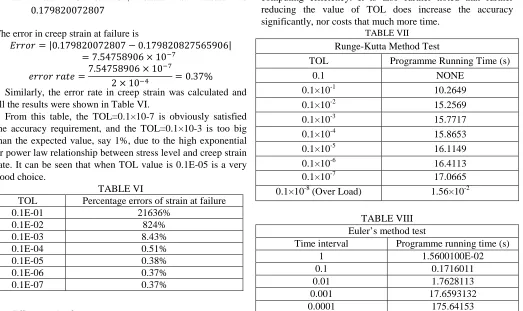
Similarly, the error rate in creep strain was calculated and all the results were shown in Table VI.
[image:5.612.52.575.71.382.2]From this table, the TOL=0.1×10⁻⁷ is obviously satisfied the accuracy requirement, and the TOL=0.1×10⁻³ is too big than the expected value, say 1%, due to the high exponential or power law relationship between stress level and creep strain rate. It can be seen that when TOL value is 0.1E-05 is a very good choice.
TABLE VI
TOL Percentage errors of strain at failure
0.1E-01 21636%
0.1E-02 824%
0.1E-03 8.43%
0.1E-04 0.51%
0.1E-05 0.38%
0.1E-06 0.37%
0.1E-07 0.37%
D. Efficiency Analysis
This constitutive equations subroutine offered the solutions of strain and damage value in each given durations. Once the subroutine running, an integration point would be solved in the finite element analysis processing. Basic that, a complete finite element analysis will call this subroutine over all the integration points and time iterations, typically in the order of thousands times thousands.
A problem occurred here is running this subroutine once, and the running time cannot be present by computer because the value is too small. In order to test the efficiency of this subroutine, 10,000 times calling was supposed, and the total calculation times following different TOL value were recorded and used for comparison.
The Euler’s method was also tested for efficiency following the same experimental setting. The results are shown in Table VII and Table VIII.
It can be seen that, from Table VII, when TOL = 0.1×10⁻⁵, the programme running time is 16.1149s. From Table VIII, when time interval is 0.001h, the programme running time is 17.6593132s. It can be defined a speed percentage like:
𝑝𝑒𝑟𝑐𝑒𝑛𝑡𝑎𝑔𝑒=17.659313216.1149−16.1149= 9.58% As mentioned before, the accuracy of Euler’s method at interval 0.001h can be derived as 0.13%; however, the absolute error is similar with R-K method at TOL of 0.1E-05.
From the above discussion, it is clear that, based on the balance of accuracy and efficiency, the Euler method should not be used and the TOL of 0.1E--04 or 0.1E-05 is a good
choice for R-K method on the balance of accuracy and computing efficiency. It is also further noted that further reducing the value of TOL does increase the accuracy significantly, nor costs that much more time.
TABLE VII Runge-Kutta Method Test
TOL Programme Running Time (s)
0.1 NONE
0.1×10⁻¹ 10.2649
0.1×10⁻² 15.2569
0.1×10⁻³ 15.7717
0.1×10⁻⁴ 15.8653
0.1×10⁻⁵ 16.1149
0.1×10⁻⁶ 16.4113
0.1×10⁻⁷ 17.0665
0.1×10⁻⁸ (Over Load) 1.56×10⁻²
TABLE VIII Euler’s method test
Time interval Programme running time (s)
1 1.5600100E-02
0.1 0.1716011
0.01 1.7628113
0.001 17.6593132
0.0001 175.64153
VII. CONCLUSION
This paper reviewed the position which the creep constitutive equations in the finite element analysis method. An advance numerical method, Runge-Kutta method was suggested by Hyhurst, and a Chinese scholar also follows this approach. The more efficient NAG routine was adopted in this research to help the creep FE software development. A specific computational experiment was been written detailed, and highlight the way to find a satisfied TOL value.
REFERENCES
Basic format for books:
[1] J .Manie, A. Wolthers, “Fem GV User's Manual: pre- and post-processing”, (2008).
[2] “GID user manual”.
[3] F. Tan, Q. Xu, Z. Lu, D. Xu, “Literature review on the development of computational software system for creep damage analysis for weldment”, Advanced Materials Research Vol. 510, 2012, pp 490-494 [4] F.V. Tahami, D.R. Hayhurst, M.T. Wong. “Hightemperature creep
rupture of low alloy ferritic steel buttwelded pipes subjected to combined internal pressure and end loadings”, Philosophical Transactions of the Royal Society A. 363 (2005) 2629-2611.
[5] Wong, M.T. Three-dimensional finite element analysis of creep continuum damage growth and failure in weldment. PhD edn.,1999, UMIST: Manchester.
[6] X. Ling, S. Tu, J. Gong., “Application of Runge-Kutta-Merson algorithm for creep damage analysis,” Int.J.Pressure Vessels Piping. 77, 2000, P. 243-248.
[8] D. Liu, Q. Xu, Z. Lu, D. Xu, “Research in the development of computational FE software for creep damage mechanics”, 18th International Conference on Automation & Computing, Loughborough University, Leicestershire, UK, 2012, pp113-118
[9] D. Hayhurst, P. Dimmer, C. Morrison, “development of continuum damage in the creep rupture of notched bars”, Phil. Trans. R. Soc. Lond. A 311, 1984, pp103-129
[10] A. F. Bastani and M. Tahmasebi, “Strong convergence of split-step backward Euler method for stochastic differential equations with non-smooth drift,” Journal of Computational and Applied Mathematics, vol. 236, Issue 7 , 2012, pp. 1903-1918.
[11] X.N. Wang, X.C. Wang, Finite element analysis on creep damage, Comput.Struct. 60 ,1996, pp. 781-786.
[12] I.J. Perrin, D.R. Hayhurst. “Continuum damage mechanics analyses of type IV creep failure in ferritic steel crossweld specimens”, Int.J.Pressure Vessels Piping. 76, 1999, 599-617.