The London School of Economics and
Political Science
Essays on Cooperation
Roberto Claudio Sormani
Declaration
I certify that the thesis I have presented for examination for the PhD degree of the London School of Economics and Political Science is solely my own work other than where I have clearly indicated that it is the work of others (in which case the extent of any work carried out jointly by me and any other person is clearly identified in it).
The copyright of this thesis rests with the author. Quotation from it is permitted, provided that full acknowledgement is made. This thesis may not be reproduced without my prior written consent.
I warrant that this authorisation does not, to the best of my belief, infringe the rights of any third party. I declare that my thesis consists of about 30,000 words, and less than 35,000.
Statement of Conjoint work
I confirm that Chapter 2 was jointly co-authored with Marco Hernandez, Julian Jamison, Ewa Korczyc, and Nina Mazar. I contributed 45% of the work in this chapter. In particular I contributed to the definition of the treatments and proposed theOmission Taxpayer intervention; I lead the treatment assignment, ran-domisation, and design procedure; I oversaw the econometric analysis presented in the chapter; I personally organised the structure and the conclusions of most of this chapter, based on the conjoint work with my coauthors. .
Statement of inclusion of previous work
Acknowledgments
These essays are the outcome of years of work, thoughts, and effort to address a question that has always been at the centre of my interests, namely how can we use economics to affect people’s contribution to the improvement of the world we temporarily share. They are also the outcome of an immense struggle with myself and with the unknown that is inherent in any research endeavour. If I started this journey at all, and if it is now coming to a close, I owe it to the support, the encouragement, the challenging stimulus given to me by so many people. A non-exhaustive list follows.
I want to thank Muizz Aziz, Marcella Cartledge and Yari Napolitano provided excellent research assistance and actively contributed to the realisation of this project.
Thanks to Tamara Anson and Kruthika Kamath from the LSE Behavioural Research Lab (BRL) were ex-tremely helpful in making the best use of the facilities that were provided by the BRL and sharing their insight. Thanks to Rose Harris from ESRC, for her incredible help in the whole PhD journey and helped me administer as best I could the research grants from ESRC. Thanks to Jane Dickson and Angela Swain from STICERD, who helped me with the logistics and the administration of the research grant that was provided by STICERD. Thanks to Mark Wilbor for his kind and helping work in the Department of Economics. Thanks to ESRC, LSE Department of Economics, and STICERD for financial support to this research. Thanks toAvvocatura per i Diritti LGBTI - Rete Lenford and its President, Maria Grazia Sangalli, who do every day an amazing job and agreed to share a platform for the realisation of this project. Thanks to Sir Thomas Hughes-Hallett, Marie Curie Cancer Trust, The Good Company, who agreed to share their time to exchange precious information and gain a better understanding of the third sector.
Thanks to Oriana Bandiera for her insightful supervision but most of all for being a huge source of inspiration and encouragement in these years. Thanks to Maitreesh Ghatak for his supervision and coaching, pushing me to new directions and stimulating curiosity. Thanks to Nava Ashraf for her excellent supervision and devoting 100% of her attention every time one needed her insight, and for her help in a better design of the experimental part of this research.
Thanks to my PhD examiners Simon G¨achter and Matteo Galizzi for their precious comments and inisghts. Thanks to Tim Besley, Gharad Bryan, Robin Burgess, Erik Eyster, Gregory Fisher, Matthew Levis, Drazen Prelec, Guido Tabellini for their helpful comments. Thanks to participants in LSE work in progress seminars and EDP conference in Brussels 2013 for helpful comments.
Thanks to Anne Brockmeyer, Marco Hernandez, Julian Jamison, Ewa Korczyc, Nina Mazar for our produc-tive and exciting work together at the World Bank.
Thanks to my mother Bianca Manganaro for teaching me kindness and the importance of the public good, which drove my research.
Thanks to my father Augusto Sormani, my sisters Daniela and Simona Sormani, my cousins Maria Giu-lianetti, Demo GiuGiu-lianetti, Ernesto and Franca Montesanto, Mario Bini and Konstantinos Lygouris for their love and help overcoming the hardest obstacles.
Thanks to Andrea Agostinelli, Corrado Anghinetti, Jim Alayo-Arnabat, Stefania Bardone, Luca Bartozzi, Francesco Cascio, Chiara Fratto, Carlotta Freni, Ola Grzech, Maryna Khorunza, Mattia Lepri Berluti, Anna Missiaia, Francesco Pongetti, Francesco Mallucci, Nicoletta Mandolini, Paola Perni, Davide Sampaolesi, Elena Santilli, Vittorio Seregni, Elisabetta Zampieri, for their true friendship.
Abstract
These essays provide arguments and evidence as to circumstances that encourage or hinder cooperation. Chapter 1 theoretically argues that incentives to participation in a cooperative environment can increase participation, but disrupt cooperation itself. Following B´enabou and Tirole’s (2003) crowding-out theory, I propose a model where cooperation is strategically complementary and principals face a trade off between pay and cooperativeness of agents. If such trade off is anticipated by agents, this can lead to multiple equilibria where the informative power of incentives disrupts cooperation.
Chapter 2 presents results from a randomised controlled trial in Poland which used reminder letters to promote voluntary compliance among 150,122 taxpayers who declared their Personal Income Tax but had failed to pay by the deadline. Taxpayers were randomly allocated to receive the letter originally used by the authorities or one of nine letters adapted using behavioural design. Among other results, we find that, relative to a control “behavioural” letter, there is a significant negative effect of a “social norm” message informing of the high frequency of compliant taxpayers. There is also a significant negative effect of a “public goods” messages that appeals to cooperation on the taxpayers’ side by reminding them of the role of taxes to support the services provided by the government. In this context, therefore, we do not find evidence of reciprocity or conditional cooperation.
Contents
1 Few But Good. Financial Incentives to Participate and Cooperation 8
1.1 Introduction . . . 8
1.2 The Basic Model . . . 11
1.2.1 Equilibrium . . . 13
1.3 Imperfect information on own returns . . . 17
1.3.1 State of the world unobserved by everyone . . . 18
1.3.2 State of the world observed by the principal . . . 20
1.4 Welfare Analysis . . . 25
1.4.1 Cooperation requires restricted participation . . . 25
1.4.2 Cooperation is compatible with full participation . . . 26
1.5 Discussion . . . 27
1.6 Conclusions . . . 29
2 Using Behavioural Insights to Improve Tax Collection: Evidence from Poland 32 2.1 Background . . . 37
2.1.1 Experimental Design . . . 40
2.1.2 Methodology . . . 41
2.1.3 Randomisation . . . 42
2.2 Treatments . . . 43
2.3 Results . . . 50
2.3.1 Payment rate . . . 50
2.3.2 Payment amount . . . 53
2.4 Conclusions . . . 61
2.A Control Letters and Experiment Letter Variants . . . 63
3 Career Choice and Cooperation in a Pro-social Team Task 67
3.1 Introduction . . . 67
3.2 Model . . . 70
3.2.1 The setting . . . 71
3.2.2 Solution concept . . . 72
3.2.3 Solution . . . 72
3.2.4 Predictions . . . 73
3.3 The experiment . . . 74
3.3.1 The experimental task . . . 74
3.3.2 The treatment . . . 75
3.3.3 The timeline . . . 75
3.3.4 The online survey . . . 76
3.3.5 The randomisation . . . 78
3.3.6 The lab task . . . 79
3.3.7 Methodological notes . . . 80
3.4 Effort and the effect of partner’s career choice . . . 82
3.4.1 Econometric analysis . . . 83
3.4.2 Distribution of effort . . . 86
3.5 Heterogeneous effects of partner’s career . . . 86
3.6 Expectations . . . 88
3.6.1 Measurement of expectations . . . 88
3.6.2 The effect of partner’s career on expectations . . . 89
3.6.3 Expectations as a channel . . . 90
3.7 Conclusions . . . 91
3.A Tables . . . 96
3.B Figures . . . 112
3.C Attrition . . . 128
3.D Beliefs . . . 133
Chapter 1
Few But Good. Financial Incentives
to Participate and Cooperation
1.1
Introduction
Does pay decrease cooperation? Sizeable and numerous strands of literature address this questions from a variety of angles, yet little attention has been devoted to the role of expectations and beliefs in this correlation. Yet this channel is a very relevant one as it is pervasive in individuals’ decision making, it can spill down to a wide variety of different contexts and it can be directly fine-tuned as a relatively low-cost policy instrument.
To study this correlation and the role of expectations I consider a model whereby a principal offers a bonus to recruit agents who take part in a project. There are two agents and, if both participate, they may decide to cooperate or not. Cooperation is strategically complementary as it takes unilateral action and is rewarded only when jointly undertaken. As agents differ in their cost of cooperation (motivation or cooperativeness), so does the reservation wage they require to take part in the project. The principal, who cares both participation, monetary costs, and cooperation in the team, faces a trade off between higher pay and higher likelihood of cooperation arising.
The role of information is separately understood by introducing different states of the world: a good one and a bad one with higher or lower frequency of motivated agents in the population. I separately study the correlation between pay and cooperation arising when the principal cannot observe the state of the world, and the causal effect that pay can have on cooperation when the principal can access more information.
I find that the trade off depends on primitives such as the principal’s returns to participation and
cooperation, agents’ value from being assured that the environment is cooperative, and the distribution of motivated (cooperative) types. I show that, when the principal can observe the state of the world, the negative correlation between pay and cooperation becomes stronger and, under some circumstances. Under some circumstances I find that information gives rise to multiple equilibria: one with cooperation and full participation, and one with a trade off between participation and cooperation. In the equilibrium with full participation and cooperation, agents do not interpret (correctly) higher pay as a signal of a bad state of the world. I thus conclude that the availability of information on the principal’s side exacerbates the negative correlation between pay and cooperation and can actively disrupt cooperation if agents use pay as a signal. To appreciate the relation between pay and cooperation, consider the following stylised scenario: a local government is supporting a training course for teachers in the community and has to decide how much to compensate for participation. As many educational experiences, the training course might involve formal or informal cooperative learning (Johnson and Johnson 1989), whose success and effectiveness depend on every participant’s effort and contribution. Yet there is a strategic complementarity, as making a contribution might involve the sharing of personal experiences, the effort of thinking harder into the problem at hand and focusing better. More motivated participants will find it easier and to make this cooperative effort, but be happy to take it if they are assured that their course mates are equally motivated. If they can be assured of this, they will need little compensation to participate as they will enjoy the outcome of cooperation that they expect to arise during the activity. Less motivated agents need higher compensation, as they do not expect high rewards from engaging in cooperative effort that they might not even be interested to undertake. There are then two possible scenarios: a high bonus scenario, with more and less motivated agents, and a low bonus scenario, limited to the less motivated who, assured by the bonus that only motivated agents are participating, will be happy to cooperate. From the provider’s point of view this is a trade off between participation on the one hand, and cooperation (together with the ability to extract the “cooperative surplus” from motivated agents) on the other hand. Which option gets chosen will most likely depend on how much the local administration cares about participation vis a vis cooperation.
In this framework, what happens if participants have little experience with this training course (for instance because it involves the discussion of novel teaching techniques) and little idea about how interested their peers are in taking part in this course? If they anticipate the principal’s trade off, higher pay will not only discourage cooperation by bringing in less cooperative people, but it will additionally reveal that the administration does not expect the general population to be motivated enough to cooperate. How strong is this effect, what does it imply for the likelihood of observing cooperation and for agents’ welfare? The model is aimed at addressing such questions.
among agents who do not know well about each other and with heterogeneous motivation for cooperation. It is mostly suited to the study of mission oriented organisations, where cooperation is very important and social interaction an important driver of participation, especially when it comes to volunteering. In some Jewish communities, for instance, rabbis manage courses for teenagers to learn rhetoric techniques against antisemitism. Cooperation among participants makes these courses more effective as participants can share their opinions, question each other, manage mock-debates autonomously, make the classes more memorable and make the activity so enjoyable that they will want to repeat a similar experience.
The importance of cooperative interactions within an organisation is however more widespread. Many private companies pride themselves for their cooperative environment and make cooperation a basic element of their organisational identity. Offering a more cooperative environment, however, might be an intangible benefit offered by the company to their employees, potentially creating a wage differential with similar, less cooperative, companies. In this paper we explore the possibility that this wage differential is self-sustaining and that offering higher wage might bring into the workers’ pool a number of people who care less about the intangible benefit of cooperation. If the share of these new people is too high, higher wages might discourage everybody from cooperating and create a whole different work environment.
Some companies or organisations might, however, have a strong reputation for their cooperative work en-vironment and their propensity to team work. Some others, especially start-ups, are not known by the wider public. The informative power of pay can be very relevant in how these organisations position themselves in the quest for motivated contributors, be they workers or volunteers.
This paper inserts itself in the broader economic literature of incentives and the possibility of “dys-functional behavioural responses” (Prendergast 1999). Arguments for the possible counter-effectiveness of monetary incentives have been moved based on their distortionary effects on the allocation of agents’ effort (Holmstrom and Milgrom, 1991).
Research in industrial psychology (Deci 1971, Cameron and Pierce 1994, Eisenberger and Cameron 1996) has additionally considered the problem of crowding out of motivation and how high incentives may disrupt “work morale” (Frey 1994). Economics has addressed crowding out with additional empirical research (ranging from confirmation of the prediction, as in Gneezy and Rustichini 2000, to disconfirmation as in Ashraf et al 2014) and explaining it by accounting for the possibility that incentives provide information about the task (B´enabou and Tirole 2003) or that they inform of the principal’s expectations.
A related literature is that on the selective effect of incentives, in particular when it comes to organisations that are driven by a mission. Dal B´o et al (2013) discuss evidence from recruitment of public workers in Mexico. Lazear et al (2012) instead show in the lab that incentives to participate to an environment in which sharing is possible attract individuals who are less willing to share. Field experiments provide mixed evidence on whether high pay attracts less motivated agents in the provision of public services is discussed in Deserranno (2019) and Ashraf et al (2018).
The consideration for the role of social interactions within the organisation owes to the research on reciprocity and conditional cooperation (e.g. Fehr and G¨achter 2000, 2001, Fehr and List 2004) and how these affect the role of incentives in an organisation (Fehr et al 2000).
In this context, pay structure is found to have strong effects on the cooperativeness of the work environ-ment, as noted by Lazear (1989) and further studied empirically by Bandiera et al (2005, 2010).
In the context of these literatures, this paper argues for an additional reason why incentives might be counter-effective and discourage cooperation, by jointly accounting for what type of agents are selected in by incentives and how agents decision to cooperate depend on the social environment they find in the organisation.
The paper is structured as follows. Section 2 shows a simple model with only one state of the world and no other informational asymmetries over the fact that each agent’s motivation is private. This section shows the relation between the distribution of the population and motivated agents’ decision to cooperate. In section 3 I extend the model to account for the informational effect of pay, drawing on B´enabou and Tirole (2003) who posit that incentives to participate in a task signal its quality. In section 4 I consider some welfare implications. Section 5 discusses the findings and their relevance. Section 6 concludes.
1.2
The Basic Model
The first basic model in this section highlights the importance of selection on agents’ decision to cooperate in the presence of strategic complementarities. The driving mechanism is heterogeneity in relative preferences for quality of participation (which depends on cooperation, which in turn is strategically complementary) and the ensuing negative correlation between agents’ reservation wage and the degree of motivation. As cooperation is strategically complementary, then, there is a trade off between participation and cooperation whose size depends on the share of cooperative agents in the population.
The model has three players: one principal indexed by 0 and two agents indexed byi∈I={1,2}. The principal has mass 1 while each agent has mass 1
distributionθ:Hi→(0,1) given by
θ(h) =
θ ifh=hL;
1−θ ifh=hH.
Cost of effort is here interpreted as motivation or cooperativeness equivalently, as the project yields individual returns that depend on the positive interaction with the partner. Interaction is however more or less costly for agents with different degrees of motivation for the project (e.g. with different attachment to the cause) or who find it more or less difficult to make their own contribution (e.g. asking questions or sharing personal experiences to contribute to a group discussion). Note thathiencompasses impure altruism (Andreoni 1990) as well as intrinsic motivation from cooperating in the cause. Returns to cooperation are assumed to be homogeneous across the population, but this does not significantly affect the predictions of the model.
Each agent’s costhiis private information to them and is unknown to the other agent and the principal. At timet= 0 the principal sets a bonusb∈B ≡Rto be offered to each agent and to be paid to each agent
if they participate at time t = 1. At time t = 1 agents 1 and 2 simultaneously decide whether they want to participate in the project or not. If they participate they earn bonusb but incur a cost of participation
f >0. If both participate the game moves to staget= 2; if any agent does not participate, the game ends
att= 1. At time 2 the subjects decide simultaneously whether they want to cooperate. Cooperative effort costshi to each agent but yields benefitγ >0 which is realised if and only if both agents cooperate. At the end of time 2 payoffs are realised. The principal obtains gross payoff equal to α
2 for each agent participating in the project, andβ ≥0 if both agents cooperate.
Assumption 1. Unmotivated agents find cooperation always too costly; motivated agents find it worthy to cooperate if they are certain that their partner cooperates too. That is,
0< hL < γ < hH .
Assumption 2. Participation of agents is always worthy to the principal if she can compensate their par-ticipation (Internal Rationality):
α > f .
The final payoffs can thus be written asπ(b, a1, a2) andui(b, a1, a2;hi) =u(b, a1, a2;hi) with
π(b, p1, c1, p2, c2) = (p1+p2)
α−b
2 +p1p2c1c2β , ui(b, pi, pj, ci, cj;hi) = u1(b, pi) +pipju2(ci, cj;hi) ,
u1(b, pi) = pi(b−f) , u2(ci, cj;hi) = ci(γcj−hi) .
A strategy for agent i is a pair of functionssi = (pi :B×Hi →[0,1], ci :B×Hi → [0,1],). For the principal, a strategy is simply the bonusb offered to all agents.
Now, a conjecture on agentj∈ {1,2}is a functionµj :Hj×B→[0,1] representing the probability that agent i6=j assigns toj being of type h∈Hj, conditional on having observed bonusb and agentj having decided to participate at stage 1. If stage 2 occurs, at the beginning of stage 2ithus usesµj to assess the probability that agentj is of typeh, withµj(h;b)≥0 ∀h, andµj(h
L;b) +µj(hH;b) = 1. Note thatµj(·;b) is conditional on agentj having participated at stage 1.
We can now define the equilibrium of the game.
Definition 1. An equilibrium of the game is a profile of strategies and conjectures
b∗,(s∗i = (p∗i, ci∗))i=1,2,µ1,µ2 (1.1)
such that
c∗i(b;hi) ∈ arg max ci
X
hj∈Hj
u2(ci, c∗j(b;hj);hi)µj(hj;b) ∀i, j∈ {1,2}, i=6 j,∀b∈B,∀hi∈Hi ;
p∗i(b;hi) ∈ arg max pi
X
hj∈Hj
u b, pi, p∗j(b;hj), c∗i(b;hi), c∗j(b;hj);hi
θ(hj) ∀i, j∈ {1,2}, i6=j,∀b∈B,∀hi∈H ;
b∗ ∈ arg max b
X
(h1,h2)∈H1×H2
π(b, s∗1(b;h1), a∗2(b;h2))θ(h1)θ(h2) ;
µj(h;b) = θ(h)p ∗ j(b, h)
X
h0∈H
θ(h0)p∗j(b, h0)
∀b: X h0∈H
j
p∗j(b, h0)>0, ∀h∈Hj,∀j∈ {1,2} .
1.2.1
Equilibrium
Let us now show what equilibria can arise from the game.
both agents play the same strategy. In any such equilibrium, unmotivated agents do not cooperate and they
participate whenever the bonus offered covers the participation costs. For motivated agents, the decision to
cooperate is non-increasing in the bonus level over the region where their equilibrium strategy is to participate.
That is,c∗i(b, hL)is non-increasing inb over{b∈B:p∗i(b, hL) = 1}.
If the share of motivated agents in the population is not large enough (θ < hL
γ ), motivated agents cooperate
only when the bonus offered is low enough to discourage unmotivated agents from participating, and the
principal offers a low bonus iff
θ2(α+β+γ−hL)−θf ≥α−f . (1.2)
Condition (??) is satisfied for all θ larger than a threshold valueθ∈(0,1). If the share of motivated agents in the population is large enough (θ ≥ hL
γ ), motivated agents always
cooperate in the second stage, and the principal offers a low bonus iff
θ2(α+γ−hL)−θf≥α−f . (1.3)
Condition (??) is satisfied for all θ larger than threshold valueθ∈(θ,1).
Proof. First, let us show that unmotivated agents must not cooperate in any such equilibrium:c∗i(b, hH) = 0. By Assumption??, unmotivated agents always find it convenient not to cooperate if they are at stage 2 if there is any type that cooperates at stage 2, as payoff from the second stage is maximised at
u2(b,0, c∗j;hH) = 0≥
X
{hj:c∗
j(b;hj)=1}
(γ−hH)µj(hj;b) =u2(b,1, c∗j;hH) .
For the limit case where the two are equal, note that this could only be sustained if c∗j(b;hj) = 0 ∀hj, but in that case the symmetry condition requires that playeri still does not cooperate either, when facing hi =hH.
Unmotivated agents thus never cooperate and prefer to participate if and only if the bonus is greater than their participation cost: p∗i(b;hH) =1(b≥f).
As motivated agents’ payoff from participation is not less thanb−f, wheneverb≥f they will participate too, therefore by bayesian updating it must be µj(h
L;b) =θ ∀b≥f. Motivated agents cooperate only if µj(b, h
L)γ≥hL, so c∗i(b, hL) = 1 ∀b≥f if and only if θ≥ hγL.
At lower levels of b, if there is any participation, it then must be that µj(h
agents participate wheneverb−f+θ(γ−hL)≥0, so
p∗i(b;hL) =1(b≥f−θ(γ−hL)) .
Thus, for bonus levels that make motivated agents participate, the equilibrium decision to cooperate is
c∗i(b;hL) =
1(f−θ(γ−hL)≤b < f) ifθ < hγL 1(b≥f−θ(γ−hL)) ifθ≥ hγL ,
which is non-increasing in the bonus level.
The decision of which bonus is offered on equilibrium thus depends on the principal’s incentive compati-bility constraint
max b
X
h1,h2
(p∗1(b;h1) +p∗2(b;h2))
α−b
2 +p ∗
1(b, h1)p∗2(b, h2)c∗1(b, h1)c∗2(b, h2)β
θ(h1)θ(h2)
Case 1: θ < hL γ .
The principal’s problem thus becomes
max b
0 ifb < f−θ(γ−hL),
θ(α−b) +θ2β iff−θ(γ−hL)≤b < f,
α−b ifb≥f.
The principal will thus choose to offer b = f −θ(γ−hL) if the incentive compatibility constraint is satisfied:
θ((α−f+θ(γ−hL)) +θ2β ≥α−f . (1.4)
We can see that there is a unique valueθ, strictly less than 1, such that condition (??) holds for allθ≥θ. Indeed, rearranging (??) we get
θ2(β+γ−hL)≥(α−f)(1−θ) (1.5)
whose LHS is strictly increasing overθ∈[0,1], while the RHS is strictly decreasing, withLHS < RHS at 0 andLHS > RHSat 1.
Case 2: θ≥hL γ .
max b
0 ifb < f−θ(γ−hL),
θ(α−b) +θ2β iff−θ(γ−h
L)≤b < f,
α−b+θ2β ifb≥f.
The principal’s incentive compatibility constraint for offering a low bonus is
θ(α−f +θ(γ−hL)) +θ2β ≥α−f +θ2β (1.6)
Note that this ICC is a stronger condition than the ICC for the case where θ < hL
γ , the reason being that, for the principal, the expected returns from cooperation can now also arise when offering the higher bonus and selecting a larger pool of participants.
Rearranging (??) we obtain
θ2(γ−hL)≥(α−f)(1−θ) , (1.7)
whose LHS is strictly increasing overθ∈[0,1] while the RHS is strictly decreasing over the same interval, with 0 =LHS < RHS atθ= 0 andLHS >0 =RHS atθ= 1. There must then be a value θ∈(0,1) such that (??) holds for allθ≥θ.
Furthermore,θ > θas the RHS is the same in both (??) and (??), but the LHS at (??) is strictly greater than that at (??).
There is then a unique valueθ∈(θ,1), such that condition (??) holds for allθ≥θ.
Semi-separating equilibria with unmotivated agents participate with positive probability, strictly less than 1, atb=f, and this probability is low enough for motivated agents to still cooperate, are ruled out by the requirement that on equilibrium all agents participate whenever it is rational to do so.
This thus concludes the proof.
The equilibria imply three different equilibrium outcomes. Ifθ <min{hL
γ , θ}motivated agents only cooperate if the principal offers a low bonus, but the principal’s ICC prescribes them to offer a high bonusb=f. All agents participate and no one makes cooperative effort. Expected welfare in this case isα−f.
If hL
γ ≤θ < θ motivated agents cooperate in any case and the principal offers a high bonus. Expected
welfare is thusα−f +θ2(β+γ−h
L)−θ(1−θ)hL.
Expected welfare is thenθ2(α−f+β+γ−h L).
1.3
Imperfect information on own returns
This section shows how the presence of uncertainty about agents’ motivation affects the negative correlation between pay and cooperation. I model uncertainty about the agents’ distribution as the presence of two states of the world that differ on how frequent motivated types are in the population. If the principal cannot observe the state of the world, the principal’s choice between a higher and a lower pay resembles that of the previous section. If the principal can observe the state of the world, the bonus offered might reveal the observed state and thus increase the negative correlation between pay and cooperation.
There are now two equally likely states of the world x∈X ={0,1}. Whenx= 1 it is more likely that agents are cooperative. Whenx= 0 this is less likely. Agents’ types arezi∈Zi={0,1}, withzi= 0 for an uncooperative type andzi = 1 for a cooperative type, that ishi =hLzi+hH(1−zi). In each state of the world agents’ types are independent of one another: z1⊥z2|x. Letfx(z) be the distribution ofziwhen the state of the world isx. Thatxis the “good” state is reflected in the assumption that f1(1)> f0(1). Then, before the game starts, the unconditional distribution ofzi isf(zi)≡ 12f0(zi) +12f1(zi).
After observingziand without any information on the state of the world, the probability that the partner is cooperative is positively affected by being cooperative, as each agent observes her own signal to update her beliefs about the state of the world. This is not the main point of the model, but it does not limit its implications. If anything, it allows to allow for projection bias and it adds a specific channel explaining it, that is Bayesian updating. So, for each agent,
P r(x|zi) = fx(z
i)
X
x0
fx0(zi) ,
and
P r(zj|zi) =P r(x= 0|zi)f0(zj) +P r(x= 1|zi)f1(zj)
=
X
x
fx(zi)fx(zj)
X
x0
fx0(zi) .
Let us define
λ≡P r(zj= 1|zi= 1) =
.
It can be shown that f1(1)> λ > f(1), as observing one’s own signal is informative of the state of the world and, through that, of the chances the opponent is cooperative.
Let us also define the probability that both agents are motivated as ϕ ≡ [f1(1)]2+[2f0(1)]2. Note that ϕ=λf(1) and soϕ <[f1(1)]2.
The principal’s strategy is a functionb:X →Bthat assigns a bonus level to each state of the world. We are going to study two cases. In the baseline case, the principal cannot observe the state of the world and thereforeb(x)≡b∈B in all states of the world; in the case with observed states of the world, the principal observesxand so her strategies are unconstrained functions inBX.
1.3.1
State of the world unobserved by everyone
At the beginning of time 1 each agent thus forms anexpectation on the population, i.e. a conjecture on the distribution of types in the population, which is a probability distribution overZj, with
P r(zj|zi) =
X
x
fx(zi)fx(zj)
X
x0
fx0(zi)
as shown above. They use this population expectation to evaluate their expected utility in the first stage. At stage 2, however, they will form anexpectation on participants, i.e. a conjecture on the teammate’s type updated conditional on the teammate having participated at time 1. Such expectation is also a function of own typezi and of bonus levelb, as own type is informative of the state of the world, as seen above, and the bonus level is informative of what type of agents will participate. This is µj(b, z
i)∈∆Zj ={t:Zj → R+, t(z)≥0 ∀z∈Zj,Pzt(z) = 1}and it is defined by
µj(zj;b, zi) =P r(zj|pj = 1;b, zi) .
Expectations on participants will have to satisfy Bayesian updating, based on the strategies played on equilibrium. That is, if strategyp∗j is played on equilibrium,
µj(zj;b, zi) = p∗
j(b, zj)P r(zj|zi)
X
z0
j
p∗j(b, zj0)P r(z0j|zi) =
p∗j(b, zj)
X
x
fx(zi)fx(zj)
X
z0
j
p∗j(b, zj0)X x
fx(zi)fx(zj0) .
b∗, s∗i = (pi∗, c∗i),µj
i,j∈{1,2}
(1.8)
such that
c∗i(b, zi) ∈ arg max ci
X
zj∈Zj
u2(b, ci, c∗j(b, zj);zi)µj(zj;b, hi) ∀i6=j,∀b∈B,∀zi∈Zi;
p∗i(b, zi) ∈ arg max pi
X
zj
ui b, pi, c∗i(b, zi), pj∗(b, zj), c∗j(b, zj);zi
P r(zj|zi) ∀i6=j,∀b∈B,∀zi∈Zi;
b∗ ∈ arg max b∈B
X
z1,z2
π(b,s∗1(b, z1),s2∗(b, z2))f(z1)f(z2) ;
µj(zj;b, zi) =
p∗j(b, zj)
X
x
fx(zi)fx(zj)
X
z0
j
p∗j(b, zj0)X x
fx(zi)fx(z0j)
∀b:X z0
j
p∗j(b, zj0)>0 ;
with
P r(zj|zi) =
X
x
fx(zi)fx(zj)
X
x0
fx0(zi) .
Equilibria where cooperation is not sustained and the principal offers bonus f are always sustained by “pessimistic” off-equilibrium expectations on participants. What we want to know, however, is the circumstances under which an equilibrium with cooperation can be sustained. Let us characterise equilibria where cooperation is sustained.
Proposition 2. Consider equilibria where all agents participate and cooperate whenever a set of beliefs or opponents’ strategies justifies that, and agents play symmetrical strategies.
In any such equilibrium, unmotivated agents never cooperate. Motivated agents cooperate for bonus levels
lower thanf and can cooperate for bonus levels greater than or equal to f if their signal is sufficiently precise
on the population’s distribution, i.e. ifλγ ≥hL.
The principal offers a low bonus b∗=f−λ(γ−hL)if
α−f ≤f(1)
f(0)λ(γ−hL) + ϕ
f(0)β1(λγ < hL) . (1.9)
The principal offersb∗=f otherwise, or if the above condition holds with equality.
the game, at stage 1 and with backward induction, will thus yield utilityb−f to unmotivated agents, so they will participate if and only ifb≥f.
For motivated agents, at time 1, b−f is the lower bound on the expected utility from participation, so they always participate whenb≥f. By Bayesian updating, then, for such large values ofb the expectation on participants should be µj(zj;b, zi) = P r(zj|zi) and motivated agents will cooperate if P r(zj = 1|zi = 1)γ≥hL.
We are now looking for equilibria where cooperation is sustained also at lower levels ofb. Fix anyb0< f. For cooperation to be sustained, it must be the case that agents participate, and the participating agents can only be the motivated ones. If that happens, by bayesian updating, µj(1;b0, z
i) = 1. If so, cooperation arises by Assumption??as it yields γ−hL>0. At stage 1, the motivated agent will participate if there is a positive expected benefit, i.e.
b0−f+λ(γ−hL)≥0
. With this, we have shown that in any equilibrium where cooperation and participation arise whenever they can be rationalised, motivated agents participate ifb≥f−λ(γ−hL) and cooperate wheneverb < f or for
b≥f whenλγ ≥hL.
The principal’s problem is thus
max b
0 ifb < f−λ(γ−hL)
f(1)(α−b) +ϕβ iff −λ(γ−hL)≤b < f
α−b+ϕ1(λγ ≥hL)β ifb≥f.
The function has two local maxima: a low bonus of f−λ(γ−hL), and a high bonus atf. The choice between the two yields condition (??) above.
1.3.2
State of the world observed by the principal
In this section we are going to see what happens when the principal can observe, at the beginning of time 0, the state of the world,x∈X. In this case, the principal’s strategy will be a functionb:X →B. Agents’ strategies are stillsi :B×Zi →Ai. Expectations on the population and on participants now additionally depend onb, as the principal’s bonus might provide a signal on the state of the world. We will then define
θj(b, zi)∈∆Zj as the conditional probability assigned to value zj after observingzi and principal’s action b: θj(z
θj(zj;b, zi) =
X
x
P r(zj|x, b, zj)P r(x|b, zi) =
X
x
fx(zj)P r(x|b, zi) .
On equilibrium, given equilibrium strategyb∗, we will want expectations on the population to be updated bayesianly, therefore
P r(x|b, zi) =P r(x|b∗(x) =b, zi) =
P r(b∗(x) =b|x, z
i)P r(x|zi)
X
x0
P r(b∗(x0) =b|x0, zi)P r(x0|zi)
= 1(b
∗(x) =b)fx(z i)
X
x0
1(b∗(x0) =b)fx0(zi)
∀b:X x0
1(b∗(x0) =b)>0 ,
so the Bayesian updating requirement becomes
θj(zj;b, zi) =
X
x
fx(zj)1(b∗(x) =b)fx(zi)
X
x0
1(b∗(x0) =b)fx0(zi)
∀b:X x0
1(b∗(x0) =b)>0 .
It is easy to see that, if the equilibrium is a separating equilibrium,θj(z
j;b∗(x), zi) =fx(zj), while if it is a pooling equilibrium,θj(z
j;b∗(x), zi) =P r(zj|zi) exactly like in the scenario where the principal was not observing the state of the world.
Expectations on participants will have to satisfy Bayesian updating, based on the strategies played on equilibrium. That is, if strategyp∗j is played on equilibrium,
µj(zj;b, zi) =
p∗j(b, zj)θj(zj;b, zi)
X
z0
j
p∗j(b, z0j)θ j
(zj0;b, zi)
∀b:X z0
j
p∗j(b, z0j)>0 .
This means that, when only one motivated agents participate (as could be the case if there is cooperation and the bonus is belowf), the partner is correctly recognised as motivated; while, when both types of agents participate, there is no updating and expectations on participants remain the same as expectations on the population.
Definition 3. An equilibrium of the game with asymmetric information is a profile of strategies and con-jectures
b∗, s∗i = (p∗i, c∗i),θj,µj
i,j∈{1,2}
such that
c∗i(b, zi) ∈ arg max ci
X
zj∈Zj
u2(b, ci, c∗j(b, zj);zi)µj(zj;b, hi) ∀i6=j,∀b∈B,∀zi∈Zi;
p∗i(b, zi) ∈ arg max pi
X
zj
ui b, pi, c∗i(b, zi), p∗j(b, zj), c∗j(b, zj);ziθj(zj;b, hi) ∀i6=j,∀b∈B,∀zi∈Zi;
b∗(x) ∈ arg max b∈B
X
z1,z2
π(b,s∗1(b, z1),s∗2(b, z2))fx(z1)fx(z2) ∀x∈X;
θj(zj;b, zi) =
X
x
fx(zj)1(b∗(x) =b)fx(zi)
X
x0
1(b∗(x0) =b)fx0(zi)
∀b:X x0
1(b∗(x0) =b)>0 ;
µj(zj;b, zi) =
p∗j(b, zj)
X
x
fx(zi)fx(zj)
X
z0
j
p∗j(b, z0j)X x
fx(zi)fx(z0j)
∀b:X z0
j
p∗j(b, zj0)>0 .
Assumption 3. Cooperation is never worthwhile for unmotivated agents. For motivated agents who are partnered up with a random agent from the population, cooperation is worthwhile in the good state and not
worthwhile in the bad state.
hH> f1(1)γ > hL> f0(1)γ
Let us now characterise equilibria in this framework.
Proposition 3. Consider equilibria where all agents participate and cooperate whenever a set of beliefs or opponents’ strategies justifies that, and agents play symmetrical strategies.
In any such equilibrium with b(1) 6= b(0) < b(1) < b(0) =f and cooperation arises only if b(1). Such equilibria can occur is the net value that the principal can extract from offering cooperation to the motivated
agents (γ−hL) is large enough to be worthy the expected reduction in participation by offering a lower bonus
in the good state.
In any equilibrium with b(1) =b(0)it must be that b(0) =b(1) = f and cooperation might or might not arise among motivated agents, depending on the parameters of the problem. Such equilibria can occur for
sufficiently large values of (γ−hL) to discourage the principal from deviating and offering a lower bonus.
Proof. Let us start from separating equilibria, i.e. those withb(0)6=b(1).
whenever possible, we conclude that whenever unmotivated agents participate also the motivated ones must. Secondly, unmotivated agents never want to cooperate and motivated agents are willing to cooperate for anyb < b(0)
Secondly, it cannot be the case that everyone participates under bothb(0) andb(1). Suppose that were the case, therefore min{b(0), b(1)} ≥f. As the population participating would be the same, the decision to cooperate for motivated agents must be the same across the two bonus levels. Then, however, the principal would always have an incentive to the lowest of the two, which is incompatible with equilibrium.
It must then be that max{b(0), b(1)}=f, as any higher bonus level would be dominated by a deviation to a lowerb0 which would preserve full participation and not affect cooperation.
Then if must be b(0) = f > b(1). If the opposite were true (b(1) = f > b(0)), then motivated agents would cooperate when offeredb(0) (else they would not accept anything less than f) but also underb(1), as f1(1)γ > h
L. The principal’s incentive compatibility constraints, however, would not be satisfied, as they would imply
α−f ≥f1(1)(α−b(0))> f0(1)(α−b(0))≥α−f .
In any separating equilibrium we thus have b(0) = f > b(1), and cooperation arising under b(1). As we are considering equilibria where agents cooperate whenever their beliefs allow them to do so, they also participate in a separating equilibrium wheneverb≥f−f1(1)(γ−h
L).
The principal’s incentive compatibility constraints, however, require the following:
f1(1)(α−b(1)) + [f1(1)]2β≥α−f α−f ≥f0(1)(α−b(1)) + [f0(1)]2β , implying
b(1)∈
α−α−f
f0(1) +f
0(1)β, α−α−f f1(1) +f
1(1)β
.
We thus have
b∗(1) = max
f−f1(1)(γ−hL), α−
α−f
f0(1) +f 0(1)β
.
This equilibrium exists as long as
α−α−f
f1(1) +f
1(1)β > f
i.e. the following condition holds:
α−f ≤ [f
1(1)]2
f1(0) (γ−hL+β) . (1.11)
Let us look now at pooling equilibria, that is equilibria withb(0) =b(1) = ˜b.
First, note that it must be ˜b=f. If ˜b > f there would be a profitable deviation for the principal to some b0 <˜b. If, instead, ˜b < f, then only motivated agents must participate and cooperate, which in a pooling equilibrium can only happen if ˜b≥f−f(1)(γ−hL). However, as we are imposing cooperation to arise for any belief that can sustain it, any deviation of the principal tob0 < f−f(1)(γ−hL) withb0≥f−f1(1)(γ−hL) would induce cooperation as motivated agents would believe the status to be the good one.
Therefore, on any pooling equilibrium there is ˜b=f, all agents participating, motivated agents cooper-ating if and only ifλγ−hL≥0. The principal’s best deviation would be to ˆb=f−f1(1)(γ−hL), and the incentive compatibility constraint for the principal (upon observing the good state, as that is the binding constraint) is then
α−f+ [f1(1)]2β1(λγ ≥hL)≥(f1(1))(α−f+f1(1)(γ−hL)) + [f1(1)]2β , that is
α−f ≥ [f
1(1)]2
f1(0) (γ−hL+β1(λγ < hL)) . (1.12)
To sum up, ifλγ < hL then there is a separating equilibrium when
α−f ≤[f
1(1)]2
f1(0) (γ−hL+β)
and a pooling equilibrium when
α−f ≥ [f
1(1)]2
f1(0) (γ−hL+β) .
Ifλγ ≥hL, then there is a separating equilibrium for
α−f ≤[f
1(1)]2
f1(0) (γ−hL+β)
and a pooling equilibrium for
α−f ≥[f
1(1)]2
1.4
Welfare Analysis
1.4.1
Cooperation requires restricted participation
For this part of the welfare analysis we are going to focus on the case with λγ < hL, i.e. the case where motivated agents do not cooperate unless they are substantially confident that their partner cooperates.
Let us compare social welfare in the two scenarios where the principal has information on the state of the world and where the principal does not.
Expected welfare in the information scenario is, as shown above,
EWinfo=
α−f ifα−f >¯¯k≡ [ff11(1)](0)2 (γ−hL+β),
1
2(α−f) + 1 2
f1(1)(α−f) + [f1(1)]2(β+γ−h
L) ifα−f ≤k.¯¯
In the case where the principal cannot observe the state of the world, expected welfare is
EWno info=
α−f ifα−f >¯k≡ ff(1)(0)λ(γ−hL) +fϕ(0)β,
f(1)[α−f] +ϕ(β+γ−hL) ifα−f ≤¯k.
Note that ¯¯k >¯k.
For α−f >¯¯k the principal would act the same way regardless of whether they have information. For
¯
k < α−f ≤¯¯k, the principal has an incentive to increase social welfare when they observe a good state,
as then she is confident enough to decrease participation while improving the chances of cooperation by offering a lower bonus. This happens both because the principal directly cares about cooperation, and because cooperation allows her to extract surplus from the agents. Social surplus can be shown to be higher in the information scenario than in the no-info scenario. However, in this region of the parameter space, the surplus created by participation (α−f) is still large enough for the principal not to want to undertake the risk when she does not have sufficient information. The availability of information in the hands of the principal, therefore, makes it easier to bring about cooperation among participants, but creates a trade-off between monetary compensation and cooperation.
For α−f <¯k, instead, the principal cares about participation relatively less, to the point of choosing
higher compensation for their lack of information.
1.4.2
Cooperation is compatible with full participation
Let us now see what happens when λγ ≥ hL, i.e. when cooperation of motivated agents is sustained on equilibrium when everybody participates and under the population beliefsP r(zj= 1|zi = 1) =λ.
In such case, there is a substantial difference between a pooling equilibrium, where cooperation is sus-tained under a high bonus, and a separating equilibrium, where higher bonus signals a bad state of the world and thus discourages cooperation. While the conditions for a separating equilibrium remain unchanged, those for a pooling equilibrium become weaker and there is now a range of parameters for which a separating and a pooling equilibrium are both possible. In particular,
• α−f < [ff11(1)](0)2(γ−hL): a separating equilibrium exists, with the principal optimising social wel-fare conditional on the agents maximising agent’s welwel-fare in the second stage and conditional on the principal’s information.
• [ff11(1)](0)2(γ−hL) ≤ α−f < [f 1(1)]2
f1(0) (γ−hL+β) a separating equilibrium and a pooling equilibrium exist. In the pooling equilibrium, high bonusb=f is offered, there is full participation and motivated agents cooperate. In the separating equilibrium, there is less-than-full participation and cooperation under the lower bonus that is offered in the good state of the world, or complete participation with no cooperation under the high bonusb=f, which is offered in the bad state of the world.
• α > [ff11(1)](0)2(γ−hL+β): there is a pooling equilibrium with full participation and cooperative effort undertaken by motivated agents.
The case where the separating and the pooling equilibrium coexist is highly interesting, as it shows that if agents interpret bonus as a signal, a high bonus may discourage cooperation. Taking into account the informative power of bonuses thus exacerbates the negative correlation between bonus offered and coopera-tion, in ways that go beyond the simple composition of the pool but that crucially depend on the inference made by agents.
Furthermore, it is ambiguous whether expected social welfare would be higher under the pooling or the separating equilibrium. The pooling equilibrium yields higher ex-ante expected social welfare if
α−f ≥[f
1(1)]2−2ϕ
f1(0) (β+γ) +
2f(1)−[f1(1)]2
f1(0) hL.
to have only motivated agents participate or bring in all agents, with higher participation but some risk (proportional to f1(0) that motivated agents might needlessly exert cooperative effort without finding a match.
From the point of view of motivated agents, however, the pooling equilibrium always yields higher ex-pected utility than the separating one, where the principal is able to use all information in order to extract the surplus from cooperation, and the principal’s choice of a high bonus in the bad state signals that there is no expected benefit from cooperating left.
1.5
Discussion
I have shown that incentives to participate may harm cooperation by worsening the quality of the pool of participants and by signalling that cooperative participants are rare in the population.
A key parameter of interest is α−f, the net surplus that can be derived from participation of each agent. In circumstances where the general population is relatively not cooperative, a principal who cares relatively more about participation than about cooperation in the project will have a higher incentive to offer high bonuses, and the high bonus will discourage cooperation by selecting into the pool less cooperative types. This is a quantity-quality type of trade off, with participation raising returns to the principal linearly according to quantity, but quality of the project being a convex function of agents’ effort. The reason why the principal might be more interested in the participation rate than in the quality of the project can be due to the principal’s career incentives, verifiability of quality, or the principal’s time preferences.
Back to the motivating example of the training course sponsored by a local administration, the principal might have political incentives to show that the project was large and involved many participants, either for reelection purposes or for the ability to extract higher rents from donors’ contribution to the project. In such case the principal might start a larger scale project with lower educational value for the teachers taking part in the training. Verifiability might affect this choice in that the principal might not be able to show the exact quality of the project and so might be unable to rip the benefits from higher cooperation in the environment. The local authorities, for instance, might not be able to show the quality of the project to their constituents, and will therefore have more of an incentive to focus on its scale.
Time preferences could affect the principal’s choice: while participation in the course is immediate, the quality of the learning and how interactive it is might have a small but more long-lasting effect. This could be a problem if the principal discounts future returns relatively highly, for instance because of term limits that prevent the administration from ripping the full stream of benefits from improved teachers’ skills.
the compensating differential that they can obtain, by giving agents the assurance that their partners are motivated and likely to cooperate. This boils down to how much heterogeneity there is in the population in terms of motivation and how quickly the motivation of the marginal participant declines as the bonus offered increases. If there is a sizeable difference between more and less motivated teachers, for instance, and if there is a small group of teachers who are willing to take part in the training without any compensation as long as the training is productive and there is scope for cooperative learning, then the principal will have more of an incentive to restrict the pool of participants as that would save more money.
A reason why the principal in this model has interest themselves in keeping the pool restricted is that restricting the pool of agents is the only way they have to ensure cooperation, if they have any at all. The principal is otherwise unable to contract on cooperation with the agents and to reward them from that -something that for high values ofβ they may well want to do. This impossibility to contract on cooperative effort might be explained by difficult measurability of effort. Also, it might be that cooperation requires more than one dimension of effort and contracting on them might distort multitasking incentives (Holmstrom and Milgrom 1991).
Even if the principal were able to contract on cooperative effort, however, there would need to be suffi-ciently high returns from effort on the principal’s side, or the principal’s ability to extract additional surplus obtained by motivated agents in a cooperative environment.
All this can happen when the principal does not have more information on the general population than the individual agents do. As we show in our model, however, the availability of information for the principal has two effects. On the one side, it allows the principal, under a range of parameters, to adapt to the information she receives and share it with the agents, who might benefit from it. Teachers in the training course would benefit from realising that other participants are less likely to be cooperative, and then refrain from exerting cooperative effort which would not be worthwhile. If the principal’s interest in cooperation and in participation are somewhat balanced, there is an incentive for the principal to share this information, which can be of benefit to the agents if it refrains them from wasting effort. When agents need reassurance that their partners are highly motivated (λγ < hL) the availability of information allows the principal to tell the agents what they need to know.
If, however, the general population is relatively cooperative (λγ ≥hL) and the case where the principal raises the bonus is a signal of a very uncooperative population (f0(1)γ < h
power to the incentives, as in the pooling equilibrium. From the point of view of ex-ante social welfare, it is dubious which of the two scenarios is better.
In the case of the training group highlighted above, the difference would be important depending on how sophisticated participants are, how they believe the administration to behave, and how sophisticated does the administration expect the teachers to be. Depending on how people make their inference we might or might not have cooperation. This particular case raises the importance of assessing agents’ beliefs and their response to prices not only when selling products (Bagwell and Riordan 1991, Cohen and Dupas 2010), but also when “selling” participation in an activity which might yield intrinsic benefits to the participant.
When does, however, the power of information held by the principal matter the most? When the principal does not have strong reputation; when the project is relatively original and not generally known of; when the reference community is not small enough and when there is little scope for communication between participants prior to the meeting; when there is little screening in the recruitment process. Back to the example of the training course, the effect of high pay will be more detrimental in larger cities than in small villages where people know each other. It will be less detrimental in organisations that have strong selection practices and a strong identity, thus being able to combine higher pay with a cooperative environment.
1.6
Conclusions
This paper has shown that there are reasons to find a negative correlation between pay and cooperation in a work environment, and that this correlation becomes stronger if incentives are thought to carry some informational power.
The contribution to the literature is to take into account the social dimension of the workplace (Bandiera et al, 2005) and agents’ strategic response to that (Fehr et al 2000), while considering pay as a powerful selection device (Besley and Ghatak 2005, Deserranno 2019).
The results complement existing results in the literature on when incentives might give rise to “dys-functional responses” (Prendergast 1999). The definition of motivation here is deliberately vague and can capture different characteristics, from outright cooperativeness of a person to the person’s specific willing-ness to cooperate within the specific organisation, either because she is aligned to the organisation’s mission (Besley and Ghatak 2005) or identity (Akerlof and Kranton 2005). What this paper adds to the existing literature on the matter is that the social environment is considered as a feature of the job in its own right, over which workers have their own heterogeneous preferences and which companies can choose and adapt to the type of workers that they are seeking.
which is contractible upon and the latter which is not, the theory also brings a modest contribution to the literature on the detrimental effect of incentives, which Eisenberger and Cameron (1996) find to crowd out intrinsic motivation to perform only when they are made conditional on the extensive margin. When incentives are conditional on the intensive margin, as would happen in this paper’s model, performance is not impacted. The paper thus provides an explanation to the phenomenon of crowding out that is compatible with an established pattern.
As the theory’s results are crucially driven by agents’ expectations and their ability to anticipate the principal’s trade off and information upon observing the pay choice, the model suggests a few empirical and experimental tests about this theory.
At an individual level, the model posits that there is an inverse relationship between reservation bonus or wage and motivation to participate in team work. This relation might be more or less present in different contexts and requires an empirical assessment. In a professional setting, for instance (see Ashraf et al 2018), reservation wage will reflect the level of ability acquired by the worker, which in turn could be positively correlated to the motivation that an agent has for performing in the job. As long as the job requires cooperation and teamwork, then, the negative correlation is less likely to be found. This assumption can be tested empirically case by case provided that good specific measures of cooperation can be found. In an experimental setting, we would need to assess the relationship between reservation wage and willingness to cooperate in a specified setting, such as a public good game. Lazear et al (2012) use a design where they incentivise participation in a dictator game vis a vis an experimental environment with a fixed payment. Raising the pay of the dictator game attracts individuals who are less willing to share. The negative correlation that is found there between reservation bonus and willingness to share should be tested in an environment where effort is exerted, as reservation wage might then be confounded by a large amount of other factors.
of x offered in the first stage will be randomised and participation will depend on whetherx >x˜.In the first stage, the other half of the subjects will not have participated.
In the second stage, however, pairs are formed between subjects who played in the first and subjects who did not play in the first stage and each pair has to play the same cooperative game with rewardb and the same structure of social returns. Those who did not play in the first stage would be informed of their partner’s reservation value ˜xand will not be told whether their partner participated, but will be asked to make a guess about the partner’s effort in case the partner participated. Expected effort should be increasing in ˜x. Secondly, once they play the game in the second stage, effort should be decreasing in the reservation wage of the partner if agents respond to their expectations.
Empirically, this theory would predict a negative correlation between pay and cooperation, more strongly so when the information about the environment is scarse. To test this one would need to measure the level of cooperation observed in similar organisations (perhaps through questionnaires with an incentive compatible design).
Chapter 2
Using Behavioural Insights to
Improve Tax Collection: Evidence
from Poland
1
Introduction
Mobilising tax collection efficiently and improving tax compliance has long been an objective of tax author-ities and economists alike. For the former, the issue was one of effectiveness and minimising enforcement costs while maximising expected revenues. For economists, the question is a reflection of a deep theoretical debate, on whether taxpayers are strategically driven by expected utility maximisation or by culture and beliefs (tax morale). The convergence of interests in the question has brought to a rich literature on the application of behavioural insights to tax authorities’ communication with the taxpayers, and how compli-ance was improved by messages focused on deterrence as opposed to messages based on other, behaviourally 1This chapter is based on work jointly done with Marco Hernandez, Julian Jamison, Ewa Korczyc, Nina Mazar. Roberto Claudio Sormani’s personal contribution to this chapter is explained in the above “Statement of Conjoint Work”
We are exceedingly grateful to the Ministry of Finance of Poland, the Tax Chamber in Zielona G´ora, and the staff from tax chambers and offices across Poland.
The research was prepared by a World Bank team comprised of Marco Hernandez, Julian Jamison, Ewa Korczyc, Nina Mazar, and Roberto Claudio Sormani who worked under the guidance of Arup Banerji (Country Director), Carlos Pinerua (Country Manager), Ivailo Izvorski (Lead Economist), Marina Wes (Country Director), and Lalita Moorty (Practice Manager). We thank Anne Brockmeyer, Tasmia Rahman, Emilia Skrok, and World Bank seminar and conference participants for helpful comments.
The findings, interpretations, and conclusions expressed in this paper do not necessarily reflect the views of the World Bank, its executive directors, or the governments they represent.
informed, interventions: in particular, igniting a sense of reciprocity, appealing to the desire to conform to social norms, or framing non-compliance as an active choice as opposed to an omission.
The evidence so far is substantially unanimous on the effectiveness of deterrence-based messages and mixed on messages that highlighted moral suasion (e.g. by highlighting the relationship between compliance and the delivery of public goods) or descriptive social norms. The inconclusiveness of this evidence pushes towards a better understanding of what typologies of countries experience different response to different types of messages. In particular, little research has been made on post-socialist countries. This is surprising as the unique experience of such countries suggests a specific relationship of the citizens with publicly provided goods. Exposure to socialism might uniquely affect the way citizens relate to the government and the way they interpret government’s messages and respond to them.
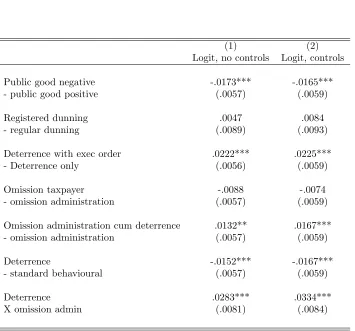
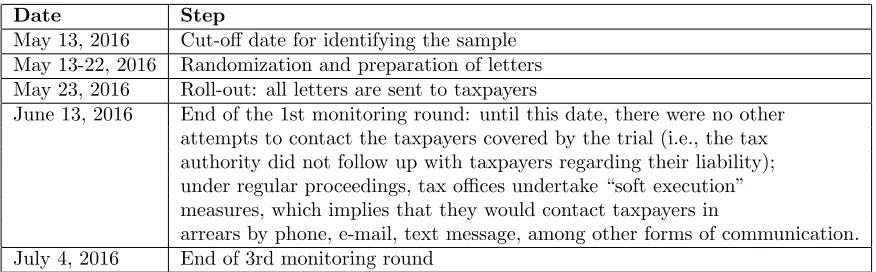
It does so by reporting results from a policy experiment that randomly allocated a variety of letters to be sent to Polish taxpayers to remind them to pay their taxes. The experimental subjects had declared their personal income tax (PIT) for the 2015 fiscal year but had failed to pay what they owed by the deadline. The trial took place between May and June 2016 and covered a total of 150,122 individuals. The control intervention was an informal reminder sent by the authorities via ordinary mail and with the use of simple language and clear information provision. The main interventions, analysed against this control one, mainly consisted of a message linking tax revenues to the delivery of local public goods (in two variants); a message based on social norms and reporting that a certain percentage of taxpayers had paid in the same region as the experimental subject; a deterrence message highlighting the negative consequences from non-compliance (coming in two variants); anomission-commission message reporting that not paying taxes would henceforth be considered not a delay but an active choice on the part of the taxpayer (itself coming in two variations). More than simply replicating existing interventions in the Polish context, however, the large sample size and the pre-existing context allowed to introduce tests that would improve our understanding of compliance behaviour among late taxpayers.
credibility, the complexity of the language made the behaviour requested of the taxpayer much harder to understand. Simplification might then have ambiguous effects when it is introduced in a system tradition-ally blighted with technical jargon. This paper adds to the existing literature by studying in a randomised setting, and separately, the effect of sending a formal letter via ordinary vs. registered mail, and the effect of writing a formal letter vs. an informal simplified message, via ordinary mail.
Secondly, we could address some sources of interaction when it comes to the application of behavioural insights. The use of behavioural insights relies by definition on subtle cues or framing: even small changes in language are thus found to have profound effects on taxpayers’ behaviour. While this makes behavioural interventions very easy and cheap to implement for the policy maker, it also calls for extreme cautions with the interaction effects between different types of messages or means of communication. Messages that make deterrence more salient, for instance, might become more or less effective depending on the underlying credibility of enforcement. If the context makes enforcement look less likely, for instance by making the tax authorities look softer and potentially understanding of minor delays with the payment, making it more salient might backfire. If the context instead clarifies that there is no tolerance for delayed payments, messages highlighting enforcement will have a stronger effect. We thus address the issue of how deterrence depends on credibility in two different ways. First, we test the addition to the deterrence message of a visual cue that shows how the authorities usually act upon missed payments - a copy of the executive order that is sent to non-compliant taxpayers when the official procedures are started. If the deterrence message is not found, in and of itself, fully credible, adding this visual cue will increase compliance. Secondly, we test whether the deterrence message has different effects when interacted with the omission-commission message, that specifies that late payments are considered as an active choice that is therefore sanctioned by the law. If the effect of deterrence depends on the credibility of enforcement, the interaction between the two treatments will be positive.
understanding of what drives non-compliant taxpayers to comply.
To achieve the outlined goals, we allocated taxpayers from the sample randomly to one of eleven different treatment conditions:
• Standard behavioural: a simple reminder to pay taxes, with clear simple language and delivered via ordinary mail
• Dunning registered: a formal “dunning” letter reminding the taxpayer to pay their taxes, written in lengthy and bureaucratic language and delivered via registered mail.
• Dunning regular: a formal “dunning” letter reminding the taxpayer to pay their taxes, written in lengthy and bureaucratic language and delivered via regular mail
• Social norms: like standard behavioural, with a message reporting percentage of compliant taxpayers in the region and inviting taxpayer not to be part of a minority.
• Public good positive: like standard behavioural, with a message reminding that paying taxes sup-ports the provision of local public goods and services.
• Public good negative: like standard behavioural, with a message reminding that not paying taxes harms the provision of local public goods and services.
• Deterrence: like standard behavioural, with a message reminding the possible actions taken against non-compliers.
• Deterrence + Execution: like Deterrence, with a copy of the execution order sent to non-compliers.
• Omission Administration: like standard behavioural, with a message informing that non-compliance will henceforth be regarded as an active choice.
• Omission Administration + Deterrence: like standard behavioural, with the message used in Omission Administration and the message used in Deterrence.
• Omission Taxpayer: like standard behavioural, with a message telling the taxpayers that they should henceforth regard non-compliance as an active choice.
Here we follow Hallsworth (2014)’s approach to tax compliance problems, interpreted as
returns on time; (ii) making accurate reports on these returns; (iii) paying any tax owed on time (US Treasury, 2009).
In the context of our intervention, this refers to paying - in full or in part - the amount owed to the tax authorities as a result of personal income tax declarations and not yet paid by the deadline.
The results from the experiment highlight several patterns.
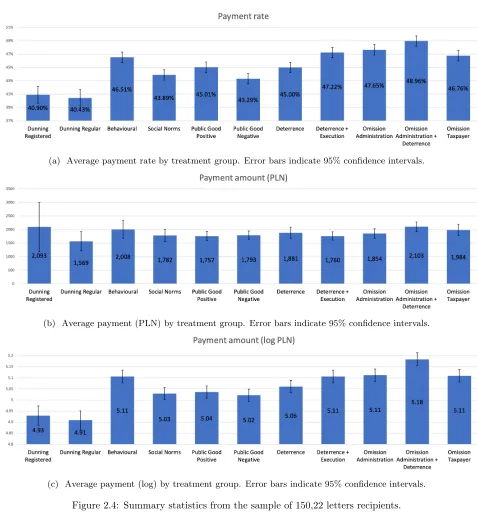
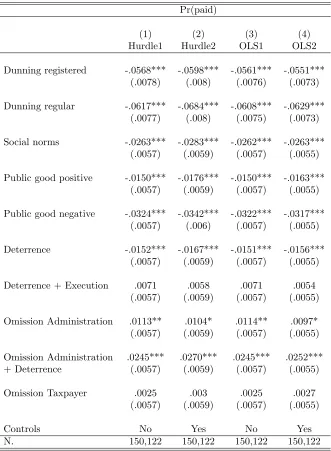
First, simplification improved compliance. Among letters sent via ordinary mail, however, we find that simplified language drove the payment rate up by 6 to 6.2 percentage points from 40.4%. Simplification of the delivery method, instead, did not significantly affect tax payment, but brought significant savings on the delivery cost of registered mail.
Second, behavioural
![Table 2.3: Summary statistics. Mean [standard deviation] of main explanatory variables](https://thumb-us.123doks.com/thumbv2/123dok_us/369886.1037951/49.612.89.674.138.437/table-summary-statistics-mean-standard-deviation-explanatory-variables.webp)