R E S E A R C H A R T I C L E
Open Access
No association between COMT val158met
polymorphism and suicidal behavior:
meta-analysis and new data
Carlos Tovilla-Zárate
1*, Isela Juárez-Rojop
2, Teresa Ramón-Frias
1, Mario Villar-Soto
3, Sherezada Pool-García
4,
Beatriz Camarena Medellín
5, Alma D Genis Mendoza
6, Lilia López Narvaez
7and Nicolini Humberto
6Abstract
Background:The polymorphism COMTval158met has been associated with suicidal behavior in case-control and meta-analysis studies, but results and conclusions remain controversial. The objective of this study was to examine the association between COMT val158met with suicidal behavior in a case-control study and to assess the
combined evidence -this case-control study and available data from other related studies- we carried out a meta-analysis.
Methods:We conducted a case-control study with 105 patients with suicide attempts and 236 controls. Subsequently, we performed a meta-analysis of published genetic association studies by searching through Medline, PubMed and Web of Science databases.
Results:No significant differences were found in the distribution of alleles (c2 = 0.33, 1 df, p = 0.56) or genotypes (c2 = 2.36, 2 df, p = 0.26). The meta-analysis comprising 12 association studies (including the present one) showed that the risk COMTmet allele of COMTval158/met is not associated with suicidal behavior (OR: 1.09, 95% CI: 0.97-1.23), even in the absence of heterogeneity (OR: 1.09, 95% CI: 0.97-1.23).
Conclusion:Our results showed no association between COMTval158/met and suicidal behavior. However, more studies are necessary to determine conclusively an association between COMT and suicidal behavior.
Background
Suicidal behavior is a major health problem worldwide. Suicide has been suggested to involve catecholaminergic dysfunction and to have a genetic correlate. Many signif-icant abnormalities in catecholaminergic dysfunction have been identified in suicide attempters and comple-ters [1]. For example, high concentration of noradrena-line with decreased a2-adrenergic binding has been described in the prefrontal cortex of suicide victims [2], whereas low concentration of 3-methoxy-4-hydroxyphe-nyglycol, a metabolite of norepinephrine, has been observed in subjects who attempted suicide [3-5].
Several lines of evidence suggest that suicide has a genetic component [6]. Attempted and completed
suicide show familial behavior. Family studies have found that those patients more likely to display suicidal behavior have parents with a history of suicidal beha-vioral with a heritability of about 40-50% [7-11]. A large number of studies in twins has also been reported. The pooled data from seven twin studies report concordance rates for suicide or suicide attempt of 23.5% in monozy-gotic twin pairs and 0.13% in dizymonozy-gotic twins [12-14]. Furthermore, the classic adoption studies demonstrate higher suicide rates in the biological parents than in adoptive parents of adoptees who died by suicide [13,15]. Despite the large amount of studies conducted, the specific genes that contribute to vulnerability for suicidal behavior are unknown. One candidate gene in the study of suicidal behavior is the gene encoding the enzyme catechol-o-methyl-transferase (COMT). The biological functions of COMT make it an attractive can-didate gene for suicidal behavior. COMT is a major
* Correspondence: [email protected]
1
Universidad Juárez Autónoma de Tabasco, División Académica Multidisciplinaria de Comalcalco, Comalcalco, Tabasco, México Full list of author information is available at the end of the article
catabolic enzyme for catecholaminergic neurotransmit-ters in the brain.
The COMT gene is located on the long arm of chro-mosome 22 at 22q11; it spans 28 kb and contains six exons. A common polymorphism of the COMT gene is the val108/158met variant (rs4680). This polymorphism is due to a G to A transition at codon 158 of the mem-brane bound form of COMT, which corresponds to codon 108 of the soluble form of COMT, resulting in a valine (val) to methionine (met) substitution [16,17]. COMT is one of the enzymes that degrade catechola-mines, including dopamine [16,17]. The low activity COMT genotype (COMTmet/met), consisting of a met/ met allele pair, yields a 3-4 fold lower enzyme activity compared to the high activity genotype (COMTval/val), which has a val/val allele pair, whereas the COMTval/ met genotype produces intermediate enzyme activity [18].
To date, the polymorphism rs4680 of COMT has been associated with a number of disorders including schizo-phrenia [19], bipolar disorder [20], major depressive dis-order [21], obsessive compulsive disdis-order [22], and Parkinson’s disease [23]. Several studies have investi-gated the association between rs4680 of COMT and sui-cidal behavior. Other COMT polymorphisms that have been investigated are rs362204 and 2097603 [24]. Actu-ally more than fourteen case-control studies have been reported, as well as one study in trios [25]. However, the association of COMT with suicidal behavior remains controversial. In addition, two meta-analyses have been published to date [11,26]. To explore the possibility that some of these COMT variants have susceptibility for suicidal behavior, we conducted a case-control study in a Mexican population and then we used the combined evidence to perform a meta-analysis of all the published data.
Methods
Case-control study
Samples
A total of 105 patients were consecutively recruited from the outpatient service of the General Hospital of Comalcalco in the state of Tabasco, Mexico and from the National Institute of Psychiatry Ramón de la Fuente in Mexico City. These patients had attempted suicide between January and August 2010. In addition, 236 unrelated controls were recruited for this study. All sub-jects signed an informed consent to participate in the study after they were given a verbal and written expla-nation of the research objectives. To reduce ethnic var-iation and stratification effects, only Mexican subjects descending from Mexican parents and grandparents par-ticipated in this study. The study was approved by the local ethics committee and performed in accordance
with the ethics standards laid down in the 1975 Declara-tion of Helsinki.
Clinical evaluation
DSM-IV Axis-I and II diagnoses were made using the Structured Clinical Interview for DSM-IV in Spanish. All patients were evaluated by a trained psychiatrist or clinical psychologists with at least a master’s level degree. Following the reports in the literature, we defined a suicide attempt as a self-harm behavior with at least some intent to end one’s life. Subjects were excluded when the self-injury behaviors were deter-mined to have no suicidal intention or ideation [5].
A total of 105 patients (55 males, 50 females) were included in the study. Their mean age was 30.5 (11.40) years old (range: 14-59 years). DSM-IV main lifetime diagnoses of mental disorders among the patients were as follows: schizophrenia spectrum disorders (n= 50), anxiety disorders (n = 35), and undiagnosed (n = 20). The mean number of suicide attempts was 2.06. The possibility of childhood abuse sufferers was not evaluated.
Control subjects consisted of 236 volunteers (132 males, 104 females); their mean age was 34.5 (10.1) years old (range: 14-51 years). They were recruited from the Blood Donor Center of the General Hospital of Comalcalco and from the general population of the Comalcalco city area in the state of Tabasco, México. Subjects were physically healthy on medical evaluation. All were of Mexican descent and none manifested chiatric problems, as assessed in brief interviews by psy-chiatrists. Informed consent was obtained from each control subject.
COMT val108/158met (rs4680) genotyping
Genomic DNA was extracted from peripheral blood leu-kocytes using a modified version of the protocol by Lahiri [27]. The final volume of the PCR reaction was 5 μL and consisted of 20 ng genomic DNA, 2.5 FL Taq-Man Master Mix, and 0.125 FL 20× Assay made to order. The amplification was performed in 96-well plates using the TaqMan Universal Thermal Cycling Protocol. After the PCR end-point was reached, fluorescence intensity was measured with the 7500 real-time PCR system using SDS v2.1 software (Applied Biosystems). An allelic discrimination was performed resulting in the clear identification of three genotypes for COMT Val108/158Met polymorphism. All genotyping was per-formed blind to patient outcome. As a quality control in our genotyping analyses we used random blind duplicates.
Statistical Analysis
allele frequencies between groups. The power to detect associations given the sample size was analyzed using the Quanto 1.2 software. The power of the analysis was 0.31. The level of significance was set at 0.05.
Meta-analysis study
Identification and selection of publications
A literature search comprising from January to March 2011 was performed. The publications were identified using the following search terms in Medline, PubMed and Web of Science databases: “COMT and suicidal behavior”, “COMT and suicide”, rs4680 and suicidal behavior”, rs4680 and suicide” and“COMT Val/Met and suicide”. These words were combined to retrieve the summaries. The search also implicated the review of the bibliography cited at the end of various research articles to identify additional papers not covered by the electronic search of abstracts.
To be selected, the publications had to fulfill the fol-lowing criteria: (1) to be published in peer-reviewed journals, (2) to be written in English, (3) to contain independent data, (4) to be case-control association stu-dies in which the frequencies of three genotypes were clearly stated or could be calculated, and (5) the use of healthy individuals as controls. Besides, we included one article consisting only of cases, because the n in this study was large and raised the detection power in the meta-analysis study [28].
Data Extraction
The following data were obtained for each of the stu-dies: authors, year of publication, region, number of cases and controls, number of alleles, male percentage, diagnostic status, and association results. These data were not always available for all studies. In cases of missing data, we contacted the respective authors to ask for the allele frequencies that were not included in the main text of the papers. One of the studies did not include a control group [29], but we made an adjust-ment accordingly based on the other studies in the lit-erature that included a control group [26]. Briefly, we calculated the weighted frequency for a particular geno-type from studies that included controls and applied it to the study not including a control group. We consid-ered the number of the“virtual”control group equal to the number of patients in a specific study. Then the hypothetical number of subjects with the particular gen-otype frequency was assigned in proportion to the per-centage of the same genotype which was obtained from the weighted analysis [30].
The outcomes of the meta-analysis were built by tak-ing into consideration the followtak-ing categories: a) exposed sick, b) exposed not-sick, c) not-exposed sick, and d) not-exposed not-sick. The “sick” term refers to
subjects exhibiting suicidal behavior and the“exposed” term to the allele of risk (COMTmet158).
Data analysis
For the meta-analysis procedures, we used the EPIDAT 3.1 program http://dxsp.sergas.es. This software is freely available for epidemiologic analysis of tabulated data. Data was analyzed with the random-effects model fol-lowing the reports in the literature [31,32]. Sample het-erogeneity was analyzed with the Dersimonian and Laird’s Q test. The result of the Q test was complemen-ted with graphs to help visualize those studies that favored heterogeneity. The results of the meta-analysis are expressed as an odds ratio (OR). To address the pro-blem of publication bias, funnel plots were calculated by the EPIDAT 3.1 software. This plotting standardizes the effect of each of the published studies on the vertical axis and its corresponding precision on the horizontal axis. Likewise, we used the Egger’s test to complement the funnel plots; the Egger’s test evaluates the hypoth-esis of absence of bias of a publication. Finally, a chi-squared (c2) analysis was used to calculate the Hardy-Weinberg equilibrium to evaluate genotype distribution.
Results
Case-control study
Of the 105 suicide attempt patients, 34 (32.4%) had the COMTval/val genotype, 58 (55.2%) the COMTval/met, and 13 (12.4%) the COMTmet/met type. Genotype fre-quencies in the patient group satisfied the Hardy-Wein-berg equilibrium (p = 0.12). In the control group, 80 individuals (33.2) presented the COMTval/val genotype, 112 (47.6%) the COMTval/met type, and 44(15.7%) the COMTmet/met type. No significant differences in geno-type (c2 = 2.36, df = 2, p = 0.26) or allele (c2 = 0.33, df = 1, p = 0.56) frequencies were observed between patients and the control group.
Meta-analysis study
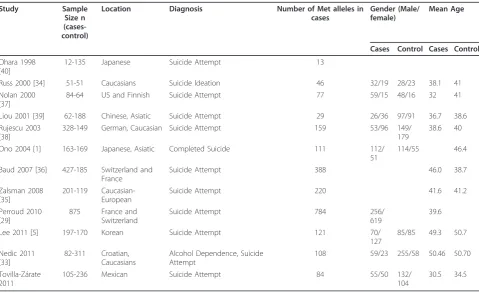
With regard to the literature search, a total of 18 papers were identified, but only 12 were included in this meta-analysis, including our case-control study [1,5,29,33-40] (Table 1). The six excluded studies did not comply with the inclusion criteria: in two of these studies genotype frequencies could not be obtained [24,25]; other study was carried out in families [41]; in other report the sam-ple overlapped with a previous one [26]; the fifth was a meta-analysis [11], and the sixth a review [42].
described by Baud et al. [36] (c2 = 6.35, p = 0.01). We explored all populations in a combined way and we still encountered them in equilibrium (p = 0.17, and p = 0.46, respectively).
Figure 1 shows the pooled OR derived from all studies indicating a non-significant association of allele met in the COMTval/met polymorphism with suicidal behavior
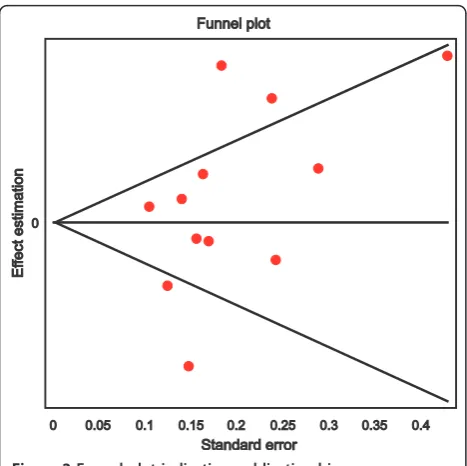
[image:4.595.58.538.98.390.2](Random effects model: OR: 1.07; 95% CI 0.85-1.33; p(Z) = 0.19). We observed heterogeneity in all studies (Q = 57.08, df = 1; p = 0.0005). The Egger’s test indicated no evidence of publication bias (t = 1.31, df = 10; p = 0.21) (Figure 2). Therefore, we carried out a second analysis, which only included studies inside the heterogeneity curve (Nedic [33], Ono [1], Baud [36] and Nolan [37] reports were excluded).
Table 1 Descriptive characteristics of 13 studies on the role of COMT val158/met polymorphism in suicidal behavior
Study Sample
Size n (cases-control)
Location Diagnosis Number of Met alleles in cases
Gender (Male/ female)
Mean Age
Cases Control Cases Control
Ohara 1998 [40]
12-135 Japanese Suicide Attempt 13
Russ 2000 [34] 51-51 Caucasians Suicide Ideation 46 32/19 28/23 38.1 41 Nolan 2000
[37]
84-64 US and Finnish Suicide Attempt 77 59/15 48/16 32 41
Liou 2001 [39] 62-188 Chinese, Asiatic Suicide Attempt 29 26/36 97/91 36.7 38.6 Rujescu 2003
[38]
328-149 German, Caucasian Suicide Attempt 159 53/96 149/ 179
38.6 40
Ono 2004 [1] 163-169 Japanese, Asiatic Completed Suicide 111 112/ 51
114/55 46.4
Baud 2007 [36] 427-185 Switzerland and France
Suicide Attempt 388 46.0 38.7
Zalsman 2008 [35]
201-119 Caucasian-European
Suicide Attempt 220 41.6 41.2
Perroud 2010 [29]
875 France and Switzerland
Suicide Attempt 784 256/
619
39.6
Lee 2011 [5] 197-170 Korean Suicide Attempt 121 70/
127
85/85 49.3 50.7
Nedic 2011 [33]
82-311 Croatian, Caucasians
Alcohol Dependence, Suicide Attempt
108 59/23 255/58 50.46 50.70
Tovilla-Zárate 2011
105-236 Mexican Suicide Attempt 84 55/50 132/
104
[image:4.595.55.543.507.713.2]30.5 34.5
However, we could not find an association either (OR: 1.09, 95% CI: 0.97-1.23; Z: 1.11, P(Z) = 0.26) (Table 2).
In addition, when we included an explorative analysis of each of the Caucasian samples, significant heteroge-neity was encountered (Q = 26.5; df = 5; p = 0.0001). Nedic [33] and Baud [36] reports contributed to the het-erogeneity. Also, we could not detect a significant asso-ciation between COMTmet allele and suicidal behavior (OR: 1.10; 95% CI: 0.91-1.16; p(Z) = 0.25).
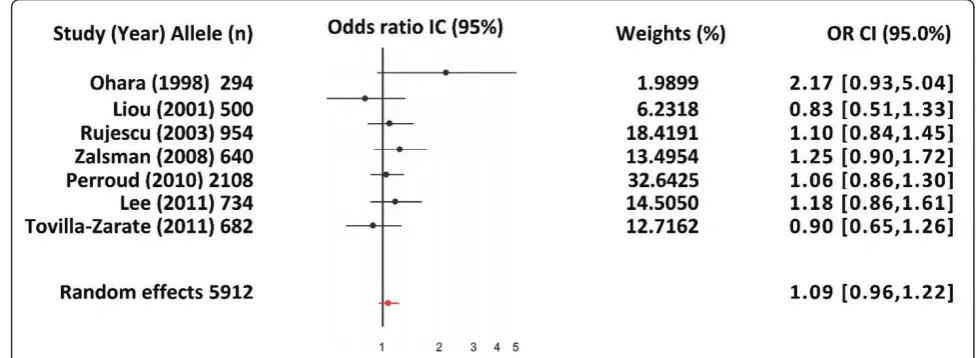
Finally, we selected a subgroup of the whole sample and performed an analysis of the studies containing only suicide attempters; however, the result was also negative (OR = 1.09, 95% CI: 0.96-1.22; Z = 0.60, P(Z) = 0.54). The same occurred without the presence of heterogene-ity (Q = 6.07, df = 6, p = 0.41) (Figure 3).
Discussion
In this study, we explored the association of COMTval/ met (rs4680) with suicidal behavior. First a case-control
study was conducted. Additionally, we performed a meta-analysis to assess the evidence of association between COMTval/met and suicidal behavior.
We could not find any association between COMT-met or COMTval allele and suicidal behavioral in a Mexican population. To our knowledge, this is the first study addressing the genetic association between COMTval/met alleles and suicidal behavior in a Mexi-can population. Our results are in agreement with recent reports in the literature stating the no association of COMTval/met and suicidal behavior [26,35]. This result is not surprising considering that complex beha-viors, such as suicidal behavior, are the result of a mod-erate number of genes that individually have small to modest effects on disease liability [26,43].
Available evidence suggests that the effect of this polymorphism on suicidal behavior may be related to the lethality of suicide attempts rather than to the risk for attempting suicide per se [11,35]. In our study we only performed an association with attempted suicide, because we wanted to establish which COMT polymorphisms were associated with suicide attempts; this could be considered as a limita-tion of our study. However, other study analyzing genotype differences with respect to lethality of sui-cide attempts or violent attempt methods reported results similar to ours [35].
[image:5.595.57.291.87.320.2]It is worth mentioning the evidence provided by other studies reporting a positive association of the COMTval allele when compared to the control group [5,36-38]. But these results are controversial, since such associa-tion was observed in presence of the COMTmet allele in patients presenting alcohol dependency or other dis-eases [33]. These differences among studies might be explained by the different diagnostic entities used. Some studies evaluated patients with alcohol dependence, while others included patients with schizophrenia, or schizoaffective or mood disorders [33]. Other limitation could be that these association studies were conducted in various populations and different criteria were used to define the phenotypes. Other relevant factor is the
Figure 2Funnel plot indicating publication bias.
Table 2 Meta-analysis of case-control studies on the role of the COMT (catechol-O-methyltrasferase) val158/108Met polymorphism in suicidal behavior
References Number of COMTval alleles Number of COMTmet alleles Odds Ratio (95% IC)
Cases Control Cases Control
Tovilla-Zárate 126 272 84 200 0.90 (0.65-1.26)
Lee [5] 223 273 117 121 1.18 (0.86-1.61)
Perroud [29] 848 255 784 221 1.06 (0.86-1.30)
Zalsman [35] 182 121 220 117 1.25 (0.90-1.72)
Rujescu [38] 139 323 159 333 1.10 (0.84-1.95)
Liou [39] 95 275 29 101 0.83 (0.51-1.33)
Russ [34] 52 58 46 40 1.28 (0.72-2.25)
Ohara [40] 11 175 13 95 2.17 (0.93-5.04)
[image:5.595.57.538.614.751.2]difference in the size of the samples. We observed that almost all studies consisted of small samples (n < 200) and some even made subdivisions within samples (gen-der or affective status, for example). Hence, n was very small and had a low power of association. When we detected this limitation we decided to analyze the evi-dence in a meta-analysis.
We tested the probability of the association of COMTmet with suicidal behavior. However, we could not find any association between these two factors. A previous meta-analysis reported a Met association with suicidal behavior [11]; however, this association is not strong because the results of this meta-analysis were highly dependent upon the inclusion of all the studies. When five of the six studies involved were individually removed from the analysis, the relationship between COMT and suicidal behavior was no longer significant [11]. Our results are in accordance with other recently published meta-analysis in which no association was found between Met or Val allele and suicidal behavior [26]. This evidence supports a lack of direct modulation of COMT on suicidal behavior.
Similarly to the results presented in a previous study, the sample sizes of the studies included in the present meta-analysis are in the low range compared to genetics studies for other diseases. Therefore, future studies com-prising larger samples of completed suicide are impor-tant to determine this association. We also consider that given the small number of studies available the associa-tion is not observable.
In a first approach we observed heterogeneity; how-ever this variation was due to four specific studies. We carried out a second analysis, in which the studies that gave rise to heterogeneity were discarded. However, no association between COMTmet and suicidal behavior
was encountered. Finally, with the aim of establishing whether this association depended on completed suicide or suicide attempt, we performed a last analysis which only included suicide attempters. Once again, no asso-ciation was confirmed.
Our study presents some limitations. Our case-control study lacks of a specific scale investigating suicide attempt. With regard to the meta-analysis, publication bias has to be considered, since negative studies are less likely to get published. Also, an overrepresentation of the results showing an association between the poly-morphism and the investigated disorder is also possible [44]. Although the contribution covering from genetic factors to personality traits may differ between male and female subjects, we did not analyze for gender. Other limitations are inherent in many meta-analysis of asso-ciation (including this one) such as their retrospective nature and the inclusion of study-level data.
Conclusion
In conclusion, our case-control study suggests no asso-ciation between COMTmet and suicidal behavior in a Mexican population. This same negative association was observed in the meta-analysis. However, more compre-hensive studies and larger samples are necessary to determine conclusively an association of COMT with suicidal behavior.
List of abbreviations used
COMT: catechol-o-methyl-transferase; DSM-IV: Diagnostic and statistical manual of mental disorders-IV.
Acknowledgements
[image:6.595.51.540.90.269.2]The authors gratefully acknowledge our research volunteers who helped to recruit the participants in this study. The collection of data and the
genotyping of subjects were accomplished thanks to the support of grants from the PROMEP/103.5/10/7315.
Author details
1
Universidad Juárez Autónoma de Tabasco, División Académica
Multidisciplinaria de Comalcalco, Comalcalco, Tabasco, México.2Universidad
Juárez Autónoma de Tabasco, División Académica de Ciencias de la Salud, Villahermosa, Tabasco, México.3Hospital de Alta Especialidad“Gustavo A.
Rovirosa P, Villahermosa, Tabasco, México.4Hospital General de Comalcalco Tabasco. Secretaría de Salud, Comalcalco, Tabasco, México.5Departamento
de Genética Psiquiátrica, Instituto Nacional de Psiquiatría“Ramón de la Fuente Muñiz”, México D. F., México.6Servicios de Atención Psiquiátrica,
Secretaria de Salud. México D. F., México.7Hospital General de Yajalón,
Yajalón, Chiapas, México.
Authors’contributions
TZC and CMB conceived the study, participated in its design, and helped to draft the manuscript. TZC, JRI, and RFT helped to perform the statistical analysis and to draft the manuscript. VSM and PGS recruited participants, and helped with the integration of data and analysis. GA, LL and HN coordinated and supervised the integration of data. All authors read and approved the final manuscript.
Competing interests
The authors declare that they have no competing interests.
Received: 3 May 2011 Accepted: 21 September 2011 Published: 21 September 2011
References
1. Ono H, Shirakawa O, Nushida H, Ueno Y, Maeda K:Association between catechol-O-methyltransferase functional polymorphism and male suicide completers.Neuropsychopharmacology2004,29(7):1374-1377.
2. Arango V, Ernsberger P, Sved AF, Mann JJ:Quantitative
autoradiography of alpha 1- and alpha 2-adrenergic receptors in the cerebral cortex of controls and suicide victims.Brain Res1993, 630(1-2):271-282.
3. Lester D:The concentration of neurotransmitter metabolites in the cerebrospinal fluid of suicidal individuals: a meta-analysis. Pharmacopsychiatry1995,28(2):45-50.
4. Jones JS, Stanley B, Mann JJ, Frances AJ, Guido JR, Traskman-Bendz L, Winchel R, Brown RP, Stanley M:CSF 5-HIAA and HVA concentrations in elderly depressed patients who attempted suicide.Am J Psychiatry1990,
147(9):1225-1227.
5. Lee HY, Kim YK:Gender Effect of Catechol-O-Methyltransferase Val158Met Polymorphism on Suicidal Behavior.Neuropsychobiology2011,
63(3):177-182.
6. Savitz JB, Cupido CL, Ramesar RS:Trends in suicidology: personality as an endophenotype for molecular genetic investigations.PLoS Med2006,
3(5):e107.
7. Garfinkel BD, Froese A, Hood J:Suicide attempts in children and adolescents.Am J Psychiatry1982,139(10):1257-1261.
8. Linkowski P, de Maertelaer V, Mendlewicz J:Suicidal behaviour in major depressive illness.Acta Psychiatr Scand1985,72(3):233-238.
9. McGuffin P, Marusic A, Farmer A:What can psychiatric genetics offer suicidology?Crisis2001,22(2):61-65.
10. Hawton K, Haw C, Houston K, Townsend E:Family history of suicidal behaviour: prevalence and significance in deliberate self-harm patients. Acta Psychiatr Scand2002,106(5):387-393.
11. Kia-Keating BM, Glatt SJ, Tsuang MT:Meta-analyses suggest association between COMT, but not HTR1B, alleles, and suicidal behavior.Am J Med Genet B Neuropsychiatr Genet2007,144B(8):1048-1053.
12. Baldessarini RJ, Hennen J:Genetics of suicide: an overview.Harv Rev Psychiatry2004,12(1):1-13.
13. Brezo J, Klempan T, Turecki G:The genetics of suicide: a critical review of molecular studies.Psychiatr Clin North Am2008,31(2):179-203.
14. Roy A, Segal NL, Centerwall BS, Robinette CD:Suicide in twins.Arch Gen Psychiatry1991,48(1):29-32.
15. Schulsinger F, Kety SS, Rosenthal D, PH W:A family study of suicide.New York, NY: Academic Press; 19791.
16. Lotta T, Vidgren J, Tilgmann C, Ulmanen I, Melen K, Julkunen I, Taskinen J:
Kinetics of human soluble and membrane-bound catechol O-methyltransferase: a revised mechanism and description of the thermolabile variant of the enzyme.Biochemistry1995,34(13):4202-4210. 17. Spielman RS, Weinshilboum RM:Genetics of red cell COMT activity:
analysis of thermal stability and family data.The American Journal of Medical Genetics1981,10(3):279-290.
18. Lachman HM, Papolos DF, Saito T, Yu YM, Szumlanski CL, Weinshilboum RM:Human catechol-O-methyltransferase
pharmacogenetics: description of a functional polymorphism and its potential application to neuropsychiatric disorders.Pharmacogenetics
1996,6(3):243-250.
19. Sagud M, Muck-Seler D, Mihaljevic-Peles A, Vuksan-Cusa B, Zivkovic M, Jakovljevic M, Pivac N:Catechol-O-methyl transferase and schizophrenia. Psychiatr Danub2010,22(2):270-274.
20. Hosak L:Role of the COMT gene Val158Met polymorphism in mental disorders: a review.Eur Psychiatry2007,22(5):276-281.
21. Kocabas NA, Faghel C, Barreto M, Kasper S, Linotte S, Mendlewicz J, Noro M, Oswald P, Souery D, Zohar J, Massat I:The impact of catechol-O-methyltransferase SNPs and haplotypes on treatment response phenotypes in major depressive disorder: a case-control association study.Int Clin Psychopharmacol2010,25(4):218-227.
22. Pooley EC, Fineberg N, Harrison PJ:The met(158) allele of catechol-O-methyltransferase (COMT) is associated with obsessive-compulsive disorder in men: case-control study and meta-analysis.Mol Psychiatry
2007,12(6):556-561.
23. Williams-Gray CH, Hampshire A, Barker RA, Owen AM:Attentional control in Parkinson’s disease is dependent on COMT val 158 met genotype. Brain2008,131(Pt 2):397-408.
24. De Luca V, Tharmalingam S, Muller DJ, Wong G, de Bartolomeis A, Kennedy JL:Gene-gene interaction between MAOA and COMT in suicidal behavior: analysis in schizophrenia.Brain Res2006,1097(1):26-30. 25. De Luca V, Tharmalingam S, Sicard T, Kennedy JL:Gene-gene interaction
between MAOA and COMT in suicidal behavior.Neurosci Lett2005,
383(1-2):151-154.
26. Calati R, Porcelli S, Giegling I, Hartmann AM, Moller HJ, De Ronchi D, Serretti A, Rujescu D:Catechol-o-methyltransferase gene modulation on suicidal behavior and personality traits: review, meta-analysis and association study.J Psychiatr Res2011,45(3):309-321.
27. Lahiri DK, Nurnberger JI Jr:A rapid non-enzymatic method for the preparation of HMW DNA from blood for RFLP studies.Nucleic Acids Res
1991,19(19):5444.
28. Perroud N, Jaussent I, Guillaume S, Bellivier F, Baud P, Jollant F, Leboyer M, Lewis CM, Malafosse A, Courtet P:COMT but not serotonin-related genes modulates the influence of childhood abuse on anger traits.Genes Brain Behav2010,9(2):193-202.
29. Perroud N, Salzmann A, Saiz PA, Baca-Garcia E, Sarchiapone M, Garcia-Portilla MP, Carli V, Vaquero-Lorenzo C, Jaussent I, Mouthon D, Vessaz M, Huguelet P, Courtet P, Malafosse A:Rare genotype combination of the serotonin transporter gene associated with treatment response in severe personality disorder.Am J Med Genet B Neuropsychiatr Genet2010,
153B(8):1494-1497.
30. Serretti A, Chiesa A:Treatment-emergent sexual dysfunction related to antidepressants: a meta-analysis.J Clin Psychopharmacol2009,
29(3):259-266.
31. Tovilla-Zarate C, Camarena B, Apiquian R, Nicolini H:[Association study and meta-analysis of the apolipoprotein gene and schizophrenia].Gac Med Mex2008,144(2):79-83.
32. Kavvoura FK, Ioannidis JP:Methods for meta-analysis in genetic association studies: a review of their potential and pitfalls.Hum Genet
2008,123(1):1-14.
33. Nedic G, Nikolac M, Sviglin KN, Muck-Seler D, Borovecki F, Pivac N:
Association study of a functional catechol- O-methyltransferase (COMT) Val108/158Met polymorphism and suicide attempts in patients with alcohol dependence.Int J Neuropsychopharmacol2011,14(3):377-388. 34. Russ MJ, Lachman HM, Kashdan T, Saito T, Bajmakovic-Kacila S:Analysis of
catechol-O-methyltransferase and 5-hydroxytryptamine transporter polymorphisms in patients at risk for suicide.Psychiatry Res2000,
93(1):73-78.
polymorphism with suicidal behavior or CSF monoamine metabolites in mood disorders.Arch Suicide Res2008,12(4):327-335.
36. Baud P, Courtet P, Perroud N, Jollant F, Buresi C, Malafosse A: Catechol-O-methyltransferase polymorphism (COMT) in suicide attempters: a possible gender effect on anger traits.Am J Med Genet B Neuropsychiatr Genet2007,144B(8):1042-1047.
37. Nolan KA, Volavka J, Czobor P, Cseh A, Lachman H, Saito T, Tiihonen J, Putkonen A, Hallikainen T, Kotilainen I, Rasanen P, Isohanni M, Jarvelin MR, Karvonen MK:Suicidal behavior in patients with schizophrenia is related to COMT polymorphism.Psychiatr Genet2000,10(3):117-124.
38. Rujescu D, Giegling I, Gietl A, Hartmann AM, Moller HJ:A functional single nucleotide polymorphism (V158M) in the COMT gene is associated with aggressive personality traits.Biol Psychiatry2003,54(1):34-39.
39. Liou YJ, Tsai SJ, Hong CJ, Wang YC, Lai IC:Association analysis of a functional catechol-o-methyltransferase gene polymorphism in schizophrenic patients in Taiwan.Neuropsychobiology2001,43(1):11-14. 40. Ohara K, Nagai M, Suzuki Y:Low activity allele of
catechol-o-methyltransferase gene and Japanese unipolar depression.Neuroreport
1998,9(7):1305-1308.
41. De Luca V, Strauss J, Kennedy JL:Power based association analysis (PBAT) of serotonergic and noradrenergic polymorphisms in bipolar patients with suicidal behaviour.Prog Neuropsychopharmacol Biol Psychiatry2008,
32(1):197-203.
42. Giegling I, Olgiati P, Hartmann AM, Calati R, Moller HJ, Rujescu D, Serretti A:
Personality and attempted suicide. Analysis of anger, aggression and impulsivity.J Psychiatr Res2009,43(16):1262-1271.
43. Kendler KS:“A gene for...": the nature of gene action in psychiatric disorders.Am J Psychiatry2005,162(7):1243-1252.
44. Van Kerkhoven LA, Laheij RJ, Jansen JB:Meta-analysis: a functional polymorphism in the gene encoding for activity of the serotonin transporter protein is not associated with the irritable bowel syndrome. Aliment Pharmacol Ther2007,26(7):979-986.
Pre-publication history
The pre-publication history for this paper can be accessed here: http://www.biomedcentral.com/1471-244X/11/151/prepub
doi:10.1186/1471-244X-11-151
Cite this article as:Tovilla-Zárateet al.:No association between COMT val158met polymorphism and suicidal behavior: meta-analysis and new data.BMC Psychiatry201111:151.
Submit your next manuscript to BioMed Central and take full advantage of:
• Convenient online submission
• Thorough peer review
• No space constraints or color figure charges
• Immediate publication on acceptance
• Inclusion in PubMed, CAS, Scopus and Google Scholar
• Research which is freely available for redistribution