University of Huddersfield Repository
Zioga, Polina, Chapman, Paul, Ma, Minhua and Pollick, Frank
A Wireless Future: performance art, interaction and the braincomputer interfaces
Original Citation
Zioga, Polina, Chapman, Paul, Ma, Minhua and Pollick, Frank (2014) A Wireless Future:
performance art, interaction and the braincomputer interfaces. In: International Conference on Live
Interfaces 2014, 20th 23rd November 2014, Lisbon, Portugal.
This version is available at http://eprints.hud.ac.uk/id/eprint/22799/
The University Repository is a digital collection of the research output of the
University, available on Open Access. Copyright and Moral Rights for the items
on this site are retained by the individual author and/or other copyright owners.
Users may access full items free of charge; copies of full text items generally
can be reproduced, displayed or performed and given to third parties in any
format or medium for personal research or study, educational or notforprofit
purposes without prior permission or charge, provided:
•
The authors, title and full bibliographic details is credited in any copy;
•
A hyperlink and/or URL is included for the original metadata page; and
•
The content is not changed in any way.
For more information, including our policy and submission procedure, please
contact the Repository Team at: [email protected].
A Wireless Future: performance art, interaction and
the brain-computer interfaces
Polina Zioga 1, Paul Chapman 1, Minhua Ma 2, and Frank Pollick 3
1 Digital Design Studio, Glasgow School of Art, Glasgow, UK
{P.Zioga1,P.Chapman}@gsa.ac.uk
2 School of Art, Design and Architecture, University of Huddersfield, Huddersfield, UK
3 School of Psychology, University of Glasgow, Glasgow, UK
Abstract. Although the use of Brain-Computer Interfaces (BCIs) in the arts originates in the 1960s, there is a limited number of known applications in the context of real-time audio-visual and mixed-media performances and accordingly the knowledge base of this area has not been developed sufficiently. Among the reasons are the difficulties and the unknown parameters involved in the design and implementation of the BCIs. However today, with the dissemination of the new wireless devices, the field is rapidly growing and changing. In this frame, we examine a selection of
representative works and artists, in comparison to the current scientific evidence. We identify important performative and neuroscientific aspects, issues and challenges. A model of possible interactions between the performers and the audience is discussed and future trends regarding liveness and interconnectivity are suggested.
Keywords: brain-computer interface (BCI), electroencephalography (EEG), human-computer interaction (HCI), wireless, performance art, real-time, liveness, mixed-media, audience.
1 Introduction
The use of Brain-Computer Interfaces (BCIs) in the arts originates in the 1960s with the pioneering work of composers like Alvin Lucier, David Rosenboom, and others. However there is a limited number of known applications in the context of real-time audio-visual and mixed-media
performances1 and accordingly the knowledge base of this area has not been developed sufficiently.
The reasons are merely two. On the one hand, the low-cost commercial devices have only recently been available in the market, making the technology approachable to artists. On the other hand, the design and implementation of BCIs presents several difficulties and is dependent on unknown parameters. However, today the field is rapidly growing and new approaches and definitions are requested. In this frame we shall refer to the use of BCIs in the context of real-time audio-visual and mixed-media performances as live Brain-Computer mixed-media performances. After a brief
introduction in section 2 to BCIs and the particular difficulties they present, we examine in section 3 a selection of representative works and artists, in order to identify important performative and neuroscientific aspects, issues and challenges and show how the development of the field is changing with the dissemination of the new wireless devices. In section 4 we outline possible directions for the future research and practices and we suggest a model of possible interactions between the
performers and the audience.
1 We use the term “mixed-media performances” as introduced by Auslander (1999, 36):
2 Brain-Computer Interfaces: limitations, difficulties and unknown parameters
Wolpaw and Wolpaw (2012, 3-12) defined a BCI as:
[…] a system that measures CNS [Central Nervous System] activity and converts it into artificial output that replaces, restores, enhances, supplements, or improves natural CNS output and thereby changes the ongoing interactions between the CNS and its external or internal environment.
Among the non-invasive techniques used for signal acquisition in BCIs, the most common is Electroencephalography (EEG). EEG, a technique that can be applied to humans repeatedly with no risk or limitation, is the recording of the electrical activity along the scalp, by measuring the voltage fluctuations resulting from the current flows (Teplan 2002, Niedermeyer and da Silva 2004). The recorded electrical activity is then categorized in rhythmic activity frequency bands2, which are
associated to different brain- and cognitive- states. EEG is a very effective technique for measuring changes in the brain-activity with accuracy of milliseconds. However, one of its technical limitations is the low spatial resolution, as compared to other brain imaging techniques, like fMRI (functional Magnetic Resonance Imaging), meaning that it has low accuracy in identifying the region of the brain being activated.
At the same time the design and implementation of the BCIs presents additional difficulties and is dependent on many factors and unknown parameters, such as the brain anatomy of the person wearing each time the device, the task/s being executed, the type of sensors used, the location of the sensors which might be differentiated even slightly during each session, and the ratio of noise and non-brain artifacts to the actual brain signal being recorded. More specifically among the non-brain artifacts are included the “internally generated”, such as the EMG (electromyographic) deriving from the neck and face muscles, the eye movements, but also the heart activity, and the “externally generated” like spikes from equipment, cable sway and thermal noise (Swartz Center of Computational Neuroscience, University of California San Diego 2012).
In recent years, with the accelerating advances in neuroscience and biomedical engineering research, new low-cost devices which use wet or dry sensors have been developed. Neurosky introduced in 2007, the first wireless device, which was also the first device with a dry sensor that did not require the application of a conductive gel, nor skin preparation. In 2009, Emotiv launched two wireless devices, the EPOC and the EEG neuroheadset, with 14 wet sensors plus 2 references. At the same time, alongside with the companies building new wireless interfaces, a community of developers and engineers working on DIY (do it yourself) devices has also emerged, such as the OpenEEG project (OpenEEG project 2014), which is a relatively well-known community amongst artists and creative practitioners. This way and within only a few years, the EEG technology has been made more approachable and easy-to use and therefore the applications in the arts have radically increased and the practices have changed. As we will discuss further on, the new wireless devices help the artists to overcome important constraints, but at the same time they also present new challenges.
2 The EEG rhythmic activity frequency bands are delta (<4Hz), theta (4-7Hz), alpha (8-13Hz), beta
3 The use of BCIs in real-time audio-visual and mixed-media performances:
neuroscientific and performative challenges
3.1 Kinesiology, facial expression and noise
Since the first works with the use of BCIs, performers have encountered considerable limitations to their kinesiology and even their facial expression; either in cases they use wired devices and electrodes, and/or because of the contamination of the EEG-data with noise and non-brain artifacts from the cranial and body muscles. A well-known example is Music For Solo Performer (1965) by Alvin Lucier, which is considered the first real-time performance using EEG. In this work, the performer has two electrodes attached to his forehead, while he seats almost without moving on a chair, opening and closing slowly his eyes, thus controlling the effect of the visual stimuli on his brain-activity and consequently the alpha rhythmic activity frequency band, which is associated with a brain-state of relaxation. The electrodes are connected via an amplifier to a set of speakers, who transmit the electrical signal and vibrate percussion instruments placed around the performance space (Ashley 1975).
Another example is INsideOUT (2009) by Claudia Robles Angel, in which she uses an open source EEG interface from Olimex, consisting of one analogue and one digital board, connected to a computer. Two electrodes, one on her forehead and one on the back of her head, are connecting respectively the frontal lobe’s activity with the sound output from the computer and the occipital lobe’s activity with the video output. The sounds and images are projected on a screen and onto the performer. They are controlled by the values of the signals acquired via the electrodes and processed via the MAX/MSP software (Angel 2011). In one of her interviews, Angel mentions that with the EEG interface she could not move because it “is so sensitive that if you move you get values [noise] from other sources” (Lopes and Chippewa 2012). Today, the new wireless devices have provided the performers with greater kinetic and expressive freedom, while in some cases they also include filters and algorithmic interpretations which can be used to some extent for the real-time processing of the acquired data. However there are certain issues, which will be discussed more in detail in section 3.4.
3.2 Rhythmic activity frequency bands and cognitive states
The limitations imposed in the performers’ kinesiology and facial expression, like in the previously presented examples of works, have further implications and result in additional performative constraints, such as the inevitable focus in the control of only the relaxation state and the associated alpha rhythmic activity frequency band. For performers that are interested in using BCIs while engaging in more active situations and states of tension, like for example in works that involve intense kinesiology and speech, the use of wireless devices is indispensable. Consequently they are also enabled to consider all the different frequency bands, associated with a greater range of brain- and cognitive-states. The EEG-data can be further processed and differentiated according to the tasks executed and in consistency with the dramaturgical conditions of the performance. In this way the use of the BCIs as a medium in live performances is enriched. Examples of such works are presented in the following sections.
3.3 Spatial resolution and the head volume conduction effect
modelling. However, these techniques are currently not applicable to artistic performances and especially in cases where low-cost interfaces are used with limited number of electrodes/sensors, either wireless or not. For this reason, either the artists should not rely the concept of their live Brain-Computer mixed-media performances on the localisation of the electrodes/sensors or they should consider applying a combination of pre-performance study and on-performance use of computational processing, which however is complex and therefore challenging.
3.4 Raw EEG data versus “detection suites”
The new low-cost wireless devices have not only given greater kinetic and expressive freedom to the performers, but with their accompanying user-friendly software, SDK (software development kit) licences and a variety of connectivity solutions, they have enabled artists to establish communication with different hardware and boards like Arduino, and software like Pure Data, MAX/MSP, Processing, Ableton Live and others, creating prototypes and playful applications. This easiness is largely
achieved because these devices enable the real-time raw EEG data extraction, but at the same time they also include ready-made algorithmic interpretations and filters for feature extraction. For example the user can view and process/map data under categorizations such as “frustration” or “excitement”, “meditation” or “relaxation”, “engagement” or “concentration”, which are differentiated amongst the different devices and manufactures.
For example, Adam John Williams with Alex Wakeman and Robert Wollner presented in 2013 a project, which uses an Emotiv EPOC headset in order to connect with and sent to a computer the participants’ EEG data, converting them to:
[…] OpenSound Control messages, which were sent to a Mac where Max MSP used the data to adjust the rules of a generative music engine. Tempo and sync information were then packed along with the original EEG messages and transmitted to the Raspberry Pi upon which the visuals were generated. (Williams 2013).
As it is shown in the video documentation, the software processes different inputs titled as
“Bored/Engaged”, “Excited”, “Excited LT”, “Meditation” and “Frustration”, which are associated with the Emotiv’s “detection suites” (Emotiv 2014).
Lisa Park in her work Eunoia (2013), a Greek word meaning goodwill and beautiful thinking, reinterprets in a way Alvin Lucier’s Music for Solo Performer (1965) by using Neurosky’s Mindwave wireless device, monitoring her brain-wave activity and processing the EEG-data categorized in different rhythmic activity frequency bands, but also states, such as “Attention” and “Meditation”. These data and the corresponding values are amplified and transmitted through five speakers, positioned underneath equal number of round metal plates, filled with water, and associated according to the artist with the emotions of “happiness”, “anger”, “sadness”, “hatred”, and “desire”. The speakers vibrate the metal plates and “varieties of water forms” are created (Park 2013).
Although the use of the aforementioned “detection suites” serves in the artists’ hands as ready-made tools for the creation of inspiring and imaginative works, there are two facts that we should bear in mind. On the one hand the algorithms and methodology upon which the interpretation and feature extraction of the brain’s activity is made are not published by the manufactures. On the other hand the published neuro-science research in the field of emotion recognition via the use of EEG data is fairly new. Thus, the use of these “detections” of emotional states should not necessarily be regarded as accurate and therefore the creative results may not be consistent to the artists’ original intentions.
documented results. Similar approaches can contribute to a new system of validation and evaluation, enabling further advancements in the field.
3.5 Coherence, synchronicity and interaction with multiple participants
One of the most cited works, Mariko Mori’s Wave UFO (2003) is an immersive video installation, where computer-generated graphics are combined with the “real-time interpretation of three participants’ alpha, beta, and theta brain-waves” (Mori, Kunsthaus Bregenz, and Schneider 2003). The participants are wearing EEG devices with three electrodes/sensors attached to their foreheads, recording the frequencies of their brains’ right and left hemispheres. According to which frequency is showing higher activity, projected animated spheres on the ceiling (one for each participant’s
hemisphere) take a different/associated colour (red for beta band, blue for alpha and yellow for theta). At the same time is also animated each participant’s brain coherence with a second pair of smaller spheres, the “Coherence Spheres”. By coherence the artist refers to the phenomenon of synchronicity of the alpha-wave activity between the two brain’s hemispheres (Mori, Kunsthaus Bregenz, and Schneider 2003). When this is achieved, the “Coherence Spheres” are joining together. If all the participants reach this state, then a circle is created, as a scientific and visualization approach to the artist’s idea of connectivity. Coherence in Mariko Mori’s work also serves as an example of a real-time interaction between the brain activity of multiple participants and the visualisation of the brain-data as a form of physicalization, which is the process of rendering physical the abstract information through either graphical representation and visual interpretation or sonification (Tanaka 2012).
More recently, the Marina Abramovic Institute Science Chamber and neuroscientist Dr. Suzanne Dikker have been collaborating in a series of projects, like Measuring the Magic of Mutual Gaze
(2011), The Compatibility Racer (2012) and The Mutual Wave Machine (2013), which explore
“moments of synchrony” of the brain-activity between two participants, when they interact by gazing at each other (Dikker 2014). As Dikker explains by “moments of synchrony” are meant points in time when the two participants present the same predominant brain-activity (Marina Abramovic Institute 2014). Could we expect to see in the future live Brain-Computer mixed-media performances where an interaction between the performer/s’ and the audience’s brain activity, jointly contribute to the final creative output/result? In this case what kind of new connections and cognitive issues might emerge?
4 Towards the future
4.1 Liveness and interaction with the audience
In real-time audio-visual and mixed-media performances, from experimental underground acts to multi dollar music concerts touring around the world in big arenas, liveness is a key element. In the case of performers using laptops and operating software, the demonstration of liveness to the audience is a challenge approached in various ways. The Erasers (2013) for example, transform the stage into a kind of audio-visual laboratory, where the creative process and the different techniques they use to produce moving images and sound, as well as the final outcome are immediately visible to the audience. Other performers use two projections, with one of them showing their computers’ desktops and the other one showing the visual output/result. A similar approach is also live coding, a programming practice disseminated in contemporary music improvisational performances.
extracted and mapped real-time to projected moving images (Association Bjcem 2013). Also Lisa Park, in her demo video for her upcoming performance Eudaimonia, a Greek word meaning bliss, presents the idea of an installation with the collaboration of eight to ten participants wearing portable BCI devices. As in her 2013 performance, discussed in section 3.4, the brain-activity of the participants will be physicalised as sound-waves, played by speakers placed underneath a shallow pool of water, vibrating and creating “corresponding ripples and droplets” on the surface (Park 2014).
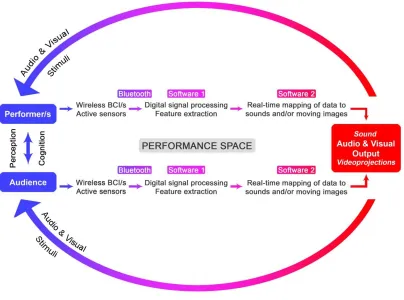
[image:7.612.106.510.273.573.2]From these and other examples a question deriving is: what might be a model for interaction between the performer/s’ and the audience’s brain-activity in the context of a live Brain-Computer mixed-media performance and how could liveness be presented to the audience? A proposal for such a model is presented in Figure 1, which demonstrates the collective participation and co-creation of the mediatized elements of the performance. According to the model, the audience is made aware of the liveness of the performance by realising the interaction taking place among its EEG activity, the audio and visual outputs and finally the performers themselves.
Fig. 1. A model of interactions between the performer/s and the audience in live Brain-Computer mixed-media performances
4.2 Interconnectivity
place in November 1995, a series of sensors were attached to different parts of his body, connected to a computer with a “touch screen interface & muscle stimulation circuitry”, and via the computer to the World Wide Web (Smith 2005). Through a “performance website” the audience remotely viewed, accessed, and actuated the body by clicking/sending commands to the computer interface located together with Stelarc at the performance site. The result was causing the body to move involuntary (Stelarc 1995).
In August 2013 Rao and Stocco conducted in the University of Washington the pilot study Direct Brain-to-Brain Interface in Humans. In the published research report is described the first brain-to-brain interface between two humans, which transits EEG signals recorded from the one participant to the second over the internet (Rao et al. 2014). In August 2014 Grau et al. published the results of a series of experiments with established “internet-mediated B2B [Brain to Brain] communication by combining a BCI […] with a CBI [Computer-Brain Interface]”. Of course the Brain to Brain re-search is a newly-born scientific breakthrough and therefore currently far from being applicable in the arts. However, the use of EEG data transferred via the internet is a reality and it is only a matter of time to witness similar applications in the context of live Brain-Computer mixed-media performances, the practices and theories of interconnectivity.
5 Conclusions
There is no doubt that the new wireless devices are not only the future, but already the present in the field of live Brain-Computer mixed-media performances. Artists are not only enabled with the new EEG technologies to use their own brain in their creative practices in the most direct way made so far possible, but they are also given a new freedom of access, interpretation, communication, interaction, and the ability to investigate new performative patterns.
The presented and discussed artists and their work is only a sample of the continuously increasing number of imaginative applications, creative and playful ideas that have emerged within only a few years. The new wireless devices help performers to overcome the so far dominant constraints, providing them with greater kinetic and expressive freedom, but at the same time they also present new challenges. By taking into account both the advantages and disadvantages, the opportunities and limitations of the technology, in comparison with the current scientific research and methodologies, artists can enrich their practices in a meaningful and consistent to the medium way. They will be able to contribute to the advancement of the field and the creation of a greater and more validated area of investigation in discourse with other relevant practices. We expect in the near future much progress and new aesthetic experiences intersecting and transcending the boundaries of performance and new media art, experimental psychology, computational neuroscience, and modern brain-computer interface design.
References
Angel, Claudia Robles. “Creating Interactive Multimedia Works with Bio-data” in NIME ’11
International Conference on New Interfaces for Musical Expression. Oslo: NIME ‘11, 30 May - 1 June, 2011, 421-424
Ashley, Robert. “Music with Roots in the Aether – Alvin Lucier (1975)”. UbuWeb video, 121:35. Accessed April 19, 2014.
http://ubu.com/film/aether_lucier.html.
Association Bjcem. ERRORS ALLOWED MEDITERRANEA 16 YOUNG ARTISTS BIENNIAL ANCONA 2013. Macerata: Quodlibet srl, 2013.
Auslander, Philip. Liveness: Performance in mediatized culture. New York: Routledge, 1999. Dikker, Suzanne. “REAL-TIME INTERACTIVE BRAIN INSTALLATIONS”. Last Modified September
2014. Accessed October 19, 2014.
Eaton, Joel, Jin, Weiwei, and Miranda, Eduardo. “The Space Between Us: A Live Performance with Musical Score Generated via Affective Correlates Measured in EEG of One Performer and an Audience Member”in NIME’14 International Conference on New Interfaces for Musical Expression. London: NIME ‘14, June 30 – July 03, 2014, 593-596
Emotiv. “Emotiv eStore”. Accessed October 20, 2014. http://emotiv.com/store/compare.
Grau, Carles, Ginhoux, Romuald, Riera, Alejandro, Nguyen ,Thanh Lam, Chauvat Hubert, Berg, Michel, Amengual, Julia L., Pascual-Leone, Alvaro, Ruffini, Giulio. “Conscious Brain-to-Brain Communication in Humans Using Non-Invasive Technologies”. PLoS ONE 9(8) (2014): e105225. Accessed October21, 2014. doi:10.1371/journal.pone.0105225.
He, Bin and Ding, Lei. “Electrophysiological Mapping and Neuroimaging”. In: Neural Engineering, edited by Bin He. New York: Springer Science+Business Media, 2013.
Lopes, Pedro and Chippewa, Jef. “Performing Biological Bodies An open conversation with Marco Donnarumma, Claudia Robles and Peter Kirn at Body Controlled #4 (Berlin, 11–15 July 2012)”.
eContact! 14.2 — Biotechnological Performance Practice / Pratiques de performance
biotechnologique (July / juillet 2012). Montréal: Communauté électroacoustique canadienne / Canadian Electroacoustic Community. Accessed March 25, 2014.
http://cec.sonus.ca/econtact/14_2/lopes_bc4-interview.html.
Marina Abramovic Institute. “Out of the Lab”. Accessed October 19, 2014. http://www.immaterial.org/content/2014/6/9/out-of-the-lab.
Mori, Mori, Kunsthaus Bregenz, and Schneider, Eckhard. Mariko Mori: wave UFO. Köln: Verlag der Buchhandlung Walther König, 2003.
Niedermeyer, Ernst. and da Silva, Fernando Lopes. Electroencephalography: Basic Principles, Clinical Applications, and Related Fields. Philadelphia ; London: Lippincot Williams & Wilkins, 2004.
OpenEEG project. “Welcome to the OpenEEG project”. Accessed April 22, 2014. http://openeeg.sourceforge.net/doc/index.html.
Park, Lisa. “Eunoia”. 2013. Accessed October 19, 2014. http://www.thelisapark.com/#/eunoia.
Park, Lisa. “eunoia (about the process)”. Vimeo video, 05:33. Posted by “Lisa Park”, 2013. Accessed October 19, 2014.
https://vimeo.com/67935519.
Park, Lisa. “Eudaimonia”. Vimeo video, 02:23. Posted by “Lisa Park”, 2014. Accessed October 19, 2014.
https://vimeo.com/85057000.
Pulse 4 Arts and Oullier, Olivier. “Interview: Pulse 4 Arts & Olivier Oullier talk about The Neuromix and their projects for 2014”. La Nuit Magazine, January 9, 2014. Accessed April 19, 2014.
http://lanuitmagazine.com/2014/01/09/interview-pulse-4-arts-olivier-oullier-talk-about-the-neuromix-and-their-projects-for-2014 (web page discontinued).
Rao, Rajesh P.N., Stocco, Andrea, Bryan, Mathew, Sarma, Devapratim, Youngquist, Tiffany M., Wu, Joseph, and Prat, Chantel. A Direct Brain-to-Brain Interface in Humans. University of Washington Computer Science and Engineering. Technical Report No. UW-CSE-14-07-01. July, 2014. Accessed October 22, 2014.
http://homes.cs.washington.edu/~rao/brain2brain/UW-CSE-14-07-01.PDF.pdf Smith, Marquard, ed. STELARC THE MONOGRAPH. Cambridge: MIT Press, 2005. Stelarc. “Fractal Flesh”. 1995. Accessed April 22, 2014.
http://stelarc.va.com.au/projects/fractal/ffvid.html. Stelarc. “BIOGRAPHY”. Accessed October 20, 2014.
http://stelarc.org/?catID=20239.
Swartz Center of Computational Neuroscience, University of California San Diego. “Introduction To Modern Brain-Computer Interface Design Wiki”. Last modified June 10, 2014. Accessed
September 24, 2014.
Tanaka, Atau. “BioMuse to Bondage: Corporeal Interaction in Performance and Exhibition”. In:
Intimacy Across Visceral and Digital Performance, edited byMaria Chatzichristodoulou and Rachel Zerihan, 159-169 . Hampshire: Palgrave Macmillan, 2012.
Teplan, Michal. “FUNDAMENTALS OF EEG MEASUREMENT”. MEASUREMENT SCIENCE REVIEW Volume 2, Section 2 (2002): 1-11.
The Erasers. “About”. Accessed April 21, 2014. http://theerasers.org/about.
Williams, Adam John. “Adam John Williams speaks on BBC Tech News about EEG-controlled generative music”. Youtube video, 01:33. Posted by “Adam John William”, January 2, 2014. Accessed April 18, 2014.
http://youtube.com/watch?v=CrY42RS9f0k.