LANGUAGE MANUAL
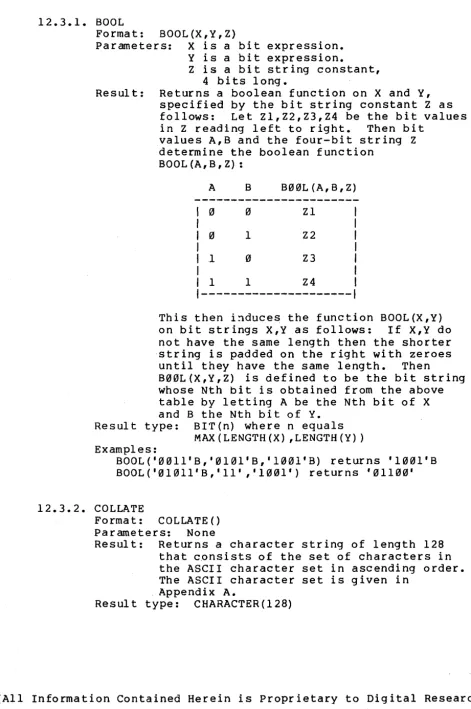
PL/I-80 LANGUAGE MANUAL
Copyright (c) 1980
Digital Research P.O. Box 579 801 Lighthouse Avenue Pacific Grove, CA 93950
(408) 649-3896
~wx 910 360 5001
COPYRIGH"r
Copyright (c) 1980 by Digital Research. All rights
reserved. No part of this o~blication may be
reproduced, transmitted, transcribed, stored 1n a
retrieval system, or translated into any lanquaqe or
computer lanquaqe, in any form or bv any means,
electronic, mechanical, magnetic, optical, chemical,
manual or otherwise, without the prior written
permission of Digital Research, Post Office Box 579, Pacific Grove, California, 93950.
~his manual is, however, tutorial in nature. ~hus, permission is granted to reproduce or abstract the example programs shown in the enclosed figures for
the ourposes of inclusion within the reader~s
programs.
Digital Research makes no representations or
warranties with respect to the contents hereof and
soecifically disclaims any implied warranties of
merchantability or fitness for any particular
putpose. Further, Digital Resea~ch reserves the
right to revise this publication and to make changes
from time to time in the content hereof without
obligation of Digital Research to notify any person of such revision or changes.
Ff1RADF.MARKS
CP/M is a registered trademark of Digital
PL/I-80, ~P/M-80, RM.Ar., ~In, ZSID and
trademarks of Diqital Research.
Research. "rEX are
The "PL!I-80 Languaqe Manual" was prepared using the Digital Research "rEX ~ext formatter.
************************************
*
Second Printing: December 1980*
1. 2. 3. 4. 5. 6. BASIC 1.1. 1.2. 1 .3. 1.4.
TABLE OF CONTENTS
STRUCTURE
The character set • Identifiers.
Constants •
Delimiters and Separators.
PROGRAM STRUCTURE 2.1.
2.2. 2.3. 2 .4 • 2.5. 2.6. 2.7. DATA 3.1. 3.2. 3.3. 3.4. 3.5.
PL/I-80 Statements Groups
Blocks
Scope of Names Block Activation
preprocessor Statements • The Prog ram
ITEMS •
Arithmetic Data
3.1.1. Fixed Binary
3.1.2. Fixed Decimal
3.1.3. Float Binary
3.1.4. Arithmetic Built-in Functions
S t ring Da t a •
3.2.1. Character String Data
3.2.2. Bit String Data
3.2.3. Concatenation
3.2.4. Strinq Built-in Functlons
Control Data Items
3.3.1. Label Data.
3.3.2. Entry Data.
Pointer Data Fi 1 e Da ta •
DATA AGGREGATES
4.1. Arrays
4.2. Structures
4.3. Arrays of Struc tures
DATA ATTRIBUTES AND THE DECLARE STATEMENT 5.1.
5.2.
The Declare Statement • List of Data Attributes
STORAGE MANAGEMENT •
6.1. The STATIC Attribute
6.2. The INITIAL Attribute
6.3. The AUTOMATIC Attribute
6.4. The BASED Attribute.
6.5. The ALLOCATE Statement
6.6. The NULL Built-In Function
6.7. The ADDR Built-In Function
6.8. The FREE Statement
7. ASSIGNMENTS AND EXPRESSIONS
· · · ·
·
·
· · ·
·
·
· ·
36 7.1. Expressions.
.
·
·
·
·
·
·
·
·
·
· · · ·
·
· · ·
·
36 7.1.2. Prefix Expressions·
· · ·
36 7.1.2. Infix Expressions· · · ·
·
· · ·
·
36 7.1.3. Precedence of Operators·
·
· · · ·
·
37 7.1.4. Relational Operators·
· ·
· · ·
·
·
37 7.1.5. Bit String Operators·
· ·
·
·
· ·
·
·
38 7.1.6. Exponentiation· ·
·
·
·
·
· ·
·
38 7.2. Arithmetic Conversions·
·
·
·
·
· ·
38 7.2.1. Ar i thmeti c to Arithmetic Conversions·
39 7.2.2. The FIXED Built-in Function·
· ·
40 7.2.3. The FLOAT Buil t- in Function· · ·
· ·
40 7.2.4. The BINARY Built-in Function·
·
·
·
·
· ·
40 7.2.5. The DECIMAL Built-in Function· · ·
·
·
·
40 7.2.6. The DIVIDE Built-in Function ~·
·
417.3. Str ing Conversions
·
· · ·
·
·
· · · ·
41 7.3.1. Arithmetic to Bit String Conversion 41 7.3.2. Arithmetic to Character Conversion· · ·
·
41 7.3.3. Bit Str ing to Arithmetic Conversion 42 7.3.4. Bit to Character String Conversion· · · ·
42 7.3.5. Character to Ar i thmeti c Conversion·
43 7.3.6. Character to Bit Str ing Conversion· ·
·
·
43 7 • 4 • Pseudo-Var iables·
·
·
·
·
·
·
· · ·
·
·
43 7.4.1. Character SUBSTR·
·
·
·
· · ·
44 7.4.2. Bit SUBSTR·
· · ·
·
· · ·
45 7.4.3. UNSPEC· ·
·
·
· · ·
45 8. SEQUENCE CONTROL STATEMENTS·
· ·
·
·
· ·
·
·
47 8.1. The GO TO Statement·
·
·
·
·
·
· · ·
47 8.2. The IF Statement·
·
· ·
·
· · ·
47 8.3. The Iterative DO Statement·
·
· ·
·
·
·
48 8.4. Condition processing·
·
·
51 8 .5. 'rhe ON statement·
·
·
· · ·
51 8.6. The SIGNAL Statement· ·
·
· · ·
52 8.7. The REVERT Statement·
· ·
· ·
·
528.8. Defaul t ON-Units
·
·
· ·
538.9. Built-In fo'unctions for Condition Processing
·
53 8.10. Procedure Block s·
· ·
· ·
·
·
· · ·
· ·
53 8.11. Invoking a Procedure·
· · · ·
·
· · ·
· · · ·
54 8.12. rfhe Struct ure of a Procedure Definition·
· · ·
54 8.13. The RETURN Statement·
·
·
·
·
·
·
·
·
·
· ·
·
55 8 .14 • The Non-Local GO TO S tat em en t·
·
·
·
56 8. 15. rrhe STOP S ta temen t·
·
·
·
56 8.16. Arguments and Parameters·
· ·
578 .17. The ENTRY Attribute 58
9. INPUT/OUTPUT PROCESSING
· ·
·
·
· ·
·
59 9.1. FILE Data Items.
·
·
·
·
·
59 9.2. File Types.
.
·
·
· ·
·
·
· ·
· ·
599.3. Opening a Fil e
·
·
· ·
6010.
11.
12.
STREAM ORIENTED INPUT/OUTPUT
10.1. LIST-Directed I/O
10.2. The GET LIST Statement 10.3. The PUT LIST Statement
10.4. EDIT-Directed I/O
10.5. The FORMAT-List
10.6. Data Format Items 10.7. Control Format Items 10.8. Remote Format Items 10.9. The FORMAT Statement 1 0 • 10. 'r h e GE TED ITS ta t em en t 10.11. The Purr EDIT Statement 10.12. Line-Directed I/O
10.13. The READ Varying Statement 10.14. The WR I'rE Va ryi ng Statement
RECORD 11.1. 11.2. 11.3. 11.4. 11.5.
ORIENTED INPUT/OUTPUT The READ Statement The WRITE Statement
The READ with KEY Statement
'r heR E AD wit h KE Y11
0 S ta t em en t The WRITE with KEYFROM Statement
BUILT-IN FUNCTIONS. 12.1.
12.2.
12.3.
Arithmetic Functions
12.1.1. ASS
12.1.2. CEIL
12.1.3. DIVIDE
12.1.4. FLOOR
12.1.5. MAX 12.1.6. MIN 12.1.7. MOD
12.1.8. ROUND
12.1.9. SIGN
12.1.10. TRUNC
i~athematica1 Func tions 12.2.1. AC OS
12.2.2. ASIN
12.2.3. ATAN
12.2.4. ATAND
12.2.5. COS
12.2.6. COSO
12.2.7. COSH
12.2.8. EX P
12.2.9. LOG 12.2.10. LOG2 12.2.11. LOG10 12.2.12. SIN 12.2.13. SIND 1 2 • 2 • 14. S IN H 12.2.15. SQRrr 12 .2. 16. TAN 12.2.17. TAND 12.2.18. TANH Str ing Functions
63 64 64 65 65 65 66 67 69 69 69 70 70 70 71 73 73 73 74 74 74 75 75 75 75 76 76 76 76 76 77 77 77 77 78 78 78 78 79 79 79
..
7912.3.1. ROOT.I 82
12.3.2. COLLA'rE 82
12.3.3. INDEX 83
12.3.4. LF.l\1G'rH 83
12.3.5. STTBS'rR 83
12.3.6. TRANSTJATE 83
12.3.7. VERIFY 84
12.4. Conversion Functi.ons 84
12.4.1. ASCII 84
12.4.2. BIl\1A.RY 84
12.4.3. 'BIT 85
12.4.4. CHARAC""ER 85
12.4.5. DRCIMAL 85
12.4.6. nIVIDE 85
12.4.7. 'PIXED 86
12.4.8. FLOAT 86
12.4.9. RANT<' 86
12.4.10. Ul\1SPF.C 86
12.5. Condi t i,on l4'unctions 87
12.5.1. ONCODE 87
12.5.2. Ol\TFILE 87
12.5.3. Ol\TKF.Y 87
12.6. Miscellaneous Functions 87
12.6.1. ADn:R 87
12.6.2. DIMF.:NSION 88
12.6.3. HBOTJNJ) 88
12.6.4. LBOUND 88
12.6.5. LINENO 88
12.6.6. NTTLL 88
12.6.7. PAGENO 88
APPENDIXES
A. rrable of ASrII Codes and Escape Characters 89
B. PL/I-80 Statement~ 90
c.
Data Attribu·tes 96D. Picture Format Item 99
INTRODUCTION
The purpose of the PL/I-SO ~anguage Manual is to provide a
relatively detailed but concise description of the PL/I-SO language
for use by experienced PL/I proqrammers, and to act as a supplement to
the accompanying Digital Research manual entitled "PL/I-SO
Applications Guide." prJ/I-BO is formally based upon the AN~I General
Purpose Subset (Subset G) of PL/I as specified bv the ANS PL/I
Standardization Committee X3Jl. The djfferences between PL/I-BO and
the Subset G specification are as follows:
~he following attributes are not included in PL/I-SO:
DEFINED
FLOAT DF.~IMAL (FIXED DECIMAL is retained) LIKE
PIC"'URE
FILR (allowed onlv in an OPEN statement in PL/I-SO) Asterisk Extents and nynamic Arrays
rrhe following builtin functions are not included in PL/I-SO:
ATANH DA"''E STRING TIME VALID
The %REPLACE statement has been added to PL/I-SO.
I/O facilities for ASCII fi.le processing have been added:
READ and WRITE forms for variable length ASCII records GErr EDIT extended to full record i.nput in A format Control characters are allowed in string constants
The following builtin functions have been added:
ASCII RANK
Throughout this document FL/I-SO statement formats will be
described in their most general forms using the following notational conventions:
Words in capital letters represent PL/I-SO keywords.
Words in lower-case letters or in a combi.nation of lower-case
letters and digits separated by a hyphen will be described or
defined more explicitly. These words represent variable
information to be selected by the user.
Square brackets ([]) enclose options.
Ellipses ( ••• ) indicate that the immediately preceding item may occur once, or any number of times in succession.
Except for the above special characters, all other punctuation and special characters represent the actual occurrrence of those characters.
1. BASIC STRUCTURE
Basic structure consists of the low level organization of the source text of a PL/I-80 proqram. It includes, in addition to a specification of the character set of the language, a specification of the rules governing the structure of identifiers (both keywords and declared names), constants, delimiters, comments, and operators.
1.1. The character set.
The PL/I-80 character set consists of both upper and lower case letters, digits, and special symbols. The special symbols and a brief des: rip t ion 0 f the i r use i s q i ve n below:
=
+
equal or assiqnment pI us sign
minus sign
*
/(
asterisk or multiply symbol slash or divide symbol
)
left parenthesis right parenthesis comma
period
single quote or prime
% percent symbol semicolon
::olon
logi cal .. not" symbol alternative tlnot l' symbol
& ampersand or loqical "and" symbol
logical "or" symbol \ a 1 t ern a t i v e .. 0 r" s ym bo 1
I alternative "or" symbol
>
greater than<
less thanbreak or underscore $' dollar sign
? question mark
1.2. Identifiers.
An identifier is a string of from 1 to 31 characters which are either letters, digits, or the underscore, such that the first character is a letter. In PL/I-80 letters are always represented
internally in upper case, therefore two identifiers which differ only in this respect determine the same identifier. PL/I-80 also allows
the question mark charac ter to be embedded wi thi n id en ti fie rs to allow access to external system entry points which often use this character. In general, embedded question marks should be avoided, however, to maintain upward compatibility with the full language.
Every identifier in the source text of a PL/I-80 program must be either a keyword or a declared name. Keywords are identifiers which have a special meaning in the PL/I-80 language, such as the names of built-in functions, statements, and data attributes (for a complete 1 ist of keywords, see the Appendixes and the .1 PL/I-80 Command
Summary"). Declared names are identifiers whose use or meaning is defined by the programmer in a DECLARE statement (see Chapter 3). A keyword may also occur as a declared name, that is, appear in a declaration as a user defined identifier. In such a case the meaning of such an identi fier in a 'PL/I-80 program will depend on how and where it appears. That is, the meaning is determined contextually.
1.3. Constants.
Constants are text items which, unlike some identifiers, have a fixed literal meaning which cannot change durinq the execution of a PL/I-80 program. The basic PL/I-80 constants are arithmetic constants, character string constants, and bit string constants. Arithmetic constants may be either FIXED BINARY, FLOAT BINARY, or FIXED DECIMAL. For a detailed description of the formats of each type of constant refer to the appropriate section of Chapter 3.
1.4. Delimiters and Separators.
In the source text of a PL/I-80 program it is essential that separate textual items, such as identifiers, be distinguishable. The
t~xtual items which can perform this role are called either delimiters or separators. Generally, delimiters enclose a textual item while separators separate textual items. In PL/I-80 each identifier and arithmetic constant must be preceded and followed by one or more delimiters or separators. Delimiters may be either spaces, operators, comments, or certain graphics delimiters.
Spaces: A space may be either a blank, a tab, or end of 1 ine cha rac ter.
Operators: The four types of operators in PL/I-80 are: Arithmetic operators:
+ addition or prefix plus subtraction or prefix minus
*
multiplication / division**
exponentiation Comparison operators:>
greater than->
not greater than>=
greater than or equal to=
equal to=
not equal to<=
I ess than or equal to<
less than-<
not less than 8i t str ing opera tor s:not
& and
! or I or
The string operator:
! ! or II concatenate
The above operators include so-called composite operators such as
>=.
These composite operators may not be separated by blanks. Comments:
Comments are used to provide documentary statements in a program and have no effect on the execution of the program. A comment may be inserted wherever a delimiter is appropriate. The comment is initiated by the composite pair /* and is terminated by the reverse composite pair */.
Graphics delimiters and separators:
The following special characters may, also function as delimiters or separators. Detailed descriptions of their use is given in an a ppr 0 pr i ate I ate r se c t ion 0 f t his man ua I •
a colon is used as a separator for entry and I abel con stants.
; a semicolon is used to terminate statements. a comma is used to separate elements of a list.
a period is used to separate items in a qualified name. a quote is used as a delimiter for the specification of character and bit string constants.
->
the arrow is used as a separator in a pointer qualified reference.=
an equal is used as a separator in an assignment statement. left parenthesisa right parenthesis together with a left parenthesis is used as a delimiter pair.
2. PROGRAM STRUC'rURE
PL/I-80 is a free format block structured language. The basic program elements are statements which may be collected together into larger program elements called groups and blocks. In the following sections the rules governing the structure of these program elements are described.
2.1. PL/I-80 Statements.
With the exception of the assignment statements consist of an optional label, followed statement body, and terminated by a semicolon. the fo 11 owi ng ca tego r ies:
Str uc t ur al statement s which d efi ne blocks. Declarative sta temen ts whi ch descr ibe data. Executable statements which define action. Null statements which indicate no operation.
statement PL/I-80 by a keyword and Statements fall into
Compound statements \>lhich are a collection of statements used to form a sinqle statement (such as an IF statement).
Assig nrnent statements.
Preprocessor statements which are compile-time instructions.
The specific structure of each type of statement is discussed in an appropriate section of this manual. A complete list of PL/I-80 statement formats and a brief description of their use is given in Appendix B.
2.2. Groups.
A group is a sequence of PL/I-80 statements that begins with a DO-statement and ends with an END statement, and may occur in one of two forms: the iterative DO and the non-iterative DO.
The non-iterative DO has the form:
[label:] DO;
Statement-l
Statement-n END [label];
The iterative DO has the form:
[I abel: ] DO-statement Sta temen t-l
Statement-n END [label];
The following illustrates the use of groups:
first:
do;
1*
non-iterative do */j = Xi
if X
>
0 thendo;
1*
non-iterative do */else
x = z;
z
=
j*
y; end;x = y;
end;
do i
=
I to 10;1*
iterative do*1
a(i)=
i*j;end;
A -further discussion of the DO-statement occurs in Chapter 8.
2 • 3 • B lock s •
A block is a sequence of statements delimited by either BEGIN and END statements (a BEGIN block) , or by PROCEDURE and END statements
(a PROCEDURE block). Blocks may be nested within one another, but are
not allowed to overlap. Blocks are used to delimit the scope of
declared names in a program. A BEGIN block has the following format:
[label:] BEGIN;
Statement-l
.
.
.
Statement-n END [label];
where Statement-l through Statement-n are any PL/I-80 statements constituting the block body. Note that the occurrence of the label option does not automatically add sufficient END statements to cause the block to balance, as found in some full-language implementations. A PROCEDURE block has the following format:
label: PROCEDURE-statement Sta tement-l Statement-n
END [I ab e I] ;
where the label identifies the procedure, and Statement-l through Statement-n are any PL/I-80 statements. Note that the label is optional for the END statement, but if included must match the label which names the procedure.
2.4. Scope of Names.
The scope of a variable refers in general to the extent of its definition in th e program. Variables may be either local, global, or EXTERNAL relative to a block in which they appear. There are two rules concerning the scope of data variables:
The scope of a variable includes the block in which it is declared but not any block outside it. Anytime a variable is declared in a block, it becomes a local variable for that block.
A variable is recognized in any block nested within the block in which it is declared. The variable is global to these nested block s. However, if the same name is declared in a subblock, a new variable is introduced in the subblock and becomes a local variable.
If neither of the above rules is satisfied, the variable is undefined. The program below illustrates the above rules:
pI:
procedure; declare
(a,b) fixed bin(7) ;
a = 2;
1*
a is local to pI */ b = 3; /* b is local to pI */ p2:procedure; declare
(c ,b) fixed bin(7) ;
b = 2;
1*
b is local to p2 */ c = a*b;1*
c is local to p2 */ a = a*b;1*
a = 4 */end p2; put list (a ,b) ; end pI;
This program produces the values 4 and 3. A new variable b is created in block P2 since it is a declared variable in that block. The PUT LIST statement is outside P2, therefore the value of the variable b of PI is 3. Since there is no declaration for the identifier a in P2, the variable a referenced in P2 is the global variable a declared in PI, and its value is changed by the assignment statement in P2. Note that the variable c declared in block P2 is unknown outside the procedure P 2.
Any variable declared as EXTERNAL is known to all blocks in which it is declared as EXTERNAL and in all contained blocks except where it is redeclared without the EXTERNAL attribute. For example,
pI:
procedure; declare
p2:
z fixed binary external;
procedure; declare
p3:
z fixed binary external;
beg in; declare
z fixed binary;
end; end p2; end pI;
The variable z in PI and P2 refer to the same external variable, but variable z in P3 is a local variable and is distinct from the external variable z. Note that due to the linkage editor format, all external names are truncated to the leftmost six characters and therefore long external names should be avoided to prevent conflicts.
2.5. Block Activation.
The essential di fference between a BEGIN block and a PROCEDURE block is the manner in which they are activated and terminated. A B EXiIN block is activated in the no nna I flow 0 f sta temen ts in a prog ram
and is tenninated when its corresIX>nding END statement is encountered or when program control transfers outside the block.
A PROCEDURE or, if it is expression. back to the encountered
block is activated only whe.n invoked by a CALL statement a function procedure, by a function reference in an A procedure block is terminated when control is passed point of call or reference. If a PROCEDURE block is during the normal flow of execution, it is skipped.
2.6. Preprocessor Statements.
PL/I-80 allows source inclusion or modification at compile time through the use of preprocessor statements. Preprocessor statements are identified by a leading % s~bol before the keyword
INCLUDE or REPLACE
The %INCLUDE statement copies PL/I-80 source text from an external CP/M file at compile time. The form of the statement is
%INCLUDE 'fname';
where fname is the name of a CP/M file to copy into the source program. If no drive name is given, the drive containing the source program is assumed. The copied text exactly replaces the % INCLUDE statement, and need not, itself, be a complete statement. Thus, for example, the %INCLUDE statement can be used to fill-out part of a structure declaration or format list. The program segment shown below provides an example:
F:
PROC;
DCL A FIXED;
%INCLUDE 'STRUC.LIS'; DCL C FLOAT;
END F;
directs the PL/I-8~ compiler to include the source text from the file STRUC .LIB at the point of the %INCLUDE statement.
The %REPLACE statement allows textual replacement of constants for defined identifiers throughout the program. The form of the definition is:
%REPLACE rep-name BY constant-exp;
where rep-name is an identifier which, when subsequently encountered by the compiler, is replaced by the constant given by constant-exp. The constant-exp may be any string or arithmetic constant expression. Mul tiple%REPLACE statements can be written as a single %REPLACE statement, where the elements are separated by commas.
Note that the defined names in a %REPLACE statement do not obey the normal scoping rules. Hence, PL/I-80 requires that all %REPLACE statements occur at the outer block level, before any nested inner blocks. Generally, all %REPLACE statements are written directly following the procedure heading in order that they can be easily located. For example,
%REPLACE TRUE BY 'liB;
replaces all occurrences of the rep-name TRUE by the constant bit string 'l'b, so that the statement
DO WH ILE (TRUE); is interpreted by the compiler as
DO WHILE ('l'B);
2.7. The Program.
As stated above, a procedure is a set of statements delimited by the PROCEDURE and END statements. A procedure not nested within another block is called an external procedure. A procedure contained entirely within an encompassing block is called an internal procedure. The source text of a PL/I-80 program may consist of one external procedure which may contain nested internal procedures or blocks. Each external procedure may be separately compiled and linked together to form a PL/I-80 object program. One of the external procedures forming the program must be the main procedure while the remaining procedures may be sub routi ne s 0 r func tion procedure s. The forma t of a
main procedure is: 1 abe 1:
PROCEDURE OPTIONS (MAIN);
Statements or Blocks
END [label];
For further details and examples of program structure and how they may be separately compiled, linked, and loaded, refer to the "PL/I-80 Applications Guide" and the "Link-80 Users Guide."
3. DATA ITEMS
The data items in a PL/I-80 program can be either constants or variables. A constant is a data item whose value cannot change during the execution of a program, while the value of a variable may change during execution. The data items in a program have certain additional properties, such as a range of subscript values, the operations which may be applied, or the amount of storage required. These properties,
called attributes, are assigned to data variables in a DECLARE
statemen t, or in some case s, such a s constants, by system de fa ul ts.
Data variables may represent single data items, or structures or
arrays, referred to as data aggregates. A single data item, either a
variable or constant, is called a scalar. In PL/I-80 there are
essentially six forms of data: arithmetic, string, pointer, label,
entry, and file data. In the following sections each of these data types are described in detail.
3.1. Arithmetic Data.
PL/I-80 supports three types of numeric data: FIXED BINARY,
FLOAT BINARY, and FIXED DECIMAL. Each numeric data item has an
associated precision and scale value, expressed as integer constants p and q enclosed in parentheses. The precision p specifies the number of decimal or binary digits the data item may contain and the scale q specifies the number of digits to the right of the decimal or binary
point. The preclslon and scale of a variable can be explicitly
specified when the variable is declared or implicitly given by default rul es.
3.1.1. Fixed Binary. A variable declared as FIXED BINARY [(p)] is an integer that has p binary digits. The range of p i s :
1
<=
P<=
15Since this data type is internally represented in two's complement
form, the range of a FIXED BINARY number is from -32768 to 32767. Storage allocated to a FIXED BINARY number depends on p. If P
<=
7, then only one byte is allocated to the item. Otherwise two bytes are a 110 cat ed • De fa ul t pre cis ion i s ( 1 5). As s i g n i ng val u e s t 0 FIXE DBINARY variabl es outside the legal range will produce undefined
r esul ts.
A FIXED BINARY constant is written as a decimal integer. Such
constants are considered FIXED BINARY data only if they appear in
contexts which require fixed binary values, such as subscripts or
arithmetic operations involving other FIXED BINARY data. Otherwise
they default to FIXED DECIMAL. Conversion from other types of data normally occurs with truncation (See Chapter 7 for conversion rules). The value 1 is assigned to the variable I, for example, in the following program segment.
DECLARE I FIXED BINARY; 1=1.99;
Declaring a variable as FIXED, BINARY, or FIXED BINARY is equivalent to declaring it as FIXED BINARY (15) •
3.1.2. Fixed Decimal. Except for those numbers used in a FIXED BINARY context, all decimal constants with or without a decimal point default to FIXED DECIMAL. A variable declared as FIXED DECIMAL [(p
[,q] )] is a decimal number with a sign, a total of p decimal digits, with q digits to the right of the deGimal point. T he range r of a FIXED DECIMAL number is:
-10** (p-q)
<
r<
10**(p-q) where:1
<=
P<=
15 ando
<=
q<=
PThe default precision and scale is (7,0). Default precision and scale of decimal constants are determined by the the form of the constants themselves. For example:
3.25 defaults to (3,2) 302 defaults to (3,0)
The internal representation of a decimal number is packed BCD format. A value which has a scale greater than a FIXED DECIMAL variable will be truncated if assigned to the variable. Also if a value which has more significant digits to the left of the decimal point than are specified for the variable is assigned to the variable, then a FIXED OVERFLOW error occurs.
3.1.3. Float Binary. A FLOAT BINARY number has two parts, the fractional part (or mantissa) representing the significant digits of the number, and the exponential part indicating the scale factor. A variable declared as FLOAT BINARY (p) has a sign s, an integer exponent e, and p binary digits representing the fractional part of the number. The range of the magnitude of a FLOAT BINARY number r is approximately
5.88*10**-39
<=
r<=
3.40*10**38Th e r a ng e 0 f p i s :
1
<=
P<=
24 The default precision of p is 24.A FLOAT BINARY constant is written in scientific notation with a sequence of decimal digits with an optional decimal point followed by the upper or lower case letter E, followed by an optionally signed
decimal integer exponent. For example:
A = 2. 3E2;
assigns the value 230 to A. Declaring a variable FLOAT is equivalent to declaring i t FLOAT BINARY.
3.1.4. Arithmetic Built-in Functions.
arithmetic operators, PL/I-80 provides the
built-in functions as part of the language:
ABS ACOS ASIN ATAN BINARY
COSD COSH DECIMAL DIVIDE EXP
FLOOR LOG LOG10 LOG2 MAX
ROUND SIGN SIN SIND SINH
TAND TANH TRUNC
In addition to the
following arithmetic
CEIL COS
FIXED FLOAT
MIN MOD
SQRT TAN
Detailed descriptions of the above buil t- in functions are given in Chapter 12.
3 • 2 • S t ring Data.
There are two types of string data in PL/I-80: character string
data and bit string data. The value of a character string is a
sequence of ASCII characters, including the empty or null sequence,
and the value of a bit st~ing is a non-empty sequence of bits. The length of a string is the number of characters or bits in the string. The rules governing the use of str ing "data are descr ibed below.
3.2.1. Character String Data. CHARACTER(n) is a character string of length between 1 and 254. For example,
A variable n, where n
DECLARE A CHARACTER(10):
declared as is a value
defines the variable A as a character string 10 characters long. If a character string assigned to A is shorter than A, blanks will be used to pad on the right up to the 1 ength 0 f A. If a longer string is
assigned to A, it will be truncated on the right.
Character string constants are written as a sequence of characters enclosed in quotes. If a quote mark is to be included in the string, it is represented as two consecutive quote marks. Thus the string constant whose value is What's Happening? is represented:.
• Wh a t I 's Ha ppe n i ng? I
A null or empty character string is defined by using two consecutive quote marks. The null string has a length of zero.
Character string variables may also have the VARYING attribute which indicates that the variable may represent varying length strings up to a maximum length of n. To illusttate:
DECLARE A CHARACTER(10) VARYING:
defines A to represent any character string value whose length is not greater than 10.
PL/I-80 allows control characters to be included in string constants. In general, the up-arrow character nAn within a string
constant indicates that a control character follows. The high order three bits of the character are masked to zero. Thus, the string 'AM'
or ' ... m' is converted to a carriage-return character. Similarly ''''1' translates to the horizontal tab character. The occurrence of a double n"'" within the string translates to a single ... character.
Note that this use of the up-arrow character is not generally available in the full language, and must be avoided if compatibility is required.
3.2.2. Bit String Data. string data item containing n between 1 and 16.
DECLARE A BIT(3):
A variable ~eclared as BIT(n) is a bit binary digits, where n is a value
defines a~bit string of length 3. Assignments follow the same rules as for character strings, exc~pt that padding takes place with zeroes instead of blanks. Bit string variables may not be given the VARYING
attribute.
8it string constants are written as a sequence of digits 0-9, and letters A-F enclosed in quote marks followed by the letter 8 and optionally followed by a digit in the range from 1 to 4 indicating the number of bits to be used to represent each digit in the sequence.
That is, bit string constants may be written in base 2 (8 or 81
format) , base 4 (82 format) , - base 8 (83 format), or base 16 (84 format). The characters or digits occurring in the sequence must be
valid digits for the base specified by the format. The following
examples illustrate the equivalence of the optional formats to the
base 2 format:
'101'81 is equivalent to '101'8 '101'82 is equivalent to '010001'8 '101'83 is equivalent to '001000001'8 '101'84 is equivalent to '000100000001'8 , 9A'B4 is equivalent to '10011010 18 '77'83 is equivalent to 1111111'8
3.2.3. Concatenation. The infix operator I I or !! can be used to concatenate either bit strings or character strings. 80th operands must be of the same type, which is then the type of the result. The length of the resulting string is always the sum of the lengths of the
operands. For character string concatenation, if either operand has
the VARYING attribute, then the result will have the VARYING
attribute. In the following example
DECLARE
A CHARACTER-(3) ,. 8 CHARACTER(6) ,
C CHARACTER(20) VARYING; A = 'ABC';
8 = 'ABCDEF';
C = A I I B;
the character string 'A8CA8CDEF' of length 9 is assigned to the
variable C.
3.2.4. String 8uilt-in Functions. The following string builtin
functions are included in PL/I-80 and are described in detail in
Chapter 12.
ASCII INDEX UNSPEC
8ITS LENGTH VERIFY
800L
RANK
CHARACTER COLLATE
SUBSTR TRANSLATE
3.3. Control Data Items.
Control data items, as opposed to problem data items, are used to control progr am flow. Identifiers used to label PL/I-80 statements and procedures are examples of control data items.
3.3.1. Label Data. Label data consists of label constants and label variables. A label constant is a label identifier which prefixes an executable statement. A label variable is a variable defined in a DECLARE statement with the LABEL attribute. Assignments of label constants or other label variables may be made to a label variable and follow the same rules as assignments for other types of va r iables.
Both label constants and label variables are subject to the same scope rules as declared names. A label data item is known only within the block in which it is declared explicitly in a DECLARE statement or implicitly by its use as a label constant. In particular, a transfer of control by the use of a GOTO statement is valid only when the target label is known in the block in which the GOTO statenent occurs. Thus transfers of control using GOTO statements and labels are limited to the currently active block or a containing block.
Label constants may be subscripted by a single (optionally signed) integer constant. All occurrences of subscripted labels with the same identifier in a single block constitute an implicit declaration of a constant label array for that block. The occurrence of the same label name within any other block, including a contained block, defines a new declaration local to that block. Any such implicitly defined constant label array is defined only for those subscripts which occur in its corresponding block. Label variables may be explicitly defined to be singly subscripted arrays in a DECLARE statemen t.
The only operators which may be used with label data are the equal and not equal comparison operators.
3.3.2. Entry Data. Entry data items may be either entry constants or variables. The label of a PROCEDURE statement is called an entry constant. Entry constants may be external (identifying an entry point to an external procedure) or internal (identifying an entry point to a nested procedure) • A variable declared as ENTRY VARIABLE is an entry variable which may be assigned entry constants or other entry variable values. As with label data, the only operators used wlth entry data are the equal and not equal comparison operators. Entry variables may also be subscripted. The. followin~ exam·ple shows how en try data i terns are used:
DECLARE
A ENTRY VARIABLE, (X,Y) FLOAT BINARY,
F(3) ENTRY (FLOAT) RETURNS (FLOAT) VARIABLE, ZZ ENTRY(FLOAT) RETURNS(FLOAT);
PI:
P2:
Y=9;
PROC; X=5; END; PROC; X=25; END;
IF Y
=
5 THEN A=
PI; ELSEA
=
P2;CALL A; F(2)
=
ZZ; Y = F(2)(X); PUT LIST(Y);ENTRY data items are discussed further in Chapter 8.
3.4. Pointer Data.
Pointer data is used to address a location in memory. Its value is the address of a variable in the program. A pointer variable is declared in the following manner:
DECLARE X POINTER;
Pointer variables may be assigned other pointer variables, but as with label and entry data the only operators defined for pointer data are
=
and-=.
Certain types of variables must be qualified by pointer data when referencing them. The format of a pointer-qualified reference is:pointer-variable -) based-variable
where pointer-variable points to the address of the based-variable. For example,
•
DECLARE P POINTER;
DECLARE X CHARACTER(2) BASED;
P - ) X = • AA' ;
Pointer data items are also discussed in Chapter
n.
3.5. File Data.
File data items are used to represent informatfon associated with an external device. PL/I-80 uses file constants and variables to access external data sets. A file constant is declared as follows:
DECLARE fname FILE;
where fname is a PL/I identifier assigned to represent the file name. In the case tha t fname is not a parameter, -the file name is automatically taken as EXTERNAL so that it will access the same data set in all modules in which it is declared. Further, note that if no OPEN statement is executed with the TITLE option, the CP/M disk file name d II f n am e • DAT" i sac c esse don the de fa ul t d r i v e •
A file variable is declared as follows: DECLARE fname FILE VARIABLE;
FILE data is presented in more detail in Chapter 9, and in the manual entitled "PL/I-80 Applications Guide."
4. DATA AGGREGATES
In PL/I-80 data items may be grouped together to form arrays or structures. A variable that represents a group of data elements is either an array or a structure variable; and is referred to as a data agg rega tee
4.1. Arrays.
An array is an ordered collection of data items whose elements have the same attributes. An entire array may be referenced by name, or an element of an array may be referenced through the use of integer subscripts. Subscripts denote the relative position of an element in an array. When an array is defined the following properties must be given: the data type of the elements, the dimension of the array, and the extent, or number of elements, in each dimension. The sum of the extents of each dimension of the array determines the total number of elements in the array. The dimension of an array is defined by the use of a d imens ion attr ibute list following the vari able name ina DECLARE statement. A simple dimension attribute list consists of a list of positive integer constants, one for each dimension, specifying the extent of the subscript for that dimension. Each is separated by a comma, with the entire list enclosed in parentheses. For example,
DECLARE A(3,4) CHARACTER (2);
defines an array whose elements are character strings of length 2, whose dimension is two, such that the extent of the first dimension is 3, and the extent of the second dimension is 4. Thus A is an array with 3 rows and 4 columns whose entries are character strings of length two.
The range of values which the subscript corresponding to a particular dimension may assume is normally implied by the extent number for that dimension. In the array A, the row subscripts may range from 1 to 3, while the column subscripts may range from 1 to 4. The range of values may be explicitly defined for the subscripts of a particular dimension by replacing the extent value by a pair of integers in the form m:n, where m represents the lower bound, and n the upper bound for the subscripts for that dimension. The values m and n may be any integer values such that m is not greater than n. For example,
DECLARE B(-2:5,-5:5,5:l0) FIXED BINARY;
defines the array B to be a three dimensional array whose subscripts range from -2 to 5, -5 to 5, and 5 to 10, respectively. The corresponding extents are 8, 11, and 6 respectively. Thus B contains 25 data items of fixed binary type.
The elements of arrays are stored internally in row major order.
An element of an array is referenced by the name of the array followed by a list of subscript expressions separated by commas and enclosed in parentheses whose values specify the position of the element in the array. The subscript expressions must be of FIXED BINARY type and there must be one expression for each dimension of the array. The value of each subscript expression must be in the range defined for the subscript of that dimension.
An array variable may be assigned to another array variable directly, without the use of subscripts, if both array variables are defined with the same data type, dimension, and subscript ranges.
The DIMENSION, HBOUND, and LBOUND built-in functions are provided to access the extent, the upper bound, and the lower bound, respectively, of each dimension of an array. For detailed descriptions of these functions refer to Chapter 12.
4 • 2 • S t r u c t ur e s.
A structure is a hierarchically ordered set of data items. The data items contained in the structure are called its members and are not required to be the same type and may even be arrays or other structures (substructures). The main structure is called the major structure and any substruc ture is called a minor structure.
A structure is defined by specifying a name for the major structure, names and data attributes for its members, together with a level number for each name to define its level in the hierarchical order. Level numbers precede the names and must be separated from them by one or more spaces. The level number of a major structure is always 1. The definitions of each member (including its level number, name, and attributes) must be separated by commas. The level numbers of the members of a minor structure must be greater than the level number of the minor structure. Stucture names may not be given data type attributes, but may be given a dimension attribute (see below) , and EXTERNAL, STATIC, or INITIAL attributes. For example, the definition of a structure for a billing account may appear as follows:
declare 1 bill,
2 name,
3 last nm
3 first nm
3 mid init
2 address,
3 street
3 city
3 state
3 zip
character (20),
character (20),
character (1),
character (20),
character (10),
character (3),
character (5). 2 charge s,
3 shop fix ed dec im a 1 ( 1 0 • 2) ,
3 snkbar fixed decimal (Ira, 2) ,
3 m 1. sc fix ed d ec im a I ( Ira, 2) ,
3 due s fix ed dec im a I ( 1 ra, 2) ;
Since the name of a member of a structure may occur as the name of the member of another structure or as the name of a data item in a substructure of the same structure, ambiguities can arise in referencing the members of structures. These ambiguities arise only in the case that the member names are within a common scope of definition. To resolve such ambiguities, qualified names are used to reference members of structures. In a qualified name the member name is preceded by a list of structure names in ascending order of level number, each followed by a period and zero or more blanks. The only structure names required are those which determine a unique reference to the member name. For example, consider the following structure:
DECLARE 1 A,
2 B,
3 C FIXED,
3 D FIXED,
2 BB,
3 C FIXED,
3 D FIXED;
A reference to item C or D is ambiguous. The qualified names B.C or B.D or BB.C or BB.D uniquely identify the structure elements. Note that the fully qualified names would be:
A.B.C A.B.D A.BB.C
A. BB.D
4.3. Arrays of Structures.
Just as structures may have arrays for its members, arrays of structures may also be defined. An array whose elements are a single type of structure is defined by giving the structure name a dimension attribute when the structure is defined. Similarly, minor structures may be given a dimension attribute. For example,
DECLARE 1 STULIST (10"'), 2 STUNAME.,
3 LASTNM CHARACTER (10) , 3 FIRSTNM CHARACTER (10) , 3 MID IN CHARACTER (1) , 2 SSN CHARACTER (9) ,
2 COUNTRY CHARACTER (10) , 2 GRADES (5) CHARACTER (2) 1
defines an array of structures whose major structure name is STULIST. Each structure element of the array has the array GRADES as a member. To reference an entry in the array, a qualified name is used together with subscripts for the structure names which have a dimension attribute and the member name if it has a dimension attribute. The subscr i pts do not have to appear wi th thei r cor responding name but must occur in parentheses separated by commas and must appear in correct order.
For example, a reference to the 3rd GRADE entry for the 61st entry of the array STULIST may occur in any of the following forms:
STULIST(6l).GRADE(3) STULIST.GRADE(6l,3) STULIST(6l,3) .GRADE
5. DATA ATTRIBUTES AND THE DECLARE STATEMENT
Except for constant data and built-in names, every program data item must be explicitly defined through the use of the DECLARE statement and data attributes. '
5.1. The Declare Sta temen t.
All variable names in a program which are not the names of builtin functions or pseudo varaibles must be defined in a DECLARE statement. File constants and variables must also be defined in a DECLARE statement. Control constants, such as statement labels and procedure names are declared implicitly by their use in a program.
The properties associated to a name which characterize it as a da ta i tern are call ed the at tr ibutes of the name. At tr i butes can be defined implicitly by defaults or explicitly by their specification in a DECLARE statement. The general format of a DECLARE statement is:
DECLAREIDCL [level] name [attribute-list] ••• [, [level] name [attribute-list]];
where: name is the variable identifier, level is a positive integer used in a structure declaration as explained in the previous chapter, and the attribute-list describes the characteristics of the name. If the at t r ibute-1 i st is omi t ted, the at tr ibutes defaul t to FIXED BINARY(15). Examples of DECLARE statements are:
DECLARE A CHARACTER (2) BASED,
DCL
B FIXED BINARY INITIAL (0), C (100) FIXED DECIMAL (5,2);
1 BOOK, 2 TITLE 2 AUTHOR,
3 LASTNM 3 FIRSTNM 2 PUBLISHER
CHAR(20) , CHAR(10) , CHAR (10) , CHAR (20) ;
Examples of simple declarations for each data type and data aggregate are given in Chapter 3 and Chapter 4.
The scope of a declared name is the region of the program in which the name with its associated attributes is known. In general, the occurrence of a name in a DECLARE statement implicitly defines the scope of the declared name to be internal, that is, the block in which the declaration occurs. If a name has the EXTERNAL attribute then its scope includes every block in which it is declared with the EXTERNAL attribute. If a variable is declared with the EXTERNAL attribute, it
must also have the STATIC attribute since the name is associated with a single generation of storage. A name cannot be declared more than once in the same block except as the name of a member of a structure
in such a way that unambiguous references may be made for each
occurrence of the name. A name may not be declared with conflicting attributes in any two blocks in which i t has the EXTERNAL attribute.
In PL/I, for convenience and simplicity, alternate forms of the
DECLARE statement are allowed. First, in general, any sequence of
DECLARE statements of the form:
DECLARE definition-I; DECLARE definition-2;
DECLARE definition-n;
can be written in the equivalent form:
DECLARE definition-I, definition-2, ••• definition-n ;
where each definition item is separated by commas and zero or more
spaces, and the DECLARE statement is terminated by a semicolon.
Moreover, attributes shared by several item definitions can be
factored to the right. That is, a sequence of definitions of the
form:
item-l attr-A, item-2 attr-A, ••• item-n attr-A
can be written in an equivalent factored form:
( item -1, item - 2, ••• item - n ) a t t r - A
Repeated applications of this rule are also allowed. For example,
DECLARE ((A,B) FIXED BINARY, C FLOAT BINARY) STATIC EXTERNAL;
is equivalent to
DECLARE A FIXED BINARY STATIC EXTERNAL, B FIXED BINARY STA'rIC EXTERNAL, C FLOAT BINARY STA'rIC EXTERNAL;
In general, the ordering of attributes is unimportant with the
exception that the dimension l i s t attribute for an array must follow the array name and precede other attributes, and the level numbers for
members of structures must precede the member name. Both attributes
may be factored. Since a dimension list is on the right of the name to which i t applies, i t is factored to the right as above. Since
level numbers precede their member names, they are factored to the
left. A sequence of the form:
level-k item-I, level-k item-2, ••• level-k item-n
is equivalent to the sequence:
I eve l-k (i tern-I, i tem-2, ••• i tem-n) For example,
DECLARE I A BASED, 2 (B FIXED BINARY,C CHARACTER(2»; is equivalent to
DECLARE I A BASED,
2 B FIXED BINARY, 2 C CHARACTER(2); An
as two complete the data compiler
attribute list may not contain conflicting attributes, such data types, or two storage class attributes, but may omit a set of attributes, that is, enough attributes to characterize item. I nth i s cas e , a t t r i bu t e s are sup pI i e d by the P L / I -8 0 according to default rules:
If no attribute is specified FIXED BINARY(15) is assumed. If DECIMAL or BINARY is specified without FIXED or FLOAT FIXED is ass lined.
then
If FIXED or FLOAT is specified without BINARY or DECIMAL then BINARY is assumed.
If no precision is specified for FIXED BINARY, FIXED BINARY(15) is assumed.
If no preC1Slon is specified for FIXED DECIMAL, FIXED DECIMAL(7,0) is assumed.
If no preclslon for FLOAT BINARY is specfied then FLOAT BIN ARY ( 24 ) i s ass urn ed •
5.2. List of Data Attributes.
The following paragraphs give the possible attributes with which program data may be associated. Abbreviations of attributes are included. Full details of the attributes are discussed in their relevant sections.
ALIGNED is a data attribute which normally forces storage boundary alignment of a variable. It has no effect in PL/I-80. AUTOMATIC is a storage class attribute which specifies that storage is allocated to the variable upon activation of the block containing the declaration. In PL/I-80, automatic storage is statically allocated, except for recursion.
BASED or BASED(p) or BASED(q(» is a storage class attribute
which specifies that allocation for a variable is user-controlled. In this case, p is a pointer variable, and q is a pointer valued function.
BINARY or BINARY (p) and BIN or BIN (p) define a BINARY variable with precision p.
BIT (n) defines a bit string of length n.
BUILTIN specifies that the name being declared is one of the built-in functions of the language. If a builtin function name is redefined in any block, then in order to reference the builtin function in a contained block, the builtin function name must be redeclared with the above attribute in the contained block.
CHARACTER (n) and CHAR (n) define a character string of length
n.
DECIMAL [(p [,q])] and DEC [(p [,q])] define a DECIMAL number with precision (p,q). If q is not specified it is assumed to be zero. The default precision is (7,0).
ENTRY [(att-l,att-2, ••• ,att-n)] defines ENTRY values. In the above , at t -1 to at t - n i s the at t r ib ute 1 is t 0 f the pa ram e t e r s
as given in the PROCEDURE definitions of the entry values.
ENVIRONMENT (options) or ENV (options) define fixed and variable length RECORD files where options may be one of the following:
F{lrecl) B(lbuff) F(lrecl) ,B{lbuff)
The expression lrecl is the record length of a fixed length record file, and lbuff is the system buffer size.
EXTERNAL or EXT define the scope of the declared item to be EXTERNAL. That is the item is known in all blocks which declared it as EXTERNAL.
FILE defines file data. Chapter 10.
File attributes are discussed in
FIXE 0 [ (p [ , q] ) ] de fin e s fix e d - po i n t a r it hm e tic d a t a o f precision (p,q).
FLOAT [(p)] defines floating point arithmetic data of precision p.
INITIAL (value-list) and INIT (value-list) causes initial values to be assigned to a STATIC variable prior to program execution. The value-list is a list of constants, separated by commas, which can be converted to the variable type being initialized. Any constant in the list may be preceded by a repetition factor
in parentheses.
LABEL defines a LABEL variable, and POINTER defines a POINTER variable.
RETURNS (attribute-list» is given with the ENTRY attribute to describe the attribute-list of the value returned by a function. STATIC is a storage class attribute that causes storage to be allocated prior to program execution.
VARIABLE is used with the FILE or ENTRY attributes to define the item as a variable and not a FILE or ENTRY constant.
VARYING and VAR define varying length character strings.
6. STORAGE MANAGEMENT
PL/I allows control over the allocation of storage for data
are as. S to r ag e may be s tat i call y all 0 cat ed at c omp i 1 e- tim e, 0 r
dynamically during program execution. Dynamically allocated storage
may be subsequently released for re-use. Every variable in a program has a storage class attrib.lte. The storage class determines how and
when storage is allocated for a variable. PL/I-80 includes three
different storage classes:
STATIC AUTOMATIC
BASED
In order to improve internal addressing mechanisms, AUTOMATIC storage is treated in the same way as STATIC storage, except in procedures
which are marked as RECURSIVE. Storage class attributes are
properties of elements, arrays, and major structure variables. These
attributes cannot be given to entry names, file names, or members of da ta agg rega te s.
6.1. The STATIC Attribute.
A variable declared with the STATIC attribute is allocated prior to execution of the main procedure. The variables belonging to this
storage class may have their data values initialized. The STATIC
attribute is illustrated in the following declarations:
DECLARE A FIXED STATIC;
DECLARE B(100) CHAR(2) STATIC; DECLARE 1 C STATIC,
2 D CHAR(10) , 2 E FIXED;
6.2. The INITIAL Attribute.
The INITIAL attribute is used to give initial constant values to
data items upon storage allocation. This initialized data becomes a
part of the program module which is loaded when the program begins execution. The form of the INITIAL attribute is:
INITIAL I INIT (value [,value1 ••• ) where the initializing value is of the form:
(iteration-factor)] constant-exp
The iteration-factor is a literal constant repeat count, which
duplicates the constant-exp value an integral number of times. The
constant-exp must be a literal constant value which is compatible with
the data type being initialized, consisting of an optionally signed
arithmetic constant, string constant, or NULL pointer value. Array
data items can be initialized with a single statement which, in this case, begins with the first element of the array, and continues in row major order until the end of the set of initialized constants, which must not exceed the size of the initialized array. structure members
must be individually initialized. Assignments of constants to
variables follow the rules for assignment statements. Thus, blank
padding occurs on the right when a shorter string is assigned to a
longer string variable, for example. Finally, only STATIC variables
can have the INITIAL attribute in order to be compatible with the full language. Examples of the INITIAL attribute are shown below.
DECLARE A FIXED BINARY STATIC INITIAL (0);
DECLARE B(8) CHARACTER (2) INITIAL «8) 'AB') STATIC; DECLARE
1 FCB STATIC,
2 FCBDRIVE FIXED(7) INITIAL (0) , 2 FCBNAME CHAR (8) INITIAL ( , EMP' ) ,
2 FCBTYPE CHAR (3) INITIAL('DAT'),
2 FCBEXT BIT(8) INITIAL('00'B4),
2 F C B FI L L ( I 9) BIT (8 ) ;
6.3. The AUTOMATIC Attribute.
Normally, the AUTOMATIC attribute forces data storage allocation
upon entry to the PROCEDURE or BEGIN block in which the variable
appears. In PL/I-80, AUTOMATIC storage is statically allocated to
improve variable addressing and execution speed. One exception is in the presence of recursion, where the AUTOMATIC variables must use the
dynamic storage mechanism to prevent data overwrite on recursive
calls. Note that the default storage class attribute for a variable not declared STATIC or BASED is AUTOMATIC, unless otherwise stated.
6.4. The BASED Attribute.
A variable declared with the BASED attribute is given storage
explicitly through the ALLOCATE statement. Whenever a BASED variable
is allocated, a corresponding PO INTER va r iable is set to the add ress of the allocated BASED variable. The format for the BASED attribute is:
BASED [(pointer-ref)]