456
SPACE-EFFICIENT AND ACCURATE FORWARDING LOOP
DETECTION METHOD USING BLOOM-FILTER FOR FAST
AND RELIABLE INTERNET ROUTING
GHADAH ALDABBAGH1, HALABI HASBULLAH2, KARAN VERMA2, OMAIMAH BAMASAK1
1
Dept. of Comp. Science, Faculty of Computing & IT, King Abdulaziz Univ., Saudi Arabia
2
Dept. of Computer & Information Sciences, Universiti Teknologi PETRONAS, Malaysia
E-mail: [email protected], [email protected], [email protected],
ABSTRACT
Link or router node failure in a network of Internet is a typical cause of traffic congestion due to the developed forwarding loop at the router. This failure has a significant impact on Internet performance, contributed from the inability of the affected router to find alternative link/route in fast manner and from the high probability of packet dropping during the attempt of re-routing. The existing Internet approach in handling this issue is to use TTL (time-to-live) of TCP/IP, by which a packet will be dropped whenever the TTL timer expires. However, this approach was found inefficient due to long convergence period. Hence, the effort now is to develop a faster re-routing mechanism, by reducing the possibility of forwarding loop incidents for any cases of link/node failures, whilst minimizing packet losses during the convergence period. This work proposes a novel detection method for possible forwarding loop incidents at a router with support of Bloom-filter. Bloom-filter is a probabilistic data structure that helps to ensure the availability of an item in a set, which never lead to false negative results, but may produce false positive results. With this Bloom-filter-based method, link’s or node’s failure information is attached at the packet header of a packet in a space-efficient manner and to accurately detect for possible incidents of forwarding loop when the packet is traversing through its route from source to destination. If the possibility can be more accurately detected, then packets losses can be minimized to very least during the convergence period and hence, fast and reliable routing shall be achieved. Through simulations, it was found that the proposed method of
BF-k/2 has outperformed the other re-routing methods. It has not only efficiently used the limited space of the
packet header, but also adaptively reducing the false positive probabilities for reliable routing.
Keywords:Internet, Link/Node Failure, Forwarding Loop, Bloom-Filter.
1. INTRODUCTION
For many reasons, a link or a router node in the network of Internet may fail at any point of time, leading to network unavailability, temporarily or permanently. The failure of network links or router nodes can disrupt Internet traffic for long periods of time, and leading to severe traffic congestion [1]. Traffic congestion at a router may arise not only from hardware failures and malicious traffics (such as DoS attacks), but also from legitimate usage spikes, e.g. flash crowds. One reason for traffic congestion is due to forwarding loop for a packet at a router, where a number of attempts were being made by a router to find an alternative link (and ultimately an alternative route), when the next outgoing link for the said packet is failed, or the router node itself is failed [17, 21]. If the network failure is caused by a router node, then
the previous router node on that link may experience congestion due to the fact that the expected link for a packet toward the failed router node is now cannot be used to forward any packets. In either cases, the result is that a packet intended for a destination will keep looping at the router trying to find an outgoing link, until finally the packet may be discarded after a number of tries, ruled by the TTL (time-to-live) timer. If congestion has happened, the Internet-based service offerings will not be available to users, and thus not reliable for the users to use.
457 packets lost during its convergence period. Convergence period is defined as the time taken from the moment when the failure is detected to the moment when the alternative link/route is found [19]. Simply, congestion is the result of packet looping whenever a packet cannot be forwarded through its outgoing link [22, 27]. At the same time, other packets from different routers have arrived at the affected router, and leading to even worst traffic congestion scenario, with some packets sent from a source to an intended destination must be dropped when the TTL timer has expired. Therefore, congestion affects the performance of the router, and ultimately to the overall Internet performance. As a result, from user point of view, the Internet is considered as ‘unreliable’, as it has failed to provide the demanded services. This may lead to a conclusion that the Internet cannot be fully adopted as a universal communication infrastructure. However, the existing Internet method of providing solution to the traffic congestion problem, and hence the problem of forwarding loop/packet looping, by using the TTL approach is inefficient due to long convergence period and high packet losses.
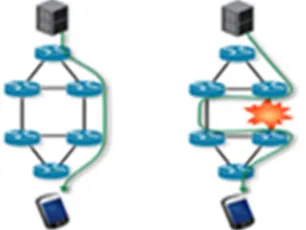
[image:2.612.116.269.527.642.2]To overcome the problem of link/node failures, and the subsequent problem of forwarding loop/packet looping at a router, a number of new re-routing protocols were proposed. This allows emergency re-routing of traffic flows in case of failure of link or router node, as depicted in Figure 1, to be performed. This helps traffic to continue reaching its destination from the point where the failure is detected, until the inter-domain routing algorithm re-converges to a solution that bypasses the affected link or router node.
Figure 1: A Re-Routing Technique For Routing Reliability
In this research work, a general solution is proposed that addresses this reliability problem with the anticipation that it will lead to a better
performing communication infrastructure of
Internet. The proposed approach is based on a layered set of interventions aimed to increase reliability at each level of abstraction: network links, network routes, and application services [2, 18]. With this approach, a packet is expected to be sent and received reliably over the Internet. However, the focus of this work is to seek solution at the network-link level only, which is an inter-domain links, rather than at sources-destinations
level. With this focused method, further
advancement in the representation and
dissemination of link’s and node’s failure information are needed to be developed. With that motivation, this research objective can be understood as seeking the answer to the following two general questions: how can probabilistic data structure be used to detect forwarding loop/packet looping incidents in a space-efficient and fast manner?; and how can the forwarding loop/packet looping detection results be more accurate?
In summary, from the network-link level abstraction, developing a space-efficient and a highly accurate detection method for incidents of forwarding loop/packet looping is proposed to resolve the problem of traffic congestion at a router node. Based on the review of literature, it was found that there are opportunities to research further on a more efficient and fast method of carrying failure information in the packet header of a packet, while providing routing reliability with the use of Bloom-filter [12, 28]. Based on the identified problems and the capability of Bloom-filter, the following research questions have now been developed:
a) How can failure information be carried in
the packet header of a packet in a space-efficient manner, which can be used to detect the possibility of forwarding loop/packet looping incidents at a router node in a fast manner?
b) How can forwarding loop/packet looping
incidents be detected as accurate as possible, in order to minimize the convergence period to a very minimal, or to eliminate it if possible?
By solving this reliability problem, Internet can be expected to satisfy the demands of user’s requirements, which is getting more stringent day by day.
458 other in a task of routing for sending data packets from a source to a destination. In achieving this aim and based on the research questions mentioned above, the followings are the specific objectives of this research work:
a) To exploit the storing and checking
capability of Bloom-filter set membership data structure to carry failure information in the limited packet header’s storage space in a space-efficient manner, and to detect for possible incidents of forwarding loop/packet looping at a router node at earliest possible.
b) To exploit the probabilistic capability of
Bloom-filter to obtain as accurate as possible the detection of forwarding loop/packet looping incidents at a router, so that packet dropping can be reduced, or eliminated, and hence convergence-free re-routing can be achieved.
2. RELATED WORK
Even after decades of development, the Internet still suffers from reliability problems, which is referring to the inability of the network to efficiently find alternative link/route due to congestion without packet lost during its convergence period. However, if the failure recovery is solely left to the routing algorithm only, such as only relying on the TTL timer, then there can be severe data losses during its long convergence period. Hence, there is a serious need to develop new method of fast and reliable re-routing approach, by which the complete information about the network topology for re-routing decision shall no longer be carried along with the packet that traversing the network. Instead, to support applications that cannot cope with this extra delay during the convergence period, researchers have proposed forwarding plane resilience mechanisms for fast and reliable re-routing task. It is implemented at router level with only requiring minimum network resources, and thus lowest possible processing overhead. One of the most significant proposals is [29], which operates by transforming topology uncertainty (due to node and link failures) into traffic volume uncertainty (due to forwarding loop). Then, a re-routing scheme is developed to find efficient alternative link from the affected router that works for a traffic congestion case and with a given set of failure scenarios.
There are ways to explore alternative links in case of link or router node failures with much reduced resource requirements. Work by [30] showed that full failure recovery can be achieved by supplying negligible failure information in packets that are traversing from source to destination and with small extension to forwarding table. This research work also improved the state-of-the-art in forwarding plane full failure recovery by investigating polynomial-time algorithms to decompose the network into an appropriate basis of oriented cycles, which can then be used to implement emergency forwarding tables in routers. However, they have been purely implemented on off-line calculation basis, which the result is late-produced and may be not as accurate as needed.
It is interesting to observe from literature that many network solutions have reduced data processing times and networking costs by exploiting some probabilistic methods. Bloom-filter (BF) is one of the methods, which was conceived by Burton Bloom in 1970 [1]. BF is a probabilistic data structure that helps to ensure the availability of an item in a set.This data structure is used to execute member queries that never leads to false negative, but may be to false positive. An important operation of a BF includes membership testing and adding elements to a set. It is widely used in many applications, like peer-to-peer networking, databases, packet routing, resource allocation, and applications like spell checkers [5,
6]. In a routing task, BF may be used at each edge
router node to filter incoming packets and to forward them to the downstream router nodes when meeting a set of specified conditions. When a packet is received by a router, the destination address in the packet is compared to a masked BF at the router, and then forwarded to matching interfaces. To implement this approach, a global level map is required, which was managed by a server in the network. In this approach, faster processing is achieved as the router does not store individual addresses, and hence the complete topology, but only in the masked-BF form [28]. However, the states of the global map must be updated instantaneously with each individual router in the network to reflect the current topology of the network. That is to say, the masked-BF of all the routers in the network must always be in synchronism with the global map.
Bloom-filter , , … . , is anm
-bit of array that represents an element set of
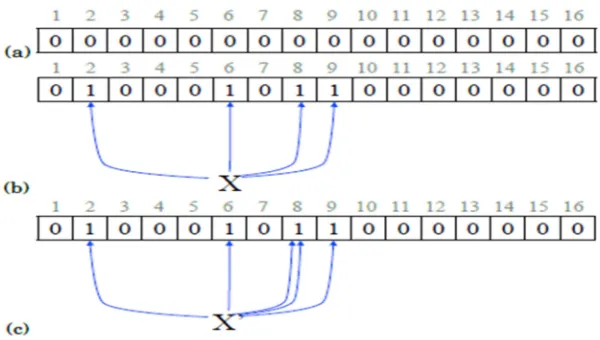
459 into the BF by computing a set of array positions in the BF that are set to 1, as shown in Figure 2(b). The presence of an element is tested by checking if those array positions are set to 1. This means that new elements can always be inserted into a BF, but no elements can be deleted. With this testing capability, false positives are always possible, i.e. a membership test can return positive even if the element has not been added to the BF. However,
false negatives are not possible to occur 1, 9].
Each element e is represented with k positions
in the array. For example, k separate hash functions
can be used to compute k array positions, each hash
function giving output [0, m-1]. The element can
be encoded as an m-bit long vector, in which the
array positions denoted by the k hash values are set
to 1, as shown in Figure 2(b). Two hash values in BF can collide, as shown in Figure 2(c), which the collision may indicate that an event has been detected. In relation to this, it is interesting to know of whether or not an incident of forwarding loop or packet looping has occurred at a router node. For example, if a set of excerpt queries is being performed for a number of attempts to find alternative links, but the results are always failed (due to collisions in the BF), this would in turn confirm that forwarding loop or packet looping has
actually occurred at the router.As the figure shows,
k = 5 hash values are inserted into the BF, but only
3 array positions are marked to 1 without collision, but collision has happened at position 8 in the array.
Figure 2: (A) Empty Bloom-Filter (B) X Is Added To Bloom-Filter By Setting The Hash Value Array Positions To 1, K = 4. (C) Shows A Hash Collision With Two Hashes For Element X’ Both Yield Position 8, K = 5.
An element can be added onto a BF by bitwise
ORing the element’s m-bit vector together with the
BF. The presence of an element is tested by checking if the k array positions are set to 1. This
can be efficiently done with ∈ ∶ ⋀ ,
where m is the Bloom-filter and e the tested
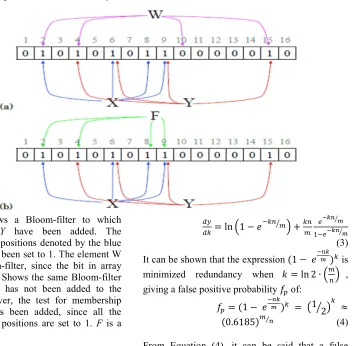
element in m-bit long form. Figure 3(a) shows a BF
after elements X and Y have been added to it. The
membership of an element, such as W, is tested by
checking if each array position set to 1 in W is also
set to 1 in the BF. The membership testing for W
shows that W is not a member in the filter, since the bit in array position 10 is set to 0. When an element has not been added to the BF, but the array positions of the element are set to 1, a false positive happens. As an example, Figure 3(b) shows a false
positive. Only two elements, X and Y, have been
added to the BF. F is denoted by the array positions
{2, 4, 8, 9}, which have all been set to 1 due to X
and Y. Hence, membership testing will indicate that
F is in the BF, while it has, in fact, not been added.
Following the membership checking capability of the BF, which may lead to false positive results as discussed earlier, then there is question of what is the chance of that false positive results to happen for any checking instances. This can be expressed as false positive probability (FPP), which is the probability that a membership test for an element will return true for an element not added to the BF.
Element count of original data set | |, and count of
hash functions | | used to calculate the BF are the
factors that determines the false positive
probability.
[image:4.612.150.450.296.466.2]460
positives. A BF representing set , … . . ,
of n elements is described by an array of m-bits;
initially, all are set to 0. It uses a k independent
hash function , … . . , with a range of 1 – !.
When a given hash function " is applied to input
#", the result is a value between 1 and . Since hash functions are uniform, the probability that this
result is equal to a particular number is 1/ .
Therefore, the probability of the bit at position
being 1 after one hash function is 1/ , and the
probability that it is 0 is (1% 1/ ). The probability
that it is 0 after all & hash functions are applied
is '1 % 1( ) . Since there are n elements in the set,
the probability that bit is equal to 0 (after
processing all * elements) is '1 % 1( ) .
Figure 3: (a) Shows a Bloom-filter to which
elements X and Y have been added. The
corresponding array positions denoted by the blue and red arrows have been set to 1. The element W is not in the Bloom-filter, since the bit in array position 10 is 0. (b) Shows the same Bloom-filter
and element F that has not been added to the
Bloom-filter. However, the test for membership
indicates that F has been added, since all the
corresponding array positions are set to 1. F is a false positive.
Hence, +1 % '1 % 1( ) , is the probability
that a given bit is set to 1 after all input elements
, , … … . , are processed as depicted by Figure 3. Since least false positive probability is
desired, the probability for an arbitrary input - and
corresponding & bits are 1 without - belonging to the set is needed. This false positive probability is:
./ 1 % 1 % (1)
Similarly, equation (1) can be expressed as;
0 11 % 23456 7 +& ln +1 % ( ,, (2)
Finally, equations (1) and (2) are combined,
:;
: ln +1 % ( , <
=234 5(
=234 5( (3)
It can be shown that the expression 1 % 2435 is
minimized redundancy when & ln 2 ∙ + , ,
giving a false positive probability ./ of:
./ 1 %
243
5 '1 2( ) 0
0.6185 ⁄ (4)
From Equation (4), it can be said that a false positive probability fp depends on & and the ratio &/ . When the probability that some bits are 0,
then '1 % 1( ). Using the & function and
* elements in the BF, there is a need to set bits from -bits as 1 for &* times. Therefore, after * elements are stored, the probability that the bits are
still 0./D can be expressed as:
./D +1 % , 0 ( (5)
[image:5.612.174.528.186.532.2]461
./E &* '1 % 1( )'1 % 1( ) (6)
Hence, the probability that &( bits is in collision
free region is given by '1 % ./4).
With this derivation, it is said that Bloom-filter that used k hash function, i.e. (n+1)k is called
BF-k. The hash addresses of the elements in the set
and one element that being looked up should be independent to each other. Filtration is essential for the operation of Internet networks. Most of the well-known approaches to filtration for Internet focus on achieving high filtration accuracy for the entire network without addressing the detection of forwarding loop incidents. The BF of the bit vector representing an element is constructed by applying a fixed number of hash functions to the element. In other words, all of the bit-vectors that represent elements are constructed using the same number of hash functions. Varying the number of used hash functions has been proposed in the context of BF forwarding [12, 17]. These proposals are motivated by varying false positive rate in network nodes of different degrees: if the same values of are used at a low degree node and a high degree node, the false positive forwarding rate of the high degree node is greater.
Now, BF with its hash functions has been extended to detect the possible forwarding loop/packet looping incidents at a router node. BF has been proposed and used to construct a hash table that records TCP/UDP data flows with limited storage cost at the packet header of a packet.
Therefore, there is a chance to solve the issue of traffic congestion (caused by forwarding loop and packet looping) at a router node, by exploiting the limited storage space of the packet header of a packet that traverses over the network and passes through the router to its intended destination. With the use of BF and its variant, and the existence of a global map of the network, this is achievable where only encoded entry/access checking is required to detect the present of forwarding loop/packet looping incidents. Additionally, the detection accuracy for any incident can be improved when the false positive probability of BF is enhanced, which shall lead to a fewer packet losses for any traffic congestion scenario. All these are the aims in providing a fast and reliable Internet infrastructure.
3. METHODOLOGY
It is important to highlight that in this work, the focus of investigation will be on two points related to routing capability: 1) how to make use of the limited storage space in the packet header in carrying failure information of the links and router nodes, and 2) how to accurately detect for possible incidents of forwarding loop/packet looping at a router node. Therefore, it is not so much on the routing task itself; instead, they are the needed supporting components for fast and reliable routing.
The specific method in detecting forwarding loop/packet looping incidents at a router node is by attaching failure information at the packet header of a packet that is traversing from a source node to a destination node in the network of Internet, with the help of Bloom-filter. Additionally, the BF will also be used to accurately detecting these incidents, such that a lower packets dropping is achieved. As a platform for improvement, a previous work by [28] will be used as the basis for developing a convergence-free forwarding/routing scheme.
Based on this, the improvement will be made on the carrying capacity of the packet header to carry a ‘representative’ of the failure information
in a space-efficient manner. The failure
information will consist of two basic facts: 1) probability of forwarding loop/packet looping incidents at a router, and 2) false positive probability that each link from that affected router is associated with. However, the complete information of these two is only available in the global map, which is managed by an appointed server in the network, and not at each the individual router. All the routers in the network will compute locally these probability values, and updates synchronously with the global map, together with the latest state of the network topology. Each router node will have a masked BF, which the BF will only use encoded-bits to check the existence and status of the information in on-line fashion, thus providing fast detection mechanism with least overhead. Simply, with BF and its encoded entry/access to the complete
information, the detection of forwarding
462 stored information, which they are now in statistical forms. Additionally, previously off-line computation was performed, leading to processing overhead at a router and delay in routing, while the proposed method will be able to perform on-line computation. Furthermore, accuracy in detecting any incidents of forwarding loop or packet looping shall lead to better performing Internet by reducing packets losses during its convergence period. The BF capability is again will be used to decrease the probability of false positive. The ultimate goal is
to provide a convergence-free re-routing
mechanism, thus reliable Internet services are obtained.
The only difference in the BF-k is that the incorrect deletion of a false positive item is undetectable, while the incorrect deletion of a multi-address item is detectable in advance. The problem is that when performing lookup for an element, this only has the element identifier and will have to try all set IDs to see if any of them is encoded in the filter. The number of different set IDs is in thousands, causing huge lookup overhead. So that to overcome such space cases of the hashing schemes, where the addressing spaces will
be halved and then abolished is called BF-k/2.The
space advantages are more difficult to sum up; again it depends on the error rate that is to be tolerated. It also depends on the potential range of the elements to be inserted; if it is very limited, a deterministic bit vector can do better. If the number of elements to be inserted cannot be estimated, it is better to use hash table or a scalable Bloom filter.
The proper management of Internet is a challenging task due to the mobility of nodes and their velocity as all devices work on open channels. These are very challenging security tasks since all of these characteristics markedly increase the possibility of threats and attacks [10]. There are three challenges for space efficient and detecting the attack traffic. First, accurate rules are needed to distinguish the attack model from the legitimate so that legitimate can still reach the victim while the attack is being space efficient functioned. Second, the attack model should use an intrinsic feature of the attack; otherwise the HBF mechanism will be evaded by a simple change of attack signature. Third, the space efficient rule must be simple (not complicated) and the HBF process should be computationally efficient, otherwise the HBF process will not be effective. Consequently, most detection schemes
developed for Internet assume high numbers of available nodes within the network that act as intermediates [8]. The basic assumption for all schemes is that there is a limited number of attack paths, and not all legitimate shares a path with the
attack. Without confidence in accurately
differentiating attack from legitimate at a single location; all schemes try to detect attack paths based on space and HBF detection mechanisms.
A BF-k/2 is a simple space-efficient
randomized data structure representing a set that supports membership queries. Its space efficiency is achieved at the cost of a small probability of false positives. A BF representing set
, … . . , of n elements is described by an array of m-bits; initially, all are set to 0. It uses a k
independent hash function , … . . , with a range
of 1– !. Here, it is assumed that hash functions
are perfectly random (Golle et al. 2001). For each
element ∈ , bits " are set to 1 for 1 F G F
& ; checking to see equation 6.
It has been found that the value of k that
minimizes the false positive probability of a single
BF-k (i.e. 1 % 2435 ) also minimizes BF % k/2
approximately up to five decimal places based on our empirical results. Hence, the number of hash
functions is set to 1 % 2435 in the BF-k/2
scheme, and the % &/2 '1 2( ) 0
0.6185 ⁄ . The value of BF % k/2 as the ratio of varies from 1 to 10. It can be shown that
when 5, it is about 0.16. When 10 drops
to 0.016 only. (Note that when 5 and
when 10 , the false positive rates of BFICK
are 0.39 and 0.15 respectively). If the nodes independently chose the k, each node could set the value so high that the average number of false positive is less than the one and packet storms are avoided. If internet router use globally decided values for generating forwarding hop identifies,
the BF-k/2 forwarding scheme uses global k.
3.1 Improving space efficiency
463 proven that BF is not space optimal [3]. Therefore, the aim for space efficiency is that it should reduce the number of bits it takes to encode (represent) each member and its set ID, particularly in checking for the failure information. This is extremely important if the data structures are placed in on-die static random-access memory (SRAM). It should reduce the number of memory entries/accesses onto the SRAM on a per-packet basis in a router. Additionally, possibly the idea for space efficiency can be implemented with the use of large and sparse BF at the sender/receiver, and compress/decompress the filter before/after transmission.
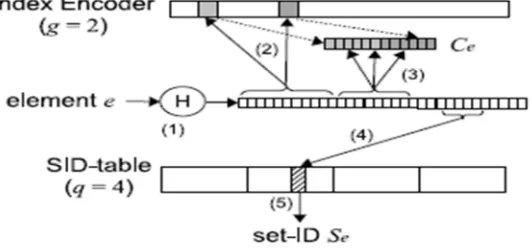
To reduce the number of bits needed per entry/access, it should encode each entry/access just once, capturing both the member identifier and the set ID, i.e. (e, Se). However, the problem is that when performing a lookup for an element, this only has the element identifier and will have to try all set IDs to see if any of them is encoded in the filter. The number of different set IDs is in thousands, causing huge lookup overhead. The target is to create indirection in the lookup process, by separating the membership encoding and the set
ID storage in two data structures, called the
index-encoder and set-id table (abbreviated as SID-table),
respectively. In the index-encoder, it encodes the
membership of a member, as well as a small index that points out where to find the right set ID in the
SID-table. This index may take a few different values (e.g., from 1 to 10).
The lookup process consists of two steps: given a member identifier, the first step tests whether the member is a member and checks few index values (instead of the set IDs in the thousands) to see which one is encoded in the
index-encoder. Using the right index, the second step finds out where to fetch the set ID from the
SID-table. In order to support efficient lookup, it
encodes the primary index K in the index-encoder
by two steps: 1) it hashes the member identifier
to a number L of blocks in the index-encoder,
where L may be one or a small integer. It will then
fetch these blocks to the processor. They can be
logically thought of as a small BF, denoted as M ,
now residing in the processor for encoding a; 2) it
hashes a (together with ) to &′ bits in M and sets
them to 1. The sequence in executing the encoding
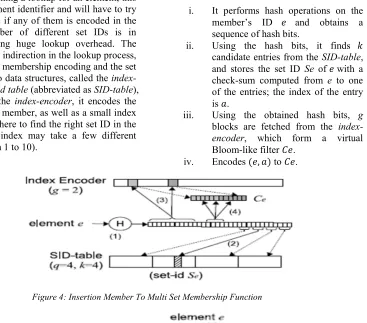
processes is shown as the following, and is depicted in Figure 4 and Figure 5.
i. It performs hash operations on the
member’s ID and obtains a
sequence of hash bits.
ii. Using the hash bits, it finds &
candidate entries from the SID-table,
and stores the set ID Se of with a
check-sum computed from e to one
of the entries; the index of the entry is K.
iii. Using the obtained hash bits, g
blocks are fetched from the
index-encoder, which form a virtual
Bloom-like filter M .
iv. Encodes , K to M .
[image:8.612.159.526.317.640.2]Figure 4: Insertion Member To Multi Set Membership Function
464 The effect of the above candidate-to-right policy (in one place only store only one bits, mean corresponding bits are checked, if all bits are equal to 0 or 1 then it can be said that the element belongs to the set, then a false positive is returned. It also avoids collision within space efficient data structure) may be amplified by allowing more than one value in one position. As shown in Figure 6, it
follows the steps to determine the set ID. First, it
generates a sequence of hash bits using element .
Using the hash bits, it locates and fetches L blocks
in the index-encoder, i.e. to the processor. The
processor has & units that test, in parallel, whether any candidate index G is encoded, for 1 F G F &. Each unit hashes G to the &′ bits in M and checks
[image:9.612.178.443.205.329.2]whether all the bits are 1s. If so, i is encoded in M .
Figure 6: Looking Up A Member
An important factor from using this highly space-efficient (reduced) data structures scheme is that the size of the filter does not linearly dependent on the number of elements inserted. Once the BF is sufficiently saturated, it can save a copy of the filter and start afresh with a new one. Using this technique, the limited storage space at the packet header is expected to efficiently store the least requested information, but has the capability to compute the complete information at a router node in on-line fashion, leading to fast decisions being made at a router.
Hence, BF-k scheme needs improvement
packet header overhead. We can reduce the two independent hash function requirement of the double hashing technique to a single hash computation based on e.g., CRC32 or BOB. This result can be applied to BF-k/2 networking applications with on-line element hashing instead of pre-computed element names. Moreover, the hash segmentation technique may be useful in other multiple-hashing-based data structures (e.g., d-left hash tables) that require hashing on a packet
basis. The main idea of is to reduce the number 1s
by choosing the “best” set of hash functions. Besides our in-packet header scope, our approach differs in that we include the information of which group of hash functions was used (d value) in the packet itself, avoiding thereby the caveat of
checking multiple sets. As for routing, when a packet is received, the destination address in the packet is compared to each BF on the router and forwarded to matching interfaces. This mechanism does not store any individual addresses in the router. There are two main ideas here: concentrate the & bits in one (or only few) cache blocks and precompute random bit patterns in order to save both hash bits and access time. While these Bloom-filter variants improve execution time at the cost of slightly increased FPR, the filters save space by engineering practical variants of the
theoretically space optimal Bloom-filter
replacements.
3.2 Improving detection accuracy for the Forwarding Loop incidents
465 two possible ways to reduce the increase of FPP: to decrease the number of entries/accesses
(element insertions) used for membership
checking, and to develop more efficient BF preserving method.
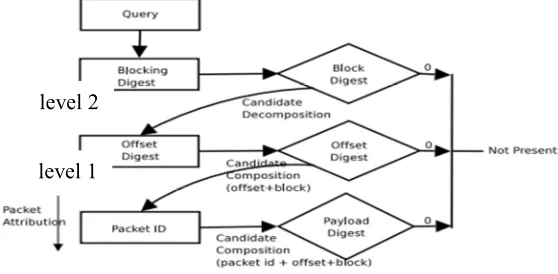
There is a need to reduce FPP to achieve accuracy in detecting forwarding loop/packet looping incidents, and hence to reduce to very minimal the dropped packets during convergence period. Hierarchical Bloom-filter (HBF) is proposed in this work, which is a method of BF preservation when a BF is saturated as the result of higher number of elements being inserted into BF for checking. With HBF, all the blocks present in the single packet are inserted into the BF in the form of a hierarchy. At level 1, the HBF behaves similar to the Block Bloom-filter (BBF), where initially the packet payload is split into blocks of equal size, and they are inserted into the BF along with their offset values. At level 2, adjacent blocks are concatenated forming a super block of double the size, and inserted into the same BF. The same process is followed for further higher levels, till all the blocks are inserted as one block.
Packet data is split into multiple blocks and each block is appended with ‘Interface Id’ from which packet arrived. After splitting the blocks from the packet payload, the first block is concatenated with offset value of 0, second block with offset value of 1. Then the modified blocks are passed through hash functions and stored in the BF. Hence, actual block data being stored into the block of BF would be appended with inbound interface (IP Address or MAC) or unique
interface-id given to each interface. All combinations of offset are tried with initial block and incrementing offset is attached to other blocks in the sequence. If all the blocks in sequence are present in the BF, which may lead to collision, it
would validate the existence of excerpt query. This would in turn confirm the forwarding loop or packet looping has happened at the router.
By having multiple hierarchical levels of the insertion of blocks into the BF, it will increase the querying accuracy and reduce collisions (reducing packets dropped). Even better, the querying accuracy increases as the HBF checks the offset values using only the set ID, which implies reduced collisions, as if there is any duplicate request came for the same set ID, HBF neglects the request. By identifying a number of routers, and if all the routers in the network tree process an excerpt query at the same time, this can also lead to packet drops, and affecting the network bandwidth. Hence, it would be better to minimize
packet losses by an alternative packet attribution
method.
The existing packet attribution process can be modified to maintain multiple BF (at the same time), one for each interface (separately). An extra
attribute called Interface Address would be added
to the existing BF data structure to identify the BFs that are associated with different interfaces. In this way, the modified attribution process initializes multiple BF at a time, one for each interface. Packets are segregated based on the interface, and packet payload can be stored into respective BF based on interface they arrived, which then determine the next router. This is depicted in Figure 7. Each block is concatenated with the corresponding offset number, and then inserted into the BF.
Block = Content || Inbound Interface-id ||
Offset,
[image:10.612.192.471.568.705.2]where Content = Block content and Offset = 0 < (Packet length / Block size)
Figure 7: Hierarchical Bloom-Filter With Its Attribution Process
level 2
466
How BF-k/2 improve detection accuracy for
incidents of forwarding loop/packet looping probabilistically filters a certain percentage of the received messages based on its computing capacity, and then reports all the invalid messages detected. HBF detection technique first extracts the IP addresses of the incoming network traffic. It then determines whether the source IP address has been seen previously or is a new IP address. The resulting time series of the rate of previously unseen or new IP addresses is then analyzed by the levels to identify whether the system is under attack. The system being protected against DoS attacks is represented in terms of two independent states: not under attack, which is the system state when receiving non-attack normal traffic, and under attack, the system state when receiving DoS attack traffic. Low-rate attacks can be as harmful as the high-rate ones, yet even more dangerous due to the fact that they are difficult for routers and counter-DoS mechanisms to detect. Where the BF is used to keep track of the set of nodes visited. Each node has a corresponding mask that can be ORed into the BF as it passes; if the filter does not change, there may be a loop. False positives may lead to packets incorrectly being dropped because of an assumed loop. The authors discuss ways to limits the negative effects of false positives in this context.
Bloom filters can yield an acceptably low rate of false positive drops if we use failures and reprieves. We demonstrate that Bloom filters still retain good loop detection accuracy, especially for small loops. The results in this section were obtained analytically, using the simulation data derived in the previous section. Again, we do not consider network effects such as packet loss. Therefore, these results represent an upper bound on the number of redundant packets allowed by a particular loop detection technique. To simplify the analysis, we only consider multicast packets. For a loop of size k, this implies that TTL’s allow for d-k redundant packets or d=k -1 redundant packets per link:
O PQ*PK*R P/& % 1 (1)
For the Bloom filter mechanism, packets are dropped once the failures and reprieves are exhausted. In the absence of reprieves, each failure allows a looping packet to traverse an extra loop of k hops. Therefore, the number of redundant packets. To minimize the overhead of loop
detection, system comprises a set of containment layers that are tailored to the needs of different kinds of protocols. Restricted protocols use the routes of an underlying multicast routing protocol such as OSPF rather than compute their own. Packets are dropped once the failures and reprieves are exhausted. In the absence of reprieves, each failure allows a looping packet to traverse an extra loop of k hops. Therefore, the number of redundant packets per link is simply the number of failures. The packet’s Bloom filter is bitwise ORed with the interface’s Bloom mask. If the Bloom filter does not change, then the packet might be looping. Possible responses to failing the Bloom test include dropping the packet, and using failures and reprieves to deter false positives. We can reduce the Bloom filter space requirement if we are willing to forego perfect detection accuracy. The basic idea is to permit a small number of Bloom collisions before dropping a packet, there by trading off detection accuracy for reduced false positives
4. RESULTS ANALYSIS AND DISCUSSION
[image:12.612.120.481.111.293.2]
467
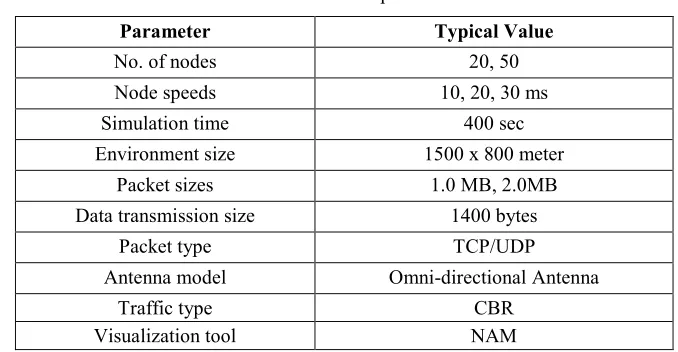
Table I: Simulation parameters
Parameter Typical Value
No. of nodes 20, 50
Node speeds 10, 20, 30 ms
Simulation time 400 sec
Environment size 1500 x 800 meter
Packet sizes 1.0 MB, 2.0MB
Data transmissionsize 1400 bytes
Packet type TCP/UDP
Antenna model Omni-directional Antenna
Traffic type CBR
Visualization tool NAM
4.1 Improvement in space efficiency of the packet header
In this section, efficient use of the limited packet header storage space is evaluated by comparing the performance of the proposed
BF-k/2 with other contemporary methods. The main
aim is to provide proofs that the BF-k/2 proposed solution has significantly improved the usage of the storage capacity of the packet header, and hence supporting the fast Internet re-routing mechanism.
a) Packet attribution
Through simulation, the performance of HBF-with packet attribution is compared against
[image:12.612.134.473.115.291.2]Block-BF and Hierarchical-Block-BF with respect to their storage size, compression ratio, and processing time. As shown in Table II, the proposed HBF-with packet attribution approach requires less storage space, while achieving higher compression ratio and faster processing time as compared to the other two solutions. Lesser processing time implies that the convergence period is shorter. In overall, the proposed HBF-with packet attribution approach has improved the space efficiency in carrying the failure information at the packet header, and has also providing faster processing time for any incidents of forwarding loop/looping packet incidents at a router.
Table II: Storage size, compression ratio, and processing time for different BF approaches
No. BF approaches Storage size (KB)
Compression ratio
Processing time (ms)
1 Block Bloom-filter 10,978.8 72.635 48,018
2 Hierarchical Bloom-filter 10,977.7 72.643 21,061
3 Hierarchical Bloom-filter with
packet attribution 6,123.7 130.222 21,059
b) Memory access counts
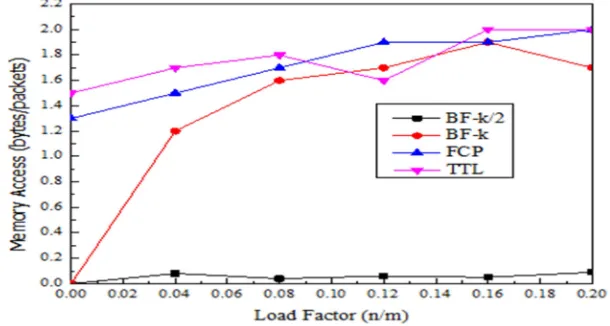
The number of memory accesses to SRAM at a router node to forward packets in an attempt to find alternative links is having impact on the limited storage space of the packet header. A lower count is required as it will reflect minimum forwarding efforts for finding alternative links. In Figure 9, variation in memory access counts with the increase in load factor (a scenario of traffic congestion) is observed. A general observation
indicated that as the number of traffic load (due to congestion) increases at a router node, the required memory access counts is also increases because now more attempts are needed to search for alternative links during its convergence period. The previous solutions of TTL, FCP
(failure-carrying packets), and BF-k (Bloom-filter with k
[image:12.612.91.521.517.598.2]468 methods are not effective in handling congestion, especially at earlier stage, where sharp increases in memory accesses are experienced, and maintaining that high memory accesses throughout the convergence period. However, with the proposed
solution of BF-k/2, the memory access counts are
significantly much reduced. Importantly, it is steadily maintaining a consistence lowest memory access counts regardless of the traffic loads being experienced. It showed that the limited storage capacity of the packet header has been successfully used to carry the required failure information (in encoded forms), and the proposed method of
BF-k/2 has been able to exploit powerfully the
memory access to encode its bits representation to check for the required failure information from the global map via the local router. With this improvement, it can detect incidents of forwarding
loop/packet looping in a fast and efficient manner. Ultimately, it implies that faster or shorter convergence period is achieved.
With the significant performance
improvement made by BF-k/2 method as
compared to the others, then it is real possible that a convergence-free re-routing can be obtained at the affected router. As can be seen from Figure 8, regardless of the traffic loads, the memory access is maintaining a lower count. This indicates that the number of trials in the attempts to find alternative link is keep low, possibly with only one time attempt, and hence convergence free period. As the router must encounter situation of traffic congestion at any point of times, the BF-k/2 is
readily available to serve the re-routing
[image:13.612.150.455.311.474.2]requirement in a convergence-free manner.
Figure 8: Memory Access Performance For N = 25000 And M = 64.
c) Packet header overhead
It is important to see the overhead being experienced by the packet header in handling a convergence period in a traffic congestion scenario. Figure 9 showed the performance of TTL, FCP,
BF-k, and BF-k/2 with respect to their packet
header overhead over a fixed convergence time period, which was set to 10000 milliseconds. It is
observed that BF-k/2 has experienced an almost
consistent packet header overhead throughout the convergence period, while the others have experienced a heavier packet header overhead. At time 0 msec., each of the method is consuming an
overhead, in which BF-k/2 has consumed the least
overhead of about 4
bytes/packet/second. It then starts to decrease sharply until 1000 msec. for each of the method. It follows that each method decreases steadily until
the set time of 10000 msec. However, BF-k/2 has
shown a flatter decrease as compared to the others.
It means that BF-k/2 offered much less packet
header overhead, and thus, a faster convergence
period. Importantly, BF-k/2 has efficiently used
[image:14.612.90.500.71.259.2]
469
Figure 9: The Effect Of Packet Header Overhead On Space Efficiency
d) Packet loss rate
It can be expected that any re-routing schemes will experience packet losses during their convergence period. The lower packet losses implied that better reliability of the re-routing scheme. Figure 10 showed the packet lost rate against the number of failures per second for any failed links or failed router nodes. It can be observed that the lost rate
for BF-k/2 has increased to 0.009 packet/sec as
compared to BF-k, FCP and TTL schemes (which
are 0.026 packet/sec, 0.028 packet/sec, 0.029 packet/sec, respectively) at the early stage when the number of failures is small. These early stage packet losses happened due to the fact that this is the first time that a forwarding loop or packet looping incident is detected, and when the packets cannot be forwarded to its alternative links, then it may be dropped. However, after that early stage
packet losses and when the number of failures
getting higher, the lost rate from BF-k/2 scheme is
significantly reduced regardless of the number of failures recorded at that point of time, while the others have increased their lost rates as the number of failures increase. It is also observed that the packet lost rate for BF-k/2 reducing steadily over the number of failures, while the other schemes of
TTL, FCP and BF-k have shown significant
increases over the number of failures. Hence, it
can be concluded that BF-k/2 has performed much
better than the other schemes when the number of failures getting higher. This is achievable due to efficient use of the limited space storage of the packet header, where the memory access for
membership checking through the use of BF-k/2
scheme is being applied as discussed above.
P
ac
ke
t he
ade
r ove
rhe
ad
(b
yt
es
/p
ac
k
et
/s
ec
[image:15.612.88.505.63.316.2]
470
Figure 10: The Effect Of Loss Rate On Space Efficiency
4.2 Detection accuracy for looping incidents
In this section, the performance of the
proposed BF-k/2 method in term of its detection
accuracy is compared with others contemporary methods. The proofs are provided to support the
claim that BF-k/2 is performing better in providing
a reliable re-routing mechanism for the Internet.
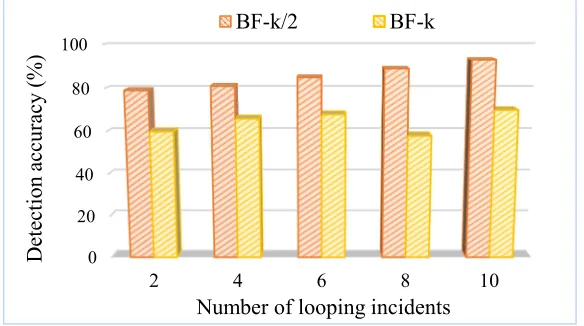
a) Detection accuracy vs. Number of looping incidents
It can be expected that when the number of forwarding loop/packet looping incidents is high, then the detection accuracy will be better. As
proposed, the performance of BF-k/2 scheme is
evaluated by simply comparing with its initial
derivative of BF-k scheme under different numbers
of looping incidents. This is done when BF-k/2
performance is checked in terms of its detection accuracy as the number of forwarding loop/packet looping incidents increased at a router node. As
can be observed from Figure 12, BF-k/2 is
achieving higher detection accuracy for any number of looping incidents as compared to its counterpart of BF-k. Therefore, it is suggested to
use BF-k/2 scheme in detecting the looping
incidents when traffic congestion has occurred so that higher accuracy can be achieved.
Figure 12: Detection Accuracy Between The Existing BF-K And The Proposed BF-K/2
0 20 40 60 80 100
2 4 6 8 10
BF-k/2
BF-k
Number of looping incidents
D
et
ec
ti
on
ac
cur
ac
y
(
%
)
P
ac
ke
t l
o
st
r
at
e
(p
ac
k
et
/s
ec
[image:15.612.161.453.523.686.2]471
b) Detection accuracy vs. false positive probability
It can be understood that traffic congestion may happen at a router at any point of time. The main task now is to understand further this behavior so that the reason for the cause is more visible. Intuitively, any incidents of forwarding loop or packet looping must be triggered by an instant of traffic congestion at a router node, which the congestion must be caused by the forwarding attempts onto a failed outgoing link, at least once. If the incidents of forwarding loop/packet looping can be accurately detected, then the chance of false positive to happen can be reduced to minimum, leading to a convergence free re-routing.
Figure 11 gives a representation that there must be a limit point between the ability to
accurately detect incidents of forwarding
loop/packet looping and the possibility of obtaining a reasonable false positive results. In general, during a congestion period, when the number of looping incidents is low and the traffic density is also low, then the accuracy in detecting
the looping incidents is low but with high false positive probability (FPP). Inversely, when the number of looping incidents and the traffic density are high, then the detection accuracy is high with lower FPP. Therefore, there must a limit point for the detection accuracy and FPP to perform at their best during a congestion period, and while a convergence process is running. This is practically true in the sense that when the detection accuracy cannot be provided, then the FPP to occur is higher. From Figure 11, it is observed that the limit point for detection accuracy and FPP for the proposed
method of BF-k/2 is achieved when the number of
looping incidents is at about 10 and the traffic density is at about 65%. That is to say, the
proposed BF-k/2 method is expected to perform at
its best when the traffic load (congestion level) is less than 65% and when the number of looping incidents is less than 10 incidents – these are the limit. Above these values, the two requirements will be compromised severely. By understanding
this behavior, then the proposed BF-k/2 method
[image:16.612.123.491.388.549.2]can always be tuned to work with lower number of forwarding loop/packet looping incidents and with less traffic loads.
Figure 11: A Balance Between Loop Detection Accuracy And False Positive Results
c) Packet lost rates over a convergence period
It is also important to see what would be the number of packets dropped when the proposed
BF-k/2 is run over a time of convergence period as
compared to TTL, FCP and BF-k schemes. This is
for the reason that when a scheme is offering lower packet lost over a shorter convergence period, it would be a better choice in handling the forwarding loop/packet looping issue. From Figure 13, it can be observed that the packet lost rate per
link with BF-k/2 method is much less than the
TTL, FCP and BF-k. Importantly to note that
BF-k/2 is offering much stable packet lost rates over a
period of convergence process, hence, its performance is much more predictable as compared to the others. With this predictable
behavior, BF-k/2 is then the best choice to handle
any case of traffic congestion. Ultimately, the convergence period will be faster with higher reliability.
0 20 40 60 80 100
0 5 10 15 20 25 30 35
Number of looping incidents
False Positive Rate
Detection Accuracy
T
af
fi
c
de
ns
it
y
(
%
[image:17.612.91.527.60.269.2]
472
Figure 13: Packet Lost Over A Failed Link During A Convergence Period
d) Convergence period with different topology setting
Also, it is interesting to see the performance
of the proposed BF-k/2 method with respect to its
detection accuracy in different topology setting. As can be seen from the earlier discussion that when the incidents of forwarding loop/packet looping can be accurately detected, then the convergence period will be shorter. For this
purpose, comparison was made between BF-k/2
with TTL, FCP and BF-k in different topologies of
Abilene [9], Exedus [11] and Random [13]. Generally, Abilene, Exedus and Random are the kind of topology that high-performance backbone network, peering network, and scale-free network. Figure 14 showed the convergence period of the
BF-k/2 as compared with TTL, FCP and BF-k. As
can be observed, the BF-k/2 method has always
[image:17.612.130.483.449.607.2]out-performed the other methods in terms of convergence period with different network topologies.
Figure 14: Impact Of Topology On Convergence Period
e) Processing times
Lastly, processing time of BF-k/2 is compared
with BF-k, FCP and TTL in three different
interface-id. From Figure 15, it is observed that
BF-k/2 has performed much better than the other
re-routing schemes. BF-k/2 has obtained the
lowest processing time ….. 0
5 10 15 20 25 30 35 40
0 2 4 6 8 10 12
P
ac
k
et
l
os
t
p
er
l
ink
(
b
y
te
)
Time (ms)
TTL
FCP
BF-k
BF-k/2
0 0.2 0.4 0.6 0.8 1 1.2
abilene exedus random
C
onv
er
g
enc
e
p
er
iod
(s
ec
)
Topology setting
TTL
FCP
BF-k
[image:18.612.90.531.54.296.2]
473
Figure 15: Processing Time With Different Interface-Id
5. Conclusion
In this research work, a novel method has been developed to provide full failure recovery through forwarding plane re-routing. It is a network-link abstraction, where space-efficient of packet header and accurate detection of packet looping probability has been proposed and evaluated. The main theoretical contribution in this approach was the design of a scheme that efficiently uses the limited storage space of the packet header and that accurately detects any possible incidents of forwarding loop or packet looping at a router node, regardless of traffic load being experienced at a router node in question. In achieving the said contributions, the Bloom-filter capability in performing membership checking has been extended to handle more complex cases of routing functions as it is demanded from the nowadays highly congested Internet traffic scenario.
It was found that Bloom-filter has also been able to be used as a space-efficient technique for data storage into a narrow storage capacity of a packet header. It was found that Bloom-filter is the best data structure, which can be used to provide reliability in detecting forwarding loop incidents at a router to as high accuracy. However, it is relatively a new area and topic to use BF in routing decisions.
It is when compared with the other previously reported contemporary and BF-based re-routing
schemes for reliability, the proposed BF-k/2
method has not only retains reliability properties,
but also bears smaller packet loss ratio and less transmission overhead, especially when the traffic
is heavy. With the BF-k/2 method, it has been
observed that the detection for forwarding loop/ packet looping incidents has increased its as
compared to the existing methods. Hence, the
proposed method has a great potential to be used with any Internet routing protocols, with least resource requirements and less overhead in mitigating the forwarding loop/packet looping problem due to traffic congestion at a router node in the network. With this reliability results, the provisioning of Internet toward a universal communications infrastructure is more promising than before.
ACKNOWLEDGEMENT
This paper has been funded by the National Plan for Science, Technology and Innovation (MAARIFAH) – King Abdulaziz City for Science and Technology - the Kingdom of Saudi Arabia – award number (12-INF 2723-03). The authors also, acknowledge with gratitude the Science and Technology Unit in King Abdulaziz University for technical support.
REFERENCES:
[1] B. H. Bloom. Space/time trade-offs in hash
coding with allowable errors. ACM of the Communications, 13(7), p. 422-426, 1970.
[2] G. Carl, G. Kesidis, R. R. Brooks, and S.
Rai. Denial-of-service attack-detection
0 10000 20000 30000 40000 50000 60000
None IP MAC
BF-k/2 BF-k FCP TTL
Interface-id appended
P
roc
es
si
ng
T
im
e
(uni
t?
??
474
techniques. IEEE Internet Computing,
10(1) , p. 82-89, 2006.
[3] C. Douligeris and A. Mitrokotsa. DDoS
attacks and defense mechanisms:
classification and state-of-the-art. Computer
Networks, 44(5), p. 643-666, 2004.
[4] E. Page. Continuous inspection schemes.
Biometrika,41, p. 100-115, 1954.
[5] S. Geravand and M. Ahmadi. Bloom filter
applications in network security: A
state-of-the-art survey. Computer Networks,vol. 57,
pp. 4047-4064, 2013.
[6] M. Sarela, C. E. Rothenberg, T. Aura, A.
Zahemszky, P. Nikander, and J. Ott. Forwarding. Anomalies in Bloom
filter-based multicast.In Proceedings of the IEEE
INFOCOM, p. 2399-2407, 2011.
[7] S. Tarkoma, C. E. Rothenberg, and E.
Lagerspetz. Theory and Practice of Bloom Filters for Distributed Systems. IEEE Communications Surveys & Tutorials, 14(1), p. 131-155, 2012.
[8] P. Francois and O. Bonaventure. Avoiding
transient loops during the convergence of link-state routing protocols. IEEE/ACM Transactions on Networking, 15(6), p 1280-1292, 2007.
[9] M. Särelä, C. E. Rothenberg, A. Zahemszky,
P. Nikander, and J. Ott. BloomCasting: security in Bloom filter based multicast.
Springer in Information Security
Technology for Applications, p 1-16, 2012.
[10] K. El Defrawy and G. Tsudik. PRISM:
Privacy-friendly routing in suspicious
MANETs (and VANETs.In Proceedings of
the IEEE International Conference on Network Protocols (ICNP), p 258-267, 2008.
[11] P. P. Lee, T. Bu, and T. Woo. On the
detection of signaling DoS attacks on 3G
wireless networks. 26th IEEE International
Conference on Computer Communication (INFOCOM), p 1289-1297, 2007.
[12] P. P. Lee, T. Bu, and T. Woo. On the
detection of signaling DoS attacks on 3G/WiMax wireless networks. Computer Networks, 53(15), p 2601-2616, 2009.
[13] D. Comer. Network Systems design Using
Network Processors. Prentice Hall, 2003.
[14] R. Jain. Characteristics of destination
address locality in computer networks: a comparison of caching schemes. Computer Networks and ISDN Systems, 18(4), p 243-254, 1990.
[15] S. lyer, R. K. Rao, and A. Shelat. Classipl:
an architecture for fast and flexible packet classification. IEEE Network, 15(2), p 33-41, 2001.
[16] S. McCreary, and k. claffy. Trends in wide
area IP traffic patterns a view from Ames Internet exchange. In Proceedings of the ITC Specialist Seminar, Monterey, 2000.
[17] A. C. Snoeren, C. Partridge, L. A. Sanchez,
C. E. Jones, F. Tchakountio, B. Schwartz, S. T. Kent, and W. T. Strayer. Single-packet IP traceback. IEEE/ACM Transactions on Networking, 10(6), p 721-734, 2002.
[18] [19] J. Saltzer, D. Reed, and D. Clark.
End-To-End Arguments In System Design. ACM Transactions on Computer Systems, 2(4), p 277-288, 1984.
[20] V. Srinivasan, G. Varghese, S. Suri, and M.
Waldvogel, Fast and Scalable Layer Four Switching In Proceedings of the ACM SIGCOMM, p 191-202, 1998.
[21] Broder, A. and Mitzenmacher, M. Network
Applications of Bloom Filters: A Survey. Internet Mathematics 1 (4), p 485–509, 2002.
[22] B. Zhou, R. Zhu, Y. Zhang, and L. Cheng,.
An Efficient Data Fingerprint Query Algorithm Based on Two-Leveled Bloom Filter. Journal of Multimedia, 8, p 73-81, 2013.
[23] A. Pagh, R. Pagh, and S. S. Rao. An
optimal Bloom filter replacement. In
Proceedings of the 16th Annual ACM-SIAM
symposium on Discrete algorithms, p 823-829, 2005.
[24] A. Broder and M. Mitzenmacher. Network
applications of bloom filters: A survey.
Internet mathematics, 1, p 485-509, 2004.
[25] R. Chikhi and G. Rizk. Space-efficient and
exact de Bruijn graph representation based on a Bloom filter. Algorithms for Molecular Biology, 8, p 1, 2013.
[26] M. Rhu, M. Sullivan, J. Leng, and M. Erez.
A locality-aware memory hierarchy for energy-efficient GPU architectures. In
Proceedings of the 46th Annual IEEE/ACM
International Symposium on
Microarchitecture, p 86-98, 2013.
[27] M. Shand, S. Bryant, S. Previdi, C. Filsfils,
P. Francois, and O. Bonaventure.
Framework for Loop-Free Convergence Using the Ordered Forwarding Information Base (oFIB) Approach. 2013.
[28] K. Lakshminarayanan, M. Caesar, M.
475
using failure-carrying packets. In
proceeding of ACM SIGCOMM, 2007.
[29] Y. Wang, H. Wang, A. Mahimkar, R. Alimi,
Y. Zhang, L. Qui, and Y. R. Yang,
R3-Resilient Routing Reconfiguration, in
Proceeding of ACM SIGCOMM, 2010.
[30] S.S. Lor, R. Landa, R. Ali, and M. Rio,