AHMAD NAZRI ALI1, MOHD ZAID ABDULLAH 1
Senior Lecturer, School of Electrical and Electronic Engineering, University Science Malaysia,
MALAYSIA
E-mail: [email protected]
ABSTRACT
This paper proposes an iris classification for small and imbalance dataset employing traditional Support Vector Machine classifier. A technique from the combination of modified conventional moving average and histogram equalization are proposed to produce the figurative and interpretability iris texture. In doing so, the smooth effect of the iris texture will take place for feature extraction. This study also proposed one-dimensional features with dynamic vector which are extracted by manipulating the global mean and intensity variation on the un-normalized iris image. The uniqueness of the proposed feature extraction technique is where eyelid, eyelashes and lighting effect will be merged together in the calculation in order to produce the feature vector. Therefore, this study has not considered the noise removal method, and this differs compared to most previous works, which have implemented noise removal method for eliminating the eyelid and eyelashes information. The images from CASIA Version 1 and Version 4-Interval are used to assess the proposed method. The results obtained on these data sets reveal the effectiveness of the suggested method.
Keywords: Iris Classification, Support Vector Machines, Global Mean, One-dimensional.
1. INTRODUCTION
With unique patterns for each person even between left and right eye, human iris is the most stable and reliable compared with other biometrics form [1,2]. Reliable features which are extracted from iris pattern with suitable matching method are the fundamental element for obtaining high accuracy. Multiple templates per individual are the important aspect to create enough template variation in database. However, it will create computational overheads as the system has to store and then compare each of the templates during enrollment and classification. Generally, the size of features is normally large in iris classification. Creating a reliable and small vector size of iris template using low computational method that capable to be applied with established matching method may be the possible approach to address the problem.
Other than feature size, the presence of unwanted parts such as eyelids, eyelashes or lighting effect is the area that requires special method to remove it as these noises may hamper the recognition accuracy. Many methods have been proposed to reduce the effect of these noises from the iris images [3,4,5].
However, the method requires extra computation for completing the process. In most literatures, once the iris region is localized, the next step is to unwrap or normalize into a fixed dimension in order to have uniform features attributes for accurate matching outcome. Normalization is applied to overcome the dimensional inconsistencies due to changes of the distance between eye and camera, rotation of the camera, or the changes of eye position in eye socket [6].
In this paper, an iris classification system is proposed using less complex algorithms on the treated rectangular iris image for feature extraction. The method is based on global variation and means average for each scanned row of the image to generate small features vector. In addition, the approach also uses dynamic dimension of features attribute for each image even for same people. Therefore, the approach differs compared to the previous works which are generally considered a uniform features vector dimension for matching process. The generated features are fed to traditional Support Vector Machines during training and testing stage. The approach utilizes the images from CASIA Version 1 and Version 4-Interval. For evaluation and comparison purposes, this study also
ONE DIMENSIONAL WITH DYNAMIC FEATURES VECTOR FOR
IRIS CLASSIFICATION USING TRADITIONAL SUPPORT VECTOR
applies an informal method by locating rectangular black color with same size to eliminate the eyelid and eyelashes instead of formal noise removal scheme.
Generally, SVMs employ well-balanced training dataset for precise accuracy. Classifying two classes which trained using imbalance dataset will produce a result that bias to majority class and concurrently low accuracy on the minority class. This situation occurs when one of the classes has a small or limited amount of samples. A unique challenge is needed to overcome this problem [7,8,9,10,11]. Modification to the traditional SVMs, over-samples the minority or under-samples the majority still requires enough sample for each situation. Therefore, in this paper, without employing all the above-mentioned schemes, this paper also presents the ability of the suggested features for imbalance dataset as well as balance using traditional SVM classifier.
The organization of this paper is as follows. First, section II describes the previous works of iris recognition, iris classification and Support Vector Machine for template matching. Section III explains the suggested features extraction method considering mean variation and global average. Then experimental approaches and results will be discussed in section IV. Finally, section V presents the conclusion obtained from this work.
2. PREVIOUS WORKS
There are various methods to perform iris recognition system. The well-known one is as proposed by Daugman [12,13,14,15]. He implemented integro-differential operators for iris localization and projecting it to Cartesian form to create the iris templates using 2D complex Gabor filter. Hamming distance is used for matching two samples. Other successful works in this field are from Wildes et al[16], Boles et al[17], Zhu et al[18], Lim et al[19] and Ma et al[20]. Motivated from these works, the focus of the research is more on finding the alternative method of the iris recognition systems. Improving segmentation algorithms, new features extraction and encoded method are the element that mainly introduced by many researchers [21,22,23,24,25,26,27,28]. Alternative matching schemes to the Hamming distance such as Neural Network and SVM have also been introduced by several researchers [29,30,31].
Support Vector Machine has comprehensively been used in iris recognition to perform the
template matching [32,33,34,36]. In SVM, two class or multi-class problems are the common practice for template matching. However, it requires enough samples with at least identical amount of samples for each class so that there is no bias outcome occurs during testing. This method also requires appropriate size and dimension of the features in order to produce a reliable enrollment model and better accuracy. Rather than that, obtaining the efficient and implementable features attribute is the key element to obtain better performance using SVM classifier.
Son et al [34] employed multiresolution wavelet transform to extract the iris features and then reduce the features dimension by using Direct Linear Discriminant Analysis (DLDA). They used nearest feature classifier and SVM for evaluating the recognition performance. Park et al[35] utilized two HDs calculated from long and short Gabor filters and then fed to SVM to authenticate the claimed sample. Roy and Bhattarcharya also implemented Gabor wavelet value as the features attribute for SVM classifier [32]. In recent work, combination between SVM and Hamming distance approach has also been introduced for better accuracy [36]. For this case, Haar wavelet and 1D Log Gabor wavelet are fed to SVM for first classifier and Hamming distance as a second classifier if SVM fails to present correct classification.
Equally balance sample for each class is the common practice for traditional SVM classifier. If the system involves with the imbalance or poor balance dataset, the conventional SVM may need to be restructured in order to minimize the tendency of severe performance for the evaluated class. In iris recognition, Roy and Bhattacharya have suggested an adaptive asymmetrical SVM scheme to control the misclassification errors and to reduce the matching time [30,32] for poorly balance dataset. Non-symmetrical SVM has also been suggested for separating the cases of false accept and false reject [37].
3. THE PROPOSED SYSTEM
The proposed system is composed according to the following common stages: iris localization, circular to rectangular iris region conversion, feature extraction together with image enhancement, and matching stage using SVM classifier.
then transformed to the rectangular (un-normalized) form using conventional polar to Cartesian conversion. Simple enhancement methods are applied in order to improve the texture appearance. Moreover, this stage is also used to compensate and minimize the noises information on iris image. The feature will be extracted by means of average and pixels variation calculation on each row plane of the image. Each row will contribute one vector of the signature. Therefore, each iris image will have a dynamic vector where its dimension depends on the detected radius during localization. A set of signature from several iris images will be combined to create a template for model generation employing SVM classifier. For testing, one iris image will be processed using the same method from localization until feature extraction and then, the generated signature will be matched with the model for predicting and classifying the input image.
4. FEATURES EXTRACTION
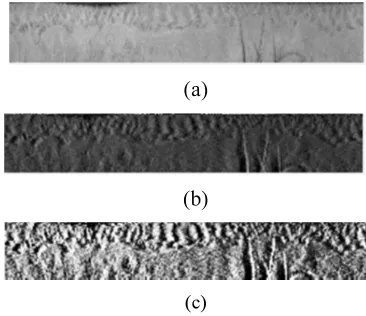
Image enhancement is the key element for the successful of the proposed system. Two main sequential processes are suggested for enhancing the rectangular image. First, each pixel in the original image (Figure 2a) will be averaged for new pixel intensity using unweighted mean of a number data point. The average value is then subtracted with the corresponding pixel and multiply it with a constant for new temporary value, ptemp .
ptemp[i] = (pave[i] – x[i]) * k (1)
This temporary value will be re-calculated to a new individual pixel value, pnew, using the
constraint as stated in Equation 2 and 3. In Equation 2, k is a constant value that controls the darkness of the new generated image (Fig. 2(b)).
if ptemp[i]<0 then pnew[i] =(x[i] – pave[i])*k (2)
if ptemp[i]>0 then pnew[i]=pave[i] (3)
In order to obtain homogenous pixel intensity (Figure 2b), the value of pnew will be recalculated if ptemp is less than zero. It can be done by reversing the order of subtracting between value x and pave as shown in Equation 2. The value of k remains as in Equation 1. However, in Equation 3, if the value from the operation using Equation 1 is greater than zero, the new generated pixel value is directly assigned from the calculated average value. Therefore, we believe that this process can eliminate the illumination noise (if any) and also
amplify the blurred information of the original image.
However, the beforehand process produces poor contrast of the iris texture even observes it through naked eye (Figure 2b). Therefore, histogram equalization method has been applied for intensifying the anterior surface of the iris pattern. As common in histogram equalization, the probability function, p[x], and cumulative distribution function, Cx are two main parameters which are normally calculated during practicing the method in image processing field. The probability function for gray level image can be derived using Equation 4 where nx is the number of pixel with the intensity x, and n is the total amount of pixel.
p[x] = nx / n, for 0 ≤ x < 256. (4)
Having the probability function, the second parameter called the cumulative distribution function using Equation 5 is calculated.
k
cdfx[k] =
∑
px[j] (5)j=0
Both p[x] and cdfx will be used for the transform
function as in Equation 6 for generating new value for each pixel.
The = (cdfx(k) – q * p[x] ) * imax (6)
where imax is the maximum pixel intensity detected in the input image and q is a constant value which control the brightness of the image (Figure 2c).
(a)
(b)
(c)
[image:3.595.314.497.543.701.2]The final processed image (as depicted in Figure 2c) is used to generate one-dimensional real value iris signature. Generally, the procedure to generate a vector value can be explained as follows:
i) Considering a row vector, j1, add all the pixels value of the column vector of this row,
∑ (6)
where I is the total number of pixel for the column vector
ii) Divide the value of t with I to get the average value,
iii) The next step is to find the intensity variation between the original histogram equalized and the average value for the column vector using the following equation.
(7)
iv)Again, add all the values to get the total variation
∑ (8)
v) Finally, the value of total variation will be
averaged and assigned as the first vector of the iris signature
/ (9)
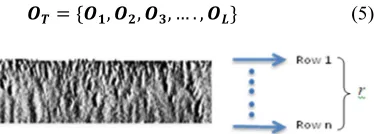
This procedure is for one cycle process that will produce one real value signature vector for each row plane of the image. This process has to be repeated for other rows on the image in order to have a set of signature vector. As mentioned earlier, the dimension of the generated signature depends on the detected radius, r (Figure 3).
With this scheme, the final features vector for one iris can be written as
[image:4.595.101.288.525.592.2], , , … . , (5)
Figure 3: Final output iris image with r radius
where O1 is the vector of first row, O2 is the vector of second row and so on.
This feature extraction process offers a virtual mechanism to reduce the noise factors due to eyelashes, eyelid and lighting effect through global mean and variation calculation. In Figure 2, it can be noticed that the quantity of noises compared to the iris element is small. Therefore, its intensity value will give no substantial effect on mean and total variation calculation using the proposed method.
5. ASSESSMENT APPROACH AND
RESULTS
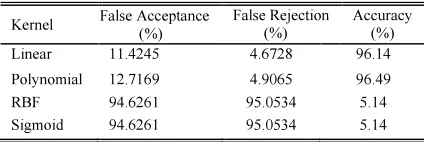
The work reported here is evaluated using CASIA database Version 1 (108 subjects), CASIA Version 4-Interval (249 subjects). For Version 4, only 7 images from 125 (left) and 122 (right) subjects are chosen. Three images from each subject are used for training and the remaining four samples are for testing. Evaluation has been done using Support Vector Machine Classifier for both training and testing by choosing the C_SVC type with four types of kernels (polynomial, linear, RBF and Sigmoid).
The assessment has been done based on two classes (positive and negative) learning problem with two types of study employing balance and imbalance class data set. Due to a limited number of samples in each subject, the balance training data is formed with three positive and negative samples respectively. In imbalance case, the data is arranged with a maximum of three for positive and more than three for the negative class.
In order to verify the performance of the proposed method is not influenced by the presence of noises information, an informal method by drawing a constant area with rectangular black area at two locations have been applied to eliminate the presence of the noises (Figure 4). For the case as in Figure 5, the image is still considered even it will be partially covered by the rectangular area.
[image:4.595.318.507.612.706.2]The balance class problem is formed using equal number of samples (three for both classes) where each training data utilizes same positive samples. However, for negative class, the samples are taken from the subject (one only) that will be matched for making balance. Each training data will be trained to produce individual SVMs model. Therefore, for respective subject, the evaluation using this learning problem will employ several training data and models.
Figure 4: Iris image with two rectangular black color
Figure 5: Image with eyelashes
whereas Table 2 shows the performance for the images which are applied with informal removal method. False acceptance that the probability to identify the imposter as enrolled image and false rejection that the probability to reject the enrolled image are considered to access the performance.
Table 1: Average Performance for both CASIA Version 1 and Version 4.
Kernel False Acceptance (%) False Rejection (%) Accuracy (%)
Linear 11.4245 4.6728 96.14
Polynomial 12.7169 4.9065 96.49 RBF 94.6261 95.0534 5.14 Sigmoid 94.6261 95.0534 5.14
For imbalance dataset, the training template is set with positive as minority whereas negative to be majority class. For each respective subject (classed as positive), the training dataset is initially formed with three positive and six negative samples (to make it imbalance). Same parameter and kernel type as in balance case is used for model generation.
The imbalance class samples are increased by only adding the negative samples and keeps same amount of samples for the positive. The dataset will be re-modeled and re-tested whenever the negative sample is added. For Version 4, we also use same number of negative samples in final training dataset for evaluation consistency. For this case, discrete point of true and false positive rate for each subject are considered for evaluating the performance and the assessment has managed to have high true positive and low false positive rate (Figure 6).
Table 3 shows the comparison of performance rate from previous promising solution for iris classification with difference features extraction. From the results in Table 3, we found that our suggested method has shown a significant performance.
6. CONCLUSIONS
In this paper, a method employing one dimensional iris signature and Support Vector Machine classifier is suggested for iris classification. The iris features vector is calculated by means of average and variation on the pixel values of row side on the image.
Table 2: Average Performance for both CASIA Version 1 and Version 4 with informal removal method
Kernel False Acceptance (%)
False Rejection (%)
Accuracy (%) Linear 13.1229 5.1452 95.76 Polynomial 14.6218 4.5454 96.17 RBF 94.6261 95.0534 5.14 Sigmoid 94.6261 95.0534 5.14
Figure 6: Performance according to true and false positive rate for each subjects in both databases.
The results show that the proposed method can classify the iris images efficiently with good performance for balance and imbalance class dataset on two kernels (linear and polynomial). Even false acceptance rate is high; this is still tolerable relative to the number of samples used in training. In addition, there is no big difference in terms of performance between the images with the presence of and without noises. Therefore, the advantage of the proposed method is able to provide a practical approach to extract the feature without implementing noise removal method. In addition, the proposed method from enhancement to feature extraction processes are simple to implement and may reduce the computational overhead during implementation.
[image:5.595.83.295.229.300.2]Moreover, the proposed system uses different size of signature vector for same subject, and the result shows that it was not greatly depends on the size for correct prediction. Therefore, it can be initially concluded that whatever factors that will change the boundary distance, such as camera-to-face distance, stimulation by light or other reasons, the suggested method can diminish all these problems.
Table 3: Comparison of Feature Extraction and Classification Method
Feaure Extraction
Matching Approach
Database Used
Rate (%)
Daugman [15]
Gabor Hamming Distance
General 100
Lelina et al [25]
Discrete Wavelet
Euclidean Distance
CASIA Ver. 1
99.47 0
0.2 0.4 0.6 0.8 1
0 0.2 0.4 0.6 0.8 1
Tr
u
e
Po
s
it
iv
e
Rat
e
[image:5.595.302.525.683.760.2]Transform
Donald et al [22]
Patch Coding based FFT
Nearest Neighbour
Classifier
CASIA 99.29
Jong et al [23]
Cummulative Sum Based
Hamming Distance
CASIA Ver. 1
98.21
Proposed Global Average (1-D)
Support Vector Machine
CASIA Ver.1 and Ver. 4
96.49
ACKNOWLEDGEMENT
Portion of the research in this paper use the CASIA-IrisV1 and V4.0 collected by the Chinese Academy of Sciences’ Institute of Automation (CASIA) which available online on the web http://biometrics.idealtest.org/. This research work was supported by the University Science Malaysia Research University - Short Term Grant (304.PELECT.60312031)
REFRENCES:
[1] B. Bonney, R. Ives, D. Etter and Yingzi Du, “Iris pattern extraction using bit planes and standard deviation,” Proceeding Conference of the ThirtyEighth Asilomar Conference on Signals, Systems and Computers, Vol 1, pp 582 – 586, 2004.
[2] A.I. Desoky, H. A. Ali, N.B Abdel Hamid, “Enchancing iris recognition system performance using templates fusion”, Ain Shams Engineering Journal, Vol. 3, pp 133-140, 2012.
[3] L. Masek, “Recognition of human iris patterns for bio-metrics identification”, B.Eng. thesis, University of Western Australia, 2003.
[4] T. H. Min, R. H. Park, “Eyelid and eyelash detection method in the normalized iris image using the parabolic Hough model and Otsu’s thresholding method”, Pattern Recognition Journal, Vol. 30, Issue 12, 2009, pp 1138-1143.
[5] W. Kong, and D. Zhang, “Accurate iris segmentation based on novel reflection and eyelash detection model”, International Symposium on Intelligent Multimedia, Video and Speech Process, May 2001, pp 263-266. [6] L. Ma, T. Tan, Y. Wang and D. Zhang,
“Personal identification based on iris texture analysis”, IEEE Trans. on Pattern Analysis Machine Intelligence, Vol. 25, 2003, pp 1519-1533.
[7] A. Rehan, K. Stephen and J. Nathalie, “Applying support vector machines to imbalanced datasets,” in Proc. Of the15th European Conference on Machine Learning (ECML 2004), pp. 39-50, 2004.
[8] L.Stefan, “Solving imbalanced classification
Problems with Support Vector
Machines,” Proc. of the Intern. Conf. on Artificial Intelligence(IC-AI’04), Las Vegas, Nevada, USA, pp 214-220, 2004
[9] Y. Tan, Y.Q. Zhang, N.V. Chawla and S. Krasser, “SVMs Modelling for Highly Imbalanced Classification,” Journal of Latex Class Files, Vol 1, No. 11, 2009
[10] R. Batuwita and V. Palade, “Efficient resampling methods for training support vector machines with imbalance datasets”. Proceeding of the International Joint Conference on Neural Networks, pp 1-8, 2010.
[11] B.Yu, H.Li, L,Ma, H.Bo and L,Zhang, “Support Vector Machines Based on the Sample Spatial Distance for Imbalanced Sample Distribution”, Journal of Computational Information Systems 8:21, pp 8753-8761, 2012.
[12] J.Daugman, “Biometric personal identification system based on iris analysis,” U.S. Patent No. 5,291,560, March 1994. [13] J.Daugman, “How iris recognition works,”
IEEE Transactions on Circuits and Systems for Video Technology. Vol 14(1), pp 21-30, 2004.
[14] J.Daugman, “Statistical richness of visual phase information: update on recognizing persons by iris patterns,” International Journal on Computer Vision, Vol 45, pp. 25-38, 2001.
[15] J. Daugman, “New Methods in Iris Recognition”, IEEE Trans. System Man Cybernetics, Part B, Vol.37 Issue 5, pp1167-1175, 2007.
[16] R. P. Wildes, “Iris Recognition: An Emerging Biometric Technology”, Proceeding of the IEEE, Vol. 85, No. 9, pp 1348-1363, 1997.
[17] W. Boles, B. Boashash, “A human identification technique using images of the iris and wavelet transform,” IEEE Trans. Signal Processing. Vol 46, no 4, pp 1185-1188, 1998.
on Pattern Recognition, Vol.2, pp 801-804, 2000.
[19] S.Lim, K.Lee, O.Byeon, T.Kim., “Efficient Iris Recognition through Improvement of Feature Vector and Classifier. ETRI Journal, Vol 23. No.3, pp 61-70, 2001.
[20] L. Ma, T. Tan. Y. Wang and D. Zhang, “Efficient iris recognition by characterizing key local variations”, IEEE Trans. on Image Processing. Vol. 13, pp 739-750, 2004. [21] M. Vatsa, R. Singh and A. Noore, “
Improving Iris Recognition Performance Using Segmentation, Quality Enchancement, Match Score Fusion and Indexing”, IEEE Transactions On Systems, Man and Cybernetics, Part B: Cybernatics. Vol, 38 Issue 4, pp 1021-1035, August 2008. [22] M.M.Donald, Soumyadip Rakshit, Dexin
Zhang. “DCT-Based iris recognition,” Journal IEEE Transactions on Pattern Analysis and Machine Intelligence, Vol. 29 Issue 4 pp 586-595, April 2007.
[23] Jong-Gook Ko, Youn-Hee Gil, Jang-Hee Yoo, and Kyo-IL Chung, "A Novel and Efficient Feature Extraction Method for Iris Recognition," ETRI Journal, vol. 29, no. 3, pp. 399-401, June 2007.
[24] M.M, Donald and Dexin Zhang, “An effective human iris code with low complexity”, International Conference on Image Processing, ICIP 2005, pp 277-280. 2005.
[25] Lelina Birgale and Kokare,M, “Iris
recognition without iris
normalization,”Journal of Computer Science., Vol. 6, no. 9, pp. 1042–1047, 2010.
[26] Yingzi Du, W.I.Robert, M.E.Delores, T.B. Welch, “Use of one-dimensional iris signatures to rank iris pattern similarities,” Optical Engineering, Vol 45(3), 037201, March 17, 2006.
[27] T.M.Khan, M.A.Khan,S.A.Malik, S.A. Khan, T. Bashir and A. H. Dar, “Automatic localization of pupil using eccentricity and iris using gradient based method”. Optics and Lasers in Engineering, Vol. 49, pp 177-187, 2011.
[28] M.T.Ibrahim, T.M. Khan, S.A.Khan, M. A. Khan and L.Guan, “Iris localization using local histogram and other image statistics”, Optics and Lasers in Engineering, Vol. 50, pp 645-654, 2012.
[29] F.N.Sibai, H.I. Hosani, R.M.Naqbi, S.Dhanhani and S.Shehhi, “Iris Recognition using Artificial Neural Networks”, Expert
System and Applications. Vol. 38, pp 5940-5946, 2011.
[30] K.Roy, P. Bhattacharya and C. Y. Suen, “Towards Nonideal Iris Recognition based on Level Set Method, Genetic Algorithms and
Adaptive Asymmetrical SVMs.”,
Engineering Applications of Artificial Intelligence, Vol. 24, pp 458-475, 2011. [31] C.H.Chen, and C.T.Chu. “High Performance
Iris Recognition based on 1-D circular feature extraction and PSO-PNN Classifier”. Expert Systems with Applications, Vol. 36, pp 10351-10356, 2009.
[32] K. Roy, and P. Bhattacharya, “Iris Recognition with Support Vector Machines”, Advances in Biometrics, Lecture Notes in Computer Science, Vol. 3832, pp 486-492, 2005.
[33] H.Ali, M. J. E. Salami, Wahyudi, “Iris Recognition System by Using Support Vector Machines”, Proceeding of the International
Conference on Computer and
Communication Engineering, pp. 516-521, 2008.
[34] B. Son, G. Kee, Y. Byun and Y. Lee, “Iris Recognition System using Wavelet Packet and Support Vector Machines”, WISA 2003, LNCS 2908, pp 365-379, 2004.
[35] H. A. Park and K. R. Park, “Iris Recognition based on Score Level Fusion by using SVM”, Pattern Recognition Letters, Vol. 28, pp 2019-2028, 2007.
[36] H. Rai and A. Yadav, “Iris Recognition using Combined Support Vector Machine and Hamming Distance Approach”, Expert System with Applications, Vol. 41, pp 588-593, 2014.