A PERSPECTIVE MATHEMATICAL MODEL FOR WEAPON TO TARGET
ALLOCATION PROBLEM USING RANDOMIZED TECHNIQUE
1
K.HARIHARAN,
2R.PARAMESHWARAN,
3C.MANIKANDAN
4
R.SATHIYAPRIYA,
5D.SABITHA,6Dr.V.VAITHIYANATHANE-mail:
1[email protected]
2
[email protected]
3[email protected]
4
[email protected]
5[email protected]
6[email protected]
ABSTRACT
TUT concentrates on ease of allocating a group of Weapon to a group of Targets. The problem of allocating weapon to a set of targets is typical an optimization problem with the aim of increasing the probability of hitting all targets by the weapon using Ant Colony Optimization. TUT model is designed in such that it maximizes the probability of mapping a set of most defensive weapon against a set of most attacking targets, to cause maximum destruction. TUT model is designed, mainly for war scenario of weapon coordination, the problem statement can be formulated based on six types of limiting factor, containing all defence information of entry angle, intercept angle ,states potential , power , resource (i.e., weapon constraints), frequency allocation constraints, as an factor to the TUT model.To make it definite, we concentrate on a platform to work with TUT and TUR by sending information from TUT to TUR with certain allocated frequency and power level. To accomplish that a set of Weapon are chosen against a set of Targets for allocation based on Ant Colony Optimization. We initially started with ant colony algorithm and compare the results with branch & bound technique on that we found, than ACO algorithm the branch and bound performs well. This enhances the accuracy of weapon to hit allocated Target. This improves the performance of overall BMD.
Key Words: Tut (Target Update Transmitter),Tur (Target Update Receiver),Bmd (Ballastic Missile
Defence) ,Mcc (Mission Control Center)
1. INTRODUCTION
Medium course BMD were easy to detect and intercept during the First World War and Second World War using certain graph searching algorithm and techniques. The technology for interception and detection behind this level has been in topic of research since First World War and currently is being studied by various Research Organizations. Trap for ballistic missile have been developed to avoid maximum destruction and intercepting technique for targets to avoid loss of life and property. To improve the precision of overall system, multimode techniques were used to map the weapon set.
Since long methodology for weapon to target mapping has been the area of research. There were many traditional graph search technique used for mapping a group of weapon to a group of targets since First World War. But most of these traditional graph search technique requires exponential time complexity. As this mapping time plays a very crucial role in BMD, thus it
becomes an essential requirement to reduce the time complexity in order to make an efficient mapping of the weapon set. Several intelligent algorithms were proposed and developed to reduce the mapping time that uses traditional graph search algorithms. But as the problem of one-to-one mapping of weapon to the target set is NP-Complete, as a result of it , most of the intelligent graph searching algorithm results in local optimal solution in an given search space rather than global optimal solution. Therefore to overcome the above shortcomings we shift our focus towards Genetic Algorithms.
2. GENETIC ALGORITHM
around the biological species and try to find a pattern, which can be used to implement an algorithm to carry out some kind of computation. We don’t use the concept of derivatives here i.e.; we don’t use calculus based technique to find derivatives. The concept of evolution and natural selection is based on the principal of “Survival of the Fittest. The best will only survive and successive generation will become better and better. The best feature of genetic algorithm is Robustness. Robustness means how much the system can adopt with slight change in environment. For example how much we can survive in hostile condition (maximum temperature we can withstand, how long we can live without food and water).
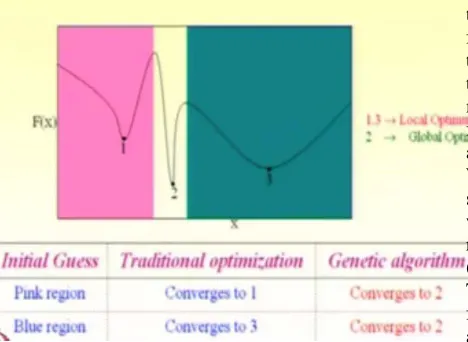
Fig 1.1 Genetic Algorithm Comparison With Intelligent Search Techniques.
The reason behind using genetic algorithm is that, it will eliminate all local minima.In the above Fig 1.1 we take any function y=f(x), which has 1, 3 as local minima and 2 as global minima. If we start our search from pink region using any traditional search mechanism we get 1 as the result, which is local optimal value. On the other hand if we start the search from blue region it results in 3 which is again local optimal value. But if we use Genetic algorithm and begin the search process from either pink or blue region we get out optimal result as 2, which turns out to be the actual global optimal value.
Ant Colony Optimisation (ACO) is an algorithm based on Genetic algorithm. Algorithm using ACO were developed and applied on Unmanned Vehicle System (UVS), missile and weapon to solve the problem of weapon mapping, to cause maximum destruction based on population and assets. When dealing with multiple targets, it is
unconvincing that the weapon can focus against all available targets at the same time, as number of available weapons may be smaller as compared to the number of Targets available. Even though if this is not the circumstance, the core problem is to trace which Weapon unit is to be mapped against particular Target in order to maximise the damage or maximise the overall expected target weightage of destroying targets. It is seem to be a resource mapping problem. Unfortunately, the allocation of Weapon to available targets is NP-complete.
Duration available for weapon allocation depends on multiple factors such as, the range of the weapon, type of detection, type of Target, algorithm used etc.
The main aim is to allocate weapons to specific targets based on power level, available frequency, and threats within a given area such that all weapons coordinate and cooperate among themselves for destroying the target leading to maximum damage. The objective function focuses on finding a sub-optimal assignment for available weapons allocated to the target units. We are fascinated in optimizing the mapping scheme for the available resource set i.e., weapons based on ACO. In this scenario, we represent the set of available weapons W as (W={w|w=1,2,3,……w}) and the set of available Targets to be allocated T as (T={t | t ranging from 1,2,3,...up to t}).If W > T i.e.; the available unit of weapons surpass the targets available. We can select the “T” most attacking and dangerous targets. Conversely if the value of `W` < = `T`, then we can select the targets based on known parameter such as states potential, power constraints, resource constraints etc. Depending on the study of vulnerability of environment, the design of BMD is quite
complex.
Therefore we propose a model TUTbased on ACO for the design of BMD for allocation of TUT and TUR. The fitness function R while deputing Weapon set W to the available Targets T using ACO must maximise the threat probability given as,
J i
Maximum R = ∑Vj [1-π (1-bsr)] xsr T=1 W=1
Xsr denotes decision variable, whenever weapon
W is assigned to T, xwt =1, else , xwt=0.
Vj denotes threat parameter of target .Threat parameter is based on power level, velocity of weapon, angle of inclination, maximum range etc.Bwt denotes destruction probability of W to T
weapon, angle of inclination, maximum range etc..
2.1 Weapon Allocation
Ant colony optimisation (ACO) (Li et al.,
2000,Su and Lee,2003) algorithms is basically a graph searching algorithm. For combinational optimisation problem Ant colony Optimisation is a paradigm for designed based on meta-heuristic algorithm. Generally it is used to perform search in graph. The aim of ACO graph searching technique is to find the minimum distanced path from the starting node to ending node in a given graph representation.ACO (Li et al.,2000,Su and Lee,2003) is based on Genetic algorithm therefore it doesn’t result in local optimal solution. The analogy or inspiration is taken from a group of biological organism called ants, which live intact in a habitat and share global information with one another to search for food. We look around the environments and try to find the pattern which the ants follow to search their food and try to stimulate the pattern into an algorithm to perform computation. Ants in real life are blind. Therefore they need some kind of co-ordinating body to communicate among themselves; the co-ordinating body is called Pheromone (biological name for the chemical which ants leave along the path they follow). Whenever an ant follows some path in a given graph, it leaves behind some chemical so that other ants can follow them based on the density of the chemical.
Fig 1.2 Ant Colony Algorithm
We place some ants at the source node and ask them to reach the goal node. Each ant selects some random path and moves from source node towards goal node. While the ants move on the edge ejk(node j to k), it leaves behind some chemical called Pheromones so that ants coming behind them can follow the path. The magnitude of pheromone deposited on edgejk is directly proportional to the goodness of the path. In other words the longer the path the lower the
[image:3.612.322.524.302.709.2]magnitude of the pheromone and the shorter the path chosen by ants the better the magnitude of the pheromone. Some ants using random path may reach the goal node and few might not reach goal node. We apply threshold to ants who have not reached their goal to make them reach the goal node. Next time whenever we place new ants on the source node and ask them to reach goal node. These new ants will have an idea based on pheromone and heuristic that, how much good the edge ejk is. Based on the goodness of the edge other ants will follow the path.ACO is similar to IF-THEN inference rules. Ant colonies don’t have a centralised controller and ACO rely on the magnitude of Pheromones. If in a graph there exist two of more path with different length then only we can implements ACO.
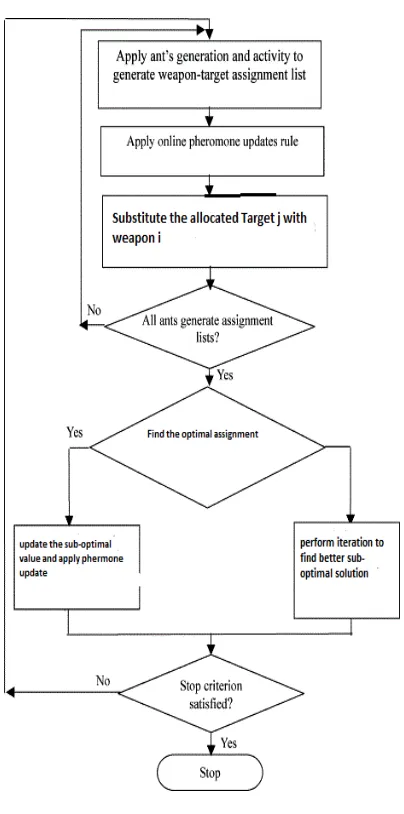
Fig 1.3: Data Flow Diagram For ACO
(TSP) as example. We denote Djk the distance between two points j , k. In the case of Euclidean TSP, Djk is the Euclidean length between i and j
Djk= √((xj-xk) 2
+ (yj-yk) 2
)
The TSP is can be represented by a graph (N, E), where E is the set of edges between targets and N is the set of targets. Let tjk (t) at time t, be the magnitude of pheromone on edge (j, k). Each ant at time t randomly chooses the next target, then it will reach at time shifted by one unit. Therefore, if we have m generation of the ant colony algorithm, then m times will be the magnitude of pheromone deposited on an edge ejk as m number of ants will pass through the edge ejk.
Ŧij (t+1) = Ŧij (t) + ΔŦtij
The ant chooses an edge j to k based on the goodness of the path.
The strategy that ant adopts to move from edge j to k depends on three parameters:
a) Attractiveness. b) Pheromones density. c) Adaptive resonance
Attractiveness can be defined as a heuristic approach which is a common sense set of rule to increase the probability of solving a problem. The ants are able to take a step, so that it becomes nearer to goal node.
Pheromone density is the measure of the goodness of a path. If the magnitude of pheromone is high on an edge then ants must travel through the edge.
Adaptive resonance purely depends on intelligence of ants some ants cant remember the already travelled node so those ants were misguided and Rome somewhere else nearer to the original node but due to their resonance capacity they find the path after a little bit of time to the belated next to the state of confusion because they already travelled by that path, like wise weapon should be trained through artificial intelligence to select the correct node even though magnitude mismatch occurs. This value is always high for frequently used node by ants and has its less probability for nodes that are not used frequently .but the less probability nodes does not vanishes out completely in ACO algorithm.
Therefore probability that an ant uses edge j to k can be defined as product of Attractiveness and Pheromones density.
2.2 Existing ACO algorithm
Ρjkm(t) = {(Ŧtjka(t).njkb)/ =∑ ΔŦtjka(t).njkb)} If k i(-- allowed.
ρjkm(t) ={o} otherwise
3. PROPOSED ALGORITHM
INTRODUCED WITH NEW PARAMETER
Here ‘a’ represents attractiveness, ‘b’ represents Pheromones density and ‘c’ represents the adaptive resonance probability
Ρjkm(t) = {(Ŧtjka(t).n
jkb)/ =∑ ΔŦtjka(t).njkbc)} If k i(-- allowed.
ρjkm(t) ={o} otherwise
Where ρ is a coefficient such that (1- ρ) represents the volatility of chemical between time t and shifted version of time by adding one to t.As M numbers of ants take the same path based on magnitude of pheromone. Therefore pheromone deposited will be m times ΔŦ. ΔŦjk=∑ ΔŦtjkM
Where ΔŦtij k is the quantity/length of pheromone in deposited by ants at edge (J, k) by the last ant between time t and n added with time”t”.
We define the transition probability from target j to target k for the last ant as:
Now as excess amount of pheromone gets deposited on an edge, this excess pheromone will start evaporating due to heating. Thus the pheromone global update can be represented as :
Tjk(t+1)= ρT jk(t)+ ΔŦjk
Where 0 <≤<1 is the parameter which controls the Evaporation of pheromone.
Check for the finishing condition:
If the ACO has reached the maximum iteration, stop the process and shortest path generated using ACO is optimizes path.
3.1 Randomized Branch and bound
adopted it is an time consuming process to select the particular node .so in our method less probability nodes are killed and only those nodes having high probabilistic value is survived .it will show the right path for weapon to hit the target at a targeted time interval ‘T’. The formula for the branch and bound can be given by,
Where A and B are the cost function denoting selection of nearest node at a given time to travel and hit the final target earlier are later than the final target window time respectively. ZI tells how fast it reaches the final target by crossing intermediate shortest path(nodes)before target time window ti where ( I belongs to W). W implies weapon.
Di tells how slow weapon I reaches the final target after target window time ti..
3.2 Frequency Allocation scheme
TUT and TUR coordinates among themselves to detect a global best path available from MCC to Targets, so that weapon can be allocated to the particular Target based on the optimum path. For coordination to take place between the TUT and TUR, both must be assigned with the same frequency. The frequency is assigned based on the location area of each TUT. If the TUT set belongs to same location, then they must be assigned frequency from the same group which are orthogonal to each other. On the other hand if TUT belongs to two different area locations, assign frequency to each of these TUT from the remaining groups.
a) Each TUT must use a frequency from the same group, for unlinking with the interceptor in the overlapped coverage area.
b) Select * coverage area (TUT`s) from Target table.
c) Allocate frequency to TUT must be allocated from the same Group in an alternate fashion.
d) Frequency i, frequency m are
orthogonal to each other.
Thus we need only 64 different frequencies for 32 TUT`s. The other factors that are taken into accounts are such as the outfall probability, the
deviation in AZIMUTH RANGE of target relative to the angular crosscut. The outfall probability on condition is P, and then the non-outfall probability is 1-P. It’s obvious that the maximized P is, the more advantageous the weapons are for intercepting target because P is limited in the interval between 0 and 1.We can also add capabilities to the weapons, such that if it’s required to use certain weapons with particular properties against particular targets then the MCC must be capable of allocating that weapon against that target.
Power Allocation
Power consumption is the major constraints for designing energy efficient TUT. The TUT can use only limited amount of power to reach the target .Thus to use minimal power the TUT must use the optimal route and must reach the target taking minimum time. As the time to hit the target reduces, the fuel consumption automatically gets reduced. There are 41 different power level available for allocation to the TUT. The power allocation scheme is designed such that it uses the minimal power that is required to route the TUT system from the Base Station to the Target. To select one of the power level out 41 different power level, we select the perpendicular distance from the Base Station MCC to current trajectory position, for each available TUT
4. SIMULATION AND RESULT
w
In TUT model we use Ant Colony Optimization Technique and also randomized branch and bound technique for weapon allocation against a set of available targets. The simulation code is written in Java programming language which uses ACO for mapping the weapon to the hostile targets. The weapon allocation is performed based on various constraints such as defense information of launching angle with respect to equator, angle of intercept, states capability constraints, power constraints, resource constraints.
In the above result the number of weapons available is 5 against the set of 5 hostile targets.
4.FUTURE WORK
Allocating frequency to all the available TUT`s within a given area, assigning capabilities to the weapon set, Comparing the Ant Colony Optimization Techniques and Branch and Bound for finding sub-optimal solution for weapon allocation with Pareto Optimization Technique and optimization Technique based on Standard Deviation and mean, SPF and BF algorithms, decision theory etc and also further subset problem should be solved for reducing contentions regarding path allocation problems.
5.CONCLUSION
Weapon Target Allocation scheme is a NP-complete complex problem. Our paper proposes an algorithm named NP hard randomized parallel branch and bound algorithms is an solution to solve weapon allocation strategies. The proposed algorithm, gives the better optimal solution for many weapon allocation schema mostly used for defense application.
REFERENCES
[1] H.P.Cai, J.X Liu, Y.W. Chen, and H. Wang, “Survey of the research on dynamic weapon-target assignment problem”.
[2] E. Wacholder, “A neural network-based optimization algorithm for the static weapon-target assignment problem”,
[3] J.L. Ressler, and M.F.
Augusteijn,”Weapon target assignment accessibility using neural networks”, Intelligent Engineering Systems Through Artificial Neural Networks, 2(1992),pp.397-402
[4] A.C. Cullenbine, “A Taboo search approach to the weapon assignment model. Department of Operational Sciences” , Air Force Institute of Technology, (2000),pp. 1-103
[6] Z.J. Lee, S.F. Su, and C.Y. Lee, “Efficiently solving general weapon-target assignment problem by genetic algorithms with greedy eugenics”, IEEE Transactions on Systems, Man, and
Cybernetics, Part B: Cybernetics,Vol.33,
no.1(2003),pp.113-121
[7] Z.J. Lee, S.F. Su, and C.Y. Lee, “A genetic algorithm with domain knowledge for weapon-target assignment problems”, Journal of the Chinese Institute of Engineers, Transactions of the Chinese Institute of
Engineers, Series A, Vol.25,no.3(2002),pp.287-295
[8] Z.J.Lee, C.Y.Lee, and S.F. Su, “An immunity-based ant colony optimization algorithm for solving weapon-target assignment problem”, Applied Soft Computing Journal, Vol.2,no.1(2002),pp.39-47
[9] S. Gao, and J.Y.Yang, “Solving weapon-target assignment problem by particle swarm optimization algorithm”, Systems Engineering and Electronics, Vol. 27,no.7(2005),pp.1250-1252,1259 [10]L. Jiao, and L. Wang, “Novel genetic