Organizing principles of a school-museum teaching
intervention for pre-school children
1
Dimitris Koliopoulos
1, Eirini Gouskou
1& Xenia Arapaki
2 1Department of Educational Sciences and Early Childhood Education, University of Patras, Greece[email protected], [email protected]
2Department of Pre-School Education, University of Thessaly, Greece
Abstract
This work is part of a wider research on the design and the evaluation of a teaching intervention that is aimed at children of preschool age with the cooperation of school and museum of zoology. This paper refers to the general principles of the proposed teaching intervention. These principles are referring to (a) the structure and content of school knowledge on the subject, (b) the constructive approach of teaching and learning of science in early child-hood education and (c) the museological conception on the teaching effectiveness of programs when they are car-ried out with the cooperation of school and museum environment. In this study will be described the content of those three principles together with the objectives, structure and content of teaching activities that can be imple-mented mainly in the zoological museum
Keywords
Preschool education, zoological museum, animal classification, cognitive precursor models
Introduction
The present study is part of a wider research related to the design and evaluation of a teaching intervention which addresses to preschool children with the cooperation of school and zoological museum. School approach of the museum may take various forms such as free or oriented visit, short term educational programs, the use of mu-seum kit and / or creation of an educational program which can evolve both in school and in the mumu-seum. The latter form is usually based on the cooperation of the museum with the school, which, as noted, can combine the advantages of the museum and the school environment in order to achieve its full educational goals for visitors - students (Anderson et al., 2010 ).
The objective of the teaching intervention is to be constructed by children a precursor model of classification of animals. The zoological museum of first generation is the oldest and most conventional type of museum where there are exposed collections of animals usually embalmed. This type of museum seems to be a suitable envi-ronment because of an explicit or an implicit way, it gives meaning to its collections through the concept of sys-tematic classification of animals.
In parallel is has also been noted that children of this age can build precursor models of natural sciences through a socio-cognitive teaching approach according to which they are able to form explanatory forms compatible with both the knowledge of science and their own mechanisms for recruiting and processing knowledge (Ravanis, 1996). In the present study will be presented the principles of organization, the structure and parts of the content of the teaching intervention and in particular those related to the visit of children in the museum.
The organizing principles of teaching intervention
The principles of the design of the proposed didactic intervention refer to (a) the epistemological validity of school knowledge which should be build by the children, (b) the psychological compatibility of this knowledge with the cognitive abilities of children of preschool age and (c) the pedagogical environment in which it is possi-ble to be implemented a teaching intervention with typical and non typical educational characteristics.
within which the concept of classification takes a different meaning. The currently accepted theory of evolution has led to the grouping of animals according to their relationships or the affinity of species (phylogenetic ap-proach) and their common origin (genealogical apap-proach). According to this theory the animal species are transformed and evolving entities and the hierarchical clustering result from a careful examination of similarities and differences in order to distinguish between the features which are due to their common origin and not the analog characteristics which are due to similarity in their function (Mayr, 1982; Lecointre, 2007). Is it possible through that this epistemologically valid knowledge can be the scientific knowledge of reference for the teaching of the subject in preschool education? Our interest focuses of course on micro-classification, a field that is examining the methods and principles with which are identified and described the types of organisms (Mayr, 1982).
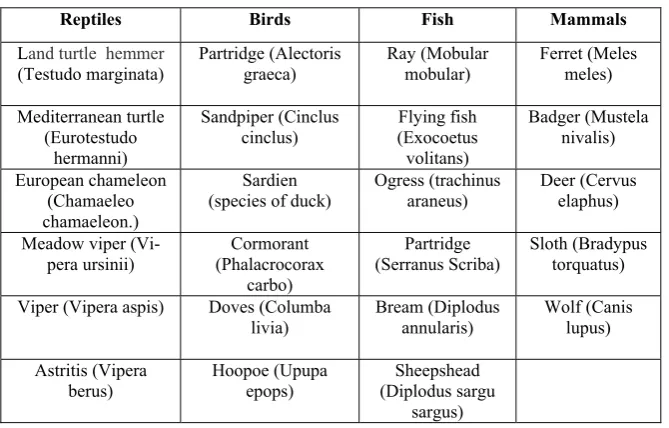
It is considered that in our approach it is impossible to introduce the types of living beings (here animals) as a biological species (taxa) in the modern sense of the term. In contrast, we use the concept of typological kind, which it may derive from theoretical framework where the notion of classification is recognized and becomes accepted without resorting to the theory of evolution, but it does not contrast with the concept of biological species. The typological (or morphological) type is considered to be a separate and stable entity, where the species are determined by fixed, key characteristics, usually morphologically. Scientists officially recognized a kind by defining a sample type that was recorded and deposited to a museum in order to represent the ideal form or morphology of the species' (Hickman, Roberts & Larson, 2001). It is considered that this choice doesn’t represent, at first an epistemological rupture between children’s conceptions (who use mainly anthropomorphic or functional criteria to classify animals) and the knowledge where the criteria for classification of animals are purely morphological. It is also assumed, that the transition from the empirical criteria to criteria concerning the theory of evolution would be difficult or impossible because of the enormous distance between the two cognitive structures. So, the conceptual component of the proposed school knowledge is established, firstly as a didactic transformation of knowledge of the typological species and secondly, as a simplification of the collections of the Museum of Zoology of the University of Patras used as a museum reference. There are created, simple collections (Lecointre et al., 2007) and were formed four typological species, reptiles, birds, fish and mammals. These categories do not have a phylogenetic significance, but they can be distinct categories at the level of school knowledge without losing completely the epistemological validity of the knowledge of reference (Lecointre et al., 2007, p. 26). As main morphological features of distinction between typological species were considered the anatomical characteristics and the nature of the skin (scales for reptiles, feathers for birds, scales for fish and hair for mammals). Yet they were established collections of samples of animals which form the phe-nomenological basis of intervention. These collections contain samples of the above categories and are referring detailed in Tables 1a and 1b.
As for the methodological dimension of the proposed school knowledge, the emphasis is given on the process of systematic observation of animals which responds to specific questions, is used to confirm some assumptions and is based on finding criteria of similarity or comparison (Guichard, 1998; Lecointre et al., 2007).
Reptiles Birds Fish Mammals
Greek Land Snake (Hourglass Sand) Pheasant (Phasianus colchicus) Ray (Mobular mobular) Ferret (Martes foina)
Greek land turtle
(Testudo graeca) (Gypaetus Seagull barbatus)
Daurade Royale
(Sparus aurata) Fox (Vulpes zerda)
Monkey
Otter (Lutra
[image:3.595.146.451.82.207.2]lutra)
Table 1a. Collections of animals (Pre - Post Test)
Reptiles Birds Fish Mammals
Land turtle hemmer
(Testudo marginata) Partridge (Alectoris graeca) Ray (Mobular mobular) Ferret (Meles meles)
Mediterranean turtle (Eurotestudo hermanni) Sandpiper (Cinclus cinclus) Flying fish (Exocoetus volitans) Badger (Mustela nivalis) European chameleon (Chamaeleo chamaeleon.) Sardien
(species of duck) Ogress (trachinus araneus) Deer (Cervus elaphus)
Meadow viper (Vi-pera ursinii) Cormorant (Phalacrocorax carbo) Partridge (Serranus Scriba) Sloth (Bradypus torquatus)
Viper (Vipera aspis) Doves (Columba
livia) Bream (Diplodus annularis) Wolf (Canis lupus)
Astritis (Vipera
[image:3.595.132.467.243.457.2]berus) Hoopoe (Upupa epops) (Diplodus sargu Sheepshead sargus)
Table 1b. Collections of animals (Before- During- After the visit to the museum)
(c) The educational environment. Finally, the educational environment in which will be implement the teaching intervention
,
was chosen to approximate three phases, each of which implemented in a formal (school) or non formal (museum) learning environment (Table 2).Each of the three instructional phases corresponds to qualitatively different educational activities (Allard, Boucher & Forest, 1994; Paquin, 1998). In the preparation phase before the visit, which takes place in school, questions are submitted and a discussion is developed concerning the museum object. On the phase during the visit which takes place in the museum, is carried out the data collection and analysis as well as the systematic observation of the museum object. Finally, in the phase after the visit which takes place in school, the aim is the further processing of data obtained in the previous phase, the drawing of conclusions and the evaluation of the constructed knowledge. This approach is based on an inquiry-based teaching and learning method engaging stu-dents in identifying relevant evidence and reflecting on its interpretations (Worth, Duque & Saltiel, 2009).
Before the visit School Preparation Submit Question Reflections on the museum object
During the visit Museum Completion Data collection and analysis Observation of museum ob-jects
After the visit School Extension Analysis and synthe-sis Building knowledge through museum objects
[image:3.595.133.465.245.458.2]Objectives and content of teaching intervention
The cognitive objectives of teaching intervention which correspond to the desired cognitive progress of children are the following: (a) the familiarization of children with various samples of animals, (b) the movement of children’s ideas from using anthropomorphic or functional criteria to the use of morphological criteria for classification of animal samples, (c) the identification of new samples of animals with one of the constructed categories of animals and (d) the creation of a new class of animals in case of the animal sample does not fit in any of the constructed categories. Then we describe the key features of teaching activities which we assume that will contribute to the achievement of these objectives.
Activities prior to the visit
The activities carried out before the visit included activities where, according to the principles of constructivist approach, are investigated primarily the initial conceptions of children on the subject of teaching intervention. Within these activities the children are asked to recognize and name the samples of animals which are depicted in a series of cards which constitute the first simple collection of animals. In addition, children are asked to create groups of animals by classifying the various samples of animals which are depicted on the cards and indicate the criteria used. Finally, there are activities aimed at developing children's interest on their visit to a museum of Zoology
.
Activities during the visit
These activities are carried out during the visit to the Museum of Zoology of the University of Patras. This particular museum exhibits mainly taxidermied animals placed in showcases that correspond to categories of animals, perfectly compatible with the typological categories of items that we seek to be constructed by children. There were introduced activities where children, through systematic observations, were asked to deconstruct the categories of animals that have been created in school and to compare their own categories with the categories adopted by the museum. Finally, children are asked to reconstitute the animal categories based on their observations and the emergence of common morphological features for each category. An example of an educational activity that took place in this phase is represented in Table 3.
Educational Activity Cognitive Objectives
- The teacher - researcher asks the children to deconstruct the groups of samples of which were created at school and they are invited to put the cards which depict animal sam-ples in the respective proposed showcases of the museum.
- Subsequently the children are asked to construct groups of animals, placing the pictures with samples of animals placed in the same and / or in adjacent showcases in the same group.
- Finally, children are invited to make assumptions for the reasons in which specific samples of animals belong in different groups of animals which were formed, turning the debate on the existence of morphological similarity criteria.
Children have
- to identify and name images of samples of animals through systematic observation.
- to modify the criteria of grouping of animal samples by using morphological criteria.
Table 3. Educational activity during the visit to the museum of Zoology
Activities after the visit
Epilogue
The teaching intervention, the basic principles and the content of which is presented in this work, will be implemented in classrooms in order to confirm or reject the hypothesis that preschoolers can build a precursor model of classification of animals with the help of sources, that are provided by a museum of Zoology. The first results of a pilot study which was held last year were already encouraging (Gouskou & Koliopoulos, 2011).
References
Allard, M., Boucher, S., & Forest, L. (1994). The museum and the School. Mc Gill Journal of Education, 29(2), 197-212.
Anderson, D.,Piscitelli, B., Weier K., Everett, M., & Tayler, C. (2010). Children's Museum Experiences: Identi-fying Powerful Mediators of Learning. Curator. The Museum Journal, 45(3), 213-231.
Arapaki, X., & Zafrana, M. (2004). The artistic expression of kindergarten children after a 'guided' teaching ap-proach. European Early Childhood Education Research Journal, 12(2), 43-58.
Lecointre, G. (Ed.) (2007). Comprendre et enseigner la classification du vivant. Paris : Belin.
Gouskou, E., & Koliopoulos, D. (2011). Teaching animal categorization in preschoolers using typical & non typical educational environments. Paper presented at the biannual conference of the European Science Education Research Association, 5-9 September, Lyon, France.
Guichard, J. (1998). Observer pour comprendre les sciences de la vie et de la terre. Paris : Hachette.
Hickman, C., Roberts, L., & Larson, A. (2001). Integrated Principles of Zoology. New York: McGraw-Hill Higher Education.
Kattmann, U. (1998). Do students have an implicit theory of animal kinship? In B. Andersson et al. (Eds.), Re-search in Didaktik of Biology (pp. 61-83), Göteborg: University of Göteborg.
Koliopoulos, D & Argyropoulou, M. (2011). Constructing qualitative energy concepts in a formal educational context with 6 – 7 year old students. Review of Science, Mathematics and ICT Education, 5(1), 63-80. Mayr, E. (1982). The growth of biological thought. Diversity, Evolution and Inheritance. Cambridge, Mass., and
London: The Beknap Press of Harvard University Press.
Paquin, M., (1998). La visite scolaire au musée. Stratégies pédagogiques pour une participation active des élè-ves de l’élémentaire. Paris : Les Presses Inter Universitaires.
Ravanis, Κ. (1996). Stratégies d’interventions didactiques pour l’initiation des enfants de l’école maternelle.
Spirale, 17, 161-176.
Ravanis, K.(2005).Les Sciences Physiques à l’école maternelle: éléments théoriques d’un cadre sociocognitif pour la construction des connaissances et/ou le développement des activités didactiques. International Re-view of Education, 51(2/3), 201-218.
Ravanis, K., Koliopoulos, D., & Boilevin, J.-M. (2008). Construction of a Precursor Model for the Concept of Rolling Friction in the Thought of Preschool Age Children: A Socio-cognitive Teaching Intervention. Re-search in Science Education, 38(4), 421-434.
Trowbridge, J., & Mintzes, J. (1988). Alternative conceptions in animal classification: A cross-age study. Jour-nal of Research in Science Teaching, 25(7), 547-571.
Worth, K., Duque, M., & Saltiel, E. (2009). Designing and implementing inquiry –based science units for pri-mary education. Paris: The Pollen FP 6 project.