ROAR, the University of East London Institutional Repository:
This paper is made available online in accordance with publisher policies. Please
scroll down to view the document itself. Please refer to the repository record for this
item and our policy information available from the repository home page for further
information.
To see the final version of this paper please visit the publisher’s website.
Access to the published version may require a subscription.
Author(s):
Maryam Yarandi, Abdel-Rahman Tawil
,
Hossein Jahankhani,
Article Title:
Adaptive e-learning system using ontology
Year of publication:
2011
Citation:
Yarandi, M., Tawil, A-R., Jahankhani, H. (2011) Adaptive e-learning
system using ontology',
22
ndInternational Workshop on Database and Expert
Systems Applications (DEXA),
Toulouse, France, 29 August-2 September 2011.
IEEE Computer Society, pp. 511-516. DOI 10.1109/DEXA.2011.9
Link to published version:
Publisher statement:
"(c) 2011 IEEE. Personal use of this material is permitted. Permission from IEEE
must be obtained for all other users, including reprinting/ republishing this material for
advertising or promotional purposes, creating new collective works for resale or
redistribution to servers or lists, or reuse of any copyrighted components of this work
in other works."
Information on how to cite items within roar@uel:
Adaptive E-Learning System Using Ontology
Maryam Yarandi, Abdel-Rahman Tawil, Hossein Jahankhani
School of Computing Information Technology and Engineering University of East London
London, UK
0934309
,
A.R.Tawil,
[email protected]Abstract -This paper proposes an innovative ontological approach to design a personalised e-learning system which creates a tailored workflow for individual learner. Moreover, the learning content and sequencing logic is separated into content model and pedagogical model to increase the reusability and flexibility of the system.
Keywords – WorkFlow; Adaptive Systems; Personalised Learning; E-Learning; Semantic technology; Ontology;
I. INTRODUCTION
Nowadays, e-learning needs to be more adaptive and flexible to support the learner. Typically, traditional learning systems ignore personalisation features such as difference in learning styles, abilities, knowledge levels and backgrounds. With the lack of this background knowledge about individual learners, the learning workflow model is not adapted to the specific needs of the individual learners, which results in delivering the same learning workflow to all learners. In order to design an adaptive learning workflow, we need to enable delivery of learning content according to particular learner’s needs.
Furthermore, recent developments of semantic web technologies have shown a trend of using ontology to promote adaptive learning workflow which allows us to create specific user profiles and content model. Boyce, S. et al. [1] emphasizes that the use of ontologies has been very successful in the instructional design and the development of course content. They support instructors on content creation or learners on accessing content in a knowledge-guided way.
This paper proposed a novel approach for developing personalised e-learning systems to offer tailored workflow which represents the different activities that should be done by a particular learner. The strength of this study is creating ontological user model, content model and pedagogical model separately to increase the flexibility and reusability of the system.
II. RELATED WORK
In the last ten years, increasing research has been seen on designing personalised learning systems to deliver learning content according to particular learner’s needs. Chen et al presented a personalised e-learning system using item response theory which provides personalised learning according to difficulty parameters of course materials and learners’ responses [2]. They proposed some personalised learning systems namely personalised curriculum sequencing during learning processes[3], a personalised intelligent
mobile learning system (PIMS) to promote the reading ability of English news for individual learners [4], a personalised mobile learning system based on item response theory which considers vocabulary ability of the learner and learning memory cycle to provide personalised learning[5]. Baylari et al has presented a personalised multi-agent e-learning system which presents adaptive tests and acts as a human instructor and gives the learners a friendly and personalised teaching environment [6].
Recent developments of semantic web technologies have shown a trend of using ontology to promote adaptive learning services which allows us to create specific user profiles that can assist during the learning process. Vassileva et al [7] design a platform which consist of authoring tool, instructor tool and adaptation engine controlling the content delivery adaptable to individual learners. For this purpose, system actors should follow specific workflows of adaptive courseware design and delivery. In this system authors have to design learning ontology graphs organizing multimedia learning objects (LOs), and metadata for both the ontology and LOs. The workflows of activities include content authors, course instructors, supervisors of the engine controlling adaptation processed and, finally, the learners. Lin et al [8]describe an innovative and flexible learning environment supported by workflow technology called Flex-el. The underlying learning strategy of Flex-eL provides flexible learning pathways and possibly brings the virtual university concept closer to reality.
Some researchers use ontologies to model user profile in different applications like semantic web searching, information retrieval system, natural language processing. Gemmis et al [9] proposed an extension of the vector space retrieval model in which user profiles learned by a content-based recommender system. Pan et al developed a semantic-based search method for personalised e-learning. They designed learner ontology and learning resource ontology for semantic analysis and algorithm for ontology semantic [10].
This paper presents a theoretical model to develop a personalised e-learning system that creates, at runtime, tailored workflow for learner. Additionally, ontological learner model, content model and pedagogical model increase the flexibility and generalizability of system.
III.PERSONALISED LEARNING WORKFLOW
aims to design an e-learning system to offer personalised workflow of learning for particular learners. In this way, system designs separate user, content and pedagogical model to facilitate flexible adaptation of content delivery.
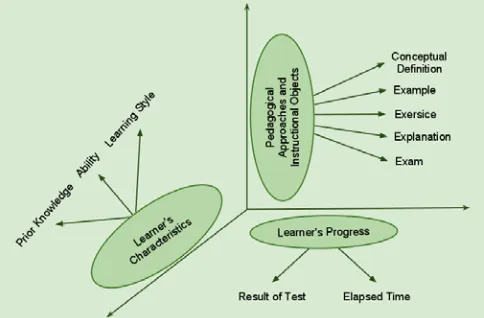
According to Conlan [11], “E-Learning courses typically differ strongly in ethos, learning goals and pedagogical approach whilst learners, even within the same course, may have different personal learning goals, motivations, prior knowledge and learning style preferences.” Therefore, the workflow which presents different steps of learning is tailored from three aspects which are showed in figure 1.
• Pedagogical approaches and instructional designs. Equivalent workflows covering same course are produced by applying different pedagogical approaches and instructional objects such as conceptual definition, examples, practices and explanations.
• Learner’s characteristics such as prior knowledge, ability and learning styles. The system creates tailored workflows that, while dealing with the same content, can be structured in different ways that support different learning preferences based on the learner’s profile.
• The progress of each individual learner at each step of the learning process based on the result of regular post-tests given by the learner and comparison of the elapsed time by learner and suggested time by system on current step.
[image:3.612.55.297.446.605.2]The proposed system monitors learners at each step of learning to determine his gained knowledge to create a tailored workflow. For this purpose, the regular post-tests are given by the learner at each step of the learning process and also the elapsed time by the learner is calculated.
Figure 1: Three Dimension of Personalisation
A key technical problem in developing personalised applications is the issue of how to build precise and complete learner models for individual learner and how these can be used to recognise a learner and describe his or her behaviour. The objective of learner modelling is the generation of an information base that contains the preferences, characteristics and activities of the learner [12].
IV. DOMAIN ONTOLOGY
Ontology is a branch of philosophy which has been widely used in recent years in the field of Artificial Intelligence and computer and information science, especially in domains such as intelligent information integration, cooperative information systems, knowledge representation, information retrieval and extraction, work flow and database management systems [13]. Available literature on ontological engineering points to a number of definitions for describing what ontology is. One of the most widely definition of ontology is: Ontology is a formal, explicit specification of a conceptualisation [14].
Smrz[15] highlights that the role of ontology in the field of web-based learning is often underestimated. Ontologies have been used to describe learners and their profile also to design the learning content and the relation between learning concepts.
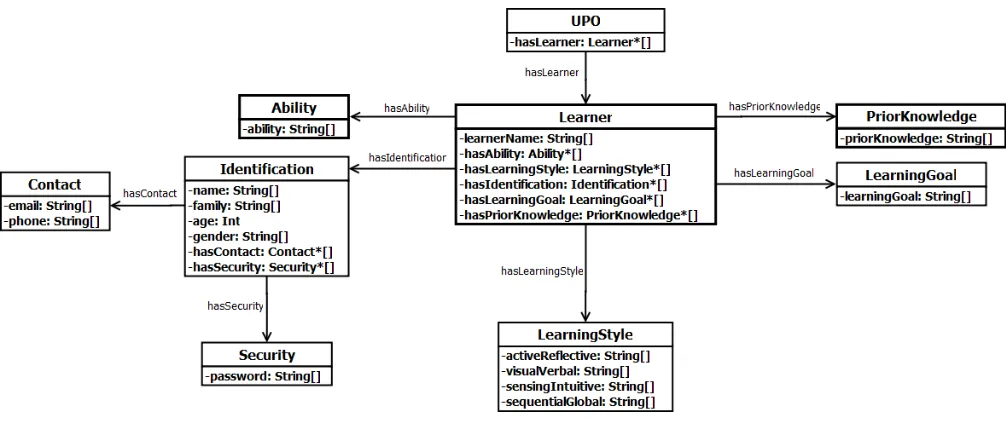
Figure 2: The class hierarchy of the ontology user profile
User Profile Ontology (UPO) involves several Learner classes which includes learners’ profiles. The Learner class is a central class as it includes all the properties of a learner. They may be data type properties such as learnerName as the identifier of the learner, or may be object properties in order to have a relation with other classes. Learner’s characteristics may influence how the learner interacts with a learning system are learner’s ability, learning goals, learning style and prior Knowledge. The hasAbility property points to the Ability class which presents the ability of learner. In order to estimate the learner’s ability, the results of some regular activities are fed into Item response Theory formulas and the output of the formulas is saved in the Ability class. The hasPriorKnowledge points to the PriorKnowledge class which present the background Knowledge of the learner. Based on the prior knowledge of learner the appropriate topic will be selected for the learner. The learner’s goal which is presented in LearningGoal class is a description of
what learners are trying to achieve through a learning process. It is pointed by hasLearningGoal property. The
hasLearningStyle points to the LearningStyle class which describe the learner’s learning style based on Felder-Silverman Learning Style Model[16]. This model has four dimensions namely active-reflective, visual-verbal, sensing-intuitive and sequential-global. The learningStyle class presents these dimensions through the four data properties from the type integer. Based on the information in the user profile, appropriate contents are provided to the learner. The Identification, Security and contact class is defined to identify a particular learner.
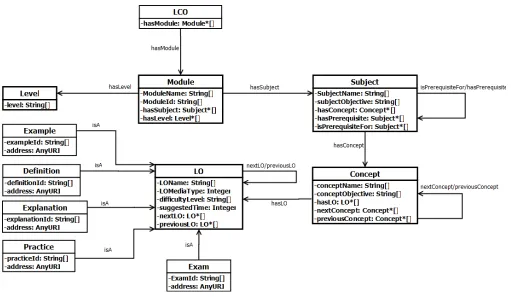
Figure 3: The Class Hierarchy of the Learning Content Ontology
The LCO is composed of several Modules (hasModule) which describes the complex learning module. In specific, the Module provides information about the content which is taught by the Module and its suitability for different learners at different levels. A Module consists of several Subjects (hasSubject) which has some Concepts (hasConcept). In particular, the hasSubject property points to the set of Subjects that compose a Module. The subject class comprises the knowledge about different subjects required by the learner to successfully complete the module. This class contains data type properties subjectName for the identifier of the class and subjectObjective points a set of objectives that should be achieved after studying the subject. It also contains object properties in order to have a relation with other classes. The hasConcept property points to the collection of Concepts which has a hasObjective property in order to represent the objective of the concept.
Concepts within LCO possesses different Learning Objects (LO) which covers same content but they have various learning properties such as difficulty level (high, fair, low), media Type(text, audio, video and image), and Suggested time for doing this LO. Each LO has different instructional types such as conceptual Definition, Example, Explanation, practice and Exam. LOs are differentiated by their properties and an individual LO may be selected through reasoning over these properties.
V. WORKFLOW ONTOLOGY
The study of workflow shows that a workflow consists of a sequence of activities, declared as work of a person or a group of persons.[17] In the proposed personalised e-learning system, a person is a learner who should perform the adaptive sequencing of activities for achieving the given learning objective. However, these activities and the order that they are performed changes depending on learners and based on their learner models. Therefore, the system uses adaptive learning workflows to infer the requirements of a learner and modify the workflow accordingly.
According to Buhler et al. [18] Adaptive workflows respond to changing conditions through adaptive change. Our system uses adaptive learning workflow that allows the learner to select different learning activities and perform them on-the-fly with the support from an ontological knowledge base. The system also uses knowledge and rule based mechanism for dynamic workflow adaptation to change the learning process as the learners show progress. Accordingly, ontology models support adaptive workflow or flexible workflow construction.
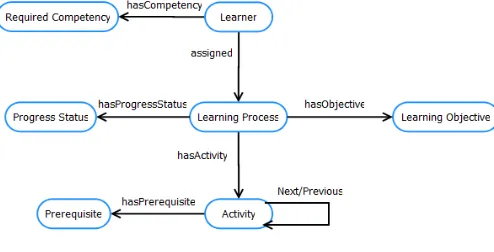
process. It means that, each learner follows a set of activities to achieve a Learning Objective. The sequenced Activities should be achieved by a particular learner for completing a Learning Process. The Activities are suggested based on required competencies which are obtained from the associated learner model. The prerequisite class in Figure 4 is defined for each particular activity. In order to complete a Learning Process,the learner must select some suggested activities which they have fulfilled their prerequisites. In each step of the Learning Process, activities are updated based on the progress of the learner.
Figure 4: The Workflow Ontology
The proposed ontology on a meta-model layer covers an adaptive workflow that is typically used to guide the construction of the learning flow for individual learners. This personalised and adaptive workflow is used to improve the quality of learning for learners.
VI. CONCLUSION
E-learning is a flexible way of learning as it is readily accessible, anywhere, anytime, any pace and ubiquitous which makes learning a rewarding lifelong process.
This paper presents a personalised e-learning system to create a tailored workflow for individual learners. The personalised workflow containing a number of different LO which is tailored to a particular learner based on information in the learner model. Moreover, Different LOs which cover same learning content but they are varied in instructional type, media type and difficulty level is defined in an ontological content model. In addition, a seed for an ontological meta-model is proposed to model adaptive learning workflow which supports personalised e-learning courses.
The proposed personalised learning system also monitors learners at each step of the learning process based on the regular given test or feedback to select the most appropriate next level of learning. The system should recognise changes in the learner’s knowledge as they progress and update the learner model accordingly.
REFERENCES
[1] S. Boyce and C. Pahl, "Developing domain ontologies for
course content," Educational Technology & Society, vol. 10, pp. 275-288, 2007.
[2] C.-M. Chen, et al., "Personalised e-learning system using item
response theory," Computers & Education, vol. 44, pp. 237 - 255, 2005.
[3] C.-M. Chen, "Intelligent web-based learning system with
personalized learning path guidance," Computers & Education, vol. 51, pp. 787-814, 2008.
[4] C.-M. Chen and S.-H. Hsu, "PersonalizediIntelligent mobile
learning system for supporting effective english learning," Educational Technology & Society, vol. 11, pp. 153-180, 2008.
[5] C.-M. Chen and C.-J. Chung, "Personalized mobile English
vocabulary learning system based on item response theory and learning memory cycle," Computers & Education vol. 51, pp. 624-647, 2008.
[6] A. Baylari and G. A. Montazer, "Design a personalized
e-learning system based on item response theory and artificial neural network approach," Expert Systems with Applications, vol. 36, pp. 8013-8021, 2009.
[7] D. Vassileva and B. Bontchev, "Activities workflow of
adaptive courseware design and delivery," in IADIS International Conference MCCSIS 2009, Algarve, Portugal, 2009, pp. 223 – 230.
[8] J. Lin, et al., "Using workflow technology to manage flexible
e-learning services," International Forum of Educational Technology & Society vol. 5, pp. 116-123, 2002.
[9] M. d. Gemmis, et al., "A retrieval model for personalized
searching relying on content-based user profiles," presented at the Association for the Advancement of Artificial Intelligence, 2008.
[10] J. Pan, et al., "A personalized semantic search method for intelligent e-learning," presented at the International Conference on Intelligent Pervasive Computing, Washington, DC, USA 2007.
[11] O. Conlan, "The multi-model, metadata driven approach to personalised elearning services," Doctor of Philosophy, Department of Computer Science, University of Dublin,Trinity College, Dublin, 2006.
[12] G. Adomavicious and A. Tuzhilin, "User profiling in personalization applications through rule discovery and validation," presented at the Fifth International Conference on Data Mining and Knowledge Discovery (KDD 99), 1999. [13] C. Snae and M. Brueckner, "Ontology-driven e-learning
system based on roles and activities for Thai learning environment " Interdisciplinary Journal of E-Learning and Learning Objects, vol. 3, pp. 1-17, 2007.
[14] T. R. Gruber, "A translation approach to portable ontology specification " Knowledge Acquisition, vol. 5, pp. 199-220, 1993.
[15] P. Smrž, " Integrating ontologies into learning management systems – A case of Czech," presented at the Proceedings of the Workshop on Ontologies, Semantics, and E-learning (WOSE 2004) in On the Move to Meaningful Internet Systems 2004, Berlin, 2004.
[17] W. v. d. Aalst and K. v. Hee, Workflow management models, methods, and systems, MIT Press: Cambridge, 2002.