By-Products
Londero, Elio
2000
by Elio Londero *
First version: July, 1999 Revised version: June, 2000
Abstract
This paper distinguishes between by-products of the activity and those associated to changes in the demand for another jointly-produced output, attempts to define when one or more jointly-produced outputs would be by-products of the activity and others would be produced at the margin, and explores the conditions that would result in one or more jointly-produced outputs to be, or behave like, by-products of the activity. These conditions are expected to help in sorting out by-products from marginally produced outputs in the preparation of cost structures for analytic work.
J.E.L. classification: D21, D57, C81
Keywords: by-products, input-output, joint production
* Inter-American Development Bank. Opinions expressed in this paper are those of the author and are not intended to represent views of the Bank. Comments by Javier León, Simón Teitel, and two anonymous referees are gratefully acknowledged. This is an Accepted Manuscript of an article published by Taylor & Francis in Economic Systems Research on 01 Jul 2010, available online:
by Elio Londero*
1. Introduction
The correct identification and treatment of by-products is an important aspect of applied
economic work at the product level. This is the case of the preparation of commodity by
commodity matrices under the commodity technology assumption, since errors in the
classification and treatment of by-products would yield incorrect results (ten Raa et al., 1984;
Londero, 1990), including the possibility of unwarranted negative coefficients (Londero, 1999).
It is also crucial in the preparation of cost structures for estimating the effects of changes in the
demand for specific outputs (e.g., shadow prices, domestic resource costs), since an increase in
the demand for one output may lead to additional costs as well as to increases in the supply of
its by-products (Londero, 1992, section 3.5). Finally, proper accounting for by-products,
particularly nontraded ones, is important for the correct calculation of effective protection
coefficients (Greenaway, Reed and Hassan, 1994; Londero, 2000).
This paper discusses two different types of by-products: those of the activity, and those
associated to changes in the demand for one of two or more joint outputs that are produced at the
margin, or by-products of the output for short. It then attempts to define when one or more
jointly-produced outputs would be by-products of the activity and others would be produced at
the margin. The conditions that would result in one or more jointly-produced outputs to be or
behave like by-products of the activity are also explored. These conditions are expected to help
preparation of cost structures for applied work.
2. Some Definitions
An activity or production process is the smallest possible breakdown of a productive unit that
allows for the allocation of inputs to outputs. In practice, however, transaction costs lead to core
groups of activities to be performed under what appears to be a single process, and it is with
respect to these core that activities are normally defined in applied economics. Therefore, the
groupings that constitute the operational definitions of activities may change over time due to
changes in transaction costs.
An activity may yield one or more outputs, and it will be called respectively a
single-product or a multiple-single-product activity. The activity or single-production process yielding multiple
outputs is called a joint production process, and the outputs of such activity are called joint
outputs (Stone, 1961, Chapter 2; United Nations, 1966, 2.45, 2,58; United Nations, 1993, 5.43).
For example, slaughterhouses yield meat, raw hides, and other joint outputs. Nuclear plants yield
electricity and radioactive waste. Joint production could be in fixed proportions (like meat and
hides), or there could be some transformation in production (like in some petroleum refineries).
From now on, unless it is explicitly stated, only joint production in fixed proportions will be
considered. Note that the analytical definitions of activity is technical, rather than economic; its
operational definition, however, is affected by economic factors and the result of practical
considerations.
Nations (1993, 15.13) defines it as the part of an institutional unit that “engages in only a single
kind of productive activity at a single location.” While conceptually desirable, this strict
definition of establishment is often not operational, particularly in less developed countries. In
practice, an establishment is often the facility where one or more activities or production
processes take place; it is closer to the definition of a plant (United Nations, 1966, 2.8) than to
the strict definition proposed by United Nations (1993).
The activity yielding the highest value of production in the establishment is called
conventionally the principal activity, and its outputs principal outputs. The remaining activities1
are called secondary and their outputs secondary outputs (United Nations, 1993, 5.8). A dairy
establishment, characterized by its principal activity yielding milk and calves as joint outputs,
may also produce poultry as a secondary activity yielding chicken, manure and pollution as joint
secondary outputs. While distinguishing the activities that take place in an establishment is very2
important for the preparation of cost structures, the definitions of principal and secondary
activities are conventional.
An output is said to be fully produced at the margin (or simply produced) for an activity
if a demand change is met in its entirety by a change in production. It is fully traded if a demand
change is met in its entirety by changes in imports and exports. The output would be nontraded
and only partially produced at the margin if adjustment includes both changes in production and
in consumption due to, for example, price increases. It would be partially traded if the domestic
demand change is met partially by changing imports or exports and partially by changing
The reader should be aware that while the definitions presented in this section are
consistent with the conventional use of the terms, a review of the literature will show that many
authors (including this one) have not been always fully consistent in their use. The definitions
adopted in this article are similar to those of United Nations (1966, section 2.45), but differ
somewhat from those used in United Nations (1993, Chapters V and XV; 1999, Chapter IV).
It is not the intention of this article to review these United Nations definitions, but to provide an
analytically based definition of by-products that is consistent with the traditional meaning of
“unintended results” (Webster, 1986) and useful for the analytical work at the product level.
3. By-Products
Consider the simple case of the joint production of a and b in fixed proportions, initially at
0 0
market equilibrium levels (a, b ). It will be said that 3 b is a by-product of the a-producing
activity for condition c when a small change in such condition for a (dca) results in changes in
the production of both a and b, while a small change in the same condition for b (dcb) does not
affect production decisions. That is, b would be a by-product of the a-producing activity k if
k k
Ma /Mca > 0 and Ma /Mcb = 0. In this case, we will say that a is produced at the margin for
condition c, and that b is a by-product of the a-producing activity for that same condition.
From a practical point of view, the most important case is that of changes in domestic
demand. Following the above definition, an output b jointly produced with a will be said to be
a by-product of the a-producing activity when an increase in the demand for a would lead to an
the preceding case, a would be (at least partially) produced at the margin for demand changes,
and b would be a by-product of the a-producing activity for that same condition.
According to the preceding definition, when profit-maximizing producers are price
takers, neither one of two jointly produced, fully traded outputs would be by-products for
changes in domestic demand. Such a situation follows from the definition of a marginally traded
good, for which marginal revenue is not affected by changes in domestic demand. However,
changes in international conditions may help in identifying by-products of activities producing
marginally traded outputs. Marginally traded output b would be a by-product of the a-producing
activity when an increase in the international price of a would lead to an increase in the
production of both, while an increase in the international price of b would not affect production
levels in that same activity.
It follows that a traded good that is produced at the margin for price increases may be
jointly produced with a nontraded by-product of the activity. Also, a good that is produced at
the margin for domestic demand increases may be jointly produced with another that could be
a traded by-product of the activity for price increases.
From the cost side, the distinction is more difficult in practice since the existence of a
common cost function would result in changes in input costs leading to price changes of both
outputs, although for different reasons. Take, for example, the case of a cost increase. The price
of the good that is produced at the margin would increase because the cost increase would lead
to a price increase. The price of the by-products of the activity may also increase because
of the by-products, and that may in turn lead to increases in their prices.
One or more jointly produced outputs could be by-products of one activity and produced
at the margin by others (United Nations, 1966). For example, this would be the case of ethylene,
which may behave as a by-product of petroleum refining, and it may also be deliberately
separated from natural gas. In the preparation of input-output tables, these situations lend
themselves to the incorrect classification of by-products of an activity as secondary outputs, and
in turn lead to errors in the preparation of commodity by commodity matrices under the
commodity technology assumption including unwarranted negative coefficients (Londero, 1999).
There is another different, but also important meaning behind the designation of an
output as a by-product. Consider n jointly produced outputs, all of which are produced at the
margin for the activity, since a demand increase for any of them would lead to an increase in its
production and thus in total output. In such a case, for each of the j = 1,..., n joint outputs there
will be a cost structure with n - 1 by-products associated to increases in the demand for j, the
by-products of j, since a demand increase for any of the outputs would lead to supply increases for
all n of them. None of them, however, would be a by-product of the activity, because a demand
increase for any of the n outputs would lead to additional production by the activity. Therefore,
in this case there would be one activity and all of its outputs will be produced at the margin.
There would be n commodity cost structures, each one of them with n - 1 by-products of the
corresponding output. In contrast, by-products of an activity do not have associated cost
structures originating in such activity.4
identify by-products of an activity. For example, institutional arrangements may impose
constraints to the operation of a production facility, resulting in one output being a by-product
of that production process. That would be the case, for example, of a hydroelectric facility
providing excess water for irrigation. In this case, the by-product nature of the water for
irrigation would result from the unconstrained operation of the dam for electricity generation,
and may be identified when looking at the actual use of the water when there are changes in the
demand for electricity.
From a longer term perspective, it should be noted that institutional and technological
change may alter the by-product status of a jointly-produced output. For example, in the
Argentina of the XVIII century, beef output seems to have behaved as a by-product of the
export-oriented, hide-producing activity. Reductions in the price of salt (nontraded) and trade
liberalization led to a great increase in the production of jerked beef, that resulted in an increase
in the share of beef in total value of production. At that time, probably both outputs were
produced at the margin, and demand increases for either one resulted in production increases of
both, one as the by-product of its joint output whose demand increased (but not as a by-product
of the activity). Technological advances in refrigeration allowed for exports of refrigerated beef
around 1890, eventually making hides to behave as a by-product of the export-oriented,
beef-producing activity (Giberti, 1981).
A comparison with the definitions used in United Nations publications shows that there
has not been a consistent use of the terms. United Nations (1993, 15.19) defines by-product as
according to this definition, all joint outputs except one would be by-products, and an output
could be a by-product of an activity and be (at least partially) produced at the margin by the same
activity. The difficulties with this definition seem to result from not distinguishing by-products
of the activity, and thus considering only the possibility of by-products of one main output.
United Nations (1999, 4.11) does not provide a definition of by-products. It seems to consider
them as a type of secondary output, different from joint outputs. The examples provided,
however, clearly refer to joint outputs. United Nations (1966, 2.60), instead, provides definitions
very similar to the ones used in this article. It defines by-product as “A second class of
joint-products ... in which one of the joint-products is of distinctly lesser importance, so that it is
undesirable to use any accounting convention which would indicate that an increase in demand
for the by-product would lead to an increase in the output of the principal joint product.”
Finally, this article deals only with the case of outputs for which there are markets. Some
activities also produce outputs that affect, positively or negatively, production and consumption,
and for which there are no markets or prices. Such would be the case of, for example, pollution.
An increase in the demand of cleaner air may lead to additional costs to society, but not to
additional costs for the polluter, and therefore not to a reduction in pollution, making it a
by-product of the polluting activity. Note that the introduction of a price that the producer would5
have to pay for the pollution that generates could change the pollution’s classification as a
by-product of the activity, since an increase in the price of pollution may lead to a reduction in the
4. Basic Conditions: The Producers
When the criterion for setting production levels is profit maximization, it should be possible to
determine a rule linking marginal revenues and marginal cost that defines one or more members
of a set of jointly-produced outputs as by-products of the activity, the production level of which
is determined by the other outputs that are produced at the margin. Such an ex-ante rule may
help in identifying the conditions determining for one or more outputs to be by-products of the
activity.
The simplest model is that of price takers using the same technology, jointly-producing
two goods a and b, which are not substitutes nor complements, in fixed proportions such that
b = ß a [1]
0 0
Given common costs C(a), assume that the initial market equilibrium corresponds to (a , pa) and
0 0
(b, pb) in Figure 1. Maximum profits for the individual producer k would be
k 0 0 k0 0 k0 0 k0
ð(p , a pb) = a pa + b pb!C(a ) [2]
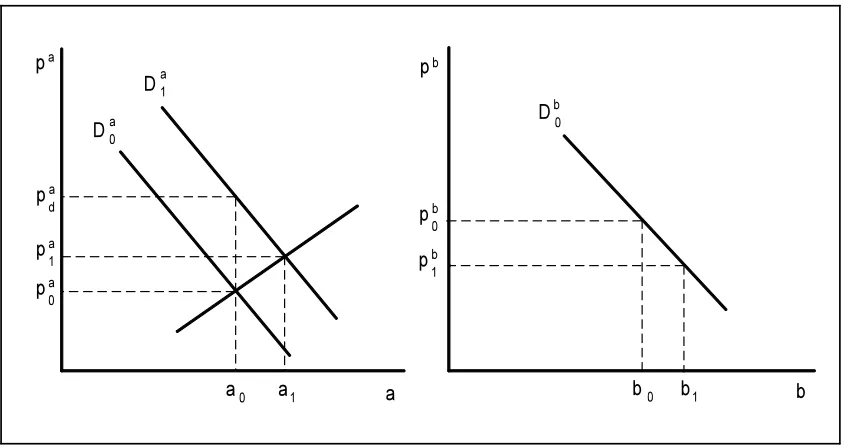
1 0 d
An increase in the demand for a (Da - Da in Figure 1) would initially raise its price to pa, where
subscript d indicates that it is a disequilibrium price. Consequently, activity profits for the
producer k would initially increase to
k d 0 k0 d k0 0 k0 k 0 0
ð(p , a pb) = a pa + b pb!C(a ) > ð(p , a pb) [3]
Figure 1. An increase in the demand for a. is, as long as
k d 0 k d c k
Mð(p , a pb) /Ma = pa + ßpb!MC/Ma > 0 [4]
c
where pb indicates a market clearing price in the market of b. In equilibrium, equation [4] would6
c k c
be equal to zero, and therefore pa = MC/Ma !ßpb where subscript c indicates market clearing
1 1
prices that correspond to prices pa and pb in Figure 1.
Since from equation [1] Mð/Mb = (Mð/Ma)(1/ß), the change in profits for the producer
attributable to increasing production in response to an increase in the demand for b would be
k c d k c d k
Mð(p , a pb) /Mb = (pa/ß) + pb! (1/ß) MC/Ma [5]
k 0 0
of a in this activity if, starting from an equilibrium position ð(pa, pb), it is verified that
k d 0 k d 0 k
Mð(p , a pb) /Mb = pa + ßpb!MC/Ma > 0
[6]
k 0 d k 0 d k
Mð(p , a pb) /Mb = pa/ß + pb! (1/ß) MC/Ma = 0
Equations [6] may be simplified by multiplying both sides of the second equation by ß, and
subtracting the equilibrium condition
0 0 k
pa + ßpb!MC/Ma = 0 [7]
from both equations in order to obtain
d 0 0 0
(pa!pa) = pa (dp /pa a) > 0
[8]
d 0 0 0
ß (pb!pb) = ßpb (dp /pb b) = 0
For profit-maximizing producers, equations [8] would be the condition for b to be a
by-product of the a-producing activity in the neighborhood of the initial equilibrium position
0 0 d 0
(a , pa). Since ß > 0, this condition implies pb !pb = 0, which could only happen if supply or
demand were infinitely elastic. Thus, in practice there would be very few activities yielding pure
by-products as defined by equations [8], since an increase in the demand for b would normally
d 0
lead to an increase in its price (pb!pb > 0). Regardless of how small ß or the price change may
be, the profit-maximizing assumption would dictate for production to be somewhat changed.7
In practice, however, the by-product nature of an output for certain activity would be
a-producing activity an empirical matter. It is whether the firm actually changes its production
when demand increases what matters. In some cases it would be the need to simplify the
modeling of cost and output data what may lead to classifying some outputs as by-products.
From this perspective, something may be said a priori about the likelihood of b behaving
(almost) as a by-product of the activity.
The smaller the total profits increase associated to the price increase of a jointly-produced
output, the less likely it seems for the producer to react and change its production level. From
equation [8], that profits condition translates into a revenue condition because costs are common.
The smaller b's revenue increase in comparison to that of the other output, the more likely it is
that b would behave as a by-product of the activity. That condition, may be represented by
0 0 0 0
ßpb (dp /pb b) pa (dp /pa a) [9]
where represents "much smaller than". Equation [9] indicates that the outcome will be
determined by a technological factor associated to the activity, the size of ß, the prices of the two
outputs, and the magnitude of the price increases. Market conditions determining the
proportional price increase will be considered in the next section. The remainder of this section
will discuss some of the implications of equation [9].
Equation [9] may also be expressed as
b 0 a 0
n (dp /pb b) n (dp /pa a) [10]
j 0 0
words, for equal proportional price increases, b would be more likely to behave as a by-product
of the a-producing activity the smaller b's share in total revenue in the initial equilibrium
position.8
b
If the price of b grows over time relative to that of a, increases in n may eventually make
b's price changes to become significant, so that a price increase for either jointly-produced output
may lead to an increase in production. This seems to have happened in the 1970s when increases
in the price of gold made it produced at the margin for mines where extraction rates had been
traditionally determined by another jointly-produced mineral. This situation was later reversed
when the price of gold declined in the 1980s. The increase in the price of gold also led, ceteris
paribus, to the increase in the supply of other minerals jointly extracted with gold.
Under the assumption of profit maximization, when a production process yields several
joint outputs (xi = 1, ..., n) that are not substitutes or complements, the condition for j to be a
by-product of the i-producing activity would be
d 0
(pi !pi) > 0
[11]
ji d 0 ß (pj!pj) = 0
ji
where ß = xj/xi. Output i will be the only joint output that is produced at the margin only if
equations [11] hold for each and every joint output j i. However, there could be more than one
output that is produced at the margin.
From the more practical point of view of the significance of the marginal revenue
1 2 n
n (dp1/p1) > n (dp2/p2) > ... > n (dpn/pn) [12]
In this ordering, for equal proportional price increases there could be a threshold participation
in total sales beyond which the firm would not react, converting all outputs beyond that threshold
in de facto by-products of the activity. Note that these shares may change over time as prices for
each output grow at different rates.
When there are several marketed joint outputs, it is possible that demand increases in the
markets of more than one by-product lead to an increase in total marginal revenue. The
aggregate effect of these demand increases may make additional production profitable or be
perceived as profitable, although individually, after the increase in total production has taken
place, some outputs continue to be produced at the margin and others continue to be (or behave
as) by-products of the activity. In other words, production may be increased in response to the
accumulation of price increases for the by-products, but an increase in the price of only one of
these outputs may not be enough to induce the production increase. For example, it is likely that
an increase in the demand for any by-product of beef production (say horns) would not lead in
isolation to an increase in the demand for cattle. However, a sufficient number of individual
demand increases for the by-products may eventually lead to an increase in the price of cattle,
since the accumulation of small increases in the prices of by-products may eventually generate
the required incentive to increase the demand for cattle. These cumulative effects may make the
practical identification of by-products of an activity more difficult.
among all joint outputs are different from zero, cross-price effects "may be of either sign
depending upon the particular form of the implicit production function" (Henderson and Quandt,
1971, section 3.8) while own price effects will follow intuition, that is
i i
Mq /Mp > 0
i j
Mq /Mp $# 0
Note than in this case, an increase in the demand for b may lead to a reduction in the supply of
a.
The possibility of substitution in production reduces the likelihood of finding by-products
of activities, because even when one output may represent a small share of total value of
production, substitutability in production would allow for adjustment to an additional demand
to take place without the need of increasing the production of the other outputs. Substitution
would prevent the associated price reductions from taking place and thus prevent reductions in
marginal revenue. However, transformation in production may be possible only among a subset9
of the joint outputs, leaving open the possibility for the other joint outputs to be by-products of
the activity.
Finally, when there us transformation in production the possibility of meeting an
additional demand for one of the joint outputs with reductions in the production levels of some
of the others creates the possibility of negative by-products of specific outputs. This is an
important consideration in the preparation of marginal cost structures (e.g., for estimating
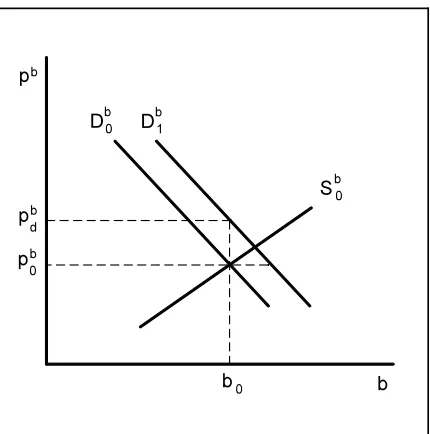
Figure 2. An increase in the demand for b. difference between average cost and marginal cost.
5. Basic Conditions: The Market
In many applications, it is the response to demand increases what is important to the economist.
If firms maximize profits, the preceding analysis has shown that, at the firm level, it is how these
demand increases translate into price increases what may be important in determining whether
an output could be expected to behave as a by-product of the activity.
Say that b is considered a likely by-product of the a-producing activity, and there is an
increase in the demand for b (Figure 2). The associated price increase may be approximated by
0
db db/b
0
dpb/pb = )))))))))))))))))))))) = ))))))))))))))) [13]
1 0 1 0 0 0 1 0 1 0 1 0
!Db(pb) çb(pb) + Sb(pb) åb(pb) !(1 + ä) çb(pb) + åb(pb)
1 0 1 0
where çb(pb) and åb(pb) are demand and supply
0
elasticities with respect to price valued at pb,
and ä is the proportional increase in demand at
0
price pb. Expression [13] shows that for a
given proportional increase in the demand for
b, the higher in absolute value the supply or demand
elasticities of b, the lower the price increase
would be. If, for example, producing a is the
substitutes, the price increase attributable to the additional demand is more likely to encourage
the additional joint production of a and b, since the whole effect of the additional demand would
be exerted upon the a-producing activity. If, however, b is also produced as a single or principal
output by other industries (that is, it is produced at the margin for those activities), the incentive
for the a-producing activity would be smaller the greater the supply elasticity of those other
activities. Similarly, if b has many close substitutes that are either traded at the margin or
produced at the margin with a high elasticity of supply with respect to price, the demand for b
would be very price-elastic and demand increases for b would have negligible effects on its price.
If those small effects on price combine with a low participation in the total sales of the a
-producing activity, it is more likely that b would behave as a by-product of the a-producing
activity.
6. Conclusions
This article proposed a set of definitions for classifying activities and outputs useful for
analytical work at the product level, and with emphasis in defining by-products. These
definitions are similar to the ones provided by United Nations (1966), but in the case of
by-products they are more general and rigorous, since by-by-products are not defined exclusively with
respect to demand changes, by-products of an activity are distinguished from those of a specific
joint output, and "lesser importance" is shown to be a condition resulting from the definition.
The analytical implications of using these definitions for classifying an output as a by-product
It was shown that the classification of an output as a by-product should specify the
condition for which it is a by-product; for example, changes in domestic demand, or changes in
international prices. It should also specify whether it is as a by-product of the activity, or of a
change in the condition for one of the other jointly produced outputs; for example, a by-product
of an increase in the demand for a joint output. If the output is classified as a by-product of an
activity, such activity should be specified, since the same good may be produced at the margin
by another activity. Care should be exercised in distinguishing secondary outputs from
by-products of activities that are produced at the margin by other activities.
In practice, very few joint products will satisfy the profit-maximizing conditions for being
true by-products of activities. When two or more outputs are jointly produced in fixed
proportions, it is more likely for some of them to behave as by-products of the activity, the
smaller their share in total revenue. Conversely, the higher an output's proportion in total sales,
the more likely for it to be produced at the margin for the activity. Also, given an output's share
in total revenue, the greater the market supply and demand price-elasticities, the more likely it
is that the joint output would behave as a by-product of the activity.
Changes in demand and technical progress may alter the way in which producers respond
to market changes. As a result, the classification of outputs as by-products of activities may
change over time.
When each of two or more outputs that are jointly-produced in fixed proportions accounts
for a significant share of total output value, it is likely that these outputs would be (at least
* Affiliation, disclaimer and acknowledgments (see footnote to cover).
1 United Nations (1993, 5.7) chose to select the activity with the highest value added.
2 There is a third type of activities called ancillary (United Nations 1993, Chapter V), which will not be considered here.
0 0 k k0
3. Total sales a are the sum of the sales by all individual producers k, that is, a = Ó a .
4 The commodity technology assumption requires that there is only one cost structure for each marginally produced output, not just for any output (cf. United Nations 1999, 4.67). Therefore, it allows for the existence of by-products, produced and nonproduced, originating in principal and secondary production (Londero, 1999).
5. Leontief (1970, 1973) and Leontief and Ford (1972) are early discussions of these issues in an input-output framework.
6. Coefficient ß appears in the marginal profit equation [4] to account for the fact that from [1], Mb/Ma = ß, that is, a unit increase in the production of a increases the supply of b in ß units.
7. "It is only when one of two things produced by the same process is valueless, unsaleable, and yet does not involve any expense for its removal, that there is no inducement to attempt to alter its amount; and, it is only in these exceptional cases that we have no means of assigning its separate supply price to each of the joint products.", (Marshall, 1890, chapter VI, § 4).
8. This may be the "distinctly lesser importance" mentioned in United Nations (1966, 2.60).
9. Marshall (1890, Ch. VI, § 4) notes that "the importation of foreign wool has caused English sheep to be adapted by judicious crossing and selection so as to develop heavy weights of good meat at an early age, even at the expense of some deterioration of their wool". Traxler this situation, a demand increase for any of them would lead to increases in the supply of the
others as by-products of the demand increase for that specific output.
Substitution in production reduces the likelihood of finding by-products of the activity
and raises the possibility of negative by-products of individual outputs. In such cases,
considerable care should be exercised in the preparation of marginal cost structures.
and Byerlee (1993) suggest that in certain regions of South Asia, the lower rates of adoption of modern cereal varieties with lower straw yields may be explained by the lower grain/straw price ratios.
References
Henderson, J., and R. Quandt (1971), Microeconomic Theory, Second Edition, New York, McGraw Hill.
Giberti, H. (1981), Historia Económica de la Ganadería Argentina (Economic History of Argentina's Cattle Raising), Buenos Aires, Ediciones Solar.
Greenaway, D., G. Reed and R. Hassan (1994), "By-products and Effective Protection", Journal of Economic Studies, 21(6), pp. 31-36.
Leontief, W. (1970), "Environmental Repercussions and the Economic Structure: An Input-Output Approach", Review of Economics and Statistics, 52(3), 262-71. Reproduced in Leontief (1986).
Leontief, W. (1973), "National Income, Economic Structure, and Environmental Externalities", in M. Moss (ed.) The Measurement of Economic and Social Performance, Studies in Income and Wealth, Vol. 38, National Bureau of Economic Research. Reproduced in Leontief (1986).
Leontief, W. (1986), Input-Output Economics, Second Edition, Oxford University Press, New York and Oxford.
Leontief, W. and D. Ford (1972), "Air Pollution and the Economic Structure: Empirical Results of Input-Output Computations", in A. Brody and A. Carter (eds.) Input-Output Techniques, North-Holland, Amsterdam. Reproduced in Leontief (1986).
Londero, E. (1990), "On the Treatment of Secondary Products and By-products in the Preparation of Input-Output Tables", Economic Systems Research, 2(3), 321-2.
Londero, E. ed. (1992), Precios de cuenta: principios, metodología y estudios de caso
(Accounting Prices: Principles, Methodology and Case Studies), Inter-American Development Bank , Washington, DC.
Londero, E. (1996), "Shadow Pricing Rules for Partially Traded Goods", Project Appraisal,
11(3), pp. 169-82.
Assumption", Economic Systems Research, 11(2), pp. 195-203.
Londero, E. (2000), "Effective Protection in the Presence of Joint Production", Journal of Economic Studies, forthcoming.
Marshall, A. (1890), Principles of Economics, from the Eighth Edition (1920), Porcupine Press, Philadelphia.
ten Raa, T., D. Chakraborty and J. Small (1984), "An Alternative Treatment of Secondary Products in Input-Output Analysis", Review of Economics and Statistics, 66(1), 88-97.
Traxler, G. and D. Byerlee (1993), "A Joint Product Analysis of the Adoption of Modern Cereal Varieties in Developing Countries", American Journal of Agricultural Economics, 75(4), pp. 981-989.
United Nations (1966), Problems of Input-Output Tables and Analysis, Series F, No. 14, United Nations, New York.
United Nations (1993), System of National Accounts 1993, Series F, No. 2, Rev. 4, United Nations, New York.
United Nations (1999), Handbook of Input-Output Table Compilation and Analysis, Series F, No. 74, United Nations, New York.
Webster (1986), Webster’s Third New International Dictionary of the English Language, Unabridged, Merriam-Webster, Springfield (Mass.).