Improving throughput of RC4 algorithm using
multithreading techniques in multicore processors
T.D.B Weerasinghe
MSc.Eng, BSc.Eng (Hons), MIEEE, AMIE (SL), AMCS (SL)Software Engineer IFS R&D International, 363, Udugama, Kandy, Sri Lanka
ABSTRACT
RC4 is the most widely used stream cipher around. So, it is important that it runs cost effectively, with minimum encryption time. In other words, it should give higher throughput. In this paper, a mechanism is proposed to improve the throughput of RC4 algorithm in multicore processors using multithreading. The proposed mechanism does not parallelize RC4, instead it introduces a way that multithreading can be used in encryption when the plaintext is in the form of a text file. In this particular research, the source codes were written in Java (JDK version: 1.6.0_21) in Windows environments. Experiments to analyze the throughput were done separately in an Intel® P4 machine (O/S: Windows XP), Core 2 Duo machine (O/S: Windows XP) and Core i3 machine (O/S: Windows 7).
Outcome of the research: Higher throughput of RC4 algorithm can be achieved in multicores when using the proposed mechanism in this research. Effective use of multithreading in encryption can be achieved in multicores using this technique.
General Terms
Accelerating RC4, Parallel RC4 Encryption, Multithreading for Encryption.
Keywords
Throughput of RC4, Multithreading in Encryption
1. INTRODUCTION
The main objective of the research was to study the robustness of RC4 (implemented purely in software) when encryption is done in multiple threads. In other words the intension was to improve the throughput of RC4 by using parallelism. For that, the following mechanism was used:
Dividing the input file into similar sized portions, then encrypting each portion by RC4 (key size: 128 bits) and merging all encrypted portions together then finally saving the final encrypted file in a folder. This process was done multiple threads to get the advantages of eligible parallelism in multicores. (Using Executors in Java).
Measurement criteria for parallel execution: Average encryption time (i.e. time taken to divide the file into similar parts, encrypt and form the final encrypted files by merging all the portions) of different plaintext data sizes in different types of multicores (after similar number of experiments for each data size).
Measurement criteria for sequential execution (to compare the results of the parallel execution and come to a conclusion): Average encryption time of different plaintext data sizes in different types of multicores (after similar number of experiments for each data size).
RC4 is the most popular stream cipher in the world of cryptography [3]. When it comes to accelerating the algorithm, the focus of many researches has been pivoted around hardware implementations. [2, 3, 4, 5]. Since RC4 is commonly used in WEP, variety of studies has been done in the areas of WEP to improve the latency of RC4 or in other words improve the throughput. [4], [6]. So, in this research the idea was to identify parallel programming model or mechanism to improve the throughput of the algorithms which is cost effective.
Improving throughput of encryption algorithms is essential as the connectivity of computers have increased rapidly. Irrespective of the cipher used, the major reason for the lower throughput is lack of parallelism. [7] Thus focus of this work was to introduce a parallel execution mechanism to RC4 in- order to enhance the throughput. In open literature, there is no evidence of using multithreading (in Java) to execute the mechanism used in this research in multicores to accelerate RC4.
Initially the input text file was divided into similar sized parts (chunks). This mechanism was adopted from a research done by Barnes A. et al. [1] but in that research the file chunking mechanism was not executed using parallelism. But here, in this research, file chunking and encryption operations were executed in multiple threads using Java‟s executors.
In the parallel approach, for each plaintext data size, the encryption time was measured in nanoseconds once all the threads have been executed. Then the average time was calculated after similar number of experiments for each data size respectively. To compare the results with the sequential implementation, original input text file was encrypted (without dividing i n t o similar p a r t s ) a n d the a v e r a g e t i m e s w e r e calculated accordingly.
2. RC4 ALGORITHM
RC4 is the most commonly used, stream cipher. It is used in applications like WEP, WPA, SSL, PDF, Bit-Torrent protocol system, MS Point-to-Point Encryption, Remote Desktop Protocol and Skype.
In this section, the algorithm RC4 is described with respect to its major parts: The key scheduling algorithm (KSA) and the pseudo-random generation algorithm (PRGA). In most applications RC4 is used with a word size n = 8 and array size N = 28. [7]
The RC4 algorithm can be illustrated as follows because n = 8 and N = 28 (256)
KSA:
for i = 0 to 255 S[i] = i; j=0
for i = 0 to 255
j = (j+S[i]+K[i]) mod 256; swap (S[i] and S[j]);
PRGA:
i = 0, j=0;
for x = 0 to L-1 i = (i+1) mod 256; j = (j+S[i]) mod 256; swap (S[i] and S[j]);
GeneratedKey = S[ (S[i] + S[j]) mod 256]
Ciphetext Bit = M[x] XOR GeneratedKey
Where „M‟ is the plain text message and L is its length. [8]
3. MULTITHREADING IN JAVA
A thread is the smallest unit of processing that is scheduled by the operating system. A process is a unit of execution in operating system level. Normally a computer executes more than one process at a time. A single program can be multi- threaded. Time slicing is done like in multiprocessing. The threads share the same memory. [9]
Tasks can be regarded as logical units of work, and threads are a mechanism that enables tasks (units of work) run asynchronously. There are two policies for executing tasks using threads: execute tasks sequentially in a single thread, and execute each task in its own thread. Both carry limitations: the sequential approach suffers from poor throughput, and the thread-per-task approach suffers from poor resource management. [10]
A thread pool, manages a homogeneous pool of worker threads. A thread pool is strictly dedicated to a work queue that is holding tasks waiting to be executed. Worker threads own a simple routine: request the next task from the work queue, execute it, and go back to waiting for another task. [10]
Executing tasks in pool threads is advantageous over the thread-per-task approach. Reusing an existing thread instead of creating a new one omits thread creation and teardown costs over multiple requests. And also, since the worker thread already exists at the time the request arrives, the latency associated with creation of threads does not delay the execution of tasks, thus responsiveness is improved. By properly tuning the size of the thread pool, enough threads can be obtained to keep the processors busy while not having so many or thrashes due to competition among threads for resources. [10]
Thus, to achieve a rich throughput, the sequential approach should be avoided; in other words, the multithread mechanism should be used (executing tasks in pool threads using Executors). Resource management will be fixed because a resource manager is used. Such a resource manager is supplied by Java in the form of “Executors”
The particular class library provides a flexible thread pool implementation along with some useful predefined configurations. [10]
newFixedThreadPool - A fixed-size thread pool creates
threads as tasks are submitted, up to the maximum pool size, defined by the user, and then attempts to keep the pool size constant (will add new threads if a thread dies due to an unexpected Exception in the middle of execution). [10]
newCachedThreadPool - A cached thread pool has more
flexibility to reap idle threads when the current size of the pool exceeds the demand for processing, and to add new threads when demand increases, but places no bounds on the size of the pool.[10]
In this research newCachedThreadPool is used as it has advantages.
An Executor is an object that manages tasks which are running. A Runnable can be submitted to the Executor’s „execute ()’
method in-order to be run with it. Instead of creating a thread for a Runnable that you have defined, and calling, „start ()‟, the following can be done[9] :
• Select the Executor object, say called exec
• Create your Runnable, say called myTask
• Submit for running: exec.execute(myTask)
Executors are designed relying on the producer-consumer pattern, where activities that submit tasks are the producers (producing units of work to be done) and the threads that execute tasks are the consumers (consuming those units of work). [10]
Summary of the usage of Executors: obtained from [9]
• Create a class that implements a Runnable to be the “task object”.
4. RESEARCH METHOD
4.1 Mechanism which adhered Parallelism
[image:3.596.24.293.219.354.2]Each input text file is divided into similar sized chunk. Chunk size is taken as 10000 bytes. After that, each portion is encrypted by RC4 cipher and saved in a folder. These two operations are done using multiple threads. Encryption time is calculated for the whole process (chunking, encrypting and saving) for all threads. Number of threads is decided by the JVM [as the static method newCachedThreadPool() is used].
Fig.1 Overview of the mechanism (referred [1])
4.2 Sequential approach for comparison
A sequential encryption mechanism is needed to compare the results of the parallel implementation and to analyze the results. Hence the sequential encryption mechanism is used as follows:
Input file is read (without chunking) line by line and then the whole string buffer is encrypted by RC4. This is the simplest sequential approach that could have been adopted!
4.3 Use of Multithreading and Execution Time:
Below code segment shows how the executors used and how the time calculation is done:
public static void main(String[] args) throws IOException {
System.out.println("Multithreading started...");
ExecutorService executor = Executors.newCachedThreadPool();
startTime1 = System.nanoTime();
executor.execute(new FileChunkAndEncrypt(i));
}
endTime1 = System.nanoTime();
System.out.println("Starting shutdown...");
executor.shutdown();
//Calculate the elapsed time in milliseconds
long timeElapsed1 = CalculateTimeDifference.GetTimeElapsed(st artTime1, endTime1);
try {
executor.awaitTermination(100, TimeUnit.SECONDS);
} catch (InterruptedException ex) {
System.out.println("Interrupted..."); }
System.out.println("All executed!");
System.out.println("Time Elapsed: " + timeElapsed1 + "ns");
}
Value of „i‟ is the chunk size and the maximum value is hard coded and it is the total file size in bytes.
The following methods are written in the class “FileChunkAndEncrypt” which implements Runnable. This is where the task is defined for executions.
public FileChunkAndEncrypt(int chunkSize) {
this.chunkSize = chunkSize; }
for (int i= 0; i<=2532271 ; i=i+10000)
Data Size/KB Average Execution Time/ns
20 4791
40 7417
60 9959
80 10507
100 12153
120 15397
140 17087
160 19015
180 20874
200 22504
@Override
public void run() { try {
// File chunking in parallel goes here....
readFragmentEncrypt("D:/testChunk.txt", chunkSize);
} catch (IOException ex) {
Logger.getLogger(FileChunkAndEncrypt.clas s.getName()).log(Level.SEVERE, null, ex); }
}
4.4 Initial Key Generation:
The initial key (in both occasions – parallel and sequential) is generated using java.security.SecureRandom and
java.math.BigInteger. Stream 128bit random bits were generated every time, the experiment was done. The size of the key was not changed throughout the research because the variable was the input data size.
5. RESULTS AND ANALYSIS
Experiments were done for both sequential and parallel implementations in a single core (P4), Core™ 2 Duo and Core™ i3 processors. Encryption times were measure 100 times and the average is taken. Then the throughput is calculated accordingly. Encryption time includes the time taken to chunk the input file into similar sized parts, encrypt each of those chunks and finally merge all of them to form one file. So, Encryption Time is referred as Execution Time. These are the results:
5.1 Tables which contains the obtained results
5.1.1 Average Execution Time (ns) Vs Data Size (KB)
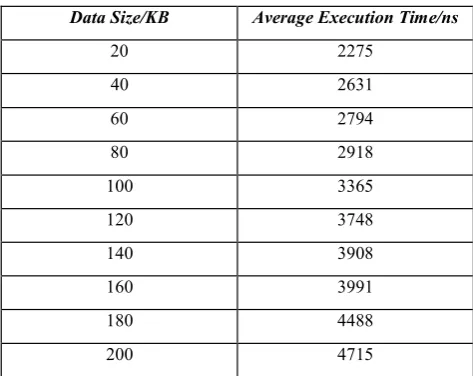
[image:4.596.308.547.282.469.2]Table 1: Average Encryption Time Vs Data Size (Sequential in Core i3)
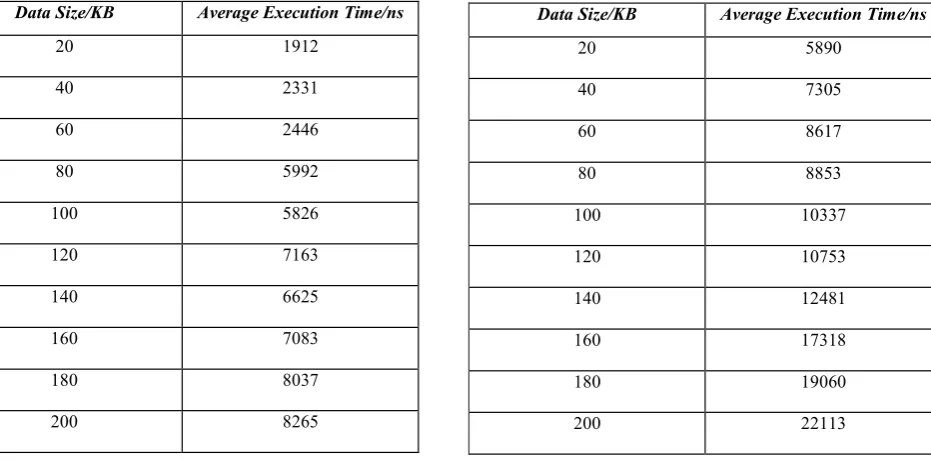
Table 2: Average Encryption Time Vs Data Size (Parallel in Core i3)
Data Size/KB Average Execution Time/ns
20 2275
40 2631
60 2794
80 2918
100 3365
120 3748
140 3908
160 3991
180 4488
[image:4.596.309.546.506.694.2]Data Size/KB Average Execution Time/ns
20 12086
40 16677
60 20625
80 24015
100 27470
120 31737
140 35346
160 38841
180 42252
200 45609
Data Size/KB Average Execution Time/ns
20 5890
40 7305
60 8617
80 8853
100 10337
120 10753
140 12481
160 17318
180 19060
200 22113
Table 3: Average Encryption Time Vs Data Size (Sequential
in Core 2 Duo) Table 5: Average Encryption Time Vs Data Size in Single Core P4) (Sequential
Data Size/KB Average Execution Time/ns
20 6938
40 10267
60 14802
80 17892
100 18761
120 21252
140 24341
160 27522
180 29419
[image:5.596.306.547.101.327.2]200 33284
Table 4: Average Encryption Time Vs Data Size (Parallel in
Core 2 Duo) Table 6: Average Encryption Time Vs Data Size (Parallel in Single Core P4)
Data Size/KB Average Execution Time/ns
20 1912
40 2331
60 2446
80 5992
100 5826
120 7163
140 6625
160 7083
180 8037
[image:5.596.75.541.369.600.2] [image:5.596.47.281.370.595.2] [image:5.596.305.544.371.597.2]Data
Size/KB Throughput/MBps
Corei3 Core 2 Duo P4
20 4076.654143 2815.112424 1616.022671
40 5266.617231 3804.665433 2342.297775
60 5883.497339 3958.502229 2840.909091
80 7435.519178 4366.476638 3253.175099
100 8035.56735 5205.279569 3555.014561
120 7611.060596 5514.1869 3692.456754
140 8001.331422 5616.809088 3868.011939
160 8217.19695 5677.276361 4022.810947
180 8421.062087 5975.092627 4160.306021
200 8679.01262 5868.059728 4282.323664
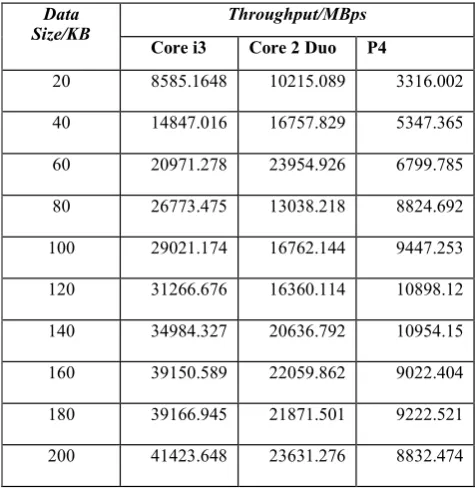
Data
Size/KB Throughput/MBps
Core i3 Core 2 Duo P4
20 8585.1648 10215.089 3316.002
40 14847.016 16757.829 5347.365
60 20971.278 23954.926 6799.785
80 26773.475 13038.218 8824.692
100 29021.174 16762.144 9447.253
120 31266.676 16360.114 10898.12
140 34984.327 20636.792 10954.15
160 39150.589 22059.862 9022.404
180 39166.945 21871.501 9222.521
200 41423.648 23631.276 8832.474
5.1.2 Throughput (MBps) Vs Data Size (KB)
Table 7: Throughput Vs Data Size (All Sequential Implementations)
5.2 Graphs which illustrates the results
[image:6.596.47.286.111.362.2]5.2.1 Average Execution Time Vs Data Size
Fig.2 Average Execution Time Vs Data Size (Core i3)
[image:6.596.313.544.123.248.2]Table 8: Throughput Vs Data Size (All Parallel Implementations)
Fig.3 Average Execution Time Vs Data Size (Core 2 Duo)
[image:6.596.315.543.284.410.2] [image:6.596.47.285.399.644.2] [image:6.596.315.543.447.572.2]5.2.2 Throughput Vs Data Size
Fig.4 Throughput Vs Data Size (Sequential Implementations)
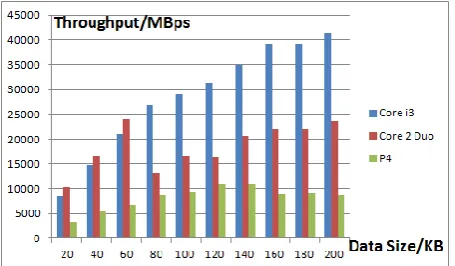
Fig.5 Throughput Vs Data Size (Parallel Implementations)
6. CONCLUSIONS AND FUTURE WORK
By looking at the results the following conclusions can be mentioned:
Parallelism mechanism made RC4 robust on any architecture. Performance or in other words, throughput increment is noteworthy. Anyways, effective improvements can be seen in multicores; especially in Core i3 as it is a quad-core processor. Since Core 2 Duo is a dual-core processor it doesn‟t have a better performance than Core i3 which is an obvious fact.
In this research Java Executors were used and the JVM decided the no. of threads were used in the parallelism process. According to the available theory and literature it is one of the most cost effective ways of using of Executors in multithreading.
Performance/throughput of RC4 has been boosted due to the mechanism of parallel encryption introduced by this research. Obviously better results can be achieved in Core i5, Core i7 and other high end processors and GPUs. The most important factor is the use of multithreading techniques in multicores! Thus it is obvious that the throughput of RC4 can be immensely increased by the proposed mechanism.
Suggested future work:
1. Improving throughput of block cipher algorithms using multithreading techniques.
2. Evaluation of the robustness of the symmetric key algorithms in multicores and GPUs.
3. Analysis of symmetric key algorithms in multicores and GPUs based on Linux and C language.
REFERENCES
[1] Barnes, A.; Fernando, R.; Mettananda, K.; Ragel, R.; , "Improving the throughput of the AES algorithm with multicore processors," Industrial and Information Systems (ICIIS), 2012 7th IEEE International Conference on , vol., no., pp.1-6, 6-9 Aug. 2012 doi: 10.1109/ICIInfS.2012.6304791
[2] Sen Gupta, S.; Chattopadhyay, A.; Sinha, K.; Maitra, S.; Sinha, B.; , "High Performance Hardware Implementation for RC4 Stream Cipher," Computers, IEEE Transactions on , vol.PP, no.99, pp.1, 0 doi: 10.1109/TC.2012.19
[3] Zong Wang; Arslan, T.; Erdogan, A.; , "Implementation of Hardware Encryption Engine for Wireless Communication on a Reconfigurable Instruction Cell Architecture," Electronic Design, Test and Applications, 2008. DELTA 2008. 4th IEEE International Symposium on , vol., no., pp.148-152, 23-25Jan.2008 doi: 10.1109/DELTA.2008.100
[4] Kitsos, P.; Kostopoulos, G.; Sklavos, N.; Koufopavlou, O.; , "Hardware implementation of the RC4 stream cipher," Circuits and Systems, 2003 IEEE 46th Midwest Symposium on , vol.3, no., pp. 1363- 1366 Vol. 3, 27-30 Dec.2003 doi: 10.1109/MWSCAS.2003.1562548
[5] Jun-Dian Lee; Chih-Peng Fan; , "Efficient low-latency RC4 architecture designs for IEEE 802.11i WEP/TKIP," Intelligent Signal Processing and Communication Systems, 2007. ISPACS 2007. International Symposium on , vol., no., pp.56-59, Nov. 28 2007-Dec. 1 2007 doi: 10.1109/ISPACS.2007.4445822 [6] Dongara, P.; Vijaykumar, T.N.;, "Accelerating private-key cryptography via multithreading on symmetric multiprocessors," Performance Analysis of Systems and Software, 2003. ISPASS. 2003 IEEE International Symposium on , vol., no., pp. 58- 69, 6-8 March 2003 doi: 10.1109/ISPASS.2003.1190233
[7] Nawaz, Y.; Gupta, K.C.; Gong G.; "A 32-bit RC4-like Keystream Generator," Cryptology ePrint Archive: Report 2005/175.
[8] Mousa, A.; Hamad, A.; "Evaluation of the RC4 Algorithm for Data Encryption,"International Journal of Computer Science and Applications, vol.3, no.2, pp. 44-56
[9] Lecture notes: www.cs.virginia.edu/~cs201/slides/cs2110-16-parallelprog.ppt
[10] Bloch J, Bowbeer J, Goetz B, Holmes D, Lea D, Peierls T.
[image:7.596.54.282.278.411.2]![Fig.1 Overview of the mechanism (referred [1])](https://thumb-us.123doks.com/thumbv2/123dok_us/8095046.785869/3.596.24.293.219.354/fig-overview-of-the-mechanism-referred.webp)