Analysis of Five Different Dielectric Substrates
on Microstrip Patch Antenna
.
ABSTRACT
The study of microstrip patch antennas has made great progress in recent years. Compared with conventional antennas, microstrip patch antennas have more advantages and better prospects. Different researchers have used different dielectric substrates to fabricate microstrip patch antenna. So a question arises that which dielectric substrate among the common substrates available gives better performance and what are the properties of the dielectric substrates which affects antenna performance. So a comparative study has been performed to know the dielectric properties of five different substrates which affect antenna performance. The aim is to design and fabricate five triangular microstrip patch antennas on five different substrates and analyze their radiation characteristics. The antenna is designed to work for X-band applications. The resonant frequency is taken 10 GHz and height of the dielectric substrate is kept constant i.e., 1.5mm for all the five antennas. The antenna is showing good results on 8 GHz frequency. This shift in the frequency is due to the fringing fields along the edges. This study will help for authors and researchers to get a fair idea of which substrate should be given preference and why to fabricate microstrip patch antenna.
KEYWORDS
Dielectric Substrate, Microstrip Patch Antenna, Triangular Patch, X-band, Radiation Characteristics.
1. INTRODUCTION
Microstrip patch antenna is one of the most preferred antenna structures due to their low profile and ease of fabrication. They are useful because they can be directly printed onto the circuit boards. They have many applications, especially in wireless communication and in satellite communication. For satellite communication, a very high microwave frequency is used. It is because the radio frequency gets reflected by the ionosphere. Five different triangular microstrip patch antennas have been designed for X-band applications. The resonant frequency is taken as 10 GHz. But it is seen that antenna is resonant at 8 GHz. This shift of frequency is due to the fringing field along the edges of the patch. The antenna dimensions must be trimmed by 2-4% for the antenna to be resonant at 10 GHz. For that to achieve, the effective dielectric constant and effective side of the equilateral triangle is to be calculated. However, we are only concerned about the analysis of radiation characteristics of the triangular patch antenna and not for the particular frequency on which it is resonant. So the effective side and effective dielectric constant is not taken into account while simulating the antenna structure. Also X-bands extends from 8 GHz to 12 GHz so it can work satisfactorily for satellite communication.
For satellite communication, circular polarization is used. Since in satellite communication transmitting and receiving antennas are not stationary, therefore, there will be polarization mismatch which can be calculated by polarization loss factor; PLF. Polarization Loss Factor is given as-
2
cos
PLF
.If one antenna is vertically polarized and other antenna is horizontally polarized than the angle between them is 90 degrees and no power is transferred. In circular polarization, waves propagate in all planes so there is no polarization mismatch. Suppose now that a linearly polarized antenna is trying to receive a circularly polarized wave or vice versa. Circular polarization is really two orthogonal linear polarized waves 90 degrees out of phase. Hence, a linearly polarized antenna will simply pick up the in-phase component of the circularly polarized wave. Circular polarizations also overcome from the interference caused by rain. Hence the reception of the antenna becomes strong. Axial ratio for circular polarization i.e., the ratio of major axis to the minor axis is unity unlike the linear polarization where it is infinite. Coaxial probe feed is used because it is easy to use and the input impedance of the coaxial cable in general is 50 ohm. There are several points on the patch which have 50 ohm impedance. We have to find out those points and match them with the input impedance. These points are found through a mathematical model. The dielectric substrates used are Bakelite, FR4 Glass Epoxy, RO4003, Taconic TLC and RT Duroid. The height of the substrates is constant i.e., 1.5 mm. Different parameters such as VSWR, Return Loss , Antenna Gain, Directivity, Antenna Efficiency and Bandwidth is analyzed.2. PROPERTIES OF DIELECTRIC
SUBSTRATES
2.1
Bakelite
Bakelite or polyoxybenzylmethylenglycolanhydride, is an early plastic. It is a thermosetting phenol formaldehyde resin, formed from an elimination reaction of phenol with formaldehyde. It is most commonly used as an electrical insulator possessing considerable mechanical strength.
2.2
FR-4 or (FR4) Gloss Epoxy
FR-4 or (FR4) is a grade designation assigned to glass-reinforced epoxy laminate sheets, tubes, rods and printed circuit boards (PCB). FR-4 is a composite material composed of woven fiberglass cloth with an epoxy resin binder that is flame resistant (self-extinguishing). FR-4 glass epoxy is a popular and versatile high-pressure thermo set plastic laminate grade with good strength to weight ratios. With near zero water absorption, FR-4 is most commonly used as an
Rajesh Nema
ASST. PROF., E&C DEPTT. NRI INST. OF INFO. SCI. AND TECH.,BHOPAL (M.P.), INDIA
Anzar Khan
M TECH. Student, E&C DEPTT., NRI INST. OF INFO. SCI. AND TECH.,
electrical insulator possessing considerable mechanical strength.
2.3
RO4003
RO4003® Series High Frequency Circuit Materials are glass reinforced hydrocarbon/ceramic laminates (Not PTFE) designed for performance sensitive, high volume commercial applications. RO4000 laminates are designed to offer superior high frequency performance and low cost circuit fabrication. The result is a low loss material which can be fabricated using standard epoxy/glass (FR4) processes offered at competitive prices.
2.4
Taconic TLC
Taconic TLC substrates are specifically designed to meet the low cost objectives for newly emerging commercial RF/microwave applications. Taconic TLC substrates are manufactured in thickness .0145" (0.37 mm) with
r =2.70, and .020" (0.50 mm) with
r =3.0 and .031" (0.80 mm) and thicker with
r =3.30 and 3.20. Both materials exhibit excellent mechanical and thermal stability and cost less than traditional PTFE substrates.2.5 RT Duroid
[image:2.595.6.282.465.733.2]RT Duroid is Glass Microfiber Reinforced PTFE (polytetrafluoroethylene) composite produced by Roger Corporation. RT Duroid 5870 substrate has low loss tangent. They exhibit excellent chemical resistance, including solvent and reagents used in printing and plating, ease of fabrication – cutting, shearing, machining, environment friendly. Properties of these substrates are given in tabular form.
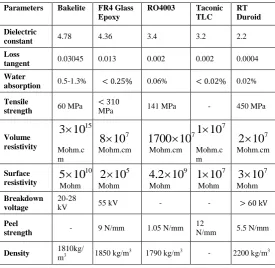
Table 2.1 Properties of different substrates
Parameters Bakelite FR4 Glass Epoxy
RO4003 Taconic TLC
RT Duroid Dielectric
constant 4.78 4.36 3.4 3.2 2.2 Loss
tangent 0.03045 0.013 0.002 0.002 0.0004 Water
absorption 0.5-1.3% 0.06% 0.02%
Tensile
strength 60 MPa
MPa 141 MPa - 450 MPa
Volume resistivity
15
3 10
Mohm.c m
7
8 10
Mohm.cm7
1700 10
Mohm.cm7
1 10
Mohm.c m
7
2 10
Mohm.cmSurface resistivity
10
5 10
Mohm5
2 10
Mohm9
4.2 10
Mohm7
1 10
Mohm7
3 10
Mohm Breakdownvoltage
20-28
kV 55 kV - -
Peel
strength - 9 N/mm 1.05 N/mm 12
N/mm 5.5 N/mm
Density 1810kg/m3 1850 kg/m3 1790 kg/m3 - 2200 kg/m3
Dielectric constant of substrates affects antenna performance. The substrate which has a low dielectric constant will give better radiations than the substrate which has a high dielectric constant. Loss tangent or dissipation factor also plays a part in antenna performance. The high dielectric material allows for a reduction of space but at the cost of higher moisture absorption level.
Dielectric losses depend on the circuit configuration, dielectric constant, frequency and loss tangent. Dielectric constant and loss tangent vary with operating temperature changes and levels of humidity. Dielectric constant values usually vary between 0 and 0.05% over a 100 degree Celsius for most PTFE based laminates. Loss tangent or Dissipation factor can change significantly up to 200% with moisture absorption as little as 0.25% of dielectric weight. Thus moisture absorption should be as low as possible.
Dielectric materials cannot resist indefinite amount of voltage and with enough voltage applied, any insulating material can succumb to the electrical pressure and electron flow will occur. However, unlike the situation with conductors where the current is in a linear proportion to applied voltage (given a fixed resistance) current through an insulator is quite non-linear, for voltage below a certain threshold level, virtually no electrons will flow, but if the voltage exceeds that threshold, there will be a rush of current. Once current is forced through an insulating material, breakdown of that materials molecular structure has occurred. Hence volume resistivity and surface resistivity should be good. After breakdown, the material may or may not behave as an insulator any more, the molecular structure having been altered by the breach. There is usually a “puncture” of the insulating medium where the electrons flowed during breakdown. The breakdown voltage should be high. Thickness of an insulating material plays a role in determining its breakdown voltage, otherwise known as dielectric strength.
3.
ANTENNA DESIGN
The resonant frequency is taken to be 10 GHz. The height of the antenna is 1.5mm.The resonant frequency corresponding to various modes can be given by-
2 2
2
2
3
mn r r rck
c
f
m
mn n
a
Where
c
is velocity of light in free space andk
mn
wave number given by-2 2
4
3
mn
k
m
mn n
a
The expression for lowest order resonance frequency is given by-
2
3
r rc
f
a
analyze antenna performance on different substrates under similar conditions so accuracy is not given much preference. As resonant frequency is 10 GHz, the side of the antenna is given by-
2
3
r rc
a
f
Where, = velocity of light
10
3 10
cm s
/
a
Side of the equilateral triangle3.1
Bakelite
Dielectric constant,
r
4 78
Loss tangent,tan
0.03045
Height of the substrate
1.5
mm
10
9
(2 3 10 )
(3 10 10
4.78)
a
0.915
cm
[image:3.595.46.550.67.758.2]
9.15
mm
Fig.3. 1 Triangular patch on Bakelite
3.1
FR4 Glass epoxy
Dielectric constant,Loss tangent,
tan
0.013
Height of the substrate
1.5
mm
10
9
(2 3 10 )
(3 10 10
4.36)
a
0.9575
cm
9.575
mm
[image:3.595.312.552.71.256.2]
Fig.3.2 Triangular patch on FR4 Glass Epoxy
3.2
RO4003
Dielectric constant,
r
3.4
Loss tangent,tan
0.002
Height of the substrate
1.5
mm
10
9
(2 3 10 )
(3 10 10
3.4)
a
1.085
cm
10.85
mm
Fig.3.3 Triangular patch on RO4003
3.3
Taconic TLC
Dielectric constant,
r
3.2
Loss tangent,tan
0.002
Height of the substrate
1.5
mm
10
9
(2 3 10 )
(3 10 10
3.2)
a
1.1175
cm
11.175
mm
[image:3.595.318.545.338.615.2]Fig.3.4 Triangular patch on Taconic TLC
3.4
RT Duroid
Dielectric constant,
r
3.2
Loss tangent,tan
0.0004
Height of the substrate
1.5
mm
10
9
(2 3 10 )
(3 10 10
2.2)
a
1.3475
cm
13.475
mm
[image:4.595.321.555.145.308.2]
Fig.3.5 Triangular patch on RT Duroid
4
SIMULATION RESULTS
4.1
Return Loss vs. Frequency Graph
[image:4.595.323.538.386.557.2]4.1.1 Bakelite
Fig.4.1.1 Return loss vs. frequency graph on Bakelite
Triangular patch antenna with Bakelite as a dielectric substrate when simulated on 10GHz frequency gives very low return losses of -18.11 dB on 8GHz frequency and its bandwidth is 12.50%.
4.1.2
FR4 Glass epoxy
Fig. 4.1.2 Return loss vs. frequency on FR4 Glass Epoxy
4.1.3
RO4003
Fig. 4.1.3 Return loss vs. frequency graph on RO4003
Triangular patch antenna with RO4003 as a dielectric substrate when simulated on 10 GHz frequency gives a return loss of -14.75dB on 8GHz frequency and its bandwidth is 7.59%.
[image:5.595.60.271.72.235.2]4.1.4
Taconic TLC
Fig.4.1.4 Return loss vs. frequency graph on Taconic TLC
Triangular patch antenna with Taconic TLC as a dielectric substrate when simulated on 10 GHz frequency gives a return loss of -14.39dB on 8GHz frequency and its bandwidth is 8.80%.. It can be seen that the difference of the dielectric constant of RO4003 and Taconic TLC is just 0.2 but there is increase in bandwidth of the Taconic TLC.
4.1.5
RT Duroid
Fig.4.1.5 Return loss vs. frequency graph on RT Duroid
Triangular patch antenna with RT Duroid as a dielectric substrate when simulated on 10 GHz frequency gives an excellent low return loss of -20.99dB on 8GHz frequency and its bandwidth is 15%. It can be seen that the dielectric constant of this substrate is very low but it gives best performance in terms of return loss and bandwidth. Return losses should be as low as possible so that all the input power should be radiated into space when the antenna is transmitting electromagnetic waves and all the incoming power should be efficiently received by the antenna when the antenna is receiving the electromagnetic waves.
4.2
VSWR vs. Frequency Graph
[image:5.595.57.271.317.468.2]4.2.1 Bakelite
Fig.4.2.1 VSWR vs. frequency graph on Bakelite
Triangular microstrip patch antenna with Bakelite as a dielectric substrate gives a voltage standing wave ratio of 1.284 at 8GHz frequency which is close to acceptable value of 1.
4.2.2
FR4 Glass epoxy
Fig.4.2.2 VSWR vs. frequency graph on FR4 Glass Epoxy
[image:5.595.61.272.579.740.2]4.2.3
RO4003
Fig.4.2.3 VSWR vs. frequency graph on RO4003
Triangular microstrip patch antenna with RO4003 as a dielectric substrate gives a voltage standing wave ratio of 1.448 which is slightly more than FR4 Glass epoxy. It is to be noticed that as the value of dielectric constant is decreasing, the value of VSWR is increasing.
4.2.4
Taconic TLC
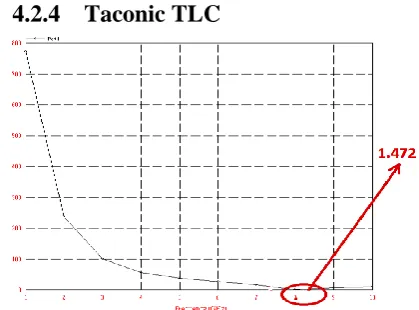
Fig.4.2.4 VSWR vs. frequency graph on Taconic TLC
Triangular microstrip patch antenna with Taconic TLC as a dielectric substrate gives a VSWR value of 1.472 at 8GHz which is close to 1.5. There is a difference of 0.2 in the dielectric constant of Taconic TLC and RO4003, but VSWR increases by 0.024.
[image:6.595.59.269.319.474.2]4.2.5
RT Duroid
Fig.4.2.5 VSWR vs. frequency graph on RT Duroid
RT Duroid has the minimum dielectric constant among the five substrates considered thus gives the lowest voltage standing wave ratio of 1.196.
4.3
ANTENNA 3D GAIN PATTERN WITH
DIFFERENT SUBSTRATES
4.3.1 Bakelite
Fig.4.3.1 Antenna 3D radiation pattern on Bakelite
[image:6.595.307.553.487.708.2]4.3.2
FR4 Glass epoxy
[image:6.595.60.271.576.749.2]4.3.3
RO4003
Fig.4.3.3 Antenna 3D radiation pattern on RO4003
[image:7.595.299.555.149.412.2]4.3.4
Taconic TLC
Fig.4.3.4 Antenna 3D radiation pattern on Taconic TLC
4.3.5
RT Duroid
Fig.4.3.5 Antenna 3D radiation pattern on RT Duroid
5. FINAL TABLE
The final table is given below in which values for different parameters are given for all the substrates considered indicating the performance analysis of the substrates.
Table2. Final Table
Parameters Substrates Bakelit
e
FR4 Glass epoxy
RO400 3
Tacon ic TLC
RT Duroid
Resonant frequency
10 GHz 10 GHz 10 GHz 10 GHz 10 GHz
side 9.15 mm 9.575 mm 10.85 mm
11.175 mm
13.475 mm Frequency 8 GHz 8 GHz 8 GHz 8 GHz 8 GHz
Return Loss
-18.11 dB
-16.14 dB
-14.75 dB
-14.39 dB
-20.99 dB VSWR 1.284 1.369 1.448 1.472 1.196
Gain 3 dBi 4 dBi 5 dBi 5.5 dBi 6.5 dBi
Directivity 6.5 dBi 6.5 dBi 7 dBi 7 dBi 7.5 dBi Bandwidth 12.50 % 10.12 % 7.59 % 8.80 % 15 %
Antenna efficiency
42-45 % 50 % 67.5 % 70 % 80 % Radiating
efficiency
42-45 % 50 % 70 % 67.5 % 80
6. CONCLUSION
[image:7.595.43.266.300.493.2]the dielectric substrate. As its water absorption is very low so its loss tangent remains constant. Bandwidth and radiation pattern depends on loss tangent also, so RT Duroid is good dielectric substrate for microstrip patch antenna. Thus, it is suggested that RT Duroid can be given preference over other four substrates which are considered.
7. REFERENCES
[1] Yogesh Bhomia, Ashok Kajla and Dinesh Yadav, ‘‘V- Slotted Triangular Microstrip Patch Antenna’’, International Journal of Electronics Engineering, 2(1), 2010,pp, 21-23.
[2] Jawad Y. Siddique and Debatosh Guha, ‘‘Applications of Triangular Microstrip Patch Antenna: Circuit Elements to modern wireless antennas.’’
[3] Dinesh Yadav, ‘‘L-Slotted rectangular microstrip patch antenna’’, 2011 International conference on communication systems and network technologies. [4] Vedaprabhu. B and K.J. Vinoy, ‘‘A double U-Slot patch
antenna with dual wideband characteristics’’, IEEE, 2010.
[5] K. Naga Mallik, Ch. Radhika, D Ujwala, H.M. Ramesh, A. Gowtham Kumar, P.Karthik,‘‘ A compact microstrip patch antenna with triangular snipped slot for wireless applications.’’,International Journal of Engineering and Advanced Technology ( IJEAT ), ISSN:2249-8958, volume-1, issue-4, April2012.
[6] Ashvini Chaturvedi, Yogesh Bhomia and Dinesh Yadav, ‘‘Truncated tip triangular microstrip patch
antenna’’, IEEE 2010.
[7] New Multiband E-Shape Microstrip Patch Antenna On RT DUROID 5880 Substrate and RO4003 Substrate for Pervasive Wireless Communication. Dr. Anubhuti Khare, Rajesh Nema and Puran Gour.