Number 6036
Konkoly Observatory Budapest
17 September 2012
HU ISSN 0374 – 0676
FIRST SOLUTION OF THE LIGHT CURVE
OF THE NEW VARIABLE STAR 3UC 281-203711
GORDA, S.YU.; SOBOLEV, A.M.
Astronomical Observatory, Ural Federal University, 19 Mira st., Ekaterinburg, 620002, Russia E-mail: [email protected]
A new variable star 3UC 281-203711V = 12m.4 was discovered during monitoring of the
young irregular variable V645 Cyg at the Astronomical Observatory of the Ural Federal University (Gorda & Sobolev, 2011: GS2011). The first brightness decrease of 3UC 281-203711 by 0m.08 was registered on JD 2454966.30. The finding chart and the data table
are presented in GS2011. Coordinates of the target, comparison and check stars are given in Table 1 of the current paper.
The AZT-3 reflector (D = 0.45m, FN ewton = 2.0 m) with an Alta-U6 CCD camera
(Kodak KAF-1001E, 1048x1048, 24-micron chip) was used. The photometry was carried out using the V and R Cousins/Bessell filters. The uncertainty of our brightness mea-surements during individual nights was within ±0m. 003 –
±0m.007, as estimated by the
brightness difference between the comparison star 3UC 281-203713 and the check star 3UC 281-203646. The reduction of the CCD frames was carried out using Muniwin
software.
Time of minimum HJDImin = 2455543.1338 was calculated from observations of one
completely covered primary minimum, namely part of the light curve prior to the eclipse, descending branch, whole bottom plateau and a considerable part of the ascending branch. Preliminary estimate of the period given in GS2011 was based on the observational data covering parts of the primary minimum: four descending branches complemented with small parts of the bottom plateau (brightness decrease by 0m. 08) and two parts of the
bottom plateau complemented with ascending branches (brightness increase by the same amount).
3UC 281-203711 is an eclipsing system. The light curve is of Algol type and manifests pronounced ellipsoidal effects. The primary minimum is not so deep but is much deeper than the secondary minimum. The mean depths of the minima are about the same in both colours and equal to 0m.103 and 0m.030 for the primary and secondary minima, respectively.
A plateau is observed in the bottom of the primary minimum, indicating that one of the eclipses is total GS2011, Fig. 1, bottom panel).
JD 2454965 and JD 2455127 these differences were systematic and reached the values about 0m.01−0m. 02. For solutions of the light curves we used almost the same data as
provided in GS2011. Data on the two nights mentioned above were an exception because they have shown better correspondence with the data for the same photometric phases obtained during other nights. Altered data points are provided in (electronic) Tables 4 and 5.
A solution of the light curve was carried out with the P HOEBE package with a graphic interface for Windows. Realizations of the Wilson-Devinney light curve analysis method and of the Nelder-Mead simplex method for search of the optimum solution from this package were used.
Nothing was known about the physical nature of components of this eclipsing binary system. Hence, the initial values of physical parameters were chosen on the basis of values of the period, surface brightness ratio, ratio of the radii of components and their relative sizes. These values were defined from the form, depth and duration of the primary minimum under the hypothesis of a total eclipse. Initial values of the temperatures corresponding to spectral class F0 were chosen. Estimate of the spectral class is based on the values of 3UC 281-203711 brightness in the optical and infrared ranges taken from the NOMAD catalog. Initial values of the mass ratio of the components and the semi-major axis of the orbit were chosen by assuming that both components belong to the main sequence.
Determination of the orbital elements and the physical parameters of the components were carried out with simultaneous use of the data in bothV andR filters. As a result of the preliminary solution it was established that the total eclipse occurs in the secondary minimum which is not deep. During the primary minimum the smaller and cooler star passes in front of the bigger and hotter component, being completely projected on its surface at the moments of time close to the middle of the eclipse.
Calculation of the physical parameters of the system with the P HOEBE package requires knowledge of the value of semi-major axis of the mutual orbit, a. This value does not influence the light curve and, hence, cannot be estimated from our data. For the current analysis we adopted the valuea= 9R⊙ (see consideration of the physical meaning of this value below).
Further, the calculation of the physical parameters of the system requires the knowledge of the value of another parameter - the mass ratio of the components, q. This parameter only weakly influences the form of the light curve and requires special efforts for its determination. A number of solutions were obtained for a set of given values of q = 0.2,0.3, ...,0.8. The other parameters remained free. It was found that the theoretical light curves do not show considerable (i.e. exceeding observational uncertainties) systematic deviations from the observational points by changing only the values of q within the interval 0.3− 0.6. Calculations with released parameter of q showed that the values
q∼0.5 provide the best fit.
A criterion of proximity of the values of effective temperatures, masses and radii of components to the values of corresponding parameters of the main sequence stars was applied in order to choose the admissible values for the semi-major axis of the eclipsing system, a.
It was found that the values ofain the range 8R⊙−10R⊙ bring the parameters of the secondary component (mass, radius, effective temperature) into close agreement with a main sequence star of spectral class K0−K3. Therefore we assume that the value of the semi-major axis for the 3UC 281-203711 eclipsing binary isa ∼9R⊙.
physical parameters of the primary component. Estimates of the spectral class vary in the range A0−F0, depending on the physical parameter (mass or temperature) used for the estimate. The values of the radius for the given mass and temperature are too high in all cases. Most likely, this reflects that the star does not belong to the main sequence: it is possibly a subgiant or starts its transformation to become a subgiant.
Values of the photometric parameters and absolute values of the parameters for 3UC 281-203646 components with adopted value of a = 9R⊙ are given in Tables 2 and 3, respec-tively. Accuracy of the parameter estimates for light curve solutions reflects scatter for a
and q in the ranges 8−10 and 0.4−0.6, respectively.
More accurate value of the period for this eclipsing system was obtained in the course of solution of the light curve. The new ephemeris is the following:
HJDImin = 2454966.4565 + 1d.948234·E.
±8 ±11
In Figure 1 light curves (observational points and theoretical curves) are shown for
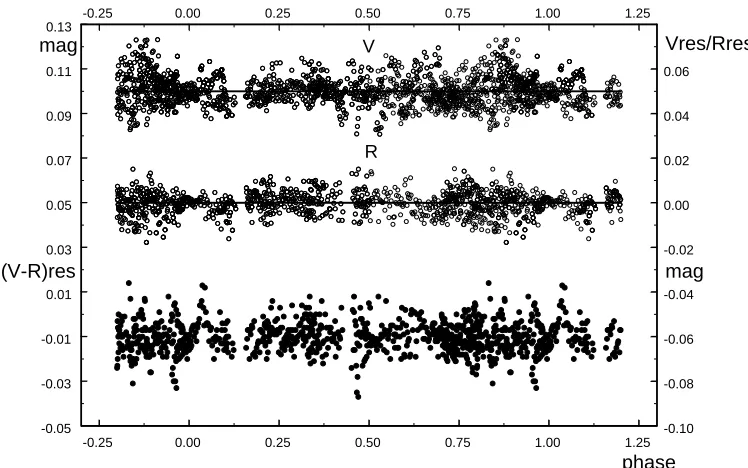
V and R filters, respectively. In Figure 2 residual values versus photometric phases are shown.
Observational light curves are fitted by the theoretical curves quite well. This is seen in the residual plots which do not show significant systematic deviations in either passbands. The brighter and more massive component has a considerable tidal deformation. This follows from the well pronounced maxima of brightness in phases 0.25 and 0.75. It can be caused by rather high values of the radius and of the component mass ratio, q∼0.5.
Figure 2 (the bottom curve) shows that the color index of the system does not vary with phase within observational accuracy. It finds natural explanation in the fact that both ratios of the sizes and the surface brightness of the primary and the secondary components are high (r1/r2 ∼ 4 and j1/j2 ∼ 16, see Table 1) and the luminosity of the primary component exceeds that of the secondary component more than 200 times.
Quality of the observational data and existence of the total eclipse in the system allowed obtaining estimates of the relative photometric elements with small uncertainties. At the same time absolute parameters were found with relatively high uncertainties. This comes from the low accuracy of the value of semi-major axis of the orbit which can be improved only by spectroscopic observations.
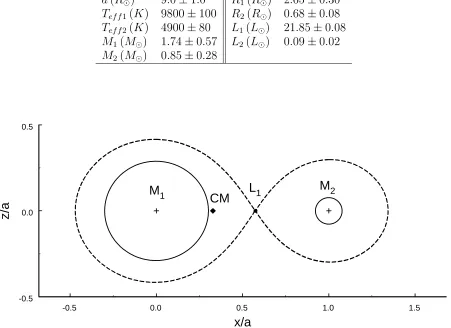
Figure 3 shows the configuration of the system corresponding to our solution. It is seen that neither components of the 3UC 281-203711 fills its Roche lobe. Hence, this system is a completely detached eclipsing binary. The primary component is probably a subgiant, hence, it is likely to fill in its Roche lobe in the future. In this case, after the start of the mass exchange phase the value of q will increase and the system can become a reverse Algol.
Authors would like to thank the referee Dr. T. Borkovits for useful suggestions and comments which improved this paper. The study was partly supported by the Rus-sian federal task program “Research and operations on priority directions of develop-ment of the science and technology complex of Russia for 2007-2012” (state contract No. 16.518.11.7074).
Reference:
-0.25 0.00 0.25 0.50 0.75 1.00 1.25
Phase
-0.14 -0.16 -0.18 -0.20 -0.22 -0.24 -0.26 -0.28 -0.30 -0.32
dV
-0.25 0.00 0.25 0.50 0.75 1.00 1.25
dR
V
R
[image:4.595.139.456.118.345.2]-0.20 -0.22 -0.24 -0.26 -0.28 -0.30 -0.32 -0.34 -0.36 -0.38
Figure 1. Theoretical (solid line) and observational (open circles) light curves of 3UC 281-203711
-0.25 0.00 0.25 0.50 0.75 1.00 1.25
phase -0.05
-0.03 -0.01 0.01 0.03 0.05 0.07 0.09 0.11 0.13
(V-R)res mag
mag
-0.10 -0.08 -0.06 -0.04 -0.02 0.00 0.02 0.04 0.06
-0.25 0.00 0.25 0.50 0.75 1.00 1.25
Vres/Rres
R V
[image:4.595.110.484.464.698.2]Table 1. Designations and coordinates of the stars
Name α(2000) δ(2000) mV
3UC 281-203711 (variable) 21h39m52s.4 +50◦ 18′
27′′
12m.40
3UC 281-203713 (comparison) 21h39m52s.4 +50◦ 15′
55′′
12m.60
3UC 281-203646 (check) 21h39m47s.6 +50◦ 17′
03′′
[image:5.595.177.422.215.316.2]12m.22
Table 2. Photometric parameters of the eclipsing variable star 3UC 281-203711.
k 0.257±0.010 i 81◦.
2±0◦.
5
r1 0.294±0.008 q 0.49±0.11
r1(pole) 0.289 j1/j2 15.8±1.4 r1(point) 0.302 L1 0.996±0.001 r1(side) 0.294 L2 0.004±0.001 r1(back) 0.299
r2 0.076±0.002
Table 3. Estimates of absolute parameters of the eclipsing variable star 3UC 281-203711
a(R⊙) 9.0±1.0 R1(R⊙) 2.65±0.30
Tef f1(K) 9800±100 R2(R⊙) 0.68±0.08 Tef f2(K) 4900±80 L1(L⊙) 21.85±0.08 M1(M⊙) 1.74±0.57 L2(L⊙) 0.09±0.02
M2(M⊙) 0.85±0.28
-0.5 0.0 0.5 1.0 1.5
x/a
-0.5 0.0 0.5