Chen, Taolue and Hague, M. and Lin, A.W. and Rümmer, P. and Wu,
Z. (2019) Decision procedures for path feasibility of string-manipulating
programs with complex operations.
Proceedings of the ACM on
Programming Languages 3 (POPL), pp. 1-30. ISSN 2475-1421.
Downloaded from:
Usage Guidelines:
Please refer to usage guidelines at
or alternatively
Decision Procedures for Path Feasibility of
String-Manipulating Programs with Complex Operations
TAOLUE CHEN,
Birkbeck, University of London, United KingdomMATTHEW HAGUE,
Royal Holloway, University of London, United KingdomANTHONY W. LIN,
University of Oxford, United KingdomPHILIPP RÜMMER,
Uppsala University, SwedenZHILIN WU,
Institute of Software, Chinese Academy of Sciences, ChinaThe design and implementation of decision procedures for checking path feasibility in string-manipulating programs is an important problem, with such applications as symbolic execution of programs with strings and automated detection of cross-site scripting (XSS) vulnerabilities in web applications. A (symbolic) path is given as a finite sequence of assignments and assertions (i.e. without loops), and checking its feasibility amounts to determining the existence of inputs that yield a successful execution. Modern programming languages (e.g. JavaScript, PHP, and Python) support many complex string operations, and strings are also often implicitly modified during a computation in some intricate fashion (e.g. by some autoescaping mechanisms).
In this paper we provide two general semantic conditions which together ensure the decidability of path feasibility: (1) each assertion admits regular monadic decomposition (i.e. is an effectively recognisable relation), and (2) each assignment uses a (possibly nondeterministic) function whose inverse relation preserves regularity. We show that the semantic conditions areexpressivesince they are satisfied by a multitude of string operations including concatenation, one-way and two-way finite-state transducers,replaceAllfunctions (where the replacement string could contain variables), string-reverse functions, regular-expression matching, and some (restricted) forms of letter-counting/length functions. The semantic conditions also strictly subsume existing decidable string theories (e.g. straight-line fragments, and acyclic logics), and most existing benchmarks (e.g. most of Kaluza’s, and all of SLOG’s, Stranger’s, and SLOTH’s benchmarks). Our semantic conditions also yield a conceptuallysimpledecision procedure, as well as anextensiblearchitecture of a string solver in that a user may easily incorporate his/her own string functions into the solver by simply providing code for the pre-image computation without worrying about other parts of the solver. Despite these, the semantic conditions are unfortunately too general to provide a fast and complete decision procedure. We provide strong theoretical evidence for this in the form of complexity results. To rectify this problem, we propose two solutions. Our main solution is to allow only partial string functions (i.e., prohibit nondeterminism) in condition (2). This restriction is satisfied in many cases in practice, and yields decision procedures that are effective in both theory and practice. Whenever nondeterministic functions are still needed (e.g. the string function split), our second solution is to provide a syntactic fragment that provides a support of nondeterministic functions, and operations like one-way transducers,replaceAll(with constant replacement string), the string-reverse
Authors’ addresses: Taolue Chen, Department of Computer Science and Information Systems, Birkbeck, University of London, Malet Street, London, WC1E 7HX, United Kingdom, [email protected]; Matthew Hague, Department of Computer Science, Royal Holloway, University of London, Egham Hill, Egham, Surrey, TW20 0EX, United Kingdom, [email protected]; Anthony W. Lin, Department of Computer Science, University of Oxford, Wolfson Buildin, Parks Road, Oxford, OX1 3QD, United Kingdom, [email protected]; Philipp Rümmer, Department of Information Technology, Uppsala University, Box 337, Uppsala, SE-751 05, Sweden, [email protected]; Zhilin Wu, State Key Laboratory of Computer Science, Institute of Software, Chinese Academy of Sciences, China.
Permission to make digital or hard copies of part or all of this work for personal or classroom use is granted without fee provided that copies are not made or distributed for profit or commercial advantage and that copies bear this notice and the full citation on the first page. Copyrights for third-party components of this work must be honored. For all other uses, contact the owner/author(s).
© 2019 Copyright held by the owner/author(s). 2475-1421/2019/1-ART49
https://doi.org/10.1145/3290362
function, concatenation, and regular-expression matching. We show that this fragment can be reduced to an existing solver SLOTH that exploits fast model checking algorithms like IC3.
We provide an efficient implementation of our decision procedure (assuming our first solution above, i.e., deterministic partial string functions) in a new string solver OSTRICH. Our implementation provides built-in support for concatenation, reverse, functional transducers (FFT), andreplaceAlland provides a framework for extensibility to support further string functions. We demonstrate the efficacy of our new solver against other competitive solvers.
CCS Concepts: •Theory of computation→Automated reasoning;Program verification;Regular languages;Logic and verification; Complexity classes;
Additional Key Words and Phrases: String Constraints, Transducers, ReplaceAll, Reverse, Decision Procedures, Straight-Line Programs
ACM Reference Format:
Taolue Chen, Matthew Hague, Anthony W. Lin, Philipp Rümmer, and Zhilin Wu. 2019. Decision Procedures for Path Feasibility of String-Manipulating Programs with Complex Operations .Proc. ACM Program. Lang.3, POPL, Article 49 (January 2019),30pages.https://doi.org/10.1145/3290362
1 INTRODUCTION
Strings are a fundamental data type in virtually all programming languages. Their generic nature can, however, lead to many subtle programming bugs, some with security consequences, e.g., cross-site scripting (XSS), which is among the OWASP Top 10 Application Security Risks [van der Stock et al. 2017]. One effective automatic testing method for identifying subtle programming errors is based onsymbolic execution[King 1976] and combinations with dynamic analysis called
dynamic symbolic execution[Cadar et al. 2008,2006;Godefroid et al. 2005;Sen et al. 2013,2005]. See [Cadar and Sen 2013] for an excellent survey. Unlike purely random testing, which runs only
concreteprogram executions on different inputs, the techniques of symbolic execution analyse
staticpaths (also called symbolic executions) through the software system under test. Such a path can be viewed as a constraintφ(over appropriate data domains) and the hope is that a fast solver is available for checking the satisfiability ofφ(i.e. to check thefeasibilityof the static path), which can be used for generating inputs that lead to certain parts of the program or an erroneous behaviour.
Constraints from symbolic execution on string-manipulating programs can be understood in terms of the problem of path feasibility over a bounded programSwith neither loops nor branching (e.g. see [Bjùrner et al. 2009]). That is,Sis a sequence of assignments and conditionals/assertions, i.e., generated by the grammar
S::= y:=f(x1, . . . ,xr)|assert(д(x1, . . . ,xr))|S;S (1)
wheref :(Σ∗)r →Σ∗is a partial string function andд ⊆(Σ∗)r is a string relation. The following is a simple example of a symbolic executionSwhich uses string variables (x,y, andz’s) and string constants (lettersaandb), and the concatenation operator (◦):
z1:=x◦ba◦y; z2:=y◦ab◦x; assert(z1==z2) (2)
The problem ofpath feasibility/satisfiability1asks whether, for a given programS, there existinput strings (e.g.xandyin (2)) that can successfully takeSto the end of the program while satisfying all the assertions. This path can be satisfied by assigningy(resp.x) tob(resp. the empty string). In this paper, we will also allow nondeterministic functionsf :(Σ∗)r →2Σ∗ since nondeterminism
1It is equivalent to satisfiability of string constraints in the SMT framework [Barrett et al. 2009;De Moura and Bjùrner
can be a useful modelling construct. For example, consider the code in Figure1. It ensures that each element ins1(construed as a list delimited by-) is longer than each element ins2. Iff :Σ∗→2Σ∗
is a function that nondeterministically outputs a substring delimited by-, our symbolic execution analysis can be reduced to feasibility of the path:
x:=f(s1); y:=f(s2); assert(len(x) ≤len(y))
In the last few decades much research on the satisfiability problem of string constraints suggests that it takes very little for a string constraint language to become undecidable. For example, although the existential theory of concatenation and regular constraints (i.e. an atomic expression is either E=E′, whereEandE′are concatenations of string constants and variables, orx ∈L, whereLis
# s1, s2: strings with delimiter '-' for x in s1.split('-')
for y in s2.split('-') assert(len(x) > len(y))
Fig. 1. A Python code snippet a regular language) is decidable and in fact
pspace-complete [Diekert 2002; Jez 2016;
Plandowski 2004], the theory becomes undecid-able when enriched with letter-counting [Büchi and Senger 1990], i.e., expressions of the form |x|a =|y|b, where| · |ais a function mapping a word to the number of occurrences of the the letterain the word. Similarly, although finite-state transductions [D’Antoni and Veanes 2013;
Hooimeijer et al. 2011;Lin and Barceló 2016] are crucial for expressing many functions used in string-manipulating programs Ð including autoescaping mechanisms (e.g. backslash escape, and HTML escape in JavaScript), and thereplaceAllfunction with a constant replacement pattern Ð checking a simple formula of the form∃xR(x,x), for a given rational transduction2R, can easily encode the Post Correspondence Problem [Morvan 2000], and therefore is undecidable.
Despite the undecidability of allowing various operations in string constraints, in practice it is common for a string-manipulating program to contain multiple operations (e.g. concatenation and finite-state transductions), and so a path feasibility solver nonetheless needs to be able to handle them. This is one reason why some string solving practitioners opted to support more string operations and settle with incomplete solvers (e.g. with no guarantee of termination) that could still solve some constraints that arise in practice, e.g., see [Abdulla et al. 2017,2018;Berzish et al. 2017;Kiezun et al. 2012;Liang et al. 2014;Saxena et al. 2010;Trinh et al. 2014,2016;Yu et al. 2010,
2014;Zheng et al. 2015,2013]. For example, the tool S3 [Trinh et al. 2014,2016] supports general recursively-defined predicates and uses a number of incomplete heuristics to detect unsatisfiable constraints. As another example, the tool Stranger [Yu et al. 2010,2014] supports concatenation,
replaceAll(but with both pattern and replacement strings being constants), and regular constraints, and performs widening (i.e. an overapproximation) when a concatenation operator is seen in the analysis. Despite the excellent performance of some of these solvers on several existing benchmarks, there are good reasons for designing decision procedures with stronger theoretical guarantees, e.g., in the form of decidability (perhaps accompanied by a complexity analysis). One such reason is that string constraint solving is a research area in its infancy with an insufficient range of benchmarking examples to convince us that if a string solver works well on existing benchmarks, it will also work well on future benchmarks. A theoretical result provides a kind of robustness guarantee upon which a practical solver could further improve and optimise.
Fortunately, recent years have seen the possibility of recovering some decidability of string con-straint languages with multiple string operations, while retaining applicability for concon-straints that arise in practical symbolic execution applications. This is done by imposing syntactic restrictions
2A rational transduction is a transduction defined by a rational transducer, namely, a finite automaton over the alphabet
including acyclicity [Abdulla et al. 2014;Barceló et al. 2013], solved form [Ganesh et al. 2012], and straight-line [Chen et al. 2018a;Holík et al. 2018;Lin and Barceló 2016]. These restrictions are known to be satisfied by many existing string constraint benchmarks, e.g., Kaluza [Saxena et al. 2010], Stranger [Yu et al. 2010], SLOG [Holík et al. 2018;Wang et al. 2016], and mutation XSS benchmarks of [Lin and Barceló 2016]. However, these results are unfortunately rather fragmented, and it is difficult to extend the comparatively limited number of supported string operations. In the following, we will elaborate this point more precisely. The acyclic logic of [Barceló et al. 2013] permits only rational transductions, in which thereplaceAllfunction with constant pattern/replace-ment strings and regular constraints (but not concatenation) can be expressed. On the other hand, the acyclic logic of [Abdulla et al. 2014] permits concatenation, regular constraints, and the length function, but neither thereplaceAllfunction nor transductions. This logic is in fact quite related to the solved-form logic proposed earlier by [Ganesh et al. 2012]. The straight-line logic of [Lin and Barceló 2016] unified the earlier logics by allowing concatenation, regular constraints, rational transductions, and length and letter-counting functions. It was pointed out by [Chen et al. 2018a] that this logic cannot express thereplaceAllfunction with the replacement string provided as a variable, which was never studied in the context of verification and program analysis. Chenet al.
proceeded by showing that a new straight-line logic with the more generalreplaceAllfunction and concatenation is decidable, but becomes undecidable when the length function is permitted.
Although the aforementioned results have been rather successful in capturing many string constraints that arise in applications (e.g. see the benchmarking results of [Ganesh et al. 2012] and [Holík et al. 2018;Lin and Barceló 2016]), many natural problems remain unaddressed.To what extent can one combine these operations without sacrificing decidability?For example, can a useful decidable logic permit the more generalreplaceAll, rational transductions, and concatenation at the same time?To what extent can one introduce new string operations without sacrificing decidability?
For example, can we allow the string-reverse function (a standard library function, e.g., in Python), or more generally functions given by two-way transducers (i.e. the input head can also move to the left)? Last but not least, since there are a plethora of complex string operations, it is impossible for a solver designer to incorporate all the string operations that will be useful in all application domains. Thus,can (and, if so, how do) we design an effective string solver that can easily be extended with user-defined string functions, while providing a strong completeness/termination guarantee?Our goal is to provide theoretically-sound and practically implementable solutions to these problems. Contributions.We provide two general semantic conditions (see Section3) which together ensure decidability of path feasibility for string-manipulating programs:
(1) the conditionalR⊆(Σ∗)kin each assertion admits a regular monadic decomposition, and (2) each assignment uses a functionf :(Σ∗)k →2Σ∗
whose inverse relation preserves łregular-ityž.
Before describing these conditions in more detail, we comment on the four main features (4Es) of our decidability result: (a)Expressive: the two conditions are satisfied by most string constraint benchmarks (existing and new ones including those of [Holík et al. 2018;Lin and Barceló 2016;
The first semantic condition simply means thatRcan be effectively transformed into a finite unionSn
i=1(L (1)
i × · · · ×L (k)
i ) of Cartesian products of regular languages. (Note that this isnot the intersection/product of regular languages.) A relation that is definable in this way is often called arecognisable relation[Carton et al. 2006], which is one standard extension of the notion of regular languages (i.e. unary relations) to generalk-ary relations. The framework of recognisable relations can express interesting conditions that might at a first glance seem beyond łregularityž, e.g.,|x1|+|x2| ≥3 as can be seen below in Example3.2. Furthermore, there are algorithms (i.e. called
monadic decompositionsin [Veanes et al. 2017]) for deciding whether a given relation represented in highly expressive symbolic representations (e.g. asynchronised rational relationor adeterministic rational relation) is recognisable and, if so, output a symbolic representation of the recognisable relation [Carton et al. 2006]. On the other hand, the second condition means that the pre-image f−1(L) of a regular languageLunder the function f is ak-ary recognisable relation. This is an expressive condition (see Section4) satisfied by many string functions including concatenation, the string reverse function, one-way and two-way finite-state transducers, and thereplaceAllfunction where the replacement string can contain variables. Therefore, we obtain strict generalisations of the decidable string constraint languages in [Lin and Barceló 2016] (concatenation, one-way transducers, and regular constraints) and in [Chen et al. 2018a] (concatenation, thereplaceAll
function, and regular constraints). In addition, many string solving benchmarks (both existing and new ones) derived from practical applications satisfy our two semantics conditions including the benchmarks of SLOG [Wang et al. 2016] with replace andreplaceAll, the benchmarks of Stranger [Yu et al. 2010],∼80% of Kaluza benchmarks [Saxena et al. 2010], and the transducer benchmarks of [Holík et al. 2018;Lin and Barceló 2016]. We provide a simple and clean decision procedure (see Section 3) which propagates the regular language constraints in abackward manner via the regularity-preserving pre-image computation. Our semantic conditions also naturally lead to extensible architecture of a string solver: a user can easily extend our solver with one’s own string functions by simply providing one’s code for computing the pre-imagef−1(L)for an input regular languageLwithout worrying about other parts of the solver.
Having talked about the Expressive, Easy, and Extensible features of our decidability result (first three of the four Es), our decidability result does not immediately lead to an Efficient decision procedure and a fast string solver. A substantial proportion of the remaining paper is dedicated to analysing the cause of the problem and proposing ways of addressing it which are effective from both theoretical and practical standpoints.
Our hypothesis is that allowing general string relationsf :(Σ∗)k →2Σ∗
(instead of just partial functions f :Σ∗ → Σ∗), although broadening the applicability of the resulting theory (e.g. see Figure1), makes the constraint solving problem considerably more difficult. One reason is that propagatingnregular constraintsL1, . . . ,Ln backwards through a string relationf :(Σ∗)k →2Σ
∗
seems to require performing a product automata construction forTn
i=1Li before computing a
a constraint language whose complexity is at most double exponential time and single exponential space (i.e.expspace); see [Chen et al. 2018a;Lin and Barceló 2016]. To provide further evidence of our hypothesis, we accompany this with another lower bound (also see Section4) that the path feasibility problem has anon-elementarycomplexity for relations that are represented by two-way finite transducers (without thereplaceAllfunction), which are possibly one of the most natural and well-studied classes of models of string relations f : Σ∗ → 2Σ∗
(e.g. see [Alur and Deshmukh 2011;Engelfriet and Hoogeboom 2001;Filiot et al. 2013] for the model).
We propose two remedies to the problem. The first one is to allow only string functions in our constraint language. This allows one to avoid the computationally expensive product automata construction for each variable in the constraint. In fact, we show (see Section5.1) that the non-elementarycomplexity for the case of binary rational relations and thereplaceAllfunction can be substantially brought down to double exponential time and single exponential space (in fact,
expspace-complete) if the binary rational relations are restricted to partial functions. In fact, we prove that this complexity still holds if we additionally allow the string-reverse function and the concatenation operator. Theexpspacecomplexity might still sound prohibitive, but the highly competitive performance of our new solver OSTRICH (see below) shows that this is not the case. Our second solution (see Section5.2) is to still allow string relations, but find an appropriate syntactic fragment of our semantic conditions that yield better computational complexity. Our proposal for such a fragment is torestrict the use ofreplaceAllto constant replacement strings, but allow the string-reverse function and binary rational relations. The complexity of this fragment is shown to beexpspace-complete, building on the result of [Lin and Barceló 2016]. There are at least two advantages of the second solution. While string relations are supported, our algorithm reduces the problem to constraints which can be handled by the existing solver SLOTH [Holík et al. 2018] that has a reasonable performance. Secondly, the fully-fledged length constraints (e.g.|x|=|y|and more generally linear arithmetic expressions on the lengths of string variables) can be incorporated into this syntactic fragment without sacrificing decidability or increasing theexpspacecomplexity. Our experimentation and the comparison of our tool with SLOTH (see below) suggest thatour first proposed solution is to be strongly preferred when string relations are not used in the constraints.
We have implemented our first proposed decision procedure in a new fast string solver OSTRICH3 (Optimistic STRIng Constraint Handler). Our solver provides built-in support for concatenation, reverse, functional transducers (FFT), andreplaceAll. Moreover, it is designed to be extensible and adding support for new string functions is a straight-forward task. We compare OSTRICH with several state-of-the-art string solving tools Ð including SLOTH [Holík et al. 2018], CVC4 [Liang et al. 2014], and Z3 [Berzish et al. 2017] Ð on a wide range of challenging benchmarks Ð including SLOG’s replace/replaceall [Wang et al. 2016], Stranger’s [Yu et al. 2010], mutation XSS [Holík et al. 2018;Lin and Barceló 2016], and the benchmarks of Kaluza that satisfy our semantic conditions (i.e. ∼80% of them) [Saxena et al. 2010]. It is the only tool that was able to return an answer on all of the benchmarks we used. Moreover, it significantly outperforms SLOTH, the only tool comparable with OSTRICH in terms of theoretical guarantees and closest in terms of expressibility. It also competes well with CVC4 Ð a fast, but incomplete solver Ð on the benchmarks for which CVC4 was able to return a conclusive response. We report details of OSTRICH and empirical results in Section6.
2 PRELIMINARIES
General Notation.LetZandNdenote the set of integers and natural numbers respectively. For
k ∈N, let [k]={1, . . . ,k}. For a vectorx⃗=(x1, . . . ,xn), let|⃗x|denote the length of⃗x(i.e.,n) and
⃗
x[i] denotexi for eachi∈[n]. Given a functionf :A→BandX ⊆B, we usef−1(X)to define the pre-image ofX underf, i.e.,{a∈A:f(a) ∈X}.
Regular Languages.Fix a finitealphabet Σ. Elements inΣ∗are calledstrings. Letεdenote the
empty string andΣ+ =Σ∗\ {ε}. We will usea,b, . . .to denote letters fromΣandu,v,w, . . .to
denote strings fromΣ∗. For a stringu ∈Σ∗, let|u|denote thelengthofu(in particular,|ε|
=0), moreover, fora∈Σ, let|u|adenote the number of occurrences ofainu. Apositionof a nonempty stringuof lengthnis a numberi∈[n] (Note that the first position is 1, instead of 0). In addition, fori ∈[|u|], letu[i] denote thei-th letter ofu. For a stringu∈Σ∗, we useuRto denote the reverse ofu, that is, ifu=a1· · ·an, thenuR=an· · ·a1. For two stringsu1,u2, we useu1·u2to denote the
concatenationofu1andu2, that is, the stringv such that|v| =|u1|+|u2|and for eachi ∈[|u1|],
v[i]=u1[i], and for eachi∈ |u2|,v[|u1|+i]=u2[i]. Letu,vbe two strings. Ifv=u·v′for some stringv′, thenuis said to be aprefixofv. In addition, ifu,v, thenuis said to be astrictprefix ofv. Ifuis a prefix ofv, that is,v =u·v′for some stringv′, then we useu−1v to denotev′. In particular,ε−1v =v.
AlanguageoverΣis a subset ofΣ∗. We will useL1,L2, . . .to denote languages. For two languages
L1,L2, we useL1∪L2to denote the union ofL1andL2, andL1·L2to denote the concatenation of
L1andL2, that is, the language{u1·u2|u1∈L1,u2∈L2}. For a languageLandn∈N, we define
Ln, theiterationofLforntimes, inductively as follows:L0={ε}andLn =L·Ln−1forn>0. We also useL∗to denote an arbitrary number of iterations ofL, that is,L∗ = S
n∈N
Ln. Moreover, let
L+
= S
n∈N\{0} Ln.
Definition 2.1 (Regular expressionsRegExp).
e def=∅ |ε|a |e+e|e◦e |e∗, wherea∈Σ.
Since+is associative and commutative, we also write(e1+e2)+e3ase1+e2+e3for brevity. We
use the abbreviatione+ ≡e◦e∗. Moreover, forΓ
={a1, . . . ,an} ⊆ Σ, we use the abbreviations
Γ≡a1+· · ·+an andΓ∗≡(a1+· · ·+an)∗.
We defineL(e)to be the language defined bye, that is, the set of strings that matche, inductively as follows:L(∅)=∅,L(ε)={ε},L(a)={a},L(e1+e2)=L(e1)∪ L(e2),L(e1◦e2)=L(e1)· L(e2),
L(e∗1) =(L(e1))∗. In addition, we use|e|to denote the number of symbols occurring ine.
Automata models.We review some background from automata theory; for more, see [Hopcroft and Ullman 1979;Kozen 1997]. LetΣbe a finite set (calledalphabet).
Definition 2.2 (Finite-state automata). A(nondeterministic) finite-state automaton(FA) over a finite alphabetΣis a tupleA=(Σ,Q,q0,F,δ)whereQis a finite set of states,q0 ∈Qis the initial
state,F ⊆Qis a set of final states, andδ ⊆Q×Σ×Qis the transition relation.
For an input stringw =a1. . .an, arunofAonwis a sequence of statesq0, . . . ,qn such that
(qj−1,aj,qj) ∈δfor everyj∈[n]. The run is said to beacceptingifqn ∈F. A stringwisaccepted
byAif there is an accepting run ofAonw. In particular, the empty stringεis accepted byAiff q0∈F. The set of strings accepted byAis denoted byL(A), a.k.a., the languagerecognisedbyA.
Thesize|A |ofAis defined to be|Q|; we will use this when we discuss computational complexity. For convenience, we will also refer to an FA without initial and final states, that is, a pair(Q,δ), as atransition graph.
Operations of FAs.For an FAA=(Q,q0,F,δ),q∈QandP ⊆Q, we useA(q,P)to denote the
FA(Q,q,P,δ), that is, the FA obtained fromAby changing the initial state and the set of final states toqandP respectively. We useq−−w→
A q
Given two FAsA1 = (Q1,q0,1,F1,δ1) andA2 = (Q2,q0,2,F2,δ2), theproduct ofA1andA2,
denoted byA1× A2, is defined as(Q1×Q2,(q0,1,q0,2),F1×F2,δ1×δ2), whereδ1×δ2is the set
of tuples ((q1,q2),a,(q′1,q′2)) such that(q1,a,q′1) ∈ δ1 and(q2,a,q′2) ∈ δ2. Evidently, we have
L(A1× A2)=L(A1)∩ L(A2).
Moreover, letA=(Q,q0,F,δ), we defineAπas(Q,qf,{q0},δ′), whereqf is a newly introduced
state not inQ andδ′comprises the transitions (q′,a,q) such that (q,a,q′) ∈ δ as well as the transitions(qf,a,q) such that (q,a,q′) ∈ δ for someq′ ∈ F. Intuitively,Aπ is obtained from A=(Q,q0,F,δ)by reversing the direction of each transition ofAand swapping initial and final
states. The new stateqf inAπ is introduced to meet the unique initial state requirement in the definition of FA. Evidently,Aπ recognises the reverse language ofL(A), namely, the language {uR |u∈ L(A)}.
It is well-known (e.g. see [Hopcroft and Ullman 1979]) that regular expressions and FAs are expressively equivalent, and generate precisely allregular languages. In particular, from a regular expression, an equivalent FA can be constructed in linear time. Moreover, regular languages are closed under Boolean operations, i.e., union, intersection, and complementation.
Definition 2.3 (Finite-state transducers). LetΣbe an alphabet. A(nondeterministic) finite transducer
(FT)T overΣis a tuple(Σ,Q,q0,F,δ), whereδis a finite subset ofQ×Σ×Q×Σ∗.
The notion of runs of FTs on an input string can be seen as a generalisation of FAs by adding outputs. More precisely, given a stringw = a1. . .an, arun ofT onw is a sequence of pairs
(q1,w1′), . . . ,(qn,wn′)∈Q×Σ∗such that for everyj ∈[n],(qj−1,aj,qj,wj′)∈δ. The run is said to beacceptingifqn ∈F. When a run is accepting,w1′. . .wn′ is said to be theoutputof the run. Note that some of thesewi′s could be empty strings. A wordw′is said to be an output ofT onwif there is an accepting run ofT onwwith outputw′. We useT(T)to denote thetransductiondefined by T, that is, the relation comprising the pairs(w,w′)such thatw′is an output ofT onw.
We remark that an FT usually defines arelation. We shall speak offunctional transducers, i.e., transducers that define functions instead of relations. (For instance, deterministic transducers are always functional.) We will use FFT to denote the class of functional transducers.
To take into consideration the outputs of transitions, we define thesize|T|ofT as the sum of the sizes of transitions inT, where the size of a transition(q,a,q′,w′)is defined as|w′|+1.
Example 2.4. We give an example FT for the functionescapeString, which backslash-escapes every occurrence of’and". The FT has a single state, i.e.,Q ={q0}and the transition relationδ
comprises(q0, ℓ,q0, ℓ)for eachℓ,’or",(q0,’,q0,\’),(q0,",q0,\"), and the final stateF={q0}.
We remark that this FT is functional. □
Computational Complexity.In this paper, we will use computational complexity theory to pro-vide epro-vidence that certain (automata) operations in our generic decision procedure are unavoidable. In particular, we shall deal with the following computational complexity classes (see [Hopcroft and Ullman 1979] for more details):pspace(problems solvable in polynomial space and thus in exponential time),expspace(problems solvable in exponential space and thus in double exponential time), andnon-elementary(problems not a member of the classelementary, whereelementary
comprises elementary recursive functions, which is the union of the complexity classesexptime,
3 SEMANTIC CONDITIONS AND A GENERIC DECISION PROCEDURE
Recall that we consider symbolic executions of string-manipulating programs defined by the rules
S::= y:=f(x1, . . . ,xr)|assert(д(x1, . . . ,xr))|S;S (3)
wheref : (Σ∗)r →2Σ∗
is anondeterministicpartial string function andд⊆(Σ∗)r is a string relation. Without loss of generality, we assume that symbolic executions are in Static Single Assignment (SSA) form.4
In this section, we shall provide two general semantic conditions for symbolic executions. The main result is that, whenever the symbolic execution generated by (3) satisfies these two conditions, the path feasibility problem is decidable. We first define the concept of recognisable relations which, intuitively, are simply a finite union of Cartesian products of regular languages.
Definition 3.1 (Recognisable relations). Anr-ary relationR ⊆ Σ∗× · · · ×Σ∗ isrecognisableif
R =Sni=1L
(i)
1 × · · · ×L
(i)
r whereL(ji)is regular for eachj∈[r]. Arepresentationof a recognisable relationR = Sni=1L
(i)
1 × · · · ×L
(i)
r is (A1(i), . . . ,Ar(i))1≤i≤n such that each Aj(i) is an FA with L(Aj(i))=L(ji). The tuples(A
(i)
1 , . . . ,A
(i)
r )are called thedisjunctsof the representation and the FAsAj(i)are called theatomsof the representation.
We remark that the recognisable relation is more expressive than it appears to be. For instance, it can be used to encode some special length constraints, as demonstrated in Example3.2.
Example 3.2. Let us consider the relation |x1| +|x2| ≥ 3 wherex1 andx2 are strings over
the alphabetΣ. Although syntactically|x1|+|x2| ≥ 3 is a length constraint, it indeed defines
a recognisable relation. To see this,|x1|+|x2| ≥ 3 is equivalent to the disjunction of|x1| ≥ 3,
|x1| ≥2∧ |x2| ≥1, |x1| ≥ 1∧ |x2| ≥ 2, and|x2| ≥ 3, where each disjunct describes a cartesian
product of regular languages. For instance, in|x1| ≥2∧ |x2| ≥1,|x1| ≥2 requires thatx1belongs
to the regular languageΣ·Σ+, while|x
2| ≥ 1 requires thatx2belongs to the regular language
Σ+. □
The equality binary predicatex1=x2is a standard non-example of recognisable relations; in
fact, expressingx1 =x2as a unionSi∈ILi ×Hi of products requires us to have|Li| =|Hi| =1, which in turn forces us to have an infinite index setI.
The first semantic condition,Regular Monadic Decompositionis stated as follows.
RegMonDec: For each assertionassert(д(x1, . . . ,xr))inS,дis a recognisable relation, a representation of which, in terms of Definition3.1, is effectively computable.
Whenr =1, theRegMonDeccondition requires thatд(x1)is regular and may be given by an
FAA, in which casex1 ∈ L(A).
The second semantic condition concerns the pre-images of string operations. A string operation f(x1, . . . ,xr)withr parameters (r ≥1) gives rise to a relationRf ⊆ (Σ∗)r ×Σ∗. LetL⊆Σ∗. The
pre-imageofLunderf, denoted byPreRf(L), is
(w
1, . . . ,wr) ∈(Σ∗)r | ∃w.w ∈f(w1, . . . ,wr)andw ∈L .
For brevity, we usePreRf(A)to denotePreRf(L(A))for an FAA. The second semantic condition, i.e. the inverse relation off preserves regularity, is formally stated as follows.
RegInvRel: For each operationfinSand each FAA,PreRf(A)is a recognisable relation, a representation of which (Definition3.1), can be effectively computed fromAand f.
Whenr =1, thisRegInvRelcondition would state that the pre-image of a regular language under the operationf iseffectively regular, i.e. an FA can be computed to represent the pre-image of the regular language underf.
Example 3.3. LetΣ = {a,b}. Consider the string function f(x1,x2) = a|x1|a+|x2|ab|x1|b+|x2|b. (Recall that|x|adenotes the number of occurrences ofainx.) We can show that for each FAA,
PreRf(A) is a recognisable relation. LetAbe an FA. W.l.o.g. we assume thatL(A) ⊆a
∗b∗. It
is easy to observe thatL(A)is a finite union of the languages{ac1p+c2bc1′p
′
+c2′ |p ∈N,p′ ∈N}, wherec1,c2,c1′,c′2are natural number constants. Therefore, to show thatPreRf(A)is a recognisable relation, it is sufficient to show thatPreRf({a
c1p+c2bc1′p′+c2′ | p ∈ N,p′ ∈ N}) is a recognisable
relation.
Let us consider the typical situation thatc1 ,0 andc1′ ,0. ThenPreRf({a
c1p+c2bc′1p′+c′2 |p ∈
N,p′∈N})is the disjunction ofL1(i,i′)×L(2j,j′)fori,j,i′,j′∈Nwithi+j=c2, andi′+j′=c′ 2, where
L(1i,i′) ={u ∈ Σ∗ | |u|a ≥i,|u|a ≡i modc1,|u|b ≥i′,|u|b ≡i′modc1′},L
(j,j′
)
2 ={v ∈Σ∗ | |v|a ≥
j,|v|a ≡jmodc1,|v|b ≥ j′,|v|b ≡j′modc1′}. Evidently,L(i,i
′)
1 andL
(j,j′)
2 are regular languages.
Therefore,PreRf({a
c1p+c2bc′1p′+c2′ |p∈N,p′∈N})is a finite union of cartesian products of regular
languages, and thus a recognisable relation. □
Not every string operation satisfies theRegInvRelcondition, as demonstrated by Example3.4.
Example 3.4. Let us consider the string functionf on the alphabet{0,1}that transforms the unary representations of natural numbers into their binary representations, namely,f(1n)
=b0b1. . .bm
such thatn=2mb0+· · ·+2bm−1+bmandb0=1. For instance,f(14) =100. We claim thatf does not satisfy theRegInvRelcondition. To see this, consider the regular languageL={10i |i ∈N}. Then
PreRf(L)comprises the strings 1
2j
withj∈N, which is evidently non-regular. Incidentally, this is
an instance of the well-known Cobham’s theorem (cf. [Pippenger 2010]) that the sets of numbers definable by finite automata in unary are strictly subsumed by the sets of numbers definable by
finite automata in binary. □
We are ready to state the main result of this section.
Theorem 3.5. The path feasibility problem is decidable for symbolic executions satisfying the
RegMonDecandRegInvRelconditions.
Proof of Theorem3.5. We present a nondeterministic decision procedure from which the theorem follows.
LetSbe a symbolic execution,y:=f(x⃗)(where⃗x =x1, . . . ,xr) be the last assignment inS, and
ρ:={д1(⃗z1), . . . ,дs(⃗zs)}be the set of all constraints in assertions ofSthat involvey(i.e.yoccurs
in⃗zifor alli∈[s]). For eachi∈[s], letzi⃗ =(zi,1, . . . ,zi, ℓi). Then by theRegMonDecassumption, дi is a recognisable relation and a representation of it, sayAi,(j1), . . . ,A(j)
i, ℓi
1≤j≤ni withni
≥1, can
be effectively computed.
For eachi ∈[s], we nondeterministically choose one tuple(A(ji) i,1, . . . ,A
(ji)
i, ℓi)(where 1≤ji ≤ni), and for alli ∈[s], replaceassert(дi(⃗zi))inSwithassert(zi,1 ∈ Ai,(j1i));. . .;assert(zi, ℓi ∈ A
(ji) i, ℓi). LetS′denote the resulting program.
We useσto denote the set of all the FAsA(ji)
i,i′ such that 1≤i ≤s, 1≤i′≤ℓi, andassert(y∈ Ai,i(ji)′)occurs inS′. We then compute the product FAAfrom FAsA
(ji)
i,i′ ∈σsuch thatL(A)is the
intersection of the languages defined by FAs inσ. By theRegInvRelassumption,д′
LetS′′be the symbolic execution obtained fromS′by (1) removingy := f(x⃗) along with all assertions involvingy(i.e. the assertionsassert(y ∈ A(ji)
i,i′)for A
(ji)
i,i′ ∈ σ), (2) and adding the
assertionassert(д′(x1, . . . ,xr)).
It is straightforward to verify thatSis path-feasible iff there is a nondeterministic choice resulting inS′that is path-feasible, moreover,S′is path feasible iffS′′is path-feasible. Evidently,S′′has one
less assignment thanS. Repeating these steps, the procedure will terminate whenSbecomes a conjunction of assertions on input variables, the feasibility of which can be checked via language nonemptiness checking of FAs. To sum up, the correctness of the (nondeterministic) procedure follows since the path-feasibility is preserved for each step, and the termination is guaranteed by
the finite number of assignments. □
Let us use the following example to illustrate the generic decision procedure.
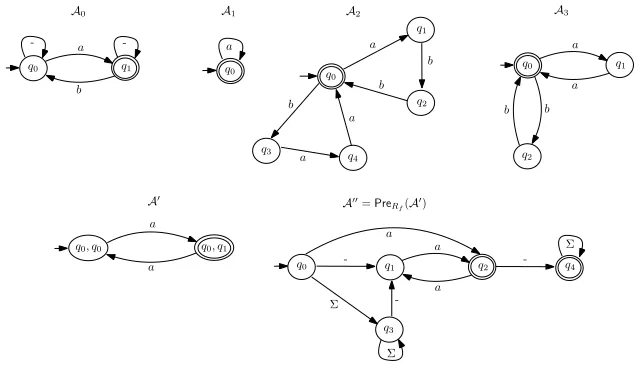
Example 3.6. Consider the symbolic execution
assert(x ∈ A0);y1:=f(x);z:=y1◦y2; assert(y1∈ A1); assert(y2∈ A2);assert(z∈ A3)
whereA0,A1,A2,A3are FAs illustrated in Figure2, andf :Σ∗→2Σ∗
is the function mentioned in Section1that nondeterministically outputs a substring delimited by -. At first, we remove the assignmentz=y1◦y2as well as the assertionassert(z∈ A3). Moreover, since the pre-image of◦
underA3, denoted byд, is a recognisable relation represented by(A3(q0,{qi}),A3(qi,{q0}))0≤i≤2,
we add the assertionassert(д(y1,y2)), and get following program
assert(x ∈ A0);y1:=f(x); assert(y1∈ A1); assert(y2∈ A2); assert(д(y1,y2)).
To continue, we nondeterministically choose one tuple, say(A3(q0,{q1}),A3(q1,{q0})), from the
representation ofд, and replaceassert(д(y1,y2)) withassert(y1 ∈ A3(q0,{q1}));assert(y2 ∈
A3(q1,{q0})), and get the program
assert(x ∈ A0);y1:=f(x); assert(y1∈ A1); assert(y2∈ A2);
assert(y1∈ A3(q0,{q1})); assert(y2∈ A3(q1,{q0})).
Letσbe{A1,A3(q0,{q1})}, the set of FAs occurring in the assertions fory1in the above program.
Compute the productA′
=A1× A3(q0,{q1})andA′′=PreRf(A
′)(see Figure2).
Then we removey1:=f(x), as well as the assertions that involvey1, namely,assert(y1∈ A1)
andassert(y1∈ A3(q0,{q1})), and add the assertionassert(x ∈ A′′), resulting in the program
assert(x ∈ A0); assert(y2∈ A2);assert(y2 ∈ A3(q1,{q0}));assert(x ∈ A′′).
It is not hard to see that -a-∈ L(A0)∩ L(A′′)andabb ∈ L(A2)∩ L(A3(q1,{q0})). Then the
assignmentx =-a-,y1=a,y2=abb, andz=aabbwitnesses the path feasibility of the original
symbolic execution. □
q0 q1 a a q2 b b A3 q0 q1 a b A2 q2 b q3 q4 b a a q0 A1
q0 q1
a
b
A0
a
q0, q0 q0, q1
a
a
A′ A′′=PreRf(A′)
-q1 q2
a
q0 q4
q3 - -Σ -Σ a Σ a
-Fig. 2. A0,A1,A2,A3,A′,PreRf(A
′), whereΣ
={a,b,-}
(for binary relations, this can be done in doubly exponential time), and deciding whether a synchronous relation is recognisable can be done in exponential time [Carton et al. 2006]. Similar results are also mentioned in [Benedikt et al. 2003;Libkin 2003].
By these results, one can check, for a given symbolic execution where the string relations in the asser-tion and the relaasser-tions induced by the string operaasser-tion are alldeterministic rationalrelations, whether it satisfies the two semantic conditions. Hence, one can check algorithmically whether Theorem3.5is applicable.
□
4 AN EXPRESSIVE LANGUAGE SATISFYING THE SEMANTIC CONDITIONS
Section3has identified generalsemanticconditions under which thedecidability of the path feasibility problem can be attained. Two questions naturally arise:
(1) How general are these semantic conditions? In particular, do string functions commonly used in practice satisfy these semantic conditions?
(2) What is the computational complexity of checking path feasibility? The next two sections will be devoted to answering these questions.
For the first question, we shall introduce asyntacticallydefined string constraint languageSL, which includes general string operations such as thereplaceAllfunction and those definable by two-way transducers, as well as recognisable relations. [Here,SLstands for łstraight-linež because our work generalises the straight-line logics of [Chen et al. 2018a;Lin and Barceló 2016].] We first recap thereplaceAllfunction that allows a general (i.e. variable) replacement string [Chen et al. 2018a]. Then we give the definition of two-way transducers whose special case (i.e. one-way transducers) has been given in Section2.
4.1 ThereplaceAllFunction and Two-Way Transducers
ThereplaceAllfunction has three parameters: the first parameter is thesubjectstring, the second parameter is apatternthat is a regular expression, and the third parameter is thereplacementstring. For the semantics ofreplaceAllfunction, in particular when the pattern is a regular expression, we adopt theleftmost and longest matching. For instance,replaceAll(aababaab,(ab)+,c)
[image:13.486.83.401.82.268.2]replaceAll(aab,(ab)+,c) =acac, since the leftmost and longest matching of(ab)+inaababaabis abab. Here we require that the language defined by the pattern parameter doesnotcontain the empty string, in order to avoid the troublesome definition of the semantics of the matching of the empty string. We refer the reader to [Chen et al. 2018a] for the formal semantics of thereplaceAllfunction. To be consistent with the notation in this paper, for each regular expressione, we define the string functionreplaceAlle :Σ∗×Σ∗→Σ∗such that foru,v∈Σ∗,replaceAlle(u,v)=replaceAll(u,e,v), and we writereplaceAll(x,e,y)asreplaceAlle(x,y).
As in the one-way case, we start with a definition of two-way finite-state automata.
Definition 4.1 (Two-way finite-state automata). A(nondeterministic) two-way finite-state automa-ton(2FA) over a finite alphabetΣis a tupleA=(Σ,▷,◁,Q,q0,F,δ)whereQ,q0,Fare as in FAs,▷
(resp.◁) is a left (resp. right) input tape end marker, and the transition relationδ ⊆Q×Σ×{−1,1}×Q,
whereΣ=Σ∪ {▷,◁}. Here, we assume that there are no transitions that take the head of the tape past the left/right end marker (i.e.(p,▷,−1,q),(p,◁,1,q)<δfor everyp,q∈Q).
Whenever they can be easily understood, we will not mentionΣ,▷, and◁inA.
The notion of runs of 2FA on an input string is exactly the same as that of Turing machines on a read-only input tape. More precisely, for a stringw =a1. . .an, arunofAonwis a sequence
of pairs(q0,i0), . . . ,(qm,im) ∈ Q×[0,n+1] defined as follows. Leta0 =▷andan+1 =◁. The
following conditions then have to be satisfied:i0 = 0, and for everyj ∈ [0,m−1], we have (qj,aij,dir,qj+1)∈δandij+1=ij +dirfor somedir ∈ {−1,1}.
The run is said to beacceptingifim =n+1 andqm ∈F. A stringw isacceptedbyAif there is an accepting run ofAonw. The set of strings accepted byAis denoted byL(A), a.k.a., the languagerecognisedbyA. Thesize|A |ofAis defined to be|Q|; this will be needed when we talk about computational complexity.
Note that an FA can be seen as a 2FA such thatδ ⊆Q×Σ× {1} ×Q, with the two end markers
▷,◁omitted. 2FA and FA recognise precisely the same class of languages, i.e.,regular languages.
The following result is standard and can be found in textbooks on automata theory (e.g. [Hopcroft and Ullman 1979]).
Proposition 4.2. Every 2FAAcan be transformed in exponential time into an equivalent FA of size2O(| A |log| A |).
Definition 4.3 (Two-way finite-state transducers). LetΣbe an alphabet. Anondeterministic two-way finite transducer (2FT)T overΣis a tuple(Σ,▷,◁,Q,q0,F,δ), where Σ,Q,q0,F are as in
FTs, andδ ⊆ Q×Σ× {−1,1} ×Q×Σ∗, satisfying the syntactical constraints of 2FAs, and the
additional constraint that the output must beϵwhen reading▷or◁. Formally, for each transition (q,▷,dir,q′,w)or(q,◁,dir,q′,w)inδ, we havew =ϵ.
The notion of runs of 2FTs on an input string can be seen as a generalisation of 2FAs by adding outputs. More precisely, given a stringw = a1. . .an, arun ofT onw is a sequence of tuples
(q0,i0,w0′), . . . ,(qm,im,wm′ ) ∈Q×[0,n+1]×Σ∗such that, ifa0=▷andan+1=◁, we havei0=0,
and for everyj ∈[0,m−1],(qj,aij,dir,qj+1,w
′
j) ∈δ,ij+1 =ij+dirfor somedir ∈ {−1,1}, and w0′=wm′ =ε. The run is said to beacceptingifim =n+1 andqm ∈F. When a run is accepting, w0′. . .wm′ is said to be theoutputof the run. Note that some of thesewi′s could be empty strings. A wordw′is said to be an output ofT onwif there is an accepting run ofT onwwith outputw′. We useT(T)to denote thetransductiondefined byT, that is, the relation comprising the pairs(w,w′)
such thatw′is an output ofT onw.
Note that an FT overΣis a 2FT such thatδ ⊆Q×Σ× {1} ×Q×Σ∗, with the two endmarkers
Example 4.4. We give an example of 2FT for the function f(w) =wwR. The transducer has three statesQ = {q0,q1,q2}, and the transition relationδ comprises (q0, ℓ,1,q0, ℓ) for ℓ ∈ Σ,
(q0,▷,1,q0,ϵ),(q0,◁,−1,q1,ϵ),(q1, ℓ,−1,q1, ℓ)forℓ∈Σ,(q1,▷,1,q2,ϵ),(q2, ℓ,1,q2,ϵ)forℓ∈Σ.
The final stateF ={q2}. □
4.2 The Constraint LanguageSL
The constraint languageSLis defined by the following rules,
S::= z:=x ◦ y|z:=replaceAlle(x,y) |y:=reverse(x) |y:=T(x)|assert(R(x⃗))|S;S (4)
where◦ is the string concatenation operation which concatenates two strings,e is a regular expression,reverseis the string function which reverses a string,T is a 2FT, andRis a recognisable relation represented by a collection of tuples of FAs.
For the convenience of Section5, for a class of string operationsO, we will useSL[O] to
denote the fragments ofSLthat only use the string operations fromO. Moreover, we will use sreplaceAllto denote the special case of thereplaceAllefunction where the replacement parameters are restricted to bestring constants. Note that, according to the result in [Chen et al. 2018a], an instance of thesreplaceAllfunctionreplaceAlle(x,u) withea regular expression andua string constant can be captured by FTs. However, such a transformation incurs an exponential blow-up. We also remark that we do not presentSL in the most succinct form. For instance, it is known that the concatenation operation can be simulated by thereplaceAllfunction, specifically, z = x ◦y ≡ z′ = replaceAlla(ab,x)∧z = replaceAllb(z′,y), wherea,b are two fresh letters. Moreover, it is evident that thereversefunction is subsumed by 2FTs.
We remark thatSLis able to encode some string functions with multiple (greater than two) argu-ments by transducers and repeated use ofreplaceAll, which is practically convenient particularly for user-defined functions.
The following theorem answers the two questions raised in the beginning of this section.
Theorem 4.5. The path feasibility problem ofSLis decidable with a non-elementary lower-bound.
To invoke the result of the previous section, we have the following proposition.
Proposition 4.6. TheSLlanguage satisfies the two semantic conditionsRegMonDecandRegInvRel.
Proof.It is sufficient to show that thereplaceAllefunctions and the string operations defined by 2FTs satisfy theRegInvRelcondition.
The fact thatreplaceAlle for a given regular expressionesatisfies theRegInvRelcondition was shown in [Chen et al. 2018a].
That the pre-image of an 2FTT under a regular language defined by an FAA is effectively regular is folklore. LetT =(Q,q0,F,δ)be a 2FT andA=(Q′,q0′,F′,δ′)be an FA. ThenPreT(T)(A) is the regular language defined by the 2FAA′=(Q×Q′,(q0,q0′),F×F′,δ′′), whereδ′′comprises
the tuples((q1,q′1),a,(q2,q2′))such that there existsw ∈ Σ∗satisfying that(q1,a,q2,w) ∈δand
q′1−−w→
A q ′
2. From Proposition4.2, an equivalent FA can be built fromA′in exponential time. □
From Proposition4.6and Theorem3.5, the path feasibility problem ofSLisdecidable.
To address the complexity (viz. the second question raised at the beginning of this section), we show that the path feasibility problem ofSLisnon-elementary.
Proposition 4.7. The path feasibility problem of the following two fragments isnon-elementary:
For eachnwe reduce from a tiling problem that is hard forn-expspace. For this we need to use large numbers that act as indices. Similar encodings of large numbers appear in the study of higher-order programs (e.g. [Cachat and Walukiewicz 2007;Jones 2001]) except quite different machinery is needed to enforce the encoding. The complete reduction is given in the full version of this article [Chen et al. 2018b], with some intuition given here.
Atiling problemconsists of a finite set of tilesΘas well as horizontal and vertical tiling relations H,V ⊆Θ×Θ. Given a tilingcorridorof a certain width, as well as initial and final tilestI,tF ∈Θ the task is to find a tiling where the first (resp. last) tile of the first (resp. last) row istI (resp.tF), and horizontally (resp. vertically) adjacent tilest,t′have(t,t′) ∈H(resp.V). Corridor width can be considered equivalent to the space of a Turing machine. We will consider problems where the corridor width is 2:2m
where the height of the stack of exponentials isn. E.g. whennis 0 the width ism, whennis 1 the width is 2m, whennis 2 the width is 22m
and so on. Solving tiling problems of width 2:2m
is complete for the same amount of space.
Solving a tiling problem of corridor widthmcan be reduced to checking whether a 2FT of size polynomial inmand the number of tiles can output a specified symbol⊤. Equivalently, we could use a 2FA. A solution is a word
t1,1t1,2. . .t1,m#. . .#th,1th,2. . .th,m
where # separates rows. The 2FT performsm+1 passes. During the first pass it checks that the tiling begins withtI, ends withtF, andti,j,ti,j+1
∈ H for all 1≤j <m. Inmmore passes we verify thatV is obeyed; thejth pass verifies thejth column.
Now consider two 2FTs and a tiling problem of width 2m. Intuitively, we precede each tile with its column number inmbinary bits. That is
0. . .00t1,10. . .01t1,2 . . .1. . .11t1,2m #. . .#0. . .00tm,10. . .01tm,2 . . .1. . .11tm,2m .
The first 2FT checks the solution similarly to the widthm problem, but needs to handle the large width when checkingV. For this it will use a second 2FT. For each column, the first 2FT nondeterministically selects all the tiles in this column (verifyingV on-the-fly). The addresses of the selected tiles are output to the second 2FT which checks that they are equal. The first 2FT goes through a non-deterministic number of such passes and the second 2FT enforces that there are 2m of them (in column order). To do this, the second 2FT checks that after the addresses of thei-th column are output by the first 2FT, then the addresses of the(i+1)-th column are output next. Lengthmbinary numbers are checked similarly to widthmtiling problems.
With another 2FT we can increase the corridor width by another exponential. For doubly-exponential numbers, we precede each tile with a binary sequence of doubly-exponential length. For this we precede each bit with another binary sequence, this time of lengthm. The first 2FT outputs queries to the second, which outputs queries to the third 2FT, each time removing one exponential. With(n+1)2FT, we can encode tiling problems over ann-fold exponentially wide corridor.
The same proof strategy can be used for FTs+replaceAll. The 2FTs used in the proof above proceed by running completely over the word and producing some output, then silently moving back to the beginning of the word. An arbitrary number of passes are made in this way. We can simulate this behaviour using FTs andreplaceAll.
To simulatey:=T(x)for a 2FTT making an arbitrary number of passes over the contents of a variablex, as above, we use fresh variablesx1andx2, and an automatonAarecognising(a♮)∗for some arbitrary characteraand delimiter♮not used elsewhere. With these we use the constraint
whereT′simulatesT in the forwards direction, and simulates (simply by changing state) a silent return to the beginning of the word when reading♮. It can be seen thatx2contains an arbitrary
number of copies ofx, separated by♮, henceT′simulatesT.
It was stated in Section1that the non-elementarycomplexity will be caused by repeated product constructions. These product constructions are not obvious here, but are hidden in the treatment ofreplaceAlla. This treatment is elaborated on in Section6.2.2. The key point is that to showreplaceAllasatisfiesRegInvRelone needs to produce a constraint onxthat is actually the product of several automata.
5 MORE “TRACTABLE” FRAGMENTS
In this section, we show that thenon-elementarylower-bound of the preceding section should not be read too pessimistically. As we demonstrate in this section, the complexity of the path feasibility problem can be dramatically reduced (expspace-complete) for the following two fragments,
• SL[◦,replaceAll,reverse, FFT], where 2FTs inSLare restricted to beone-way and functional, • SL[◦,sreplaceAll,reverse, FT], where thereplacementparameter of thereplaceAllfunction is restricted to be a stringconstant, and 2FTs are restricted to beone-way(butnotnecessarily functional).
These two fragments represent the most practical usage of string functions. In particular, instead of very general two-way transducers, one-way transducers are commonly used to model, for instance, browser transductions [Lin and Barceló 2016].
5.1 The FragmentSL[◦,replaceAll,reverse, FFT]
The main result of this subsection is stated in the following theorem.
Theorem 5.1. The path feasibility ofSL[◦,replaceAll,reverse, FFT] isexpspace-complete. To show the upper bound of Theorem5.1, we will refine the (generic) decision procedure in Section3in conjunction with a careful complexity analysis. The crucial idea is toavoid the product constructionbefore each pre-image computation in the algorithm given in the proof of Theorem3.5. This is possible now since all string operations inSL[◦,replaceAll,reverse, FFT] are (partial) functions, and regular constraints are distributive with respect to the pre-image of string (partial) functions.
Fact 1. For every string (partial) functionf :(Σ∗)r → Σ∗and regular languagesL1andL2, it
holds thatPreRf(L1∩L2)=PreRf(L1)∩PreRf(L2).
To see this, supposeu⃗ ∈PreRf(L1)∩PreRf(L2). Thenu⃗ ∈PreRf(L1)andu⃗∈PreRf(L2). Therefore, there arev1∈L1,v2∈L2such that(⃗u,v1) ∈Rf and(u⃗,v2)∈Rf. Sincef is a (partial) function, it follows thatv1=v2∈L1∩L2, thus⃗u∈PreRf(L1∩L2). This equality doesnothold in general iff isnotfunctional, as shown by the following example.
Example 5.2. Let -∈ Σand f :Σ∗ → 2Σ∗ be the nondeterministic function mentioned in the introduction (see Figure1) that nondeterministically outputs a substring delimited by-. Moreover, leta,bbe two distinct letters fromΣ\ {-},L1=a(Σ\ {-})∗, andL2=(Σ\ {-})∗b. Then
PreRf(L1)∩PreRf(L2) = (a(Σ\ {-})
∗∪a(Σ\ {-})∗-Σ∗∪Σ∗-a(Σ\ {-})∗∪Σ∗-a(Σ\ {-})∗-Σ∗) ∩
((Σ\ {-})∗b∪(Σ\ {-})∗b-Σ∗∪Σ∗-(Σ\ {-})∗b∪Σ∗-(Σ\ {-})∗b-Σ∗), which is different from
PreRf(L1∩L2) =a(Σ\ {-})
∗
The distributivity of the pre-image of string functions means that, for eachy:=f(x⃗)andy∈ A withL(A) = L(A1)∩ · · · ∩ L(As), we can computePreRf(A) byseparately computing the pre-imagePreRf(Ai)for each assertiony∈ Ai, i.e., no product construction is performed.
Moreover, to obtain theexpspaceupper bound, we need to carefully examine the complexity of the pre-image computation for each string operation. The pre-image computation of thereplaceAll
function has recently been addressed in [Chen et al. 2018a]. In the following, we tackle other string functions inSL[◦,replaceAll,reverse, FFT]. To this end, we utilise a succinct representation of the conjunction of a special class of regular languages, calledconjunctive FAs.
Definition 5.3 (Conjunctive FA). A conjunctive FA is a pair(A,Ω), whereA=(Q,δ)is a transition graph andΩ⊆Q×Qis called aconjunctive acceptance condition. The language defined by(A,Ω), denoted byL(A,Ω), is T
(q,q′)∈Q
L((Q,q,{q′},δ)). The size of(A,Ω), is defined as|Q|.
Note that the conjunctive FA(A,Ω)is exponentially more succinct than the product automaton of all FAs(Q,q,{q′},δ)for(q,q′)∈Ω. For a string operationf :(Σ∗)r →Σ∗, we usePreRf(A,Ω) to denote the pre-image ofL(A,Ω)underRf. Aconjunctive representation ofPreRf(A,Ω)is a collection((A(j1),Ωj(1)), . . . ,(Aj(r),Ωj(r)))1≤j≤n, where each atom(Aj(i),Ω(ji))is a conjunctive FA.
Based on conjunctive FAs and the fact that the product construction of regular constraints can be avoided, we show theexpspaceupper bound forSL[◦,replaceAll,reverse, FFT].
Proposition 5.4. The path feasibility ofSL[◦,replaceAll,reverse, FFT] is inexpspace.
The proof of Proposition5.4can be found in the full version of this article [Chen et al. 2018b]. For theexpspacelower bound, it has been shown in [Lin and Barceló 2016] thatSLwithF FT and◦isexpspace-hard. (Note that all transducers used in the reduction therein are functional.) To complement this result, we show thatSLwithreplaceAllsolely is alreadyexpspace-hard. This result is interesting in its own right. In particular, it solves an open problem left over in [Chen et al. 2018a].
Proposition 5.5. The path feasibility problem forSL[replaceAll]isexpspace-hard.
The proof of the above proposition is by a reduction from a tiling problem over an exponentially wide corridor (see Section4.2for a definition). We give the full proof in the full version of this article [Chen et al. 2018b].
5.2 The FragmentSL[◦,sreplaceAll,reverse, FT]
Theorem5.1shows that inSL, if the transducers are restricted to be functional and one-way, then the complexity of the path feasibility problem becomesexpspace-complete. In the following, we show that the same complexity bound holds if thereplaceAllefunction is made unary, whereas the transducers are allowed to be relational. We remark that the proof of the complexity upper-bound deviates from that ofSL[◦,replaceAll,reverse, FFT].
Theorem 5.6. The path feasibility ofSL[◦,sreplaceAll,reverse, FT] isexpspace-complete. The lower-bound in Theorem5.6follows from that in [Lin and Barceló 2016] for◦and FTs. We focus on the upper-bound. LetSbe a symbolic execution inSL[◦,sreplaceAll,reverse, FT]. Without loss of generality, we assume that the subject parameters of thesreplaceAllfunctions inS are always string variables (otherwise it can be eliminated). We have the four-step procedure below:
(1) At first, for each assertionassert(R(⃗x))inS, we nondeterministically choose one disjunct (A1, . . . ,Ar)of the representation ofR, replaceassert(R(⃗x))with the sequence of assertions assert(x1∈ A1);. . .;assert(xr ∈ Ar). LetS1be the resulting program. Note that the size of
(2) Transform each assignment of the formy :=replaceAlle(x,u)inS1withe a regular
ex-pression andua string constant, intoy :=Te,u(x), whereTe,u is an FT corresponding to
replaceAlle(·,u)that can be constructed frome,uin exponential time ([Chen et al. 2018a]). LetS2denote the resulting program.
(3) Remove all the occurrences of the◦operator fromS2, resulting inS3. This step can be done
in nondeterministic exponential time w.r.t. the size ofS1(notS2), thus the size ofS3is at most
exponential in that ofS1.
(4) Finally, reduceS3into a programS4that contains no occurrences of thereversefunction.
The reduction is done in polynomial time.
Note thatS4is a program that contains only FTs and assertions of the formy∈ Athe size of which
is exponential in that ofS. According to [Barceló et al. 2013][Theorem 6.7], the path feasibility of a symbolic execution that contains only FTs and assertions of the formy ∈ Acan be solved in polynomial space. Therefore, we conclude that the path feasibility ofSL[◦,sreplaceAll,reverse, FT] is in nondeterministic exponential space, thus inexpspaceby Savitch’s theorem.
Since the first step is clear and the second step was shown in [Chen et al. 2018a], we will focus on the third and fourth step.
The third step is similar to the proof of Theorem 5 in [Lin and Barceló 2016]: The main idea is to do a bottom-up induction on the structure of the dependency graph (namely starting from the input variables) and split each variable into multiple segments represented by fresh variables. (In the current setting, one additional inductive case should be added to deal with thereverse
function.) Crucially the number of fresh variables introduced in the third step depends only on the structure of the dependency graph, but is independent of the size of the transducers or automata in S2. Therefore, there are at most exponentially (in the size ofS1) many fresh variables are introduced.
The transducers or automata inS3are obtained from those ofS2by designating one initial and one
final state respectively. Therefore, the size ofS3is at most exponential in that ofS1.
We mainly describe the fourth step, i.e., to eliminate thereversefunction while preserving path feasibility. During this course, we need to introducereversed transducers. For an FTT, we define FT Tπ by reversing the direction of each transition ofT and swapping initial and final states.
LetXdenote the set of variables occurring inS3. The fourth step comprises the following substeps.
(4.1) For eachx ∈X, add a new variablex(π), which intuitively denotes the reverse ofx.
(4.2) Remove eachy:=reverse(x)inS3and replace each occurrence ofyinS3withx(π).
(4.3) In this substep, we intend to make sure for each variablex∈X, it cannot be the case that bothx andx(π)occur. To this end, we sequentially process the statements ofS
3, as follows.
Mark all the remaining assignments as unprocessed. Repeat the following procedure until all the assignments are processed:
• If the first unprocessed statement is of the formy:=T(x(π))(resp.y(π) =T(x(π))) andx occurs in some processed assignment, then replacey:=T(x(π))(resp.y(π):=T(x(π))) by y(π):=Tπ(x)(resp.y:=T(x)) and mark the new statement as processed.
• If the first unprocessed statement is of the formy(π) :=T(x)(resp.y:=T(x)) andx(π) occurs in some processed assignment, then replacey(π) :
= T(x) (resp.y :=T(x)) by y:=Tπ(x(π))(resp.y(π) :=Tπ(x(π))) and mark the new statement as processed.
• For all the other cases, mark the first unprocessed statement as processed.
(4.4) For each variablex ∈X, ifxoccurs in the assignments, then replace each regular constraint of the formx(π) ∈ L(A)byx ∈ L(Aπ), otherwise, replace each regular constraint of the formx ∈ L(A)byx(π) ∈ L(Aπ).
Recall that we useS4to denote the symbolic execution that results from executing the fourth step
onS3. From the arguments above, we know that for eachx ∈X, exactly one ofx orx(π) occurs
inS4, but not both. Therefore,S4is a symbolic execution inSL[◦,sreplaceAll,reverse, FT] that
contains only FTs and regular constraints.
The following example illustrates the fourth step.
Example 5.7. Consider the symbolic execution
z:=T(x);y:=reverse(x);z′:=T′(y);assert(x ∈ A1); assert(z∈ A2); assert(z′∈ A3)
whereT,T′are FTs andA1,A2,A3are FAs. In the first substep, we add the variablesx(π),y(π), z(π),(z′)(π). In the second substep, we removey:=reverse(x)and replaceywithx(π), resulting in the program
z:=T(x);z′:=T′(x(π));assert(x ∈ A1); assert(z∈ A2); assert(z′∈ A3).
In the third substep, since when processingz′:=T′(x(π)),x has already occurred in the processed assignmentz:=T(x), we transformz′:=T′(x(π))into(z′)(π):=T′(x), resulting in the program
z:=T(x); (z′)(π):=T′(x); assert(x ∈ A1);assert(z∈ A2); assert(z′∈ A3).
Note that after the third substep,x,z,(z′)(π)occur in the assignments, but none ofx(π),z(π)and z′do. In the fourth substep, we replaceassert(z′ ∈ A3) withassert((z′)(π) ∈ Aπ3) and get the following symbolic execution inSL[◦,sreplaceAll,reverse, FT] where only FTs and regular constraints occur,
z:=T(x); (z′)(π) :=T′(x);assert(x ∈ A1); assert(z∈ A2); assert((z′)(π) ∈ Aπ3).
□
As mentioned in Section1, our algorithm reduces the problem to constraints which can be handled by the existing solver SLOTH [Holík et al. 2018].
Extensions with Length Constraints.Apart from regular constraints in the assertion, length constraints are another class of commonly used constraints in string manipulating programs. Some simple length constraints can be encoded by regular constraints, as partially exemplified in Example3.2. Here, we show that whenSL[◦,sreplaceAll,reverse, FT] is extended with (much more) general length constraints, theexpspaceupper bound can still be preserved. We remark that, in contrast, ifSL[◦,replaceAll,reverse, FFT] is extended with length constraints, then the path feasibility problem becomes undecidable, which has already been shown in [Chen et al. 2018a].
To specify length constraints properly, we need to slightly extend our constraint language. In particular, we consider variables of typeInt, which are usually referred to asinteger variablesand range over the setNof natural numbers. Recall that, in previous sections, we have usedx,y,z, . . .
to denote the variables ofStrtype. Hereafter we typically usel,m,n, . . .to denote the variables of
Int. The choice of omitting negative integers is for simplicity. Our results can be easily extended to the case whereIntincludes negative integers.
Definition 5.8 (Length assertions). A length assertion is of the formassert(a1t1+· · ·+antn ≤d), wherea1, . . . ,an,d ∈Zare integer constants (represented in binary), and eachtermtiis either
(1) an integer variablen;