N A N O R E V I E W
Open Access
Cellulose fibres, nanofibrils and microfibrils: The
morphological sequence of MFC components
from a plant physiology and fibre technology
point of view
Gary Chinga-Carrasco
Abstract
During the last decade, major efforts have been made to develop adequate and commercially viable processes for disintegrating cellulose fibres into their structural components. Homogenisation of cellulose fibres has been one of the principal applied procedures. Homogenisation has produced materials which may be inhomogeneous,
containing fibres, fibres fragments, fibrillar fines and nanofibrils. The material has been denominated microfibrillated cellulose (MFC). In addition, terms relating to the nano-scale have been given to the MFC material. Several modern and high-tech nano-applications have been envisaged for MFC. However, is MFC a nano-structure? It is concluded that MFC materials may be composed of (1) nanofibrils, (2) fibrillar fines, (3) fibre fragments and (4) fibres. This implies that MFC is not necessarily synonymous with nanofibrils, microfibrils or any other cellulose nano-structure. However, properly produced MFC materials contain nano-structures as a main component, i.e. nanofibrils.
Review
Introduction
Wood pulp fibres are presently a major area of research for several end-use applications. Fibres can be utilised as reinforcement in bio-degradable composites and as a source of raw materials for bio-energy and biochemical production. Wood pulp fibres have been applied as the raw material for the production of a fibrillated material, which was introduced and defined as microfibrillated cellulose (MFC) by Turbak et al. [1] and Herrick et al. [2]. Several modern and high-tech nano-applications have been envisaged for MFC [1]. Although cellulose fibres have constituted the main source for MFC pro-duction, the utilisation of other pulp fibres, agricultural crops and by-products have also been explored [3-5]. With the years, various subjective definitions have been given to the fibrillated materials, e.g. nanofibrillated cel-lulose, nanofibres, nanofibrils, microfibrils and nanocel-lulose [6-10].
The German philosopher Immanuel Kant (1724 to
1804) wrote: “Things which we see are not by
them-selves what we see... It remains completely unknown to us what the objects may be by themselves and apart from the receptivity of our senses. We know nothing but our manner of perceiving them...”. Perception is thus a key word with respect to how we subjectively interpret structures. This is clearly exemplified in the relatively large number of terms that have been applied to roughly the same material, and emphasises the neces-sity of objectively clarifying and standardising the termi-nology applied within cellulose nanotechtermi-nology research. All the given terms relate to structures with nano-dimensions. However, is MFC a nano-structure? The purpose of this review is thus to shed more light on (1) the morphology of MFC structures, (2) the rela-tionship between biological components of fibre wall structures and engineered cellulose-based nano-materi-als and (3) the terms associated with the MFC denomi-nation. This review will not include other forms of cellulose materials, such as whiskers or bacterial cellu-lose, which may also be referred to as nanocellulose. For interested readers, see Klemm et al. [5].
Correspondence: [email protected]
Paper and Fibre Research Institute (PFI AS), Høgskolerringen 6b, 7491 Trondheim, Norway
The structure of wood pulp fibres
The wood pulp fibres have multiscale characteristics [11]. Roughly, typical lengths of fibres are 1 to 3 mm and typical widths are 10 to 50μm. The fibre wall
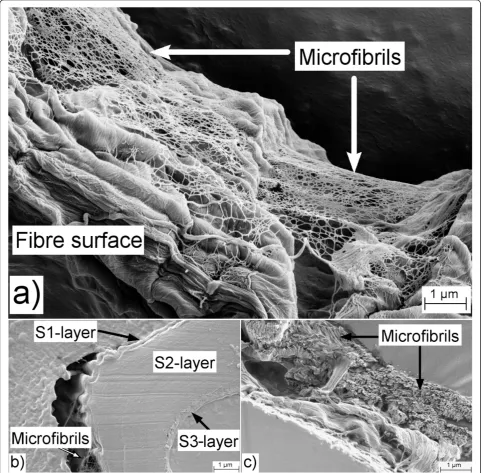
thick-ness is roughly between 1 and 5 μm (Figure 1). The
fibre wall is composed of defined layers (Figure 1b), including the primary wall (P) and several secondary wall layers (S1, S2 and S3). Each of these layers is
[image:2.595.57.542.206.679.2]characterised by a specific arrangement of fibrils as has been detailed described for more than 40 years ago [12]. Chemical pulp fibres are produced through chemical pulping where lignin and hemicellulose are extracted. Chemical pulp fibres have a surface, which is charac-terised by a particular pattern created by wrinkles and microfibrils in the outer layers of the fibre wall structure (Figure 1a). The surface structure of chemical pulp
fibres corresponds mainly to the primary and S1 layers of the fibre wall, which are preserved during chemical pulping. Contrary to the outer layers of the fibre wall (primary and S1 layers), the S2 layer is characterised by having a structure of microfibrils organised in a helical manner [12].
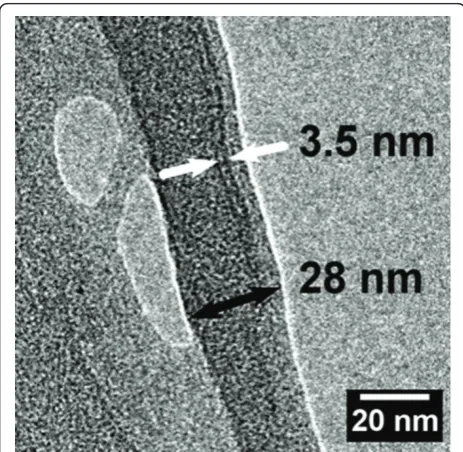
According to Meier [13], the cellulosic components of a wood fibre wall structure are the cellulose mole-cule, the elementary fibril, the microfibril, the macrofi-bril and the lamellar membrane. In the work of Maier [13], the term “elementary fibril” was reported to have a diameter of 3.5 nm and was applied following the terminology of Frey-Wyssling [14]. Heyn [12] stated that elementary fibrils are universal structural units of natural cellulose, as the same biological structure had been encountered in cotton, ramie, jute and wood fibres. Blackwell and Kolpak [15] reported also the occurrence of elementary fibrils with diameters of approximately 3.5 nm in cotton and bacterial cellulose, thus giving supportive evidence about the basic fibrillar unit in cellulose microfibrils, see also [16]. According to Meier [13], microfibrils are agglomerates of elemen-tary fibrils and always have diameters which are multi-ples of 3.5 nm (Figures 1c and 2). The bundling of elementary fibrils into microfibrils is caused by purely physically conditioned coalescence as a mechanism of reducing the free energy of the surfaces [17]. The max-imum diameter of a microfibril was proposed to be 35
nm [13]. Clearly, there has been a debate during the 1950 to 1960s about the terminology applied for describing the elementary components of a plant cell wall. Ohad and Danon [18] applied the microfibril term to the basic plant cell wall structures having a diameter of 3.5 nm, i.e. the elementary fibrils [12,14,19,20]. The microfibril structures reported by Frey-Wyssling [14] were defined as “composite fibres” by Ohad and Danon [18].
Elementary fibrils are generated in complex biological processes, involving cellulose synthase complexes in the plasma membrane, exocytosis of cell wall polymers and cortical microtubules [21]. It seems to exist sufficient evidences that elementary fibrils in vascular plant cell walls are composed of 36b-1,4-glucan chains, synthe-sised by the cellulose synthase proteins in the plasma membrane (rosette complexes) [22,23].
Microfibrillated cellulose
[image:3.595.57.289.446.672.2]Since the introduction of the transmission electron microscope, it seems that researchers have attempted to disintegrate cellulose fibres into single microfibrils/ele-mentary fibrils for ultrastructural studies. Already in the 1950s, ultrasonic, hydrolysis and oxidation treatments were applied for disintegrating cellulose structures [14,17,24]. In addition, Ross Colvin and Sowden [25] reported a homogenization process based on beating for opening the structure of cellulose fibres and thus expos-ing the microfibril structures for transmission electron microscopy (TEM) analysis.
The disintegration of cellulose fibres into their struc-tural components (microfibrils) has also found industrial interest. As mentioned above, in 1983, Turbak et al. [1] introduced a homogenisation procedure for fibrillating cellulose fibres with commercial purposes. The MFC terminology, which was originally applied to the fibril-lated material, was probably refibril-lated to the predominant structures encountered in fibre wall structures, i.e. microfibrils [9].
Although microfibrils seem to be the main component of MFC, several studies have shown that fibrillation pro-duces a material which may be inhomogeneous [2,16,26,27], containing, e.g. fibres, fibre fragments, fines and fibrils (Figures 3, 4 and 5). As exemplified in Figure 3, the fraction of each component depends on (1) the treatment applied to the fibres before homogenization, (2) the number of passes through the homogenizer and (3) the pressure applied during homogenization. The more severe the homogenisation, the more fibrillated is the material. Higher degree of fibrillation can be indi-cated by an increase in the transparencies of the MFC materials due to the generation of optically inactive fibrils. Such fibrils form dense and compact structures, with low light scattering potential.
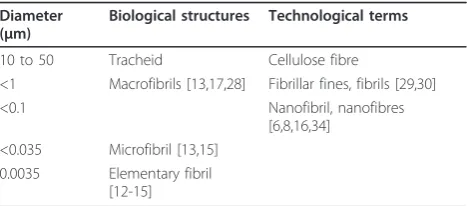
Having fibrillated materials with different degree of homogenisation and composed of a variety of structures emphasises the necessity of clarifying the different com-ponents encountered in MFC. Table 1 gives a rough classification of MFC components, including classical terminology that has been applied in plant physiology for decades and terminology related to fibre technology.
The fibril term has been applied for defining
struc-tures with a dimension less than 1 μm, although not
consequently. Structures with diameters of <1.0 μm have also been observed in the fibre wall structure of pulp fibres. Such structures have been denominated
macrofibrils, and diameters of approximately 0.66μm
have been reported [28]. However, according to Meier [13], macrofibrils do not have definite dimensions. A fibril may also be considered an engineered structure as it is produced during mechanical fibrillation. There seems to be no concrete border line between fibrils and fibrillar fines (Figure 5A). Fibrillar fines may also be cre-ated through refining or beating, from mechanical and
chemical pulp fibres, respectively [29]. Subramanian et al. [30] considered fibrillar fines, microfines and microfi-brillar cellulose in the same category, i.e. particles that pass a 75-μm diameter round hole or a 200-mesh screen of a fibre length classifier. Such a definition indicates that MFC may also be considered as fines, as exempli-fied in Figure 5A. Both materials are composed of rela-tively small and fibrillated components. However, according to Turbak et al. [1], no amount of conven-tional beating yields the microfibrillation obtained with an optimally homogenised product.
The microfibrillation mentioned by Turbak et al. [1] does not seem to refer to the creation of micrometre-sized particles but to the fibrillation of fibres into indi-vidualised microfibrils with diameters less than 100 nm [1]. In this context, it is appropriate to introduce in this review a scale that has been widely emphasised during the last years within modern technology, i.e. “nano”. It seems to be widely accepted that a
[image:4.595.59.538.90.408.2]nano-scale refers to sizes between 0.001 and 0.1 μm (1 to
Figure 3Films made of cellulose materials with a grammage of 20 g/m2. (A) Control film made of 100%P. radiatapulp fibres. (B) Film
100 nm). This implies that the nanofibril term refers to fibrils with diameters less than 100 nm. Based on this definition, it seems obvious that microfibrils can be considered nanofibrils, which also are composed of crystalline and amorphous regions. However, the dif-ference between microfibrils and nanofibrils is that the former is a well-defined biological structure found in plant cell walls, whereas the latter can be considered a technological term introduced to describe secondary and engineered structures with diameters less than 100 nm.
[image:5.595.59.543.90.272.2]As mentioned above, conventional MFC production yields materials with inhomogeneous sizes (Figures 3B, C, 4A and 5A). However, the fibrillation can be facili-tated by, e.g. pre-treating the cellulose fibres enzymati-cally [31] or chemienzymati-cally [32,33]. Pre-treatments have thus facilitated the production of homogeneous fibril qualities, with fibril diameters less than 100 nm (Figure 3E,F). In addition, some authors have reported a filtra-tion procedure to remove poorly fibrillated fibres, thus maintaining mostly the fraction of homogeneous nanofi-brils [34].
Figure 4Surfaces of films (20 g/m2) made of microfibrillated cellulose. (A) MFC obtained by mechanical homogenisation. The image corresponds to the film shown in Figure 3C. (B) MFC obtained with TEMPO-mediated oxidation as pre-treatment and mechanical
homogenisation. The image corresponds to the film shown in Figure 3F. The insets in (A) and (B) represent the surface structure visualised at 50,000× magnification from areas without a metallic coating. Both MFC materials have been collected after passing five times through the homogeniser, at 1,000 bar. For details, see Chinga-Carrasco et al. [16].
[image:5.595.58.545.502.682.2]In general terms, the production of homogeneous fibril qualities may require major costs, including costs related to pre-treatments and to energy consumption during production. The less energy that is utilised, the less is the fibrillation of cellulose fibres and the less the amount of produced nanofibrils [35]. Considering that conventional fibrillation (e.g. homogenisation without pre-treatment) produces a material that is inhomoge-neous and may contain a major fraction of poorly fibril-lated fibres and fines, can we state that MFC is a nano-structure? MFCper seis not necessarily a nano-material, but contains nano-structures, i.e. the nanofibrils (Figures 4 and 5). To define MFC as a nano-structure, it is necessary to give substantial evidence with respect to (1) the fraction of fibrillated fibres, (2) the fraction of nano-fibrils and (3) the morphology of the nanonano-fibrils in an MFC material. Provided that a given MFC is composed of an appropriate fraction of individualised nanofibrils, the MFC will have a major influence on the rheological, optical, mechanical and barrier properties of the corre-sponding materials.
Commonly, morphological evidences are given by microscopy and subjective evaluations. Researchers may focus on the visualisation of nano-structures, applying equipment designed for nano-assessment, e.g. FESEM, AFM and TEM. However, such equipment may limit the field of view considerably, which also introduces a subjec-tive pre-selection of small areas containing nano-struc-tures. Proper characterisation requires the quantification of the fibrillated material at several scales. This can include methods for assessing large areas, with a suitable resolu-tion. One important aspect is not only the quantification of nanofibril morphology but also the quantification of fibres that are poorly fibrillated (see, e.g. Figure 3). Meth-ods for assessing relatively large areas and structures at the micrometre scale are thus most valuable for comple-menting specialised devices for nano-characterisation.
Conclusions
It has been considered most important to propose an appropriate morphological sequence and definitions of
MFC components. Microfibrils are important fibre wall components, i.e. biological nano-structures. However, due to the classical suffix “micro”, microfibrils may be wrongly associated with micrometre-sized fibrils, which may be 1,000 times larger (>1 μm). According to evi-dences given in the literature and personal experience with characterisation of a variety of MFC qualities, it appears that MFC materials may be composed of (1) nanofibrils, (2) fibrillar fines, (3) fibre fragments and (4) fibres. This implies that MFC is not necessarily synon-ymous with microfibrils, nanofibrils or any other cellu-lose nano-structure. However, properly produced MFC materials contain nano-structures as a main component, i.e. nanofibrils.
Abbreviations
MFC: microfibrillated cellulose; TEM: transmission electron microscopy; FESEM: field emission scanning electron microscopy; AFM: atomic force microscopy.
Acknowledgements
All the images have been acquired by the author of this review, except Figure 2 which was acquired with the skilful cooperation of Yingda Yu (NTNU). Kristin Syverud (PFI) is acknowledged for valuable discussions and Philip André Reme (PFI) for revising the original manuscript.
Competing interests
The author declares that he has no competing interests.
Received: 8 March 2011 Accepted: 13 June 2011 Published: 13 June 2011
References
1. Turbak AF, Snyder FW, Sandberg KR:Microfibrillated cellulose, a new cellulose product: properties, uses, and commercial potential.J Appl Polym Sci Appl Polym Symp1983,37:815-827.
2. Herrick FW, Casebier RL, Hamilton JK, Sandberg KR:Microfibrillated Cellulose: Morphology and accessibility.J Appl Polym Sci Appl Polym Symp 1983,37:797-813.
3. Siró I, Plackett D:Microfibrillated cellulose and new nanocomposite materials: a review.Cellulose2010,17(3):459-494.
4. Spence KL, Venditti RA, Habibi Y, Rojas OJ, Pawlak JJ:The effect of chemical composition on microfibrillar cellulose films from wood pulps: mechanical processing and physical properties.Bioresource technology 2010,101(15):5961-5968.
5. Klemm D, Kramer F, Moritz S, Lindström T, Ankerfors M, Gray D, Dorris A: Nanocelluloses: A New Family of Nature-Based Materials.Angewandte Chemie Int Ed50.
6. Abe K, Iwamoto S, Yano H:Obtaining cellulose nanofibers with a uniform width of 15 nm from wood.Biomacromolecules2007,8(10):3276-3278. 7. Gardner DJ, Oporto GS, Mills R, Samir MASA:Adhesion and surface issues
in cellulose and nanocellulose.J Adhesion Sci Techn2008,22:545-567. 8. Ahola S, Österberg M, Laine J:Cellulose nanofibrils–adsorption with poly
(amideamine) epichlorohydrin studied by QCM-D and application as a paper strength additive.Cellulose2008,15(2):303-314.
9. Mörseburg K, Chinga-Carrasco G:Assessing the combined benefits of clay and nanofibrillated cellulose in layered TMP-based sheets.Cellulose2009, 16(5):795-806.
10. Siqueira G, Bras J, Dufresne A:Cellulose Whiskers versus Microfibrils: Influence of the Nature of the Nanoparticle and its Surface Functionalization on the Thermal and Mechanical Properties of Nanocomposites.Biomacromolecules2009,10(2):425-432.
[image:6.595.57.291.99.202.2]11. Chinga-Carrasco G:Microscopy and computerised image analysis of cellulose fibres multiscale structures.InMicroscopy: Science, Technology, Applications and Education. Microscopy Book Series.Edited by: Méndez-Vilas Table 1 Components of microfibrillated cellulose
Diameter (μm)
Biological structures Technological terms
10 to 50 Tracheid Cellulose fibre
<1 Macrofibrils [13,17,28] Fibrillar fines, fibrils [29,30]
<0.1 Nanofibril, nanofibres
[6,8,16,34] <0.035 Microfibril [13,15]
0.0035 Elementary fibril [12-15]
A, Díaz J. Badajoz: Formatex Research Center, Badajoz, Spain; 2011:2182-2189.
12. Heyn AN:The elementary fibril and supermolecular structure of cellulose in soft wood fiber.J Ultrastructure research1969,26:52-68.
13. Meier H:Chemical and morphological aspects of the fine structure of wood.Pure and applied chemistry1962,5:37-52.
14. Frey-Wyssling A:The fine structure of cellulose microfibrils.Science1954, 119:80-82.
15. Blackwell J, Kolpak FJ:The cellulose microfibril as an imperfect array of elementary fibrils.Macromolecules1975,8(3):322-326.
16. Chinga-Carrasco G, Yu Y, Diserud O:Quantitative electron microscopy of cellulose nanofibril structures fromEucalyptusandPinus radiatakraft pulp fibres.Microscopy and microanalysis2011.
17. Peterlin A, Ingram P:Morphology of Secondary Wall Fibrils in Cotton. Textile Res J1970,40(4):345-354.
18. Ohad I, Danon D:On the dimensions of cellulose microfibrils.J Cell Biol 1964,22(1):302-305.
19. Moor H:Platin-Kohle-Abdruck-Technik angewandt auf den Feinbau der Milcröhren.J Ultrastructure Res1959,2:393-422.
20. Frey-Wyssling A, Mühlethaler K:Die elementarfibrillen der cellulose. Makromol Chem1963,62(1):25-31.
21. Lindeboom J, Mulder BM, Vos JW, Ketelaar T, Emons AMC:Cellulose microfibril deposition: coordinated activity at the plant plasma membrane.J Microscopy2008,231(2):192-200.
22. Somerville C:Cellulose Synthesis in Higher Plants.Annu Rev Cell Dev Biol 2006,22:53-78.
23. Mutwil M, Debolt S, Persson S:Cellulose synthesis: a complex complex. Curr Opin Plant biol2008,11(3):252-257.
24. Morehead F:Ultrasonic disintegration of cellulose fibres before and after acid hydrolysis.Textile Res J1950,20(8):549-553.
25. Ross Colvin J, Sowden LC:The three-dimensional morphology of aggregates of native cotton cellulose microfibrils.Int J Biol Macromol 1985,7(4):214-218.
26. Plackett D, Anturi H, Hedenqvist M, Ankerfors M, Gällstedt M, Lindström T, Siró I:Physical properties and morphology of films prepared from microfibrillated cellulose and microfibrillated cellulose in combination with amylopectin.J Applied Pol Sci2010,117(6):3601-3609.
27. Siró I, Plackett D, Hedenqvist M, Ankerfors M, Lindström T:Highly transparent films from carboxymethylated microfibrillated cellulose: The effect of multiple homogenization steps on key properties.J Applied Pol Sci2011,119(5):2652-2660.
28. Paiva AT, Sequeira SM, Evtuguin DV, Kholkin AL, Portugal I:Nanoscale structure of cellulosic materials: challenges and opportunities for AFM. InModern Research and Educational Topics in Microscopy.Edited by: Méndez-Vilas A, Díaz J. Badajoz: Formatex Research Center, Badajoz, Spain; 2007:726-733.
29. Luukko K, Maloney TC:Swelling of Mechanical Pulp Fines.Cellulose1999, 6(2):123-136.
30. Subramanian R, Fordsmand H, Paltakari J, Paulopuro H:A new composite fine paper with high filler loading and functional cellulosic microfines.J Pulp Paper Sci2008,34(3):146-152.
31. Pääkkö M, Ankefors M, Kosonen H, Nykänen A, Ahola S, Österberg M, Ruokolainen J, Laine J, Larsson PT, Ikkala O, Lindström T:Enzymatic hydrolysis combined with mechanical shearing and high-pressure homogenization for nanoscale cellulose fibrils and strong gels. Biomacromolecules2007,8(6):1934-1941.
32. Saito T, Nishiyama Y, Putaux JL, Vignon M, Isogai A:Homogeneous Suspensions of Individualized Microfibrils from TEMPO-Catalyzed Oxidation of Native Cellulose.Biomacromolecules2006,7(6):1687-1691. 33. Wågberg L, Decher G, Norgren M, Lindström T, Ankerfors M, Axnas K:The
Build-Up of Polyelectrolyte Multilayers of Microfibrillated Cellulose and Cationic Polyelectrolytes.Langmuir2008,24(3):784-795.
34. Fukuzumi H, Saito T, Iwata T, Kumamoto Y, Isogai A:Transparent and high gas barrier films of cellulose nanofibers prepared by TEMPO-mediated oxidation.Biomacromolecules2009,10(1):162-165.
35. Syverud K, Chinga-Carrasco G, Toledo J, Toledo P:A comparative study of
EucalyptusandPinus radiatapulp fibres as raw materials for production of cellulose nanofibrils.Carbohydrate Polymers2010,84(3):1033-1038.
doi:10.1186/1556-276X-6-417
Cite this article as:Chinga-Carrasco:Cellulose fibres, nanofibrils and microfibrils: The morphological sequence of MFC components from a plant physiology and fibre technology point of view.Nanoscale Research Letters20116:417.
Submit your manuscript to a
journal and benefi t from:
7Convenient online submission 7Rigorous peer review
7Immediate publication on acceptance 7Open access: articles freely available online 7High visibility within the fi eld
7Retaining the copyright to your article