Campanella, C. and Lopez-Fontal, E. and Milanesi, L. and Tomas, Salvador
(2017) Modulation of the cooperativity in the assembly of multistranded
supramolecular polymers. Physical Chemistry Chemical Physics 19 , pp.
9617-9624. ISSN 1463-9076.
Downloaded from:
Usage Guidelines:
Please refer to usage guidelines at
or alternatively
Journal Name
ARTICLE
a.School of Biological and Chemical Sciences, Queen Mary, University of London,
Mile End Road, London E1 4NS, UK.
b.
Institute of Structural and Molecular Biology and Department of Biological Sciences, School of Science, Birkbeck University of London, Malet Street, London WC1E 7HX, UK.
† Footnotes relating to the title and/or authors should appear here.
Electronic Supplementary Information (ESI) available: Detailed derivatization of the equations and detailed procedure for fitting to the non-allosteric Na+ binding model See DOI: 10.1039/x0xx00000x
Received 00th January 20xx, Accepted 00th January 20xx DOI: 10.1039/x0xx00000x
www.rsc.org/
Modulation of the cooperativity in the assembly of multistranded
supramolecular polymers
Cristiana Campanella,a Elkin Lopez-Fontal,b Lilia Milanesi *,a and Salvador Tomas *,b
It is highly desirable that supramolecular polymers self-assemble following small changes in the environment. The degree of responsiveness depends on the degree of cooperativity at play during the assembly. Undertanding how to modulate and quantify cooperativity is therefore highly desirable for the study and design of responsive polymers. Here we show that the cooperative assembly of a porphyrin-based, double-stranded polymer is triggered by changes in building blocks and in salt concentration. We develop a model that accounts for this responsiveness by assuming the binding of the salt countercations to the double-stranded polymer. Using our assembly model we generate plots that show the increase in concentration of polymer versus the normalized concentration of monomer. These plots are ideally suited to appreciate changes in cooperativity, and show that, for our system, these changes are consistent with the increase in polymer length observed experimentally. Unexpectedly, we find that polymer stability increases when cooperativity decreases. We attribute this behaviour to the fact that increasing salt concentration stabilizes the overall polymer more than the nucleus. In other words, the cooperativity factor , defined as the ratio between the growth constant Kg and the nucleation constant Kn decreases as the overall stability of the polymer increases. Using our model to simulate the data, we generate cooperativity plots to explore changes in cooperativity for multistranded polymers. We find that, for the same pairwise association constants, the cooperativity sharply increases with the number of strands in the polymer. We attribute this dependence to the fact that the larger the number of strands, the larger is the nucleus necessary to trigger polymer growth. We show therefore that the cooperativty factor does not properly account for the cooperativity behaviour of multistranded polymers, or any supramolecular polymer with a nucleus composed of more than 2 building blocks, and propose the use of the corrected cooperativity factor m. Finally, we show that multistranded polymers display highly
cooperative polymerisation with pairwise association constants as low as 10 M-1 between the building blocks, which
should simplify the design of responsive supramolecular polymers.
Introduction
Many molecules assemble into long 1D structures by means of weak intermolecular interactions, leading to supramolecular
polymers.1-3 On account of the weak intermolecular
interactions that hold the building blocks together, these
polymers are dynamic structures, i.e., capable of self-organise
into large scale assemblies in response to specific stimuli.4,5
This process plays a key role in the function of biological systems. Examples are cell division and motility which are regulated by dynamic assembly of microtubules and actin
filaments, respectively.6-8 Some small synthetic molecules also
undergo supramolecular polymerization to yield hydrogels that
assemble and disassemble in response to external stimuli,9,10
and are being developed for applications in controlled drug
delivery11,12 and tissue engineering.13-15 Synthetic
supramolecular polymers are also being exploited in
nanofabrication, for the development of nanowires16-19 or as
components of artificial molecular machines.20 For such
applications, what is required are molecules that, like their biological counterparts, polymerize and de-polymerize in response to small environmental changes. This behaviour requires that the polymerization is cooperative. As opposite to isodesmic polymerization, that leads to the steady growth as
the monomer concentration increases, cooperative
polymerization results in a nucleation-growth type of mechanism, where polymers form suddenly upon reaching the
nucleation concentration.21-23 For these polymers, small
environmental changes (including changes in pH, temperature
or salt concentration24-26) may modify the nucleation
ARTICLE Journal Name
the development of nano-scale optical and electronic
devices.16,18,27 Their spectroscopic properties make them also
ideally suited to study in detail mechanisms of supramolecular
polymerization. 28-30
We have recently described the assembly of cobalt
metalloporphyrin C and bipyridine B. C and B form linear
oligomers by the alternating assembly of C and B building
blocks.31 These oligomers dimerize, leading to double stranded
polymers. The formation of these polymers follows a nucleation-growth mechanism, which we have described using a model that combines the isodesmic oligomerization of single stranded oligomers (characterized by the oligomerization
constant Ko) with the dimerization of the oligomers into
double stranded polymers (characterized by the lateral
association constant Kl). Our model identifies multivalency as
the root of the cooperativity leading to the formation of the polymer. However, an optimal control of the assembly (and, hence, of responsiveness) requires also an understanding of
how the degree of cooperativity can be manipulated.22 This
understanding can be applied to design monomers for which polymerization can be finely controlled and ultimately a desired functionality achieved.
Here we carry out the detailed study of how the polymerization of our porphyrin-bipyridine building blocks
responds to changes in salt concentration. To avoid complicating effects due to potential binding of the chlorine anion to the porphyrin metal we use sodium phosphate as the salt in all the experiments. We develop a model that allow us to fully account for the spectroscopic data and to show that changes in the salt concentration affect the lateral association constant of the oligomers (i.e. Kl) but have no effect on the
oligomerization constant of the single stranded oligomers (i.e.
Ko). This is explained in terms of the salt countercations
binding to the double stranded oligomers but not to the single
stranded oligomer. We find that increasing Kl leads to an
increase in the stability of the polymer, but reduces the degree of cooperativity in the polymerization. This trend is opposite to the behavior observed in other systems that display a
dependence of assembly cooperativity with salt
concentration.26 We show that this apparent contradiction is
due to the fact that an increase in Kl stabilizes the nucleus to a
[image:3.595.73.524.368.538.2]larger extent than it stabilizes the overall polymer. We also show that the degree of cooperativity strongly depends on the number of building blocks required for the assembly of the nucleus. As a consequence, polymers composed of 5 or more strands can show a high degree of cooperativity even with very low values of Ko and Kl (i.e., down to 10 M-1).
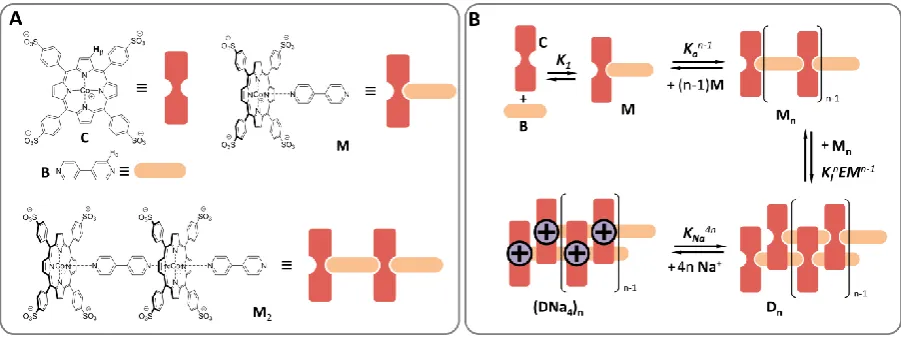
Figure 1. A. Chemical structure of the building blocks and their cartoon representation. B. Schematic representation of the formation of single and double stranded polymers in solutions containing equal concentrations of C and B. The binding of Na cations to the double stranded polymer is also shown.
Results and discussion
We have recently shown,31 cobalt metalloporphyrin C and
bipyridine B form complexes of the form CB, with a binding
constant K1 of 1.14x10
6
M-1. We call these complexes
monomers M, that oligomerise into single stranded oligomers
of the form Mn following an isodesmic (i.e., non-cooperative)
mechanism, with oligomerization constant Ko = 8400 M
-1
. M
forms also double-stranded polymers of the form (Mn)2,
following a nucleation-growth (i.e., cooperative) mechanism
(Figure 1A and 1B). The formation of (Mn)2 can be seen as the
dimerization of linear Mn oligomers, with a dimerization
constant Knl. This constant can be written as a function of the
dimerization constant per unit repeat, Kl, and the effective
molarity (i.e., a measure of the local concentration of the polymer repeats within the polymer) EM as follows:
𝐾
𝑛𝑙= 𝐾
𝑙𝑛𝐸𝑀
𝑛−1(1)
where n is the number of oligomer repeats in the dimerizing
oligomers. With the product Kl x EM larger than 1,
At low salt concentration (i.e., 5 mM phosphate, pH 7.2) the
NC of the double stranded polymer is approx.500 M., which
means that it does not form below this concentration.31
However, addition of salt to a sample of C and B both 10 M
results in the growth of a red-shifted Soret band, characteristic of the formation of the double stranded polymer, when the concentration of salt approaches 100 mM (Figure 2A). Similarly, increasing the concentration of buffer in a sample
containing equimolar C and B 25 M leads to the loss of the
NMR signals assigned to C, consistent with the formation of
large polymers (Figure 2B). It is reasonable to attribute these
changes to an increase in the pairwise binding constants Ko
and Kl, because increasing ionic strength reduces the
electrostatic repulsion between the anionic porphyrin units.
Ko can be written as a function of the different binding
constants for the formation of CB, C2B and CB2 complexes.31
The value of these binding constants is however the same, within the error, for different buffer concentrations (i.e., 5 and
100 mM) which means that Ko does not depend on the
concentration of buffer.31 This result suggests that the
bi-pyridine ligand keeps the anionic porphyrin rings far apart enough to render electrostatic repulsion between them negligible within the single stranded oligomers. The distance between negative charges in the double stranded polymer is
however much smaller (Figure 2C). The implication is that Kl
will be affected by changes in ionic strength to a greater extent than Ko. Specifically Kl is expected to increase as the ionic
strength increases because of the increase in the screening of the sulphonate negative charges provided by the salt countercations. The effect of the ionic strength on the interactions between charged species, particularly in supramolecular polymerization, can be treated using the
Debye-Huckle model.26 An alternative, convenient way to
seamlessly incorporate the effect of the salt in our assembly model is to consider the binding of the counteractions to the
different species present. In our experiments, Porphyrin C is
used in the tetrasodium salt form. However, given the low
concentration of C (0.5 to 140 M) in relation to the buffer
concentration (2 to 500 mM), the contribution of the sodium
cations coming from C to the total concentration of sodium is
negligible.
For C, M and single stranded polymer Mn the negative charges
located are far apart in the structure so that no more than one
anion can be interacting with a countercation. For (Mn)2 on the
other hand negative charges are brought in close proximity upon double strand formation. As a consequence, a countercation can interact simultaneously with two or more anions. In fact, a close inspection of the structure of the polymer dimer, constructed from single-crystal derived
structures,32 shows the presence of up to 4 potential binding
sites for the sodium cation, in the form of cavities surrounded by up to 4 sulfonate groups for each polymer repeat (Figure 2C). It is therefore reasonable to assume that the cation binds much more strongly to these cavities than to the single stranded polymer or to other sites in the double stranded polymers. To model the effect of the salt, we thus assume that
Na+ binds exclusively to the double stranded polymers. For
simplicity of notation, we call the repeat units within the
double-stranded polymer D, so that (Mn)2 can be noted Dn
(Figure 1B). The binding of up to 4 Na cations to the polymer
repeat D leads to polymer repeats of the form NaiD, with i
values up to 4 for full occupancy. We can assume that the
affinity for Na+ for each of the binding sites is intrinsically the
same, that is, the binding of the Na+ is non-cooperative (see
Supplementary Information and Supplementary Figure 1). The relative rapid rise of polymer concentration with increasing salt concentration, as shown by the experimental data (Figure 2A inset), is consistent however with a model in which the
[image:4.595.115.484.489.636.2]binding of Na+ is cooperative.
Figure 2. A. Changes in the Soret band region of the UV spectrum of an equimolar solution of C and B ([C] = 10 M) upon increasing the concentration of buffer. The inset shows the changes in the mol fraction of double stranded polymer, xD, derived from the UV data (empty circles). The continuous line is the simulated change in xD by our model for a KNa
of 70 M-1 (See Supplementary Information for details). B. Section of the 1H NMR spectrum of a mixture of C and B showing the peaks assigned to the proton of C in discrete complexes and the ortho proton (Ho) of free B (see Figure 1A for the proton labelling scheme) at different concentrations of Na+. The concentration of C was 34 M and that of B
51 M in all cases. The inset shows the changes in the mole fraction of the double stranded polymer derived from the integration of the NMR signals (empty circles). The continuous line is the changes in xD projected by our model for a KNa of 70 M-1. C Molecular model of the double stranded polymer, derived from a crystal structure of the C and B
complex 31,32 (top). In the bottom, the same model is shown in a CPK representation, with Na cations placed in the cavities defined by the sulfonate groups.
A scenario can be envisaged in which potential binding sites
for Na+ within the polymer-dimer repeats are ill-defined prior
ARTICLE Journal Name
more likely (and therefore displaying larger binding affinity constants). This scenario describes a typical allosteric binding, with the binding affinity increasing as the occupancy increases. In the upper limit of cooperativity of allosteric binding, only
the complex with full occupancy, that is, Na4D, is populated to
a meaningful extent. The average binding constant for Na+,
KNa, is related to the concentrations of complex and free
species as follows:
𝐾
𝑁𝑎4=
[𝐃][Na][Na4𝐃]4(2).
We can then write the lateral association constant Kl as a
function of the concentration of Na+ as follows (see
Supplementary Information for details):
𝐾
𝑙= 𝐾
𝑙0(1 + 𝐾
𝑁𝑎4[Na]
4)
(3)
where Kl0 is the value of lateral association constant in the
absence of Na+. When the concentration of both B and C are
the same, the total concentration of C, [C]0, can be written as a
function of free C as follows (see Supplementary Information
for details):
[𝐂]
0=
[𝐂] +
𝐾1[𝐂]2(1−𝐾𝑜𝐾1[𝐂]2)2
+
2𝐾𝑙0(1+𝐾𝑁𝑎4[Na]4)𝐾12[𝐂]4
(1−𝐾𝑙0(1+𝐾𝑁𝑎4[Na]4)𝐸𝑀(𝐾𝑜𝐾1[𝐂]2)2)2
(4)
While the total concentration of D repeats, [D], can be written
as a function of C and the concentration of Na+ as follows:
[𝐃] =
𝐾𝑙0(1+𝐾𝑁𝑎4[Na]4)𝐾12[𝐂]4 [image:5.595.50.540.195.397.2](1−𝐾𝑙0(1+𝐾𝑁𝑎4[Na]4)𝐸𝑀(𝐾𝑜𝐾1[𝐂]2)2)2
(5)
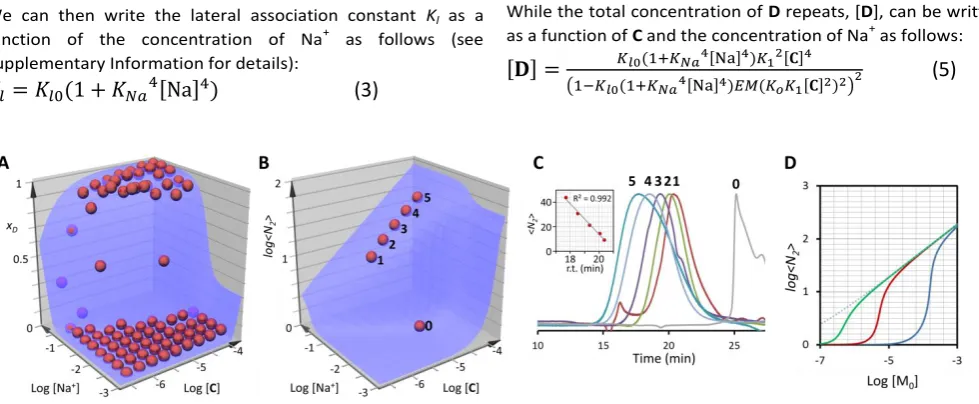
Figure 3. A. Changes of the mole fraction of monomer within the double stranded polymer, xD, with the concentration of Na+ and the total concentration of C (which is equal to
that of B). The red spheres are the experimental values of xD calculated from the UV spectra (see Supplementary information for details). The blue surface is the best fit to the
model described by equations 4, 5 and 6. B. Changes in the average number of repeats of the double stranded polymer, <N2>, as a function of Na+ and the total concentration of C
(which is equal to that of B) (blue surface). The red spheres correspond to the predicted values of <N2> for the samples analysed by size exclusion chromatography (SEC) in panel C.
C. SEC traces of choice samples with increasing concentration of building blocks (concentration of salt 125 mM). For reference, a trace corresponding to a sample without double stranded polymer (trace 0) is also shown. The inset shows the correlation between predicted number of repeats and the retention time of the corresponding peak. D. Changes in the average number of repeat of a double stranded polymer as a function of the total concentration of monomer for values of KlEM =5 (blue trace), 500 (red trace) and 50000
(green trace) M-1 obtained using eq. 7 with EM=1 M and K
o = 8400 M-1. The dotted line represents the change in <N2> for KlEM = ∞.
The double stranded polymer Dn is the species responsible for
the red-sifted band with maxima at around 460 nm in the UV spectrum, while all the other species present (i.e., single
stranded Mn, double stranded Dn and free C) contribute to the
absorbance at 430 nm (Figure 2A).31 The mole fraction of
building block C in in the double stranded polymer Dn over the
concentration of total C, xD, can be calculated from the ratio of
absorbance at 460 nm over that at 430 nm, xA , as follows (see
Supplementary Information for details):
2[𝐃]
[𝐂]0
= 𝑥
𝐷=
𝜀𝑅1𝑥𝐴
1−𝑥𝐴(1+𝜀𝑅2−𝜀𝑅3)
(6)
where R1, R2 and R3 are appropriate ratios of extinction
coefficients of D and that of the non-polymeric species present
(see Supplementary Table 1 and Supplementary Information for details). We carried out an UV titration-dilution
experiment where samples containing equimolar amounts of C
and B were diluted and each of the dilutions titrated with
sodium phosphate. The relevant data from the UV spectra was
used to calculate xD, and these values were fitted to the model
defined by equations 4, 5 and 6 (Figure 3A, inset of Figure 2A
and 2B). K1 (with a value of 1.14 × 10⁶ M-1) and Ko (with a value
of 8400 M-1) had been previously determined, together with Kl
in buffer phosphate 5 mM (with EM = 1). We can assume that
at this low buffer concentration, the value of Kl is Kl0 (i.e., 6.1
M-1).31 In the fitting, we enter these values as fixed parameter
and only KNa is optimized. In these conditions the fitting of the
model to the experimental data is very good, giving a value of
KNa of 70 M-1. This is a reasonable value for a receptor of Na+ in
water, in the same range found for some biological
receptors.33 We reiterate that the Na+ binding model is a
convenient way of incorporating the effect of the buffer into our model. However, both the close fitting of the data to the
modified model and the reasonable values for KNa obtained
suggest that our approach offers a valid description of the phenomenon under study.
Knowing KNa, it is possible to determine the average number of
repeats of the double stranded polymer , <N2>, as a function of
the concentration of Na+ and building blocks C, B. For
solutions with equal concentration of C and B, <N2> can be
< 𝑁
2>=
1−𝐾 1𝑜2𝐸𝑀𝐾𝑙0(1+𝐾𝑁𝑎4[Na]4)(𝐾1[𝐂]2)2
(7)
Size exclusion chromatography performed on samples with
increasing concentration of C and B yield results that are
consistent with the variations predicted by equation (7): there is a jump in size around the nucleation concentration, and a subsequent smooth increase of the size of the polymer as the concentration increases (Figure 3B and 3C). The magnitude of the jump in the average number of repeats of the double
stranded polymer, <N2>, upon nucleation depends on the
concentration of Na+, and is attributed to changes in Kl as the
concentration of Na+ is changed. This dependence is more
clearly seen by plotting <N2> as a function of the changes in
total concentration of monomer at constant Ko but with
different values of Kl (with EM = 1) (Figure 3D). This plot shows
that in addition of the jump in size of the polymer increasing as
Kl decreases it also becomes steeper. Cooperativity in binding
is characterized by the steep increase of the concentration of bound species when a critical concentration of the building blocks is reached. The larger the degree of cooperativity, the steeper is this increase, leading to an on/off behaviour in systems displaying very high degree of cooperativity. For this reason, the steeper increase in the jump of <N2> at lower Kl
suggests that the degree of cooperativity increases as Kl
decreases. The implications are that, in our system, the degree of cooperativity decreases as the stability of the resulting polymer increases. This behaviour is opposite to the one observed in other examples of supramolecular polymerisation
modulated by the salt content. For example, Schaefer et al.
found that the stability and degree of cooperativity both
increased as the ionic strength in the medium increased.26
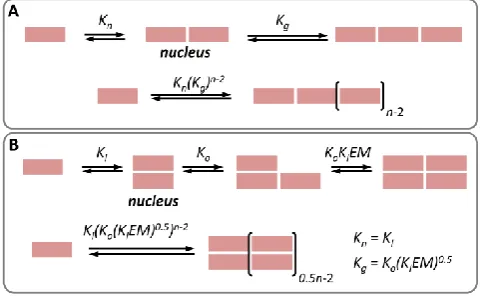
Figure 4.A. Schematic representation of the nucleation-growth of a single stranded polymer. B. Schematic representation of the nucleation-growth polymerization of a double stranded polymer showing the correspondence of the lateral and oligomerization constant in a double stranded polymer (Kl and Ko) with the nucleation
and growing constants ( Kn and Kg) of general models of supramolecular
polymerisation.
To understand why our system behaves differently, it is useful to direct our attention to the different ways polymers assemble and how cooperativity is defined. Typically, models of cooperative supramolecular polymerization assume that the formation of the initial nucleus is characterized by the
nucleation constant Kn, and the growth of the polymer by the
growth constant Kg (Figure 4A). The cooperativity is often
measured by the cooperativity factor which is the ratio
between Kg and Kn:22
𝛼 =
𝐾𝑔𝐾𝑛
(8)
We have described the assembly of our double stranded polymer as the combination of two pairwise binding events, the lateral assembly and linear assembly, characterized by
constants Kl and Ko. The assembly process of the double
stranded polymer can be seen as the dimerization of growing single stranded chains (Figure 1B). Alternatively, and for better comparison with traditional nucleation-growth models, it can be thought of as the polymerization of laterally assembled dimers (Figure 4B). In this scenario, the formation of the first lateral dimer is equivalent to the nucleation step in the nucleation growth of the double stranded polymers, and
depends only on Kl. Subsequent polymerization steps depend
on both Kl, Ko and the effective molarity EM (Figure 4B). For a
building block that polymerizes following this mechanism the
cooperativity factor can be written as:
𝛼 =
𝐾𝑜(𝐸𝑀)1/2(𝐾𝑙)1/2
(9)
In the work of Schaefer et al., involving a single stranded
polymer, the calculations show that increasing salt
concentration does have the effect of increasing Kg but not Kn,
leading to the corresponding increase in the cooperativity
factor , according to equation (8). In our system, increasing
the salt concentration has no effect on Ko, but increases Kl
which, according to equation (9) decreases the cooperativity
factor. Therefore increasing Kl leads to two somewhat
contrasting effects: one is the increase in overall stability of the polymer, and the second is the decrease in cooperativity (as predicted by eq.(9)) and because Ko is constant since it is
independent of the salt concentration. Clearly, our model shows that the interplay between the lateral association and the polymerization is critical in the degree of cooperativity observed. Our model can be expanded to the analysis of multistranded polymers with any number of strands. A convenient way to compare the degree of cooperativity in supramolecular polymerization is to plot the increase of concentration of monomer within the multi-stranded polymer
P with addition of monomer M, [P]/[M]0 vs. the total
concentration normalized, that is, expressed in multiples of
the maximum concentration of free monomer, n[M]max (see
[image:6.595.44.287.450.598.2]ARTICLE Journal Name
Figure 5. A. Cooperativity curves for double stranded polymers with values of KlEM = 5
blue trace), 500 (red trace) and 50000 (green trace). Ko is 8400 M-1 in all cases. B
Cooperativity curves for multistranded polymers. The number of strands m is shown near the corresponding trace. KlEM is 50000 M-1 and Ko = 8400 M-1. See Supplementary
Figure 3 for traditional cooperativity plots for the same systems.
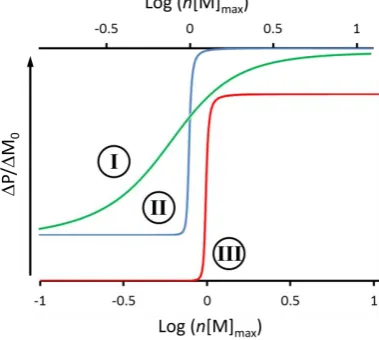
Larger cooperativity results in sharper curves, consistent with a sharper transition from quantitative assembly of discrete species to quantitative assembly of polymers. The increase in cooperativity as Kl decreases is clearly seen for our double
stranded polymer (Figure 5A). Strikingly, simulations for
polymers with the same Ko and Kl values, but composed of
more than two strands show a very large increase in
cooperativity as the number of strands m increases (Figure
5B). This increase in the cooperativity with m is attributed to
the fact that as the number of strands increases, so does the minimum size of the nucleus, which is composed of m building blocks. The larger the nucleus, the narrower the thermodynamic bottleneck that leads to the growth of the polymer, which leads to a larger cooperativity.
A clear dependence with the size of the nucleus is also observed with the traditional model of supramolecular polymerization, typically used for the assembly of single stranded and helical polymers (see Supplementary Information
for details).22 From our simulations, it is clear that, in systems
where the nucleus contains more than 2 building blocks, the
use of the parameter as measure of cooperativity
underestimates the cooperativity effect (Figure 6, Table 1). To compare cooperativity between systems with different sized
nuclei we introduce the parameter m, defined as follows:
𝛼
𝑚= (
𝐾𝑔𝐾𝑛
)
𝑚−1
(10)
where m is the number of building blocks in the nucleus, or the number of strands in a multi-stranded polymer. As shown in
our simulations, m offers a good quantification of the
cooperative behaviour for systems that display a clear
cooperative effect (i.e., ≥ 10). From these plots is also clear
that very weak pairwise interactions may lead to very sharp cooperative behaviour for multistranded polymers with more than 5 strands (Figure 6, Table 1).
Figure 6. Cooperativity curves for polymer with 2 strands (or a nucleus containing 2 building blocks, traces I and II, x-axis labels shown in the top) and 6 strands (or a nucleus containing 6 building blocks, trace III, x-axis labels shown at the bottom). See Table 1 for detailed parameters used in these simulations.
Table 1. Parameters used to generate the curves displayed in Figure 6
Curve m Kn (M
-1
) Kg(M
-1
) m
I 2 10 100 10 10
II 2 10 106 105 105
III 6 10 100 10 105
Conclusions
We have shown that our double stranded polymer assembles cooperatively following both changes in concentration of the building blocks and of salt. The cooperativity is explained in terms of a multivalence effect, for the dependence with the concentration of the building blocks, and in terms of an allosteric cooperative binding of countercations to the polymer, for the dependence with the concentration of salt. The net effect of the binding of the countercation is the
increase of the lateral association constant, Kl. This increase in
Kl results in a decreasing NC, showing an increase in the
[image:7.595.309.499.171.341.2] [image:7.595.296.554.425.503.2]opposite to that found in other polymers, where the increase in stability induced by an increase in salt content results also in a more marked cooperativity. The difference in behavior is
attributed to the fact that, in our system, an increase in Kl
enhances nucleation to a larger extent than it enhances the
growth. As a result, the cooperativity factor is smaller as Kl
increases. To graphically show the cooperativity effect, we propose using plots of the relative growth of the concentration of polymer with total concentration of monomer. These plots clearly show the relatively mild dependence of the
cooperativity with Kl. Plots simulated for polymers with any
number of strands show that cooperativity increases sharply as the number of strands increases. We attribute this effect to the increased size of the nucleus required, and we show that the there is a general strong dependence of the cooperativity with the size of the nucleus for any type of polymer. We
propose the use of m as the parameter that allow comparing
cooperativity for polymers with nuclei of any size
These findings clearly show that an ideal on/off polymerization does not require large pairwise interaction parameters between the building blocks, often difficult to achieve using small molecules. It suffices that the building blocks are designed to assemble into a polymer composed of 5 or more strands. Using this strategy will simplify the design and synthesis of highly responsive supramolecular polymers with improved properties for nanofabrication, controlled drug delivery and the assembly of bio-mimetic molecular machinery. Research in our labs is now directed to the development of highly responsive tri- and tetra-stranded porphyrin-based supramolecular polymers as sensor elements and for nanofabrication.
Experimental
Materials and methods
Chemicals and solvents (including bipyridine B) where
obtained from commercial sources and used without further
purification. Cobalt porphyrin C was synthesized using a
method described elsewhere.34
UV titration-dilution experiments
A stock solution containing C and B 109 mM in buffer
phosphate 500 mM, pH 7.2, was prepared and serially diluted
with a second solution containing the same concentration of C
and B in pure water, to generate 9 stocks 109 mM in C and B
but with buffer concentration ranging from 500 mM down to 2 mM. Each of these stocks was serially diluted with the corresponding buffer, so for each salt concentration, 9 samples
were generated with the concentration of C and B ranging
from 109 mM down to 0.43 mM. The samples were stored in stoppered plastic UV cuvettes at r. t. and kept in the dark. Their UV spectrum was recorded using a Cary300 UV spectrophotometer after equilibration overnight and again after one week. All the solutions prepared contained a 10% of D2O, so that the samples could be used for NMR analysis.
HPLC-SEC
Size exclusion experiments were performed on selected samples, using an Agilent 1100 instrument equipped with a TSK-GEL G6000PW , 7.5mm x 30.0 cm column. The eluent was the buffer of the corresponding sample containing 2% of SDS to minimize non-ideal size exclusion behaviour due to absorption of the sample on the stationary phase. The injection volumes for each of the samples was adjusted so that the same number of moles of C and B was injected (i.e., 0.1 nmol, corresponding to an injection of 100 uL for a concentration 1 uM in the sample, to 1 uL 100 uM. The UV detector was set at 430 nm, were all the species (monomer, small assemblies and polymers) absorb.
NMR experiments
The 1H NMR spectra of selected samples was performed using
a Bruker AV600 NMR spectrometer.
Acknowledgements
The authors will like to thank the Faculty of Science, Birkbeck, University of London, and Queen Mary, University of London, for funding.
Notes and references
1 T. F. A. De Greef, M. M. J. Smulders, M. Wolffs, A. P. H. J.
Schenning, R. P. Sijbesma and E. W. Meijer, Chem. Rev.,
2009, 109, 5687.
2 T. Aida, S. I. Stupp and E. W. Meijer, Science 2012, 335. 813.
3 J. D. Fox and S. J. Rowan, Macromolecules, 2009, 42, 6823.
4 R. J. Wojtecki, M. A. Meador and S. J. Rowan, Nat. Mater.,
2011, 10, 14.
5 X. Yan, F. Wang, B. Zheng and F. Huang, Chem. Soc. Rev.,
2012, 41, 6042.
6 D. A. Fetcher and R. D. Mullinds, Nature, 2010, 463, 285.
7 M, K. Gardner, B. D. Charlebois, I. M. Jánosi, J. Howard, A. J.
Hunt and D. J. Odde, Cell, 2011, 146, 582.
8 E. D. Korn, Physiol. Rev., 1982, 62, 672.
9 L. Milanesi, C. A. Hunter, N. Tzokova, J. P. Waltho and S.
Tomas, Chem. Eur. J., 2011, 17, 9753.
10 E. A. Appel, J. del Barrio, X. J. Loh and O. A. Scherman, Chem.
Soc. Rev., 2012, 41, 6195.
11 E. J. Howe, B. O. Okesola and D. K. Smith, Chem. Commun.,
2015, 7451.
12 J. Zhang, and P. X. Ma, Adv. Drug Deliv. Rev., 2013, 65, 1215.
13 J. Boekhoven and S. I. Stupp, Adv. Mater., 2014, 26, 1642.
14 R. N. Shah, N. A. Shah, M. M. D. Lim, C. Hsieh, G. Nuber and
S. I. Stupp, Proc. Nat. Acad. Sci. USA 2010, 107, 3293.
15 A. R. Hirst, B. Escuder, J. F. Miravet and D. K. Smith, Angew.
Chem. Int. Ed., 2008, 47, 8002.
16 H. L.Anderson, Chem. Commun. 1999, 2323.
17 M.-H. M. Cativo, D. K. Kim, R. A. Riggleman, K. G. Yager, S. S.
Nonnenmann, H. Chao, D. A. Bonnell, C. T. Black, C. R. Kagan
and S.-J. Park, ACS Nano, 2014, 8, 12755.
18 M. Gilbert and B. Albinsson, Chem. Soc. Rev., 2015, 44, 845.
19 R. Daly, O. Kotova, M. Boese, T. Gunnlaugsson and J. J.
Boland, ACS Nano, 2103, 7, 4838.
20 J. Leckie, A. Hope, M. Hughes, S. Debnath, S. Fleming, A. W.
Wark, R.V. Ulijn and M. D. Haw, ACS Nano, 2014, 8, 9580.
21 R. B. Martin, Chem. Rev., 1996, 96, 3043.
22 C. A. Hunter and H. L. Anderson, Angew. Chem. Int. Ed.,
2009, 48, 7488.
ARTICLE Journal Name
24 L. H. Beun, X. J. Beaudoux, J. M. Kleijn, F. A. de Wolf and M.
A. Stuart, ACS Nano, 2012, 6, 133.
25 X. Ma and H. Tian, Acc. Chem. Res., 2014, 47, 1971.
26 C. Schaefer, I. K. Voets, A. R. A. Palmans, E. W. Meijer, P. van
der Schoot and P. Besenius, ACS Macro Lett., 2012, 1, 830.
27 Y. Tian, C. M. Beavers, T. Busani, K. E. Martin, J. L. Jacobsen,
B. Q. Mercado, B. S. Swartzentruber, F. van Swol, C. F.
Medforth and J. A. Shelnutt, Nanoscale, 2012, 4, 1695
28 C. A. Hunter and S. Tomas, J. Am. Chem. Soc., 2006, 128,
8975.
29 F. G. J. Odille, S. Jonsson, S. Stjernqvist, T. Ryden and K.
Warnmark, Chem. Eur. J., 2007, 13, 9617.
30 S. Ogi, K. Sugiyasu, S. Manna, S. Samitsu and M. Takeuchi,
Nature Chem., 2014, 6, 188.
31 E. Lopez-Fontal, L. Milanesi and S. Tomas, Chem. Sci. 2016, 7,
4468.
32 A. Fidalgo-Marijuan, G. Barandika, B. Baza, M.-K. Urtiaga and
M. I. Arriortua, CrystEngComm, 2013, 15, 4181.
33 G. Scheiner-Bobis, Eur. J. Biochem., 2002, 269, 2424.
34 M. Bhatti, T. D. McHugh, L. Milanesi and S. Tomas, Chem.
![Figure 2. A. Changes in the Soret band region of the UV spectrum of an equimolar solution of C and B ([C] = 10 M) upon increasing the concentration of buffer](https://thumb-us.123doks.com/thumbv2/123dok_us/8856397.936911/4.595.115.484.489.636/figure-changes-soret-spectrum-equimolar-solution-increasing-concentration.webp)