© 2015, IRJET ISO 9001:2008 Certified Journal Page 686
ANALYSIS OF WINGTIP PERFORMANCE
ADITYA.V
Student, Mechatronics Department, MGIT , Telangana , Hyderabad
---***---Abstract -
The main objective of this study is tosimulate the effects of wingtip on ONERA M4 model using CFD simulation. This is to be done by comparing the results of both with and without wingtip computations of ONERA M4 model. This study is to show the induced drag coefficient reduction in existing wing with the use of winglets. CATIA-V5 is used for Aircraft modeling (with and without winglet). Discretization and the CFD simulation is done in AcuSolve. The objective of this simulation is to investigate the performance of the winglet shape with 28 degree cant angle. The simulation is carried out in low subsonic speed of 20m/s for 0° Angle of Attack (AOA). The comparison of Pressure, Velocity and Vorticity plots are to be utilized from the computational studies to show that the wingtip reduces the tip vortices which lead to reduction in Induced drag.
Key Words:
Wingtip, Wind tunnel, Model testing,Simulation, Downwash
1. HISTORY & INTRODUCTION
In 1979 and 1980, NASA Dryden Flight Research Center was involved with general aviation research with the KC-135 aircraft. A winglet, developed by Richard Whitcomb of the Langley Research Center, was tested on the jet aircraft. This winglet concept was tested on aKC-135A tanker loaned to NASA by the Air Force. The research showed that the winglets could increase an aircraft's range by as much as 7 percent at cruise speeds. The first application of NASA's winglet technology in industry was on General Aviation business jets, but winglets are now being incorporated into most commercial and military transport jets, including the Gulfstream III, IV and V (Renamed to G550) business jets, the Boeing 747-400 and McDonnell Douglas MD-11 airliners, the McDonnell Douglas C-17 military transport, and Embraer aircraft. In recent years, many aftermarket modification kits have been offered for adding winglets to aircraft, which did not originally have them. By using CFD tools and wind-tunnel testing Embraer was able to design winglets for several of its aircraft. Some of these aircraft were designed and certified without
winglets, whereas others were conceived
envisaging the benefits of winglets from the beginning. One of the technical challenges then became how to add winglets to existing wings, achieving significant aerodynamic improvements with minimal structural weight penalty and minimal system changes.
2. REVIEW OF LITERATURE
In this project, Computational Fluids Mechanist analysis of winglets have been done therefore it is
absolutely necessary to understand the
aerodynamics concepts. Aerodynamics from the union of two Greek words: eros, which means air, and dynamis, meaning power. Thus, aerodynamics is the study of forces and movements that occur in objects through the air. A more current definition of the term aerodynamics: the branch of fluid mechanics that studies the actions on the solid objects when there is relative motion between them and the fluid that bathes them.
2.1 Aerodynamic forces
Aerodynamic forces are those displayed by the fact of having a body moves at speed immersed in a fluid. There are the following forces in an aircraft: -Weight, although not strictly an aerodynamic force is always present, and will determine the lift we need to keep the plane in the air. It is a force that is always directed toward the center of the earth. The magnitude of the weight depends on the mass of all the airplane parts, plus the amount of fuel, plus any payload on board (people, baggage, freight, etc.) (Tom Bensom, 2010).-Lift, the lift is the force perpendicular to the direction of the free stream. To overcome the weight force, airplanes generate an opposing force called lift. The magnitude of the lift depends on several factors including the shape, size, and velocity of aircraft.
© 2015, IRJET ISO 9001:2008 Certified Journal Page 687 force. To overcome drag, airplanes use a propulsion
system to generate a force called thrust.
The figure 1, reproduced below, shows the forces in an aircraft.
Fig.1: four forces of flight.
2.2 Wingtip fence
They are a special variant of winglets that extend both upward and downward from the tip of the wing. Preferred by European plane-maker Airbus, it is featured on their full
product range (except the A330/340 family and the future A350). The Airbus A300 was actually the first jet airliner to feature this kind of solution by default, but it was a very small version of the tool. Provided that most of the Airbus planes (including all A320 family jets) feature such wingtip fences, this may be the most seen and most produced winglet type. Even the new Airbus A380 double-decker features wingtip fences.
Fig.2: Airbus Wingtips as seen from the outsider.
Fig.3 : Airbus Wingtip as seen from onboard.
2.3 Blended wingtips
They know as the real “Winglets”. They are the most popular winglet type, leveraged by Airbus, Boeing, Embraer and Bombardier but also by Russian Tupolev and Iljushin. Blended winglets were first introduced on the McDonnell Douglas MD-11 aircraft in 1990 with launch customer Finnair (it also features a smaller winglet at the bottom side of the wing). In contrast to Airbus who applies the wingtip fences by default on most of their aircraft (and the winglets on the A330/340 family), blended winglets are considered by Boeing for example as an optional extra feature on their products, except for the Boeing 747-400. For some of the older Boeing jets (737 and 757) such blended winglets have been offered as an aftermarket retrofit, these are the newer, tall designs and do not connect to the tip of the wing with a sharp angle, but with a curve instead. These winglets are popular among airlines that fly these aircraft on medium/long haul routes as most of the real fuel savings materialize while cruising. Longer flights mean longer cruising, thus larger fuel savings. They also server as marketing surface for airline logos or web addresses usually.
Fig.4 : blended wingtips.
Computational Fluids Dynamics (CFD)
Fluid mechanics is the branch of continuum mechanics (which in turn is a branch of physics) that studies the movement of fluids (gases and liquids) and the forces that cause them. The key feature that defines the fluid is its inability to withstand shear forces (causing lacking definite form). It also examines the interactions between the fluid and the boundary that limits.
The governing equations of fluid mechanics all are obtained by applying the conservation principles of mechanics and thermodynamics to fluid volume. To generalize we use the Reynolds transport theorem and the theorem of divergence (or Gauss) for the equations in a form more useful for the Eulerian formulation.
© 2015, IRJET ISO 9001:2008 Certified Journal Page 688 equation of energy conservation. These equations
can be integrated in their design or in differential form, depending on the problem. This set of equations given in differential form is also called Navier-Stokes equations.
3 EXPERIMENTAL PROCEDURES
3.1 Solid Edge v18
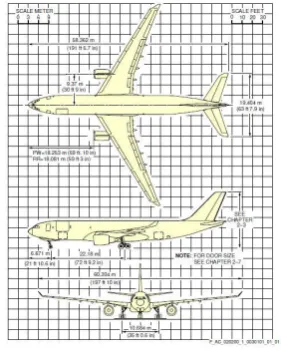
[image:3.595.302.552.154.298.2]Solid edge v18 is a kind of software created and dedicated to draw very easy in 3D. The wing model without winglet and the three wings models with winglets have been designed in solid edge v18. Circular winglet, blended winglet and wingtip fences have also been built. In order to do that, an airfoil section was picked as well as a data file was created with the airfoil points. To work in solid edge v18, it was previously necessary to create a excel table with the lower and upper surfaces airfoil points. By the time where the wings were finished, they were automatically exported to Gambit 2.4.6 in “step” format. When you export into “iges” format, volumes can not be exported; therefore you need to get them generated in Gambit 2.4.6. A naca 2415 airfoil was chosen to develop my wings. Later on, I used that airfoil at the wing root airfoil and at the wing tip airfoil. I found it impossible to make a research regarding the A330 airfoil so I chose that type of naca airfoil, especially since it is used in similar aircrafts. After that, a symmetrical naca airfoil 0012 was used to drawn blended winglets and wingtip fences. A symmetrical airfoil must be used because we do not want a high drag coefficient linked to the winglet. So I finally tried to draw an Airbus 330-300 wing. In the figure 14, reproduced below, can be seen A330-300 general dimensions.
Fig.5: A330-300 general dimensions.
The images, reproduced below, show naca 2415 airfoil.
Fig. 6: contours of vorticity magnitude (1/s) at 0º in control zones. No winglet.
Fig.7: surface at wingtip to work out pressure difference. Perspective projection.
4. RESULTS AND DISCUSSION
[image:3.595.297.581.164.545.2] [image:3.595.91.232.552.728.2]© 2015, IRJET ISO 9001:2008 Certified Journal Page 689 axis in which wingtip vortex is developed moves
down and laterally when the vortices are away from wingtip. Vorticity magnitude is related to lift so the wingtip vortex intensity will be checked when the lift increases. Finally, a summary table will be showed in which the drag coefficient improvement can be compared. The set of results will be given in several tables, diagrams or figures.
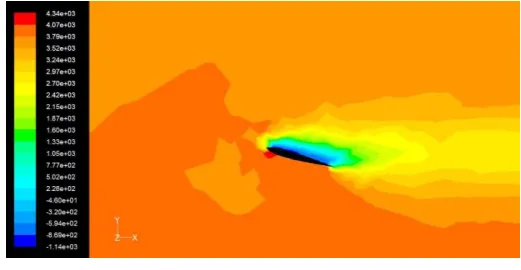
Fig.8: contours of total pressure (Pa) 0º no winglet at wingtip.
Fig.9: contours of total pressure (Pa) 4º no winglet at wingtip
Fig.10: contours of total pressure (Pa) 8º no winglet at wingtip.
Fig.11: contours of total pressure (Pa) 12º no winglet at wingtip.
Fig.12: contours of total pressure (Pa) 16º no winglet at wingtip.
5.
CONCLUSIONS
The wingtips vortex are developed as a wing is able to produce a ratio Cl/Cd higher than 1. If ratio Cl/Cd is less than 1, there are no wingtip vortices since the wing is not operating a positive lift. To produce a ratio Cl/Cd higher than 1, the pressure of the lower surface must be higher than the pressure of the upper surface, as can be seen from figures 35 until 38. The difference pressure between lower and upper surface in a wing generates lift and therefore wingtip vortices. The vorticity magnitude increases respect to angle of attack due to the lift increases as the angle of attack goes up.
[image:4.595.302.567.104.252.2] [image:4.595.30.276.180.756.2] [image:4.595.32.265.207.329.2] [image:4.595.301.562.315.450.2]© 2015, IRJET ISO 9001:2008 Certified Journal Page 690 axis moves down and up, graphics 2 until 9. Furthermore,
the vortex axis moves away sideways from the wingtip, graphics 10 until 17. The maximum value is placed into the wingtip vortex axis and wingtip vortex is turning around on its own axis. Also, vortex widens as it moves away from the wingtip.
The function of the winglet is to reduce the size of the vortex. Winglet attracted to him the vortex and the vortex is deflected far over the wing. The three wing models with winglet are able to reduce the vorticity magnitude in control zones, tables 2 until 4. Therefore, the induced drag Cdi goes down in all my wing models with winglet. However, wing model with circular winglet is not able to reduce drag coefficient Cd. Circular winglet design was not suitable and acceptable. It is not very difficult to reduce wingtip vortex (circular winglet) although to get Cd reduction is much complex.
6. RECOMMENDATIONS
Blended winglet model and wingtip fence model should be made of different airfoil and then, drag coefficient reduction could be compared. Furthermore, circular winglet model should be re-designed due to its design’s fail.
On the other hand, it would be highly interesting to end up by doing my computational fluids dynamics analysis when the aircraft is flying at cruise velocity.
7. REFERENCES
1. Aerotecnología, 2010. ¿Qué es un winglet?.
[online] Avaliable at :< http://
aerotecnologia.blogspot.com/2010/09/que-es-un-winglet.html> [Accessed 25 January 2010]. 2. Airline world. Aircraft Winglets. [online]
Avaliable at :< http://airlineworld. wordpress.com/2008/10/01/aircraft-winglets/ > [Accessed 25 November 2010].
3. Aviation Partners Boeing, 2006. Winglets. [online] Avaliable at :< http:// www. aviationpartnersboeing.com/winglets/ind ex.html [Accessed 12 November 2010].
4. Ardua ad Astra, 2006. Vórtices, winglets y demás parafernalia aeronáutica. [online]
Avaliable at: <
http://perarduaadastra.eu/2010/10/vortices-