© 2016, IRJET | Impact Factor value: 4.45 | ISO 9001:2008 Certified Journal | Page 1259
Pythagorean triangle with Area/Perimeter as a
Jarasandha number of orders 2 & 4
G.Janaki
1, C.Saranya
2 1,2Assistant Professors,
Department of Mathematics, Cauvery College for Women,
Tiruchirappalli, Tamil Nadu, India.
---***---Abstract -
We present patterns of Pythagorean triangles, ineach of which the ratio Area/Perimeter is represented by the Jarasandha number. A few interesting relations among the sides are also given.
Key Words: Pythagorean triangles, Jarasandha numbers.
1.INTRODUCTION
Mathematics is the language of patterns and relationships, and is used to describe anything that can be quantified. Number theory is one of the largest and oldest branches of mathematics. The main goal of number theory is to discover interesting and unexpected relationships. It is devoted primarily to the study of natural numbers and integers. In number theory, Pythagorean triangles have been a matter of interest to various mathematicians, because it is a treasure house in which the search for many hidden connection is a treasure hunt. For an extensive variety of fascinating problems, one may refer [1-5]. Apart from the polygonal numbers, we have some more fascinating patterns of numbers namely Jarasandha numbers, nasty numbers and dhuruva numbers. These numbers have been presented in [6-9].
In [10], special pythagorean triangles connected with nasty numbers are obtained. In [11], special pythagorean triangles connected with Jarasandha numbers are obtained. In [12], special pairs of pythagorean triangles and Jarasandha numbers are presented. Recently in [13] &[14], rectangles in connection with Jarasandha numbers are obtained.
In this communication, we search for patterns of Pythagorean triangles, in each of which the ratio Area/Perimeter is represented by the Jarasandha number. Also, a few interesting relations among the sides are given.
2.BASIC DEFINITIONS
Definition 1:
The ternary quadratic Diophantine equation given by 2
2 2
z
y
x
is known as Pythagorean equation wherey
x
,
andz
are natural numbers. The above equation is alsoreferred to as Pythagorean triangle and denote it by
)
,
,
(
x
y
z
T
Also, in Pythagorean triangle
T
(
x
,
y
,
z
)
: 2 2 2z
y
x
,x
andy
are called its legs andz
its hypotenuse.Definition 2:
Most cited solution of the Pythagorean equation is 2 2 2 2
,
2
,
y
mn
z
m
n
n
m
x
, where m > n > 0. This solution is called primitive, ifm
,
n
are of opposite parity andgcd(
m
,
n
)
1
.Definition 3:
An n-digit number that is the sum of nth powers of its digits is called narcissistic number.
3. Jarasandha Numbers
In our indian epic mahabharatha, we come across a person named ‘JARASANDHA’. He had a boon that if he was split into two parts and thrown apart, the parts would rejoin and return to life. In fact, he was given life by the two halves of his body. In the field of mathematics, we have numbers exhibiting the same property as Jarasandha. Consider a number of the form XC. This may split as two numbers X and C and if these numbers are added and squared we get the same number XC.
(i.e)
XC
(
X
C
)
2
XC
Note: If
C
is an n-digit number, thenC
X
C
X
)
(
10
n)(
)
(
2 .4.Method of Analysis
Denoting the Area & Perimeter of the triangle by A & P respectively, the assumption
P
A
= Jarasandha number.
© 2016, IRJET | Impact Factor value: 4.45 | ISO 9001:2008 Certified Journal | Page 1260
2 ) (m n
n Jarasandha number. (1)
Case 1:
When
2 ) (m n
n 81(2-digit Jarasandha number) (2)
n
(
m
n
)
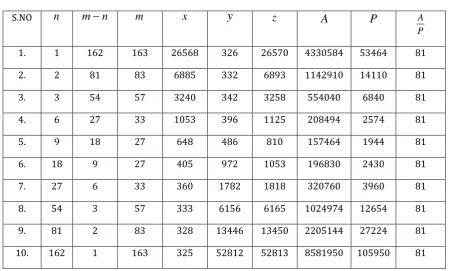
= 162 (3)On evaluation, the values of the generators
n
[image:2.595.73.524.213.484.2]m
,
satisfying(3) are given in the following Table1:Table 1:
S.NO
n
m
n
m
x
y
z
A
P
P A
1. 1 162 163 26568 326 26570 4330584 53464 81
2. 2 81 83 6885 332 6893 1142910 14110 81
3. 3 54 57 3240 342 3258 554040 6840 81
4. 6 27 33 1053 396 1125 208494 2574 81
5. 9 18 27 648 486 810 157464 1944 81
6. 18 9 27 405 972 1053 196830 2430 81
7. 27 6 33 360 1782 1818 320760 3960 81
8. 54 3 57 333 6156 6165 1024974 12654 81
9. 81 2 83 328 13446 13450 2205144 27224 81
10. 162 1 163 325 52812 52813 8581950 105950 81
Thus it is seen that there are 10 Pythagorean triangles. Of these 10 Pythagorean triangles, 2 triangles are Primitive and remaining 8 triangles are non-primitive triangles.
Case 2:
Consider the 4-digit Jarasandha number 2025,
In this case,
n
(
m
n
)
= 4050 (4)Following the same procedure as in case1, we have 30 distinct values for
m
,
n
satisfying (4) are given below:Table 2:
S.NO
n
m
n
m
x
y
z
A
P
P A
1. 1 4050 4051 16410600 8102 16410602 66479340600 3282930400 2025
2. 2 2025 2027 4108725 8108 4108733 16656771150 8225566 2025
3. 3 1350 1353 1830600 8118 1830618 7430405400 3669336 2025
4. 5 810 815 664200 8150 664250 2706615000 1336600 2025
© 2016, IRJET | Impact Factor value: 4.45 | ISO 9001:2008 Certified Journal | Page 1261
6. 9 450 459 210600 8262 210762 869988600 429624 2025
7. 10 405 415 172125 8300 172325 714318750 352750 2025
8. 15 270 285 81000 8550 81450 346275000 171000 2025
9. 18 225 243 58725 8748 59373 256863150 126846 2025
10. 25 162 187 34344 9350 35594 160558200 79288 2025
11. 27 150 177 30600 9558 32058 146237400 72216 2025
12. 30 135 165 26325 9900 28125 130308750 64350 2025
13. 45 90 135 16200 12150 20250 98415000 48600 2025
14. 50 81 131 14661 13100 19661 96029550 47422 2025
15. 54 75 129 13725 13932 19557 95608350 47214 2025
16. 75 54 129 11016 19350 22266 106579800 52632 2025
17. 81 50 131 10600 21222 23722 112476600 55544 2025
18. 90 45 135 10125 24300 26325 123018750 60750 2025
19. 135 30 165 9000 44550 45450 200475000 99000 2025
20. 150 27 177 8829 53100 53829 234409950 115758 2025
21. 162 25 187 8725 60588 61213 264315150 130526 2025
22. 225 18 243 8424 109350 109674 460582200 227448 2025
23. 270 15 285 8325 153900 154125 640608750 316350 2025
24. 405 10 415 8200 336150 336250 1378215000 680600 2025
25. 450 9 459 8181 413100 413181 1689785550 834462 2025
26. 675 6 681 8136 919350 919386 3739915800 1846872 2025
27. 810 5 815 8125 1320300 1320325 5363718750 2648750 2025
28. 1350 3 1353 8109 3653100 3653109 14811493950 7314318 2025
29. 2025 2 2027 8104 8209350 8209354 33264286200 16426808 2025
30. 4050 1 4051 8101 32813100 32813101 132909461600 65634302 2025
Thus it is seen that there are 30 Pythagorean triangles. Of these 30 Pythagorean triangles, 4 triangles are Primitive and remaining 26 triangles are non-primitive triangles.
Case 3:
For the 4-digit Jarasandha number 3025,For this choice, we have,
n
(
m
n
)
= 6050 (5)© 2016, IRJET | Impact Factor value: 4.45 | ISO 9001:2008 Certified Journal | Page 1262
Table 3:S.NO
n
m
n
m
x
y
z
A
P
P A
1. 1 6050 6051 36614600 12102 36614602 221554944600 73241304 3025
2. 2 3025 3027 9162725 12108 9162733 55471137150 18337566 3025
3. 5 1210 1215 1476200 12150 1476250 8967915000 2964600 3025
4. 10 605 615 378125 12300 378325 2325468750 768750 3025
5. 11 550 561 314600 12342 314842 1941396600 641784 3025
6. 22 275 297 87725 13068 88693 573195150 189486 3025
7. 25 242 267 70664 13350 71914 471682200 155928 3025
8. 50 121 171 26741 17100 31741 228635550 75582 3025
9. 55 110 165 24200 18150 30250 219615000 72600 3025
10. 110 55 165 15125 36300 39325 274518750 90750 3025
11. 121 50 171 14600 41382 43882 302088600 99864 3025
12. 242 25 267 12725 129228 129853 822213150 271806 3025
13. 275 22 297 12584 163350 163834 1027798200 339768 3025
14. 550 11 561 12221 617100 617221 3770789550 1246542 3025
15. 605 10 615 12200 744150 744250 4539315000 1500600 3025
16. 1210 5 1215 12125 2940300 2940325 17825568750 5892750 3025
17. 3025 2 3027 12104 18313350 18313354 110832394200 36638808 3025
18. 6050 1 6051 12101 73217100 73217101 443000063600 146446302 3025
Thus it is seen that there are 18 Pythagorean triangles. Out of these 18 Pythagorean triangles, 4 triangles are Primitive and remaining 14 triangles are non-primitive triangles.
Case 4:
Consider the 4-digit Jarasandha number 9801,
Following the same procedure as in case1, we have 30 distinct values for
m
,
n
.Table 4:
S.NO
n
m
n
m
x
y
z
A
P
P A
1. 1 19602 19603 384277608 39206 384277610 7532993950000 768594424 9801
2. 2 9801 9803 96098805 39212 96098813 1884113171000 192236830 9801
© 2016, IRJET | Impact Factor value: 4.45 | ISO 9001:2008 Certified Journal | Page 1263
4. 6 3267 3273 10712493 39276 10712565 210371937500 21464334 9801
5. 9 2178 2187 4782888 39366 4783050 94141584500 9605304 9801
6. 11 1782 1793 3214728 39446 3214970 63404080340 6469144 9801
7. 18 1089 1107 1225125 39852 1225773 24411840750 2490750 9801
8. 22 891 913 833085 40172 834053 16733345310 1707310 9801
9. 27 726 753 566280 40662 567738 11513038680 1174680 9801
10. 33 594 627 392040 41382 394218 8111699640 827640 9801
11. 54 363 417 170973 45036 176805 3849970014 392814 9801
12. 66 297 363 127413 47916 136125 3052560654 311454 9801
13. 81 242 323 97768 52326 110890 2557904184 260984 9801
14. 99 198 297 78408 58806 98010 2305430424 235224 9801
15. 121 162 283 65448 68486 94730 2241135864 228664 9801
16. 162 121 283 53845 91692 106333 2468577870 251870 9801
17. 198 99 297 49005 117612 127413 2881788030 294030 9801
18. 242 81 323 45765 156332 162893 3577266990 364990 9801
19. 297 66 363 43560 215622 219978 4696247160 479160 9801
20. 363 54 417 42120 302742 305658 6375746520 650520 9801
21. 594 33 627 40293 744876 745965 15006644330 1531134 9801
22. 726 27 753 39933 1093356 1094085 21830492570 2227374 9801
23. 891 22 913 39688 1626966 1627450 32285513300 3294104 9801
24. 1089 18 1107 39528 2411046 2411370 47651913140 4861944 9801
25. 1782 11 1793 39325 6390252 6390373 125648330000 12819950 9801
26. 2178 9 2187 39285 9526572 9526653 187125690500 19092510 9801
27. 3267 6 3273 39240 21385782 21385818 419589042800 42810840 9801
28. 6534 3 6537 39213 85425516 85425525 1674895379000 170890254 9801
29. 9801 2 9803 39208 192158406 192158410 3767073391000 384356024 9801
30. 19602 1 19603 39205 768516012 768516013 15064835130000 1537071230 9801
© 2016, IRJET | Impact Factor value: 4.45 | ISO 9001:2008 Certified Journal | Page 1264
5.Observations
1.
x
y
z
,
y
z
,
2
(
x
z
),
2
(
z
x
)
are perfect squares.2.
6
(
x
y
z
),
6
(
y
z
),
3
(
x
z
),
27
(
z
x
)
are nasty numbers.3.
4
z
y
x
is a Jarasandha number.
4. It is worth to note that for one of the triangles in all the cases,
m
,
n
are consecutive &y
,
z
are also consective.5.For the Jarasandha number 81,
y
z
46
x
Narcissistic number.6.Conclusion
To conclude, One may search for the connections between the Pythagorean triangles and other Jarasandha numbers of higher order and other number patterns.
References
[1] W. Sierpinski, Pythagorean triangles, Dover publications, INC, New York, 2003.
[2] M. A. Gopalan and A. Vijayasankar, “Observations on a Pythagorean problem”, Acta Ciencia Indica, Vol.XXXVI M, No 4, 517-520, 2010.
[3] M. A. Gopalan, A. Gnanam and G. Janaki, “A Remarkable Pythagorean problem”, Acta Ciencia Indica, Vol.XXXIII M, No 4, 1429-1434, 2007. [4] M. A. Gopalan and A. Gnanam, “Pythagorean
triangles and Polygonal numbers”, International Journal of Mathematical Sciences, Vol 9, No. 1-2, 211-215, 2010.
[5] M. A. Gopalan and G. Janaki, “Pythagorean triangle with Area/perimeter as a special polygonal number”, Bulletin of Pure & Applied sciences., Vol 27(2), 393-402, 2008.
[6] J. N. Kapur, Dhuruva numbers, Fascinating world of Mathematics and Mathematical sciences, Trust society, Vol 17, 1997.
[7] Bert Miller, Nasty numbers, The mathematics teacher, No.9, Vol 73, 649, 1980.
[8]Charles Bown. K, Nasties are primitives, The mathematics teacher, No.9, Vol 74, 502-504, 1981. [9] P. S. N. Sastry, Jarasandha numbers, The mathematics teacher, No.9, Vol 37, issues 3 and 4, 2001.
[10] M. A. Gopalan and G. Janaki, “Pythagorean triangle with nasty number as a leg”, Journal of applied Mathematical Analysis and Applications, Vol 4, No 1-2, 13-17, 2008.
[11] G.Janaki and C.Saranya,“Connection between Special Pythagorean Triangles and Jarasandha Numbers”, International Journal of Multidisciplinary
Research & Development, vol-3, issue-3, 236-239, March 2016.
[12] G.Janaki and C.Saranya, “Special Pairs of Pythagorean Triangles and Jarasandha Numbers”, American International Journal of Research in Science, Technology, Engineering & Mathematics, issue-13, 118-120, Dec 2015-Feb 2016.
[13] G.Janaki and C.Saranya, “Special Rectangles and Jarasandha Numbers”, Bulletin of Mathematics and Statistics Research, vol-4, issue-2, 63-67, Apr-June 2016.