© 2016, IRJET | Impact Factor value: 4.45 | ISO 9001:2008 Certified Journal | Page 1416
“Bi-directional Evolutionary Structural Optimization of Brake Chamber
Mounting Bracket”
Mr. Sagar Awate
1, Prof. Arun Bhosale
2,
1 ME Student, Department of Mechanical Engineering, Alard College of Engineering & Management, Pune, India
2 Assistant Professor, Department of Mechanical Engineering, Sinhgad Academy of Engineering, Pune, India.
---***---Abstract -
Present trends in the competitive automotiveworld a light weight component with required strength is playing a vital role in fuel efficiency and cost of a vehicle. This leads to design a light weight component for the desired safety standards. One key technical design strategy for improving vehicle efficiency is the reduction of vehicle mass, or weighting. Vehicle light-weighting not only enhances fuel efficiency, but also lowers vehicle emissions and improves driving performance. Increase in the fuel prices, every customer demands more for maximum mileage of vehicle. In goods transporter want vehicle which carrier maximum load with minimum fuel consumption. This will be archived by reducing the weight of vehicle itself. Every manufactures is looking to produce light weight vehicle to increase the fuel efficiency as well as to load carrying capacity of the vehicle. In this paper, we have undertaken the work of “cost and weight reduction design” of brake chamber mounting bracket. The said bracket is a part of air brake system used on LCV, HCV & buses. In this project, we have under taken a single part for optimization, but, if as many as components are replaced by reduced weight, then automatically overall weight is reduced therefore the power required to run vehicle itself is reduced, resulting in the increase in the mileage.
Keywords: BESO, ESO, Topology
1. INTRODUCTION
The present trends in the competitive automotive world a light weight component with required strength is playing a vital role in fuel efficiency and cost of a vehicle. This leads to design a light weight component for the desired safety standards. One key technical design strategy for improving vehicle efficiency is the reduction of vehicle mass, or light-weighting. Vehicle
light-weighting not only enhances fuel efficiency, but also lowers vehicle emissions and improves driving performance.Light-weight subsystems such as hoods and dashboard are already employed throughout the industry to achieve small weight savings. However, significant improvements in vehicle efficiency will require larger changes in mass. Vehicle weight reduction is a known strategy to address growing concerns about greenhouse gas emissions and fuel use. We find that every 10% reduction in vehicle weight can cut fuel consumption by about 7%. Scenarios of future vehicle characteristics and sales mix indicate that the target is aggressive. New vehicles must not only become lighter, but also forgo horsepower improvements, and progressively use advanced, more fuel-efficient powertrains, such as hybrid-electric drives. We can reduce weight by substituting some of the iron and steel used in vehicles with lighter-weight high-strength steel or aluminum, redesigning the vehicle, and/or downsizing the vehicle. Using these approaches, it is possible to achieve vehicle weight reduction. Vehicle weight and size reduction is one known strategy to improve fuel economy in vehicles, and presents an opportunity to reduce fuel use from the transportation sector. By reducing the mass of the vehicle, the inertial forces that the engine has to overcome when accelerating are less, and the work or energy required to move the vehicle is thus lowered.
Need Of Research
© 2016, IRJET | Impact Factor value: 4.45 | ISO 9001:2008 Certified Journal | Page 1417 manufactures is looking to produce light weight vehicle
to increase the fuel efficiency as well as to load carrying capacity of the vehicle.
2. LITERATURE REVIEW
Sasi Kiran Prabhala, et.al [1], presented a research paper on “Design & weight optimization of I.C engine”. He is carried out his research on weight reduction of piston, connecting rod & crankshaft. Earlier these parts were made from steel, because of good strength. Replacing the steel components with aluminium components will reduce the weight but the strength is not enough so he used aluminium alloy such that the aluminium alloy exhibits the strength like the steel because of its alloying material and own property of less weight. In his project he has taken, aluminium alloy 5086-H32, and cast alloy steel for designing the piston & connecting rod.
A. Prasad Babu, et.al [2], presented a research paper on “Topology optimization in engine mounting bracket”. In this paper, topology optimization approach is presented to create an innovative design of an engine mount bracket. Final comparison in terms of weight and component performance illustrates that structural optimization techniques are effective to produce higher quality products at a lower weight and cost. The Engine mounting bracket has been used to for mounting support as well as reduction of the vibration created by the engine. The engine mounting bracket is made up of different materials Aluminum alloy, Aluminum Silicon Carbide and Grey Cast Iron. In this paper the weight reduction engine mounting bracket is taken under the consideration without varying the performance of the component. In this process the structural analysis of the basic model done by using the RADIOSS tool, for obtaining the stress and displacement of the basic model with three different materials. The bracket has further undergone weight reduction using the material selection through the usage of ALTAIR Optistruct software.
Sourav Das, [3], presented paper on “Design & weight optimization of aluminum alloy wheel”. This paper deals with the design of aluminum alloy wheel rim for
automobile application which is carried out paying special reference to optimization of the mass of the wheel. The Finite Element analysis it shows that the optimized mass of the wheel rim could be reduced to around 50% as compared to the existing solid disc type Al alloy wheel. Optimization of the wheel rim is done through Hyper mesh – optimization solver. Optimization is carried out taking special reference to the minimum material requirement to sustain the stresses applied on the wheel during operation. Unwanted material was removed from solid wheel rim. Figure shows the shape of the wheel rim before optimization and shape of the wheel rim after optimization. It is observed that the mass of the wheel rim was 26 kg of Al alloy and after optimization the actual mass required for the wheel rim is reduced to 12.15 kg of Al alloy. This shows that there is a reduction of 13.85 kg of Al alloy for making the components. This exercise clearly indicates that a proper optimization of wheel rim considerably reduces the useful mass of Al alloy required to make the component.
Basem Alzahabi, et.al [4], presented paper on “Optimization of transmission mount bracket”. This paper focused on the optimization of transmission cross member. The main purpose of the optimization of bracket is to reduce the noise in driver cabin by improving the stiffness of the bracket. Transmission cross member is made up of two plates, namely, lower plate & upper plate. In his study, three possible mass reductions were investigated with NASTRAN. Brief details of three designs are as below.
Design I – Thickness of lower plate is decreased from 2 mm to 1 mm & thickness of upper plate is increased from 2 mm to 2.4 mm. Two additional holes are provided in upper bracket that gives mass reduction of 0.13 kg as compared to base line bracket.
© 2016, IRJET | Impact Factor value: 4.45 | ISO 9001:2008 Certified Journal | Page 1418 reduction is about 0.07 kg, compared to baseline
bracket.
Design III – It is same as design II, only two additional holes are provided in the bottom plate. Achieved mass reduction of 0.10 kg compared to baseline bracket.
Suresh Kumar Kandreegula, et.al. [5], presented paper on “Structural non liner topology optimization of transmission housing & its experimental verification”. In his study about the transmission housing, he replaced cast iron housing with aluminium housing to achieve the weight reduction. Aluminium housing in designed in such that the stress level, which was observed in cast iron housing, same was maintained in aluminium housing. A significant weight reduction of 40% is achieved by using aluminium material for transmission housing.
Xiao-Yong Pan, et.al. [6], presented paper on “Structural optimization for engine mount bracket”. In this paper, two different structural optimization methods are applied to improve the original design. Topology optimization & shape optimization approaches are used to create an innovative design of engine mount bracket. A cast iron mounting bracket is developed through the procedure of structural design. A finite element analysis is used to remove the unnecessary material from the design space. After topology optimization shape optimization is performed to refine the topology based model. A weight reduction of 0.33 kg is achieved. Stress level measured at four points, reduced in final design compared to initial design. Improvement in stiffness also observed in final design.
2.1 Outcome Of Review Papers
From the research papers studied, it is observed that, there are different methods used to reduce weight & cost of the product such as
a) Use of alternative light weight material. b) Use of Topology optimization method. c) Use BESO / ESO methods.
d) Shape optimization. e) Size optimization.
f) Geometrical changes in component such as making cavities, holes etc. in component.
3. TYPES OF STRUCTURAL OPTIMIZATION
Structural optimization seeks to achieve the best performance for a structure while satisfying various constraints such as a given amount of material. Optimal structural design is becoming increasingly important due to the limited material resources, environmental impact and technological competition, all of which demand lightweight, low-cost and high-performance structures. The types of structural optimization may be classified into three categories,
Size Optimization. Shape Optimization. Topology optimization.
3.1 Size Optimization - Size optimization is to find the optimal design by changing the size variables such as the cross-sectional dimensions of trusses and frames, or the thicknesses of plates. This is the easiest and earliest approach to improving structural performance.
3.2 Shape Optimization - Shape optimization is mainly performed on continuum structures by modifying the predetermined boundaries to achieve the optimal designs.
3.3 Topology Optimization - Topology optimization for discrete structures, such as trusses and frames, is to search for the optimal spatial order and connectivity of the bars. Topology optimization of continuum structures is to find the optimal designs by determining the best locations and geometries of cavities in the design domains. Topology optimization is can be done by using two approaches, such as,
Evolutionary Structural Optimization (ESO) Bi-directional Evolutionary Structural Optimization
(BESO)
3.3.1 Evolutionary Structural Optimization (ESO)
© 2016, IRJET | Impact Factor value: 4.45 | ISO 9001:2008 Certified Journal | Page 1419 evolve towards its optimal shape and topology.
Theoretically, one cannot guarantee that such an evolutionary procedure would always produce the best solution. However, the ESO technique provides a useful tool for engineers and architects who are interesting in exploring structurally efficient forms and shapes during the conceptual design stage of a project.
3.3.2 Bi-directional Evolutionary Structural Optimization (BESO)
The bi-directional evolutionary structural optimization (BESO) method allows material to be removed and added simultaneously. The initial research on BESO was conducted by Yang, for stiffness optimization. In their study, the sensitivity numbers of the void elements are estimated through a linear extrapolation of the displacement field after the finite element analysis. Then, the solid elements with the lowest sensitivity numbers are removed from the structure, and the void elements with the highest sensitivity numbers are changed into solid elements. The numbers of removed and added elements in each literation are determined by two unrelated parameters: the rejection ratio (RR) and the inclusion ratio (IR) respectively. The BESO concept has also been applied to ‘full stress design’ by using the von Mises stress criterion. In BESO algorithm, elements with the lowest von Mises stresses are removed and void elements near the highest von Mises stress regions are switched on as solid elements. Similarly, the numbers of elements to be removed and added are treated separately with a rejection ratio and an inclusion ratio respectively. Such kind of treatment of ranking elements for removal and those for addition separately is rather cumbersome and illogical. It is noted that the user must carefully select the values of
RR and IR in order to obtain a good design; otherwise, the algorithm may not produce an optimal solution. Another problem of the early versions of BESO is that the computational efficiency is quite low because of the large number of iterations usually involved. In many cases, the final design needs to be selected from a plethora of generated topologies, and the convergence history of the objective function is often highly chaotic.
4. EXISTING SYSTEM DESIGN
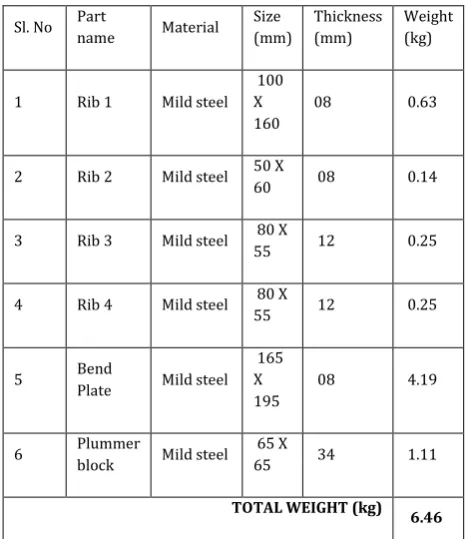
[image:4.595.309.560.224.333.2]Presently used chamber mounting bracket is “Fabricated” & is made up of MS plates. It consists of six sub parts namely, supporting rib 1, 2, 3, & 4, base plate & Plummer block. All this parts are welded together to form complete bracket. Below picture shows the existing chamber mounting bracket design.
Figure 1 Existing bracket design
Weight calculations of Excising Bracket
Sl. No Part
name Material Size (mm)
Thickness (mm)
Weight (kg)
1 Rib 1 Mild steel 100 X 160
08 0.63
2 Rib 2 Mild steel 50 X
60 08 0.14
3 Rib 3 Mild steel 80 X
55 12 0.25
4 Rib 4 Mild steel 80 X
55 12 0.25
5 Bend
Plate Mild steel 165 X 195
08 4.19
6 Plummer
block Mild steel 65 X
65 34 1.11
TOTAL WEIGHT (kg) 6.46
Table: 1 - Existing bracket weight calculations
5. PROPOSED DESIGNS.
As we have seen BESO method, to achieve the structural optimization, unutilized material can be removed from the surface of bracket & material can be added to the area of high stress concentration. This
[image:4.595.317.551.394.664.2]© 2016, IRJET | Impact Factor value: 4.45 | ISO 9001:2008 Certified Journal | Page 1420 calls to vary the thickness of bracket as per stiffens
requirement. Varying thickness is not possible in plate i.e. in fabricated design. Hence another aspect searched, in which thickness & size of the bracket can be varied easily i.e. casting of bracket, so decided to manufacture bracket by casting method.
As studied in research papers, aluminium is light weight material so aluminium & cast iron are chosen. Density of existing material & proposed material are studied. The results are as below.
Material M.S.
Plate
Aluminium
casting Cast iron
Density
(Kg/m3) 7850 2712
[image:5.595.34.286.266.376.2]6800 - 7200
Table: 2 - Material density
From the density result, aluminium is light weight compare to cast iron. But cost wise aluminium die casting is costly compare to cast iron because aluminium die casting specially designed dies to withstand against high temperature & pressure. Aluminum casting supplier is less compress to cast iron. Cast iron is cheaper compare to aluminium casting. Objectives of weight & cost reduction, quality improvement, can be achieved by using cast iron material. Hence cast iron material selected for design proposal.
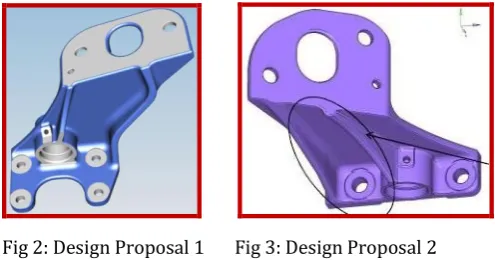
Fig 2: Design Proposal 1 Fig 3: Design Proposal 2
4.1 Comparison of Design Proposals
Two design proposals were made. Finite element analyses were carried on both designs. Necessary modifications were done in the design proposals to meet CAE requirement. Design 1, is in line with existing
bracket design. There will no need to make any modification in mating part of the bracket as there are same mountings. Design 1, is proposed to avoid modification on axle part. Weight of the bracket is observed 4.2 kg. It gives approximately weight reduction of 2 kg compare to existing bracket.
Design 2, is proposed with two mounting holes. It needs to make modification in mating part of bracket. Weight of the bracket is observed approximately, 3.58 kg. It gives the weight reduction of 2.62 kg. This is 43% weight reduction compare to the existing bracket. Project objective is to achieve maximum possible weight reduction, so design 2, is selected for F. E. analysis.
6. CONCLUSION
Weight reduction of 2.62 kg can be achieved in cast bracket compared with existing fabricated bracket. Approximately 43 % weight reduction can be
achieved in design 2
Casting in better option for MS for weight reduction.
ACKNOWLEDGMENT
[image:5.595.35.283.559.689.2]© 2016, IRJET | Impact Factor value: 4.45 | ISO 9001:2008 Certified Journal | Page 1421
REFERENCES
[1] Sasi Kiran Prabhala, K. Sunil Ratna Kumar, “Design & weight optimization of I. C. engine”, International Journal of Advanced Engineering Research and Studies, IJAERS/Vol. II/ Issue I/Oct.-Dec.,2012/56-58.
[2] A. Prasad Babu, Y.Vijaya Kumar, Dr. C. Udaya Kiran, “Topology Optimization in Design of Engine Mounting Bracket”, International conference on Emerging Trends in Mechanical Engineering, ISBN: 978-93-82163-09-1 .Volume 1, 24th, 25th February 2014
[3] Sourav Das, “Design & Weight optimization of alloy wheel”, International Journal of Scientific and Research Publications, Volume 4, Issue 6, June 2014
4] Basem Alzahabi, Scott C. Simon, Logesh Kumar Natarajan, “Optimization of transmission mounting bracket”, Society of Automotive Engineers, SAE 2003-01-1460
[5] Xiao-Yong Pan & Doni Zonni, Guo-Zhong Chai, Yang Qing Zhao & Cui Cui Jiang, “Structural optimization for engine mounting bracket”, Society of Automotive Engineers, SAE 2007-01-2419.
[6] Suresh Kumar Kandreegula, Naveen Sukumar, Sunil Endugu, and Umashanker Gupta, “Structural Non-linear Topology Optimization of Transmission Housing and Its Experimental Verification”, Society of Automotive Engineers, SAE 2015-01-0098.
Books
[7] Singiresu S. Rao, “Engineering optimization”, Fourth edition, 2009
[8] Tirupati R. Chandrupatla, Ashok D. Belegundu, “Introduction to finite elements in engineering, Third edition, 2002.
[9] X. Huang, Y.M. Xie “evolutionary topology optimization of continuum structures” first edition, 2010.
BIOGRAPHIES:
Mr. Sagar Awate is studying in
M.E - Mechanical design
engineering at Alard college of Engineering and Management. E-mail- [email protected]