© 2016, IRJET | Impact Factor value: 4.45 | ISO 9001:2008 Certified Journal
| Page 1941
Secure Live VM Migration model for Virtualized Cloud environment
S Ramamoorthy
1, S Rajalakshmi
21
Assistant professor, Department of Computer Science & Engineering, SCSVMV University, Tamilnadu, India
2Professor, Department of Computer Science & Engineering, SCSVMV University, Tamilnadu, India.
---***---Abstract -
Cloud Virtual Infrastructure management is theemerging technology in the IT industry today. Most of the IT business process demanding on the virtual infrastructure as a service from the cloud service providers including compute, network and storage etc., The dynamic adoption of computing resource and elimination of major investment cost to setup the physical infrastructure attracted the IT industry towards cloud infrastructure. Live VM Migration techniques allows more frequently move the virtual machines from one physical location to another to avoid the situations like load balancing, Fault tolerance, edge computing, virtual migration etc., The major challenge which found on this process security issues on the VM live migration. The proposed model trying to eliminate the security challenges in the pre-copy migration strategy by introducing the network addressing level hashing technique to avoid the critical part of migration process. The dirty VM memory pages are released to the destination server only after the authenticated network process.
Key Words:
Cloud computing, VM Live Migration, Hashing, Pre-Copy, Memory pages, Network Addressing.1.INTRODUCTION TO CLOUD COMPUTING
Cloud Computing Data Center model will provide the facility to operate the IT business services by offering its infrastructure like Compute, Storage, Network etc., Number of physical Servers are massively utilized to perform many number of applications with the hypervisor support on the physical Environment. Every Hypervisor creates multiple number of Virtual machines to perform the host level operations. Virtual Machines are nothing but the set of files which will inherit the abstract behavior of the physical machine. There are number of Virtual machine migration operations performed on the same cloud environment for continuity of uninterrupted Service offered by the cloud to its customers.
Cloud Computing is a Internet based Technology offers computing resources as a services to its end users support various IT business process. The computing resources are physical infrastructure as a service including compute ,network and storage etc., The Cloud computing services are
offered to the customers in the different models like Infrastructure as a Service (IaaS), Platform as a Service (PaaS) and Software as a Service (SaaS).
Cloud Deployment models selected by the customers based on their specific business needs. If the customer is more concern about the data and less concern about the cost they opted to go for the private cloud model in the home location. If the customer is less concern about the data security but more concern about the hiring cost then they will go for an public cloud model for their organization.
1.1
Virtual Infrastructure
The third model will provide the intermediate level facility to the customers by offering hybrid infrastructure for their business process.
Virtual Infrastructure is the backbone of the cloud computing business model, this will eliminate the need for setting up the physical infrastructure by customers. Instead of these customers can hire the computing resources as pay as you go model structure.
Virtual machine Manager (Hypervisor) abstract the physical infrastructure to the Virtual Machines running on the Hypervisor. This model allows the Multiple VM’s to run multiple guest operation system on the same physical server. Many application’s can be deployed using this flexibility of the physical infrastructure. Automated Live VM migration is the one of the technique which is frequently handled by the hypervisor to move the Virtual machine into different physical servers depends on the requirement of the resource availability.
1.2
VM Level Attacks:
© 2016, IRJET | Impact Factor value: 4.45 | ISO 9001:2008 Certified Journal
| Page 1942
example Cloud Platform like Amazon EC2 , Microsoft Azurerunning multiple number of VMs on the same Environment can lead multiple number of Security issues at the host level. Predominant usage of internet services in the process of Connection establishment between Cloud data center and the Client machine will reflect the untrusted channel communication in public cloud environment. Untrusted Network operations, Untrusted Port group, protocols and interconnecting devices will require maximum attention while setting up the Cloud Environment for running multiple number of VM on the same physical Machine.
Remote Level machine authentication is also part of this data center activity which needs to prove itself as a authorized user to access the Virtual Machine created on the cloud Environment.
2 Characteristics of VM Operations:-
Virtual machine is the set of files which inherit the abstract concept from the physical machine and creates the Virtual environment as a mirror image of physical machine. Hypervisor is the software layer which allows the multiple number of OS’s run simultaneously by sharing the common resource among themselves from the underlying physical machine.
There are two types of Hypervisor namely a)Bare metal Hypervisor b) Hosted Hypervisor that is a software layer which allows the VM level interaction between physical hardware and Virtual Machine created on the same hypervisor.
Fig -1:
Hosted HypervisorFrom the above diagram it is clear that various level of security enforcement are required on the cloud Infrastructure at Infrastructure level (IaaS), Platform level (PaaS) and Application level (SaaS).
3 Live VM Migration Process:-
Live VM Migration is the process of migrating the VM from one physical server to another physical server to different location. VM contents like CPU state, Memory pages, VM configuration data etc., migrated to the destination server while VM still in running state.
Two types of Migration strategies are followed in the process of Live Migrations
1. Pre copy Migration 2. Post copy Migration
In the Pre copy migration process the Running VM contents are copied at a time and all the memory pages of the VM are migrated to destination host, this process was done without disturbing the running application.
In Stop and Copy migration process the currently running VM was stopped for the specific point of time in the source, in subsequent iteration the modified memory pages ( Dirty pages) are copied to the destination server, after that VM will be resumed at the destination server.
4 Challenges Related to Co located VM’s:
Primary threat for a Virtual machine is due to running
multiple VMs on the Same Hypervisor. The attack
surface will be very high among the VMs even the
malicious VMs can also the part of this Surface. Efficient
sharing of resources among the number of VMs will
also lead to different issues on this environment. Live
Migration of Failed VM from one hypervisor to another
hypervisor will carry the sensitive information to the
untrusted environment which could have the
possibility to attack the target VM and extract the
confidential information about the target.
The major challenge in the Live VM migration is the
Security issues related to the VM content migration.
Secure transfer of VM memory pages must be
protected from the unauthorized modification. The
VM’s are still running state while transferred between
different physical servers. There is a possibility of
X86 Hardware
Hypervisor(Virtual Machine
Monitor)
Virtual
Machine
(VM1)
Virtual
Machine
(VM2)
OS
OS
Ap
p
© 2016, IRJET | Impact Factor value: 4.45 | ISO 9001:2008 Certified Journal
| Page 1943
masquerade VM contents into another. Strong
Cryptographic Techniques are need to be deployed to
avoid this kind of memory modification but key
management is the another overhead for this kind of
security mechanism. The proposed model trying to
eliminate this critical situation by introducing the
network level Hashing technique to authenticate the
memory page migrations. Types of Operations on
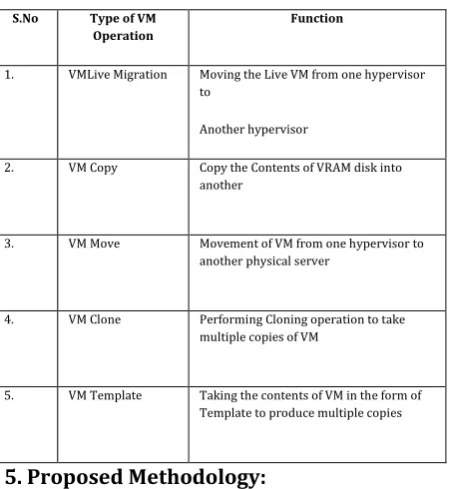
Cloud Virtual Machine given as follows:
Table – 4.1
VM level OperationsS.No Type of VM
Operation
Function
1. VMLive Migration Moving the Live VM from one hypervisor to
Another hypervisor
2. VM Copy Copy the Contents of VRAM disk into another
3. VM Move Movement of VM from one hypervisor to another physical server
4. VM Clone Performing Cloning operation to take multiple copies of VM
5. VMTemplate Taking the contents of VM in the form of Template to produce multiple copies
5. Proposed Methodology:
Proposed model try to achieve the required level of security by implementing following security polices at VM level.
Self Destructive nature of VM when there is an unauthorized effect made on the VM.
Authenticated move or Copy of VM operations at hypervisor level.
For every VM operation required to prove itself as a authenticated operation on a VM.
Identification of unauthorized move can be monitored based on the level of traffic flow between two VM’s and Virtual Switch.
[image:3.595.308.557.86.232.2] If the traffic flow exceed the preset Limit then it will become concluded as a unauthorized move of VM and it will destroy by itself.
Fig-5.1
Co-Located VM surface AttackAbnormal traffic rate identified between VM’s are enforced to apply some set of security policy given below:
Behavior of VM Security Policy Rule
Traffic rate HIGH- Destroy the VM fail to provide Signature Identity
Traffic Rate=MEDIUM-Signature Identity Check
Traffic Rate= LOW – Continue its normal operation.
5.1. Vsignature – Authentication Process:-
Every clustered hypervisor’s group generated some hash value signature when it was created as the part of cluster group for the Authentication purpose. This hash based signature used to identify the hypervisor while moving the Live VM’s between one Hypervisor to another in the same cluster group.
This Signature Authentication will provide sufficient security to prevent the Virtual Machine hosted in a attackers hypervisor in unauthorized manner.
Every time the Virtual machine will update the new MAC Address by throwing back to its router where its previously hosted network. The Signature Verification module will now recomputed the hash value based on the MAC address which is thrown by the hypervisor.
6. Implementation & Result Analysis:-
The above work is simulated using Cloudsim by setting up the two different data center along with multiple number of Virtual machines running on the same hypervisor cloudlet. It is allowed to move a virtual machine from one hypervisor to another hypervisor and the data transfer rates are monitored at the VM and VSwitch level.
Hypervisor
– Co-location attack among
VM’s
Threat
VM
Target
VM
[image:3.595.34.259.263.508.2]© 2016, IRJET | Impact Factor value: 4.45 | ISO 9001:2008 Certified Journal
| Page 1944
Capacity of CloudletBy setting pre Limit condition to the data traffic rate between two VMs and Vswitch identifies the unauthorized behavior of the Virtual machine.
Mathematical Evaluation:
Tmr = Tc+ Tsd --- (1)
T service downtime = Tmr – Tcycles - (2)
Tsd > Est. Th value ---- (3)
Concluded as a abnormal behaviour VM.
RTT / ICMP Packet: (Vswitch)
Total Data transfer = Total no. Of RTT peak@/CPU cycles +Data Transfer +Total down time
RTT mean time between Time at first packet sent
Time at response
Let the size of the virtual machine RAM is ‘V’ the peak rate at which packet’s sent ‘P’ and the network bandwidth available be ‘B’.
For an instance, Xen virtualization environment.
The Threshold limit, on the number of RTT peaks / CPU cycles limited to 5.
If RTT > Peaks > 5VM – abnormal
If the maximum amount of data transfers, set to 3 times of Vm RAM.
(1)If amount of data transfer > 3 times VRAM
Forcefully stop VM and directed signature authentication
Then, set Th memory page = 50 (Or) > 50 memory pages
(2)If VM migration amount is < X then, downtime > Th value Then destroy VM & migration.
Data migration during its nth cycle will always less than (or) equal to size of VRAM – V.
V * P n-1 < V ; n >=1 ---(4) B
The RTT peak rate always less than network bandwidth available.
RTTP < B B Tc = V/B
Tc = [V/RTTP] --- (5)
Total Data migrated during the down time,
V P n < ⍦ V ---(6) B
[image:4.595.306.542.564.734.2]⍦ - Limit data transfer.
6.1 Results Analysis:-
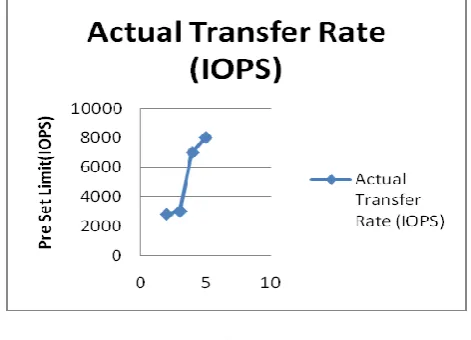
Table -6.1 Report analysisS.No Preset Transfer rate (IOPS)
Starting Time
(ms)
Completion Time
(ms)
Actual Transfer
Rate (IOPS)
1. 3000 4.03 ms 5.08ms 2800
2. 4000 5.09 6.05 3000
3. 4200 6.15 ms 7.10 7000
4. 3500 7.12ms 8.10ms 8000
Variation in the IOPS from the above statistical analysis clearly shows that unexpected data traffic between the VM’s and Vswitch will lead to an unauthorized move of Virtual machine from the known Hypervisor to target attack surface in the cloud environment.From the estimated values above graph shows a sudden rise of the curve when there is high volume of data transfer at specific point of time.
Time (ms)
© 2016, IRJET | Impact Factor value: 4.45 | ISO 9001:2008 Certified Journal
| Page 1945
7. Conclusion
The Proposed model tries to reduce the Co- located VM attack on the same hypervisor and enforcing the security polices over the Virtual Machine, when there is an unauthorized move or Copy of Live VMs into malicious hypervisor. Monitoring preset data traffic rate between two VMs and Vswitch node helps to identify uncertainty of VMs at a specific point of time.
Simulated results also shows that proposed model will reduce the risk associated on the VM running on the suspected hypervisor in cloud.
Acknowledgement
I dedicate this research paper to my research supervisor Prof Dr.S.Rajalakshmi, Director Advanced Computing Centre,SCSVMV University for the support and guidance throughout my research work.
9.References:-
[1]Identifying and analyzing security threats to Virtualized Cloud Computing Infrastructures by Brohi, S.N., Bamiah, M.A.,Brohi, M.N., Kamran, R. in Cloud Computing Technologies IEEE 2012
[2] Improving the Resistance to Side-Channel Attacks on Cloud Storage Services by Heen, O., Neumann, C.,Montalvo, L.,Defrance, S in New Technologies, Mobility and Security (NTMS), IEEE 2012.
[3] Large-Scale Coordinated attacks: Impact on the Cloud Security by Riquet, D. , Grimaud, G. Hauspie, M. in Innovative Mobile and Internet Services in Ubiquitous Computing (IMIS), 2012 Sixth International Conference on IEEE may-2012.
[4] Incentive Compatible Moving Target Defense against VM-Colocation Attacks in Clouds
by Yulong Zhang, Min Li, Kun Bai, Meng Yu, and Wanyu Zang in Computer Science Department, Virginia Commonwealth University ,IBM T.J. Watson Research Center, USA.
[5] On the Security of Tenant Transactions in the Cloud by Varadharajan, V.,Tupakula, U. in Cloud Computing Technology and Science (CloudCom),IEEE (Volume:1 )2013.
[6] An Analysis on the Possibilities of Covert Transfers between Virtual Machines Clustered In Cloud Computing: Survey by Wilson Bakasa1, Kudakwashe Zvarevashe, Nicholas N. Karekwaivanane in International Journal of
Innovative Research in Computer and Communication Engineering Vol. 2, Issue 6, June 2014
[7] Security Games for Virtual Machine Allocation in Cloud Computing by Yi Han , Tansu Alpcan , Jeffrey Chan, Christopher Leckie in CCSW '14 Proceedings of the 6th edition of the ACM Workshop on Cloud Computing-2014
[8] Cloud Security: Attacks and Current Defenses by Gehana Booth, Andrew Soknacki, and Anil Somayaji
8th annual symposium on information assurance (ASIA’13), JUNE 4-5, 2013.
[9] Security of cloud computing, storage, and networking by Hamdi, M., Ariana, Tunisia in Collaboration Technologies and Systems (CTS), 2012 International Conference on IEEE-may-2012
[10] MUSHI: Toward Multiple Level Security cloud with strong Hardware level Isolation by Ning Zhang , Ming Li ,Wenjing Lou, Hou, Y.T. in military communications conference, IEEE 2012
[11] Cloud computing-based forensic analysis for collaborative network security management system Chen, Zhen , Han, Fuye, Cao, Junwei, Jiang, Xin more authors ,Tsinghua Science and Technology (Volume:18 , Issue: 1 ) 2013
[12] Mitigation of Cloud-Internal Denial of Service Attacks by Alarifi, S.,Wolthusen, S.D.,Service Oriented System Engineering (SOSE),IEEE-2014.