A Power Allocation Scheme Using Updated SLNR Value
Based on Perturbation Theory
*
Wenwen Cao1, Zi Teng1,2, Jun Wu1
1College of Electronics and Information Engineering, Tongji University, Shanghai, 201804, China 2 School of Mathematics, Physics & Information Engineering, Jiaxing University, Jiaxing, Zhejiang, China.
E-mail: {1131660, 2011tengz, wujun }@tongji.edu.cn
Received June, 2013
ABSTRACT
The performance of downlink multiple-input multiple-output (MIMO) cellular networks is limited by co-channel inter-ference (CCI). In this paper, we propose a linear precoding scheme based on signal-to-leakage-and-noise ratio (SLNR) criteria which can reduce the CCI significantly. Since each user’s SLNR value is corresponding to the largest eigen-value of the generalized matrix which indicates the channel quality that we propose a scheme to do a dynamic power allocation as an auxiliary way to improve SLNR precoding scheme. We use the perturbation theory to update each user’s SLNR value each time step in time-varying channels rather than directly decompose the channel matrix so as to reduce the amount of calculation. The simulation results show that the proposed scheme offers about 0.3 bps/Hz addi-tional capacity gain and 0.5 dB BER gain over convenaddi-tional SLNR precoding method with lower computaaddi-tional com-plexity. And it also obtains about 0.5 bps/Hz additional capacity gain and 1 dB BER gain compared to the scheme only update the preceding vectors.
Keywords: Updated SLNR Value; Perturbation Theory; Power Allocation
1. Introduction
In downlink multi-user MIMO system, because of the limited frequency resources, a base station (BS) has to communicate with several co-channel user Equipments (UEs) to achieve high system capacity. This way of transmission inevitably causes co-channel interference. In general, there are non-linear and linear MU-MIMO precoding schemes to solve this problem. Due to the high complexity, the nonlinear schemes [1,2] are seldom used in practical. Only linear MU-MIMO precoding schemes are applied in 3GPP long-term evolution (LTE) [3]. The conventional linear schemes such as ZF (Zero- Forcing) [4-6], MMSE (Minimum Mean-Square Error) [4,6] and BD (block diagonalization) [7] can eliminate or reduce the interference among users and data streams. But all these solutions have the drawbacks that the number of base station antennas must be equal or greater than the data streams of all users. In [8], the SINR(Signal to In-terference plus Noise Ratio) precoding has been pro-posed which is desirable to maximize the average SINR for designing a robust precoder connected to maximize the sum rate. But the algorithm contains iterative part which increases the complexity of the realization.
How-ever, the expression of SINR is coupled for each user that the solution of precoder vectors is difficult.
In [9,10], SLNR (signal to 1eakage and noise ratio) has been developed to suppress the CCI. This scheme takes a comprehensive consideration of the useful signal, interference signal and channel noise. For each user, the transmitter only needs to work out a generalized eigen-value to obtain the optimal precoding matrix. There is no constraint on the system configuration in terms of the number of transmit and receive antennas. So the SLNR precoding achieves a good tradeoff of algorithm com-plexity and system performance. In practical wireless communication system, because of the infraction and scattering, there exists time-delay and multipath-fading. In [11], the author has mentioned to employ a perturba-tion theory to update formula of precoding vector design as an approximate solution with tolerable small per-formance loss under time-varying channels. This method gives us an inspiration that since each user’s SLNR value is corresponding to the largest eigenvalue of the general-ized vector, we can use the perturbation theory to update each user’s SLNR value as well as the generalized ei-genvector corresponding to the slowly varying channel information.
In the most of existing precoding methods, it is always
*This work is financially supported by NSFC General Program under
assumed that the transmitter distributes equal power to each user. But in the real wireless communication system, the users usually have different channel states. In [12,13], the multi-user iterative water filling algorithm has been proposed. Although it achieves a good performance knowing the perfect CSI, its high complexity restricts the method to be put into practice. According to this classic power allocation approach, it is very important to note here that we tend to allocate more power to users in good channel condition in order to obtain better system per-formance. Thus, if the transmit power is allocated accord-ing to the accuracy CSI, some gains may be achieved due to the effective power allocation. In conventional SLNR precoding scheme, the SLNR value seems useless, but in our proposed scheme, we use each user’s updated SLNR value as the refernece for power allocation to improve the system performance.
Notation: Throughout this paper, matrices are denoted by boldface symbols.
H denotes the conjugate transpose,F
represents the Frobenius norm, IN is the N N
identity matrix. M N represents the set of M N matrices in complex field. Besides, means x is dif-ferentiable.
x
The paper is organized as follows. The system model, previous works done on SLNR precoding, and the solu-tion of updated eigenvalue based on perturbation theory are introduced in Section II. We propose a new power allocation scheme using the updated SLNR value in Sec-tion III. Numerical results and conclusion are provided in Section IV and Section V.
2. System Model
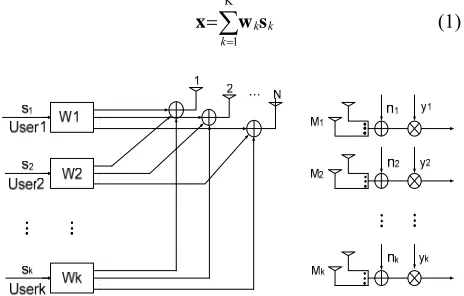
We consider a downlink MU-MIMO system in Figure 1,
where there is a base station communicating with K users simultaneously over the same time-frequency resource. The base station has N transmit antennas and each user is equipped with Mk antenna. We employ a linear precoding
matrix at the transmitter, so the transmit data symbol vector xN1 can be presented as
K
1
k k k
[image:2.595.57.289.568.716.2]x w s (1)
Figure 1. A block diagram of downlink MU-MIMO system.
where skL1
L Mk
denotes the transmitted data for k-th user. L is the number of data streams supported for user k
and it is assumed equal for all the users for simplicity.
Here and . The scalar data is
mul-tiplied by a
N LM k sk
N 1 precoding vector before being
trans-mitted over the channel. We can set as the
transmit power constraint. And is the total transmit power of downlink.
2 Ex p0 0
p
For a given user, the received signal vector at the
k-th receiver is
yk
K
1,
k k k k i
i i k k
y H x H x n (2)
where the received signal vector of user k is denoted as
1
k
M k
y . MIMO channel for the k-th user is Hk
k
MN
. It is modeled as independent and identically
dis-tributed complex Gaussian variables with zero-mean and
unit-variance. The noise is independent
com-plex Gaussian distributed,
1
k
M k
n
k~CN(0,k2 Mk)
i.e n I .
2.1. Signal to Leakage and Noise Ratio
The SLNR precoding design makes a balance between eliminating the co-channel interference and the noise. The basic concept in a SLNR system is that it maximizes the strength of the desired signal relative to the noise and total interference caused to the other users [9]. This ap-proach is discussed below.
We can use the linear SLNR precoder in [9] as an op-timization metric. Since each user’s precoding vector can be optimized, the optimization problem turns into a com-pletely decoupled one. So we can obtain a closed-form solution. Besides, the SLNR precoding scheme does not need the constraint on the system configuration in terms of the number of transmit and receive antennas.
From the definition in [9], the k-th user’s SLNR is
2 F
K 2
2
F 1, k
SLNR 1 K
Mσ
k k k
k i i i k i
H wH w (3)
The SLNR precoding scheme deals with the total in-terfering power that user i causes on all other users. The robust precoding vectors can be achieved by solving the following optimization problem. The precoder design aims at maximizing the SLNR can be formulated as
arg max 1 K
k
opt
k k SLNR k
w
w (4)
Using the criterion of max each user’s own SLNR
value can decouple the precoding vector { in the
objective function of (3), in [9], the optimum solution is given by
} k
w
2 H 1 H eigvector((M σ )
k k k k k k k)
w H H H H (5)
2 H 1 H 1
(MkσkH Hk k)H H Tk k kΛkdiag( , , N) (6)
The maximum SLNR value is given by
max
1
SLNRk max( , , N) (7)
In the conventional SLNR precoding approach, it is assumed that equal power is allocated to each user. As the SLNR value is available to the transmitter and it can indicate the channel quality of each user, we should take advantage of the knowledge of SLNR value which may bring further improvement to the system performance.
2.2. Calculate Updated SLNR Value Using Perturbation theory
We assume that the time-varying channel is slow fading which suits the practical wireless communication system. Actually, at two consecutive time steps, the transmit channels are not independent that we view the current channel as a slightly updated version of the previous one [14]. If we do the eigen-decomposition every time step, it will be a burdensome to calculation. So we should make full use of the time dependency of the channels between two consecutive time steps. Here the perturbation theory will be applied in calculating the current updated version of eigenvalues and eigenvectors.
The perturbation theory [15] considers the effect of a small disturbance in the equation and finds an approxi-mate solution to a problem which cannot be solved ex-actly. It often provides a better approximate answer to what the real solution should be. Our approach is to ap-ply matrix perturbation theory to the SLNR linear pre-coding where eigenvalues and eigenvectors are computed at every time step not using the matrix decomposition which reduces the complexity of computation.
Let , the definition of the generalized
ei-gen equation is Where , is
called a generalized eigenvector and is called a gen-eralized eigenvalue. When the equation is perturbed, we bring a parameter to illustrate the change of the equa-tion. By the definition, we know that
m n
,
A B
xiλi x .i
A B
ε
n
xi xi λi
AεA
xi
ε λ ε i
BεB
xi (8)where ε1. Let
λ εi
and
xi
ε
be the set ofgeneralized eigenvalues and eigenvectors. The problem is to find the nontrivial solutions of equation (8).
When we solve the equation (8), λ εi
and xi
ε aredifferentiable about . Set = 0 in the equation and the initial conditions to derive an initial value problem which determines the unperturbed solution
ε ε
λi 0 . Theequation (8) can be transformed to be
x 0 x 0
λ 0 x 0 λ 0 x 0 λ 0 x 0
i i
i i i i i i
A A
B B B (9)
λ εi and xi ε can be expressed in the form of Taylor
expansion.
2λ ε λi i 0 ελi 0 Ο(ε ) (10)
2xi ε x 0i εx 0i Ο(ε ) (11)
All of the other terms in the linear equation are of
or-der . By substituting the expansion (10) and (11)
into the differential equation (9), we obtain solutions of the eigenvalues and eigenvectors to first order
2
Ο(ε )
Hλ ε λ εi i x (i AλiB)xi (12)
H
N H1, i
εx ( λ )x
ε
x ε x 1 2x x j λ λi ix
i i i i j (13)
i j j j
B
A Bi
In (12), the updated eigenvalues are formed by the unperturbed solution and the first-order perturbation
correction .
λi H i εx (
λ εi λi )x
A B
From the form of the solution (12) and (13), we can see that the computation of the updated eigenvalues and eigenvectors do not need to do eigen-decomposition all the time. Because of the approximate solution, there ex-ists small loss of the system performance. In our forth-coming scheme, we applied the unused eigenvalue to be an indication of the channel quality, so the transmitter can do the power allocation according to it. The simula-tion has proved that it is a good scheme to compensate the performance loss.
3. Proposed Power Allocation Scheme
In the following, we propose a power allocation scheme which compensates the power loss due to approximated computation by perturbation theory. The SLNR precod-ing design in (3) also depends on the amount of power allocated to each user which takes the CSI into consid-eration. However in the practical wireless communica-tion system, each user’s channel fading is not completely the same. By (6), we can clearly see that the channel quality directly determine the SLNR at the receiver, it can significantly affect the system performance. Since the total transmission power of BS is constrained, if the transmit power is allocated according to the perfect CSI, we can get performance gains due to the improved power- efficiency.
The receivers feedback the liability CSI to the trans-mitter and the transtrans-mitter choose the preferable precod-ing vector to transmit the signal. We put forward a straight solution of a simplified power allocation problem. As the transmitter knows the perfect CSI, it allocates more power to the user which has better channel quality. The precoding vector is the eigenvector corresponding to
the largest eigenvalue of , and it is in
propor-tion to the channel power , so that the largest eigenvalue can be used as an indication to the quality of channel. Then, an SLNR-based power allocation scheme can be
λ H
k k
formulated as
K 0
1
λ λ
k k
i i
p p
(14)The solution of the updated SLNR value λ εi
in (12)substituted in (14), the updated SLNR value is more ac-curacy to do the power allocation.
K 0
1
(λ λ ε ) (λ λ ε) k k k
i i i
p p
(15)Using the updated SLNR to do power allocation, we can see the effect of parameters like eigenvalues, trans-mit power and channel perturbation on the capacity.
K
0 K
2 1
1
(λ λ ε )p
C log(1 )
σ (λ λ ε)
k k per
k i i i
(16)When computing λk, we define A n[ ]HHk
n Hk[n]and
2 H
k k Hk
Mσ n [n
B n Hk ] at time n.
In the computation of updated SLNR value, we also achieve performance gain benefits by adjusting the up-dated precoding vectors obtained from solution (13). The proposed simplified power scheme barely adds any addi-tional calculation compared to the scheme only updating the precoding vectors and it has less computation amount compared to the conventional SLNR precoding scheme which do the eigen-composition every time step in the time-varying channel. So the proposed allocation scheme using updated eigenvalue can improve the system per-formance considering of less computation complexity.
4. Numerical Results
In this section, we evaluate the performance of the pro-posed algorithm. We consider a MU-MIMO system with 4 (K = 4) users. Assume the BS has 12 (N = 12) antennas,
each user equipped with 2 ( ) antennas and each
user is transmitted with 2 (L = 2) streams. In this simula-tion experiment, the number of transmit antenna is more than the sum of all the receivers. All simulations are conducted using a QPSK modulation and a frame with 200 bits averaged over 10000 frames. We use the first order Gauss-Markov model to simulate a time-varying Rayleigh-fading channel. And the average bit error rate (BER) of users and system capacity are used as the eval-uation criterion.
M 2k
In Figure 2, we can clearly see that when we update the SLNR each time step, the loss of the SLNR can be notably reduced compared to the non-updated scheme. We simulate about 100 depth of time steps and it is ob-vious that calculating the updated SLNR with the
pertur-bation theory, the SLNR loss is negligible. Figure 2
shows that the SLNR value degrades only 0.1 through the approximate calculation. However the non-update scheme degrades about 0.6 which demonstrates that the
updated SLNR scheme will have small effects on the system performance with reduced computational com-plexity.
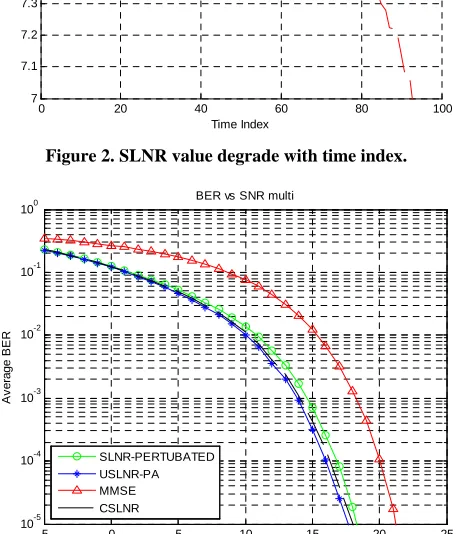
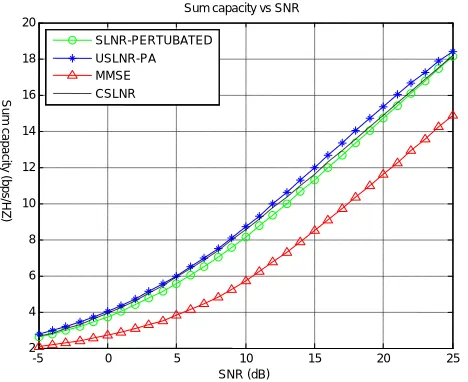
For the purpose of matching our hardware implemen in Figures 3 and 4 , we compare the BER performance and system capacity of the proposed power allocation scheme using updated SLNR value (USLNR- PA) with MMSE algorithm (MMSE), the conventional SLNR maximization algorithm (CSLNR) and the updated pre-coding vectors scheme in [12] (SLNR-PERTUBATED). When the channel variation is not significant, the SLNR-PERTUBATED scheme only update the precod-ing vectors causes about 0.3 dB loss in BER and 0.2 bps/Hz loss in capacity compared to the conventional SLNR precoding scheme. From the result, the proposed power allocation scheme shows about 0.5 bps/Hz addi-tional capacity gain and 1 dB BER gain per user over the SLNR-PERTUBTED scheme. Although the average achievable BER and capacity of the proposed algorithm
0 20 40 60 80 100
7 7.1 7.2 7.3 7.4 7.5 7.6 7.7 7.8 7.9 8
Time Index
S
L
NR V
a
lu
e
non-updated SLNR
[image:4.595.312.535.329.509.2]updated-SLNR
Figure 2. SLNR value degrade with time index.
-5 0 5 10 15 20 25
10-5 10-4 10-3 10-2 10-1 100
SNR (dB)
Av
e
ra
g
e
BER
BER vs SNR multi
SLNR-PERTUBATED USLNR-PA MMSE CSLNR
[image:4.595.310.538.438.705.2]Figure 4. Sum capacity of K = 4, N = 12, Mk = 2.
is small but the simplified power allocation scheme ob-tain the performance gain with no additional computation and it not only makes up the performance loss in [11], but also obtains the performance gain about 0.5dB in BER and 0.3bps/HZ in capacity compared with the con-ventional algorithm.
The results show that the proposed scheme has the best performance from both BER and system capacity. Using perturbation theory to obtain the updated SLNR and the updated precoding vector rather than decomposing the matrix to get the generalized eigenvalues and eigenvec-tors is an excellent way to achieve balance between algo-rithm complexity and system performance. What’s more, using the updated SLNR value to do a power allocation can further improve the system performance. From (2), the SLNR precoding design depends on the amount of power allocated to each user so that allocating more power to the user having good channel quality can in-crease the system performance. This strategy to compen-sate the performance loss in [12] is feasible.
5. Conclusions
In this paper, we have investigated the power allocation scheme using the updated SLNR value base on perturba-tion theory. As the time-varying channel is taken into consideration, we avoid doing the eigen-decomposition in two consecutive time step. It leads to relatively less amount of calculation compared to the conventional SLNR algorithm and better system performance com-pared to the scheme only updating precoding vector. Then the proposed power allocation scheme using up-dated SLNR value which is more accuracy as an indica-tor to the channel quality compensates the performance loss caused by the approximate calculation.
REFERENCES
[1] C. Windpassinger, R. F. H. Fisher, T. Vencel, and J. B. Huber, “Precoding in multiantenna and multiuser com-munications,” IEEE Trans. Wireless Communications, Vol. 3, No. 4, 2004, pp. 1305-1316.
doi:10.1109/TWC.2004.830852
[2] M. Costa, “Writing on Dirty Paper,” IEEE Transactions Information Theory, Vol. 29, No. 3, 1983, pp. 439-441. doi:10.1109/TIT.1983.1056659
[3] C. B. Ribeiro, K. Hugl, M. Lampinen and M. Kuusela, “Performance of Linear Multi-user MIMO Precoding in LTE System,” Wireless Pervasive Computing, 2008.
ISWPC 2008. 3rd International Symposium on, 7-9 May 2008, pp. 410-414.
[4] M. Joham, W. Utschick and J. A. Nossek, “Linear Transmit Processing in MIMO Communications Sys-tems,” IEEE Transactions Signal Process., Vol. 53, No. 8, 2005, pp. 2700-2712. doi:10.1109/TSP.2005.850331 [5] C. B. Peel, B. M. Hochwald and A. L. Swindlehurst, “A
Vector-perturbation Technique for Near-capacity Mul-tiantenna Multiuser Communication—Part I: Channel Inversion and Regularization,” IEEE Transactions Com-munications, Vol. 53, No. 1, 2005, pp. 195-202. doi:10.1109/TCOMM.2004.840638
[6] Q. H. Spencer, A. L. Swindlehurst and M. Haardt, “Ze-ro-forcing Methods for Downlink Spatial Multiplexing in Multiuser MIMO Channels,” IEEE Transactions Signal. Processing, Vol. 52, No. 2, 2004,pp. 461-471.
doi:10.1109/TSP.2003.821107
[7] Q. H. Spencer, A. L. Swindlehurst and M. Haardt, “Ze-ro-Forcing Methods for Downlink Spatial Multiplexing in Multiuser MIMO channels,”
[8] M. S chubert and H . Boche, “Solution of the Multiuser Downlink Beam-forming Problem with Individual SINR Constraints,” IEEE Transactions on Vehicular Technol-ogy, Vol. 53, No. 1, 2004, pp. 18-28.
[9] M. Sadek, A. Tarighat and A. H. Sayed, “A Leak-age-based Precoding Scheme for Downlink Multi-user MIMO Channels,” IEEE Transactions Wireless Commu-nications, Vol. 6, No. 5, 2007, pp. 1711-1721. doi:10.1109/TWC.2007.360373
[10] A. Tarighat, M. Sadek and A. H. Sayed, “A Multi User Beam-forming Scheme for Downlink MIMO Channels Based on Maximizing Signal-to-leakage Ratios,” in Proc. IEEE Int. Conf. Acoust., Speech, Signal Process., Phila-delphia, PA, Mar. Vol. 3, 2005, pp. 1129 -1132.
[11] H. Yu, J. C. Shin and S.-k. Lee, “Multi-user MIMO Downlink Beamforming Based on Perturbation Theory of Generalized Eigenvector,” Wireless Communication Sys-tems (ISWCS), 2012 International Symposium on, pp. 141-145, 28-31 Aug. 2012.
[12] P. Viswanath, D. N. C. Tse and V. Anantharam, “As-ymptotically Optimal Waterfilling in Multiple Antenna Multiple Access Channels,” Information Theory, 2000.
Proceedings. IEEE International Symposium on, pp. 466, 2000.
[13] W. Yu, W. Rhee, J. M. Cioffi, “Optimal Power Control in Multiple Access Fading Channels with Multiple
Anten--5 0 5 10 15 20
20
25 2
4 6 8 10 12 14 16 18
SNR (dB)
Sum
cap
a
city (
b
ps/HZ)
Sum capacity vs SNR
SLNR-PERTUBATED
nas,” Communications, 2001. ICC 2001. IEEE Interna-tional Conference on, Vol. 2, 2001, pp. 575-579.
[14] H. Yu, Y. Sung, H. Kim and Y. H. Lee, “Beam Tracking for Interference Alignment in Slowly Fading MIMO In-terference Channels: A Perturbations Approach Under a
Linear Framework,” Signal Processing, IEEE Transac-tions on, Vol. 60, No. 4, 2012, pp. 1910-1926.
[15] R.-C. Li, “Matrix Perturbation Theory,”