DC-Link Based Micro-grid System
Miro Milanovič, Mitja Truntič, Miran Rodič
University of Maribor; FERI, SI-2000 Maribor, Slovenia
Email: [email protected], [email protected], [email protected]
Received April, 2013
ABSTRACT
Design and evaluation of dynamic model of multi-input/multi-output power converter consisting of six converters con-nected by dc-link will be presented in the paper. The model was created in Matlab/Simulink based on the existing sys-tem, with the goal of evaluating various power management strategies, where only transient behavior in case of changed operating regime is of interest. In future the model will be used as a Software-In-the-Loop development tool for the design of supervisory control algorithms.
Keywords: Power Management; Power Electronics; Simulation; Modeling; Control
1. Introduction
In many applications there is a requirement for multiple power sources to be connected together, providing the power for a single or multiple loads. For example in electric and hybrid vehicles, distributed generation sys-tems etc., multiple sources of electric energy are avail-able, which have to be connected together in order to maximize the efficiency of the overall system under the different operating conditions.
This kind of operation has recently achieved a wide attention due to the extensive use in the electric and hy-brid vehicles [1,2], as well as in the distributed [3,4] and micro-generation systems [5,6]. Especially the use in alternative and renewable sources utilization can be counted among the most interesting applications [4,6], [7]. Due to the nature of this kind of systems, the super-visory control is required, especially for the performance of power and energy management [8-10]. However, the converters of that complexity become relatively hard to manage, and in the early stage of development, a lot of attention has to be given to the safety of the operation, which has to be set to a much higher level than the one required in the normal operation. Thus the possibilities of testing new algorithms are limited and information ob-tained is in many cases not sufficient. In development of modern industrial applications simulations are an effi-cient tool, but applied simulation models have to be pre-cise enough to ensure reliable results and at the same time not too complex in order to allow them to be per-formed in a reasonable time on the available computers, which in our case are PCs.
In the presented case a multi-input/multi-output power converter was modeled and simulated. The paper will be
organized in the way, which will allow the insight into the bottom-up development of the model. After short introduction a complete system will be presented briefly, to give a basic idea of the model requirements. This will be followed by the presentation of the applied converters and their models. In the next step interconnection of the converters will be presented and explained. Next stage will be the presentation of the supervisory control. This is the main purpose of the model, thus it will be pre-sented in more details. Example of a simple supervisory control will be described together with its presentation by the means of state automata in Matlab/Simulink State- flow tool and then the results will be presented, first ex-perimental and afterwards numerical (simulation) ones. Finally, the conclusion will summarize the paper and give some ideas for the future work.
2. System Model
Multi-input/multi-output converter consists of six con-verter units (C1-C6), which are connected into the
sys-tem using the DC link (Figure 1). Three bi-directional
(C2, C3 and C4) and three unidirectional (C1, C5 and C6) converter units (in the terms of energy exchange) are used. For the short-term transfer operation system is supported by the capacitor banks applied at the DC-link sides of all converters. The modularity of the system was an important issue due to the demands set, where special attention was on the maintenance. Possibility to ex-change both power and controller hardware units was required. As it can be seen from converter schemes in
Figures 2 (a)-(f), there are the equal half-bridge units
used as basic power electronics blocks. Based on this
In both levels hybrid control approaches have to be ap-plied due to the required controlled operation in different operation modes.
Figure 1. System layout.
Figure 2. Converters in system; (a) AC-DC converter-C1, (b) AC-DC converter-C2; (b) DC-DC converter-C3; (e) DC-DC converter-C4; (e) DC-AC converter-C5; (f) DC-DC-AC converter-C6.
Figure 3. (a) Power module, (b) DSP module.
2.1. Modelling of Converter Units
In the modeling of converter units the complexity is re-duced to the level of single converter. It is assumed that the converter is operating in failure-free operation. Thus
bustness. The converter control scheme, which enables operation as voltage and current controller, is presented
in Figure 4. The switching between the voltage and
cur-rent control can be presented by the use of simple switch,
SCx. For the sake of simplicity only C3 will be considered.
The model of the current controlled bi- directional
con-verter is shown in Figure 5. The converter is modeled by
the transfer functions for operation as a load or source. Additionally, delays are introduced representing the time-delay at starting and stopping of the converter. Such a representation is possible, because in order to increase the safety of the converter system operation, the current has to be zero before operation can be switched between the load and source mode.
Likewise unidirectional converters are also modeled in
a similar way, as presented in Figure 6 and Figure 7.
Since the control, due to the complexity and spatial dis-tribution, cannot be performed with a centralized algo-rithm, a distributed control is applied. For that purpose all the converters, which can act as sources (C1, C2, C3
and C4), have control as shown in Figure 4. The model
of such presented converter is presented in Figure 8. One
of the converters (master) should be voltage controlled, while others must be current controlled.
Figure 4. Single converter control scheme.
Figure 6. Model of uni-directional (pure source) converter.
Figure 7. Model of uni-directional (pure load) converter.
Figure 8. Simulink model of voltage control algorithm.
2.2. Modeling of Converters Interaction
The current balance of the DC-link is calculated based on the well-known Kirchhoff formula:
6
1
0
Ck k
i
(1)where iCk denotes the current of k-th converter from/to
DC-link. Simulink model of the current interconnection
is featured in Figure 9, making it possible to attach not
only passive, but also active power loads. The basic idea is to enable the replacement of the ideal current source with a more precise converter model in SymPower-
Sys-tems (Matlab toolbox), when required. Figure 10
fea-tures the Simulink subsystem containing the complete system current dynamics. A better representation is given by:
6
1
dc
Ck k
dE
p dt
(2)where Edc is the DC-link energy, whereas pCk represents
the power of the k-th converter. If the converter acts as a power source towards the DC-link, the power is repre-sented by positive value, and vice-versa, when the con-verter acts as a load; the power is represented by negative value.
Figure 9. Electrical interconnection of converter units.
Figure 10. Current dynamics of the converter system.
2.3. Modelling of Power Management Schemes
The calculation of currents for the converters connected to remaining sources is performed in the supervisory system based on (1) and (2), together with applied source and load priority schemes. Different operation modes are applied for the system. In each of them there is one pri-mary power source, which presents the main source of energy and also controls the DC-link voltage, and several secondary power sources, of which only provides the additional power into the system. The presentation of the power management states from the viewpoint of the
converters' operation is presented in Table 1. The
opera-tion as source is denoted by s, whereas the operaopera-tion as load is denoted as l. The primary operation is denoted by the capital letter. The priority of the source (where the operation in regenerative mode for short time is not in-cluded, like in the case case of converter C5) is presented by the number in superscript, where 0 denotes the pri-mary source and higher priority is represented by the lower number. Additionally, the primary source con-verter is marked with the gray background. Stateflow model of power management scheme is presented in
Figure 11. The states marked by grey backgrounds
con-tain sub-states. Only the ONNET state is presented in
more details in Figure 12. An algorithm for the load
management is also presented in Figure 13. The State
ONNET Grid Off S0/l s1/L L s/L L
NETSUPP Generator S0 s/L S1/l S2/l s/L L
BAT24V 24V battery Off Off s1/L S0/l s/L L
BATTERY HV battery Off Off S0/l L s/L L
ISLAND Generator S0 Off S1/l L s/L L
FAULT None Off Off Off Off Off Off
NETSUPP ONNET
STANDBY during: On=ml('[0,0,0,0,0,0,0]'); during: Source=ml('[0,0,0,0,0,0,0]'); during: Voltage_control=ml('[0,0,0,0,0,0,0]'); entry:P_c=ml('[0,0,0,0,0,0,0]'); entry:B_c=1; BAT24V
ISLAND BATTERY
entry: On=ml('[0,0,0,1,1,1,1]'); entry: Source_avail=ml('[0,0,0,1,0,0,0]'); entry: Source=ml('[0,0,0,1,0,0,0]'); entry: Voltage_control=ml('[0,0,0,1,0,0,0]'); during:B_c=1;
[Mode==1] [Mode==5]
[Mode==1]
3
[Mode==1] [Mode==5]
[Mode==5]
5
[(Mode!=1)&&(BatS>0)]
[Mode==1]
2 [Mode==5]
[Mode==5] [Mode==4]
[Mode==4] [(Mode==3)||(Mode==2)||(Mode==4)]
[Mode==0] [(Mode==0)||((Mode!=1)&&(BatS==0))]
[Mode==2]
3
[Mode==0] [Mode==0]
1
[Mode==0] [(Mode==3)&&(BatS>0)]
1
[Mode==4]
4
[Mode==2]
2
[(Mode==3)&&(BatS>0)]
[(Mode==4)||(Mode==5)]
4
[(Mode==3)&&(BatS>0)]
Figure 11. Stateflow representation of the power manage-ment model. ONNET entry: On=ml('[0,0,1,1,1,1,1]'); entry: Source=ml('[0,0,1,0,0,0,0]'); entry: Source_avail=ml('[0,0,1,1,0,0,0]'); entry: Voltage_control=ml('[0,0,1,0,0,0,0]'); ONNET_HVB entry: Source[3]=1; during:P_c[3]=P_df-0.8*P_a[2]; during:B_c=1; ONNET_BC entry: Source[3]=0; during:P_c[3]=P_a[3]; during:B_c=0; ONNET_S entry: Source[3]=0; during:P_c[3]=0; during:B_c=1; [Mode==1] [Mode==5] 3 [Mode==1] [Mode==1]
[((P_d > (P_a[2]))&&(BatS>1))||((Mode!=1)&&(BatS==0))]
2
[Mode==5]
1
[(Mode!=1)&&(BatS>0)]
2
[((P_d < (0.8*P_a[2]))&&(Mode==1))||(Mode!=1)]
1 [(BatS>2)||(Mode!=1)] [(BatS<2)&&(Mode==1)] 3 [(Mode==3)||(Mode==2)||(Mode==4)] 4 [Mode==1]
Figure 12. Stateflow representation of the ONNET opera-tion mode.
all_on
during:Load_On=ml('[0,1,1,1,1,1,1]'); exit: mode_x=mode;
first_off
during:Load_On[priority[3]]=0; exit: mode_x=mode;
second_off
during:Load_On[priority[2]]=0;
third_off
during:Load_On[priority[1]]=0;
fourth_off
during:Load_On[priority[0]]=0;
[mode_x!=mode] [mode_x!=mode] 2 [mode_x!=mode] 1 [mode_x!=mode] 2
[(I_conv[priority[3]]+I_conv[priority[2]]+I_conv[priority[1]]+I_conv[priority[0]])>P_avail_max]
[(I_conv[priority[2]]+I_conv[priority[1]]+I_conv[priority[0]])>P_avail_max] 1
[(I_conv[priority[1]]+I_conv[priority[0]])>P_avail_max] 2
[(I_conv[priority[0]])>P_avail_max] 1
Figure 13. Algorithm for the load management.
code as a result), but also to enforce systematic approach on the designer. In Matlab/Simulink it is possible to ex-change the Stateflow block with a s-function block, making it possible to evaluate the algorithms written di-rectly in C-code, which is an important goal for the fu-ture use of the converter system model.
3. Experimental and Simulation Results
3.1. Laboratory Set-up
Experiments were performed on the custom design hard- ware, with the master and converter control units using TI TMS320F2809 microcontroller. The algorithms for voltage and current control were executed in 25µs time interval, whereas power management algorithm was ex-ecuted in 10 ms time interval. The multi-converter
sys-tem is shown Figure 14. Each power module contains an
IGBT converter leg, like the one presented in Figure
3(a). The power modules are fully interchangeable, and
thus oversized for the majority of converters. This makes the system more useful for the experimenting purposes.
3.2. Simulation Results
Unlike most of the technical papers, simulation results follow the experimental ones. This is due to the fact, that the model and its operation are a result in the presented case. The model, containing all sub-systems described
above is presented in Figure 17. The model additionally
includes battery status model to serve as output for test-ing operation in case of various battery states (low,
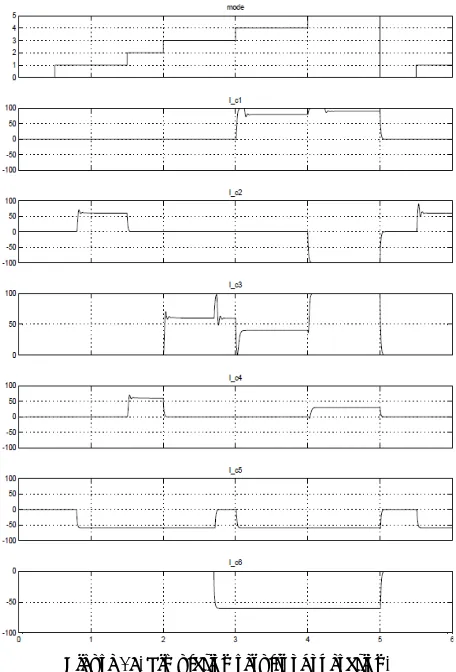
full, …). Simulation results in Figure 18 present a run-
trough over all the active operating states (presented in
Table 1), where states are represented by the value of the
variable mode (0 – system turned off, 1–ONNET,
Figure 15. Transfer from C3 to C2 (1-battery current, IBAT-
5A/div; 2-current to grid, IGRID 5A/div; 3-DC-link voltage,
UDC 100 V/div, x-axis 1s/div).
Figure 16. Transfer from C2 to C3 (1-battery current, IBAT-
5A/div; 2 - current to grid, IGRID-5A/div; 3- DC-link voltage,
UDC-100 V/div, x-axis 1s/div).
Continuous
powergui
[0 0 6 5].'
load priority levels (high -> low)
I_conv
P_av ail_max
mode
priority Load_On
load management scheme 1 z
1
Unit Delay6 z
1
Unit Delay5
z 1
Unit Delay4
1/z Unit Delay3 1/z Unit Delay2 1/z Unit Delay1
z 1
Unit Delay 450
Udc_des
P_d
P_a
P_aMax
Mode
P_df
BatS Voltage_control
On
Source
Source_av ail
P_c
B_c
State machine - sources
Saturation Product Power_max_Conv
On
Source_av ail
Source
I_conv P_av ail
P_demand
P_av ail_max
P_demand_f ilt
Power demand and Available power Battery Status
Mode
Battery mode P_av ailable
P_available
Mode
I_des
I_conv
U_DC_des
U_DC
mode
P_a Measurements
Load 6 Load 5 Load 4
-1
Gain I_conv Udc
Electrical system I_des
I_Load
On
Source I_conv
Current dynamics (with current controllers) Loads - current is negative Sources - current is positive Current_des
Voltage_control
Voltage_error Current_des_out
Controllers
0
Constant10 Battery Status
[image:5.595.310.538.84.420.2]0-very low, 1-low, 2- ok, 3-high
Figure 17. Complete Matlab/Simulink model of converter system.
[image:5.595.68.280.284.438.2]2–BAT24V, 3–BATTERY, 4–ISLAND, 5–NETSUPP). Positive currents would be the ones flowing from the converter to the DC-link. The effects of applied load management scheme are also presented. Converters C5 and C6 are turned-on by user and turned-off by the load
Figure 18. Simulation results of operation.
[image:5.595.58.287.485.634.2]power grid by the maximal possible power (this is pre-sented by the negative current for this controller), which is, together with the power required by loads connected to converters C5 and C6 provided not only by the gen-erator (converter C1), but also by the C3 and in smaller portion by C4. At the end of test the system is turned-off and converters C5 and C6 are also turned-off.
To demonstrate the possibility of restarting at the end of simulation test the mode is again changed to ONNET.
4. Conclusions
Research and development on the equipment are still active, especially in the power management schemes to be applied. In future we hope to be able to present more contributions in this direction. However, in order to be able to analyze the operation also off-line, a model of the system was created and is now under evaluation. It can serve as a good study and analysis tool. Next steps in its development will include the possibility of use in HIL (Hardware-In-the-Loop) and SIL (Software-In-the-Loop) systems. The model has to be improved further by ex-tending the dynamic model from the currently used linear approximation to the non-linear representation. It was also considering the creation of a simple interface for the introduction of s-functions. In practice it is often impos-sible to measure them, especially because the currents into the DC-link capacitors would have to be measured. Transformation values obtained from the input currents or other (converter-internal) variables would have to be used instead. However, use of DC-link currents can be used in the model of the presented kind, which is a fur-ther advantage of its use.
Special attention will be given to the development of the presented system, apart from its main purpose, can be also used as a valuable research and teaching tool, power and energy management schemes, with the focus on the cost functions and introduction of renewable power sources.
visory Control Strategies for Hybrid Electric Vehi-cles,”IEEE Transactions on Control Systems Technology,
Vol. 15, No. 3, May 2007, pp. 506-518.
[3] H. Dehbonei, S. R. Lee, S. H. Ko and C. V. Nayar, “A Control Approach and Design Consideration of PV/Diesel Hybrid Distributed Generation System Using Dual Voltage Source Inverter for Weak Grid,”
SICE-ICASE International Joint Conference 2006, Oct.
18-2 1, 2006 in Bexco, Busan, Korea, pp. 672-677. [4] A. Hajizadeh and M. A. Golkar, “Control of Hybrid Fuel
Cell/Battery Distributed Power Generation System with Voltage Sag Ride-Through Capability,” 2nd IEEE
Inter-national Conference on Power and Energy (PECon 08),
December 1-3, 2008, Johor Baharu, Malaysia, pp. 463-467.
[5] A. Molderink, V. Bakker, J. L. Hurink and G. J. M. Smit, “Algorithms for Balancing Demand-side Load and Mi-cro-generation in Islanded Operation,” 19th International
Conference on Systems Engineering, pp. 115-120.
[6] Z. Jiang, “Power Management of Hybrid Photovoltaic - Fuel Cell Power Systems,” IEEE Power Engineering
So-ciety General Meeting, 18-22 June, 2006, pp. 1-6.
[7] C. Abbey, J. Robinson and G. Joós, “Integrating Renew-able Energy Sources andSstorage into Isolated Diesel Generator Supplied Electric Power systems,” EPE-PEMC 2008, 1-3 Sept. 2008, pp. 2178-2183.
[8] J. Zhuo, C. Chakrabarti, K. Lee and N. Chang, “Dynamic Power Management with Hybrid Power Sources,” in:
44th ACM/IEEE Design Automation Conference, DAC '07 , 4-8 June 2007, pp. 871-876.
[9] M. E. Torres-Hernández and M. Vélez-Reyes, “Hierar-chical Control of Hybrid Power Systems,” in: 11th IEEE International Power Electronics Congress, 2008. CIEP 2008, 24-27 Aug. 2008, pp. 169-176.
[10] A. A. Ferreira, J. A. Pomilio, G. Spiazzi and L. de Araujo Silva, “Energy Management Fuzzy Logic Supervisory for Electric Vehicle Power Supplies System,” IEEE
Transac-tions on Power Electronics, Vol. 23, No. 1, January 2008,