ORIGINAL RESEARCH ARTICLE
A METHODICAL QUALITATIVE AND QUANTITATIVE STUDY OF SUBLIME “VIOLET
POISON” W.S.R. TO RASAKARPURA
*1
Dr. Sushant Sud,
2Dr. Khyati S Sud,
3Dr. Joyal Patel and
4Dr. Vinay, T.C.
1
Asst. Prof, Dept of Agad Tantra, SGAM, Gujarat Ayurved University, Jamnagar, India
2
Asso. Prof, Dept of Kayachikitsa, Dhanwantari Ayurved College, Koydam, Dist. Mahisagar, Gujarat, India
3
Asst. Prof, Dept of Shalya Tantra, SGAM, Gujarat Ayurved University, Jamnagar, India
4
Asst. Prof. Dept of Agad Tantra Vyavahar Ayurved, TMAES Ayurvedic Medical College,
Shimoga, Karnataka
ARTICLE INFO ABSTRACT
Rasakarpura is one of the Nirgandha murchana bheda of Parada. It appears as a white sublimate with chemical composition of mercuric chloride. The artificially prepared rasakarpura is commonly available in the market, prepared sublimed from metallic mercury, sulphuric acid and rock salt. This compound is widely used for many ayurvedic preparations. It is also known as Mercury bi-chloride or Mercury per-chloride. It appears as crystals or white granules or as powder; in the toxicology field it has a nickname “violet poison”. The work was taken up to fix up the standards for assessment of quality control over a Rasakarpura in order to interpret the pharmacokinetics and pharmacodynamics of the drug. The analysis of the drug Rasakarpura to establish standards in terms of Organoleptic characters, physico-chemical analysis, elemental analysis, XRD were carried out in IIT (SAIF), Powai, Mumbai and BTH, Bangalore. The result revealed that pH of the sample was more nearer to the neutral side. Particle size was 18 micron to 31 micron which may facilitate better absorption in the body. X-RD showed presence of HgCl2 as
a main constituent along with other trace elements. These results were interpreted systematically and are presented in the paper.
Copyright ©2018, Dr. Sushant Sud, et al. This is an open access article distributed under the Creative Commons Attribution License, which permits unrestricted use, distribution, and reproduction in any medium, provided the original work is properly cited.
INTRODUCTION
Parada, Mercury, Sublime, Rasakarpura, Analytical study. Rasashastra is a most important and popular branch of Ayurved developed in Medieval period. It deals with knowledge related with alchemy and Ayurvedic pharmaceutics specially connected to the drugs of mineral origin to prevent mankind from ageing process. Concept of Rasashastra in ancient classical text book shows the inclination in the usage of parada was towards Datuvada and Dehavada, which gradually turned its importance in chikitsa. For the purpose of chikitsa the concept of murchana to Parada came into existence. Murchana is the most important process of Mercury in which Mercury is made to convert in such compound form
*Corresponding author: Dr. Sushant Sud,
Asst. Prof, Dept of Agad Tantra, SGAM, Gujarat Ayurved University, Jamnagar, India.
which must possess disease destroying property.1, 2 Under the
concept of Murchana 4 forms medicines are explained, they are Parpati Rasayana, Potali Rasayana, Kharaliya Rasayana, Kupipakwa Rasayana. Among the 4 divisions, kupipakwa Rasayana is one which is prepared by using Gandhaka and without Gandhaka known as Sagandha and Nirgandha Respectively, Rasakarpura is one such Nirgandha variety of Kupipakwa Rasayana. Hence improper use of Rasakarpura
will lead to Parada vikaras. 3, 4 As per modern science it is
considered as Mercuric or Mercurous chloride. Mercurous chloride because of its low solubility it is poorly absorbed and is regarded as safe medicine, but in large doses it acts as irritant poison and even in medicinal dosage it produces toxic effect in susceptible individuals in some cases death may also
occurs. 5, 6 Rasakarpura appears as a white sublimate with
chemical composition of mercuric chloride. The artificially prepared Rasakarpura is commonly available in the market,
ISSN: 2230-9926
International Journal of Development Research
Vol. 08, Issue, 01, pp.18584-18588, January,2018
Article History:
Received 12th October, 2017 Received in revised form 26th November, 2017
Accepted 20th December, 2017
Published online 31st January, 2018
Key Words:
Parada, Mercury, Sublime, Rasakarpura, Analytical study.
Citation: Dr. Sushant Sud, Dr. Khyati S Sud, Dr. Joyal Patel and Dr. Vinay, T.C. 2018. “A methodical qualitative and quantitative study of sublime “violet poison” w.s.r. to rasakarpura”, International Journal of Development Research, 08, (01), 18584-18588.
prepared from metallic mercury, sulphuric acid and rock salt. This compound is widely used for many Ayurvedic preparations. It is also known as Mercury bi-chloride or Mercury per-chloride. It appears as crystals or white granules or as powder; in the toxicology field it has a nickname “violet poison.” As there is lot of discussions existing in regard to Heavy metal Toxicity in recent days, so better to assess the Drug in terms of Physical, Chemical, Biological aspects, to provide scientific data and statistical validation for safety. Hence the study A Methodical Qualitative and Quantitative
study of sublime “violet poison” w.s.r. to Rasakarpura was
undertaken. The Analytical Study proved that Rasakarpura is a compound containing Mercuric Chloride as a main content along with some other trace elements and other parameters showed drug is suitable to body.
AIMS AND OBJECTIVES
To study the organoleptic character, Physico-Chemical
properties of Rasakarpura.
To study qualitative and quantitative properties of
Rasakarpura by following:
Particle Size Analysis
X-ray diffraction.
Elemental analysis.
MATERIALS AND METHODS
Organoleptic Characteristic Assessment
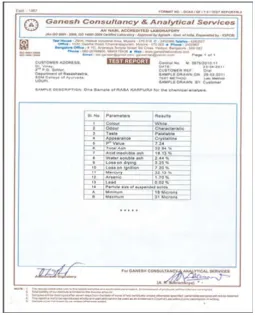
The drug is examined by means of the Sense Organs, and the difference in the drugs which are observable at a macroscopic level is appreciated. Organoleptic Characteristic Assessment of the drug Rasakarpura also confirmed by Ganesh consultancy and analytical services. These below mentioned tests were carried out in Ganesh consultancy and analytical services, Mysore.
Colour: White.
Odour: Characteristic.
Taste: Palatable.
Appearance: Crystalline.
Physico – Chemical Analysis:
Determination of pH.
Moisture Content (Loss on Drying).
Total Ash,
Acid Insoluble Ash,
Water soluble Ash.
Determination of PH value
Materials required: Digital PH meter.
Applied aspect: To know the degree of acidity and alkalinity of the sample.
Procedure: 1 gm of sample mixed with 100 ml of distilled
water, and the PH reading was taken by using digital PH meter.
7
Results
PH of the sample Rasakarpura was: 7.24
Determination of Total Ash
Materials required:
Muffle furnace,
Silica crucible.
Spatula.
Dedicator.
Analytical balance.
Rasa karpura.
Procedure
Incinerate the 2 g of accurately weighed & grounded drug in a
tarred dish at a temperature not exceeding 4500c until free
from carbon, cool & weighed (Gokhale, 2002 and Ayurvedic
Pharmacopeia of India, 1985). 8, 9
Result
The Percentage of total Ash value of Rasakarpura is 32.84%.
Determination of Acid Insoluble Ash
Materials required
Muffle furnace,
Silica crucible.
Spatula.
Dedicator.
Analytical balance.
Dil HCl.
Applied aspect
Used to determine existing impurities in the given sample. It expresses the quality & purity of the given sample.
Procedure
The ash obtained after incinerating was boiled for 5 min with 25% of dilute Hcl, collected the insoluble matter was collected in a on an ash less Filter Paper, and washed with hot water & ignited to constant weight then calculate the % age of acid insoluble ash with reference to the air dried drug (Gokhale,
2002 and Ayurvedic Pharmacopeia of India,). 8, 9
Results
The Percentage of acid insoluble ash value of Rasakarpura is 18.13%
Determination of Water soluble Ash
Materials required
Silica crucible
Burner
Ashless filter paper
Electronic weighing Machine
Distil Water – 100 ml
Procedure: The ash obtained after incinerating was boiled for 5 min with 25% of dilute Hcl, collected the insoluble matter was collected in a on an ash less Filter Paper, and washed with hot water & ignited for 15 minutes at a temperature not exceeding 450º. then Substraced the weight of the insoluble matter from the weight of the ash; the difference in weight represents the soluble ash. The percentage of water-soluble ash with reference to the air-dried drug. The weight is then expressed in terms of %w/w (Gokhale, 2002 and
Ayurvedic Pharmacopeia of India). 8, 9
Results
The Percentage of water soluble ash value of Rasakarpura is 2.44%.
Determination on Loss on Drying (Moisture Content)
Materials required
Hot air oven.
Evaporating dishes.
Applied aspect
The moisture content of a drug should be minimized in order to prevent decomposition either due to chemical change or due to microbial contamination.
Procedure
1gm of the air-dried powder of drug was taken in a petri dish and weighed accurately. It is then placed in Electric oven at
110oC for 1 hour. After removing from oven it is allowed to
cool down to room temperature in a desiccators and then weighed this was done repeatedly to constant weight (Gokhale,
2002 and Ayurvedic Pharmacopeia of India). 8, 9
Results
The Percentage of loss on drying value of Rasakarpura is 3.25%.
Quantitative Analysis
Particle Size Determination
Definition: Particle Size determination can be defined as the estimation of average size of the particles, which are expressed
in terms of number distribution and weight distribution. 8, 9
Applied aspect: Particle size of the drug affects its absorption hence its determinination can assess the rate of absorption. Determining the particle size of the material before and after processing helps to draw the conclusion regarding the significance of that particular pharmaceutical procedure.
Materials required
Ocular micrometer,
stage micro meter.
microscope.
Result
Particle size of suspended solids in sample Rasakarpura: Minimum: 18 microns and Maximum: 31 microns.
Estimation of different elements: Estimation of different elements was carried out at Ganesh consultancy and analytical
services, Mysore, Karnataka. 10
Results
Mercury: 32.1%. Arsenic: 1.70%. Lead: 0.02%.
Crystallographic study by X-ray diffractometer
This test was carried out to identify elements present in the sample.
Principles
When a beam of X-radiation is incident upon a substance, the electrons constituting the atoms of the substances become as small oscillators. These oscillate at the same frequency as that of incident X-radiation. These scattered waves come from electrons which are arranged in a regular manner in a crystal lattice and then travel in certain directions. If these waves undergo constructive interference they are said to be diffracted by the crystal plane.
Every crystalline substance scatters the X-rays in its own unique diffraction pattern producing a finger print of its atomic and molecular structure. X-ray diffraction (XRD) patterns were obtained using a Shimadzu XRD-6000 diffractometer
with Cu - K as target with 40 KV voltages and 30 MA
current. The X-ray diffraction of the sample was matched against the standard reference spectra library of software for
[image:3.595.307.563.457.773.2]phase identification (Dr.D.R.Lohar, 2008). 10
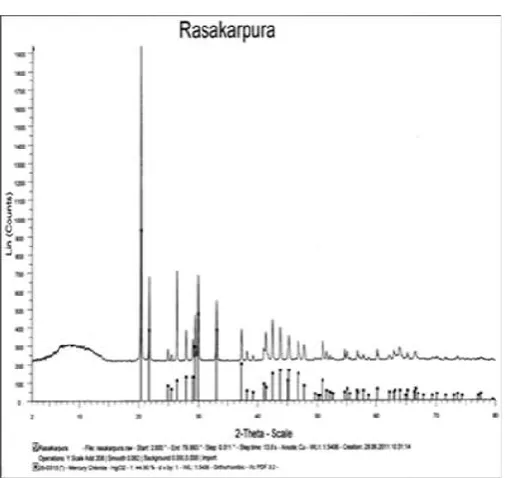
Figure 2. Results & Inferences- Xr-D
Figure 3. Xr-D Lin Counts
Results
The X –ray spectrum obtained was compared to the spectrum
of Hg, HgCl2, As, Pb, Na, Fe, and Mg for their presence. The
tentative assignments were made to the intense peak appearing
at various 2 values. The intense peak at 2=20.364 (100%)
indicates the presence of calcium. The prominent peak
corresponds to HgCl2 24.86 and 26.37 indicate the presence of
Hg as HgCl. And weak signals at 2=43.8 to 45.2 and the
prominent at the 33.12 were assigned to the presence of Na.
weak signals appearing at 2= 52.15 was assigned to Pb, a
weak signal at 2=37.24 was assigned presence of Zn in
traces. The peak corresponds to Hg at 2=23.0, 30 to 31.5, 34
and 36.0 were found missing but a very weak signals appear
2= 43.87, 52.15 with reduced intensity indicates the presence
of traces of Fe and at 2=45.24.
Inference
X-ray diffraction study indicated the presence, HgCl2, Ca Na,
traces of Pb. Ar, Zn, Mg, Fe and almost absence of free Hg. The graphs obtained along with the result readings are attached further.
Figure 4. Xr-D Lin Counts
DISCUSSION
Analytical study brings the standard parameters for the good quality drug. Physicochemical data of the drug help to know how the drug acts in the body. The pH of the sample of
Rasakarpura is 7.24 the PH of the sample if found to be more
nearer to neutral side, normally the drug to be administered should not be either too Acidic or much Alkaline in nature but should be maintained around neutral. The ash value helps us to determine the amount of inorganic substances present in the sample. The value was found to be very less that is 32.84% as a drug is totally inorganic in nature ash value should be more, but this compound containing volatile materials like mercury, sulphur, arsenic and chlorine are will not be stable at the
temperature of 4500 C. The percentage of acid insoluble ash
[image:4.595.39.292.350.589.2]presence, HgCl2, Ca, Na, traces of Pb, Ar, Zn, Mg, Fe and
almost absence of free Hg.
CONCLUSION
Rasakarpura is white colour, crystalline, structure with characteristic odour, PH of Rasakarpura is 7.24, Particle size Rasakarpura is 18 micron to 31 micron which facilitate better
absorption in body. X-RD Reveals presence of HgCl2 as a
main constituent along with other Trace elements
REFERENCES
1. Acharya Dundukanatha, Rasendra Chinthamani, siddhi
pradha commentary by Dr. S.N.Mishra, 1st edition-2000, Chaukhambha orientalia, Varanasi, pp-395, pg.no.-.15.
2. Vaidya Bhajandas Swamy Dadupantha, Rasa Darpana,1st
volume,3rdedition-1982, Chaukhambha Publications, New Delhi,pp-424, pg.no.- 138-144.
3. Acharya Shri Madhava, Ayurveda Prakasha, Arthavidyatini
& Artha Prakasini hindi commentary by shri Gulraj Sharma Mishra & Pandit Shiv Sharma,edition-1999, Chaukhambha Bharati Academy,Varanasi,pp-504, pg.no.-108.
4. Siddhinandan Mishra, Ayurvediya Rasashastra, Varanasi,
Choukhamba orientalia, 9th edn. 200pp620 pg no-208.
5. Block, Roche, sonie, inorganic, Medical and
Pharmaceutical Chemistry, 1st edition, Bombay, vargees
Publishing House.pp 472, page no.236
6. Block, Roche, sonie, inorganic, Medical and
Pharmaceutical Chemistry, 1st edition, Bombay, vargees
Publishing House.pp 472, page no.240
7. Chatwal- Anand, Instrumental methods of chemical
analysis, 13th Edition, Delhi, Himalaya Publishing house,
1997, 21st Chapter, 455-466pp.
8. S.B. Gokhale, Dr. C.K. Kokkate, A.P Purohit, A text book
of Pharmacognosy, 14h edn, Nirali Prakashan, 2002, Chapter 1, P. 58-60.
9. Ayurvedic Pharmacopeia of India, Controller of
Publication, Delhi, 1985, Vol-II, (A-122, 124, 137) Edition-III.
10.Dr.D.R.Lohar, Quality Control Manual for Ayurvedic,
Siddha, & Unani medicine, edition 2008, Government of India, Department of AYUSH, Ministry of Health & Family Welfare, Pharmacopoeial Laboratory For Indian
Medicine, Ghaziabad.pp-71, Pg. no.-46