149
ANTECEDENTS AND CONSEQUENCES OF EWOM IN
SOCIAL COMMERCE
1SAHABI Y. ALI , 2AB RAZAK CHE HUSSIN, 3MASITAH GHAZALI
1,2Universiti Teknologi Malaysia, Department of Information Systems, Malaysia
1Ahmadu Bello University, Department of Computer Science, Nigeria
3Universiti Teknologi Malaysia, ViCubeLab Research Group, Malaysia
E-mail: 1[email protected], 2[email protected], 3[email protected]
ABSTRACT
As a business paradigm, social commerce (s-commerce) has brought about a new stage of innovation, and by extension, has transmuted the power from sellers to buyers. S-commerce is an integration of transactional and social activities, in which, individuals may spread word of mouth (WOM) about their shopping experiences, knowledge, as well as providing information about product and services to their friends. This kind of social interactions among individuals has increased the potentials of eWOM communication. Most of the studies in relation to eWOM happen to be fragmented as they consider either the antecedents or consequences of eWOM leading to conflicting results especially in s-commerce. The present study aims to look into the antecedents and consequences of eWOM in s-commerce from different literatures and aggregate them into a comprehensive model to guide future research. This study will help managers and practitioners to understand the antecedents and consequences of eWOM communication, and it will also spur the research community to delve into more research in order to investigate other drivers as well as consequences of eWOM communication in s-commerce.
Keywords: eWOM, Social commerce, Social media, Purchase intention, Antecedents, Consequence
1. INTRODUCTION
Consumers, at present, have the tendency to exchange their sentiments and encounters about products between each other and this is alluded to as Word of mouth (WOM)[1]. WOM refers to somebody's casual opinion about products and brands from his/her experience of using them [2]. Notably, the communication among buyers may happen physically or by separation and due to its significance in marketing for quite some time, it has been referred to as a substitute to conventional communication tools, and also has an exceedingly influential asset [3]. With the advent of internet, the impact of WOM has become even more prominent [4]–[7].The internet has grown astronomically in the past few years, maximizing its reach and cross-industry impact [8]. Moreover, the evolution of the social web has changed the internet into a collaborative setting, especially given the introduction of social media, in which consumers can connect and create content online [9]. Through social media, customers are now at liberty to create and share consumption experience among peers. This shared information is referred to as Electronic
Word of Mouth (eWOM) and is defined as any positive or negative statement made by potential, actual, or former customers about a product or company, which is made available to a multitude of people and institutions via the internet [5].eWOM can be created by both consumers and merchants. Consequently, they are alluded to as user generated content and marketer-generated content respectively. Merchants impart their content by means of organization-controlled sites, while consumers spread their content through social media sites [10]. eWOM conversations among consumers in s- commerce often revolves around brands [11]; and hence, they are naturally expected to have a strong impact in influencing consumers’ behaviour [12].Recent empirical studies have shown that effective collaboration in the form of WOM is a necessary condition for the success of s-commerce [13].
150 purchase online after consulting online customers’ reviews. Due to these enormous potentials of eWOM, researchers are now showing great interest in eWOM; in which considerable amount of research relating to eWOM has been carried out [10], [15]. With the ever growing market competition in commerce, eWOM information has transformed into an effective tool in moulding consumers’ attitudes and behaviours [16].
Nowadays, e-commerce companies engage or interact with their customers to get informed feedbacks on their product [17]. This engagement marks the evolution of a new form of business model which is called s-commerce [18], [19]. S-commerce is defined as an evolution of e-commerce, in which, social interaction is the hallmark of this mechanism and consumers are encouraged to create content using social media [20]. In s-commerce, the sellers ultimate aim is to transform consumers into brand advocates, whereas the buyers aim is to make better informed purchasing decisions [21]. It is found that by 2021, nearly 50% of the U.K consumers’ population will be involved in s-commerce [22]. With the huge potential associated with s-commerce, research in this field appears to be as wide open as the phenomena itself [23].
Previous studies have looked into the antecedents or drivers of eWOM [24], [25] and the consequence or influence of eWOM [26], [27] in s-commerce. However, most of these studies happen to be fragmented as they consider different approaches and obtain contradicting results. For this reason, this study brings to fore the antecedents and consequences of eWOM in s-commerce to bridge the knowledge gap concerning the drivers and consequence of eWOM communication by building a comprehensive model using all factors from the reviewed literature.
2. SOCIAL COMMERCE AND EWOM
With the recent development observed in Web 2.0 and online networking, e-commerce firms have now began to coordinate new innovations on their sites with the aim of providing their customers with more social and engaging shopping experience [28], [29]. The growing proliferation of social media has given consumers the opportunity to continuously participate in online discussions of various kind and to actively disseminate their unique experiences and divergent views on product [30]. One of the rationales in s- commerce is that social media is capable of benefitting commercial transactions of merchants by means of establishing effective customer interactions, improving the
nature of that interaction among consumers to the businesses [9]. Consumers have reportedly realized that social media is an appealing platform for sharing divergent views and unique consumption experiences with companions and associates [31], [32] using eWOM. eWOM is a major determinant of consumer behavior [33]. S-commerce encourages the collaborative strength which relies on information sharing that is capable of helping consumers to make informed decisions and fulfills customers’ need at the same time[34]. Some of the recent studies have indicated that consumers progressively perceive social media as an aspect of s-commerce with an end goal of acquiring information about new brands on the market[35]– [37]. Consumers may therefore have access to social knowledge and experiences with the help of s-commerce that lead them to better understand their purchasing purposes, and better still, make more informed and accurate decisions [38]. Such interactions have shaped s-commerce which in turn enhance creativity [39] and led to increased sales for merchants [20].
3. METHODOLOGY
In an attempt to realize the aim of this study, we use the systematic literature review (SLR) approach. SLR is referred to as a process of identifying, evaluating, and interpreting all available research relevant to research questions, area of study, or rising phenomenon of interest [40]. Analyzing previous studies is an important endeavor in all disciplines [41]. A sound literature study should; systematically consider quality literature; provide a basis any research; indicate the novelty of the research work, and also suggest future research attractions and benefits [42], [43]. The present study employs the approach proposed by [40]. According to [40], an SLR activity revolves around three phases: Planning the Review, Conducting the Review and Reporting the Review. In all phases there are predefined tasks.
The ultimate aim of the present study is to answer the research question stated below:
RQ1. What are the antecedents or drivers of eWOM information in s-commerce?
RQ2. What are the consequences of eWOM information in s-commerce?
RQ3. What is the suitable research model for eWOM information in s-commerce?
3.1 Review Protocol
151
tends to reduce the possibility of researcher bias [44]. According to [44], the components of a protocol include all the elements of the review plus some additional planning information: Background, Research questions, Search strategy, Study selection process, Quality assessment, Data extraction, and Synthesis of the extracted data. The protocol for this study is as presented in Figure 1.
Figure 1: Review Protocol
………
………
………
Identifying research questionsRQ1. What are the antecedents or drivers of eWOM
information in s-commerce?
RQ2. What are the consequences of eWOM information in
s-commerce?
RQ3. What is the suitable research model for eWOM
information in s-commerce?
Search strategy
Automatic search using keywords
Exclude studies based on exclusion and inclusion criteria
Exclude duplicated studies using Mendeley
ACM Library, AISeL, IEEE Explorer, EbscoHost, Taylor and Francis, emeraldInsight, ISI Web of Knowledge, ScienceDirect, Scopus, and ThomasReuters Web of Science Stage one
Stage two
Keywords: s-commerce, eWOM, online WOM, e-commerce, consumer review
Exclusion and inclusion criteria
articles count
Manual search using forward and backward technique on primary paper references
Apply quality assessment
Results: primary studies articles count articles count
Results: primary studies
Results: primary studies
Data extraction
Synthesis of extracted data
152 3.2 Inclusion and Exclusion Criteria
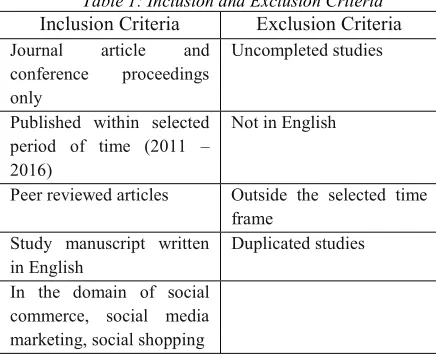
In carrying out any literature review there is the need to ensure the relevance of the of the reviewed articles to the problem at hand. In this study we use this technique to ensure quality and relevance of the articles. Given that the ultimate aim of this study is to examine the antecedents and consequences of EWOM in s-commerce, consideration is giving to journal articles, conferences and book chapters written in English language. Table 2 presents the criteria for the inclusion and exclusion technique employed in this study.
Table 1: Inclusion and Exclusion Criteria
Inclusion Criteria Exclusion Criteria
Journal article and
conference proceedings only
Uncompleted studies
Published within selected period of time (2011 – 2016)
Not in English
Peer reviewed articles Outside the selected time frame
Study manuscript written in English
Duplicated studies
In the domain of social commerce, social media marketing, social shopping
3.3 Search Strategy
The search strategy employed in this study involves two phases: automatic and manual phase. The primary studies were identified in the automatic phase. Some renowned online databases were considered to retrieve a wide range of publications. According to Webster and Watson 2002, a researcher should not constrain his search process to certain journals. The online databases used are: ACM Digital Library, AIS eLibrary, IEEE Explorer, ISI Web of Knowledge, ScienceDirect, Scopus, and ThomasReuters Web of Science. To carry out the automatic search, keywords were also used in the search process. The keywords used are: “eWOM”, “electronic word of mouth”. “Word of mouth”, “online review”, “world of mouth”, “online recommendations”, “social commerce”, “online shopping”, “social e-commerce” and “social business”. The second phase involves the manual search. The researcher uses the backward and forward search method to obtain the citations of the selected studies [41]. Mendeley reference manager tool was employed to synthesize the retrieved articles and remove all duplicates.
3.4 Study Selection Process
With a well structured search strategy
completed, the study selection process takes center stage. This step indentifies related studies to the present study. The result of the initial search produces 270 literatures. Mendeley was used to remove duplicates after which we ended up with 230 articles. The inclusion and exclusion criterion is then applied on both abstract and conclusion from which we eliminate 91 articles, leaving us with 139 studies. From this point full-text scanning was used for the entire study. Finally, the quality assessment criteria is applied, were additional (15) articles are removed leaving the researcher with a total of 124 studies as the primary study.
3.5 Quality Assessment
After the inclusion exclusion criteria, it is significant to evaluate the quality of the selected articles [44]. In carrying out quality assessment, researchers’ judgment must be based on some quality criteria. These criteria could be, a set of factors or questions which are considered on every article [40], [45]. In this study we develop five QA criteria to evaluate the quality of every article: QA1.Does the topic of the article corresponds to eWOM, s-commerce?
QA2.Does the article address eWOM, s-commerce? QA3.Does the researcher(s) effectively present the methodology in the article?
QA4.Does the researcher(s) effectively present the steps in collecting data?
QA5. Is the analysis well presented in the article?
3.6 Inclusion and Exclusion Criteria
[image:4.612.85.303.248.425.2]A data extraction form is developed at this stage to help gather relevant information from the selected literature. The extraction process is carried out using two tools: Mendeley and Microsoft Excel spreadsheet. Several columnswerecreated in excel in the extraction stage: authors, title, journal type, issue, methodology, context, theory, results/findings, limitations, recommendation, citation count, and year of publication. These items are described in Table 2.
Table 2: Data Extraction Columns
Extracted Data Description
Authors Name of the authors
Title The name of the paper
Journal type The name of the journal
Issue Volume, page number, issue
number
Methodology Quantitative, Qualitative, or Mixed Method
Context The domain of the study
Theory Theory adopted by the paper.
153
Results/Findings The outcome of the research
Limitations Weaknesses in the paper
Recommendation Request for future research Citation count Number of citation by other
authors
Year of publication The year it is published
3.7 Publication Sources
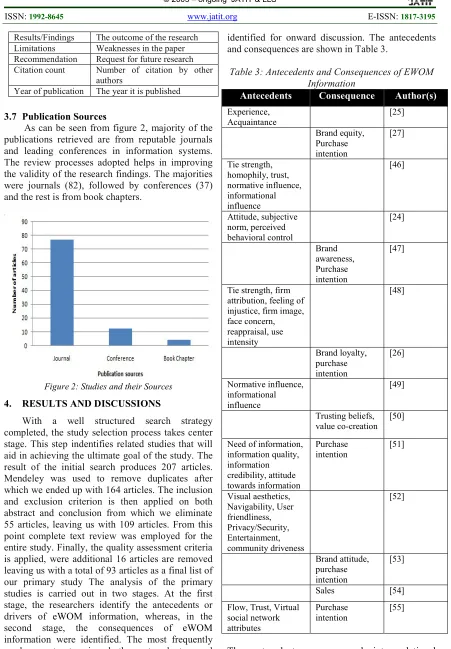
[image:5.612.86.537.62.711.2]As can be seen from figure 2, majority of the publications retrieved are from reputable journals and leading conferences in information systems. The review processes adopted helps in improving the validity of the research findings. The majorities were journals (82), followed by conferences (37) and the rest is from book chapters.
Figure 2: Studies and their Sources
4. RESULTS AND DISCUSSIONS
With a well structured search strategy completed, the study selection process takes center stage. This step indentifies related studies that will aid in achieving the ultimate goal of the study. The result of the initial search produces 207 articles. Mendeley was used to remove duplicates after which we ended up with 164 articles. The inclusion and exclusion criterion is then applied on both abstract and conclusion from which we eliminate 55 articles, leaving us with 109 articles. From this point complete text review was employed for the entire study. Finally, the quality assessment criteria is applied, were additional 16 articles are removed leaving us with a total of 93 articles as a final list of our primary study The analysis of the primary studies is carried out in two stages. At the first stage, the researchers identify the antecedents or drivers of eWOM information, whereas, in the second stage, the consequences of eWOM
information were identified. The most frequently used constructs in both antecedents and consequences of eWOM information were
identified for onward discussion. The antecedents and consequences are shown in Table 3.
Table 3: Antecedents and Consequences of EWOM Information
Antecedents Consequence Author(s)
Experience,
Acquaintance [25]
Brand equity, Purchase intention
[27]
Tie strength, homophily, trust, normative influence, informational influence
[46]
Attitude, subjective norm, perceived behavioral control
[24]
Brand awareness, Purchase intention
[47]
Tie strength, firm attribution, feeling of injustice, firm image, face concern, reappraisal, use intensity
[48]
Brand loyalty, purchase intention
[26]
Normative influence, informational influence
[49]
Trusting beliefs, value co-creation
[50]
Need of information, information quality, information credibility, attitude towards information
Purchase intention
[51]
Visual aesthetics, Navigability, User friendliness, Privacy/Security, Entertainment, community driveness
[52]
Brand attitude, purchase intention
[53]
Sales [54]
Flow, Trust, Virtual social network attributes
Purchase intention
[55]
154 influence and acquaintance), technical factors(Visual aesthetics, Navigability, User friendliness, Privacy/Security, Entertainment), information characteristics(information quality, information credibility), individual characteristics(experience) and consumer behavior(community driveness, need of information, attitude towards information, perceived behavioral control, self enhancement, normative influence, subjective norm ).
4.1 Proposed Model
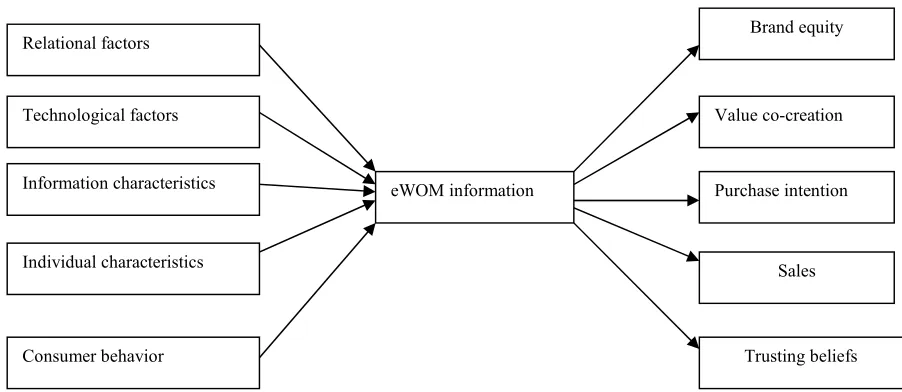
This study proposes a comprehensive model for all antecedents and consequences of eWOM in s-commerce as shown in figure 2. It elaborates on the different aspects that should be considered while investigating the antecedents as well as possible consequence of eWOM in s-commerce.
4.2 Antecedents
Several factors have been considered to serve as antecedents of eWOM in the literature by the research community. We choose the most frequently occurring antecedents and discuss in details below.
4.2.1 Experience
Experience is defined as displaying some level of recognition with a specific item, that is achieved with some form of interaction [25]. It also serves as prior knowledge of consumers about the consumption of a particular product making it a close correlate of consumer expertise [56]. This experience makes consumers to create and share content with other consumers, and such conversation revolves around brands [11]; and
hence, they are posited to have a strong impact in influencing consumers’ behavior [12]. This impact also increases with the expertise of the eWOM source.
[image:6.612.87.538.309.505.2]Generating a higher level customer experience appears to be the ultimate aim of present day etailers [57]. Consumers’ experience according to [25] plays a key in influencing eWOM engagement of s-commerce users. Experienced consumers attain enhanced cognitive capital due to their lengthy engagement with a product or service and their ability to apply (as well as generate) useful information, applications and tacit norms [25].
Figure 3: Proposed EWOM Model
Potentials customers tend to depend so much on the experience of the existing customer in making their purchase decision as eWOM information is considered more credible than traditional advertisement [58]. This is because experienced individuals are more likely to post meaningful, credible, useful and attractive content online [59], [60], which is more likely, in turn, to engage and attract new users [61]. For this reason, consumers experience is a significant antecedent of eWOM information.
4.2.2 Acquaintance
Acquaintance is defined as the sum of direct active contacts between the sender and the audience reached by a post. The greater the level of acquaintance the more effective the message as more and more members will want to mimic the Information characteristics
Relational factors
Technological factors
Consumer behavior Individual characteristics
eWOM information Purchase intention Brand equity
Value co-creation
Sales
155 behavior of an acquaintance given that market is now emotionally driven. The greater the size of acquaintances a customer has, the more the opportunity for mimicking and responding. For this reason, observing and mimicking acquaintances will increase the likelihood of eWOM generation and sharing in s-commerce [25]. Prior acquaintance with the sender results in selection bias owing to the abundance of online cues and information an individual is surrounded with, which offers some degree of connectedness as compared to, say, a stranger, and is therefore able to mitigate source uncertainty over the content [62], [63]. Acquainted individuals are relatively more interested in each other and share an increased chance to reciprocate with each other. Interestingly, [25] considers acquaintance with members as a key determinant of eWOM engagement in s-commerce.
4.2.3 Attitude
Attitude towards eWOM information is referred to over-all effect of favorable or unfavorable disposition towards eWOM information which is not connected to particular event of fulfillment [24]. It is also referred to as a learned inclination to consistently exhibit favourable or unfavourable disposition towards a certain object or behaviour [64]. Attitude towards information is an effective driver of eWOM information in s-commerce. Prior to sharing their views online, consumers are always careful about the consequences of that behavior. For this reason, consumers with positive attitude towards eWOM information are likely to share their views in s-commerce platforms and vice versa. Therefore, attitude has been proven to be among the antecedents of eWOM information.
4.2.4 Subjective Norm (SN)
SN can be defined as the influence of significant others on the behavioral choice of an individual. This is considered as affecting the willingness of consumers to generate and share content with other consumers as this may affect their social standing in the community. Some people do not want to be seen as nuisance or opinion leaders in their community. Normative influence is also identified as an important driver of eWOM behavior. Also, consumers do not want to express their negative experience about any product or service in an online platform because those comments can easily be traced back to the authors [65]. Therefore, subjective norm is considered a factor that affects eWOM information in s-commerce.
4.2.5 Perceived Behavioral Control (PBC)
PBC is an individual’s consideration of the ease or difficulty of carrying out a certain behavior. When consumers considers the creation and sharing on content online as fun, easy and free from effort they tend to embrace that culture. Conversely, if the sharing of information is considered as a burden or difficult, then consumers will most likely refuse to engage in eWOM conversation. Empirical evidence have shown that the integration of PBC in the Theory of Planned Behavior (TPB) model has had a great impact on the prediction of behavioral intentions [66]. Therefore, PBC is considered as an antecedent of eWOM information in s-commerce.
4.2.6 Navigation
Navigation alludes to the navigational plan used to help or frustrate users as they access various segments of a website [67]. Every activity within a social shopping website is controlled by its navigational aspect. It is expected that companies will design their websites to simulate real life shopping navigation that will provide an ultimate affordance for both potential and existing customers alike. When consumers considers the navigational aspect of a shopping website as user friendly, they tend to be glued towards the site, thereby sharing valuable consumption experiences with other potential customers. Hence, the need to give priorities to the navigational aspect of s-commerce website in the design phase, which has been shown to be an antecedent eWOM.
4.3 Consequence
The consequence of eWOM has long been established in the literature. It is believed that eWOM information influences consumers behavior such as brand equity [27], purchase intention [68]– [70] etc. Brand equity can be argued to encompass all the other constructs related to brand. The researcher chooses purchase intention as it appears more frequently and the other factors leads to it in the reviewed literature in addition to brand awareness, brand equity, and value co-creation to elaborate on them.
4.3.1 Brand Equity
156 perceptions [72]. eWOM is believed to strongly influence consumers behavior as the communication mostly relates to brand. Most of the literature considers brand equity as an added value that a brand name place on a product [73]. Being that eWOM originates from individuals with consumption or usage experience about a particular product, it provides credible and reliable information for potential consumers as regards to brands[74]. For this reason, eWOM affects brand equity through its ability to effectively mould customers’ interactions with a particular brand [75]. Therefore, brand equity is considered as a consequence of eWOM communication in s-commerce.
4.3.2 Purchase Intention
Purchase intention is widely considered as a predictor of actual purchase [76] as it represents the likelihood that an individual will purchase a particular product[77]. It is also acknowledged that eWOM information influences consumers’ purchase intention [68]–[70]. Consumers purchase decision making process follow three stages and they are: requirement cognition, information gathering and the purchase behavior[78]. Additionally, the literature confirms that purchase intention occurs as a direct consequence of eWOM[79]. Nowadays, consumers tend to go in search of information that would guide and reduce their anxiety as it relates to purchasing[80]. Thus, eWOM is found to exert a significant influence on purchase intention.
4.3.3 Value Co-creation
Co-creation behaviour is delineated as a joint, shared, simultaneous, peer-like process of producing value, both tandibly and symbolically [81] and comprises dimensions such as physical and/or psychological participation [82]. It also implies a pro-active strategy for empowering firms to create value through co-opting consumer skills [83]. In the traditional settings there is lack of direct customer involvement or knowledge of customer needs as they are considered outside the value creation chain. Consumers play the part of ‘validators’, remain detached amid design, and were used as test-subjects for exchanging information with designers to enhance the functionality and usefulness of products [83].This epitomized the individual nature of firms in value creation as they are considered as producing agents while consumers are labeled consumption agents. These consumers have no role in the value creation
process. Then come the era of the social web were consumers have become active stakeholders in devising solutions to pressing problems rather than being passive in the whole value chain. In this approach, the ‘single-inventor perspective’ is replaced by a knowledge flow (inflow and outflow) process between stakeholders as partners [84]. Products, services and experiences are developed jointly by companies and their customers [85], [86] through collaboration that extends beyond organizational boundaries and integrates entities external to the firm [87]. As indicated by service-dominant logic, customers are seen as members of the value creation chain instead of passive receivers of value [88]. Research reveals that consumers partake in co-creating value with employees, other consumers, and the setting [89]–[91]. Consumers who participate in creating value in the consumption process are shown to be more satisfied than passive agents [82], [92]. Armed with various tools, consumers no longer accept whatever firms pass on to them as they are now spoilt with alternatives, they now want to collaborate and create value. Nowadays, firms have realized the strength of these consumers as they have become more knowledgeable and wield enormous power; as a result these firms have co-opted their customers into the value creation process. For example, some firms set out competitions for consumers to propose the best design for their next product. The firm chooses the best of designs presented by the consumers and incorporate it into their initial design process thereby meeting consumer’s needs and increasing return of investment. By adopting a collaborative approach in a value creation process to capture customer needs, companies will remain competitive based on differentiation achieved through knowledge of customer needs and cost leadership that understands and minimizes costs associated with product-life cycles and new product development [93], [94]. As eWOM is a manifesto form of consumers’ engagement or collaboration, it has been shown that eWOM has a direct impact on value co-creation.
4.3.4 Brand Awareness
157 means through which individuals become informed and accustomed with a brand name and recall and recognize the brand [96]–[98]. It is also one's active and passive knowledge of a particular brand [99]. eWOM is a veritable source of brand awareness and also a vital tool for a firm’s success. Firms that incorporate eWOM as a marketing tool are more competitive and vice versa [100]. eWOM help in disseminating this form of knowledge about brand to potential consumers thereby increasing bridging their knowledge gap about such brand. Earlier, companies devote so much of their resources to advertisements which cost a huge fortune but provide less return on investment compared to the free eWOM communication. This is because customers complaint of information asymmetry and distrust towards the message passed by the advertisers. Brand awareness is very likely to contribute to customers perception of price fairness due to the level of awareness of the consumer [101]. Several studies have examined the influence of eWOM on brand awareness [36], [47], [102]. Brand awareness affects consumer attitude towards reviews and recommendations. Thus, it is believed that eWOM would have a positive impact on brand awareness.
5. CONCLUSION AND FUTURE WORK
Most of the studies considered in this research were conducted using different approach and also obtain varying results. The ultimate goal of the present study is to create a better understanding of the antecedents as well as the consequences of eWOM in s-commerce. With guidelines derived from SLR, the study presents several antecedents and consequences of eWOM information that if considered will improve consumer participation in eWOM information as well as increase firms’ profit.
This study enhances the body of knowledge by showcasing key factors that affects eWOM information as well as its impact. The proposed model will guide managers and practitioners on the various aspects to consider when encouraging consumers to engage in eWOM information. In the future, more constructs can be investigated to improve the understanding of eWOM information in s-commerce.
ACKNOWLEDGEMENT
This work is supported by the Malaysia Ministry of Higher Education (MOHE) and Research Management Centre (RMC) at the Universiti Teknologi Malaysia (UTM) under the Research
University Grant Category (VOT
Q.J130000.2528.16H49).
REFERENCE:
[1] J. Arndt, “Role of Product-Related Conversations in the Diffusion of a New Product,” J. Mark. Res., vol. 4, no. 3, p. 291, 1967.
[2] S. Sen and D. Lerman, “Why are you telling me this An examination into negative consumer reviews on the web,” J.
Interact. Mark., vol. 22, no. 4, pp. 1–12,
2007.
[3] M. Trusov, R. E. Bucklin, and K. Pauwels, “Effects of word-of-mouth versus traditional marketing: Findings from an Internet social networking site,” J. Mark., vol. 73, no. 3, pp. 90–102, 2008.
[4] B. Bickart and R. M. Schindler, “Internet Forums As Influential Sources of Consumer Information,” J. Interact. Mark., vol. 15, no. 3, pp. 31–40, 2001.
[5] T. Hennig-Thurau, K. P. Gwinner, G. Walsh, and D. D. Gremler, “Electronic word-of-mouth via consumer-opinion platforms: What motivates consumers to articulate themselves on the Internet?,” J. Interact. Mark., vol. 18, no. 1, pp. 38–52, 2004.
[6] M. Lee and S. Youn, “Electronic word of mouth (eWOM): How eWOM platforms influence consumer product judgement,”
Int. J. Advert., vol. 28, no. 3, pp. 473–499,
2009.
[7] T. Sun, S. Youn, G. Wu, and M. Kuntaraporn, “Online word-of-mouth (or mouse): An exploration of its antecedents and consequences,” J. Comput. Commun., vol. 11, no. 4, pp. 1104–1127, 2006. [8] C. Kim, R. D. Galliers, N. Shin, J. H. Ryoo,
and J. Kim, “Factors influencing Internet shopping value and customer repurchase intention,” Electron. Commer. Res. Appl., vol. 11, no. 4, pp. 374–387, 2012.
[9] M. N. Hajli, “The role of social support on relationship quality and social commerce,”
Technol. Forecast. Soc. Chang., vol. 87, pp.
17–27, 2014.
[10] C. M. K. Cheung and D. R. Thadani, “The impact of electronic word-of-mouth communication: A literature analysis and integrative model,” Decis. Support Syst., vol. 54, no. 1, pp. 461–470, 2012.
158 electronic word of mouth communication through social media platforms,” J. Mark.
Manag., vol. 29, no. 5–6, pp. 562 – 583,
2013.
[12] X. Wang, C. Yu, and Y. Wei, “Social Media Peer Communication and Impacts on Purchase Intentions: A Consumer Socialization Framework,” J. Interact.
Mark., vol. 26, no. 4, pp. 198–208, 2012.
[13] Y. Wang and C. Yu, “Social Interaction-based Consumer Decision-making Model in Social Commerce : The role of word of mouth and observational learning,” Int. J.
Inf. Manage., 2015.
[14] eMarketer, “Online review sway shoppers,”
2008. [Online]. Available:
http://www.ccsenet.org/journal/index.php/ij ms/article/viewFile/18487/13453.
[15] R. A. King, P. Racherla, and V. D. Bush, “What we know and don’t know about online word-of-mouth: A review and synthesis of the literature,” J. Interact.
Mark., vol. 28, no. 3, pp. 167–183, 2014.
[16] H. Shih, K. Lai, and T. C. E. Cheng, “Informational and Relational Influences on Electronic Word of Mouth: An Empirical Study of an Online Consumer Discussion Forum,” Int. J. Electron. Commer., vol. 17, no. 4, pp. 137–166, 2013.
[17] N. Hajli, X. Lin, and M. S. Featherman, “Social word of mouth How trust develops in the market,” Int. J. Mark. Res., vol. 56, no. 3, pp. 387–404, 2014.
[18] D. Saundage and C. Y. Lee, “Social commerce activities – a taxonomy,” in ACIS 2011: Identifying the Information Systems Discipline: Proceedings of the
22nd Australasian Conference on
Information Systems, 2011.
[19] M. Shanmugam, S. Sun, A. Amidi, F. Khani, and F. Khani, “The applications of social commerce constructs,” Int. J. Inf.
Manage., vol. 36, no. 3, pp. 425–432, 2016.
[20] N. Hajli and J. Sims, “Social commerce: The transfer of power from sellers to buyers,” Technol. Forecast. Soc. Change, vol. 94, pp. 350–358, 2015.
[21] A. M. Kaplan and M. Haenlein, “Users of the world, unite! The challenges and opportunities of Social Media,” Bus. Horiz., vol. 53, no. 1, pp. 59–68, 2010.
[22] Barclays, “Social Commerce: The next generation of retail,” 2012.
[23] K. Siau and J. Erickson, “The rise of social commerce,” J. Database Manag., vol. 22,
no. 4, pp. 1–7, 2011.
[24] J. R. Fu, P. H. Ju, and C. W. Hsu, “Understanding why consumers engage in electronic word-of-mouth communication: Perspectives from theory of planned behavior and justice theory,” Electron.
Commer. Res. Appl., vol. 14, no. 6, pp.
616–630, 2015.
[25] A. Rossmann, K. R. Ranjan, and P. Sugathan, “Drivers of user engagement in eWoM communication,” J. Serv. Mark., vol. 30, no. 5, pp. 541–553, 2016.
[26] B. K. P. D. Balakrishnan, M. I. Dahnil, and W. J. Yi, “The Impact of Social Media Marketing Medium toward Purchase Intention and Brand Loyalty among Generation Y,” Procedia - Soc. Behav. Sci., vol. 148, pp. 177–185, 2014.
[27] J. Beneke, S. de Sousa, M. Mbuyu, and B. Wickham, “The effect of negative online customer reviews on brand equity and purchase intention of consumer electronics in South Africa,” Int. Rev. Retail. Distrib.
Consum. Res., vol. 26, no. 2, pp. 171–201,
2016.
[28] T. Friedrich, “Analyzing the Factors that Influence Consumers ’ Adoption of Social Commerce – A Literature Review,” in Twenty-first Americas Conference on
Information Systems, 2015, pp. 1–16.
[29] R. G. Curty and P. Zhang, “Social commerce: Looking back and forward,” Proc. Am. Soc. Inf. Sci. Technol., vol. 48, no. 1, pp. 1–10, 2011.
[30] C. M. K. Cheung, B. S. Xiao, and I. L. B. Liu, “Do actions speak louder than voices? the signaling role of social information cues in influencing consumer purchase decisions,” Decis. Support Syst., vol. 65, pp. 50–58, 2014.
[31] R. V. Kozinets, K. Valck, A. C. Wojnicki, and S. J. . Wilner, “Networked Narratives: Understanding Word-of-Mouth Marketing in Online Communities,” J. Mark., vol. 74, no. 2, pp. 71–89, 2010.
[32] G. Moran and L. Muzellec, “eWOM credibility on social networking sites: A framework,” J. Mark. Commun., pp. 1–13, 2014.
[33] T. Liang and E. Turban, “Introduction to the special issue social commerce: A research framework for social commerce,”
Int. J. Electron. Commer., vol. 16, no. 2,
pp. 5–14, 2011.
159 Tsydypov, “What drives electronic word-of-mouth on social networking sites? Perspectives of social capital and self-determination,” Telemat. Informatics, vol. 33, no. 4, pp. 1034–1047, 2016.
[35] C. H. Baird and G. Parasnis, “From social media to social customer relationship management,” Strateg. Leadersh., vol. 39, no. 5, pp. 30–37, 2011.
[36] A. A. Barreda, A. Bilgihan, K. Nusair, and F. Okumus, “Generating brand awareness in Online Social Networks,” Comput.
Human Behav., vol. 50, pp. 600–609, 2015.
[37] K. Goodrich and M. de Mooij, “How ‘social’ are social media? A cross-cultural comparison of online and offline purchase decision influences,” J. Mark. Commun., vol. 20, no. 2, pp. 1–14, 2013.
[38] B. Lu, W. Fan, and M. Zhou, “Social presence , trust , and social commerce purchase intention : An empirical research,”
Comput. Human Behav., vol. 56, pp. 225–
237, 2016.
[39] R. Cachia, R. Compano, and O. Da Costa, “Grasping the potential of online social networks for foresight,” Technol. Forecast.
Soc. Change, vol. 74, no. 8, pp. 1179–1203,
2007.
[40] B. Kitchenham and S. Charters, Guidelines for performing Systematic Literature
reviews in Software Engineering, vol. 45.
2007.
[41] J. Webster and R. T. Watson, “Analyzing the Past to Prepare for the Future : Writing a Literature Review,” MIS, vol. 26, no. 2, pp. xiii–xxiii, 2002.
[42] M. Chiasson, M. Germonprez, and L. Mathiassen, “Pluralist action research: A review of the information systems literature,” Inf. Syst. J., vol. 19, no. 1, pp. 31–54, 2008.
[43] J. Dibbern, T. Goles, R. Hirschheim, and B. Jayatilaka, “Information Systems Outsourcing: A Survey and Analysis of the Literature,” SIGMIS Database, vol. 35, no. 4, pp. 6–102, 2004.
[44] B. Kitchenham, Procedures for performing
systematic reviews, vol. 33. 2004.
[45] W. Bandara, S. Miskon, and E. Fielt, “A Systematic, Tool-Supported Method for Conducting Literature Reviews in Information Systems,” in ECIS 2011: Proceedings of the 19th European
Conference on Information Systems, 2011,
pp. 1 – 14.
[46] S. C. Chu and Y. Kim, “Determinants of consumer engagement in electronic Word-Of-Mouth (eWOM) in social networking sites,” Int. J. Advert., vol. 30, no. 1, pp. 47– 75, 2011.
[47] Y. Sharifpour, I. Sukati, M. Noor, and A. Bin, “The Influence of Electronic Word-of-Mouth on Consumers ’ Purchase Intentions in Iranian Telecommunication Industry,”
Am. J. Bus., vol. 5, no. 3, pp. 1–6, 2016.
[48] M. S. Balaji, K. Wei, A. Yee, and L. Chong, “Determinants of negative word-of-mouth communication using social networking sites,” Inf. Manag., vol. 53, no. 4, pp. 528–540, 2016.
[49] L.-C. Hsu, W.-H. Chih, and D.-K. Liou, “Investigating community members ’ eWOM effects in Facebook fan page,” Ind.
Manag. Data Syst., vol. 116, no. 5, pp.
978–1004, 2016.
[50] E. W. K. See-To and K. K. W. Ho, “Value co-creation and purchase intention in social network sites: The role of electronic Word-of-Mouth and trust - A theoretical analysis,” Comput. Human Behav., vol. 31, no. 1, pp. 182–189, 2014.
[51] I. Erkan and C. Evans, “The influence of eWOM in social media on consumers’ purchase intentions: An extended approach to information adoption,” Comput. Human
Behav., vol. 61, pp. 47–55, 2016.
[52] K. Yang, X. Li, H. J. Kim, and Y. H. Kim, “Social shopping website quality attributes increasing consumer participation, positive eWOM, and co-shopping: The reciprocating role of participation,” J.
Retail. Consum. Serv., vol. 24, no. C, pp. 1–
9, 2015.
[53] H. Kim, “A Study on the Effects of eWOM in Social Network Service on the Brand Attitude, Purchase Intentions and Diffusion of eWOM.pdf,” Information. 2015.
[54] N. Amblee and T. Bui, “Harnessing the Influence of Social Proof in Online Shopping:,” Int. J. Electron. Commer., vol. 4415, no. November, pp. 91–114, 2011. [55] M. Mortazavi, M. R. Esfidani, and A. S.
Barzoki, “Influencing VSN users’ purchase intentions The roles of flow, trust and eWOM,” J. Res. Interact. Mark., vol. 8, no. 2, pp. 102–123, 2014.
[56] K. Braunsberger and J. M. Munch, “Source expertise versus experience effects in hospital advertising,” 1998.
160 Parasuraman, A. Roggeveen, M. Tsiros, and L. A. Schlesinger, “Customer Experience Creation : Determinants , Dynamics and Management Strategies,” vol. 85, no. 2007, pp. 31–41, 2009.
[58] E. Qualman, “Socialmonics,” Organ.
znanja, vol. 15, no. 4, pp. 189–192, 2010.
[59] D. Constant, L. Sproull, S. Kiesler, S. O. Science, N. M. Apr, D. Constant, L. Sproull, and S. Kiesler, “The Kindness of Strangers : The Usefulness of Electronic Weak Ties for Technical Advice The Kindness of Strangers : The Usefulness of Electronic Weak Ties for Technical Advice,” vol. 7, no. 2, pp. 119–135, 2017. [60] M. M. Wasko and S. Faraj, “It is what one
does : why people participate and help others in electronic communities of practice,” J. Strateg. Inf. Syst., vol. 9, no. 2, pp. 155–173, 2000.
[61] S. Moldovan, J. Goldenberg, and A. Chattopadhyay, “The different roles of product originality and usefulness in generating word-of-mouth,” Int. J. Res.
Mark., vol. 28, no. 2, pp. 109–119, 2011.
[62] H. S. Bansal and P. A. Voyer, “Word-of-Mouth Processes within a Services Purchase Decision Context,” J. Serv. Res., vol. 3, no. 2, pp. 166–177, 2000.
[63] J. E. Phelps, R. Lewis, L. Mobilio, and D. Perry, “Viral Marketing or Electronic Word-of-Mouth Advertising : Examining Consumer Responses and Motivations to Pass Along Email,” vol. 44, no. 4, 2004. [64] I. Ajzen and M. Fishbein,
“Attitude-behavior relations: A theoretical analysis and review of empirical research,” Psychol.
Bull., vol. 84, no. 5, pp. 888–918, 1975.
[65] I. Riivits-arkonsuo and A. Leppiman, “Consumer online word-of-mouth - analysis through an experience pyramid model,” no. January, pp. 10–13, 2013. [66] I. Ajzen, “The theory of planned behavior,”
Orgnizational Behav. Hum. Decis.
Process., vol. 50, pp. 179–211, 1991.
[67] D. Cyr and C. Bonanni, “Gender and website design in e-business,” Int. J.
Electron. Bus., vol. 3, no. 6, p. 565, 2005.
[68] A. Baber, R. Thurasamy, M. I. Malik, B. Sadiq, S. Islam, and M. Sajjad, “Online word-of-mouth antecedents, attitude and intention-to-purchase electronic products in Pakistan,” Telemat. Informatics, vol. 33, no. 2, pp. 388–400, 2016.
[69] C. W. Chen, W. C. Chen, and W. K. Chen,
“Understanding the effects of eWOM on cosmetic consumer behavioral intention,”
Int. J. Electron. Commer. Stud., vol. 5, no.
1, pp. 97–102, 2014.
[70] M. Mortazavi, M. R. Esfidani, and A. S. Barzoki, “Influencing VSN users’ purchase intentions,” J. Res. Interact. Mark., vol. 8, no. 2, pp. 102–123, 2014.
[71] B. Yoo and N. Donthu, “Developing and validating a multidimensional consumer-based brand equity scale,” vol. 52, 2001. [72] K. L. Keller, “Conceptualizing , measuring
, and managing customer-based brand equity,” 1993.
[73] H. H. Chang and Y. M. Liu, “The impact of brand equity on brand preference and purchase intentions in the service industries,” vol. 2069, no. February, 2009. [74] S. Bambauer-sachse and S. Mangold,
“Journal of Retailing and Consumer Services Brand equity dilution through negative online word-of-mouth communication,” J. Retail. Consum. Serv., vol. 18, no. 1, pp. 38–45, 2011.
[75] J. B. Xu and A. Chan, “A conceptual framework of hotel experience and customer-based brand equity Some research questions and implications,” 2010.
[76] D. Grewal, K. B. Monroe, and R. Krishnan, “The effects of price-comparison advertising on buyers ’ perceptions of acquisi ...,” 1998.
[77] A. O’Cass and K. Lim, “The Influence of Brand Associations on Brand Preference and Purchase Intention The Influence of Brand Associations on Brand Preference and Purchase Intention : An Asian Perspective on Brand Associations,” vol. 1530, no. July, 2002.
[78] Y. Lu, L. Zhao, and B. Wang, “From virtual community members to C2C e-commerce buyers: Trust in virtual communities and its effect on consumers’ purchase intention,” Electron. Commer.
Res. Appl., vol. 9, no. 4, pp. 346–360, 2010.
[79] D. H. Park and J. Lee, “eWOM overload and its effect on consumer behavioral intention depending on consumer involvement,” Electron. Commer. Res.
Appl., vol. 7, no. 4, pp. 386–398, 2008.
161 February, 2010.
[81] M. Galvagno and D. Dalli, “Theory of value co-creation: a systematic literature review,” Manag. Serv. Qual., vol. 24, no. 6, pp. 643–683, 2014.
[82] N. K. Prebensen, H. (Lina) Kim, and M. Uysal, “Cocreation as Moderator between the Experience Value and Satisfaction Relationship,” J. Travel Res., vol. 55, no. 7, pp. 934–945, 2016.
[83] C. Durugbo and K. Pawar, “A unified model of the co-creation process,” Expert Syst. Appl., vol. 41, no. 9, pp. 4373–4387, 2014.
[84] M. Bogers and J. West, “Managing distributed innovation: Strategic utilization of open and user innovation,” Creat. Innov.
Manag., vol. 21, no. 1, pp. 61–75, 2012.
[85] V. Ramaswamy, “Leading the transformation to co-creation of value,” Strateg. Leadersh., vol. 37, no. 2, pp. 32– 37, 2009.
[86] F. S. Visser and V. Visser., “Re-using users Co-create and co-evaluate,” Pers.
ubiquitous Comput., vol. 10, no. 2–3, pp.
148–152, 2006.
[87] M. Sawhney, G. Verona, and E. Prandelli, “Collaborating to create: The internet as a platform for customer engagement in product innovation,” J. Interact. Mark., vol. 19, no. 4, pp. 4–34, 2005.
[88] C. F. Chen and J. P. Wang, “Customer participation, value co-creation and customer loyalty - A case of airline online check-in system,” Comput. Human Behav., vol. 62, pp. 346–352, 2016.
[89] U. S. Grissemann and N. E. Stokburger-Sauer, “Customer co-creation of travel services: The role of company support and customer satisfaction with the co-creation performance,” Tour. Manag., vol. 33, no. 6, pp. 1483–1492, 2012.
[90] N. K. Prebensen and L. Foss, “Coping and co-creating in tourist experiences,” Int. J.
Tour. Res., vol. 13, no. 1, pp. 54–67, 2011.
[91] P. C. Verhoef, W. J. Reinartz, and M. Krafft, “Customer Engagement as a New Perspective in Customer Management,” J.
Serv. Manag., vol. 13, no. 3, pp. 247–252,
2010.
[92] S. Navarro, L. Andreu, and A. Cervera, “Value co-creation among hotels and disabled customers: An exploratory study,” J. Bus. Res., vol. 67, no. 5, pp. 813–818, 2014.
[93] K. Altun, T. Dereli, and A. Baykasogglu, “Development of a framework for customer co-creation in NPD through multi-issue negotiation with issue trade-offs,” Expert
Syst. Appl., vol. 40, no. 3, pp. 873–880,
2013.
[94] H. Wang, Y. Ohsawa, and Y. Nishihara, “Innovation support system for creative product design based on chance discovery,”
Expert Syst. Appl., vol. 39, no. 5, pp. 4890–
4897, 2012.
[95] O. I. Moisescu, “The Importance of Brand Awareness in Consumers’ Buying Decision and Perceived Risk Assessment,” Manag.
Mark., vol. 7, no. 1, pp. 103–110, 2009.
[96] D. Gursoy, J. S. Chen, and C. G. Chi, “Theoretical examination of destination loyalty formation,” Int. J. Contemp. Hosp.
Manag., vol. 26, no. 5, pp. 809–827, 2014.
[97] K. Djakeli and T. Tshumburidze, “Brand Awareness Matrix in Political Marketing Area,” J. Bus., vol. 1, no. 1, pp. 25–28, 2012.
[98] Y. Lin, “Evaluation of co-branded hotels in the Taiwanese market: the role of brand familiarity and brand fit,” Int. J. Contemp.
Hosp. Manag., vol. 25, no. 3, pp. 346–364,
2013.
[99] P. M. Valkenburg and M. Buijzen, “Identifying determinants of young children’s brand awareness: Television, parents, and peers,” J. Appl. Dev. Psychol., vol. 26, no. 4, pp. 456–468, 2005.
[100] R. B. Mason, “Word of mouth as a promotional tool for turbulent markets,” J.
Mark. Commun., vol. 14, no. 3, pp. 207–
224, 2008.
[101] H. Oh, “The Effect of Brand Class, Brand Awareness, and Price on Customer Value and Behavioral Intentions,” J. Hosp. Tour. Res., vol. 24, no. 2, pp. 136–162, 2000. [102] Y. Wang, S. H. Hsiao, Z. Yang, and N.