Available online on www.ijpsr.com 103
IJPSR (2010), Vol. 1, Issue 10 (Research Article)
Received on 23 May, 2010; received in revised form 19 August, 2010; accepted 14 September, 2010
DEVELOPMENT AND EVALUATION OF A DIRECTLY COMPRESSIBLE CO-PROCESSED MULTIFUNCTION SUSTAINED RELEASE AGENT FOR ISOSORBIDE MONONITRATE SUSTAINED RELEASE TABLETS
J. Ayyappan*1, P. Umapathi 1 and Darlin Quine 2
Department of Research and Development, Micro Labs Ltd, 67/68-A, Third Phase, Peenya Industrial Area, Bangalore, Karnataka, India
Department of Biotechnology, Shanmuga Arts, Science, Technology & Research Academy, Thanjavur, Tamil Nadu, India
ABSTRACT
Directly compressible co-processed sustained release multifunction agent [DCCSRA] comprising povidone and glyceryl behenate in the ratio of 1:1, 1:2 and 1:3 were prepared and evaluated for formulation of sustained release tablets of isosorbide mononitrate. The DCCSRA exhibited good flow and compressibility. The DCCSRA, prepared by hot melting method and co-precipitation method served as a retardant, binder and lubricant in isosorbide mononitrate sustained release tablets. The DCCSRA may be used for manufacturing of isosorbide mononitrate sustained release tablets.
Keywords:
Glyceryl behenate, Povidone, Coprocessing, Isosorbide mononitrate, Sustained Release Tablets
Correspondence to Author: J. Ayyappan
Available online on www.ijpsr.com 104
INTRODUCTION: Co-processed excipients are
combinations of two or more excipients that possess performance advantages when compared to a physical mixture of the same combination of excipients. Typically co-processed excipients are produced using some form of specialized manufacturing process and are helpful in achieving the desirable characteristics in a formulation 1-7. This work focuses on the preparation and evaluation of a co-processed excipient comprising povidone and glyceryl behenate. This co-processed excepient is useful as a sustained release matrix forming agent. Glyceryl behenate is mainly used as tablet and capsule lubricant and as tablet binder. It has been used in preparation of sustained release tablets and as matrix-forming agent (above 10 % w/w) for the controlled release of water soluble drugs.
Povidone is used as binder (at a concentration of 0.5% w/w to 5 % w/w) in tablets. It also acts as a solubilizer and enhances the dissolution of poorly soluble drugs from solid dosage forms. The molecular adduct formation of povidone may be used to advantage in slow release solid dosage forms 8. The co-processing of glyceryl behenate with povidone by hot melting method and co- precipitation method leads to formation of a multifunctional excipient which can act as a matrix forming agent, binder and lubricant. This improved functionality of the co-processed excipient may reduce the time and cost of manufacture of sustained release tablets. Since povidone is hydrophilic, the hydrophobicity of glyceryl behenate gets reduced when co-processed with povidone. To check the retention capacity of the DCCSRA, the drug molecule selected need to have a high solubility. For this study, Isosorbide mononitrate was selected as a model drug based on this solubility criterion.
MATERIALS AND METHODS:
Materials: Glyceryl Behenate (Compritol 888),
Povidone K 25, Dicalcium Phosphate Dihydrate (Emcompress), Lactose Monohydrate (Flowlac 100) and diluted Isosorbide mononitrate were received from Micro Labs Ltd. (Bangalore, India).
Methods: The following experimental approach
has been used in this work.
Preparation of physical blend of glyceryl behenate and povidone and evaluation of its flow property.
Preparation of DCCSRAs mixtures of glyceryl behenate and povidone comprising different ratios of the two components by hot melting method and co-precipitation method and evaluation of the flow of the DCCSRAs.
Preparation of the Isosorbide mononitrate sustained release tablets using the DCCSRAs.
Evaluation of the Isosorbide mononitrate release pattern from tablets prepared with DCCSRAs and comparison of the release data with that of reference product [Imnit 60 tablets]
The flow characteristic of the physical blend of glyceryl behenate and povidone has been compared with that of the co-processed excipient. The co-processed excipient was evaluated for its suitability for direct compression of isosorbide mononitrate sustained release tablets.
Preparation of Physical Blend of Glyceryl
behenate and Povidone: Povidone and glyceryl
Available online on www.ijpsr.com 105
agents by Hot melting Method [DCCSRA-HM]: DCCSRA-HMs was prepared by hot melting method. Glyceryl behenate and povidone were passed through 40-mesh sieve and mixed well. This powder mix was transferred into a stainless steel vessel and heated to about 90°C in a water bath with stirring until a smooth paste was formed. In this mix glyceryl behenate melts since its melting range is between 65-77°C. This mass was then cooled to room temperature with intermittent mixing. The mass was then milled in a multimill with 1.5mm screen and passed through 30-mesh sieve and stored in an airtight container till further use. The ratios of the components in the co-processed excipients have been presented in Table 1.
Preparation of Directly compressible co-processed sustained release multifunctional agents by Co-precipitation method
[DCCSRA-CM]: DCCSRA-CMs were prepared by
co-precipitation method. Glyceryl behenate and povidone were passed through 40-mesh sieve and mixed well. This powder mix (50g) was transferred into a beaker containing methylene chloride (250 ml). The contents of the beaker were stirred using a magnetic stirrer to dissolve the powder mix in methylene chloride.
[image:3.612.61.550.383.503.2]The temperature was maintained between 40°C and 45°C, and stirring was continued till most of methylene chloride has been evaporated. The wet coherent mass was granulated through 30-mesh sieve. The wet granules were dried in a tray drier at 45°C for 15 minutes. The dried granules were sifted through 30-mesh sieve and stored in an airtight container till further use. The ratios of the components in the co-processed excipients have been presented in Table 1.
TABLE 1: DCCSRA – RATIO OF THE COMPONENTS
Hot Melting Method
Composition Ratio
Composition-I [DCCSRA-HM-I] Povidone : Glyceryl Behenate [1:1]
Composition-II [DCCSRA-HM-II] Povidone : Glyceryl Behenate [1:2]
Composition-III [DCCSRA-HM-III] Povidone : Glyceryl Behenate [1:3]
Co-precipitation method
Composition-I [DCCSRA-CM-I] Povidone : Glyceryl Behenate [1:1]
Composition-II [DCCSRA-CM-II] Povidone : Glyceryl Behenate [1:2]
Composition-III [DCCSRA-CM-III] Povidone : Glyceryl Behenate [1:3]
Evaluation of Angle of repose:
Angle of repose: For the measurement of angle of repose, a glass funnel was secured with its tip at a given height (H) above a piece of graph paper placed on a horizontal surface. Powder was passed through the funnel until the apex of the conical pile touched through the funnel. The angle of repose was calculated with formula tan α = H/R, where α is the angle of repose and R is the radius of the conical pile. The angle of repose of the physical blend and co-processed excipient
were measured by the above method. The results have been tabulated in Table 2.
TABLE 2: EVALUATION OF FLOW PROPERTY [ANGLE OF REPOSE] FOR THE PHYSICAL BLEND AND DCCSRA
Composition
Angle of Repose Physical
Blend
DCCSRA-HM
DCCSRA-CM
Composition-I 40° 23° 21°
Composition-II 42° 25° 23°
Composition-III 45° 28° 26°
Pure Povidone K 25 35°
[image:3.612.311.564.579.685.2]Available online on www.ijpsr.com 106
Preparation and Evaluation of Isosorbide
mononitrate sustained release tablets:
Isosorbide mononitrate sustained release tablets were prepared by direct compression. Diluted Isosorbide mononitrate, HM/ DCCSRA-CM and Emcompress / Flowlac 100 were passed through 30 mesh sieve and then blended. The angle of repose of the blends was measured as
described above [Table 2]. The tablets were compressed with a target weight of 300mg using 9 mm normal concave punches using an 8 station tablet machine (Rimek). The composition of various trial formulations formulated with the DCCSRA has been presented in the Tables 3 and 4.
TABLE 3: FORMULATION COMPOSITION OF ISOSORBIDE MONONITRATE SUSTAINED RELEASE TABLETS USING DCCSRA- HM [TRIALS]
Materials Batch Code
HT1 HT2 HT3 HT4 HT5 HT6 HT7
Diluted Isosorbide mononitrate* 75 75 75 75 75 75 75
DCCSRA- HM-I 150
DCCSRA -HM-II 150
DCCSRA- HM-III 150 150 60 75 90
Flowlac 100 75
Emcompress 75 75 75 165 150 135
* Diluted isosorbide 75mg is equivalent to 60 mg of isosorbide mononitrate
TABLE 4: FORMULATION COMPOSITION OF ISOSORBIDE MONONITRATE SUSTAINED RELEASE TABLETS USING DCCSRA- CM [TRIALS]
Materials Batch Code
CT1 CT2 CT3 CT4 CT5 CT6 CT7
Diluted Isosorbide mononitrate* 75 75 75 75 75 75 75
DCCSRA- CM-I 150
DCCSRA -CM-II 150
DCCSRA- CM-III 150 150 60 75 90
Flowlac 100 75
Emcompress 75 75 75 165 150 135
* Diluted isosorbide 75mg is equivalent to 60 mg of isosorbide mononitrate
The tablets were evaluated for crushing strength, friability and in vitro dissolution release. Crushing strength of the tablets was measured using Dr Schleuniger Pharmatron Tablet tester. Friability was evaluated as the percentage weight loss of 20 tablets tumbled in a friabilator (Model EF2, Electrolab, India) for 4 minutes at 25 rpm. The i n-vitro drug release study of Isosorbide mononitrate was estimated using a USP dissolution test apparatus (model TDT-08L, Electrolab) fitted with paddle (50 rpm) at 37±0.5°C using 900 ml of water as dissolution medium. The samples of 10 ml volume were
[image:4.612.51.563.367.478.2]Available online on www.ijpsr.com 107
Evaluation of reference product of Isosorbide mononitrate sustained release tablets [Imnit 60 tablet]: The in vitro dissolution release of the reference product [Imnit 60 tablet] was estimated as described above in different dissolution media.
RESULTS:
Physical properties of glyceryl behenate, povidone K 25 and the physical blend of glyceryl
behenate with povidone K 25: The angle of
repose of pure glyceryl behenate, pure povidone K 25 and the physical blend have been presented in Table 2. The angle of repose values of the physical blend ranging from 40o to 45o indicates that the flow property of the physical blend may not be suitable for direct compression. The angle of repose values of the HM and DCCSRA-CM between 21o to 28o indicates that the DCCSRA have a good flow suitable for use in direct compression process [Table 2].
Evaluation of Isosorbide mononitrate tablets compressed with HMs and
DCCSRA-CMs: To investigate the versatility of the
DCCSRA-HMs and DCCSRA-CMs, tablets of Isosorbide mononitrate were prepared and evaluated for crushing strength, friability and in vitro
[image:5.612.54.555.516.593.2]dissolution release. Initially batches HT1 to HT3 and CT1 to CT3 were formulated to assess the flow of the blend, lubrication capacity, binding capacity (crushing strength) and the retarding capacity of the DCCSRA-HMs & DCCSRA-CMs. The concentration of Diluted Isosorbide mononitrate was kept constant at 75 mg (25 % w/w) which is equivalent to 60 mg of Isosorbide mononitrate in all the batches. The composition of the DCCSRA-HM and DCCSRA-CM used in the HT1, HT2, HT3, CT1, CT2, CT3 batches has been given in Tables 3 and 4. The concentration of DCCSRA-HM used was 150 mg (50% w/w) in the three batches of HT1 to HT3 and concentration of DCCSRA-CM used was 150 mg (50% w/w) in the three batches of CT1 to CT3. The diluent used in these batches was dicalcium phosphate dihydrate (Emcompress) at a concentration of 75mg (25% w/w) in each batch. The results in Table 2 show that the flow of the DCCSRA is much superior to that of the physical blend of the two components showing that the DCCSRA is suitable for the direct compression process. The crushing strength of the tablets was found to be maximum for tablets compressed with DCCSRA (povidone: glyceryl behenate [1:1]) when compared to the tablets compressed with DCCSRA with lesser quantities of povidone [Tables 5 and 6].
TABLE 5: EVALUATION OF BLEND AND TABLETS OF ISOSORBIDE MONONITRATE COMPRESSED WITH DCCSRA-HM
Parameters
Batch Code
HT1 HT2 HT3 HT4 HT5 HT6 HT7
Angle of repose 23° 25° 28° 29° 24° 26° 27°
Crushing strength 100N 95N 85N 85N 85N 85N 85N
[image:5.612.55.560.615.698.2]Friability 0.06% 0.09% 0.12% 0.14% 0.12% 0.13% 0.12%
TABLE 6: EVALUATION OF BLEND AND TABLETS OF ISOSORBIDE MONONITRATE COMPRESSED WITH DCCSRA-CM
Parameters
Batch Code
CT1 CT2 CT3 CT4 CT5 CT6 CT7
Angle of repose 22° 23° 25° 27° 23° 24° 26°
Crushing strength 110N 100N 90N 90N 90N 90N 90N
Available online on www.ijpsr.com 108
The in-vitro dissolution profile in Figures 1 and 2 show that the dissolution release decreases with increase in the concentration of Glyceryl behenate in the DCCSRA-HM and DCCSRA-CM. The dissolution release from formulations of Isosorbide mononitrate prepared with DCCSRA of different ratios was in the order of 1:1 > 1:2 > 1:3. The release at each time point was highest with excipient of ratio 1:1 and lowest with ratio of 1:3. Refer to the dissolution release values of trials HT1, HT2, HT3, CT1, CT2 and CT3 in Tables 7 and 8.
TABLE 7: DRUG RELEASE ISOSORBIDE MONONITRATE FROM TRIAL FORMULATIONS HT1 TO HT4
Time in Hours
% Mean Drug Release In Water
HT1 HT2 HT3 HT4
1 14 11 8 14
2 23 16 12 18
4 31 27 18 23
6 36 30 29 30
8 49 37 32 36
10 56 45 41 45
12 61 52 46 53
TABLE 8: DRUG RELEASE OF ISOSORBIDE MONONITRATE FROM TRIAL FORMULATIONS CT1 TO CT4
Time in Hours
% Mean Drug Release In Water
CT1 CT2 CT3 CT4
1 12 10 7 13
2 21 15 11 16
4 29 23 16 21
6 34 28 24 29
8 48 36 31 35
10 55 43 39 44
12 59 49 44 51
Effect of Lactose and Dicalcium Phosphate: The batch HT3 & HT4 were formulated using the DCCSRA-HM [Povidone: Glyceryl behenate: 1:3] and batch CT3 & CT4 were formulated using the DCCSRA-CM [Povidone: Glyceryl behenate: 1:3]. In batches HT3 and CT3 dicalcium phosphate (Emcompress) was used as diluent and in batches HT4 and CT4 Lactose (Flowlac 100) was used as diluent. The dissolution release results of batches HT3 and HT4 have been shown in Figure 1 and Table 7 and the dissolution release results of batches CT3 and CT4 have been shown in Figure 2 and Table 8.
FIG. 1: IN VITRO DISSOLUTION RELEASE PROFILE OF BATCHES HT1 TO HT4 IN WATER
FIG. 2: IN VITRO DISSOLUTION RELEASE PROFILE OF BATCHES CT1 TO CT4 IN WATER
Isosorbide Mononitrate Dissolution Profile in Water
0 20 40 60 80 100
0 2 4 6 8 10 12
Time in hours
%
D
r
u
g
R
e
le
as
e
d
HT1
HT2
HT3
HT4
Isosorbide Mononitrate Dissolution Profile in Water
0 20 40 60 80 100
0 2 4 6 8 10 12
Time in hours
%
D
r
u
g
R
e
le
as
e
d
CT1
CT2
CT3
[image:6.612.317.568.276.446.2] [image:6.612.319.570.487.659.2]Available online on www.ijpsr.com 109
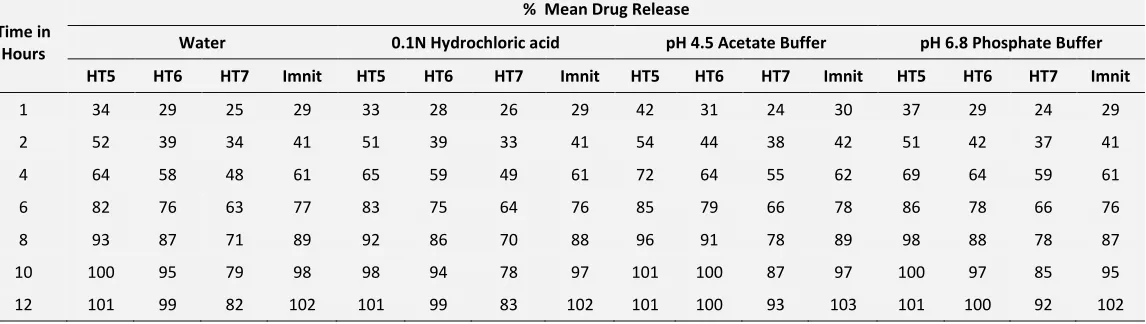
Evaluation of Dissolution profile of Reference Product [Imnit 60 tablet] and trial formulations: To match the dissolution profile of test product with that of the reference product, the trial batches of HT5 to HT7 and CT5 to CT7 were formulated by varying the concentration of co-processed multifunctional sustained release agent. The DCCSRA-HM of povidone: glyceryl behenate (1:3) was used for trials HT5 to HT7 and the DCCSRA-CM of povidone: glyceryl behenate (1:3) was used for trials CT5 to CT7. The tablet weight was kept constant at 300 mg and the difference in the concentration of DCCSRA was adjusted with dicalcium phosphate [Emcompress].
[image:7.612.317.566.77.241.2]The dissolution release of batches HT5 to HT7 and CT5 to CT7 were checked in water as well as dissolution media of three different pH values. The in-vitro dissolution profile results of Imnit 60 tablet [reference product] and trial batches HT5 to HT7 and CT5 to CT7 have been presented in the Figures 3 to 10 and the dissolution release values have been tabulated in Tables 9 and 10.
FIG. 3: IN VITRO DISSOLUTION RELEASE PROFILE OFIMNIT 60 TABLETS AND TRIAL BATCHES HT5 TO HT7 IN WATER
[image:7.612.56.300.449.622.2]FIG. 4: IN VITRO DISSOLUTION RELEASE PROFILE OFIMNIT 60 TABLETS AND TRIAL BATCHES CT5 TO CT7 IN WATER
FIG. 5: IN VITRO DISSOLUTION RELEASE PROFILE OFIMNIT 60 TABLETS AND TRIAL BATCHES HT5 TO HT7 IN 0.1N HYDROCHLORIC ACID
FIG. 6: IN VITRO DISSOLUTION RELEASE PROFILE OFIMNIT 60 TABLETS AND TRIAL BATCHES CT5 TO CT7 IN 0.1N HYDROCHLORIC ACID
Isosorbide Mononitrate Dissolution Profile in Water
0 20 40 60 80 100
0 2 4 6 8 10 12
Time in hours
% D r u g R e le as e d HT5 HT6 HT7 Imnit 60
Isosorbide Mononitrate Dissolution Profile in Water
0 20 40 60 80 100
0 2 4 6 8 10 12
Time in hours
% D r u g R e le as e d CT5 CT6 CT7 Imnit 60
Isosorbide Mononitrate Dissolution Profile in 0.1N Hydrochloric acid
0 20 40 60 80 100
0 2 4 6 8 10 12
Time in hours
% D r u g R e le as e d HT5 HT6 HT7 Imnit 60
Isosorbide Mononitrate Dissolution Profile in 0.1N Hydrochloric acid
0 20 40 60 80 100
0 2 4 6 8 10 12
Time in hours
[image:7.612.317.565.485.645.2]Available online on www.ijpsr.com 110 FIG. 7: IN VITRO DISSOLUTION RELEASE PROFILE OFIMNIT
60 TABLETS AND TRIAL BATCHES HT5 TO HT7 IN pH 4.5 ACETATE BUFFER
[image:8.612.56.301.76.243.2]FIG. 8: IN VITRO DISSOLUTION RELEASE PROFILE OFIMNIT 60 TABLETS AND TRIAL BATCHES CT5 TO CT7 IN pH 4.5 ACETATE BUFFER
FIG. 9: IN VITRO DISSOLUTION RELEASE PROFILE OFIMNIT 60 TABLETS AND TRIAL BATCHES HT5 TO HT7 IN pH 6.8 PHOSPHATE BUFFER
FIG. 10: IN VITRO DISSOLUTION RELEASE PROFILE OF IMNIT 60 TABLETS AND TRIAL BATCHES CT5 TO CT7 IN pH 6.8 PHOSPHATE BUFFER
TABLE 9: DISSOLUTION RELEASE VALUES OF TRIALS HT5, HT6, HT7 AND REFERENCE PRODUCT IMNIT-60 TABLET IN DIFFERENT DISSOLUTION MEDIA
Time in Hours
% Mean Drug Release
Water 0.1N Hydrochloric acid pH 4.5 Acetate Buffer pH 6.8 Phosphate Buffer
HT5 HT6 HT7 Imnit HT5 HT6 HT7 Imnit HT5 HT6 HT7 Imnit HT5 HT6 HT7 Imnit
1 34 29 25 29 33 28 26 29 42 31 24 30 37 29 24 29
2 52 39 34 41 51 39 33 41 54 44 38 42 51 42 37 41
4 64 58 48 61 65 59 49 61 72 64 55 62 69 64 59 61
6 82 76 63 77 83 75 64 76 85 79 66 78 86 78 66 76
8 93 87 71 89 92 86 70 88 96 91 78 89 98 88 78 87
10 100 95 79 98 98 94 78 97 101 100 87 97 100 97 85 95
12 101 99 82 102 101 99 83 102 101 100 93 103 101 100 92 102
Isosorbide Mononitrate Dissolution Profile in pH 4.5 Acetate buffer
0 20 40 60 80 100
0 2 4 6 8 10 12
Time in hours
%
D
r
u
g
R
e
le
as
e
d
HT5
HT6
HT7
Imnit 60
Isosorbide Mononitrate Dissolution Profile in pH 4.5 Acetate buffer
0 20 40 60 80 100
0 2 4 6 8 10 12
Time in hours
%
D
r
u
g
R
e
le
as
e
d
CT5
CT6
CT7
Imnit 60
Isosorbide Mononitrate Dissolution Profile in pH 6.8 Phosphate buffer
0 20 40 60 80 100
0 2 4 6 8 10 12
Time in hours
%
D
r
u
g
R
e
le
as
e
d
HT5
HT6
HT7
Imnit 60
Isosorbide Mononitrate Dissolution Profile in pH 6.8 Phosphate buffer
0 20 40 60 80 100
0 2 4 6 8 10 12
Time in hours
%
D
r
u
g
R
e
le
as
e
d
CT5
CT6
CT7
[image:8.612.317.553.291.449.2] [image:8.612.57.300.291.452.2] [image:8.612.25.598.526.688.2]Available online on www.ijpsr.com 111 TABLE 10: DISSOLUTION RELEASE VALUES OF TRIALS CT5, CT6, CT7 AND REFERENCE PRODUCT IMNIT-60 TABLET IN DIFFERENT DISSOLUTION MEDIA
Time in Hours
% Mean Drug Release
Water 0.1N Hydrochloric acid pH 4.5 Acetate Buffer pH 6.8 Phosphate Buffer
CT5 CT6 CT7 Imnit CT5 CT6 CT7 Imnit CT5 CT6 CT7 Imnit CT5 CT6 CT7 Imnit
1 33 28 23 29 32 27 24 29 40 30 22 30 36 27 23 29
2 50 37 31 41 50 38 30 41 53 44 35 42 50 41 36 41
4 61 57 45 61 64 57 46 61 72 62 53 62 69 62 57 61
6 80 75 60 77 81 74 61 76 84 76 65 78 84 77 65 76
8 90 84 70 89 90 86 67 88 94 88 76 89 96 85 76 87
10 98 94 78 98 97 92 76 97 98 97 84 97 100 94 84 95
12 100 98 79 102 100 97 81 102 101 100 91 103 100 98 89 102
DISCUSSION: In the present study the DCCSRAs
were prepared and the feasibility of using the co-processed agent as multifunctional agent in a sustained release formulation was evaluated by comparing the in vitro dissolution release of the trial formulations containing isosorbide mononitrate with that of a reference product [Imnit 60 tablet]. The angle of repose of physical blends of povidone K 25 and glyceryl behenate (containing the components in the ratios 1:1,1:2 and 1:3) were found to be 40°, 42° and 45° respectively indicating that the flow of the blend has to be improved if the blend has to be used for direct compression .
The angle of repose of DCCSRA-HMs of povidone K 25 and glyceryl behenate were 23°, 25° and 28° respectively [Tables 1 and 2]. The angle of repose of DCCSRA-CMs of povidone K 25 and glyceryl behenate were 21°, 23° and 26° respectively [Tables 1 and 2]. These angle of repose values show that the DCCSRAs have better flow than the physical blend of povidone and glyceryl behenate. The angle of repose values of the trial formulation blends have been presented in Tables 5 and 6. These values below 30° indicate the good flow of these blends which is suitable for direct compression. The results of crushing strength and friability of trial batch
tablets reveal that the co-processed agent provides sufficient strength to the tablets [Tables 5 and 6]. The batches HT3 and CT3 were formulated with dicalcium phosphate (Emcompress) which is an insoluble diluent and the batches HT4 and CT4 were formulated with lactose (Flowlac 100) which is a soluble diluent. The in vitro dissolution release of HT4 and CT4 batches was higher at all the time points when compared with HT3 and CT3 batches [Tables 7 and 8]. This shows that the dissolution release increases when a soluble excipient is used in the formulation along with the proposed DCCSRA.
[image:9.612.23.598.100.256.2]Available online on www.ijpsr.com 112 TABLE 11: RESULTS OF DIFFERENCE FACTOR (F1) AND SIMILARITY FACTOR (F2)
Dissolution Medium f1 Value f2 Value
HT5 HT6 HT7 CT5 CT6 CT7 HT5 HT6 HT7 CT5 CT6 CT7
Water 6.24 2.82 19.11 3.82 4.83 22.33 63.18 80.29 41.57 69.33 71.02 38.72
0.1N hydrochloric acid 6.28 2.83 18.42 4.86 4.66 22.06 63.28 81.35 42.37 67.55 71.80 39.01
pH 4.5 acetate buffer 10.78 2.79 11.98 8.98 1.60 14.97 53.37 81.35 52.17 56.24 86.18 47.87
pH 6.8 phosphate
buffer 10.79 2.24 10.18 9.78 2.24 12.42 54.05 84.20 55.22 56.78 82.84 51.39
[image:10.595.30.573.258.471.2]TABLE 12: STABILITY DATA FOR THE TRIAL FORMULATION OF ISOSORBIDE MONONITRATE SUSTAINED RELEASE TABLETS [TRIAL HT6]
Duration & Condition
Assay Results
[image:10.595.27.573.505.754.2](In %) [95 to105%]
Mean Dissolution release in water (in %)
Difference (f1) and Similarity (f2) Factor
Related Substances (in %)
1st Hour
2nd Hour
4th Hour
6th Hour
8th Hour
10th Hour
12th Hour
f1 [<15]
f2 [>50]
Isosorbide 2- nitrate [NMT 0.5%]
Isosorbide dinitrate [NMT 0.5%]
Initial 100.3 29 39 58 76 87 95 99 2.82 80.29 Not Detected Not Detected
40°C/ 75% RH
1 Month 100.1 30 39 57 77 86 94 98 3.62 75.16 Not Detected Not Detected
3 Months 99.5 31 38 58 79 87 94 99 3.82 76.32 Not Detected Not Detected
6 Months 99.7 32 40 59 77 88 96 99 2.41 82.53 Not Detected Not Detected
30°C/ 65% RH
1 Month 100.2 28 37 57 74 86 95 99 4.23 74.11 Not Detected Not Detected
3 Months 99.7 30 38 59 78 87 94 98 3.42 77.04 Not Detected Not Detected
6 Months 99.9 29 40 60 78 88 95 99 2.01 84.57 Not Detected Not Detected
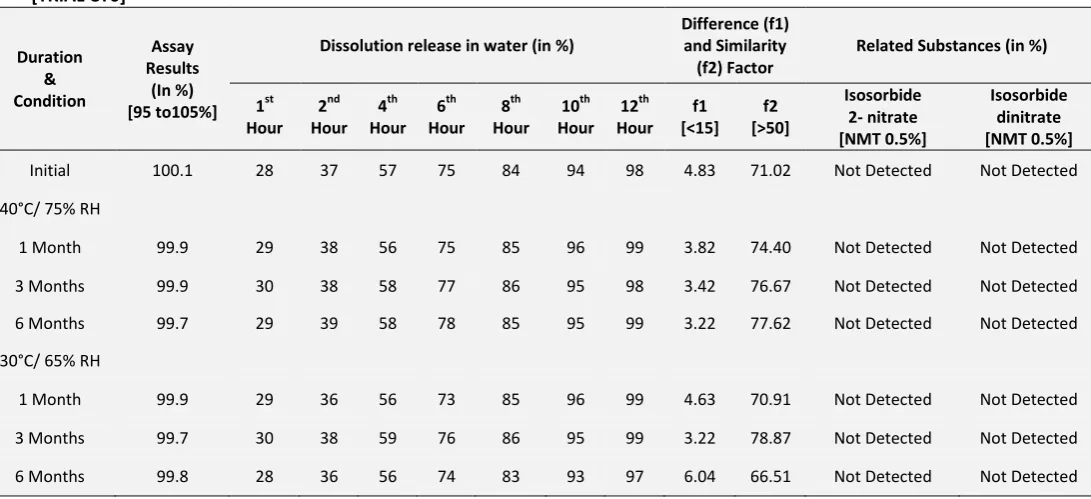
TABLE 13: STABILITY DATA FOR THE TRIAL FORMULATION OF ISOSORBIDE MONONITRATE SUSTAINED RELEASE TABLETS [TRIAL CT6]
Duration & Condition
Assay Results
(In %) [95 to105%]
Dissolution release in water (in %)
Difference (f1) and Similarity (f2) Factor
Related Substances (in %)
1st Hour
2nd Hour
4th Hour
6th Hour
8th Hour
10th Hour
12th Hour
f1 [<15]
f2 [>50]
Isosorbide 2- nitrate [NMT 0.5%]
Isosorbide dinitrate [NMT 0.5%]
Initial 100.1 28 37 57 75 84 94 98 4.83 71.02 Not Detected Not Detected
40°C/ 75% RH
1 Month 99.9 29 38 56 75 85 96 99 3.82 74.40 Not Detected Not Detected
3 Months 99.9 30 38 58 77 86 95 98 3.42 76.67 Not Detected Not Detected
6 Months 99.7 29 39 58 78 85 95 99 3.22 77.62 Not Detected Not Detected
30°C/ 65% RH
1 Month 99.9 29 36 56 73 85 96 99 4.63 70.91 Not Detected Not Detected
3 Months 99.7 30 38 59 76 86 95 99 3.22 78.87 Not Detected Not Detected
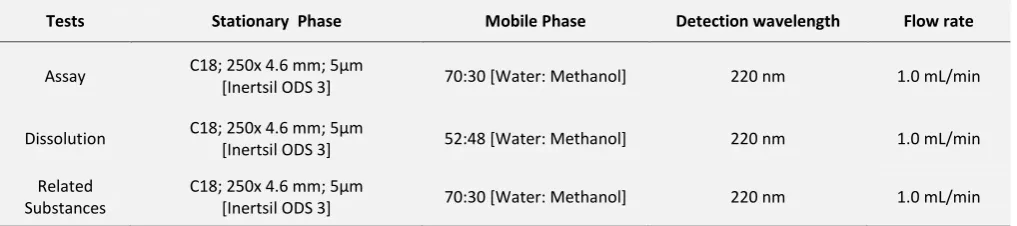
Available online on www.ijpsr.com 113 TABLE 14: ANALYTICAL PARAMETERS FOLLOWED FOR STABILITY STUDY OF TRIAL FORMULATION HT6& CT6
Tests Stationary Phase Mobile Phase Detection wavelength Flow rate
Assay C18; 250x 4.6 mm; 5µm
[Inertsil ODS 3] 70:30 [Water: Methanol] 220 nm 1.0 mL/min
Dissolution C18; 250x 4.6 mm; 5µm
[Inertsil ODS 3] 52:48 [Water: Methanol] 220 nm 1.0 mL/min
Related Substances
C18; 250x 4.6 mm; 5µm
[Inertsil ODS 3] 70:30 [Water: Methanol] 220 nm 1.0 mL/min
CONCLUSION: In the trial formulations using
direct compression, the isosorbide mononitrate was directly compressed using DCCSRA and dicalcium phosphate (Emcompress). The process of direct compression was simple with two additives leading to saving of cost and time. The DCCSRA used in the formulation acted as retardant, binder and lubricant. No glidant was used to assist the flow of blend during compression. The calculated difference factor (f1 factor) and similarity factor (f2 factor) of trial batch HT6 and CT6 show that the dissolution release pattern of these batches were comparable to that of reference product [Imnit 60 tablet]. The above facts suggest that the DCCSRAs which have been prepared and evaluated in this study may be used as a multifunctional excipient in the sustained release formulation of Isosorbide tablets.
ACKNOWLEDGEMENT: This work was
supported by Micro Labs Limited., India and Shanmuga Arts, Science, Technology & Research Academy, India.
REFERENCES:
1. Mukesh C. Gohel, Rajesh K. Parikh, Bansari K. Brahmbhatt, and Aarohi R. Shah: Preparation and assessment of novel coprocessed superdisintegrant consisting of crospovidone and sodium starch glycolate: A Technical Note. AAPS PharmSciTech 2007; 8(1): E63-E69.
2. Nahala S. Barakat, Ibrahim M, Elbagory, and Alanood S. Almurshedi: Controlled-release Carbamazepine matrix granules and tablets comprising lipophillic and
hydrophilic components. Drug Delivery 2009; 16(1):57-65.
3. Vasinee Limwong, Narueporn Sutanthavibul, and Poj Kulvanich: Spherical composite particles of rice starch and microcrystalline cellulose: A new co processed excipient for direct compression. AAPS PharmSciTech 2004; 5(2): 40-49.
4. Mukesh C. Gohel, Rajesh K. Parikh, Bansari K. Brahmbhatt, and Aarohi R. Shah: Improving the tablet characteristics and dissolution profile of ibuprofen by using a novel co processed superdisintegrant: A Technical Note. AAPS PharmSciTech 2007; 8(1): E94-E99.
5. Jacob.S, Shirwaikar. A.A., Joseph. A, Srinivasan. K.K: Novel co-processed excipients of mannitol and microcrystalline cellulose for preparing fast dissolving tablets of glipizide. Indian Journal of Pharmaceutical Sciences 2007; 69(5): 633-639.
6. Arvind K. Bansal, Satish K Nachaegari. Co processed Excipients for Solid Dosage Forms. Pharmaceutical Technology. January 2004; 52-64.
7. Gohel M.C., Pranav D Jogani: A review of co-processed directly compressible excipients. J Pharm Pharmaceutical Sci 2005; 8(1): 76-93.
8. Raymond C Rowe, Paul J Sheskey and Paul J Weller: Hand Book of Pharmaceutical Excipients. Published by the Pharmaceutical Press and the American Pharmaceutical Association,Fourth Edition 2003. 9. United States Pharmacopoeia and National Formulary
(USP 31-NF26). Rockville, MD: US Pharmacopoeia 2008.
10. Vinod P. Shah, Yi Tsong, Pradeep Sathe and Roger L. Williams: “Dissolution profile comparison using similarity factor, f2”, Office of Pharmaceutical Science, Centre for Drug Evaluation and Research, Food and Drug Administration, Rockville, MD. Available at: http://www.dissolutiontech.com /DTresour/899Art/DissProfile.html.
![TABLE 2: EVALUATION OF FLOW PROPERTY [ANGLE OF REPOSE] FOR THE PHYSICAL BLEND AND DCCSRA](https://thumb-us.123doks.com/thumbv2/123dok_us/8897186.953510/3.612.61.550.383.503/table-evaluation-property-angle-repose-physical-blend-dccsra.webp)
![TABLE 4: FORMULATION COMPOSITION OF ISOSORBIDE MONONITRATE SUSTAINED RELEASE TABLETS USING DCCSRA- CM [TRIALS]](https://thumb-us.123doks.com/thumbv2/123dok_us/8897186.953510/4.612.51.563.367.478/formulation-composition-isosorbide-mononitrate-sustained-release-tablets-dccsra.webp)