IJPSR (2016), Vol. 7, Issue 9 (Research Article)
Received on 27 April, 2016; received in revised form, 18 July, 2016; accepted, 13 August, 2016; published 01 September, 2016
DEVELOPMENT AND IN-VITRO CHARACTERISATION OF ORAL SUSTAINED RELEASE
MATRIX TABLETS OF GEMIGLIPTIN
Srinivas Martha*, CH. Sagarika, K. Nandini, V. Seshavardhan and M. Kranthi kumar
Department of Pharmaceutics, Joginpally B.R. Pharmacy College, Yenkapally (V), Moinabad (M), Hyderabad- 500075, Telangana, India.
ABSTRACT: This project involves in the development of sustained release matrix tablets of Gemigliptin. Which is an oral anti-hyperglycemic agent designed for the management of non insulin dependent diabetes mellitus (NIDDM). The basic goal of therapy is to achieve a steady sate blood level that is therapeutically effective and non toxic for an extended period of time. The objective in dosage form design is to optimise the delivery of medication to achieve the control of therapeutic effect in the face of uncertain fluctuation in the in-vivo environment in which drug release takes place. Eight formulations of Gemigliptin 50mg were formulated by admixing with HPMC K4M, Carbopol were used as rate controlling polymers in different concentrations, Micro crystalline cellulose, Lactose, Talc, Magnesium stearate. Pre-formulation and post-formulation studies were carried out and the values obtained, satisfies the pharmacopoeial specifications. Several kinetic models were applied to the dissolution profiles to determine the drug release kinetics. Of all the formulations F5exhibited gradual and completion extended release for Gemigliptin. The F5 (carbopol) with 1:1 ratio produced 89% drug release at end of the hour.
INTRODUCTION: Tablets are solid oral dosage forms containing ingredients with or without filler
material 1. Sustained release dosage forms are the
drug delivery systems that are designed to achieve prolonged therapeutic effect by continuously releasing medication over an extended period of time after administration of single dose. The goal in designing oral sustained delivery system is to reduce the frequency of the dosing or to increase effectiveness of the drug by localizing at the site of action, reducing the dose required or provide uniform drug delivery, thereby also improving
patient compliance 2.
QUICK RESPONSE CODE
DOI:
10.13040/IJPSR.0975-8232.7(9).3770-80
Article can be accessed online on: www.ijpsr.com
DOI link: http://dx.doi.org/10.13040/IJPSR.0975-8232.7 (9).3770-80
Sustained release dosage forms provide a better control of plasma drug levels, less dosage frequency, less side effect, increased efficacy and
constant delivery 3.
Diabetes is an extremely common disorder which affects many people. It is defined as a heterogeneous metabolic syndrome characterised by chromic hyperglycaemia i.e. increase in blood levels with disturbances in carbohydrate, fat and protein metabolism. It is the most common occurring chronic endocrinal disorder which affects almost each and every cell of the human body. Gemigliptin is used in the management of non
insulin dependent diabetes mellitus NDDM 4.
Gemigliptin is an oral anti- hyperglycaemic agent of the new dipeptidyl peptidase-4 inhibitor class of drugs. It is known that glucose lowering affects of DDP-4 inhibitors are mainly mediated by Glucagon
Keywords:
Sustained release, matrix tablet, Gemigliptin, pre-formulation studies,
post-formulation studies, polymers
Correspondence to Author: Srinivas Martha
Assistant professor
Joginpally B.R Pharmacy college Yenkapally (v), Moinabad (M), Hyderabad-500075, Telangana, India.
like peptide-1 and Gastric inhibitory polypeptide (GIP) incretin hormones which are inactivated by
DDP-4 5. Gemigliptin was rapidly absorbed after
single oral dosing and the compound was eliminated with a half-life of 3.6, 5.2, 5.4 and 30.8 hrs in the rat, dog, monkey and humans respectively. Bioavailability of gemigliptin in the rat, dog, monkey was species dependent with the values of 94%, 73%, 26% respectively. In clinical studies Gemigliptin monotherapy (50mg for 12
week) improved the HbA1C, FPG level, oral glucose
tolerance test results, beta cell function and insulin sensitive measures and was well tolerated in
subjects with type 2 diabetes 6.
Sustained release matrix tablets are relatively easy to fabricate by incorporating drug particles in slowly disintegrating or inert porous material. Hydroxypropyl methylcellulose is a hydrophilic polymer used to prolong the drug release pattern due to its gelling property, rapid hydration and robust mechanism, choice in viscosity grades, non-ionic nature, reproducible release profile and good
compressibility property 7. Carbopol is a
hydrophilic polymer used as the matrix formers in
oral controlled release dosage forms 8.
MATERIALS AND METHODS:
Materials: The various materials in our study include Gemigliptin, HPMC K4M, Carbopol, Microcrystalline cellulose, Lactose, Talc and Magnesium stearate. All other materials used were of analytical grade.
Methods:
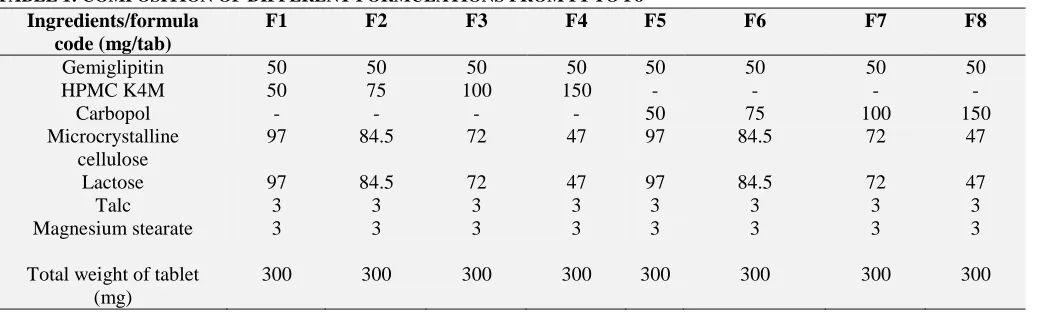
Formulation of Gemigliptin sustained release matrix tablets: Sustained release matrix tablets Gemigliptin were prepared by Direct compression technique. Eight formulations of tablets each containing 50mg dose of Gemigliptin were prepared with different concentration of excipients
as showed in the Table 1.
Gemigliptin and polymers such as HPMC K4M, Carbopol were accurately weighed, geometrically mixed and passed through #40 mesh and Lactose is
used as diluents 9 and Microcrystalline cellulose as
binder were accurately weighed and passed through
#40 mesh 10. Both mixtures were mixed for 5
minutes as a dry mixing and the mixture of talc and magnesium stearate 1:1 ratio was used as lubricant
added to the mixture and mixed for 2 minutes 10.
Then the mixtures were compressed into tablets using 8 station rotary compressed machines with punch size of 9 mm with a hardness of 3 to 5
[image:2.612.50.571.459.615.2]kg/cm2.
TABLE 1: COMPOSITION OF DIFFERENT FORMULATIONS FROM F1 TO F8
Evaluation of pre-compression blend:
Before compression the granules were evaluated
for their flow and compressibility characteristics 11.
Angle of repose: The angle of repose of powder was determined by the funnel method. The accurately weighed granules were taken in a funnel .The height of the funnel was adjusted in such a manner that the tip of the funnel just touched the
apex of the heap of the powder. The granules were allowed to flow through the funnel freely onto the surface.
The diameter of the powder cone measured and angle of repose was calculated using the following equation:
Tan ϴ = h/r
Ingredients/formula code (mg/tab)
F1 F2 F3 F4 F5 F6 F7 F8
Gemiglipitin 50 50 50 50 50 50 50 50
HPMC K4M 50 75 100 150 - - - -
Carbopol - - - - 50 75 100 150
Microcrystalline cellulose
97 84.5 72 47 97 84.5 72 47
Lactose 97 84.5 72 47 97 84.5 72 47
Talc 3 3 3 3 3 3 3 3
Magnesium stearate 3 3 3 3 3 3 3 3
Total weight of tablet (mg)
Where h and r are the height and radius of the powder cone, ϴ is the angle of repose.
Granules with angle of repose 31-35° show good flow property.
Determination of bulk Density and Tapped Density:
An accurately weighed quantity of the powder (W) was carefully poured into the graduated cylinder and volume (Vo) was measured. Then the graduated cylinder was closed with the lid and set into the tap density tester (USP).The density apparatus was set for 100 taps and after that the
volume (Vf) was measured and continued operation
till the two consecutive readings were equal.
The bulk density and the tapped density were calculated using the following formula
Bulk density =W/Vo
Tapped density=W/Vf
Where,
W=Weight of the powder VO =Initial volume
Vf =final volume
% Compressibility or Carr’s Index:
Carr’s index (CI) is an important measure that can be obtained from the bulk and tapped densities. In theory, the less compressible a material the more flowable it is.
Carr’s Index =
Tapped density – Bulk density x 100 Tapped density
Granules with compressibility index value up to 16% show good flow property.
Hausner’s Ratio:
It is the ratio of tapped density and bulk density. Hausner found that this ratio was related to inter-particle friction and, as such, could be used to predict powder flow properties. Generally a value ≤ 1.25 indicates good flow properties, which is equivalent to 20% of Carr’s Index.
Hausner’s ratio =Tapped density/Bulk density.
Evaluation of Gemigliptin matrix tablets: Physical appearance:
The control of general appearance of tablet involves measurement of number of attributes such as tablet size, shape, colour, presence or absence of odour, taste, surface texture and consistency of any identification marks. The general appearance of tablets, its visual identity and overall elegance is essential for consumer acceptance.
Thickness:
Twenty tablets from the representative sample were randomly taken and individual tablet thickness was measured by using digital vernier caliperse.
Average thickness was calculated.
Hardness:
Tablet hardness was measured by using Monsanto hardness tester. From each batch six tablets were measured for the hardness and average of six values was noted.
Friability Test:
From each batch, ten tablets were accurately weighed and placed in the friability test apparatus (Roche friabilator). Apparatus was operated at 25 rpm for 4minutes and tablets were observed while rotating. The tablets were then taken, de-dusted and reweighed. The friability was calculated as the percentage weight loss. The acceptable limits of the weight loss should not be more than 1%. The percentage friability was calculated according to the following formula.
% Friability = (initial weight – final weight)/initial weight x 100
Weight Variation Test:
To study weight variation individual weights (WI) of 20 tablets from each formulation were noted using electronic balance. Their average weight (WA) was calculated. Percent weight variation was calculated as follows. Average weights of the tablets were calculated.
%weight variation = (WA-WI) x100/WI
Where,
WI= Individual weight of the tablets
According to IP 1996, out of twenty tablets for
tablets weighing more than 250mg 5% weight
variation can be allowed for not more than two tablets out of twenty tablets.
Content uniformity:
Tablets must comply with the requirements for uniformity of content specified in is calculated by doing assay for a particular drug. Over ten tablets were selected randomly and average weight was calculated. Tablets were crushed in a motor and accurately weighed amount of tablets triturate was taken for analysis and it was diluted with the phosphate buffer solution. The content was shaken well and sonicated for five minutes for dissolving the drug. Appropriate dilutions were made. The
drug content was estimated by recording the absorbance at 257nm.
In-vitro dissolution studies:
Dissolution test is to provide critical in-vitro drug release information for quality control purpose i.e.
to predict in-vivo drug release profiles 12.
Dissolution studies were carried out for all the formulations employing USP-II paddle method and 900 ml of phosphate buffer solution as the dissolution medium operated at 50rpm. The medium was allowed to equilibrate to temperature of 37 ± 0.5°C. The samples were collected after end of the hour at intervals of 1, 4, 8, 12, 16, 20, 24
hr, as per parameters showed in Table 2. The
[image:4.612.41.567.311.360.2]samples were analyzed spectrophotometrically at 257nm using UV-spectrophotometer.
TABLE 2: PARAMETERS OUTLINE INVOLVED IN IN-VITRO DISSOLUTION
Drug name Dosage
form
Dissolution apparatus
Speed (RPMs)
Medium Medium volume
(ml)
Sampling intervals (Hrs)
Gemigliptin Tablets USP II Paddle type 50 RPM 0.1N HCL
900 1, 4, 8, 12, 16, 20, 24 hrs
Kinetic Analysis of Dissolution Data:
To analyze the in vitro release data various kinetic models were used to describe the release kinetics. The zero order Eq. (1) describes the systems where the drug release rate is independent of its concentration. The first order Eq. (2) describes the
release from system where release rate
concentration dependent. Higuchi described the release of drugs from insoluble matrix as a square root of time dependent process based on Fickian diffusion Eq. (3).
C=Ko t (1) Eq.
Where,
Ko is zero-order rate constant expressed in units of concentration/time and t is a time.
LogC = LogCo –K1 t/2.303 (2) Eq.
Where,
Co is the initial concentration of drug and K1 is the first order constant.
Q = KHt1/2 (3) Eq.
Where,
KH is the constant reflecting the design variables of the system.
The following plots were made using the in-vitro drug release data
Cumulative %drug release vs. time
(Zero order kinetic model)
Log cumulative of %drug remaining
vs. time (First order kinetic model)
Cumulative %drug release vs. square
root of time (Higuchi model)
Mechanism of Drug Release:
Korsmeyer et al (1983) derived a simple relationship which described drug release from polymeric system to find out mechanism of drug release, first 60% drug release data was fitted in Korsmeyer-peppas model.
Mt/M =Ktn
Where Mt/M is a fraction of drug released at the time t, K is the exponent. The n value is used to characterize different release mechanisms.
RESULTS AND DISCUSSION:
evaluation studies. The results obtained were agreeing the pharmacopoeial standards.
Standard calibration curve of Gemigliptin:
Calibration curve of the pure drug Gemigliptin was prepared in the concentration range of 1 to 5 µg/ml
at the wavelength of 257nm using 6.8 pH phosphate buffer solution. The calibration curve showed good linearity and regression coefficient
[image:5.612.173.442.151.303.2]was 0.999 (r2), showed in Fig. 1.
FIG. 1: STANDARD CURVE OF GEMIGLIPTIN IN pH 6.8 PHOSPHATE BUFFER SOLUTION
Pre-compression parameters:
The powder characteristics of various batches of
sustained release Gemigliptin tablets were
evaluated and the values obtained was mentioned
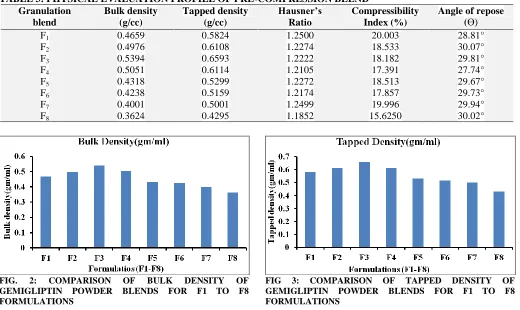
in the Table 3. Various formulations shows good
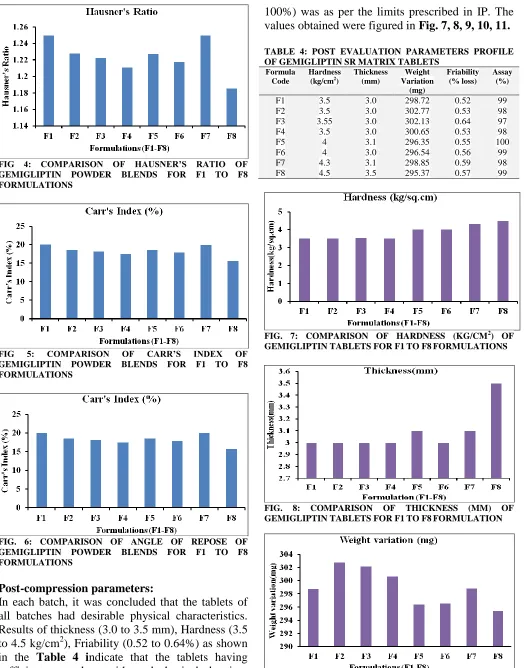
flow properties. Results of bulk density (0.362 to 0.539 gm/cc), tapped density (0.42 to 0.65gm/cc),
compressibility index (15.62% to 20.01%. 12-16 %), Hausner’s ratio (1.18 to 1.25), angle of repose (27.74° to 30.07°) shows satisfactory results, Which are required for better bioavailability. Values of parameters obtained were figured in the
[image:5.612.49.569.446.756.2]Fig. 2, 3, 4, 5, 6.
TABLE 3: PHYSICAL EVALUATION PROFILE OF PRE-COMPRESSION BLEND Granulation
blend
Bulk density (g/cc)
Tapped density (g/cc)
Hausner’s Ratio
Compressibility Index (%)
Angle of repose (ϴ)
F1 0.4659 0.5824 1.2500 20.003 28.81°
F2 0.4976 0.6108 1.2274 18.533 30.07°
F3 0.5394 0.6593 1.2222 18.182 29.81°
F4 0.5051 0.6114 1.2105 17.391 27.74°
F5 0.4318 0.5299 1.2272 18.513 29.67°
F6 0.4238 0.5159 1.2174 17.857 29.73°
F7 0.4001 0.5001 1.2499 19.996 29.94°
F8 0.3624 0.4295 1.1852 15.6250 30.02°
FIG. 2: COMPARISON OF BULK DENSITY OF GEMIGLIPTIN POWDER BLENDS FOR F1 TO F8 FORMULATIONS
FIG 4: COMPARISON OF HAUSNER’S RATIO OF GEMIGLIPTIN POWDER BLENDS FOR F1 TO F8 FORMULATIONS
FIG 5: COMPARISON OF CARR’S INDEX OF GEMIGLIPTIN POWDER BLENDS FOR F1 TO F8 FORMULATIONS
FIG. 6: COMPARISON OF ANGLE OF REPOSE OF GEMIGLIPTIN POWDER BLENDS FOR F1 TO F8 FORMULATIONS
Post-compression parameters:
In each batch, it was concluded that the tablets of all batches had desirable physical characteristics. Results of thickness (3.0 to 3.5 mm), Hardness (3.5
to 4.5 kg/cm2), Friability (0.52 to 0.64%) as shown
in the Table 4 indicate that the tablets having
sufficient strength to withstand physical abrasion. Tablets of all batches passed the weight variation (296.35 to 302.77 mg) test and assay (97% to
100%) was as per the limits prescribed in IP. The
values obtained were figured in Fig. 7, 8, 9, 10, 11.
TABLE 4: POST EVALUATION PARAMETERS PROFILE OF GEMIGLIPTIN SR MATRIX TABLETS
Formula Code
Hardness (kg/cm2)
Thickness (mm)
Weight Variation
(mg)
Friability (% loss)
Assay (%)
F1 3.5 3.0 298.72 0.52 99
F2 3.5 3.0 302.77 0.53 98
F3 3.55 3.0 302.13 0.64 97
F4 3.5 3.0 300.65 0.53 98
F5 4 3.1 296.35 0.55 100
F6 4 3.0 296.54 0.56 99
F7 4.3 3.1 298.85 0.59 98
F8 4.5 3.5 295.37 0.57 99
FIG. 7: COMPARISON OF HARDNESS (KG/CM2) OF GEMIGLIPTIN TABLETS FOR F1 TO F8 FORMULATIONS
FIG. 8: COMPARISON OF THICKNESS (MM) OF GEMIGLIPTIN TABLETS FOR F1 TO F8 FORMULATION
[image:6.612.50.574.50.718.2] [image:6.612.52.333.60.627.2] [image:6.612.309.572.108.385.2] [image:6.612.314.565.415.726.2]FIG. 10: COMPARISON OF % FRIABILITY OF GEMIGLIPTIN TABLETS FOR F1 TO F8 FORMULATIONS
FIG. 11: COMPARISON OF ASSAY OF GEMIGLIPTIN TABLETS FOR F1TO F8FORMULATIONS
In-vitro drug release studies of Formulations (F1-F8):
The sustained release Gemigliptin matrix tablets
containing drug, HPMC K4M, Carbopol,
Microcrystalline cellulose, lactose, magnesium stearate, talc prepared by direct compression process, released the drug from sustain matrix
release of time up to 24hrs as shown in the Table 5.
TABLE 5: IN - VITRO DRUG RELEASE DATA OF GEMIGLIPTIN FORMULATIONS (F1TO F8)
Time(hrs)/ % Drug
release
F1 F2 F3 F4 F5 F6 F7 F8
1 16 13 15 12 20 14 13 17 4 24 21 23 21 30 25 23 27 8 32 30 32 29 42 34 33 36 12 44 43 46 40 53 47 46 52 16 57 55 57 51 64 57 57 62 20 66 65 67 63 75 65 68 73 24 76 72 77 74 89 75 78 86
Among all the eight formulation F5 showed the 89% drug release at end of the time was determined by UV-visible spectrometer at 257nm. The results shown that the release of drug depends not only on the nature of matrix but also upon the drug polymer ratio. As the percentage of polymer decrease, the
kinetics of release increased. The comparative graphs of all the formulations for drug release were
plotted shown in the Fig. 12, 13, 14 15.
FIG. 12: DRUG RELEASE PROFILE OF GEMIGLIPTIN FORMULATIONS FROM F1 TO F4
FIG. 13: DRUG RELEASE PROFILE OF GEMIGLIPTIN FORMULATIONS FROM F5 TO F8
FIG. 14: DRUG RELEASE PROFILE OF SUSTAINED RELEASE GEMIGLIPTIN MATRIX TABLETS OF F1 TO F8
In-vitro drug release profile of pure drug Gemigliptin:
In-vitro dissolution studies of pure drug
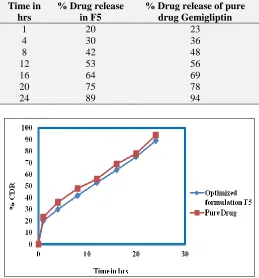
[image:7.612.46.301.58.349.2] [image:7.612.313.566.109.258.2] [image:7.612.313.566.290.441.2] [image:7.612.314.566.479.619.2]Table 5. Comparison graph was plotted and
showed in the Fig. 15.
TABLE 6: IN-VITRO DRUG RELEASE PROFILE OF OPTIMIZED FORMULATION (F5) OF GEMIGLIPTIN SUSTAINED RELEASE MATRIX TABLETS AND PURE DRUG GEMIGLIPTIN
Time in hrs
% Drug release in F5
% Drug release of pure drug Gemigliptin
1 20 23
4 30 36
8 42 48
12 53 56
16 64 69
20 75 78
[image:8.612.44.303.138.416.2]24 89 94
FIG. 15: IN-VITRO DRUG RELEASE PROFILE OF OPTIMIZED FORMULATION (F5) VERSUS PURE DRUG GEMIGLIPTIN
Study of Drug release kinetics:
For understanding the mechanism of drug release and release rate kinetcs of the drug release and rate kinetics of the drug from the dosage form, the in-vitro drug dissolution data obtained as showed in the Table 7 was fitted to various mathematical models. The dissolution data of optimized
formulation (F5) tablets were subjected to various
kinetic models such as Zero order kinetics (cummulative percentage amount of drug release versus time), First order kinetics (log cummulative percentage of drug remaining to release versus time), Higuchi (fraction of drug release versus square root of time) and Korsermeyer-peppas (log fraction of drug released versus log time) showed
in the Fig. 16, 17, 18, 19.
Which were applied to assess the kinetics of drug release from prepared tablets. Most suited model for drug release was predicted on the basis of regression coefficient towards 1, greater the suitability of best fitted release mechanism. The kinetics shows that the release of drug followed zero order release in all the formulations. As the drug release was best fitted in Zero order kinetics, indicating that the rate of drug release is not dependent on the concentration of the drug.
TABLE 7: DISSOLUTION KINETICS DATA OF OPTIMIZED FORMULATION F5
Time (hrs)
Square root of time
Log time % Drug
release
Log% Drug release
% Drug remaining
Log % Drug remaining
1 1 0 20 1.301029 80 1.90309
4 2 0.60206 30 1.477121 70 1.84509
8 2.8284 0.90309 42 1.623249 58 1.76343
12 3.464 1.07918 53 1.724275 47 1.67209
16 4 1.20412 64 1.806179 36 1.55630
20 4.472 1.30102 75 1.875061 25 1.39794
24 4.8989 1.38021 89 1.949390 11 1.04139
FIG. 16: ZERO ORDER KINETICS PLOT OF OPTIMIZED FORMULATION F5
[image:8.612.50.567.465.732.2]FIG. 18: HIGUCHI ORDER KINETICS PLOT OF OPTIMIZED FORMULATION F5
FIG. 19: KORSEMEYER PEPPA’S ORDER KINETICS PLOT OF OPTIMIZED FORMULATION F5
Comparison of release mechanism of Optimized formulation usingkinetic study:
The release profile of Gemigliptin optimized
formulation F5 was processed for comparison of
different orders of drug release and to understand the linearity liaison, i.e., Kinetic principles. The data were processed for regression analysis. In vitro release data of time points between 1 to 24 hrs were considered and treated for following kinetic principles.
According to the regression values obtained
showed in the Table 8, the formulation did not
follows a first-order release pattern, when data plotted according to the zero-order equation shows a linearity, with regression value of 0.998. According to Higuchi plot the formulation shows a fair linearity with regression value 0.966.
In order to explore more precise mechanism of release of Gemigliptin from in domicile developed SR tablets, the dissolution data was fitted to the well-known exponential equation i.e., Korsemeyer-peppa’s equation, which is often used to describe the drug release behaviour from polymeric systems.
After plotting the formulation showed r2 = 0.961
and slope (n) value of 0.518. A value of n = < 0.45 indicates Fickian diffusion, 0.45 < n < 0.89 indicates non-Fickian diffusion, n = 0.89 is case-II transport and n > 0.89 is Super case-II transport. The n value obtained is between 0.45 < n < 0.89, hence the results concluded that non-Fickin mechanism for drug release. The relative complexity of this formulation and its components may indicate that the drug release is controlled by diffusion process and non-fickian mechanism.
TABLE 8: KINETIC PROFILE OF OPTIMIZED FORMULATION F5
Optimized formulation
Zero order
First order
Higuchi’s Peppa’s
R2 R2 R2 n R2
F5 0.998 0.911 0.966 0.518 0.961 Drug-polymer interaction/compatibility study using FTIR:
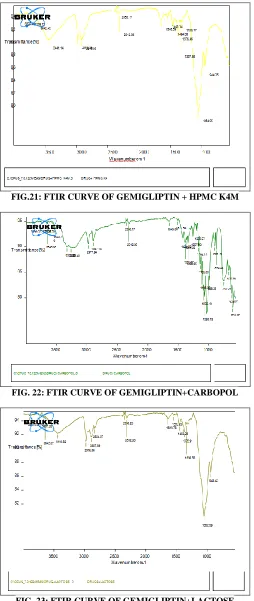
The different peaks of drug, polymer and their
physical mixture indicate all groups and
characteristics of the drug were not altered. There is no significant interaction in drug and polymer. Physical mixture of drug and polymer was characterised by FTIR spectral analysis for any physical as well as chemical alteration of drug characteristics. From results it was concluded that there was no interference in the functional group as the principal peaks of Gemigliptin were found to be un-altered in the drug polymer physical mixture as
shown in the Fig. 20, 21, 22, 23.
FIG. 20: FTIR CURVE OF PURE DRUG
[image:9.612.308.571.219.291.2] [image:9.612.313.565.506.736.2]FIG.21: FTIR CURVE OF GEMIGLIPTIN + HPMC K4M
FIG. 22: FTIR CURVE OF GEMIGLIPTIN+CARBOPOL
FIG. 23: FTIR CURVE OF GEMIGLIPTIN+LACTOSE
CONCLUSION: The drug release rate of the different formulation, among the hydrophilic matrix formers was in the subsequent order
Carbopol, HPMC K4M. The results of in-vitro
dissolution study indicated that the F5 as an optimized one since it successfully sustained the
drug release at end of the hour and compared with pure drug and the drug release patterns obtained was within the pharmacopoeial limits. Direct compression is feasible for development of once a day controlled release tablet of Gemigliptin provided with careful selection of optimised
concentration of Carbopol. The optimised
formulation prepared with drug: polymer
(carbopol) ratio 1:1 showed 89% drug release at end of the hour. The release kinetics shows that the release of drug followed Zero order release in all the formulation. From the Korsemeyer-peppas study, the n value of the formulations shows that the release profile obeys Fickian and Non-Fickian diffusion mechanism.
On the basis of result it was concluded that sustained release tablets of Gemigliptin prolong the time for absorption as well as bioavailability and thus better patient compliance can be achieved. The
present study demonstrated the successful
preparation of stable once daily sustained release matrix tablet of Gemigliptin thus the objectives envisaged in this work were achieved.
ACKNOWLEDGEMENT: The authors sincerely
utter thanks to the Management, Department of pharmaceutics of Joginpally B. R. Pharmacy College and Jawaharlal Nehru Technological University, Hyderabad for providing amenities to carry out this research work. Authors are thankful to Rainbow Pharma Training Labs Ltd, Hyderabad for providing API and Excipients.
REFERENCES:
1. Dipti Phadtare, Ganesh phadtare, Nilesh B, Mahendra
Asawat: Hypromellose- A choice of polymer in extended release tablet formulation. WJPPS, 2014; 3:456-479.
2. Eunsoo jung, Junghyun Kim, Sung Ho Kim Myung-Haing
Cho: Gemigliptin, a novel dipeptidyl peptidase-4 inhibitor, exhibits potent anti-glycation properties vitro and in-vivo. European Journal of pharmacology, 2014; 744:98-102.
3. Gregory Thoorens, Fabrice Krier, Bruno Leclercq, Brian
Carlin, Brigitte Evrard: Microcrystalline cellulose, a direct compression binder in a quality by design environment-A review. IJP 2014; 437(1):64-72.
4. S.J. Yang, K.W. Min, Gupta, J.Y. Park, V.K. Shivane,
5. Sung-Ho Kim, Sung-Hack Lee, Hyeon-Joo Yim: Gemiglitin, a novel dipeptidyl peptidase-IV inhibitor: First new anti-diabetic drug in the history of Korean pharmaceutical industry. Springer October 2013; 36:1185-1188.
6. K.P. Sampath kumar, Debjit Bhowmik, Shweta Srivastava,
Shravan paswan and A.S. Dytta: Sustained release drug delivery system potential: The Pharma Innovation 2012; 1:333-358.
7. Avinash H. Hosmani, Yogesh S. Thorat, Kature: Carbopol
and its pharmaceutical significance. Research gate 2006; 4:567-592.
8. Subrahmanyam CVS: Textbook of physical
pharmaceutics. Vallabh Prakashan, Delhi, First edition, 2005.
9. Bramhanker DM, jaiswal SB: Controlled release
medications. In Biopharmaceutics and pharmacokinetics treatise. Vallabh prakashan. 1995; 335-375.
10. Lerk CF: Consolidation and compacton of lactose. Drug
Dev Ind pharm 1993; 19:2359-2398.
11. Lachmman L, Liberman HA, Konig JL: The theory and
practice of Industrial Pharmacy, Vargheese Publishing House, Bombay, Third edition 1991, 430.
12. Howard CA: Introduction to pharmaceutical dosage forms.
Lea and Febiger, Philadelphia, 4th edition 1985, 167.
All © 2013 are reserved by International Journal of Pharmaceutical Sciences and Research. This Journal licensed under a Creative Commons Attribution-NonCommercial-ShareAlike 3.0 Unported License.
This article can be downloaded to ANDROID OS based mobile. Scan QR Code using Code/Bar Scanner from your mobile. (Scanners are available on Google Playstore)
How to cite this article:
MarthaS, Sagarika CH, Nandini K, Seshavardhan V and Kranthi kumar M:Development and in-vitro characterisation of oral sustained