IJPSR (2014), Vol. 5, Issue 5 (Research Article)
Received on 12 December, 2013; received in revised form, 21 January, 2014; accepted, 26 March, 2014; published 01 May, 2014
IN VITRO ANTI-INFLAMMATORY AND ANTI-ARTHRITIC ACTIVITY IN METHANOLIC
EXTRACT OF COCCULUS HIRSUTUS (L.) DIELS. IN VIVO AND IN VITRO
Deepika Arya*, Mukesh Meena, Neha Grover and Vidya Patni
Plant Pathology, Tissue Culture and Biochemistry Laboratory, Department of Botany, University of
Rajasthan, Jaipur-302005, Rajasthan, India
ABSTRACT: The present study deals with the in vitro anti-inflammatory and anti-arthritic activity in methanolic extracts of in vivo (leaf and stem) and in vitro (callus) plant parts of Cocculus hirsutus. The previous phytochemical analysis of methanolic extract of Cocculus hirsutus has indicated the presence of several physiologically active phytochemicals such as phenols, flavonoids, triterpenoids, steroids, alkaloids etc. Since these compounds are of pharmacological interest, coupled with the use of this plant in traditional medicine, prompted us to check all in vivo and in vitro plant parts of Cocculus hirsutus for in vitro
anti-inflammatory activity by HRBC (Human Red Blood Cell) membrane stabilization method and anti-arthritic activity by the inhibition of protein denaturation method. The methanolic extracts of all plant parts exhibited notable anti-inflammatory activity and remarkable anti-arthritic action. The membrane stabilization was found to be maximum in leaves (88.8% at a dose of 1000µg/ml) and that of protein denaturation was also found to be maximum in leaves (65.85% at a dose of 1000µg/ml) as compare to other in vivo (stem) and in vitro (callus) plant parts. Therefore, our studies support the isolation and the use of active constituents from in vivo and in vitro plant parts of Cocculus hirsutus in treating inflammations and rheumatism.
INTRODUCTION: India is one of the largest producers of medicinal herbs in the world. Plant derived drugs serve as a prototype to develop more effective and less toxic medicines. The curative properties of medicinal plants are perhaps due to the presence of various secondary metabolites such as alkaloids, flavonoids, phenols, saponins, sterols etc. There is a growing attention in correlating the phytochemicals of a medicinal plant with its
pharmacological activity 1.
QUICK RESPONSE CODE
DOI:
10.13040/IJPSR.0975-8232.5(5).1957-62
Article can be accessed online on:
www.ijpsr.com
DOI link: http://dx.doi.org/10.13040/IJPSR.0975-8232.5(5).1957-62
The mechanism of inflammation injury is attributed, in part, to release of Reactive Oxygen species (ROS) from activated neutrophil and macrophages. Free radicals are important mediators that provoke or sustain inflammatory processes and consequently, their neutralization by antioxidants and radical scavengers can attenuate inflammation
2
. Rheumatoid arthritis is a chronic, systemic inflammatory disease predominantly affecting the joints and peri-articular tissues. Tumour necrosis factor alpha (TNF-alpha) is the product of macrophages has been demonstrated to play an important role in the pathogenesis of RA. The screening and development of drugs for their anti-inflammatory activity is still in progress and there is hope for finding anti-inflammatory drugs from
indigenous medicinal plants 3, 4.
Keywords:
Cocculus hirsutus, anti-arthritic activity, anti-inflammatory, methanolic extract
Correspondence to Author:
Dr. Deepika Arya
Post Doctoral Fellow
Plant Pathology, Tissue Culture and Biochemistry Laboratory,
Department of Botany, University of Rajasthan, Jaipur-302005, Rajasthan, India
Cocculus hirsutus is an important medicinal plant. It is commonly known as Patalagarudi, Jaljamni and belongs to family Menispermaceae. It is distributed throughout India mainly in dry localities. The plant is a perennial climbing shrub
with softly villous young parts. Earlier
investigation on the plant resulted in the isolation
of several bioactive alkaloids and triterpenoids 5, 6, 7,
8
. It is medicinally used by the Indian tribes for a wide range of ailments, including constipation, kidney problems, gonorrhea, spermatorrhoea,
urinary troubles, diarrhea and hyperglycemia 9, 10, 11,
12
. The main aim of the present investigation was to
study the in vitro arthritic and
anti-inflammatory activities in methanolic extracts of in
vivo (leaf and stem) and in vitro (callus) plant parts
of Cocculus hirsutus.
MATERIALS AND METHODS:
Plant material: The plant parts of Cocculus hirsutus were collected from the Kulish Smriti Van, Jaipur. The plant material was authenticated by herbarium of the Department of Botany, University of Rajasthan, Jaipur. A voucher specimen was deposited in the herbarium of the Department. The plant materials (leaves and stem) were air dried at room temperature under shade, and then powdered to a fine grade by using a laboratory scale mill. These shade dried parts of the plant were powdered and kept in air tight plastic bag until use.
Callus Induction and Establishment: For callus establishment the fresh and healthy plant twigs were collected and washed with detergent followed by running tap water. To overcome the problem of
in vitro oxidative browning, the explants were given a pretreatment with an antioxidant solution comprising ascorbic acid (50 mg/L), polyvinyl pyrrolidone (100 mg/L) and citric acid (100 mg/L) for One hour. The explants were then surface sterilized with 0.1% mercuric chloride for One minute and rinsed with sterile distilled water. Sterilized leaf discs and nodal segments were used as explants for the induction of callus. The explants
were inoculated on MS medium 13 consisting of
basal salts and vitamins with 3% (w/v) sucrose and 0.8% agar with various concentrations of growth regulators like NAA (0.25-2.0 mg/l) and BAP (0.5-2.0 mg/l) alone or in the combination.
The induced callus was then subcultured on MS media with various concentrations of BAP (0.25-2.0mg/l) with the aim to stimulate the rate of cell division for enhancement of callus growth. These cultures were allowed to grow upto their maximum
growth age (6 weeks). The developed
undifferentiated homogenous cell mass was repeatedly subcultured to maintain cell growth. The collected cell mass was allowed to dry at room temperature and then used for further investigation.
Preparation of Extract: All the powdered plant materials (leaf, stem and callus) were extracted separately with methanol using Soxhlet apparatus for 48 hours. The solvent was distilled at lower
temperature under reduced pressure and
concentrated on water bath to get the crude extract which is stored in desiccators for future use. All chemicals and reagents used including the solvents were of analytical grade.
In vitro anti-inflammatory activity by HRBC membrane stabilization method: The principle involved here is stabilization of human red blood cell membrane by hypo tonicity induced membrane lysis. The assay mixture contains 1ml phosphate buffer [pH 7.4, 0.15 M], 2 ml hypo saline (0.36%), 0.5 ml HRBC suspension (10% v/v) with 0.5 ml of each plant extracts (leaf, stem and callus) of various concentrations (100, 250, 500, 1000 μg/ml), standard drug diclofenac sodium (100, 250, 500, 1000 μg/ml) and control distilled water instead of hypo saline to produce 100 % hemolysis were
incubated at 37oC for 30 min and centrifuged
respectively 14, 15. The hemoglobin content in the
suspension was estimated using spectrophotometer at 560 nm. The percentage hemolysis produced in the presence of distilled water was taken as 100 %. Percentage of HRBC membrane stabilization or protection was calculated using the formula;
Percentage stabilization = 100 - [(optical density of test solution) ÷ (optical density of control) × 100].
In vitro anti-arthritic activity by inhibition of protein denaturation method:
1. The Test solution (0.5ml) consists of 0.45ml of
plant extracts (leaf, stem, callus) of various concentrations (100, 250, 500, 1000 μg/ml).
2. Test control solution (0.5ml) consists of 0.45ml
of bovine serum albumin (5% W/V aqueous solution) and 0.05ml of distilled water.
3. Product control (0.5ml) consists of 0.45ml of
distilled water and 0.05 ml of test solution.
4. Standard solution (0.5ml) consists of 0.45ml of
Bovine serum albumin (5% W/V aqueous solution) and 0.05ml of diclofenac sodium (250µg/ml).
All the above solutions were adjusted to pH 6.3 using 1N HCl. The samples were incubated at 37°C for 20 min and the temperature was increased to keep the samples at 57°C for 3 min. After cooling, add 2.5 ml of phosphate buffer to the above
solutions. The absorbance was measured using
UV-Visible spectrophotometer at 416 nm 15, 16, 17. The
percentage inhibition of protein denaturation can be calculated as;
Percentage Inhibition = [100 - (optical density of test solution – optical density of product control) / (optical density of test control) × 100.
The control represents 100% protein denaturation. The results were compared with diclofenac sodium (250µg/ml).
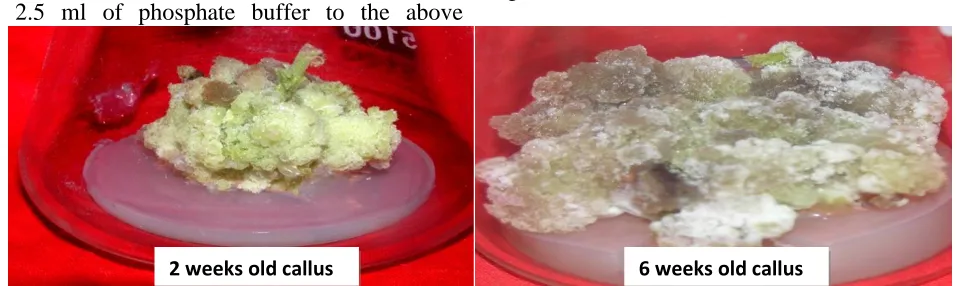
RESULTS AND DISCUSSION: Callus induction and establishment was best reported on MS media supplemented with NAA (0.5mg/l) and BAP (1.0 mg/l) using nodal explants. These static cultures were allowed to grow upto their maximum growth age i.e. 6 weeks.
FIG. 1: STATIC CALLUS CULTURES OF COCCULUS HIRSUTUS GROWN ON MS MEDIUM SUPPLEMENTED WITH NAA (0.5 MG/L) AND BAP (1.0 MG/L) AT DIFFERENT TIME INTERVALS.
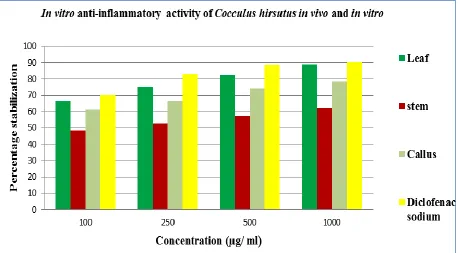
In vitro anti-inflammatory activity by HRBC membrane stabilization method: The investigation is based on the need for newer anti-inflammatory agents from natural source with potent activity and lesser side effects as substitutes for chemical therapeutics. The effect of methanolic extracts of all plant parts (leaf, stem and callus) of
Cocculus hirsutus on stabilization of HRBC
membrane is shown in Table 1 and Figure 2.
The maximum percentage stabilization was observed in methanolic extract of leaves (88.8% at
1000µg/ml) as compared to other in vivo (stem)
and in vitro (callus) plant parts. It possesses significant activity comparable with that of the
standard diclofenac sodium 18, 19. All the plant parts
[image:3.612.66.550.310.453.2]of Cocculus hirsutus have significant anti-inflammatory activity which may be due to presence of chemical profile such as flavonoids, tri-terpenoids and phenols.
TABLE 1: IN VITRO ANTI INFLAMMATORY ACTIVITY OF METHANOLIC EXTRACT OF Cocculus hirsutus IN VIVO AND IN VITRO
Concentrations (µg/ml)
% stabilization on HRBC membrane Plant parts
Standard (Diclofenac sodium) Leaf Stem Callus
100 66.5 48.25 61.11 70.14
250 75.25 52.78 66.38 82.74
500 82.5 57.35 74.2 88.39
1000 88.8 62.25 78.5 90.10
FIG. 2: EFFECT OF VARIOUS EXTRACTS OF IN VIVO AND IN VITRO PLANT PARTS OF COCCULUS HIRSUTUS ON ANTI-INFLAMMATORY ACTIVITY BY HRBC MEMBRANE STABILIZATION
In vitro anti-arthritic activity by inhibition of protein denaturation method: The effects of methanolic extract of all plant parts (leaf, stem and
callus) of Cocculus hirsutus on inhibition of protein
denaturation are shown in Table 2 and Figure 3.
Extracts of all plant samples at different concentrations (dose levels) provided significant protection against denaturation of proteins. The maximum percentage inhibition was observed in
methanolic extract of leaves (65.85% at
1000µg/ml) as compared to other in vivo (stem)
and in vitro (callus) plant parts.
It possesses significant activity comparable with that of the standard diclofenac sodium. Most of the investigators have reported that denaturation of
protein is one of the cause of rheumatoid arthritis. Production of auto-antigens in certain rheumatic
diseases may be due to in vivo denaturation of
proteins 19, 20.
Mechanism of denaturation probably involves alteration in electrostatic, hydrogen, hydrophobic and disulphide bonding. From the results of present study it can be stated that methanolic extracts of all
the plant parts of Cocculus hirsutus is capable of
controlling the production of auto antigen and inhibits denaturation of protein in rheumatic disease.
TABLE 2: IN VITRO ANTI ARTHRITIC ACTIVITY OF METHANOLIC EXTRACT OF COCCULUS HIRSUTUS IN VIVO AND IN VITRO
Concentrations (µg/ml)
% inhibition of protein denaturation Plant parts
Standard (Diclofenac sodium) Leaf Stem Callus
100 52.15 32.14 49.19 -
250 55.75 37.58 53.31 75.20
500 61.11 42.24 57.11 -
[image:4.612.78.536.66.319.2]FIG. 3: EFFECT OF VARIOUS EXTRACTS OF IN VIVO AND IN VITRO PLANT PARTS OF COCCULUS HIRSUTUS ON ANTI-ARTHRITIC ACTIVITY BY PERCENTAGE INHIBITION OF PROTEIN DENATURATION
CONCLUSION: This is the first comparative in vitro study on anti-inflammatory and anti-arthritic
activities of in vivo and in vitro plant parts of
Cocculus hirsutus. The methanolic extract of the
leaves of Cocculus hirsutus showed maximum
anti-inflammatory and anti-arthritic activities as
compared to other in vivo and in vitro plant parts.
The plant contains many secondary metabolites e.g. flavonoids, sitosteroids, alkaloids, tri-terpenoids and phenolics. Hence proper isolation of the active principles might help in the findings of new lead compounds in the fields of arthritic and anti-inflammatory drug research. This established a significant scope to develop a broad spectrum use of Cocculus hirsutus in herbal medicine and as a base for the development of novel potent drugs against inflammations and arthritis.
ACKNOWLEDGEMENTS: Financial support provided by the University Grants Commission (UGC), New Delhi under the Post Doctoral fellowship scheme for women (Fellowship no. 15-33/12 (SA-II)) is gratefully acknowledged.
REFERENCES:
1. Arya, D and Patni, V: Pharmacognostic profile and phytochemical investigation of Pluchea Lanceolata
Oliver&Hiern. in vivo and in vitro. Int. J. Pharm. Sci. Rev. Res., 2013; 22(2): 157-161.
2. Chatterjee A: The Treatise of Indian Medicinal Plants. National Institute of Science and Seema CC and Meena V:
Antioxidant, anti-inflammatory and anti-arthritic activity of Centella asiatica extracts J. Chem. Bio. Phy. Sci. 2011; 1 (2): 260– 269.
3. Lavanya R, Maheshwari S, Harish G, Bharath J, Kamali S, Hemamalani D, Bharath Varma J and Umamaheswara C R: Investigation of In-vitro anti-Inflammatory, anti-platelet and anti-arthritic activities in the leaves of Anisomeles malabarica Linn. Res. J. Pharm. Biol. Chem. Sci. 2010; 1:745-752.
4. Chandrashekhar KA and Sheikh, S: In vitro antimicrobial, antioxidant, anti-arthritic and phytochemical evaluation of
Pscychotria flavida Talbot- an endemic plant of Western Ghats. International Journal of Pharmacy and Pharmaceutical Sciences 2013; 5: 214-218.
5. Jagannadha Rao KV and Ramachandra RL: Chemical examination of Cocculus hirsutus (Linn) Diels. J Sci Ind Res 1961; 20: 125-126.
6. Viquaruddin A and Iqbal S: Cohirsitine, A new isoquinoline alkaloid from Cocculus hirsutus. Fitoterapia 1992; 63: 308-310.
7. Viqaruddin A, Iqbal S and Haiderine A: New isoquinoline alkaloid from Cocculus hirsutus. Nat Prod Lett 1993; 2:105-109.
8. Viquaruddin A, Tahir R and Shaista I: Cohirsinine, an alkaloid from Cocculus hirsutus. Phytochemistry, 1991; 30: 1350-1351.
9. Kirtikar KR and Basu BD: Indian Medicinal Plants. Lalit Mohan Basu, Allahabad, Edition 3, Vol. I, 1981: 80-82, 86-90.
10. Badole S, Patel N, Bodhankar S, Jain B and Bhardwaj S: Acute and chronic diuretic effect of ethanolic extract of leaves of Cocculus hirsutus (L.) Diels in normal rats,J Pharm Pharmacology. 2009; 61(3); 387-393.
11. Ganapaty S and Dash GK: Diuretic, laxative, toxicity studies of Cocculus hirsutus. Fitoterapia, 2002; 73, 28-31. 12. Marya HB and Bothara BS: Ethnopharmacological
[image:5.612.96.518.56.290.2]13. Murashige T and Skoog F: A revised medium for rapid growth and bioassays with tobacco tissue culture. Plant Physiology. 1962; 15: 473-497.
14. Yogesh VU, Pravin GM and Avinash SD: Phytochemical Compositions and in-vitro anti-inflammatory activity of
Plectranthus mollis. Journal of Advanced Pharmacy Education & Research.2013; 3: 85-89.
15. Shravan Kumar N, Kishore G, Siva Kumar G and Sindhu priya ES: In vitro anti inflammatory and anti-arthritic activity of leaves of Physalis angulata.IndustrialJournal of Pharmacy and Industrial Research. 2011; 1: 211-213. 16. Deshpande V, Jadhav VM and Kadam VJ: In vitro
anti-arthritic activity of Abutilon indicum (Linn.) Sweet. J Pharm Res. 2009; 2(4): 644-645.
17. Kokila N, Radha R and Jayshree N: In vitro Antioxidant and Antiarthritic Activity of Polyherbal Formulation. IJPI’S Journal of Pharmacognosy and Herbal Formulation.
2013; 13(3): 10-15.
18. Rajalakshmi GR and Harindran J: Anti-inflammatory activity of Samadera indica leaves by Membrane Stabilization. Int J Pharm Sci Res. 2013; 4(2): 721-723. 19. Arya D and Patni V: Comparative analysis of in vitro
anti-inflammatory and anti-arthritic activity in methanolic extract of Pluchea lanceolata Oliver & Hiern. in vivo and
in vitro. Int J Biol Pharm Res. 2013; 4(9): 676-680. 20. Singh M, Soni P, Upmanyu N and Shivhare Y: In-vitro
Anti-arthritic activity of Manilkara zapota Linn. Asian J Pharm Tech.2011; 1:123-124.
All © 2013 are reserved by International Journal of Pharmaceutical Sciences and Research. This Journal licensed under a Creative Commons Attribution-NonCommercial-ShareAlike3.0 Unported License
This article can be downloaded to ANDROID OS based mobile. Scan QR Code using Code/Bar Scanner from your mobile. (Scanners are available on Google Playstore)
How to cite this article: