Technology (IJRASET)
©IJRASET: All Rights are Reserved
358
Design and Implementation of Finger Writing In
Air by Using Open CV (Computer Vision) Library
on Arm Platform
P. Rajasekhar1, G.Mukesh2
1
PG Scholar, 2Assistant professor , Dept of ECE, Audisankara College of Engineering & Technology (Autonomous),
Gudur, Nellore, Andhra Pradesh.
Abstract:The Main Aim of the project is to design “A Kinect Sensor for Finger Writing in the Air” Evaluating the performance of an operating system on an embedded before delving into its implementation, an introduction is needed to the parts involved in the project. The whole report is centered around the field of embedded systems and the use of Linux to run applications on them. Hence an introduction to Embedded Systems and using Linux asanOS in them is provided. Digital pen with trajectory recognition can be done by using accelerometer. The digital pen consists of a tri-axial accelerometer,a microcontroller, and an RF wireless transmission module for sensing and collecting accelerations of hand writing and gesture trajectories. In receiver section RF signals can be received by RF receiver and given to microcontroller. Thecontroller processes the information and finally the results can be displayed on Graphical LCD. In proposed system, going to use web cam, ARM microcontroller and display unit. Here, using pen or hand for drawing in front of the camera then what ever going to draw in front of it will be displayed on the display unit
Keywords: Notebook computer, Desktop computer, Cemara, USB Cable, Common Unix Printing Method, Raspberry pi
I. INTRODUCTION
The project is aimed at evaluating the performance of an operating system on an embedded system. Before delving into its implementation, an introduction is needed to the parts involved in the project. The whole report is centered around the field of embedded systems and the use of Linux to run applications on them. Hence an introduction to Embedded Systems and using Linux as an OS in them is provided. An embedded system is a special purpose computer system that is designed to perform very small sets of designated activities. Embedded systems date back as early as the late 1960s where they used to control electromechanical telephone switches. The first recognizable embedded system was the Apollo Guidance Computer developed by Charles Draperandh is team. Later they found their way into the military, medical sciences and the aerospace and automobile industries
II. LITERATURE SURVEY
With embedded systems fast expanding its reach, subject matter related to this field is available in abundance. While working on this project we have studied matter from various sources such as books, online articles and reference manuals. The knowledge gained from this activity has been of great help to us in understanding the basic concepts related to our project and has ignited further interest in this topic.
“Linux for Embedded and Real time Applications”, by Doug Abbott has been of great help in providing an introduction to the process of building embedded systems in Linux. It has helped us understand the process of configuring and building the Linux kernel and installing tool chains. We understood the preponderance of the ARM processors in the field of embedded systems and the features of ARM processors from the document “The ARM Architecture” by Leonid Ryzhyk. The ARM architecture is a confluence of many useful features that makes it better than other peer processors. Being small in size and requiring less power, they prove useful in providing an efficient performance in embedded applications.
III. METHODOLOGY
A. Existing System
Technology (IJRASET)
©IJRASET: All Rights are Reserved
359
trajectories. Our embedded project first extracts the time- and frequency-domain features from the acceleration signals and, then transmits the signals by using RF transmitter. In receiver section RF signals can be received by RF receiver and given to microcontroller. The controller processes the information and finally the results can be displayed on Graphical LCD.
B. Proposed System
In proposed system, going to use web cam, ARM microcontroller and display unit. Here, using pen or hand for drawing in front of the camera then what ever going to draw in front of it will be displayed on the display unit. Our embedded system is capable of translating time-series acceleration signals into important feature vectors. Users can use the pen to write digits or make hand gestures etc can be displayed on the display unit.
[image:3.612.204.410.206.358.2]IV. BLOCK DIAGRAM
FIG 1.Block Diagram
V. HARDWARE MODULES
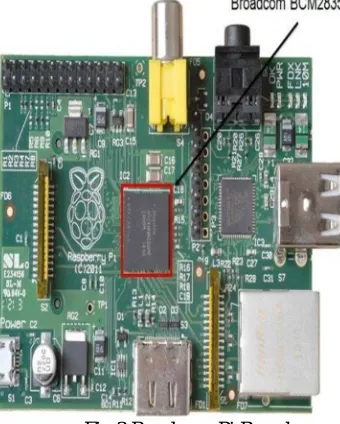
A. Raspberry Pi Board
The Raspberry Pi is a charge card estimated single-board PC grew in the UK by the Raspberry Pi Foundation with the expectation of advancing the instructing of fundamental software engineering in schools. The Raspberry Pi is made in two board arrangements through authorized assembling manages Newark element14 (Premier Farnell), RS Components and Egoman. These organizations offer the Raspberry Pi on the web. Egoman produces a form for appropriation exclusively in China and Taiwan, which can be recognized from different Pis by their red shading and absence of FCC/CE marks. The equipment is the same over all makers.
[image:3.612.213.383.476.688.2]Technology (IJRASET)
©IJRASET: All Rights are Reserved
360
[image:4.612.207.398.87.274.2]1) BCM2835 Features:
Fig 3.1: Raspberry pi features
a) Broadcom BCM2835 with 700MHz ARM1176JZFS processor with Video core 4 GPU and FPU. b) 512Mega Bytes of RAM.
c) High-Definition Multimedia Interface video socket. d) 2 x USB 2.0 sockets.
e) RCA composite video socket. f) SDHC Class 6 Card.
g) StorageDevice card socket. h) Powered with micro USB socket. i) 3.5mm audio out jack.
j) Raspberry pi Size: 85.6 x 53.98 x 17mm.
B. Raspberry Pi Specifications
1) UVC Driver Camera: AUVC (or Universal Video Class) driver is a USB-category driver. A driver enables a device, such as your web cam, to communicate with your computer’s operating system. And USB (or Universal Serial Bus) is a common type of connection that allows for high-speed data transfer. Devices that are equipped with a UVC driver, such as the Logitech® Quick Cam® Pro9000 for Business are capable of streaming video.
[image:4.612.182.374.522.692.2]Technology (IJRASET)
©IJRASET: All Rights are Reserved
361
2) Display Unit: HD TVs and many LCD monitors can be connected using a full-size 'male' HDMI cable, and with an inexpensive
adaptor if DVI is used. HDMI versions 1.3 and 1.4 are supported and a version 1.4 cables is recommended. The RPi outputs audio and video via HMDI, but does not support HDMI input.
VI. SOFTWARE MODULES
A. Linux Operating System
Linux is, in simplest terms, an operating system. It is the software on a computer that enables applications and the computer operator to access the devices on the computer to perform desired functions. We have to download Linux OS source code version from kernel.org and it is cross compiled for Mini2440 boards.
B. Qt for Embedded Linux
Qt for Embedded Linux is a C++ framework for GUI and application development for embedded devices.It runs on a variety of processors, usually with Embedded Linux. Qt for Embedded Linux provides the standard Qt API for embedded devices with a
Chip Broadcom BCM2835 SOC
Core architecture ARM11
CPU
700 MHz Low Power
ARM1176JZFS
Applications Processor
GPU
Dual Core Video Core IV Multimedia Co-
Processor
Provides Open GL ES 2.0, hardware-
accelerated OpenVG, and
1080p30 H.264 high-profile decode Capable of 1Gpixel/s, 1.5Gtexel/s or
24GFLOPs with texture filtering
and DMA infrastructure
Memory 512MB SDRAM
Operating System
Boots from SD card running a version of the
Linux operating system
Dimensions 85.6 x 53.98 x 17mm
Technology (IJRASET)
©IJRASET: All Rights are Reserved
362
lightweight window system.
C. GCC Compiler
GNU Compiler Collection (GCC) is a free softwareproject that includes compilers for Ada, C, C++, Fortran, Java, and Objective-C, as well as libraries for these languages. It is capable of generating executables for a variety of platforms including x86, ARM, MIPS, PowerPC, etc.
D. OpenCV
Open CV (Open Source Computer Vision) is a library of programming functions for real time computer vision. It is developed by Willow Garage, which is also the organization behind the famous Robot Operating System(ROS).
Now you’d say MATLAB also can do Image Processing, then why Open CV? Stated below are some differences between both.
Once you go through them, you can decide for yourself.
VII. EXPERIMENTAL RESULTS
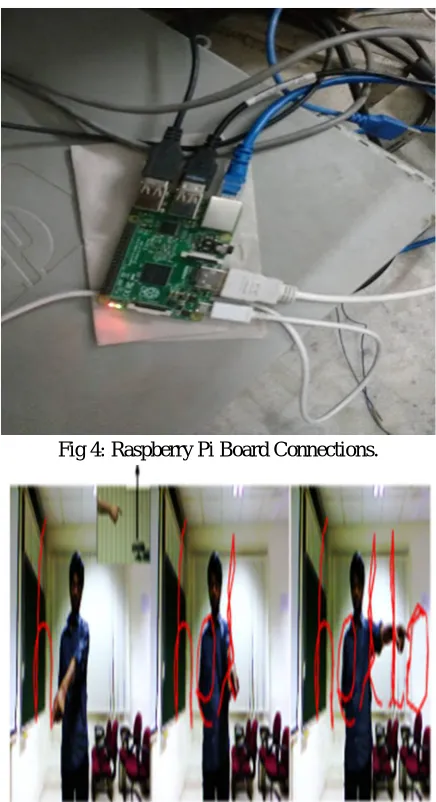
[image:6.612.197.415.288.689.2]This figure shows the how all the devices which are connected to the Raspberry Pi Board
Fig 4: Raspberry Pi Board Connections.
Technology (IJRASET)
©IJRASET: All Rights are Reserved
363
Fig6: Implemention Result
VIII. CONCLUSION
The project “Design and implementation of finger writing in air by using Open CV(computer vision )Library on Arm
Platform ” has been successfully designed and tested. It has been developed by integrating features of all the hardware components
and software used. Presence of every module has been reasoned out and placed carefully thus contributing to the best working of the unit. Secondly, using highly advanced Raspberry pi board and with the help of growing technology the project has been successfully implemented.
REFERENCES [1] Datasheets and the user manuals of ARM controller.
[2] Beginning of Linux programming by Neil Matthew, Richard Stones.
[3] Z. Zhang, “Microsoft Kinect Sensor and its Effect,” IEEE MultiMedia, vol. 19, no. 2, 2012, pp. 4–10.
[4] P. Kakumanu, S.Makrogiannis, and N. Bourbakis, “A Survey of Skin-Color Modeling and Detection Methods,” Pattern Recognition, vol. 40, 2007, pp. 1106– 1122.
[5] J. Alon et al., “A Unified Framework for Gesture Recognition and Spatiotemporal Gesture Segmentation,” IEEE Trans. Pattern Analysis and Machine Intelligence, vol. 31, no.9, 2009, pp. 1685–1699.
[6] G.R. Bradski and A. Kaehler Learning OpenCV, O’Reilly Media, 2008.
[7] K. Kim et al., “Real Time Foreground-Background Segmentation Using Code Book Model,” Real-Time Imaging, vol. 11, no.3, 2005, pp. 172–185.
BIOGRAPHIES
P. Rajasekhar received her B.Tech degree in Electronics and Communication Engineering from Gokula Krishana College of Engineering For sullurupet, NelloreDistrict, affiliated to JNTU Anantapuram .He is currently pursuing M.Tech EMBEDDED SYSTEMS in Audisankara college of Engineering and Technology, Gudur.