Technology (IJRASET)
©IJRASET: All Rights are Reserved
289
Coordinated Active and Reactive Power
Control of Grid Connected Micro Grid Using Soft
Computing Technique
Dr.H.S.Jain1, Kesa Jyothi2
1
Associate Professor, Vardhaman College of Engineering, Electrical and Electronics Department, Hyderabad
2
Professor, Vardhaman College of Engineering, Electrical and Electronics Department Hyderabad
Abstract—A micro grid is a cluster of DG units that interface with an electrical distribution network using power electronic interfaces such as Voltage Sourced Inverter (VSI). The main task of a DG unit is to control the output active power (P) and reactive power (Q) based on their reference values. The main aim of control mode is to attain a fast response, and to preserve system stability, especially during abrupt changes. To accomplish this, it is necessary to conduct this mode with the current based nonlinear controller or linear controller scheme to ensure high power tracking. This paper examines a novel power controller based on current regulation, by combining the advantages of both linear and nonlinear controllers, for better microgrid configuration subjected to variable load conditions. In this tuning of active and reactive power control parameters subjected to load change is done by soft computing technique... Therefore required load power is shared equally between microgrid and utility during the change in load.
Keywords— Distributed Generator, Voltage Source Inverter (VSI), Active Power (P) and Reactive Power (Q)
I. INTRODUCTION
Distributed renewable generators are generally installed at various locations in micro grids. A microgrid is a cluster of DG units that interface with an electrical distribution network using power electronic interfaces such as Voltage Sourced Inverter (VSI). The high market penetration of the micro-sources such as wind, photovoltaic, hydro, and fuel cell emerge as alternatives which provide green energy and a flexible extension to the utility grid. This scenario represents a complementary infrastructure to the utility grid that offers many advantages for the power system such as; peak load shaving, reliability against the power system faults, and high power quality via a flexible control scheme [3, 4].Moreover, microgrid can operate in two modes: grid connected mode and islanding mode. It imports or exports the power from/to the grid depending on both the generation and load. However, in islanding mode, the microgrid disconnects from the utility when an abnormal condition occurs in the grid, in which case the primary function of the microgrid is to satisfy the load with the required level of power quality. In such a system the microgrid operates according to the inverter’s control modes, so the synthetic control scheme is necessary to play a key role in ensuring the high performance operation of the DG units [5-8].
In this paper, a architecture of a smart grid is given below consisting of a photovoltaic (PV) array, a proton-exchange membrane fuel cell (PEMFC), and a storage battery (SB)..The fuel cell is balanced by a Pv array..To maintain system stability during shortage of power supply and maximum load shaving in grid mode, back up unit is used.To coordinate active and reactive power algorithm is proposed.. By this , the working out time is greatly decreased..This paper provides a complete solu tion for the operation of a microgrid which will all together transmit active and reactive power during both grid connected & islanded operations [24].
II. REPORT OFTHESYSTEMAND ITSMODELING
Technology (IJRASET)
©IJRASET: All Rights are Reserved
290
Fig.1. Architecture of the proposed micro grid
For smooth progress of charging and discharging operations of DG inverter 2,a back up unit(SB) is connected to DC side of DG inverter -2 via DC/DC buck –boost converter.. The function of back up unit(SB) is to keep balance of power while islanded operation, which is given by
Where PDG is the power of main DG unit, the back up unit power which is subjected to the charging and discharging constraints is given by
and PL is the real power delivered to the loads. The energy constraints of the SB are determined based on the state-of-charge (SOC) limits which are given as
SOC of the back up unit can be calculated by many assessments presented in [21] and [22].
The distribution grid and circuit breaker are connected at the point of common coupling for the period of grid connected operation.
Fig.2. Equivalent single-phase representation of the DG inverters for grid connected operation.
The main usage of DG unit is to reduce the burden on the load by supplying limited power and voltage from the grid..Due to highly usage of power electronic components in the micro grid ,they influence the load currents by the presence of harmonics. The role of DG units is to compensate harmonics that occur due to non linear loads and to prevent the spread of them to other components connected to the PCC.PV array generates different powers based on the requirement of the loads.
Technology (IJRASET)
©IJRASET: All Rights are Reserved
291
shown in Fig. 2.. To attain peak shaving ,the SB can transmit power to the grid when SOC is above the minimum SOCmin.The circuit breaker cuts the micro grid connection from grid during faults. The main DG unit and the SB are the sole power sources left to regulate the loads. For continuous power balance and stability of the system, the SB is required to coordinate the shortage in active and reactive power as shown in Fig. 3.
Fig.3. Equivalent single-phase representation of the DG inverters for islanded operation.
respectively [23]–[25].. LC filter is used to minimize high frequency harmonics produced by the DG unit.
The resistance Rj models the loss of the DG inverter. The total load current , which is the sum of the currents delivered to the load ( K = 1, 2, 3), is given by
and can be modeled as two components consisting of fundamental iLf and harmonic iLf with their peak amplitudes and ILH , respectively, and is represented by
where ѱ Lf and ѱ Lh are the respective phase angles of the fundamental and harmonic components of iL , and iLf ,p and iLf ,q the instantaneous fundamental phase and quadrature components of iL ., The inverter of the DG unit supplies a current that is given by
total demand will be supplied by the DG unit during island mode of operation..This can be achieved through the voltage-control mode (VCM).
III. SIMULATION RESULTS
Technology (IJRASET)
©IJRASET: All Rights are Reserved
292
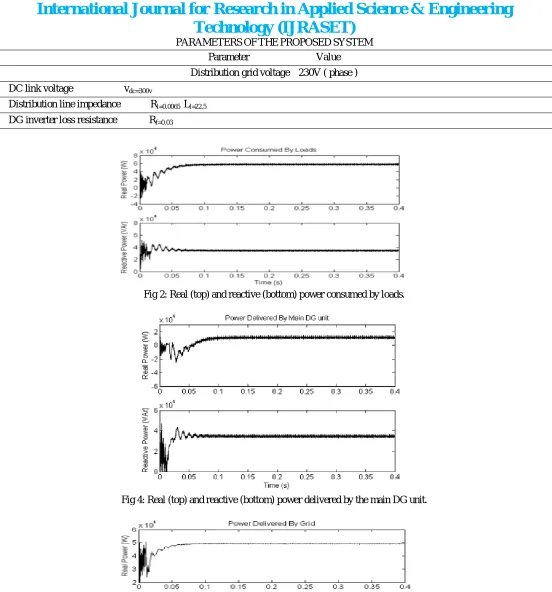
PARAMETERSOFTHEPROPOSEDSYSTEM
Parameter Value
Distribution grid voltage 230V ( phase ) DC link voltage vdc=300v
[image:5.612.32.584.40.632.2]Distribution line impedance Rl=0.0065 Ll=22.5 DG inverter loss resistance Rf=0.03
[image:5.612.173.434.353.528.2]Fig 2: Real (top) and reactive (bottom) power consumed by loads.
Fig 4: Real (top) and reactive (bottom) power delivered by the main DG unit.
[image:5.612.156.443.559.710.2]Technology (IJRASET)
©IJRASET: All Rights are Reserved
293
IV. CONCLUSION
In this paper, Coordination of active & reactive power from grid to micro grid using soft computing technique named greywolf optimizer is proposed. In this algorithm, a controller is proposed which gives the solutions individually for steady state and transient sub problem, there by decreasing working out time. To generate necessary references, the controller integrates with kalman filter to pull out harmonics of the load currents.. DG output changes dynamically due to sudden changes in load connected, it is necessary for a controller to tune automatically under such circumstances. In this work automatic tuning of power controller parameters subjected to load change is done by soft computing technique. Hence required load power is shared equally between microgrid and grid during the change in load.
REFERENCES
[1] Eneko Unamunon, Jon Andoni Barrena, “Hybrid ac/dc micro grids—Part I: Review and classification of topologies”, Renewable and Sustainable Energy
Reviews. vol. 52, pp. 1251–1259, 2015.
[2] Inam Ullah Nutkani, Poh Chiang Loh, Peng Wang, Tseng King Jet, Frede Blaabjerg, “Intertied ac–ac microgrids with autonomous power import and export”,
Electrical Power and Energy Systems. Vol. 65, pp. 385–393, 2015.
[3] M.S. Mahmoud, S. Azher Hussain, M. A. Abido, “Modeling and control of microgrid: An overview”, Journal of Franklin Institute. Vol. 351, pp. 2822-2859,
2014.
[4] Piagi P, Lasseter RH. Autonomous control of microgrids. In: Power engineering society general meeting. IEEE; 2006. p. 8
[5] Y.W. Li, et al., “Design, analysis and real-time testing of controllers for multi-bus microgrid system”, IEEE Trans. Power Electron. Vol. 19, pp. 1195–1204,
2004
[6] F. Katiraei, M.R.Iravani, “Power management strategies for a microgrid with multiple distributed generation units,” IEEE Trans. Power Syst. Vol. 21(4), pp.
1821–1831, 2006.
[7] Peng, Z. Fang, Yun Wei Li, Leon M. Tolbert, “Control and protection of power electronics interfaced distributed generation systems in a customer-driven
microgrid”, in: IEEE Power and Energy Society General Meeting (PES'09), IEEE, 2009
[8] Marwali, N. Mohammad, Jin-Woo Jung, Ali Keyhani, “Control of distributed generation systems. Part II. Load sharing control”, in: IEEE Trans. Power
Electron. Vol. 19(6), pp. 1551–1561, 2004.
[9] Dai Min, et al., “Power flow control of a single distributed generation unit”, IEEE Trans. Power Electron. Vol. 23(1), pp. 343–352, 2008
[10] Wang Y, Lu Z, Yong M, “Analysis and comparison on the control strategies of multiple voltage source converters in autonomous microgrid”, In: 10th IET
international conference on developments in power system protection (DPSP 2010). Managing the Change; 2010. p. 1–5.
[11] Bi Ying R, Xiang Qian T, Sha T, Xiang Dong S, “ Research on the control strategy of inverters in the micro-grid”, In: Power and energy engineering
conference (APPEEC), Asia-Pacific; 2010. p. 1–4.
[12] Bong-Hwan K, Byung-Duk M, Jang-Hyoun Y “An improved space-vector-based hysteresis current controller”, IEEE Trans Ind Electron. Vol. 45(5), pp 752–
760, 1998.
[13] Kazmier kowski MP, Malesani L. “Current control techniques for three-phase voltage-source PWM converters: a survey”, IEEE Trans Ind Electron Vol. 45(5),
pp 691–703, 1998.
[14] R. Zamora, A. Srivastava, “Controls for microgrids with storage: review, challenges, and research needs”, Renew. Sustain. Energy Rev. Vol. 14(7), pp. 2009–
2018, 2010.
[15] T.Ersal, C.Ahn,I.A. Hiskens,H.Peng, A.Stefanopoulou, J.L.Stein, “On the effect of DC Source Voltage on Inverter-Based Frequency and Voltage Regulation in