Sequencing and Scheduling of Jobs and Tools in a
Flexible Manufacturing System using Jaya
Algorithm
Modapothula Chaithanya1, N Siva Rami Reddy2, P Ravindranatha Reddy,
1
PG Student, Dept of Mechanical, AITS, Rajampeta, Kadapa, AP, India.
2
Professor, Dept. of Mechanical, AITS, Rajampet, Kadapa, AP, India.
3Assistant Professor, M.Tech, Dept of Mechanical, AITS, Rajampeta, Kadapa, AP, India.
Abstract: Jobs and tool flows are the two key factors in the operation of FMS. The work centre of FMS can process a group of jobs.
Tool magazine is in practice for FMS facilities in order to reduce tool inventory. In this paper jaya algorithm is proposed for
simultaneous scheduling of jobs and tools neglecting tool transfer times between machines it makespan as an objective. The
proposed heuristic is tested on various problems with makespan as objective and the results are compared with the results of the
existing methods. The results show that the proposed heuristic outperforms the existing methods.
Keywords: Scheduling, Flexible Manufacturing System, Jaya Algorithm
I. INTRODUCTION
At present, most industries are confronted with perpetual customer demands for a wider variety of products, faster production rates, shorter delivery time and more reliable delivery. The flexibility to manufacture a wide range of products in short time has been achieved at the expense of manufacturing efficiency. The primary goal of any manufacturing industry is to achieve a high level of productivity and flexibility which can only be done in a computer integrated manufacturing environment. The system should be flexible, productive and should be able to meet the demands within time bounds at a reasonable cost. FMS belongs to a class halfway amidst job shop manufacturing system and batch manufacturing system. An FMS has an integrated and computer controlled configuration which is capable of automatically changing tools and parts. These machines are interconnected by automatic guided vehicles, pallets and storage buffers that have flexibility that allows modifying system behavior on occurrence of changes whether predicted or unpredicted. It is modeled as a collection of workstations. The FMS should be designed to simultaneously manufacture different volumes of a varying variety of high quality products.
A flexible manufacturing system (FMS) is an integrated computer-controlled configuration in which there is some amount of flexibility that allows the system to react in the case of changes, whether predicted or unpredicted. FMS consists of three main systems. The work machines which are often automated CNC machines are connected by a material handling system(MHS) to optimize parts
flow and the central control computer which controls material movements and machine flow.
A. Flexible Manufacturing System
manufacturing cells. Today two or more CNC machines are considered a Flexible Manufacturing Cell (FMC), and two or more cells are considered a Flexible Manufacturing System (FMS)
Flexible manufacturing system is a computer controlled manufacturing system, in which numerically controlled machines are interconnected by a material handling system and a master computer controls both NC machines and material handling system.
B. Flexible Manufacturing System Layouts
Flexible manufacturing system has different layouts according to arrangement of machine and flow of parts. According to part flow and arrangement of machine, layouts of flexible manufacturing system are discussed below
C. In-Line Fms Layout
The machines and material handling system are arranged in a straight line. In Figure 1.1(a) the parts move from one workstation to the next in a well-defined sequence with work always moves in one direction and with no back-flow. Similar operation to a transfer line except the system holds a greater variety of parts. Routing flexibility can be increased by installing a linear transfer system with bi-directional flow, as shown in Figure 1.2(b). Here a secondary handling system is provided at each workstation to separate most of the parts from the primary line. Material handling equipment used: in-line transfer system; conveyor system; or rail-guided vehicle system.
Figure1.1In line FMS layout
II. LITERATURE REVIEW
For shop floor productivity improvement, scheduling is considered to be a major task. In scheduling problems, for ‘n’ jobs and ‘m’ machines (nl)mdifferent number of sequences are to be examined with respect to any performance measure, to suggest a best sequence. This implies that the search region is increased exponentially for problem of larger size that makes the scheduling problem as NP- hard problem.
Jerald and asokan [3] presented various optimization algorithms for solving FMS scheduling problems. In the FMS scheduling area, for optimization, earlier the researchers hard considered machine scheduling and tool scheduling as two separated problems, where as in recent years more attention has been paid for combined effect of machine scheduling and tool scheduling.
Several researchers have studied tool scheduling and allocation. Tsukada and shin [5], proposed a distributed artificial intelligence method for a tool scheduling and tool borrowing problem in FMS and also a polite tool sharing approaches to considered the unexpected arrival of jobs in a dynamic environment. It is shown that tool sharing between different cells in FMS reduces the tooling cost and increases the effective utilization of tools.
Jun, Kim and Sub [6], for provisioning problem and scheduling of tools in FMS, proposed a greedy search algorithm to determined the number of tools required from each type for minimizing make spam objective. also when the configuration of FMS changes due to change of the product mix, this method decides additional number of tools to be purchased.
Suresh kumar and sridharan [7] addressed sharing and scheduling of tools problem in FMS for minimizing the objectives such as mean tardiness, conditional mean tardiness and flow time by using scheduling priority rules and job scheduling priority rules sureshkumar et al [8] analyzed a tool scheduling problem in FMS by minimizing mean flow time, mean tardiness, mean waiting time for tool and percentage of tardy parts by using various priority dispatching rules. Agnetis et al [1] investigated a joint part/tool scheduling problem in a FMC. They proposed that all the tools are stored in a central tool magazine and moved throughout the cell by an automatic tool transporter. When the same tool is required by two machines, Tabu search algorithm was employed to resolve the conflict and make production schedules for minimizing makespan and maximum lateness. The FMC overall performance can be improved by the combined scheduling considering the secondary resource such as tools and fixtures. Prabhaharan, Nakkeran and Jawahar [9] attempted on joint operation tool scheduling problem in a FMC which consists of “m” identical work cells and a CTM. They proposed priority dispatching rule algorithm and simulated annealing algorithm to minimize makespan for joint job and tool scheduling. Udhaykumar and Kumanan [10] proposed ant colony optimization algorithm for job and tool scheduling problem. J. Aldrin Raj, D.Ravindren et al[11] addressed combined machine and tool scheduling in a FMS which consisted of machines and a central tool magazine. They proposed four heuristics namely priority dispatching rules modified non delay schedule generation algorithm with six different rules, modified Giffer and Thompson algorithm and AIS algorithm, to solve combined machine and tool problems with makespan as objective. They found that AIS algorithm yielded better results for simultaneous scheduling of machines and tools.
In this work three new meta heuristic search algorithms are used to minimize makespan by simultaneous scheduling of jobs and tools without considering tool transfer times and is explained in the fourth section.
III. PROBLEM FORMULATION
In general, FMS is provided with CTM for the storage of tools. The required tool is shared from other machines or transported from the
central tool magazine by a tool transporter during the machining of job. CTM reduces the number of tools required in the system and
thereby reduces the tooling cost. The problem definition and assumptions with constraints are given in the following sections.
A. Problem Definition
Consider the processing of ‘n’ jobs {J1,J2,…..,Jn} to be processed through ‘m’ machines {M1,M2,…..,Mm} and requires tools from
minimizes the makespan by applying heuristic procedures. In the present work, jaya algorithm is used to generate optimal schedules
with makespan as objective. The same sets of problems that were analyzed with methods explained in [4] are considered and the
results of proposed met heuristics are compared with those results.
The procedure employed is illustrated with an example problem in table 1, the jobs, machines and tools shown are considered for a job
set 2. The job set 2 consists of 6 jobs, the first 3 jobs have two operations and other 3 jobs have three operations and it is assumed that
the system has four machines and four tools. For example M1-T3[10] explains that job 1 requires machine M1, tool T3 and processing
time of 10 units. It is required to propose a sequence of jobs that minimizes the make span by considering machine and tool constraints.
During the process of scheduling, it is required to make a decision on selection of machine and tool for every job. Both machine and
CTM will have a set of requests as a queue from unfinished jobs. A right job with the request has to be selected so as to minimize the
makespan. Thus, a sequence of jobs is formed that minimizes the total elapsed time.
B. Fms Environment
The FMS environment considered here consists of four machines, a CTM consisting of four tools, one automatic tool changer (ATC),
the AGVs and tool transporter (TT). On one end there is loading and unloading station. Buffer storage at each machine center is
provided to store the jobs before and after processing. There is an automated storage and retrieval system (AS/RS) for storage of raw
materials and retrieval. The system is shown in fig.3.1 with the elements.
1) Assumptions and constraints
The problem under study is assumed to have the following assumptions:
a) Each job has ‘j’ distinct operations.
b) Required machines and tools to process each operation are known in advance before scheduling. c) Each job has its own processing order and there are no technological constraints.
d) Each job has set of operations, the sequence of operations and its corresponding process times are pre-specified. e) Each machine can process only one job at a time.
f) All the jobs and machines are simultaneously available in the beginning. g) Set-up times of operations are included in the processing times.
j) Tools are moved throughout the system by a tool transporter. k) Tools are shared among machines in the system.
The constraints of the problems are as follows:
Precedence constrains exist, that is every job has a set of predetermined sequence of operations that cannot be changed. For example, consider the operation (1114),
1 – Job number
1 – First operation on job number 1
1 – First operation of job number 1 is performed on machine number 1
4 – Tool number is needed for the first operation of job number 1 with machine number 1.
The second operation of job number 1 cannot be processed before completion of first operation, and hence the operation 12XX cannot
be placed before 11XX. This restriction in processing of the job is called precedence constraint
IV. METHODOLOGY AND WORK
A. Jaya Algorithm
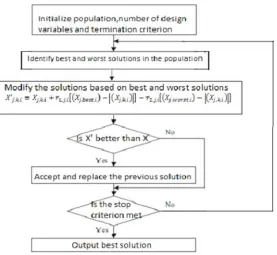
[image:6.612.204.481.444.699.2]Jaya algorithm is another powerful parameter less algorithm for finding optimal solutions. In this algorithm also only common control parameter is required like TLBO algorithm that is population size and number of generation size. JAYA algorithm always tries to improvise the solution to avoid the worst solution. JAYA algorithm has only one phase and it is relatively simpler to use for any specific problems. First of all needs to initialize the population size, iteration number which is a common control parameter, then identify the best and worst solution for a given population. The important step of the algorithm is a modification of the solution by evaluating the best and worst result for the particular objective function and problem defined for minimization or maximization. r1 and r2 are any two random numbers in between 0 and 1.
Table no: 4.1 Job set details
V. RESULTS AND DISCUSSION
The optimization of make span in the FMS by scheduling of jobs, machines and tools has been executed by the proposed algorithms. Totally 22 job sets are considered in the work and the data of these job sets is given in appendix 1. The job sets with different number of jobs, machines and tools with their processing times have been taken into account to test the efficiency of proposed methods. The details of the job sets such as the number of jobs, number of operations in each job, maximum number of operations among jobs, total number of operations of all jobs, number of machines and number of tools used in job set are presented in table 4.1. All the job sets use four machines and four tools except job set 21 and 22. The job set 21 uses six machines and six tools whereas job set 22 uses eight machines and eight tools. The minimum number of jobs is five (for job sets 1, 4, 5, 9, 13 and 19) and the maximum number of jobs is 20 (for job set 22) among the job sets. Total number of operations in job sets varies from 13 (for job set 1 and 5) to 151 (for job set 22). The results are compared with results of existing methods and are shown in table 4.2. The objective function developed in this work tested optimal sequences provided by the existing AIS method [4] and are corresponding makes pans obtained are same as given [4]. From table 4.2 it is observed that the proposed methods have provided that sequences with better make pans than in [4]. So the solutions provided by the existing methods are only local optimal whereas the solution provided by the proposed methods are global optimal or near optimal solutions.
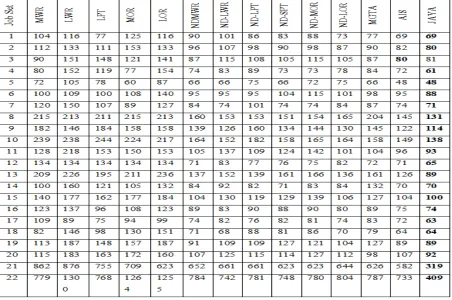
The minimum make span is represented and it is observed that proposed methods have outperformed all existing methods for all 22 job sets. Table 5.1 shows the percentage improvement in make span of the proposed methods with respect to best and poorest makes pans of existing methods. For majority job sets improvement is noticed. Percentage improvements in make span over the best make span of existing methods are for job set 22 44.2% and for job set 21 45.19% given by Jaya algorithm. Percentage improvements in make span over the poorest make span of existing methods are for job set 22 is 68.54% and for job set 21 is 63.58% given by Jaya algorithm. For job set 21 the total number of operations is 110 and for job set 22 it is 151. It is observed that the proposed methods are providing better solutions for the problems which have large number of jobs and operations. The percentage improvement obtained by the proposed method over the best make span of existing method is more than 10% for 5 job sets (job sets 4, 13, 17, 21 and 22), between 5-10% for 7 job sets (for job sets 6, 7, 8, 9, 10, 12 and 20), less than 5% for 3 job sets (for job sets 2, 11 and 15) and no improvement for 7 job sets.
Table no: 5.1 Results and Analysis
Figure: 5.1 Comparison of Makespan for job set 22
Figure: 5.2 Gantt chart for job set 5
VI. CONCLUSION
Scheduling of jobs, tools and machines is performed with the proposed algorithm and it is noticed that proposed algorithm outperform the existing methods in minimizing make span. The proposed algorithm has 22 job sets to show its consistency. The work can be extended further by considering travelling time of jobs between machines that influence the makespan.
REFERENCES
[1] Agentis, A; Alfieri, A; Brandimarte, P; Princsecchi, P: Job/Tool Scheduling in a Flexible Manufacturing Cell with No On-Board Tool Magazine, ‘Computer
Integrated Manufacturing System’, vol. 10, no. 1, 1997, 61-68.
[2] Baker, KR: Introduction to Sequencing and Scheduling, Wiley, New York, 1974.
[3] Jerald, J; Asokan, P: Simultaneous Scheduling of Parts and Automated Guided Vehicles in an FMS Environment using Adaptive Genetic Algorithm,
‘International Journal of Advanced Manufacturing Technology’, vol. 29, no. 5,2006, 584-589.
[4] Lee, D; Dicesare, F: Integrated Scheduling of FMSs Employing Automated Guided Vehicles, ‘IEEE Transactions on Industrial Electronics’, vol. 41, no. 6, 1994,
602-610.
[6] Jun, H; Kim, Y; Sub, H: Heuristics for a Tool Provisioning in a FMS without an Automatic Tool Transporter, ‘IEEE Transactions on Robotics and
Automation’, vol. 15, no. 3, 1999, 488-497.
[7] Sureshkumar, N; Sridharan, R: Simulation Modeling and Analysis of Tool Flow Control Decisions in Single Stage Multimachine FMS, ‘Robotics and Computer
Integrated Manufacturing’, vol. 23, 2007, 361-370.
[8] Sureshkumar, N; Sridharan, R: Simulation Modeling and Analysis of Tool Flow Control Decisions in a FMS, ‘Robotics and Computer Integrated
Manufacturing’, vol. 25, 2009, 829-838.
[9] Prabhaharan, T; Nakkeeran, PR; Jawahar, N; Sequencing and scheduling of Job and Tool in Flexible Manufacturing Cell, ‘International Journal of Advanced
technology’, vol. 29, no. 3, 2006, 729-745.
[10] Udhayakumar, P; Kumanan, S: Sequencing and Scheduling of Job and Tool in Flexible Manufacturing System Using Ant Colony Optimization Algorithm,
‘International Journal of Advanced Manufacturing Technology’, vol. 50, no. 9, 2010, 1075-1084.
[11] Aldrin Raj, J; Ravindran, D; Saravanan, M; Prabharan, T: Simultaneous Scheduling of machines and tools in multimachine flexible manufacturing system
using artificial immune system algorithm, ‘International Journal of Computer Integrated Manufacturing’, vol. 27, no. 5, 2014, 98-112.
[12] Cheng, Min-Yuan; Prayogo, Doddy: Symbiotic Organisms Search : A new metahueristic optimization algorithm, ‘Computers and Structures’, vol. 139, 2014,
98-112.
[13] Askarzadeh, Alireza: A novel metahueristic method for solving constrained engineering optimization problems: Crow search algorithm, ‘Computers and
Structures’, vol. 169, 2016, 1-12.
[14] Yang, Xin-She: Flower Pollination Algorithm for global optimization, Unconventional computation and natural computation 2012, LNCS’, vol. 7445, 2012,