Technology (IJRASET)
Smart Transport Database Management System
Saravanan.R1, Vishal.J.S2, Gokul Raj.M3, Ramanarooban.M4, Jagadeesh Raja.M5
1, 2, 3, 4
B.E/EEE, 5Assistant professor/EEE Knowledge Institute of Technology, Tamilnadu, India.
Abstract--In the current scenario, automation plays major role in various sectors because of provide reliable products, performing hazardous tasks, and monitoring continuously without relaxation. These properties of automation have made the industries to adopt this technique for their profits and benefits. In some Organizations, the vehicle monitoring is a complex process. Due to manual process, it is difficult to determine the exact monitoring and reporting for vehicles which travels from the premises to outer area and from external area to the premises. This novel project idea proposes an automatic device to recognize an authorized and unauthorized vehicle in an organization. In addition to that, the fuel level in the vehicle can be identified using float sensor. Furthermore, the distance travelled by the vehicle can also be detected using odometer. These data’s can be acquired by communicating the information using wireless technology. This system will be useful to monitor the status and performance of vehicle in the organization and also to know the fuel level, distance travelled, arrival and departure time from the organization through the data base where manpower can be eliminated for performing such a task.
Keywords: RF Transmitter, RF Receiver, Odometer, Diesel Level Sensor and PC.
I. INTRODUCTION
In general, the need for automation increases proportionally with growth in usage of automobiles. In some places, the vehicle entry and its departure is restricted as it is the property of that specific organization. In most system, the vehicle detection is done by camera which involves image processing (Optical Character Recognition System, OCR) and much hardware for identifying the alphanumeric characters in the number plate[1]. It involves image manipulation, detection, normalization and enhancement of the image. It also requires different algorithms for the recognition of registered number plate of the vehicle. This type of system is complex to identify the register number of the vehicle. Even the number plate used is having different pictures and font style which make it tedious to identify the correct data from the number plate. Sometimes the image may not be captured correctly as it will be hazy image or there may be flaw in the angular capturing of the image. In order to overcome these problems, we could use the
signal detection method which is quite easy to implement and to get the required data from the system.The objective of our project
work is to assure safety in organization, by introducing such an arrangement in the automobiles which will help the authorized people to recognize the vehicle entering and leaving the organization. The fuel level in the tank cannot be determined easily. The Float sensor is used to determine the amount of fuel available in the tank. The distance travelled by the vehicle is also unknown by people. This information like the amount of fuel and the distance travelled by the automobile is needed by the mobilization to the in
charge of the organization. In this system, First of all, we are detecting the presence of a vehicle at a certain area. Secondly, the
diesel level in the tank is found by the use of float sensor. Finally, the distance travelled by the vehicle is obtained from the speedometer with some arrangements. The above parameters are communicated using wireless RF technology. This project can be further improved by the inclusion of some other parameters which are significant to consider in an automobile. The communication technology can be further improved by using some other signals which are highly communicative to a large area. This will increase the sensing level in the system.
II. LITERATURE SURVEY
Dileep Kumar et al., [1] “RFID and Camera-based Hybrid Approach to Track Vehicle within Campus”. In this paper, they have
used License plate recognition system, RFID (Radio Frequency Identification) and Camera for the recognition the authorized vehicle using image processing technique. It is a tedious process which requires certain characteristics like rectangular plate, white board with black letters. It is impossible to have a standard number plate like this as the people try to have their automobiles number plate to be unique from others.
E.Sifuentes et al., [2] “Wireless Magnetic Sensor Node for Vehicle Detection with Optical Wake-Up”. In this research paper, they
have used Wireless sensor network (WSN), Magnetic and Optic Sensors for the detection of vehicle. The main drawback in this system is the power drainage taking place while detecting a vehicle based on the magnetic field sensed by the sensor.
Qi Zhang et al., [3] “Forest intrusion detection system with sensor network”. In this research work they have used Wireless
Technology (IJRASET)
an expensive method as it requires accelerometer; magnetometer; geophone, sensor network and intrusion detection.
Bhupendra Moharil et al., [4] “An Efficient Approach for Automatic Number Plate Recognition System Using Quick Response
Codes”. In this idea, they have used QR (Quick Response) code for the identification of the vehicle. This is present in the top of the automobile which is taken snap shot by a camera and it is processed to find out the possessor of that specific vehicle. It has some drawbacks like comparison of the QR code with data base details is time consuming and duplicate code detection is also made by monitoring the movement in that area and the other area in which the original vehicle is present.
Kamaljit Kaur et al., [5] “Automated Vehicle Tracking System (VTS) using Image Processing Techniques”. In this system, they
have used CCD cameras along with image processing algorithm for detection. It uses fuzzy logic for the identification and noise and errors are produced in this method as it uses complex logics.
III. PROPOSED METHOD
A. Transmitter Section
In this section, we are using Unique RF signals for the recognition of different vehicles and we are also getting the information like fuel level in the tank and the distance travelled by the vehicle are obtained from the microcontroller through wireless data transmission using RF Transmitter.
The proposed system uses the module which will detect the signal at a range of 100m. The signal generated will be at the frequency range of 300MHz to 345MHz.
B. RF Transmitter
This module has a circuit for encoding the signal for transmission and other devices like power modulator and signal amplifier. The RF signal produced is varied by changing the amplitude of the carrier wave. This modulation of the carrier wave will produce the signal uniquely which will help to identify the specific vehicle
C. Fuel Level Sensor
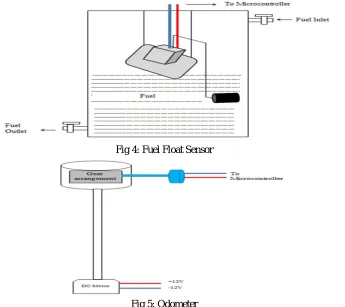
It senses the amount of fuel present in the tank and sends this data to the microcontroller for updating the information in the data base for future references. In this project, a float sensor is used as fuel level detector. The float sensor consists of a float material at one end and a spring at the other end. Whenever the floating level changes the spring resistance changes which can be used to find out the amount of fuel present in the tank.
D. Odometer
It is a device which measures the distance travelled by the vehicle. This data is transmitted to a microprocessor in digital form to transmit the data through a RF transmitter. In the proposed system a speedometer with mechanical counter arrangement for the measurement of distance travelled by the automobile is used. The gear movement is tapped through a 100KΩ Potentiometer. So that the distance travelled by the vehicle can be determined according to the rotation and resistance variation through the potentiometer. This data is transmitted to the microcontroller for the processing and determination of distance travelled by the vehicle.
E. Receiver Section
In this part, the signal obtained will have noises and errors. So they are filtered, amplified and processed using a microcontroller. These data are then transmitted to a data base which is taken care by the respective higher official or respective in-charge in the organization.
F. RF Receiver
This module has a circuit for decoding the obtained signal and other devices like filter and signal amplifier.
G. RTC
Technology (IJRASET)
H. Data Base [image:4.612.145.468.109.287.2]The information obtained through the receiver is stored in the data base for the usage by automobile in-charge of the organization.
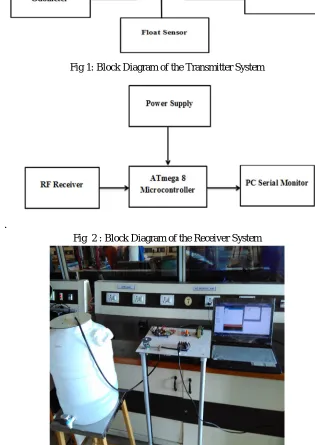
Fig 1: Block Diagram of the Transmitter System
[image:4.612.139.454.233.678.2].
Fig 2 : Block Diagram of the Receiver System
Technology (IJRASET)
IV. EXPERIMENTAL ANALYSIS
[image:5.612.142.487.152.459.2]In the Proposed Method, only three parameters are considered for analysis and determination as they are significant in an automobile. They are time of arrival, fuel level in tank and distance travelled by the vehicle. The float sensor and odometer data is obtained through analog pins in the arduino. These data are then digitalized in the microcontroller for sending through a wireless RF Transmitter. A 12V DC Motor is used to drive the Speedometer in replacement for the automobile wheel motion for the analysis.
[image:5.612.98.511.503.704.2]Fig 4: Fuel Float Sensor
Fig 5: Odometer
The data obtained by the receiver is send to the digital pin of an arduino which is interfaced to a PC using Arduino IDE. A RTC is also connected to this Microcontroller to act as a time and date information provider to the microcontroller. The Serial Monitor option in the Arduino IDE provides the necessary data obtained by the Receiver along with date and time is shown below in Fig 5.
[image:5.612.101.510.505.704.2]Technology (IJRASET)
V. CONCLUSION
Technology development is an ultimate aim in all sectors. Especially, more new technologies are emerging in automobile field for the betterment of people and to serve the people. The proposed arduino based indicating device acts as an assist to control, monitor and trace a vehicle. This also reduces the stress of repeated checking about the status of vehicle in the organization. It also has an appreciable advantage such as small size and completely automated. Definitely, this device will help the people to know about the automobile status especially through monitoring system with less initial investment if implemented in real time work.
REFENENCES
[1] Dileep Kumar, Pankaj Pratap Singh and Shirshu varma, “RFID and Camera-based Hybrid Approach to Track Vehicle within Campus”, International Symposium on Computing, Communication, and Control (ISCCC 2009) Proc .of CSIT vol.1 (2011) © (2011) IACSIT Press, Singapore 2009.
[2] Sifuentes. E, Casas. O, Pallas-Areny. R “Wireless Magnetic Sensor Node for Vehicle Detection with Optical Wake-Up”, IEEE Sensors Journal, Vol. 11, No. 8, August 2011.
[3] Qi Zhang , Gang Wang, Kai Gong, Baopu Li, Meng, M.Q.H, Shuang Son R “Forest intrusion detection system with sensor network”, International Conference on Information and Automation Yinchuan, China, August 2013.
[4] Bhupendra Moharil, Vijayendra Ghadge, Chaitanya Gokhale, Pranav Tambvekar “An Efficient Approach for Automatic Number Plate Recognition System Using Quick Response Codes” International Journal of Computer Science and Information Technologies (IJCSIT), Vol. 3 (5) , 2012,5108 – 5115. ISSN: 0975-9646.
[5] Kamaljit Kaur, Dr. Rinkesh Mittal “Automated Vehicle Tracking System (VTS) using Image Processing Techniques”, International Journal of Advanced Research in Computer Science and Software Engineering, Volume 5, Issue 4, 2015. ISSN: 2277 128X
[6] Sachin S. Aher and Kokate R. D. “FUEL MONITORING AND VEHICLE TRACKING USING GPS, GSM AND MSP430F149”, International Journal of Advances in Engineering & Technology, July 2012. ©IJAET ISSN: 2231-1963.
[7] Kunal D. Dhande, Sarang R. gogilwar, Sagar Yele, Ass. Prof. Vivek Gandhewar “Fuel Level Measurement Techniques: A Systematic Survey”, International Journal of Research in Advent Technology, Vol.2, No.4, April 2014. E-ISSN: 2321-9637
[8] S.-B. Kim, J.-C. Bazin, H.-K. Lee K.-H, Choi S.Y. Park, “Ground vehicle navigation in harsh urban conditions by integrating inertial navigation system, global positioning system, odometer and vision data” IET Radar Sonar Navig., 2011, Vol. 5, Iss. 8, pp. 814–823 & The Institution of Engineering and Technology 2011 doi: 10.1049/iet-rsn.2011.0100