5
VIII
August 2017
Analysis and Study of Harmonics Reduction by
Using Passive Harmonics Filter
Rahul Yadav1 and Mr. Naveen Goel2
1M-Tech, 2Assistant Prof. (H.O.D), Department of Electrical Engineering
Shri Shankaracharya Group of Institution, C.S.V.T.U, Bhilai, C.G. India
Abstract: Both electric utilities and end users of electric power are becoming increasingly concerned about the quality of electric power. It is an umbrella concept for a multitude of individual types of power system disturbances. One such major concern is the harmonics which is made the focus of study in this work. When electronic power converters first became commonplace in the late 1970s, many utility engineers became quite concerned about the ability of the power system to accommodate the harmonic distortion. Harmonics problems counter many of the conventional rules of power system design and operation that consider only the fundamental frequency. Therefore, the engineer is faced with unfamiliar phenomena that require unfamiliar tools to analyze and unfamiliar equipment to solve. This thesis is basically concerned with the Analysis and Mitigation of Harmonics generated by Power Electronic Converters. The investigation of harmonics has been carried out using Fast Fourier Transform (FFT) to evaluate the Total Harmonic Distortion (THD) of the converters with and without filters. And MATLAB/SIMULINK has been employed for presenting the simulation results because it is well established and recognized simulation software for the power system. Next, the designing of Passive Filter is carried out after a literature review and have been applied to the converters for harmonics mitigation.
Keywords: Total Harmonics Distortion (THD), FFT, Passive Filter, MATLAB software
I. INTRODUCTION
In Harmonics are the sinusoidal waveform of currents and voltages having frequencies that there is an integer numbers of the frequency at which the supply power system is designed to operate. Harmonics are combined with their fundamental voltage and current can produce waveform distortion. In Harmonic (disturbance) distortion exists due to the non-linear characteristics of devices (system) and loads on the electric power system. Current distortion results as these voltages causes non-linear voltage drops across their system impedance (Z). When their industrial loads like as discharge lighting and electric arc furnaces can causes the harmonic distortion. Their effect of harmonics in the electrical power system includes the loss of data, overheating device or damage to sensitive equipment and more heating of capacitor banks. The Maximum frequency harmonics may also causes interference to nearby which telecommunication system [1]. When their Harmonic current and Voltage is isolated by using harmonic filters in order to protect the electrical equipment from getting damaged due to harmonic current distortion. They can also to be used to improve their power factor. Harmonic distortion is a growing concern for their many customers and for the overall electrical power system due to increasing application of power electronics equipment. Harmonic distortion high levels can be found throughout the complete their harmonic spectrum, their magnitudes of each an individual harmonic component are varying their inversely with position in the spectrum. Furthermore, the phase angle of each component is unique into itself. It is also common to use a single quantity, the (THD) total harmonic distortion, where measure of the magnitude and angle of harmonic distortion. Now in recent days Electrical power quality in electrical energy system has become a major challenge to engineers to maintaining the sinusoidal waveform in the device. if any distortion come in the waveforms is known as Harmonic Distortion in the system.
alternator and prime movers, failure of insulation problems, failure of control system & unpredictable behaviour of protection & relay connected in System etc. All these above said problems and identified are severe for the electrical power system, so the harmonic mitigation is the important for both points of view of consumers and utilities end [4]. In Electrical Harmonic filtering technique by using passive filters and it is one of the most used and earliest technologies present in the system used to address the harmonics mitigation in system. The Passive filters has been used very widely uses because it is very simple and easier designing process and low cost factors. In their harmonics is sinusoidal waveform of currents or voltages having frequencies that are integer numbers of the frequency at which the supply power system is designed to operate. Harmonics are combined with their fundamental voltage and current can produce waveform distortion. In Harmonic (disturbance) distortion exists due to the non-linear characteristics of devices (system) and loads on the electric power system. Current distortion results as these voltages causes non-linear voltage drops across their system impedance. Industrial loads like electric arc furnaces and discharge lighting can cause harmonic distortion. The effect of harmonics in the power system includes the corruption and loss of data, overheating or damage to sensitive equipment and overheating of capacitor banks. The high frequency harmonics may also cause interference to nearby telecommunication system [5]. Harmonic current is isolated by using harmonic filters in order to protect the electrical equipment from getting damaged due to harmonic voltage distortion [6]. They are also be used to improving the electrical power factor. Harmonic distortion is a growing concern for many customers and for the overall power system due to increasing application of power electronics equipment. Harmonic distortion levels can be found throughout the complete harmonic spectrum, with the magnitudes of each individual harmonic component varying inversely with their position in the spectrum. Furthermore, the phase angle of each component is unique into itself. It is also common to use a single quantity, the total harmonic distortion (THD), as a measure of the magnitude of harmonic distortion. Passive filters exhibit the best relationship cost-benefit among all other mitigation techniques when dealing with low and medium voltage rectifier system [1-4]. They supply Real and reactive power to the system while being highly effective in attenuating harmonic components. In Typically, Passive filter banks installed in medium-voltage systems are able to provide satisfactory to reduction in currents and voltages distortions after their planning and design the other solution is the application of active filters [5-7]. These Electrical devices operate by rectification the waveforms and storing its all energy in the DC side; then, an inverter typically transforms this energy to AC to new reconstruct the waveforms at a desirable magnitude. Active filters operate very as well as in low voltage power systems, but their complexity and cost when operating at medium- and high voltage systems usually make them non-regarded as viable [8]. Therefore, their passive filters (R-L-C) are still most suitable are mitigating scheme, even though are in mature subject.
II. CLASSIFICATIONOFPOWERSYSTEMDISTURBANCES
Electrical Power quality problems occur due to various types of electrical disturbances. Most of the disturbances depend on amplitude and magnitude or frequency or on both frequency and amplitude. Based on the duration of existence of EPQ disturbances, events can divided into short, medium or long type. These disturbances are mainly classified as:
A. Interruption/under voltage/over voltage B. Voltage/Current unbalance
C. Harmonics D. Transients
E. Voltage Sag F. Voltage Sag G. Flicker H. Ringing waves
III. PASSIVEFILTER
them from affecting the circuit. The tuning depends on the configuration of the filter designed. The passive filter is a very good choice for constant loads and is a cost effective solution to harmonic reduction and power factor improvement. All these advantages can be lost if the input filter is not properly designed. An oversized input filter unnecessarily adds cost and volume to the design and compromises system performance Proposed Filter Connections This project explains how to design the optimal input filter for a two pulse diode rectifier application using optimization. For a two pulse diode rectifier circuit with low power rating, using a passive filter is best suited. In most of the cases a passive filter involves an RLC combination tuned (shunt and series) to serve the purpose. The proposed RLC filter approach to reduce line current and voltage harmonics generated by two diode rectifier. The simple passive-filter solution is the R-L-C passive filter equivalent circuit. The transfer functions of the filter:
Fig. 1 DC line inductance based passive filtering
Fig. 2 Tuned series passive filter type.
A Passive shunt filter very low impedance (Z) path at the frequency to which it is tuned and it shunts most of the harmonic current at that frequency. When their most common Passive shunt filter types are the single tuned and high-pass filters. The layout of this practical passive shunt filter.
Fig. 3 Shunt passive filter type
IV. MATLABSIMULATION&RESULTS
The passive filters are used to mitigate power quality problems in ac-dc converter with R-C load. Moreover, apart from mitigating the current harmonics, the passive filters also provide reactive power compensation, thereby, further improving the system performance. Voltage and current source type of harmonic producing loads, generally, passive shunt filters and passive series filters are recommended. These filter apart from mitigating the current harmonics, also provide limited reactive power compensation and dc bus voltage regulation. The performance of these Passive filters depends heavily depends on the source impedance present in the system or device, as these filter act as sinks for the harmonic currents. On the other hand, for voltage source type harmonic producing loads, the use of the series passive filters is recommended.
source impedance. But, passive filter like shunt and series filter suffer due to the reduction in dc link voltage and current due to the voltage drop across the passive filter components at both fundamental as well as fundamental harmonic frequencies. These passive filters block the flow of harmonic current and voltage into ac/dc mains, by providing large impedance path at certain harmonic distortion frequencies for which the filter is tuned. Moreover, the harmonic compensation is practically independent of the source impedance. But, passive filter like shunt and series filter suffer due to the reduction in dc link voltage and current due to the voltage drop across the passive filter components at both fundamental as well as fundamental harmonic frequencies
A. Case 1-Model Running without Harmonic Filters
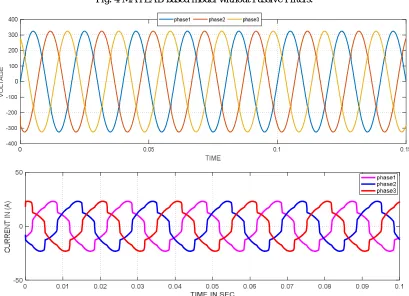
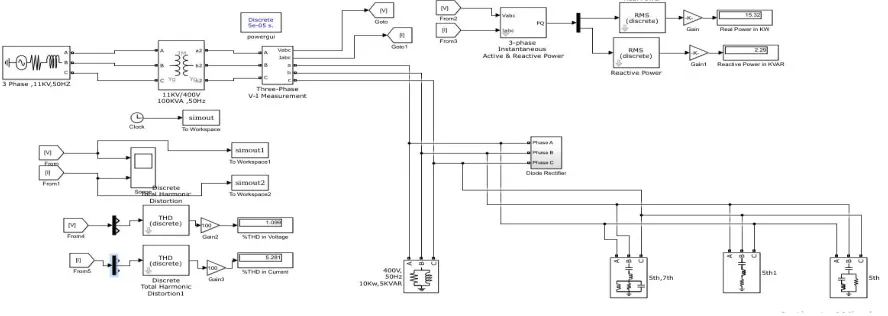
[image:5.612.95.517.219.390.2]In the Simulink model, the HVDC rectifier is built up from two 6-pulse thyristor bridges connected in series. The converter is also to connected to the electrical power system system with a 11kVA three-phase transformer (three windings). A 50kVAR resistive load is connected to the DC side through a 0.5H smoothing reactor as shown in Fig.4
Fig. 4 MATLAB based model without Passive Filters.
[image:5.612.102.511.414.710.2]B. Case 2-Model Running with C-types High Pass+ Double Tuned+ Single Tuned Harmonic Filters
MATLAB based model with three-phase C-types high pass+ double tuned+ single tune passive Filters is as shown in Fig. 6 When the model is running with load on condition with harmonic filters installation, the status of voltage and current waveforms and Fig. 7 As shown in Fig. 8 voltage and current waveforms change to smooth by the effect of C-types high pass+ double tuned+ single tune harmonic filters installation.
[image:6.612.83.527.160.318.2]
Fig. 7 Voltage and Current Waveform with C-types high pass+ double tuned+ single tuned Harmonic Filters.
V. PASSIVEFILTERDESIGNWITHHARMONICBEHAVIOUR
These Passive filters block the flow of harmonics current and voltage into ac mains, by provide the high impedance (Z) path at certain harmonic frequencies for which the Passive filter is tuned. Moreover, In harmonic compensation is practically independent of the source impedance. But, passive filter suffer due to the less in dc link voltage due from the voltage drop across the filter components at both fundamental as well as harmonic frequencies In this project we studies and discuss electricity or electrical power are increases day by day and transmits more electrical power by rapidly increasing the transmission line capacity from one station to another station.
In passive harmonic filters, preventing the circulation of the unwanted harmonic currents in the power system can be achieved by the usage of a high series impedance to block them (series filter concept) or by diverting the harmonic currents to a low impedance shunt path (shunt filter concept). They are also employed either to passive shunt and passive series the harmonic currents and voltage off the line or to block their flow between parts of the system by tuning the elements to create a resonance at a selected frequency.
In passive harmonic filters, preventing the circulation of the unwanted harmonic currents in the power system can be achieved by the usage of a high series impedance to block them (series filter concept) or by diverting the harmonic currents to a low impedance shunt path (shunt filter concept). AC line reactor filter and DC-link inductor filter are the two purely inductive type filters. AC line reactors offer a considerable magnitude of inductance that alters the shape or form factor the current waveform drawn by the rectifier bridge.
VI. CONCLUSIONS
This Paper has presented a brief idea about their harmonic & their consequences effect on the distribution & Distribution line system here we also study the basic their harmonic mitigation technique which is now a days applying in fashion. Here we presented this project a brief idea about the designing and construct process of passive filter for the mitigation of harmonic distortion in the system. When it improves the electrical power quality and total harmonics distortion and gives us the pure sinusoidal wave. Passive power filters are the emerging devices, which can perform the job of harmonic elimination properly. First their harmonic disturbances are detected from the electrical power line using transducers, and then harmonic waveform is separated from the fundamental sine wave using reference signal estimation techniques. The Pulse Width Modulation signals for their controlling purpose are then generated using any one of control signal generation schemes. Thus a passive shut filter and passive series filter will provide harmonic elimination with better controlling methods.
A. Many number of filters are required for mitigating more harmonic Distortions orders. This might also increase the initial capital cost.
B. In system flexibility in control cannot be achieved using passive filters but the contrary electrical power systems are also dynamic in nature and hence there is need for automated control.
REFERENCES
[1] Thet Mon Aye and Soe Win Naing, “Analysis of Harmonic Reduction by using Passive Harmonic Filters” IJSETR ISSN 2319-8885 Vol.03, Issue.45 December-2014, Pages: 9142-9147.
[2] D.Maheswaran, N. Rajasekar, L. Ashok kumar,” Design of passive filters for reducing harmonic distortion and correcting power factor in two pulse rectifier systems using optimization” Journal of Theoretical and Applied Information Technology 30th April 2014. Vol. 62 No.3
[3] Hamid Rahimi Esfahani, Rasoul Amirfattahi, Farshad Kiyoumarsi, and Ebrahim Borzabadi, “Designing Passive Filters for Harmonic Reduction in a Noisy System Based on Discrete Wavelet Transform” International Journal of Computer Theory and Engineering, Vol. 4, No. 5, October 2012
[4] Gonzalez, D. A “Harmonics Mitigation of Industrial Power System Using Passive Filters” Mehran University Research Journal of Engineering & Technology, Volume 31, No. 2
[5] Zubair Ahmed Memon, “Design of Three-Phase Hybrid Active Power Filter for Compensating the Harmonic Currents of Three-Phase System” Mehran University Research Journal of Engineering & Technology, Volume 31, No. 2
[6] Surajit Chattopadhyay ,Madhuchhanda Mitra, Samarjit Sengupta , “Electric Power Quality”
[7] Bollen, M.H.J.: Understanding Power Quality Problems-Voltage Sags and Interruptions. IEEE Press, NewYork (2001)
[8] N. Mohan, T.M. Undeland, W.P. Robbins, Power Electronics-Converters, Applications, and Design, John Wiley & Sons, Inc., New York 1989. [9] Taylor, J.T. and Huang, Q.: Handbook of Electrical Filters, Boca Raton, Fla, (1997).
[10] Yacamini, R.: Power System Harmonics, (1996) 185– 93.
[11] Bose, B.K.: Modern Power Electronics Evolution, Technology and Applications, (1992).
[12] Akagi, ΄΄Control Strategy and site selection of a shunt active filter for damping of harmonies propagation in power distribution systems ΄΄, IEEE Trans. on
[13] Lecture notes: harmonic analysis Russell Brown,Department of mathematics University of Kentucky Lexington, KY 40506-0027 12 June 2001
[14] Harmonics, Sources, Effects and Mitigation Techniques Ali I. Maswood and M.H. Haque School of EEE, Nanyang Technological University Second International Conference on Electrical and Computer Engineering ICECE 2002, 26-28 December 2002, Dhaka
[15] Roger C.Dugan, Mark F. McGranaghan, Surya Santoso and H.Wayne Beaty, Electrical Power System Quality, McGraw Hill, pp 324-425, 2002. [16] Update of Harmonic Standard IEEE-519, "IEEE Recommended Practices and Requirements for Harmonic Control in Power Systems", October 1991. [17] Swamy M.M.: Passive Harmonic Filter Systems for Variable Frequency Drives, U.S.Patent no: 5,444,609, August, (1995).
[18] A.A. Girgis, et al, "Measurement and Characterization of Harmonic and High Frequency Distortion for a Large Industrial Load", IEEE Transactions on Power Delivery, No.70, pp.427-434, April 1989.
[19] Takahashi, and Y. Omura, “High power active filter using LC tuned filter”, JIEE Trans. Ind. Appl. D 112 (9), 823–828 (1992), (in Japanese )