Technology (IJRASET)
Evaluating the Effect of Modified Bitumen after
Short-Term Aging using FTIR Spectroscopy &
SEM
Kinjal Surti1, Prof. C.B.Mishra2
1,2
M.tech Transportation Engineering (Civil), B.V.M engineering college
Abstract: In the developing country like India, growth of urbanization is a vital process ultimately leads to the vehicle growth and thus the load on the pavement increases which leads to distress of the pavement. Major problem in pavement seen is the aging of the pavement and to overcome such problem an attempt is made formed polymer modified bitumen using different type of polymer. Here elastomer like SBS and ETP-5170 are used as a modifier to form a long lasting pavement which has a least effect of the climatic condition and thus withstand against aging process which occurs in the bitumen. Here the analysis made using the technique like FTIR and SEM so as check the functional group present in the polymer modified bitumen which help to prevent distress and dispersion of the polymer in the bitumen respectively.
Keywords: VG-10; Aging; SBS; ETP; FTIR; SEM.
I. INTRODUCTION
Bitumen is one of the most important ingredients in the construction of the flexible pavement due to its good adhesive and viscoelastic property, but with the lapse of time due to atmospheric changes and increasing the traffic load on the pavement this property of the bitumen gets erode which badly affects the life of pavement. Majorly this type of problem is seen in the developing countries due increase in the population with which traffic volume is also increasing leading to the increment of axle load on the pavement. This all factors leads the bitumen to undergo aging phenomenon, in which the bitumen become stiff and fragile due oxidation process which ultimately hardens the bitumen and thus affect the service life of the pavement. To overcome such problem polymer modified bitumen is formed by adding the different of polymer into it which enhance the property of the bitumen by resisting the aging process thus prolong the service life of the pavement. By using the elastomeric polymer Styrene-butadiene-Styrene (SBS) and Ethylene-Ter-Polymer (ETP) an attempt is made to modify bitumen of VG-10 grade and attenuated study is carried out on transient maturing of bitumen called short term aging process using the Thin Film Oven Test (TFOT). Further analysis of the same is done using FTIR and SEM techniques.
II. EXPERIMENTALDETAILS
A. Material used
VG-10 grade bitumen having penetration grade 80/100 is been used as a base bitumen in the experiment. The elastomers uses to formed synthetic binder are Styrene-Butadiene-Styrene (SBS) and Ethylene-Ter-Polymer of grade 5170 (ETP-5170). SBS is tri-block chains with combine property of polystyrene and polybutadiene which is tough hard plastic and rubbery respectively. Thus SBS is having a good compatibility with bitumen. ETP-5170 is also an elastomeric polymer having the potential to enhance the reactivity of asphalt and formed a homogeneous mixture with less dosage and can also be stored for long period of time without the separation of the polymer from the bitumen.
B. Preparation of Polymer Modified Bitumen
Technology (IJRASET)
III.TESTING
The blend formed in the by adding the elastomers into the base bitumen is called polymer modified bitumen. On this comparative analysis is done between the two polymer modified bitumen as well as on the plain bitumen. Different physical test has been carried out on the base as well as polymer modified bitumen such as viscosity test, penetration test, softening point test and elastic recovery test which help to determine the property of binder. This all test are conducted on the bitumen and polymer modified bitumen before and after Thin-Film-Oven-Test to check the changes after short term aging. After this test FTIR and SEM test has been conducted on this short- term aged sample.
A. Physical Test
To determine the physical property of the bitumen different physical test are performed on the neat as well as PMB sample before and after short term aging. more than 3 levels of headings should be used.
1) Penetration Test: This test is performed using the digital penetrometer which indicates the consistency of the bitumen. It shows that by adding the polymer into the bitumen it becomes more hard and consistent which help in preventing the rutting behaviour of the PMB.
2) Softening Point: By using the Ring-Ball apparatus this test is performed. Increase in the softening point of the PMB indicating the stiffening effect of the binder which determines the temperature resistance property of the binder. Thus in hot climatic condition it is non-susceptible to high temperature and also withstand in heavy traffic area.
3) Elastic Recovery Test: Using ductilometer apparatus this test is performed, this apparatus is also used to perform ductility test. Higher the value of elasticity good is the homogeneity of the binder also helps to increase the life of the pavement.
4) Viscosity Test: To measure the resistance of flow this test is performed using brook-field viscometer. Kinematic as well as Absolute viscosity of the binder can be detected using this test. As thickness of binder is essential parameter for easy flow and pump of the binder.
B. Short-Term Aging Test
Using Thin Film Oven this test is conducted. 100gm of sample is taken in the dish after weighing it and kept in the oven for five hours at temperature of 163°C. After five hours dish is taken out from the oven and the loss of weight of the sample dish is note down, which determine the effect of high temperature on the neat bitumen as well as polymer modified bitumen. After this test again all the physical test is conducted on the TFOT sample of bitumen which manifest the changes in the property of the bitumen sample.
C. Fourier Transformed Infrared Radiation Test (FTIR)
This test is performed on the TFOT polymer modified bitumen sample to known the presence of different functional group in it. With the help of this presence of functional group, property of the bitumen and its reaction can also be known with passage of time. The instrument is having the wave length between the 400cm-1 to 4000cm-1. Different peak having the different intensity is indicating different functional group. The individual spectra and overlay spectra of two different polymer modified bitumen is shown in the figure 1-4.
D. Scanning Electron Microscope (SEM)
Thistest is used to study the micro-structure of sample. Here this test is carried out on the base bitumen (VG-10) as well as polymer modified bitumen to check the composition and the electron interaction of the elastomeric polymer with the bitumen content in the polymer modified bitumen. It scan the topography of the sample using automated scanning computer well equipped with the features like focus, gun saturation contrast and brightness and produced images are same.
IV.RESULTANDDISCUSSION
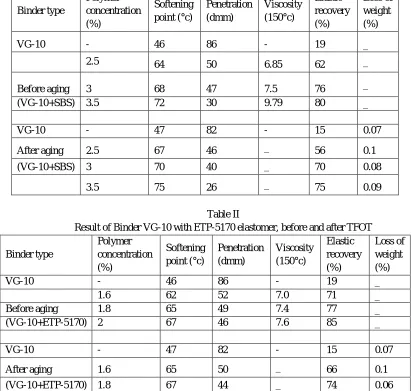
The test result shows the changes that had been taken place in the physical property of the base bitumen and polymer modified bitumen before and after the TFOT test. Table I and Table II shows the changes in physical properties of polymer modified bitumen formed using SBS and ETP-5170 elastomer respectively.
A. FTIR Analysis
Technology (IJRASET)
In figure-1 spectra of VG-10 is shown which gives the peak values 2923.48 cm-1 and 2853.55 cm-1 indicate the presence of alkanes, but in the VG-10 compound the ester group is not present but the sulfuric ester is present while amines is present with weak N-H bond and only with one range that is 3400 cm-1to3500 cm-1 thus it is not a strong anti- stripping agent thus cannot withstand in all climatic condition compare to polymer modified bitumen.
[image:4.612.111.502.246.466.2]Here in the FTIR spectra of figure 2 and figure 3 the peak seen is having different range with different intensity. But in the spectra of VG-10+SBS and VG-10+ETP-5170 the peak value differs very minutely thus there is not much different between in their functional group. The value ranges 3400-3500 cm-1 having functional group amines which is having the N-H bond of weak intensity with the same functional group other value range is 1550-1650 cm-1 and 1000-1250 cm-1 having the medium intensity. The function of amines in bitumen is help to resist the stripping process thus it is called anti-stripping agent. The peak having this values range can be seen in both the spectra of figure 2 and figure3
Table I
Result of Binder VG-10 with SBS elastomer, before and after TFOT
Binder type Polymer concentration (%) Softening point (°c) Penetration (dmm) Viscosity (150°c) Elastic recovery (%) Loss of weight (%)
VG-10 - 46 86 - 19 _
2.5 64 50 6.85 62 _
Before aging 3 68 47 7.5 76 _ (VG-10+SBS) 3.5 72 30 9.79 80 _
VG-10 - 47 82 - 15 0.07
After aging 2.5 67 46 _ 56 0.1
(VG-10+SBS) 3 70 40 _ 70 0.08
3.5 75 26 _ 75 0.09
Table II
Result of Binder VG-10 with ETP-5170 elastomer, before and after TFOT
Binder type Polymer concentration (%) Softening point (°c) Penetration (dmm) Viscosity (150°c) Elastic recovery (%) Loss of weight (%)
VG-10 - 46 86 - 19 _
1.6 62 52 7.0 71 _
Before aging 1.8 65 49 7.4 77 _ (VG-10+ETP-5170) 2 67 46 7.6 85 _
VG-10 - 47 82 - 15 0.07
After aging 1.6 65 50 _ 66 0.1 (VG-10+ETP-5170) 1.8 67 44 _ 74 0.06
[image:4.612.101.512.256.647.2]Technology (IJRASET)
Fig. 1 FTIR Spectra of VG-10
cm-1
Fig. 2 FTIR Spectra of VG-10+SBS
cm-1
Technology (IJRASET)
Fig. 4Overlay Spectra of VG-10+SBS &VG-10+ETP-5170
B. SEM Analysis
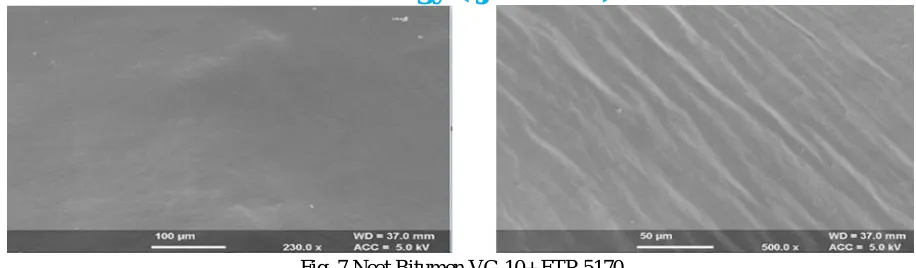
This test is conducted to check the dispersion of elastomeric polymer in the bitumen VG-10. Here the figure 5-10 shows the SEM images of neat VG-10 and VG-10 with different elastomeric polymer and it can be justify that polymer are well dispersed in the bitumen forming a homogeneous binder having no lumps in it are seen in the SEM images of polymer modified bitumen.
[image:6.612.88.524.47.287.2] [image:6.612.81.540.362.712.2]Technology (IJRASET)
Fig. 7 Neat Bitumen VG-10+ ETP-5170
V. CONCLUSION
After TFOT test physical characteristics of the bitumen and polymer modified bitumen has been changed which is seen in table-I and table-II, thus it implicate that softening point will increase while the penetration will decrease after short term aging with decrease in elastic recovery too which indicate that oxidation of modified bitumen had occur.
FTIR clearly state that some functional are missing in the neat VG-10 bitumen while in the polymer modified bitumen other groups are present which strengthen the bitumen and prevent the aging of the bitumen and also worked as an anti-stripping agent. But no such major difference is seen in the spectra of FTIR of two different polymer modified bitumen as the structural changes are their compare to neat bitumen it enhance the property of bitumen in terms of performance. SEM test gives the conclusion that elastomeric polymer are well dispersed in the bitumen thus it will lead to structural modification of bitumen and enhance the rheological, morphological and engineering properties of the binder.
REFERENCES
[1] Giovanni Polacco, Jiri Stastna, Dario Biondi, Federico Antonelli, Zora Vlachovicova, Ludovit Zanzotto (2004), “Rheology of asphalts modified with glycidyl methacrylate functionalized polymers”, Journal of Colloid and Interface Science 280 (2004) 366–373.
[2] Gupta Reena, Sangita and Kaur Verinder, “Characterization of bitumen and modified bitumen (e-PMB) using FTIR, thermal and SEM techniques.” Research journal of chemical science, ISSN-2231-606X, vol-2(8), 31-36, aug-2012.
[3] Hilde Soenen*, Xiaohu Lu**, Per Redelius, “The morphology of bitumen-SBS blends by UV microscopy: An evaluation of preparation methods”, Road Materials and Pavements Design., pg no. 1 to nJ Volume X – No X/2005.
[4] Kishan K. Vacchani and C.B.Mishra, “Influence of VG30 Grade Bitumen with and without reactive Ethylene Terpolymer (Elvaloy® 4170) in short term aging”, in International Journal of Current Engineering and Technology, vol. 4, 2014
[5] L. Barbes, C. Radulescu, C. Stihi, “ATR-FTIR Spectrometry characterization of polymeric material” in Romanian Reports in Physics, Vol. 66, No. 3, P. 765– 777, 2014.
[6] Lan Wang, Ghani Razaqpur, Yongming Xing and Gang Chen, “Microstructure and rheological properties of aged and unaged polymer modified asphalt binders”, Road Materials and Pavement Design, 2014.
[7] Manider Singh, “Evaluating Physical, Rheological and Chemical properties of Modified Binders” Bonfring International journal of industrial engineering and Management science, Vol. 2 No. 4, December 2012
[8] Pierre J. Carreaul, Mosto Bousmina2 and Frank Bonniotl , “The Viscoelastic Properties of Polymer-Modified Asphalts” , The Canadlan Journal of Chemical Engineering, Volume 78, June 2000.
[9] S. Keyf, O. Ismail & B. D. Çorbacioğlu (2007), “Polymer-Modified Bitumen Using Ethylene Terpolymers”, European Polymer Journal, Petroleum Science
and Technology Volume 25, Issue 7, 2007.
[10] Szabolcs Biro-Bence Fazekas (2005), “Asphalt rubber versus other modified bitumen”, Journal Construction and Materials and Pavements Design. Volume X – No X/2005.
[11] Teltayev Bagdat, Izmailova Galiya and Amirbayev Yerik, “Rheological Properties of Oxidized Bitumen with Polymer Additive”, Journal of Applied Sciences, 15:129137; Published: November 20, 2014.
[12] IS: 1202- 1978, “Methods for testing tar and bituminous materials: determination of specific gravity”. [13] IS: 1203- 1978, “Methods for testing tar and bituminous materials: determination of penetration”. [14] IS: 1205- 1978, “Methods for testing tar and bituminous materials: determination softening point”. [15] IS: 1206- 1978, “Methods for testing tar and bituminous materials: determination of viscosity” [16] IS: SP 53- 2002, “Guidelines on the use of Polymer Modified Binder Specifications”. [17] IS: 15462- 2004, “Polymer and Rubber Modified Bitumen- Specification”.