5
X
October 2017
Analysis of RTS/CTS Mechanism to Minimize
Hidden Node Problem Using Media Access Control
Protocol
Sourabh Pathak1
1
Lecturer, Department of Electronics and Communication EngineeringM.J.P. Rohilkhand University,Bareilly.
Abstract: By increasing the popularity of wireless network there is used the many advance devices as Mobile phones, tablet etc. But there are two types of problems are produced in wireless network first is Hidden node second is exposed node problem that reduce the efficiency of complete system. Hidden node problem of the network reduce the throughput of the system. RTS/CTS mechanism only solution of this problem. It is the reservation scheme that is used to reduce the frame collisions to each other which are produced by the hidden node problem.
Problem Statement:The most implemented protocol that is used to reduce the hidden node problem that is MAC protocol. It is used to access control between two media share that medium between competing stations.
Approach:The research has been done till now only for the current number ofactive nodes. An algorithm is used for the optimization of contention window size that is novel back-off.
Key words: MAC Protocol, back-off Algorithm, Contention window
I.INTRODUCTION
The use of wireless network is increased tremendously over past few days. The Media Access control (MAC) protocol has very important role in wireless communication to remove the hidden node problems. The MAC protocol provides the variety of functions that hold the many operations of Local Area Network. We know that in the infrastructure base network there is centralized node is present due to this it is useful for the determine the allocation of channel.We know that in the ad-hoc network the allocation of channel in distributed. But in the wireless network there is problem is created that is hidden node problem which create the media access control.
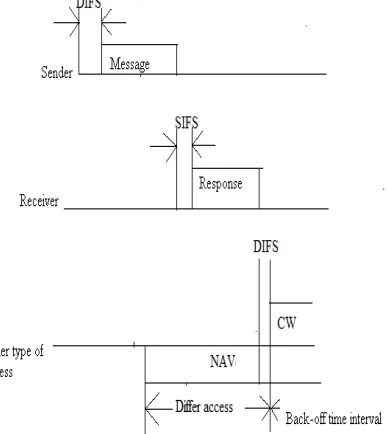
There are two types of problem created in wireless network first is Hidden node and second is exposed node, the hidden node problem can be explained by the following example as let node A wants to transmit message node B but there is another node C that is also want to transmit message to B but node B does not know about the node C thus we can say that node C is hidden for node A that is hidden node problem.In the hidden node problem there are many types of problems created as packet collisions, dropping of packet, network performance is decreases and network is busy all time, loss of packets. To remove this problem there is mechanism is used that is RTS/CTS phenomenon [12]. This mechanism has the very important role in to reduce the hidden node problem. It is handshaking type of mechanism. In the figure 1 there is showed the RTS/CTS mechanism with network Allocation Vector (NAV).
The Point Coordination Function (PCF) and Ad-hoc network is useful for the infrastructure based network. Distributed Coordination Function (DCF) has the very important role in RTS/CTS mechanism to delivery of packet at the link layer of OSI model and a protocol is used to reduce the collision that is Carrier Sense Multiple Access for Collision avoidance (CSMA/CA). There is another type of ad-hoc network that is Mobile ad-hoc Network (MANET). This type of network is the working group of network that is used in factories’, hospitals, offices and other many places.
A. RTS/CTS Mechanism
Coordination Function mode if base station has the data packet for the transmission then that station send the RTS packet to receiver. In this mode receiving the correct message/packet from the receiver it waits for the some duration of time that is known as Short Inter Frame Spacing interval (SIFS) and transmitted the CTS command only when it is idle position.In the RTS/CTS mechanism when RTS and CTS packet involve in the time period then it utilized the Network Allocation Vector (NAV), this type of vector shows the time in which the channel is busy. In the DCF mode when station has the packet and ready to transmission then first it check the position of packet, if the station is idle state then it is provided the time interval that is known as Distributed Inter Frame Spacing (DIFS) and Binary Back off Interval that is used for the Contention window size that is normally [0-CW-1]. The 802.11 MAC protocol and DCF mode set the contention window size from CW to CW minimum. If the channel in idle position then back off timer is continued but if
[image:3.612.206.400.266.385.2]The channel is busy then backoff algorithms stop the timer.When receiver receives the correct message it waits for the time period that is known as Short Inter Frame Spacing (SIFS). An acknowledgement is very important for the sender for successful transmission. Toavoids the collision RTS/CTS mechanism has the very important role in wireless network. Contention window size that is used for to control the back-off algorithms.
[image:3.612.224.418.424.641.2]Fig. 1: Data transmission with RTS/CTS
Fig. 2: Data transmission without RTS/CTS
II. RELATED WORK
Austin Peter C. Karlsson, TeliaSonera Sweden[2] told about the PCS and cellular system that collides with each other to remove this type of problem there is another concept is used that is hold the integration of data and voice in Ethernet wireless point and cellular network.Luciano Bononi, Marco Conti, and Enrico Gregori [3] told about in distributed system for contention window control in IEEE 802.11 wireless LANs.This type of phenomenon is known as Asymptotically Optimal Back-off (AOB), that is accepting the moving size of contention window size.
Lin Dai, Member, IEEE, and XinghuaSun [4] told about the analytical framework that is used for study the stability, throughput, and delay performancein homogeneous buffered Distributed Coordination Function (DCF).
Paal E. Engelstad [5] told about the Enhanced Distributed Channel Access (EDCA) mechanism in IEEE 802.11e.
HwangnamKim [6]told about that envelop a model-based frame scheduling scheme that is , known as MFS, to increases the capacity of IEEE 802.11 standard, operated in wireless local area networks (WLANs) for both user datagram protocol (UDP) traffic and transmission control protocol
Alberto Lopez Toledo [7] explained about in CSMA/CA media access control layer denial- of-service attacks that does not require any modification to the existing protocols.
AbderrahimBenslimane [8] explained about in an analytical model to study the effect of jamming on WLANs.
Guobin Liu, JiaqingLuo, QingjunXiao, Bin Xiao[9] explained about in existence of a unique Nash Equilibrium point that is based on Based an equilibrium analysis, they discuss the condition under which a defense strategy will increase a dynamic retransmission mechanism defense strategy and utility of the network .
RohitNegi, ArjunanRajeswaran [10] explained about in Reservation based Medium Access Control (MAC) protocols such as the 802.11 and Distributed Coordination Function (DCF), that are used to to maximize efficiency, throughput by using small control packets.
KonstantinosPelechrinis, MariosIliofotou and Srikanth V. Krishnamurthy [11] explained about in a detailed up-to-date discussion on the jamming attacks recorded in the literature.
AravindVenkatarama, CheritaCorbettcherita, RaheemBeyah [12] explained about in an abstract methodology for detecting DCF parameter manipulation.
ByungJoon Oh and Chang Wen Chen [13] explained about in a cross-layer design for a reliable video transmission over wireless ad hoc networks that is based on multichannel MAC protocol with Time Division Multiple Access scheme.
III. METHODOLOGY
The methodology is used for contention window control due to which call could not permanently block. The phenomenon is used here that is related to state of conversion. There are eight states used for conversation of call. A back off algorithm is used here for contention window control. The lost of packet is involved the collision and channel error. The RTS/CTS mechanism is used here to check the states of call or node. The table 1 indicate the two value 0 and 1, where 0 indicates theUnsuccessful transmission and 1 is successful transmission.Here two parameters are used y and z for the updating of contention window size control.
In the figure 3, A flowchart is made that is related to the channel state and algorithm for successful transmission. In the flowchart is showed that if collision is detected then the channel state set to be 0 conditions. If the collision is not detected then channel state set to be 1 and successful transmission is possible.
Fig. 3: Flowchart of Channel state
IV. SIMULATION/RESULT
For the simulation this type of mechanism proposed the MAT lab software version 8.1 and resolves the efficiency, Packet delivery ratio, average end to end delay and mobility at different motion scale. When run the program then get many things related to the RTS/CTS mechanism in terms of successful transmission, total transmission, total acknowledgement, estimate time, total collisions, unreachable packets, unreachable acknowledgement,and efficiency. For the successful transmission and to remove the collision there are following parameters are used assimulation time= 0.2sec, Motion of random scale= 0 km/hr,5 km/hr,10 km/hr, Frame size=8184
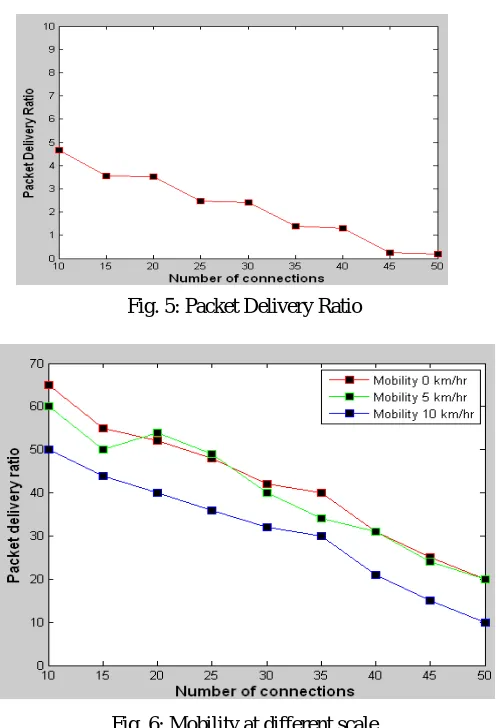
A. Packet Delivery Ratio (PDR)
The packet delivery ratio is defined the ratio the number of packets originated by the application layer source to packet received by the final destination.
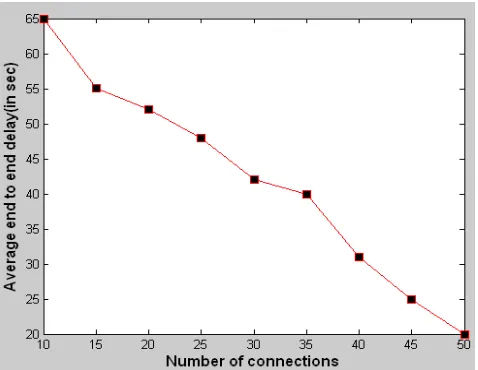
B. Average end to end delay to receive the packet:
average end to end delay is defined the average time requiredtime to receive the packet.
C. Mobility at different motion scale
Here consider the mobility at different motion scale as static motion or we can say static node, 5km/hour and 10km/hour. There are following result shown in the graph these show the best result of packet delivery ratio, Average and to end delay, and mobility at different motion scale.
[image:5.612.194.433.531.716.2]Fig. 5: Packet Delivery Ratio
Fig. 6: Mobility at different scale
V. CONCLUSION
In this study, we considerthe back-off algorithm to enhance the performance of the network based upon IEEE 802.11 architecture. The basic idea that is used that is size of contention window control to increase the performance of network and remove the collision. .
REFERENCES
[1] Utpal Paul, AnandKashyap, RiteshMaheshwari, and Samir R. Das,” Passive Measurement of Interference in Wi-Fi Networks with Application in Misbehavior Detection” IEEE Transaction on mobile computing, VOL. 12, NO. 3, March 2013
[2] Sanjay Shakkottai and Theodore S. Rappaport, the University of Texas at Austin Peter C. Karlsson, TeliaSonera Sweden” Cross-Layer Design for Wireless Networks” IEEE Communications Magazine October 2003
[3] Luciano Bononi, Marco Conti, and EnricoGregori” Runtime optimization of IEEE 802.11 Wireless LANs Performance”IEEE Transaction on parallel and distributed system, VOL. 15, NO. 1, January 2004
[4] Lin Dai, Member, IEEE, and Xinghua Sun” A Unified Analysis of IEEE 802.11 DCF Networks: Stability, Throughput, and Delay” IEEE Transaction on mobile computing, VOL. 12, NO. 8, August 2013
[5] Paal E. Engelstad Olav N. sterb” Analysis of the Total Delay of IEEE 802.11e EDCA and 802.11 DCF” IEEE Communications Society subject matter experts for publication in the IEEE ICC 2006 proceedings.
[6] Hwangnam Kim, Student Member, IEEE, and Jennifer C. Hou, Senior Member, IEEE” Improving Protocol Capacity for UDP/TCP Traffic With Model-Based Frame Scheduling in IEEE 802.11-Operated WLANs” IEEE Journal selected areas of communication, VOL. 22, NO. 10, December, 2004
[7] Alberto Lopez Toledo, Student Member, IEEE, and Xiaodong Wang, Fellow, IEEE” Robust Detection of MAC Layer Denial-of-Service Attacks in CSMA/CA Wireless Networks” IEEE Transaction information forensic and security, VOL. 3, NO. 3, September 2008
[8] AbderrahimBenslimaneAbdelouahid El Yakoubi and Mohammed Bouhorma” Analysis of Jamming effects on IEEE 802.11 Wireless Networks” IEEE Communications Society subject matter experts for publication in the IEEE ICC 2011 proceedings
[10] RohitNegi, ArjunanRajeswaran” DoS analysis of reservation based MAC protocols” 2005 IEEE
[11] Konstantinos Pelechrinis, MariosIliofotou and Srikanth V. Krishnamurthy” Denial of Service Attacks in Wireless Networks: The Case of Jammers” IEEE communication surveys & Tutorials, VOL. 13, NO. 2, second quarter, 2011
[12] Aravind Venkatarama Cherita Corbett,RaheemBeyah” A Wired-side Approach to MAC Misbehavior Detection” IEEE Communications Society subject matter experts for publication in the IEEE ICC 2010 proceedings
[13] Mi Kyung Han and LiliQiu, Senior Member, IEEE” Greedy Receivers in IEEE 802.11 Hotspots: Impacts and Detection” IEEE transaction on dependable and secure computing,VOL. 7, NO. 4, October-December 2010
[14] Mi Kyung Han, Brian Overstreet, LiliQiu” Greedy Receivers in IEEE 802.11 Hotspots” 37th Annual IEEE/IFIP International Conference on Dependable Systems and Networks (DSN'07)
[15] JaeminJeung, SeungmyeongJeong, and Jaesung Lim”Adaptive Rapid Channel-hopping Scheme Mitigating Smart Jammer Attacks in Secure WLAN”IEEE 2011
[16] Kai Zeng, KannanGovindan, Daniel Wu, PrasantMohapatra” Identity-Based Attack Detection in Mobile Wireless Networks”IEEE 2011
[17] JayanthiRao and SubirBiswas “Transmission Power Control for 802.11: A Carrier-Sense based NAV Extension Approach” IEEE Communications Society subject matter experts for publication in the IEEE Globecom 2005 proceedings.
[18] SoufieneDjahel, YoucefBegriche and FaridNa¨ıt-Abdesselam” A Bayesian Statistical Model to Alleviate Greediness in Wireless Mesh Networks” IEEE Communications Society subject matter experts for publication in the IEEE Globecom 2010 proceedings
[19] Hsueh-Wen Tseng, Shan-Chi Yang, Ping-Cheng Yeh, and Ai-Chun Pang” A Cross-Layer Mechanism for Solving Hidden Device Problem in IEEE 802.15.4 Wireless Sensor Networks” IEEE Communications Society subject matter experts for publication in the IEEE "Globecom" 2009
[20] Yuma ASADA and Hiroyuki YOMO” Impact of Hidden Nodes on Wake-up Signaling based on Frame Length Modulation for Energy-Efficient WLAN” 2013 IEEE
[21] Vamsi Krishna Tumuluru, Ping Wang” A Novel Spectrum-Scheduling Scheme for Multichannel Cognitive Radio Network and Performance Analysis” IEEE transaction on vehicular technology,VOL. 60, NO. 4, May 2011
[22] Satish C. Jha, Mohammad M. Rashid, Vijay K. Bhargavaand Charles Despins” OMC-MAC: An Opportunistic Multichannel MAC for Cognitive Radio Networks” 2009 IEEE
[23] Jihoon Park, Student Member, IEEE, PrzemyslawPawelczak, Member, IEEE, and DanijelaCabri “Performance of Joint Spectrum Sensing and MAC AlgorithmsforMultichannel Opportunistic Spectrum Access Ad Hoc Networks” IEEE transaction on mobile computing,VOL. 10, NO. 7, July 2011
[24] F. Babich, Senior Member, IEEE, and M. Comisso, Student Member, IEEE” Throughput and Delay Analysis of 802.11-Based Wireless Networks Using Smart and Directional Antennas” IEEE transaction on communication, VOL. 57, NO. 5, May 2009
[25] A. Bahillo, J. Prieto, S. Mazuelas, R. M. Lorenzo, J. Blasand P. Fern´andez ”IEEE 802.11 Distance Estimation Based on RTS/CTS Two-Frame Exchange Mechanism” 2009 IEEE
[26] Yvonne Günter, Bernhard Wiegel and Hans Peter Grobmann” Medium Access Concept for VANETs based on Clustering” 2007 IEEE
[27] Jad El-Najjar Brigitte JaumardChadiAssi” Minimizing Interference in WiMax/802.16 based Mesh Networks with Centralized Scheduling” IEEE Communications Society subject matter experts for publication in the IEEE "GLOBECOM" 2008
[28] Minho Kim,” Hidden-Node Detection in IEEE 802.11n Wireless LANs” IEEE transaction on vehicular technology,VOL. 62, NO. 6, July 2013
[29] Wen-Tsuen Chen, Fellow, IEEEJen-Chu Liu Chun-Chieh Chang” An Efficient Flow Control and Medium Access in Multihop Ad Hoc Networks with Multi-Channels” National Science Council, Taiwan, R.O.C. under Grant NSC-95-2221-E-007-025.
[30] MohssinBarradi, 1Abdelhakim S. Hafid, 2Sultan Aljahdali” Highway Multihop Broadcast Protocols for Vehicular Networks” IEEE ICC 2012 - Wireless Networks Symposium
[31] Ji Fang, Student Member, IEEE, KunTan, Member, IEEE, Yuanyang Zhang, Shouyuan Chen, Lixin Shi, Jiansong Zhang, Yongguang Zhang, Senior Member, IEEE, and Zhenhui Tan, Member, IEEE” Fine-Grained Channel Access in Wireless LAN” IEEE/ACM Transaction on networking, VOL. 21, NO. 3, June 2013 [32] NileshKhude, Anurag Kumar, Fellow, IEEE, and AdityaKarnik, Member, IEEE” Time and Energy Complexity of Distributed Computation of a Class of
Functions in Wireless Sensor Networks” IEEE transaction on mobile computing, VOL. 7, NO. 5, MAY 2008
[33] Frank H. P. Fitzek, Diego Angelini, GianlucaMazzini, and Michele Zorzi “Design and performance of enhanceIEEE 802.11 MAC protocol for Multihop coverage extension” December 2003
[34] Kin K. Leung,” Power Control by Interference Prediction for Broadband Wireless Packet Networks” IEEE transaction on wireless communication, VOL. 1, NO. 2, APRIL 2002
[35] Chong Han, Student Member, IEEE, MehrdadDianati, Member, IEEE, Rahim Tafazolli, Senior Member, IEEE, Xing Liu, and Xuemin (Sherman) Shen, Fellow, IEEE” A Novel Distributed Asynchronous Multichannel MAC Scheme for Large-Scale Vehicular Ad Hoc Networks” IEEE transaction on vehicular technology, VOL. 61, NO. 7, September, 2012
[36] Yi Zhong, Wenyi Zhang, MartinHaenggi” Stochastic Analysis of the Mean Interference for the RTS/CTS Mechanism” IEEE ICC 2014
[37] Wanrong Yu, Jiannong Cao, Xingming Zhou, Xiaodong Wang,Keith C. C. Chan, , Alvin T. S. Chan,, and H. V. Leong,” A High-Throughput MAC Protocol for Wireless Ad Hoc Networks” IEEEtransaction on wireless communication, VOL. 7, NO. 1, January 2008
[38] Christos Papachristou and FotiniNioviPavlidou” Collision-Free Operation in Ad Hoc Carrier Sense Multiple Access Wireless Networks” IEEE communications letters, VOL. 6, NO. 8, August, 2002
[39] Tamer NadeemWith Opportunistic Mechanisms” IEEE transaction on vehicular technology, VOL. 59, NO. 6, July 2010
[40] Da Rui Chen and Ying Jun (Angela) Zhang” Is Dynamic Back-off Effective for Multi-Rate WLANs” IEEE communication letters, VOL. 11, NO. 8, August 2007
[41] Jaehyuk Choi, Jongkeun Na, Yeon-sup Lim, Kihong Park, Member, IEEE, and Chong-kwon Kim, Member, IEEE” Collision-Aware Design of Rate Adaptation for Multi-Rate 802.11 WLANs” IEEE journal on selected areas in communications , VOL. 26, NO. 8, October 2008