http://dx.doi.org/10.4236/jamp.2015.310158
How to cite this paper: Yan, W.J., Wang, A.X. and Guan, G.X. (2015) A Numerical Method for Shape Optimal Design in the Oseen Flow with Heat Transfer. Journal of Applied Mathematics and Physics, 3, 1295-1307.
http://dx.doi.org/10.4236/jamp.2015.310158
A Numerical Method for Shape Optimal
Design in the Oseen Flow with Heat
Transfer
Wenjing Yan1*, Axia Wang2, Guoxing Guan1
1School of Mathematics and Statistics, Xi’an Jiaotong University, Xi’an, China 2School of Science, Chang’an University, Chang’an, China
Email: *[email protected]
Received 30 June 2015; accepted 26 October 2015; published 29 October 2015
Copyright © 2015 by authors and Scientific Research Publishing Inc.
This work is licensed under the Creative Commons Attribution International License (CC BY).
http://creativecommons.org/licenses/by/4.0/
Abstract
This paper is concerned with the optimal design of an obstacle located in the viscous and incom-pressible fluid which is driven by the steady-state Oseen equations with thermal effects. The structure of shape gradient of the cost functional is derived by applying the differentiability of a minimax formulation involving a Lagrange functional with a space parametrization technique. A gradient type algorithm is employed to the shape optimization problem. Numerical examples in-dicate that our theory is useful for practical purpose and the proposed algorithm is feasible.
Keywords
Shape Optimization, Oseen Equations, Shape Gradient, Minimax Principle, Convective Heat Transfer, Function Space Parametrization Technique
1. Introduction
In this paper, we consider the shape optimization of an immersed body in the viscous and incompressible fluid which is driven by the Oseen equations coupling with heat transfer. Shape optimization problem is to find the geometry shapes that minimize certain objective functional, for instance, the energy dissipation, subject to me-chanical and geometrical constraints. The research of shape optimization is a branch of optimal control governed by PDEs and has a very wide range of applications in engineering such as in the design of impeller blades, air-craft wings, high-speed train heads, and bridges in medically bypassing surgeries. The optimal shape design in fluids has been a challenging task for a long time, and has been investigated by many mathematicians and
neers.
Shape optimization problem usually entails very large computational costs: besides numerical approximation of partial differential equations and optimization, it requires also a suitable approach for representing and de-forming efficiently the shape of the underlying geometry, as well as for computing the shape gradient of the cost functional to be minimized. The control variable is the shape of the domain; the object is to minimize a cost functional that may be given by the designer, and finally the optimal shapes can be obtained.
In the last few decades, the shape optimization problems have attracted the interests of many specialists. Pi-ronneau [1][2] evaluated the derivative of the cost functional using normal variation approach; Simon applied the formal calculus to deduce an expression for the derivative [3]; and Bello considered this problem theoreti-cally in the case of Navier-Stokes flow by the formal calculus in [4][5]. In the present paper, we will use the so-called function space parametrization technique which was advocated by M.C. Delfour and J.P. Zolésio to solve Poisson equation with Dirichlet and Neumann condition (see [6][7]). In our paper [8]-[10], we solved the shape reconstruction problems for the inverse Stokes, Oseen and Navier-Stokes problems, and investigated the numerical simulation by the domain derivation and the regularized Gauss-Newton iterative method. D. Chenais studied a shape optimal design problem in a potential flow coupled with a thermal model in [11].
In this paper, we will consider the energy minimization problem for Oseen flow with convective heat transfer despite of its lack of rigorous mathematical justification in case where the Lagrange formulation is not convex. We shall show how this theorem allows at least formally bypassing the study of material derivative and obtain-ing the expression of shape gradient for the dissipated energy functional. For the numerical solution of the visc-ous energy minimization problem, we introduce a gradient type algorithm with mesh adaptation technique, while the partial differential systems are discretized by means of the finite element method. Finally, we give some numerical examples concerning with the optimization of a two-dimensional solid body in the viscous flow. This paper is organized as follows. In Section 2, we briefly give the description of the shape optimization problem of the Oseen flow taking account of conductive heat transfer, and we employ a velocity method to scribe a variational domain in the optimization process. In addition, we introduce the definitions of Eulerian de-rivative and shape gradient. Then we draw the divergence-free condition directly into the Lagrangian functional which leads to a saddle point formulation of the shape optimization problem for the state equations. In Section 3, we obtain the continuous gradient of the cost functional with respect to the boundary shape with the adjoint equ-ations and a function space parametrization technique, which plays the role of design variables in the optimal design framework. In Section 4, we present a gradient-type algorithm for the shape optimization problem, and numerical examples demonstrate that our method is efficient and useful in the numerical implementations.
Before closing this section, we state some notations to be used in this paper. 2
( )
L Ω denotes the space of square integrable functions defined in domain Ω. We use 2
( )
L Ω based Sobolev spaces k
( )
H Ω equipped with norms and seminorms given by
2 2
, D ,
k
k
u αu
α
Ω Ω
≤
=
∫
∑
2 2, D ,
k
k
u αu
α
Ω Ω
=
=
∫
∑
where Dαu denotes the α-th order mixed derivatives of u. Now we introduce the following functional spaces,
( )
{
(
( )
)
2}
2
0 : : 0 on w s in ,
V Ω = u∈ H Ω u= Γ Γ Γ
( )
{
(
2( )
)
2}
: : 0 on , on ,
g w s in
V Ω = u∈ H Ω u= Γ Γ u=g Γ
( )
{
1( )
}
: : 0 on w in ,
W Ω = S∈H Ω S= Γ Γ
( )
:{
1( ) : d 0 ,}
Q Ω = p∈H Ω
∫
Ωp x=The boundary Γ consists of four parts: Γin is the inflow boundary; Γout denotes the outflow boundary; Γw represents the boundary corresponding to the fluid wall; and Γs is the boundary which is to be optimized.
2. Shape Optimization Problem
the domain Ω is filled with a Newtonian incompressible viscous fluid of the kinematic viscosity ν.
The fluid is modeled by the Oseen flow taking account of thermal effects, and the unknowns are the fluid velocity u, the pressure p, and the temperature T:
(
)
divσ ,p D λ 0 in ,
− u + u⋅ +α u= Ω (2.1)
divu=0 in Ω, (2.2) 0 on w s,
= Γ Γ
u (2.3)
on in,
= Γ
u g (2.4)
and
0 in ,
T T
β
− ∆ + ⋅∇ =u Ω (2.5)
0 on out s,
T
∂ = Γ Γ
∂n (2.6)
1 on w,
T =T Γ (2.7)
2 on in,
T=T Γ (2.8) where σ
(
u,p)
is the stress tensor defined by σ(
u,p)
:= − +pI 2νε( )
u with the rate of deformation tensor( )
:(
D D)
2 ,ε = +∗
u u u ∗Du denotes the transpose of the matrix Du, vector α satisfies divα=0 and β represents the inverse of Peclet number.
In this paper, our purpose is to optimize the shape of the boundary Γs that minimizes a given cost functional
J which depends on the velocity and the temperature. The cost functional may represent a given objective re-lated to specific characteristic features of the fluid flow. In an abstract form, a shape optimization problem can be written as the minimization of a cost functional J
( )
Ω over a set of admissible shapes ,( )
( )
2 1 2min 2 d d .
2
J ν εΩ x Ω T x
Ω∈ Ω =
∫
u +∫
∇ (2.9)The boundary Γ = Γd: w Γs Γin is fixed, and an example of the admissible set is given by
{
}
: N: is fixed, d constant .
d x
= Ω ⊂ Γ
∫
Ω =
Let Ω be of piecewise 1
C , the minimization problem (2.9) has at least one solution with given area in two di-mensions [12].
Now, we choose an open set Ω in N
with the boundary ∂Ω piecewise Ck, and a velocity space
[ ]
( )
(
)
E :k C 0,τ ; k N
∈ = Ω
V , where τ is a small positive real number and k
( )
Ω N denotes the space of all k-times continuous differentiable functions with compact support contained in Ω. The velocity field
( )( )
x =( )
,x , x∈Ω, ≥0V V
belongs to k
( )
Ω N for each . It can generate transformations F
( )
V X =x(
,X)
through the following dynamical system(
)
(
( )
)
(
)
d
, , , 0,
d
x
X = x x X =X
V
with the initial value X given. We denote the transformed domain by Ω
( )
V at ≥0, and also set itsboun-dary Γ =: F
( )
∂Ω .Moreover, we suppose J
( )
Ω is a real-valued functional associated with any regular domain Ω. TheEule-rian derivative of the cost functional J
( )
Ω at Ω for the velocity field V is defined as( )
( )
(
)
0
1
lim J Ω −J Ω : d= J Ω;V .
Furthermore, if the map VdJ
(
Ω;V)
: Ek → is linear and continuous, J is shape differentiable at Ω. In(
)
(
( ))
( )dJ Ω;V = ∇J,V k DN′×k DN. (2.10)
When J has a Eulerian derivative, we say that ∇J is the shape gradient of J at Ω.
3. Adjoint Equations and Shape Gradient
Generally, there is a few approaches to compute the exact differential or the shape gradient. In the direct diffe-rentiation, it requires to derive the state equations with respect to the shape variables. In practice, it implies to solve as many PDEs systems as discrete shape variables. To avoid this extra computational cost, we use the classical adjoint state method which requires to solve only one extra PDE system. There are two ways for it. The first one is to discretize the equations, using a finite element method for example, and to derive the discrete equ-ations and obtain the discrete shape gradient. The second one is to calculate the expression of the exact differen-tial of the cost functional and to discretize it. In this paper, we follow the latter approach. We will derive the structure of the shape gradient for the cost functional J
( )
Ω by the function space parametrization technique.The weak formulation of (2.1)-(2.8) can be expressed as follows: find
(
u,p)
∈Vg( )
Ω ×Q( )
Ω , such that( ) ( )
( )
( )
0
2 : D div d 0, ,
div d 0, ,
p x V
q x q Q
νε ε λ
Ω
Ω
+ ⋅ ⋅ + ⋅ − = ∀ ∈ Ω
= ∀ ∈ Ω
∫
∫
u v u v u v v v
u
α
(3.1)
and seek 1
( )
T∈H Ω , such that
(
β T S TS)
dx 0, S W( )
.Ω ∇ ⋅∇ + ⋅∇ = ∀ ∈ Ω
∫
u (3.2)We will utilize the differentiability of a minimax formulation involving a Lagrangian functional with the function space parametrization technique. First of all, we introduce the following Lagrangian functional asso-ciated with (3.1) and (3.2):
(
, , , , , ,)
( ) (
, , , , , ,)
,G Ωu p T vq S =J Ω −L Ωu p T v q S (3.3) where
(
)
( ) ( )
(
)
, , , , , , 2 : D div div d
d .
L p T q S p q x
T S TS x
νε ε λ
β
Ω
Ω
Ω = + ⋅ ⋅ + ⋅ − −
+ ∇ ⋅∇ + ⋅∇
∫
∫
u v u v u v u v v u
u
α
Thus, the minimization problem (2.9) reads as the following form
( ) ( ) ( ) 1( ) ( ) ( ) ( ) ( )
(
)
0
, , , ,
min min max , , , , , , .
g v q S V Q W
u p T V Q H
G p T q S
Ω∈ ∈ Ω × Ω × Ω ∈ Ω × Ω × Ω Ωu v (3.4)
The minimax framework can be applied to avoid the study of the state derivative with respect to the shape of the domain. The Karusch-Kuhn-Tucker conditions will furnish the shape gradient of the cost functional J
( )
Ω by using the adjoint system. Next, we will establish the first optimality condition for the problem,( ) ( ) ( ) 1( ) ( ) ( ) ( ) ( )
(
)
0
, , , ,
min max , , , , , , .
g v q S V Q W
u p T V Q H
G p T q S
∈ Ω × Ω × Ω
∈ Ω × Ω × Ω Ωu v (3.5)
Conversely, the adjoint equations are defined from the Euler-Lagrange equations of the Lagrange functional G. Obviously, the variation of G with respect to
(
v, ,q S)
can recover the state system and its mixed weak formu-lation (3.1)-(3.2). In order to seek the adjoint state system, we differentiate G with respect to p in the directionp δ ,
(
, , , , , ,)
div d 0.G
p T q S p p x
p δ Ωδ
∂ Ω ⋅ = =
∂ u v
∫
vConsidering δp with compact support in Ω yields
(
)
(
)
( )
( )
(
)
( )
, , , , , , 2 d d
D d D d d d
2 d d 4 d
2 d D div d
, d
G
p T q S x q x
x x s S T x
s q s s
x q S T x
q s
δ ν δ ν δ
δ δ δ δ
ν ε δ δ ν ε δ
ν δ ν λ δ
σ δ
Ω
∗
Ω Ω ∂Ω Ω
∂Ω ∂Ω ∂Ω
Ω Ω
∂Ω
∂ Ω ⋅ = − ∆ ⋅ + Ω ∆ − ∇ ⋅
∂ + ⋅ ⋅ − ⋅ ⋅ − ⋅ ⋅ ⋅ − ∇ ⋅ − ⋅ ⋅ + ⋅ + ⋅ ⋅ = − ∆ ⋅ + ∆ − ∇ + ⋅ + ⋅ − − ∇ ⋅ − ⋅ ⋅ −
∫
∫
∫
∫
∫
∫
∫
∫
∫
∫
∫
∫
u v u u u v u
u
v u u u v u u v n u u
v n u u n u n u
u u v v v v u
v n u
α α
( )
ds 4 d .s
δ ν ε δ
∂Ω ⋅ ⋅ ⋅ + ∂Ω ⋅ ⋅
∫
α v n u∫
u n uTaking δu with compact support in Ω gives
D div 2 .
q S T
ν∆ − ∇ +v v⋅ +α α⋅ −v λv− ∇ = ∆ν u (3.7) Then varying δu on Γout leads to
( )
,q 4( )
.σ v ⋅ + ⋅ ⋅ =n α v n νε u n⋅ (3.8) Finally, we obtain the following adjoint state system of (2.1)-(2.4),
( )
( )
D div 2 in
div 0 in
, 4 0 on
0 on .
out
d
q S T
q
ν λ ν
σ νε
− ∆ − ⋅ − ⋅ + + ∇ + ∇ = − ∆ Ω
= Ω
⋅ + ⋅ ⋅ − ⋅ = Γ
= Γ
v v v v u
v
v n u v n u n
v
α α
(3.9)
By the same technique, we differentiate G with respect to T in the direction δT,
(
)
(
)
, , , , , ,
d d
d d .
out s G
p T q S T
T
S
S S T x S T s
T T x T T s
δ
β δ β δ
δ δ
Ω Γ Γ
Ω ∂Ω ∂ Ω ⋅ ∂ ∂ = ∆ + ⋅∇ ⋅ − + ⋅ ⋅ ∂ − ∆ ⋅ + ∇ ⋅ ⋅
∫
∫
∫
∫
u vu u n
n
n
The adjoint state system of (2.5)-(2.8) can be read as
in
on
0 on .
out s
in w
S S T
S
S T
S
β β
− ∆ − ⋅∇ = −∆ Ω
∂
+ ⋅ ⋅ = ∇ ⋅ Γ Γ
∂
= Γ Γ
u
u n n
n (3.10)
Now we introduce the so-called function space parametrization technique, which consists in transporting the different quantities defined in the variable domain Ω back into the reference domain Ω which does not de-pend on the perturbation parameter . So we are able to apply the differential calculus since the functionals in-volved are defined in a fixed domain Ω with respect to the parameter .
We only perturb the boundary Γs and consider the mapping F V
( )
, the flow of the velocity field( )
(
)
{
0 2}
ad: 0, ; : 0 in the neighorhood of .
N N
d
V C τ C V
∈ = ∈ = Γ
V V
The perturbed domain can be defined by Ω = F
( )( )
V Ω . Our purpose is to derive the derivative of j( )
with respect to , where
( )
( ) ( )(
)
, , , ,
: min max , , , , , , ,
u p T v q S
j = G Ω u p T v q S
(3.11)
( )
{
1( )
}
: ,
g g
V Ω = uF− u∈V Ω
( )
{
1( )
}
0 : 0 ,
V Ω = vF− v∈V Ω
( )
{
1( )
}
: ,
Q Ω = p F − p∈Q Ω
( )
{
1( )
}
: ,
W Ω = S F − S∈W Ω
( )
{
( )
}
1 1 1
: ,
H Ω = T F − T∈H Ω
where “” denotes the composition of the two maps.
Since F and F−1 are diffeomorphisms, these parametrizations cannot change the value of the saddle point. We can rewrite (3.11) as
( )
( ) ( )(
1 1 1 1 1 1)
, , , ,
min max , , , , , , .
u p T v q S
j = G Ω uF− p F − T F − vF− q F − S F − (3.12)
Correspondingly, the Lagrangian functional is given by
(
1 1 1 1 1 1)
( )
( )
( )
1 2 3
, , , , , , ,
G Ω uF− p F − T F − vF− q F − S F − =I +I +I (3.13)
where
( )
(
)
2(
)
21 1
1
1
: 2 d d ,
2
I ν F− x T F− x
Ω Ω
=
∫
u +∫
∇
( )
(
) (
) (
) (
)
(
) (
) (
) (
)
(
)(
)
1 1 1 1
2
1 1 1 1 1 1
: 2 : D
div div d ,
I F F F F
F F p F F F q F x
νε ε λ − − − − Ω − − − − − − = − + ⋅ ⋅ + ⋅ − −
∫
v u u vu v v u
α
( )
(
1) (
1) (
1) (
1)(
1)
3 : d .
I = −
∫
Ω β∇ T F − ⋅∇ S F − + F− ⋅∇ T F − S F − x
u
We introduce the following Hadamard formula [13] to differentiate the perturbed Lagrange functional
(
1 1 1 1 1 1)
, , , , , ,
G Ω uF− p F − T F − vF− q F − S F − ,
( )
( )
( )
d
, d , d , d ,
d
F
F x x x x F x s
Ω Ω ∂Ω
∂
= + ⋅
∂
∫
∫
∫
V n (3.14)
for a sufficiently smooth functional F: 0,
[ ]
τ ×N →. Now we are able to calculate the partial derivative for(
, , , , ,)
G u p T vq S with the expression (3.13) by applying the Hadamard formula,
(
)
( )
( )
( )
1 1 1 1 1 1
0
1 2 3
, , , , , ,
0 0 0 ,
G F p F T F F q F S F
I I I
− − − − − −
=
∂ Ω
′ ′ ′
= + +
u v
where
( )
( ) (
)
( )
(
)
2 1 20 4 : D d 2 d
1
D d d ,
2
s n
n
I x s
T T x T s
ν εΩ ε ν Γ ε
Ω ∂Ω
′ = − ⋅ +
+ ∇ ⋅∇ − ⋅ + ∇
∫
∫
∫
∫
u u V u V
V V (3.15)
( )
(
) ( )
( ) (
)
(
)
(
)
(
)
(
) (
)
(
) (
)
(
)
( ) ( )
(
)
(
)
2 0 2 D 2 D D D
D D D D div
div D div div D d
2 : D div div d ,
s n
I
p
p q q x
p q s
νε ε νε ε
λ λ
ν ε ε λ
Ω Γ ′ = − − ⋅ ⋅ + ⋅ − ⋅ + ⋅ ⋅ − ⋅ + − ⋅ ⋅ ⋅ + − ⋅ ⋅ + ⋅ − ⋅ − −∇ ⋅ − − ⋅ − −∇ ⋅ − − ⋅ + − − ⋅ ⋅ − ⋅ + +
∫
∫
u V v u v V u v V
u V v u V v u v V V v
v V V u u V
u v u v u v v u V
α α
α
( )
(
)
(
)
(
)
(
)
(
)
(
)
3 0 D d D d D d
D d D d d .
s n
I S T x S T x TS x
T S x T S x T S TS s
β β
β
Ω Ω Ω
Ω Ω Γ
′ = − ∇ − ⋅ ⋅∇ − ∇ ⋅∇ − ⋅ − − ⋅ ⋅∇
− ⋅∇ − ⋅ − ⋅∇ − ⋅ − ∇ ⋅∇ + ⋅∇
∫
∫
∫
∫
∫
∫
V V u V
u V u V u V (3.17)
We introduce the following lemma to simplify (3.15)-(3.17).
Lemma 4.1.[6] If two vector functions u and v vanish on the boundary Γs, the following identities
Du V n⋅ ⋅ =divuVn; (3.18)
( ) ( )
:(
( )
)
(
( )
)
;ε u ε v = ε u n⋅ ⋅ ε v ⋅n (3.19)
( )
(
ε u n⋅ ⋅)
(
Dv V⋅)
=(
ε( )
u n⋅ ⋅)
(
ε( )
v ⋅n V)
n (3.20) hold on the boundary Γs.According to Lemma 4.1, it follows that
( )
(
)
( )
(
)
2 1
2
0 2 D d 2 d
1
D d d .
2
s
s
n
n
I x s
T T x T s
ν Ω ν Γ ε
Ω Γ
′ = − ∆ − ⋅ +
− ∆ ⋅ − ⋅ + ∇
∫
∫
∫
∫
u u V u V
V V
(3.21)
Since
(
u, ,p T)
and(
v, ,q S)
satisfy the state Equations (2.1)-(2.8) and the adjoint Equations (3.9)-(3.10) re-spectively, the above expression reduces to( )
(
)
(
) (
)
( ) ( )
(
)
(
)
2 0 2 D d D d
2 : div div d .
s n n
I x TS x
p q s
ν
ν ε ε
Ω Ω Γ ′ = ∆ − ⋅ + ∇ ⋅ − ⋅ + + +
∫
∫
∫
u u V u V
u v V v u V (3.22)
Similarly, (3.17) can be written as
( )
(
)
(
)
3 0 D d D d d .
s n
I′ =
∫
Ω∆ −T T⋅V x−∫
Ω − u V⋅ ⋅∇TS x+∫
Γ β∇ ⋅∇ ⋅T S V s (3.23)Summing the three integrals together, we finally derive the boundary expression for the Eulerian derivative of
( )
J Ω ,
(
)
( ) ( )
( )
22
d ; 2 : 2 div div d
1
d d .
2
s
s s
n
n n
J p q s
T s T S s
νε ε ν ε
β Γ
Γ Γ
Ω = + + +
+ ∇ + ∇ ⋅∇ ⋅
∫
∫
∫
V u v u v u V
V V
(3.24)
Since the mapping V dJ
(
Ω;V)
is linear and continuous, we get the boundary expression for the shape gra-dient according to (3.1),( ) ( )
( )
2 1 22 : 2 div div .
2
J νε ε ν ε p q T β T S
∇ = + + + + ∇ + ∇ ⋅∇
u v u v u n (3.25)
4. Numerical Simulation
This section is devoted to present the numerical algorithm and examples for the shape optimization problem in two dimensions.
In all computations, the finite element discretization is effected using the P1 bubble-P1 pair of finite element spaces on a triangular mesh. The mesh is performed by a Delaunay-Voronoi mesh generator (see [1]) and during the shape deformation, we utilize a metric-based anisotropic mesh adaptation technique where the metric can be computed automatically from the Hessian of a solution. The Hessian h of yh can be approximated by using a recovery method, such as the Zienkiewicz-Zhu recovery procedure [14], the simple linear fitting [15], or the double L2 projection
(
)
(
)
(
)
2 2 ,
h=IL ∇ IL ∇uh
where IL2 denotes the L
2
projection on the P1 Lagrange finite element space (see [16]). As it has been said in [16], there’s no convergence proof of this method but the result is better.
Taking no account of regularization, a descent direction is found by defining
, k
h G
= − ∇
V
and then we can update the shape Ω as
(
I)
,k hk
Ω = + V Ω
where hk is a small descent step at k-th iteration. Likewise, we obtain
(
)
( )
1 , 0, : ,
k k k k k k k
J + =J −h ∇J ∇J J =J Ω (4.2)
which guarantees the decrease of the cost functional J
( )
Ω .In the numerical implementation, we choose the descent direction d∈H1
( )
Ω 2 to be the unique solution of the problem(
)
1( )
2D : D dx dJ ; , H .
Ω = Ω ∀ ∈ Ω
∫
d V V V (4.3)It is clear that d is a descent direction which guarantees the decrease of J. The computation of d can also be interpreted as a regularization of the shape gradient, and the choice of H1
( )
Ω 2 as space of variations is more dictated by technical considerations rather than theoretical ones.The numerical algorithm can be summarized as follows: • Step 1: Give an original shape Ω0 and an initial step h0;
• Step 2: Solve the state system and adjoint state system, and evaluate the descent direction dk by (4.3) with k
Ω = Ω ;
• Step 3: Set Ωk+1= +
(
I h dk k)
Ωk, where hk is a small positive real number which can be chosen by some rules (see [1]).Let us now characterize the framework of Section 3 to a problem of interest in fluid dynamics, namely the op-timal design of a body immersed in a fluid flow, aiming at reducing the dissipation energy acting on its surface. We solve the minimization problem
( )
( )
2 1 22 d d ,
2
J Ω = ν ε
∫
Ω u x+∫
Ω∇T xsubject to
(
)
div , D 0 in ,
div 0 in ,
0 on ,
on ,
w s
in
p
σ λ
− + ⋅ + = Ω
= Ω
= Γ Γ
= Γ
u u u
u u u g
α
and
1
0 in ,
0 on ,
on , on ,
out s
w
in
T T
T
T T
T T
β
− ∆ + ⋅∇ = Ω
∂
= Γ Γ
∂
= Γ
= Γ
u
n
The outer boundary is a rectangle which is fixed, and the inner boundary Γs which is to be optimized. The fluid enters horizontally from the left boundary Γin, and exits from the right boundary Γout. We choose an example of the admissible set is:
{
}
:= Ω ⊂N:ΓinΓwΓout is fixed, the area of Ωis 1.9 .
condition on the outlet. The boundary Γs is to be optimized. Our aim is to seek a geometric shape of S whose volume is 0.1 to minimize the cost functional J in domain Ω.
We choose the initial shape of the body S to be different shapes: Case 1: A circle with center
( )
0, 0 and radius r=0.25; Case 2: An elliptic curve:{
x=0.3cosπ ,t y=0.2 sinπt}
.The state system and the adjoint system are discretized by a mixed finite element method. Spatial discretiza-tion is effected using the Taylor-Hood pair [16] of finite element spaces on a triangular mesh, i.e. the finite ele-ment spaces are chosen to be continuous piecewise quadratic polynomials for the velocity and continuous piecewise linear polynomials for the pressure.
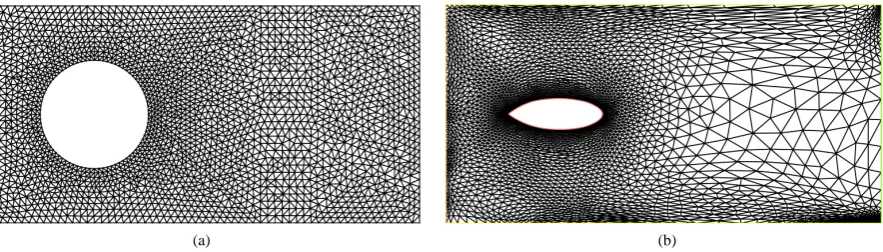
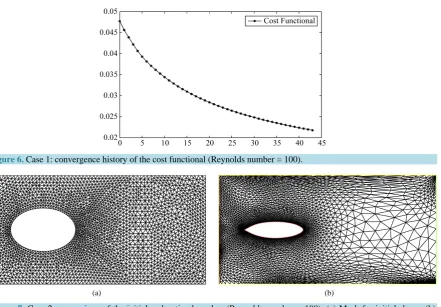
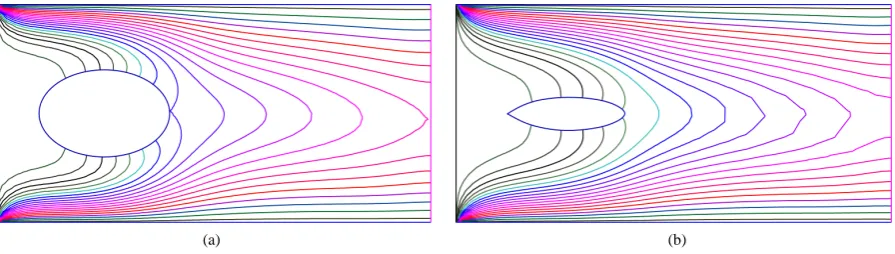
Figures 1-5andFigures 7-11 demonstrate the comparison between the initial shape and optimal shape for the
computing mesh, the contours of the velocity u=
(
u u1, 2)
T, the pressure p and the temperature T.We run many iterations in order to show the good convergence and stability properties of our algorithm, however it is clear that it has converged in a small number of iterations (see Figure 6andFigure 12).
[image:9.595.96.538.251.377.2]
(a) (b)
Figure 1. Case 1: comparison of the initial and optimal meshes (Reynolds number = 100). (a) Mesh for initial shape; (b) Mesh for optimal shape.
[image:9.595.90.541.411.535.2]
(a) (b)
Figure 2. Case 1: contour of u1 for the initial and optimal shapes (Reynolds number = 100). (a) u1 for initial shape; (b) u1
for optimal shape.
(a) (b)
Figure 3. Case 1: contour of u2 for the initial and optimal shapes (Reynolds number = 100). (a) u2 for initial shape; (b) u2
[image:9.595.92.538.569.699.2][image:10.595.85.539.77.207.2]
(a) (b)
Figure 4. Case 1: contour of p for the initial and optimal shapes (Reynolds number = 100). (a) p for initial shape; (b) p for optimal shape.
[image:10.595.90.541.242.368.2]
(a) (b)
Figure 5. Case 1: contour of T for the initial and optimal shapes (Reynolds number = 100). (a) T for initial shape; (b) T for optimal shape.
Figure 6. Case 1: convergence history of the cost functional (Reynolds number = 100).
(a) (b)
[image:10.595.100.542.398.705.2] [image:10.595.88.543.571.696.2][image:11.595.76.539.81.209.2]
(a) (b)
Figure 8. Case 2: contour of u1 for the initial and optimal shapes (Reynolds number = 100). (a) u1 for initial shape; (b) u1
for optimal shape.
[image:11.595.87.542.245.369.2]
(a) (b)
Figure 9. Case 2: contour of u2 for the initial and optimal shapes (Reynolds number = 100). (a) u2 for initial shape; (b) u2
for optimal shape.
(a) (b)
Figure 10. Case 2: contour of p for the initial and optimal shapes (Reynolds number = 100). (a) p for initial shape; (b) p for optimal shape.
(a) (b)
[image:11.595.89.540.404.533.2] [image:11.595.91.539.567.694.2]Figure 12. Case 2: convergence history of the cost functional (Reynolds number = 100).
5. Conclusion
In this paper, we consider the shape optimization problem of a body immersed in the incompressible fluid go-verned by Oseen equations coupling with a thermal model. Based on the continuous adjoint method, we formu-late and analyze the shape optimization problem. Then we derive the structure of shape gradient for the cost functional by employing the differentiability of a minimax formulation involving a Lagrange functional with the function space parametrization technique. Moreover, we propose a gradient-type algorithm for the shape opti-mization problem, and the numerical examples indicate that the proposed algorithm is feasible and effective for the low Reynolds numbers.
Funding
This work is supported by the National Natural Science Foundation of China (No. 11371288), and the Research Foundation of Department of Education of Shaanxi (No. 11JK0494).
References
[1] Pironneau, O. (1984) Optimal Shape Design for Elliptic Systems. Springer, Berlin.
http://dx.doi.org/10.1007/978-3-642-87722-3
[2] Mohammadi, B. and Pironneau, O. (2001) Applied Shape Optimization for Fluids. Clardendon Press, Oxford.
[3] Simon, J. (1990) Domain Variation for Drag in Stokes Flow. Proceedings of IFIP Conference in Shanghai, Lecture Notes in Control and Information Science, Springer, New York, 1990.
[4] Bello, J., Fernndez-Cara, E. and Simon, J. (1992) The Variation of the Drag with Respect to the Domain in Navi-er-Stokes Flow. Optimization, Optimal Control, Partial Differential Equations, International Series of Numerical Ma-thematics, 107, 287-296. http://dx.doi.org/10.1007/978-3-0348-8625-3_26
[5] Bello, J., Fernndez-Cara, E., Lemoine, J. and Simon, J. (1997) The Differentiability of the Drag with Respect to the Variations of a Lipschitz Domain in a Navier-Stokes Flow. SIAM Journal on Control and Optimization, 35, 626-640.
http://dx.doi.org/10.1137/S0363012994278213
[6] Delfour, M.C. and Zolésio, J.-P. (2001) Shapes and Geometries: Analysis, Differential Calculus, and Optimization. SIAM, Philadelphia.
[7] Sokolowski, J. and Zolésio, J.-P. (1992) Introduction to Shape Optimization: Shape Sensitivity Analysis. Springer- Verlag, Berlin. http://dx.doi.org/10.1007/978-3-642-58106-9
[8] Yan, W.J. and Ma, Y.C. (2008) Shape Reconstruction of an Inverse Stokes Problem. Journal of Computational and Applied Mathematics, 216, 554-562. http://dx.doi.org/10.1016/j.cam.2007.06.006
[9] Yan, W.J. and Ma, Y.C. (2009) The Application of Domain Derivative of Thenonhomogeneous Navier-Stokes Equa-tions in Shape Reconstruction. Computers and Fluids, 38, 1101-1107.
http://dx.doi.org/10.1016/j.compfluid.2008.11.003
[11] Chenais, D., Monnier, J. and Vila, J.P. (2001) A Shape Optimal Design Problem with Convective Radiative Thermal transfer. Journal of Optimazation Theory and Applications, 110, 75-117. http://dx.doi.org/10.1023/A:1017543529204
[12] Pironneau, O. (1988) Optimal Shape Design by Local Boundary Variations. Springer-Verlag, Berlin.
[13] Hadamard, J. (1907) Mémoire sur le problème d'analyse relatif à l'équilibre des plaques élastiques encastrées. Mémoire des savants étrangers, 33, 515-629.
[14] Simon, J. (1980) Differentiation with Respect to the Domain in Boundary Value Problems. Numerical Functional Analysis and Optimization, 2, 649-687. http://dx.doi.org/10.1080/01630563.1980.10120631
[15] Dogan, G., Morin, P., Nochetto, R.H. and Verani, M. (2007) Discrete Gradient Flows for Shape Optimization and Ap-plications. Computer Methods in Applied Mechanics and Engineering, 196, 3898-3914.
http://dx.doi.org/10.1016/j.cma.2006.10.046