Listless Block Tree Coding with Discrete Wavelet
Transform for Embedded Image Compression at
Low Bit Rate
Chandandeep Kaur
UIET, Panjab UniversityChandigarh [India]
Sumit Budhiraja
UIET, Panjab UniversityChandigarh [India]
ABSTRACT
Listless Block Tree Coding (LBTC) is Wavelet Block Truncation Coding (WBTC) algorithm without using lists. LBTC is evolved from two variants of Set Partitioning In Hierarchal Trees (SPIHT) which are Wavelet based Block Tree Coding (WBTC) and No list SPIHT (NLS). WBTC works on blocks with varying root sizes instead of pixels so it lowers the memory requirement as compared to SPIHT and uses three ordered auxiliary lists to keep track of the significant coefficients similar to SPIHT. SPIHT uses lists which keep on increasing at each pass and require o lot of memory, so another variant of SPIHT is NLS which uses a state table to store the significant coefficients. This state table uses four bits for each coefficient. In LBTC, listless variant of WBTC is implemented using the concept of NLS in which instead of lists, markers are used. This paper presents the proposed algorithm in which LBTC is combined with DWT and the quality of compressed image is improved significantly by optimizing the Peak Signal to Noise Ratio (PSNR) and Mean Square Error (MSE). It outperforms other compression methods by a wide margin in terms of PSNR and MSE though the time taken by the algorithm is more than LBTC.
General Terms
Algorithm, Bit rate, Compression, Markers, Memory Management, Optimize, Root Size
Keywords
SPIHT, NLS, Block Tree, DWT, PSNR, MSE, EZW
1.
INTRODUCTION
SPIHT [1] is an image compression method introduced by Said and Pearlman in 1996 in which the basic principle is to use set partitioning so that spatial self similarity across different scales can be exploited. SPIHT by using parent– child relationship order the wavelet coefficients into sets and check their significance at successively finer quantization levels. The complexity of SPIHT cannot be estimated easily as it depends upon the source image and decomposition depth [2]. Even if the compression ratio is noticeably high, the quality of reconstructed image is very good. The basic idea of SPIHT is that, it applies progressive coding and image is processed at decreasing threshold at each level. Main concept is of zero trees [3], which consider relationship between coefficients in subbands at different levels. If in a particular
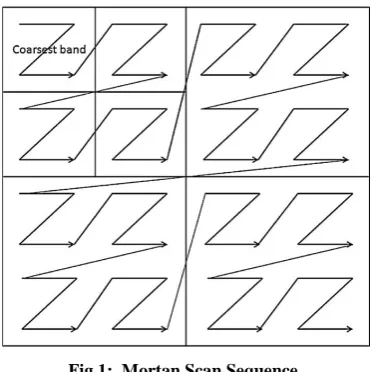
information. This is an array of coefficient values in which each coefficient has four bits. LBTC uses eight markers to store the significant coefficients [22]. In this a coefficient is not addressed by two coordinates but linear indexing is used hence a one dimensional array is formed by mapping two dimensional array of coefficients. Using the concept of Morton scan sequencing, shown in figure 1 [23] insignificant block trees are skipped efficiently. Encoding process of this algorithm is performed bit plane by bit plane starting from the most significant bit plane to the least significant bit plane.
Fig 1: Mortan Scan Sequence
2.1
The Proposed LBTC-DWT Algorithm
While using DCT, blocks are formed by dividing an image and each block goes through transformation. This creates a series of frequency components corresponding to detail levels of an image [24]. Significant coefficients are stored using some coding technique. DWT performs multi-scale image decomposition and reveals data redundancy very effectively by applying filtering and sub sampling. Data is compressed using some coding technique. There are two ways to implement DWT. Convolution (filtering) is applied in first method which handles boundaries in an appropriate manner and the second method is a fast lifting approach, which gives same result as the first approach by applying filters in a different way and leads to significant saving of computations and memory. As an image is a two dimensional array of pixels, the transform is applied rows and columns wise. So when the transform is applied at first level, four subbands arise, one is low-pass subband which contains the coarse approximation of the source image and is represented as LL and there are three high-pass subbands which exploit details of an image across various directions – HL is for horizontal, LH is for vertical and HH is for diagonal details. At the second level of the transform, the LL band is used for further decomposition and respective four subbands develop form it[25]. The three level decomposed image is as shown in figure 2. LBTC-DWT codec provides efficient image compression by improving the quality of compressed image in terms of various parameters as PSNR and MSE [26].
Fig 2: Three level wavelet decomposition
Markers used in LBTC are:
BIP- pixel is insignificant for current bit plane
BNP- newly significant pixel and will not be refined for current bit plane
BSP- pixel is significant and will be refined for current bit plane
BDS- first child pixel in a single tree consisting all descendants
BCP- same as BIP but it will be tested for significance in the current pass
SD- first child pixel in a composite tree consisting descendants
SG- first grandchild pixel in a tree of grand descendants
SN- used on the main nodes at each generations of an insignificant block tree
2.2
Steps of LBTC-DWT Encoder
algorithm
2.2.1. Set initial threshold:
T= log2 max(c (i,j)) , a coefficient s is significant if s ≥ 2T . At decoder, when a significant bit arrive it’s reconstructed as ± 1.5 × 2T. 2T−1 is added to its reconstructed value if the significant bit is in current pass otherwise subtarcted
2.2.2 Insignificant pixel pass:
For a pixel at ith position with i=0 and i≤ I;
- if insignificant, it is marked as BIP and d= val[i] and s is output
- Further check the significance and mark it as BNP if significant and output d= sign[i] and move to next coefficient
[image:2.595.75.262.179.365.2]2.2.3 Insignificant set pass:
- If block tree of descendants is significant, mark it as SD
- Quad split and mark as BDS
- Set of grand descendants marked as SG
- If grand descendant block tree is significant, it’s quad split and and marked as SD else skip to next grand descendant block tree
- After reaching to a single tree, check it’s significance and mark as BCP if significant otherwise skip to next tree
- The significance of each coefficient inside the single tree is checked and marked as BNP if significant else BI
2.2.4 Refinement pass
- The pixels marked as BSP are refined in the same pass
- The pixels marked as BNP are significant for next pass and are marked as BSP in next pass and then refined
[image:3.595.63.533.227.314.2]- If a pixel is marked as BIP, it is skipped and move to the next block
Fig 3: Block Diagram of Proposed LBTC-DWT Algorithm
3.
RESULTS AND PERFORMANCE
ANALYSIS
The performance of LBTC-DWT is compared with other compression methods as LBTC, WBTC, NLS and SPIHT. The proposed algorithm is found to be better than other methods by a wide margin in terms of various parameters as memory requirement, image quality measured by PSNR and MSE.
3.1 Memory Requirement
Number of block trees required by LBTC is less than NLS and SPIHT. As if a root block is of size (2×2), (4×4), and (8×8) LBTC requires 1/4, 1/16 and 1/64 times lesser block trees respectively when compared to NLS. So as compared to NLS, the initial cost required by LBTC is 25%, 6.25% and 1.25% less respectively. Due to block based nature of WBTC used in LBTC, the number of coefficients arre more than list nodes. So the total memory occupied by LBTC is less than SPIHT which is almost one third of the memory required by SPIHT. The number of coefficients in the DC band is Idc=Rdc
And the memory required by LBTC is
MLBTC = IW + RC/ 2
MWBTC= ∼0.95× MSPIHT
3.2 Image Quality
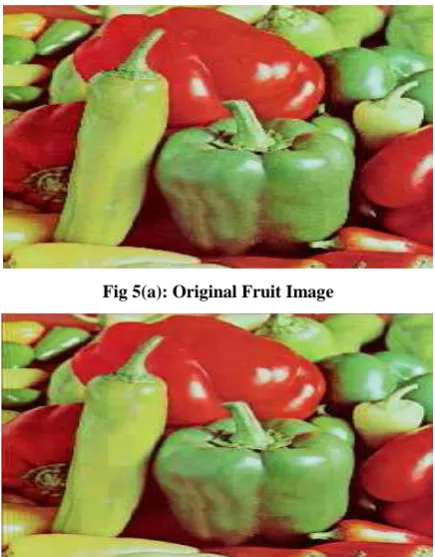
Quality of the compressed image is measured by analyzing various parameters as PSNR and MSE. These parameters are improved by a large extent using the proposed algorithm when compared to other compression methods. Table 1 shows the comparison of various algorithms in terms of PSNR and MSE for gray scale Lena and Barbara image respectively. Table 2 shows the comparison PSNR and MSE of colored Lena and Barbara images with LBTC-DWT algorithm. Figure 4(a) and Figure 4(b) shows the colored original and
Table 1. Comparison of PSNR Values of LBTC-DWT, LBTC, WBTC, NLS, SPIHT For Gray Scale Lena and
Barbara Image (in dB)
Image Algorithm PSNR MSE
Lena LBTC-DWT
LBTC
WBTC
NLS
SPIHT
48.35
24.67
22.89
21.97
21.94
42.25
54.67
56.76
57.12
57.34
Barbara LBTC-DWT
LBTC
WBTC
NLS
SPIHT
46.56
22.95
20.32
20.53
19.84
44.56
55.23
57.13
58.67
[image:4.595.59.276.323.647.2]58.95
Table 2. Comparison Of PSNR And MSE Of Gray Scale And Colored Images Using LBTC-DWT Algorithm
Image PSNR MSE
Lena (gray) 48.35 42.25
Lena (colored) 82.51 24.23
Fruit (gray) 47.56 43.86
Fruit (colored) 80.86 25.36
Fig 4(a): Original Lena Image
Fig 4(b): Compressed Image By LBTC-DWT Algorithm
Figure 5(a) and 5(b) shows the colored original and fruit images using LBTC-DWT algorithm. From the analysis done by observing the PSNR and MSE values of gray scale Lena and Barbara images using various algorithms its shown that the proposed algorithm outperforms other compression methods by a wide margin by optimizing the PSNR and MSE values to large extent. Also the algorithm performs very efficiently for colored images as the quality of colored images after compression is lot better than gray scale images. In future the prposed algorithm can be combined with neural networks to furthur optimise the quality of compressed image.
Fig 5(a): Original Fruit Image
[image:4.595.319.537.384.663.2]4.
REFERENCES
[1] Said A, Pearlman WA., “A New fast and Efficient Image Codec Based on Set Partitioning in Hierarchical Trees”, IEEE Trans Circuits Syst Video Tech., Jun. 1996;6(3):243–50
[2] J.M Shapiro, “Embedded Image Coding Using Zero Trees of Wavelet Coefficients”, IEEE trans on signal processing, Dec. 1993;(41):3445-3462
[3] W.K.Lin, N.Burgess, “ Listless Zero Tree Coding for Color Images”, in Proc of 32nd
Asilomar Conf on Signals, Sys. And Computers, Nov. 1998;(1):231-235
[4] C.L Tung, T.S Chen, “ A New Improvement of SPIHT Progressive Image Transmission”, Proc of IEEE 5th
Int. Symposium on Multimedia Software Engineering, Jun. 2003;(7)
[5] E.Khan, M.Ghanabari, “Error Detection And Correction Of Transmission Errors In Spiht Coded Images”, IEEE, ICIP, Jun. 2002:689-692
[6] H.Minghe, Z.Cuixiang, “ Application Of Improved SPIHT for Multispectral Image Compression”, 5th
Int. Conf. On Computer Science & Education, China, Aug. 2010:1058-1061
[7] Y.Jin, H.Lee, “A Block-Based Pass-Parallel SPIHT Algorihtm”, IEEE Tran Circuits And Systems Video Tech.,(22) July 2012
[8] L.Zhu, Y.Yang, “Embeded Image Compression Using Differential Coding and Optimization Method”, IEEE, 2011
[9] J.Zhu, S.Lawson, “Improvements to Spiht for Lossy Image Coding”, IEEE, Jan. 2001
[10] S.Zaibi, V.Kerbaol, “Efficient Source and Channel Coding for Progressive Image Transmission over Noisy Channels”, IEEE, Feb. 2002
[11] M.A.Khan, E.Khan, “Error Resilient Technique for SPIHT Coded Color Images”, IEEE, Sept. 2009
[12] Y.Hue, W.A Pearlman, “Progressive Significance Map and Its Application to Error-Resilient Image Transmission”, IEEE Trans. Image Processing, (21) No. 7, July 2012
[13] P.Singh, M.N.S.Swamy, “Block Tree Partitioning for Wavelet Based Color Image Compression”, IEEE, ICASSP, Jun. 2006
[14] Y.Sun, H.Zhang, “Real-Time Implementation of a New Low-Memory SPIHT Image Coding Algorithm Using DSP Chip”, IEEE Trans. Image Processing, (11)9, Sept. 2002
[15] T.Brahmi, A.Melit, “Improvements to SPIHT for Lossless Image Coding”, IEEE, Jun. 2006
[16] F.W.Whheler, W.A,Pearlman, “SPIHT Image Compression Without Lists”, in Proc IEEE, ICASSP, (4),Jun. 2000:2047-2050
[17] J.W.Han, M.C.Hwang, “Vector quantizer based block truncation coding for color image compression in LCD overdrive,” IEEE Trans. Consumer Electron., (54)4, Nov. 2008, pp.1839–1845
[18] R.Praba1, C.Vasanthanayaki, “Enhanced Wavelet Block Tree Based Image Coding Algorithm”, Int. Conf. on Control, Automation,Communication And Energy Conservation, Jun. 2009
[19] Pearlman W.A., Islam A., Nagaraj N., Said A., “Efficient low complexity image coding with set-partitioning embedded block coder’, IEEE Trans. Circuits Syst. Video Technol., 2004(14) pp. 1219–1235
[20] Munteanu A., Cornelis J, “Wavelet Image Compression – The Quadtree Coding Approach. IEEE Trans. on Information Technology.in Biomedicine,1999 (3), :176– 18
[21] R.K.Senapati, U.C.Pati, “Listless block-tree set partitioning algorithm for very low bit rate embedded image compression”, International Journal of Electronics and Communications (AEÜ), 2012
[22] Liu G., Zeng X., “A novel direction-adaptive wavelet based image compression.”, Int J Electron Commun, Elsevier 2010;64(6):531–9
[23] Chai BB., Vass J., “Significance-linked connected component analysis for wavelet image coding”, IEEE Trans Image Process 1999;8(6):774–84
[24] Pan H., Siu WC., “A fast and low memory image coding algorithm based on lifting wavelet transform and modified SPIHT”, Signal Process: Image Commun., 2008;23(3):146–61
[25] Douak F., Benzid R., “Color image compression algorithm based on DCT transform combined to an adaptive block scanning. Int J Electron Commun, Elsevier 2011;65(1):16–26.