http://dx.doi.org/10.4236/jcc.2015.311016
A Control Strategy for Multi-Robot System
Navigating in a Dynamic Environment
Ting Wang, Ryad Chellali, Yang Yi, Wen Qin, Mingzhu Wei
College of Electric Engineering and Control Science, Nanjing Tech University, Nanjing, China
Received October 2015
Abstract
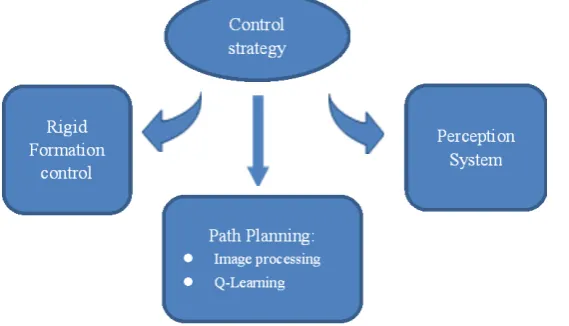
This paper introduces a new control strategy for heterogeneous multi-robots systems dedicated to industrial logistic setups. This control strategy is based on both distributed intelligence and ma-chine learning and involves three parts: the rigid formation controller, the perception system and the path planner. Our controller is event-based and thus its control-coordination strategy can be self-adaptive and applied to real dynamic environment. During the navigating process, the mul-ti-robots system derives the environment model, performs the path planning process that guaran-ties both the transportation constraints and the obstacle avoidance. For the validation, both simu-lation and real robot experiments are performed. The results show that the developed control strategy can be well used for realistic logistics applications.
Keywords
Multi-Robots System, Distributed Intelligence, Machine Learning, Dynamic Environment
1. Introduction
Since 1980s, researcher interests in multi-robots systems (MRS) are increasing as it becomes clear that they of-fer more benefits compared single robot systems [1] [2]: MRS are more robust and they support higher mobility. Indeed, their inherent redundancy reduces the effects of individual malfunctions while having a high number of degrees of freedom for the full system. These advantages are counter-balanced by a higher complexity, i.e., one has more challenging control and path planning issues to solve. In addition to the classical control/oath planning problems, MRS should consider the interactions among robots’ group under four umbrellas: collective, coopera-tive collaboracoopera-tive and coordinacoopera-tive behaviors [3]. For some applications, only part these behaviors are necessary. For the more general case, all of them are needed. In [4] for instance, an MRS is used for exploration task and the LUNARES (Lunar Exploration Scenario) system is used to gather information about its environment. In lo-gistics applications for instance, all behaviors are necessary: the group of robots handles an object and move it for a given area to another area. In such cases, it is necessary to solve a multi-objective problem: 1) deriving the right formation (relative placement of robots) allowing transporting rigid objects, 2) performing accordingly path planning, including obstacles avoidance for individual robots.
T. Wang et al.
Universal Modular ACTOR Formalism [8]. The second project was GOFFER [9] [10]. In GOFFER, a central task planning and scheduling system (CTPS) can communicate with all robots and can get a global view. Like-wise, the ALLIANCE architecture was developed by Parker in [11] [12] to study the cooperation in a heteroge-neous, small-to-medium-sized team of largely independent, loosely coupled robots.
As for stepping from one to more robots, involving heterogeneity in MRS has a cost: the design of the control strategy is harder due to the multiplicity of locomotion. Indeed controlling simultaneously a walking robot to-gether with a wheeled robot to achieve a given formation requires combining two different state spaces for which solutions are not straightforward (moving a non-holonomic system and maintaining the equilibrium of a biped). To cope with these difficulties, we addressed the issue of unifying the four previous requirements to ob-tain a single formalism allowing solving a multi-objective optimization problem where both robots as a group and as individuals should obey to simultaneous constraints dealing with rigid formation and obstacle avoidance. In this paper, we present an application related to logistics. Our goal is allowing the MRS transporting differ-ent kinds of objects from one point to another point in unknown and varying environmdiffer-ents. The size, the shape and the weight of the transported objects may vary. As well, the working space is partially unknown and may vary itself. In this perspective, we used machine-learning techniques to make the MRS self-adaptive and react-ing effectively and safely to any unexpected change in the workreact-ing environment.
The contribution is organized as follows. Section 2 introduces the control strategy. Section 3 presents the rigid formation control of multi-robots system. Section 4 details the path planning algorithm as well as the perception system. Simulations and real robot experiments are given in Section 5. Conclusions and future work were given in the Section 6.
2. System Overview
2.1. Task DescriptionIn real transportation, it usually needed to carry large and heavy loads in many situations, both in indoor and outdoor environments. In such cases, it is crucial to maintain the rigid formation of the multi-robots system in order to keep the load not falling down during the transport. In addition, the obstacle avoidance should be solved for individual robots as well as the multiple robots as a whole. Accordingly, the MRS should perform tasks as depicted in Figure 1 and Figure 2. It consists of maintaining rigid formation to carry objects. Meanwhile, the perception system establishes an occupation grid map allowing planning safe and feasible paths. The perception system is responsible for gathering the image and information of the current environment. In the paper, a camera or a flying robot materializes the perception system. With the occupancy grid and given the final destination, an optimal path is determined thanks to the Q-learning algorithm.
2.2. Perception Module
[image:2.595.177.462.542.705.2]In order to get environment model, we developed a computer vision based module to extract changes. Our sys-
Figure 2. Even-based coordination strategy and Petri-net.
tem compares successive images taken by a UAV (or a moveable camera). After background substraction, we obtain a binary matrix E(i, j).
1 0 1 1 1 1 1 1 1 1
1 0 1 1 1 1 1 1 1 1
1 0 0 0 0 0 1 0 0 0
1 0 0 0 0 0 1 0 0 0
1 1 1 1 0 0 1 0 0 0
1 1 1 1 0 0 0 0 0 0
1 0 0 0 0 0 0 0 0 1
1 0 0 0 0 0 0 0 0 1
1 0 0 0 0 0 0 0 0 1
1 1 1 1 1 1 1 1 1 1
E
=
(1)
In which 1 represents obstacles and 0 is free path. Here, in order to adapt to our experimental robot (Khepera III), we reshape the size of matrix E to fit to the real dimension of the working space (see in Figure 7). In this example, the environment is divided into 100 states where each state is a square of 30 cm × 30 cm. Rigid forma-tion control part and Q-learning part can be found in [13]-[16].
2.3. Example of Execution
T. Wang et al.
Figure 3. Virtual environment of the multi-robot system.
Figure 4. Illustration of the path planning task carried out by the top camera and remote computer: start point (left), goal point (right).
3. Real Robot Experiment
The real experiment consisted firstly to compute the path planning by the supervisor and secondly to control the rigid formation of multi-robots system. In the real experiment, we use two Khpera III robots, a humanoid robot Nao played a role of local supervisor, a camera and a computer acted as a supervisor for remote control of both camera and robots. The camera is hanging on the 2 m height. The real environment (in Figure 5(a)) constitutes by a 1.5 m wide and 2.1 m long rectangular floor. Some paper used to act as obstacles. The environment com-prises 35 states and each state is a 30 cm side square.
3.1. Environment and Path Planning
The path planning of the unknown environment is displayed in Figure 5(b). The initial position (the green dot and circle) and final position (the blue dot and circle) respectively are [4; 2] and [1; 6]. In the experiment, multi- robots system maintained the vertical formation 2 from the beginning to the end. The initial position marked with green dot (the reference robot) and green circle. The final position marked with blue dot and blue circle.
A
B
A B
[image:4.595.119.511.259.507.2]
(a) (b)
Figure 5. (a) Unknown environment; (b) Path planning results.
3.2. Experiment Results
Let us suppose that the multi-robots system entered the current room k (see in Figure 6(a)) from the previous room k − 1. They aim to go across the room k and enter into next room k + 1. The process includes two parts. In the first part, Nao led two Khepera III robots move ahead, because there is a free pass way in front of the mul-ti-robots system on initial time step. In the second part, we put a barrier to block the pass way in front of the multi-robots system. Based on an event-based coordination strategy, HMRS can be self-adaptive to the sudden disturbance of the environment. The detailed process is as follows: (1) Nao explored the front area at each time step. As soon as it observed the obstacle, it enabled the top camera to send an image of current unknown envi-ronment. Then, through calculating the path planning by a supervisor, two Khepera III robots (multi-robots sys-tem) apply ANFIS rigid formation control to avoid obstacles. Nao executed the corresponding actions according to the results of path planning. Finally, multi-robots system crossed the current room k as well as they arrived at the initial position of room k + 1. The results and description of go forwards part and path planning part are as follows.
The pictures of the first part displayed in Figure 6. At the beginning of the experiment, HMRS went into room k from room k − 1. Nao led two Khepera III robots (MRS) keep going ahead as there is a pass way. The
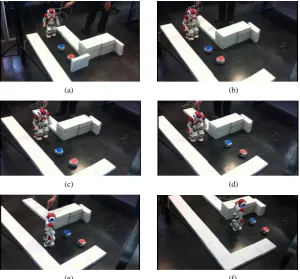
initial state of experiment showed in Figure 6(a) and the segment of the first part showed in Figure 6(b). After the short go forwards part, we set an obstacle in order to stop HMRS and removed it after few seconds (see in Figure 7(a)). In this case, as Nao updated the current image and detected the obstacle, it demanded the external camera to give the image of the current room K to the supervisor. Using Q learning, the optimal path and actions obtained by supervisor (see in Figure 7(b)). Multi-robots System was interrupted and exchanged commands with the supervisor. The supervisor switched the go forwards control to rigid formation control.
The path planning demonstrated in Figure 7(b). Actions are 1 1 3 3 3 for the rest part of environment. In the part, two Khepera III robots (MRS) formed a vertical line rigid formation. By the ANFIS rigid formation control, MRS crossed the area without colliding with obstacles. After two continuous go forwards translational actions (see in Figure 7(b) and Figure 7(c)), multi-robots system turned left to finish the rest three left translational ac-tions. Nao followed the MRS to turn left (see in the Figure 7(d) and Figure 7(e)) after the two continuous for-wards translational actions. The rest three actions illustrated respectively in Figures 7(d)-(f). The final state of the experiment showed in Figure 7(f). They will continue to move in the room k + 1.
4. Conclusion
T. Wang et al.
[image:6.595.165.464.83.185.2]
(a) (b)
Figure 6. Go forwards part. (a) Initial state of the experiment; (b) Multi-robots team goes forwards.
(a) (b)
(c) (d)
(e) (f)
Figure 7. Path planning part.
strategy is that it makes the heterogeneous multi-robots team be self-adaptive to any disturbance of the current environment. Due to the coordination and cooperation among different types of robots, the HMRS can accom-plish a common task by the unified distributed intelligence. Besides the simulation in a very widely virtual en-vironment, the paper also validated the strategy with a real robots experiment. The strategy may be used to the practical logistic industry, such as environment exploring, transportation tasks and so on. In the future, the work will continue to focus on the adaptation of formation versus type of load aiming to apply in the logistic industry.
References
[1] Arai, T., Pagello, E.and Parker, L.E. (2002) Editorial: Advances in Multi-Robot Systems. IEEE Trans. Robot. Autom, 18,655-661. http://dx.doi.org/10.1109/TRA.2002.806024
[2] Cao, Y., Fukunaga, A. and Kahng, A. (1997) Cooperative Mobile Robotics: Antecedents and Directions. Auton. Robot., 4, 1-23. http://dx.doi.org/10.1023/A:1008855018923
[3] Parker, L.E. (2008) Multiple Mobile Robot System. In: Bruno, S. and Oussama, K.S., Eds., Handbook of Robotics, Springer-Verlag, Berlin Heidelberg, 921-941. http://dx.doi.org/10.1007/978-3-540-30301-5_41
[image:6.595.164.465.226.505.2]Planthaber, S., Roehr, T., Scheper, M. and Kirchner, F. (2010) LUNARES: Lunar Crater Exploration with Heteroge-neous Multi Robot Systems. Intelligent Service Robotics, 6 December 2010, 1-29.
[5] Asama, H., Ishida, Y., Ozaki, K., Habib, M.K., Matsumoto, A., Kaetsu, H. and Endo, I. (1992) A Communication Sys-tem between Multiple Robotic Agents. In: Leu, M., Ed., Proc. the Japan USA Symposium on Flexible Automation, 647-654.
[6] Alami, R., Fleury, S., Herrb, M., Ingrand, F. and Robert, F. (1998) Multi-Robot Cooperation in the MARTHA Project. Robot Automation. Mag, 5, 36-47.
[7] Ishida, Y., Endo, I. and Matsumoto, A. (1991) Communication and Cooperation in an Autonomous and Decentralized Robot System. IFAC Int. Symp. on Distributed Intelligent Systems, 299-304.
[8] Hewitt, C., Bishop, P., Greif, I., Smith, B., Matson, T. and Steiger, R. (1973) A Universal Modular Actor Formalism for Artificial Intelligence. Proc. Intl. Joint Conf. Artificial Intelligence, 235-245.
[9] Caloud, P., Choi, W., Latombe, J.C., Le Pape, C. and Yim, M. (1990) Indoor Automation with Many Mobile Robots. Proc. IEEE Int. Workshop Intell. Robot. Syst., Tsuchiura, 67-72. http://dx.doi.org/10.1109/iros.1990.262370
[10] LePape, C. (1990) A Combination of Centralized and Distributed Methods for Multi-Agent Planning and Scheduling. IEEE ICRA, 488-493.
[11] Parker, L.E. (1994) ALLIANCE: An Architecture for Fault Tolerant, Cooperative Control of Heterogeneous Mobile Robots. Proc. IEEE/RSJ/GI Int. Conf. Intell. Robot. Syst., Munich, 776-783.
http://dx.doi.org/10.1109/IROS.1994.407550
[12] Parker, L.E. (1994) Heterogeneous Multi-Robot Cooperation. Ph.D. Thesis, M.I.T. Department of Electrical Engineer-ing and Computer Science.
[13] Parker, L.E. (2008) Distributed Intelligence: Overview of the Field and Its Application in Multi-Robot Systems. Elec-trical Engineering, 2,5-14.
[14] Wang, T., Gautero, F., Sabourin, C. and Madani, K. (2011) A Neural Fuzzy Inference Based Adaptive Controller Us-ing LearnUs-ing Process for Nonholonomic Robots. International Work-conference on Artificial Neural Networks (IWANN 2011), CD-Rom Proceedings, 65-72. http://dx.doi.org/10.1007/978-3-642-21501-8_9
[15] Wang, T., Ramik, D.M., Sabourin, C. and Madani, K. (2012) Intelligent Systems for Industrial Robotics: Application in Logistic Field. Industrial Robot: An International Journal, 39, 251-259.
http://dx.doi.org/10.1108/01439911211217071
[16] Wang, T., Ramik, D.M., Sabourin, C. and Madani, K. (2011) Machine-Learning for Heterogeneous Multi-Robots Sys-tems in Logistic Application Frame. Proceedings of the 14th International Conference on Climbing and Walking Ro-bots and the Support Technologies for Mobile Machines (CLAWAR2011), Paris, September 2011, 207-222.