A Secure Mobile Banking Scheme Based on
Certificateless Cryptography in the Standard Security
Model
Mohammed Hassouna
Faculty of Computer Studies,National Ribat University, P.O.Box 22, Khartoum, Sudan
Nashwa Mohamed
Faculty of Mathematical Sciences,University of Khartoum, P.O.Box 321, Khartoum, Sudan
Eihab Bashier
Faculty of Sciences ant Arts, Albaha University, P.O. Box: 1988,Baljurashi, Saudi Arabia [email protected]
ABSTRACT
Providing the security services (authenticity, integrity, confidential-ity and non-repudiation) all together in mobile banking has re-mained a problematic issue for both banks and their customers. Both the public key infrastructure (PKI) and the identity-based public key cryptography (IB-PKC) which have been thought to provide solutions to these security services, have their own limi-tations. While the PKI suffers the scalability and certificate man-agement problems, the identity-based cryptography suffers the key escrow problem. This paper proposes a secure web-based mo-bile banking scheme using certificateless public key cryptogra-phy. Within this scheme, the key generating center(KGC) has an offline connection with a public directory server. Both of the client and the bank’s web-server use the identities of each other to obtain the public key of each from the KGC’s public direc-tory server. Then, each party computes an authenticated per-session shared secret symmetric key. By using this shared secret key the client can encrypt his username and password to access his banking account and carry out signed banking transactions. As a result, the proposed scheme is secure in the standard model and provides authentication, confidentiality, integrity and non-repudiation. Moreover, the scheme is secure against known key attack, resilient against unknown key share and key-compromise impersonation, and secure against weak perfect forward secrecy.
General Terms:
Certificateless cryptography, Mobile banking
Keywords:
Certificateless cryptography, Key generating center, Mobile banking, Standard security model, Security services
1. INTRODUCTION
Mobile banking is a way for a bank’s customer to access bank-ing services usbank-ing its cell phone to carry out bank transactions. It makes life of customer easier by being able to access his/her accounts anytime anywhere. From the side of bank, it reduces time and effort costs at the different bank branches. Also, quality services mobile banking brings more customers to the bank and makes it competent to the other banks.
Usually, banks enable customers to access their banking ac-counts through one of four technologies. These technologies are the interactive voice response(IVR), the short messaging
ser-vice(SMS), the web-based mobile applications and the stand-alone mobile application clients.
The mobile phones can be connected to the Internet through WAP or Wi-Fi technologies. Because mobile banking have some weaknesses which reduce the trust in the mobile banking, partic-ularly, the problem of being struggling with the task of authen-ticating a user’s identity. Therefore, the customer’s serious fraud about mobile banking is the safety of using mobile banking. The customer wants to guarantee that no one else will impersonate his identity to perform banking transactions on his/her banking accounts. On the other hand, the main bank’s fraud is whether the customer who claims that he is, is really he is. Also, the bank wants to guarantee that the customer will not deny a transaction that he has performed using mobile banking. Both the bank and the customer would like to be sure that the bank has performed the exact transaction that the customer has carried out.
Public Key Infrastructure (PKI) has been thought of as the most practical solution for the problem of mobile banking security. Based on this thought, many mobile banking systems based on PKI have been proposed (see for example [2, 5, 6, 15] and [22]). Generally, the PKI suffers two problems: scalability and certifi-cate management[1]. The identity-based cryptography [9] came to address these two problems, but could not offer true non-repudiation due to the key escrow problem [1] and [3]. However, few researchers introduced solutions to the problem of the secu-rity of mobile banking based on the identity based cryptography. For example Zhao and Aggarwal [21] proposed an end-to-end secure messaging in mobile networks based on identity-based cryptography. Shubat et. al [10] presented an encryption mecha-nism based on the identity based scheme using elliptic curves to provide end-to-end SMS. The same work of Zhao and Aggrawal [21] was re-introduced by Parasad et. al in [12] in which a se-cure end-to-end messaging in mobile networks based on identity based cryptography was presented.
This paper proposes a secure web-based mobile banking system based on Al-Riyami and Paterson’s certificateless cryptography scheme. In the proposed scheme, the KGC server has offline connection with a public directory server. The public directory server holds the system’s parameters and the public and partial private keys of the bank’s mobile customers. The public direc-tory server can authenticate itself to the mobile clients through a challenge. The mobile client runs handshake protocol with the bank’s web-server to first authenticate each other and generate a per-session shared symmetric key, using this key to encrypt the transactions that mobile client does later.
The rest of this paper is organized as follows. Section 2 gives backgrounds about mobile banking technologies. In Section 2.5, we introduce the concept of certificateless public key cryptog-raphy. In Section 3, we introduce the proposed secure mobile banking scheme using certificateless cryptography. Section 0??
discusses security properties provided by the proposed scheme. Finally, Section 5 concludes the paper.
2. BACKGROUNDS
In this section, backgrounds about the methods by which a mo-bile client can access the momo-bile banking services are introduced. As stated in the previous section, there are four technologies to access the mobile banking services. These technologies are in-teractive voice response, the short messaging service, the web-based and the stand-alone mobile application clients.
2.1 Interactive Voice Response
The interactive voice response (IVR) enables the communication between a customer and a service provider (which is a bank in our case). After the customer calls some predefined number to activate a service, a computer program at the service provider side provides a list of given choices to the customer using voice and the customer responds via touch-tone selection. The inter-action continues between the customer and his service provider until he gets the service(s) done.
2.2 Short Messaging Service
In the short messaging service (SMS), the customer requests a service or specific information by sending an SMS containing the service command to a prespecified number. Then the bank responds to the customer by a message informing the delivery of the service or containing the specific information.
2.3 Web-based Mobile Banking
Mobile phones have very limited resources (CPUs, memories, display capabilities, input facilities and battery powers) and the wireless networks have narrower bandwidths compared to the wired networks. Moreover, the mobile networks can utilize the WAP protocol which is not IP-based and therefore they do not support the standard Internet protocols. The Wireless Applica-tion Protocol (WAP) aimed at enabling the mobile phones and the other wireless devices to access the Internet contents and web services. The WAP does allow the use of the Extensible Hyper-text Markup Language (XHTML) to build platform-independent wireless applications. The different releases of the WAP support the standard Internet protocols, such as TCP, IP and HTTP and can operate over all the wireless technologies, such as the Code Division Multiple Access (CDMA), the General Packet Radio Service (GPRS) and the third generation (3G) cellulars. WiFi is a wireless technology brand owned by the Wi-Fi Alliance intended to improve the operating of wireless products. Common applica-tions for Wi-Fi include Internet and VoIP phone access, gaming, and network connectivity for consumer electronics such as mo-bile phones, laptops, game consoles, MP3 players and PDA’s. Wi-Fi also allows connectivity which enables devices to connect
directly with each other. This connectivity mode is useful in con-sumer electronics and gaming applications.
2.4 Standalone Mobile Application
Standalone mobile applications allow accessing mobile services (including mobile banking) through user’s interfaces. It enables the implementation of secure and reliable channel of communi-cation.
Running mobile applications require that the mobile device does support at least one development environment, such as J2ME, android or Qualcomm’s BREW. The mobile applications clients require being downloaded (from the service provider’s website) on the client device before they can be used.
The major disadvantage of mobile application clients is that the applications need to be customized to each mobile phone on which it might finally run, for example J2ME ties together the API for mobile phones which have the similar functionality in what it calls ’profiles’, android applications need Dalvik Virtual Machine(DVK) to be installed and run in any mobile device.
2.5 Certificateless Public Key Cryptography (CL-PKC)
In 2003 Al-Riyami and Paterson [1] introduced the concept of Certificateless Public Key Cryptography (CL-PKC) to overcome the key escrow limitation of the identity-based cryptography. In CL-PKC a trusted third party called Key Generation Center (KGC) supplies a user with partial private key, the user then com-bine the partial private key with a secret value (unknown to the KGC) to obtain his full private key. In this way the KGC does not know users private keys. Then the user combines the same secret value with the KGC’s public parameters to compute his public key.
Compared to identity based public key cryptography (ID-PKC), the trust assumptions made of the trusted third party in CL-PKC are much reduced. In ID-PKC, users must trust the private key generator (PKG) not to abuse its knowledge of private keys in performing passive attacks(decrypting the traffic that sent to the customer), while in CL-PKC, users need only trust the KGC not to actively propagate false public keys[1].
In CL-PKC users can generate more than one pair of key(pubic/private) for the same partial private key. To guaran-tee that KGC does not replace user’s public keys Al-Riyami and Paterson[1] introduced a binding technique to bind a user’s pub-lic key with his identity. In their binding scheme, the user first fixes his secret value and his public key and supplies the KGC his public key. Then the KGC redefine the identity of the user to be the user’s identity concatenated with his public key. By this binding scheme the KGC replacement of a public key apparent, and equivalent to a CA forging a certificate in a traditional PKI.
Al-Riyami and Paterson Scheme. In this section a general description to Setup, Set-Secret-Value, Partial-Private-Key-Extract, Set-Private-Key and Set-Public-Key algorithms as in-troduced by Al-Riyami and Paterson [1] is inin-troduced.
Letkbe a security parameter given to the Setup algorithm and IGbe a Bilinear Diffie-Hellman Problem (BDH) parameter gen-erator with inputk.
Setup (running by the KGC): this algorithm runs as follows: (1) RunIGon inputkto generate output< G1, G2, e >where
G1andG2are groups of some orderqande:G1×G1−→
G2is a pairing.
(2) Choose an arbitrary generatorP∈G1.
(3) Select a master-keysuniformly at random fromZ∗qand set P0=sP.
(4) Choose cryptographic hash functions
and
H2:G2−→ {0,1}n
wherenis the bit-length of plaintexts taken from some mes-sage spaceM = {0,1}nwith a corresponding ciphertext spaceC=G1× {0,1}n.
Then, the KGC publishes the system parametersparams=< G1, G2, e, n, P, P0, H1, H2 >, while the secret master-keysis
saved secure by the KGC.
Set-Secret-Value (running by the user): The inputs of this algo-rithm areparamsand entitym’sidntifierIDm. It selectsxm ∈
Z∗qat random and outputxmasm’ssecret value. Then, the entity mcomputesXm=xmPand sendsXmto the KGC.
Partial-Private-Key-Extract (running by the KGC): The inputs of this algorithm are an identifierIDm∈ {0,1}∗andXm. The algorithm carries out the following steps to construct the partial private key for entitymwith identifierIDm.
—ComputeQm=H1(IDm||Xm).
—Output the partial private keyDm=sQm∈G∗1.
Entitym when armed with it’s partial private keyDm, it can verify the correctness of the partial private keyDmby checking e(Dm, P) =e(Qm, P0).
Set-Private-Key (running by the user): The inputs of this algo-rithm areparams,Dm(the parital private key of entitym) and xm ∈ Z∗q (the secret value of entitym. It transforms the par-tial private keyDmto a private key Smby computingSm = xmDm=xmsQm∈G∗1.
Set-Public-Key (running by the user): The inputs of this algo-rithm areparamsandxm∈Z∗q-which is the secrete value of en-titym. It then constructs the public key of identitymasPm=< Xm, Ym>, whereXm=xmPandYm=xmP0=xmsP.
3. THE PROPOSED MOBILE BANKING
SCHEME
This section describes the proposed certificateless web-based mobile banking scheme. In this scheme, we make use of the CL-PKC that proposed by Al-Riyami and Paterson [1] and de-scribed in the previous section. The mobile network operator has the role of an internet service provider. The scheme consists of four servers, their details are as follows:
(1) The bank’s database server in which the records and infor-mation of the bank’s customers are stored.
(2) The bank’s web-server(or application server) which is a middleware between the bank’s customer and the bank’s database server and is responsible for hosting the bank’s web applications that enable the banking services and handling all bank’s customers transactions. The bank’s web-server has an offline connection with the bank’s database server. The domain name of the bank’s web-server is used as its identity.
(3) The Key Generation Center server (KGC) is a trusted third party which is responsible for generating it’s private and public keys, the system parameters and to compute the par-tial private keys of the bank’s customers. The KGC has an off-line connection with the public directory server in which it publishes the system public parameters and the partial pri-vate keys and keep it’s pripri-vate key secure as it’s master se-cret key, so in case of any attack made to the public directory server, the attacker will not be able to get the master secret of the KGC server.
(4) The public directory server is trusted third party in which system parameters, the identities, public keys and partial private keys of the bank’s customers are stored. The partial private keys are generated by the KGC using the identities, public keys and the system’s parameters.
(1) Requesting mobile banking service + full mobile number
(4) Username + Password
(2) Approving the customer request
(3
6DYLQJ
WKH
FXVW
RP
HU
¶V
UH
FRU
GV
(3) Update database of customers identities
O
ff
li
ne
connect
ion
Offline connection
Customer (Mobile client)
%DQN¶V (PSOR\HU
Key Generating Center (KGC)
%DQN¶V 'DWDEDVH 6HUYHU
(1) Requesting mobile banking service + full mobile number
[image:3.595.323.562.109.288.2](4) Username + Password to access the service
Fig. 1. Customer registration for mobile banking services.
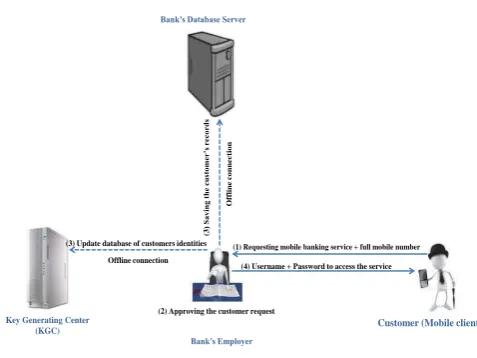
Before being able to access mobile banking services, a cus-tomer must apply for the service by meeting the bank’s employer and provides his account number(s) and mobile station interna-tional subscriber directory number(MSISDN) which is consid-ered the customer’s identity. Then the bank’s employee opens of-fline connections with both the bank’s database server(and check if there exists such customer with such account number(s) in the database) and the KGC server to insert the customer’s informa-tion and generates a username, password for this new subscriber. The procedure of registering a customer for mobile banking ser-vices is explained by Fig. 1.
The public directory server authenticate itself to the bank cus-tomer through the KGC server using a challenge as follows:
—the customer sends his account number encrypted by his given password using any password-based cryptosystem to the KGC server.
—the KGC server receives the customer’s encrypted message, decrypts it and sends back the customer’s account number plus his username encrypted with same customer’s password and using the same used password-based cryptosystem.
—if the customer can decrypt the encrypted message that re-ceived from the KGC server, then the customer trusts on the KGC server(and it’s public directory), otherwise it reject the connection.
—at this point both the customer and KGC server authenticate each other.
—then the customer send
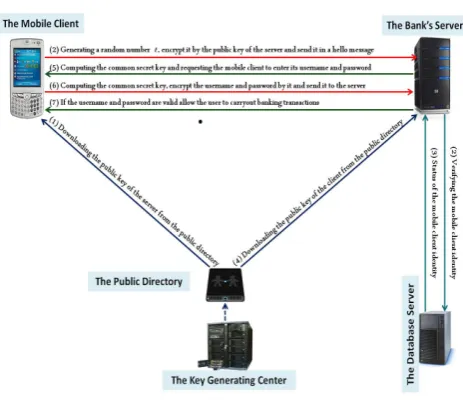
When a customer wants to request a banking service, it does the following:
—downloads the public key of the bank’s web-server from the public directory server.
—generates a random numbert∈Z∗
q, encrypts it with the public key of the bank’s server and send it to the bank’s web-server in a hello message.
—the customer also computes a shared secret symmetric key us-ing the public key of the web-server, its own private key and the random numbert.
—on the other hand, when the bank’s web-server receives the hello message of the mobile client, it validates the identity of the mobile client from the database server.
Fig. 2. The certificateless mobile banking scheme.
client’s public key and the valuetto compute the per-session symmetric key.
—at this point, phase two of the protocol is initiated by using the shared session key to secure the channel between the mobile client and the bank’s web-server.
—hence, the bank’s web-server requests the mobile client to pro-vide its username and password. The mobile client then en-crypts its username and password with the computed symmet-ric key and sends it to the bank’s web-server, where it is de-crypted and verified before enabling the customer to carry out banking transactions.
—all the subsequent message exchanges between the mobile client and the bank’s web-server are signed, by using an el-liptic curve digital signature.
The full description of the procedure of enabling a mobile client to access mobile banking services is explained by Figure 2. To show that the mobile client and the bank’s web-server obtain the same per-session secure symmetric key, we start by assum-ing that a mobile client has a private keySm=xmDm, a public keyPm =< Xm, Ym >and the bank’s web-server’s private key isSb =xbDband public key isPb =< Xb, Yb >. Then, the common authenticated per session secret key can be com-puted at both sides of mobile client and bank’s web-server as follows(handshake phase).
(1) The mobile client:
—generates a random positive integert, uses it to compute
Kmb=H2(Qm||Qb||txmXb),
whereQm=H1(IDm||Xm)andQb=H1(IDb||Xb). —encryptst∗=E
Pb(t)using bank web-server’s public key and sends hello message to the bank web-server including t∗.
(2) The bank’s web-server decryptst∗ to obtaint = D
Sb(t∗) using his private key, and computes
Kbm=H2(Qm||Qb||txbXm), Then, sends hello message back to the mobile client. (3) The mobile client encrypts its username and password
us-ing the keyKmbto obtain the cipher textC=EKmb(M), whereM denotes the username/password and sendsC(the encrypted message) to the bank’s web-server.
(4) The bank’s web-server decrypts the message C using the corresponding decryption function to obtain M0 =
DKbm(C).
(5) The bank’s web-server verifies the validity of the username and password from the database server. If valid, it enables the mobile client to carry out banking transactions. (6) All subsequent transactions between the mobile client and
bank’s web-server are processed as follows. (a) The mobile client
—encrypts the message M sg using symmetric algo-rithms to obtainCipher=EKmb(M sg).
—signs the encrypted messageCusing an elliptic curve digital signature algorithm (ECDSA) algorithm [14], [4], its private key and public parameters obtaining the signature(r, s).
—sendsCipherand the signature(r, s)to the bank’s web-server.
(b) The bank’s web-server verifies the signature (r, s), if valid, the bank’s web-server decrypts the message Cipherusing the corresponding symmetric decryption algorithmM sg=EKbm(Cipher).
It can be easily proven that the two computed keysKmband Kbmare equal:
Kmb = H2(Qm||Qb||txmXb) = H2(Qm||Qb||txmxbP)) = H2(Qm||Qb||txbxmP) = H2(Qm||Qb||txbXm) =Kbm
4. SECURITY ANALYSIS
Since our CTAKA protocol is based on the Elliptic Curve Dis-crete Logarithm(ECDLP) and Collision Resistant hash function standard cryptographic primitives, then it is secure against stan-dard security model, in this section the cryptographic primitives or assumptions that we based our protocol on are discussed. Also, stated some of the security properties that are provided by the proposed scheme. The following general definition of negli-gible function is required.
Definition. A real-valued function(k)is said to benegligible inkif for allc >0, there existskc>0such thatk > kcimplies (k) < 1
kc. A function that is not negligible is known as non-negligible.
4.1 Collision Resistant Hash Function Assumption
A hash functionH−→H(k)is collision resistant if for all prob-abilistic polynomial time(PPT) algorithmsAthe advantage
AdvACR(k) = P r[H(x) =H(y)∧x
6
= y|(x, y)−→A(1k, H)∧H−→H(k)]
is negligible as a function of the security parameterk.
4.2 Ellitpic Curve Discrete Logarithm Problem(ECDLP) Assumption
Given two pointsP, Q ∈ E(Fq)on an elliptic curve, ECDLP determines the integer a, satisfying Q = aP, where P has order n, provided that such k < n exists. So the advan-tage of any PPT algorithmAto findagiven P, Qis negligi-ble as function of security parameterk or AdvECDLP
A (k) =
P r[f ind asuch thatQ=aP]≤.
Also the proposed system provides the following security prop-erties. We follow Swanson and Jao [11] in the statement of some of these properties in terms of our scheme.
is related to the partial private key Dm, since Dm = sH1(IDm||Xm). Therefore, there is one-to-one correspon-dence between the public key and the partial private key of either the mobile client or the bank’s web-server, and in-sures that mobile client/bank’s web server can create only one long term public key for the corresponding private key. The existence of two valid public keys for the same iden-tity (mobile client or bank’s web-server) guarantees that the KGC will be identified to misbehaved in issuing both corre-sponding partial private keys.
(2) Key agreement without interactions:the most probable attack during the run of a key agreement protocol, is the man-in-the-middle attack. Our proposed key agreement pro-vides resistance against the man-in-the-middle attack, by en-abling both the mobile client and the bank’s web-server to compute the shared secret key using its own private key, the other party’s public key and a randomly generated number (by the mobile client), without any interaction between the two communicating parties (mobile client and bank’s web-server).
(3) Authentication:since the shared per-session secret key is generated using Mobile’s client private key and bank’s web-server public key and public parameters, then authentication of entities are provided. Also any party can check the au-thenticity of the public key by running the pairing operation.
(4) Confidentiality: confidentiality is provided by the scheme because a symmetric cryptosystem for encryp-tion/decryption is used.
(5) Integrity and non-repudiation:the mobile client signs the message using the ECDSA algorithm, its private key and public parameters, so the integrity of the message is pro-vided. Also the mobile client cannot deny sending a message because the message is signed by mobile client’s private key. Also, the KGC cannot impersonate the mobile client to perform banking transactions since any transaction must be signed by the mobile client’s private key.
(6) Known key security:Each session key is unique, because both the mobile client and the bank’s web-server make use of a random numbertwhich is generated in each protocol run, thus the knowledge of previous session keys (if it hap-pened to be) does not help an adversary to derive informa-tion about other session keys.
(7) Unknown key share resilience:The public parametersQm andQbare included in the computation of the common se-cret key. Therefore, both the mobile client and the bank’s web-server know who they share the key with.
(8) Key-compromise impersonation resilience:An adversary who has compromised the long-term private keys of the mo-bile clientmis unable to impersonate other party to mobile clientmbecause the shared key contains the identities of the mobile client and the other party.
(9) Weak perfect forward secrecy: Suppose that an adversary has compromised long-term secret keys Sm, Sb, xm, x0m, xb, x0b, Dm and Db, he cannot obtain the secret random number t, because these long-term secret keys are unrelated to the random numbert, thus the adversary is unable to determine previously established session keys.
5. CONCLUSIONS AND REMARKS
This paper discussed the weaknesses of the existing mobile banking schemes, particularly the PKI based mobile banking schemes and schemes based on identity based cryptography. Then, it introduced a web-based a secure mobile banking scheme based on certificateless cryptography.
In the proposed certificateless web-based mobile banking scheme, the KGC server has an offline connection with the pub-lic directory server. The KGC’s pubpub-lic directory can authenticate itself to the mobile clients through a certificate. Both the bank’s service provider and the mobile client are able to compute the same secret session symmetric key. All the interactions between the mobile client and the bank’s service provider are secured by encryption/decryption (using the public key of the bank’s web-server and the computed symmetric authenticated key) to guarantee confidentiality, and digital signature (using an elliptic curve digital signature algorithm) to guarantee the integrity and to provide full non-repudiation.
Since our proposed CTATA based on ECDLP and Collision Re-sistant hash function cryptographic primitives, then it is secure against standard security model, the security features that are provided by the proposed scheme include an authenticated key agreement protocol, confidentiality which is achieved through the encryption of transactions, integrity and non-repudiation which are provided by the elliptic curve digital signature. More-over, the scheme is secure against known key attack, resilient against unknown key share and key-compromise impersonation, secure against weak perfect forward secrecy and man-in-the-middle attacks.
Compared to the CTAKA protocol presented by Yang et. al [19], the proposed scheme in this paper is resistant to the key escrow problem. This comes in contrast to the scheme proposed by Yang et. al in [19] where the KGC can easily compute the full private key for user m by multiplying the public termYmby its master secret values.
With those security properties provided by the proposed mo-bile banking scheme, there is no thought possible attack on the scheme at any of its stages.
6. REFERENCES
[1] S.S. Al-Riyami and K.G. Paterson. Certificateless public key cryptography. In C.S. Laih, editor,Asiacrypt 2003, Lecture Notes in Computer Science, pages 452–473, 2003. Full version available at Cryptology ePrint Archive. [2] Shaghayegh Bakhtiari, Ahmad Baraani, and Mohammad-Reza Khayyambashi. Mobicash: A new anonymous mo-bile payment system implemented by elliptic curve cryp-tography. In Mark Burgin, Masud H. Chowdhury, Chan H. Ham, Simone A. Ludwig, Weilian Su, and Sumanth Yen-duri, editors,CSIE (3), pages 286–290. IEEE Computer Society, 2009.
[3] Alexander W. Dent, Benoˆıt Libert, and Kenneth G. Pater-son. Certificateless encryption schemes strongly secure in the standard model. InPublic Key Cryptography, pages 344–359, 2008.
[4] Patrick Gallagher, Deputy Director Foreword, and Cita Furlani Director. Fips pub 186-3 federal information processing standards publication digital signature stan-dard (dss), 2009.
[5] C. Narendiran, S.A. Rabara, and N. Rajendran. Perfor-mance evaluation on end-to-end security architecture for mobile banking system.Wireless Days, 2008. WD ’08. 1st IFIP, pages 1–5, 2008.
[6] C. Narendiran, S.A. Rabara, and N. Rajendran. Public key infrastructure for mobile banking security.Global Mobile Congress 2009, pages 1–6, 2009.
[9] A. Shamir. Identity-based cryptosystems and signature schemes. InIn Advances in Cryptology-CRYPTO’84, vol-ume 196, pages 47–53, 1984.
[10] S.A. Shubat and M.A. Ashraf. Secure protocol for short message service. InProceedings of world academy of sci-ence, engineering and technology, volume 49, 2009. [11] C. Swanson and D. Jao. A study of two-party
certificate-less authenticated key-agreement protocols. In Proceed-ings of the 10th International Conference on Cryptol-ogy in India: Progress in CryptolCryptol-ogy, INDOCRYPT ’09, pages 57–71, Berlin, Heidelberg, 2009. Springer-Verlag. [12] M.Sunanda V.R. Prasad and V. Maruthi Prasad. Secure
sms with identity based cryptography in mobile telecom-munication networks.International Journal of Computer Science and Technology, 2, 2011.
[13] C. Wang, D Long, and Y. Tang. An efficient certificateless signature from pairing.International Journal of Network Security, 8(1):96–100, 2009.
[14] Erik De Win, Serge Mister, Bart Preneel, and Michael J. Wiener. On the performance of signature schemes based on elliptic curves. InProceedings of the Third Interna-tional Symposium on Algorithmic Number Theory, pages 252–266, London, UK, 1998. Springer-Verlag.
[15] K. Wouters, G. Van Damme, and N. Luyckx. A pki-based mobile banking demonstrator, 8th european work-shop on public key infrastructure.services and applica-tions, 48:203–20, 2011.
[16] Wenjian Xie and Zhang Zhang. Certificateless signcryp-tion without pairing. IACR Cryptology ePrint Archive, 2010:187, 2010.
[17] Wenjian Xie and Zhang Zhang. Efficient and provably secure certificateless signcryption from bilinear maps. In WCNIS, pages 558–562, 2010.
[18] H. Xiong, Z. Qin, and F. Li. An improved certificateless signature scheme secure in the standard model. Funda-menta Informaticae, 88, 2008.
[19] H. Yang, Y. Zhang, and Y. Zhou. An improved certifi-cateless authenticated key agreement protocol. Cryptol-ogy ePrint Archive, Report 2011/653, 2011. http:// eprint.iacr.org/.
[20] L. Zhang and F Zhang. A new provably secure certificate-less signature scheme. In08 IEEE International Confer-ence on Communications, pages 1685–1689, 2008. [21] S. Zhao, A. Aggarwal, and S. Liu. Building secure
user-to-user messaging in mobile telecommunication networks. In Wireless Telecommunications Symposium (WTS) 2008, pages 151–157, 2008.